light RENAULT CAPTUR 2017 1.G Owners Manual
[x] Cancel search | Manufacturer: RENAULT, Model Year: 2017, Model line: CAPTUR, Model: RENAULT CAPTUR 2017 1.GPages: 248, PDF Size: 6.56 MB
Page 192 of 248
5.10
If you have a puncture, re-
place the wheel as soon as
possible.
A tyre which has been punc-
tured should always be inspected
(and repaired, where possible) by a
specialist.
CHANGING A WHEEL (2/2)
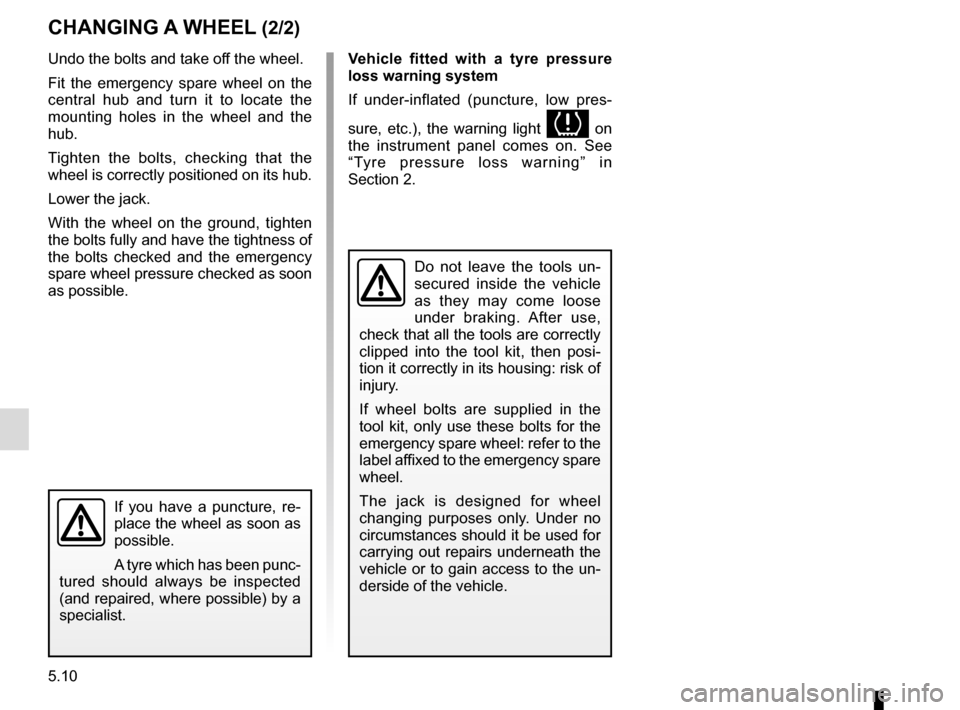
Undo the bolts and take off the wheel.
Fit the emergency spare wheel on the
central hub and turn it to locate the
mounting holes in the wheel and the
hub.
Tighten the bolts, checking that the
wheel is correctly positioned on its hub.
Lower the jack.
With the wheel on the ground, tighten
the bolts fully and have the tightness of
the bolts checked and the emergency
spare wheel pressure checked as soon
as possible.
Do not leave the tools un-
secured inside the vehicle
as they may come loose
under braking. After use,
check that all the tools are correctly
clipped into the tool kit, then posi-
tion it correctly in its housing: risk of
injury.
If wheel bolts are supplied in the
tool kit, only use these bolts for the
emergency spare wheel: refer to the
label affixed to the emergency spare
wheel.
The jack is designed for wheel
changing purposes only. Under no
circumstances should it be used for
carrying out repairs underneath the
vehicle or to gain access to the un-
derside of the vehicle.
Vehicle fitted with a tyre pressure
loss warning system
If under-inflated (puncture, low pres-
sure, etc.), the warning light
on
the instrument panel comes on. See
“Tyre pressure loss warning” in
Section 2.
Page 194 of 248
5.12
Pressures should be checked when the
tyres are cold; ignore higher pressures
which may be reached in hot weather
or following a fast journey.
If tyre pressures cannot be checked
when the tyres are cold, assume an in-
crease of 0.2 to 0.3 bar (or 3 PSI).
Never deflate a hot tyre.
TYRES (2/3)
Please be aware that a
poorly tightened or miss-
ing valve cap can make the
tyres less airtight and lead
to pressure loss.
Always use valve caps identical to
those fitted originally and tighten
them fully.
Incorrect tyre pressures
lead to abnormal tyre wear
and unusually hot running.
These are factors which
may seriously affect safety and lead
to:
– poor road holding,
– risk of bursting or tread separa- tion.
The pressure depends on the load
and the speed of use. Adjust the
pressure according to the condi-
tions of use (refer to the label affixed
to the edge of the driver’s door).
Tyre pressures
Adhere to the tyre pressures (including
the emergency spare wheel). The tyre
pressures should be checked at least
once a month and additionally before
any long journey (refer to the label af-
fixed to the edge of the driver’s door). Vehicle fitted with a tyre pressure
loss warning system
If under-inflated (puncture, low pres-
sure, etc.), the warning light
on
the instrument panel comes on. See
“Tyre pressure loss warning” in chap-
ter 2.
Page 196 of 248
5.14
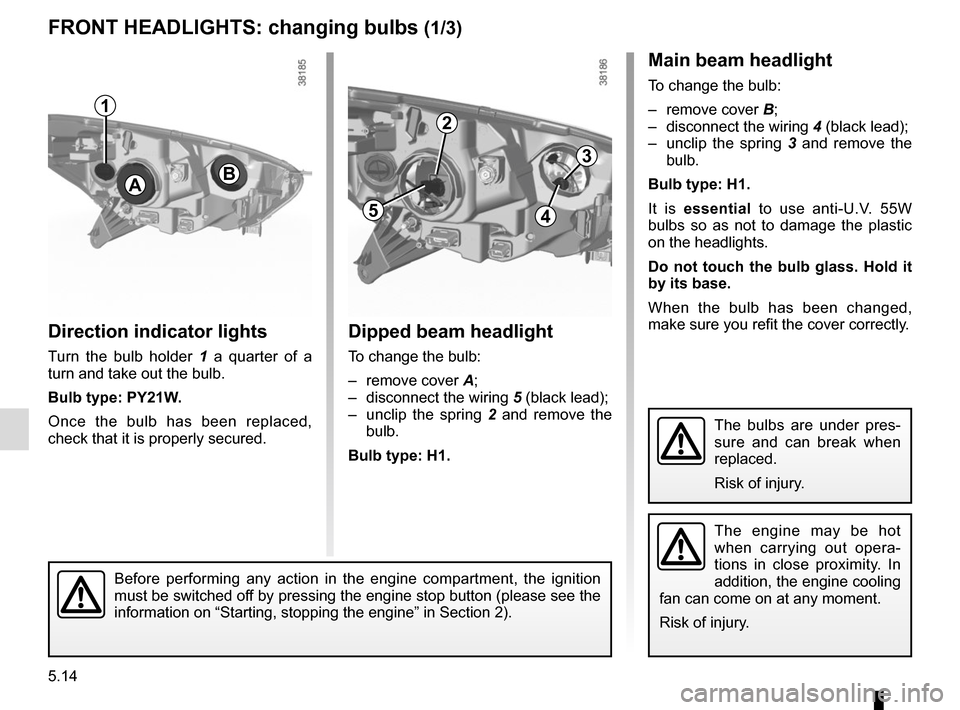
Direction indicator lights
Turn the bulb holder 1 a quarter of a
turn and take out the bulb.
Bulb type: PY21W.
Once the bulb has been replaced,
check that it is properly secured.
Dipped beam headlight
To change the bulb:
– remove cover A;
– disconnect the wiring 5 (black lead);
– unclip the spring 2 and remove the
bulb.
Bulb type: H1.
FRONT HEADLIGHTS: changing bulbs (1/3)
The engine may be hot
when carrying out opera-
tions in close proximity. In
addition, the engine cooling
fan can come on at any moment.
Risk of injury.
B
Main beam headlight
To change the bulb:
– remove cover B;
– disconnect the wiring 4 (black lead);
– unclip the spring 3 and remove the
bulb.
Bulb type: H1.
It is essential to use anti-U.V. 55W
bulbs so as not to damage the plastic
on the headlights.
Do not touch the bulb glass. Hold it
by its base.
When the bulb has been changed,
make sure you refit the cover correctly.
A
1
2
54
3
The bulbs are under pres-
sure and can break when
replaced.
Risk of injury.
Before performing any action in the engine compartment, the ignition
must be switched off by pressing the engine stop button (please see the
information on “Starting, stopping the engine” in Section 2).
Page 197 of 248
5.15
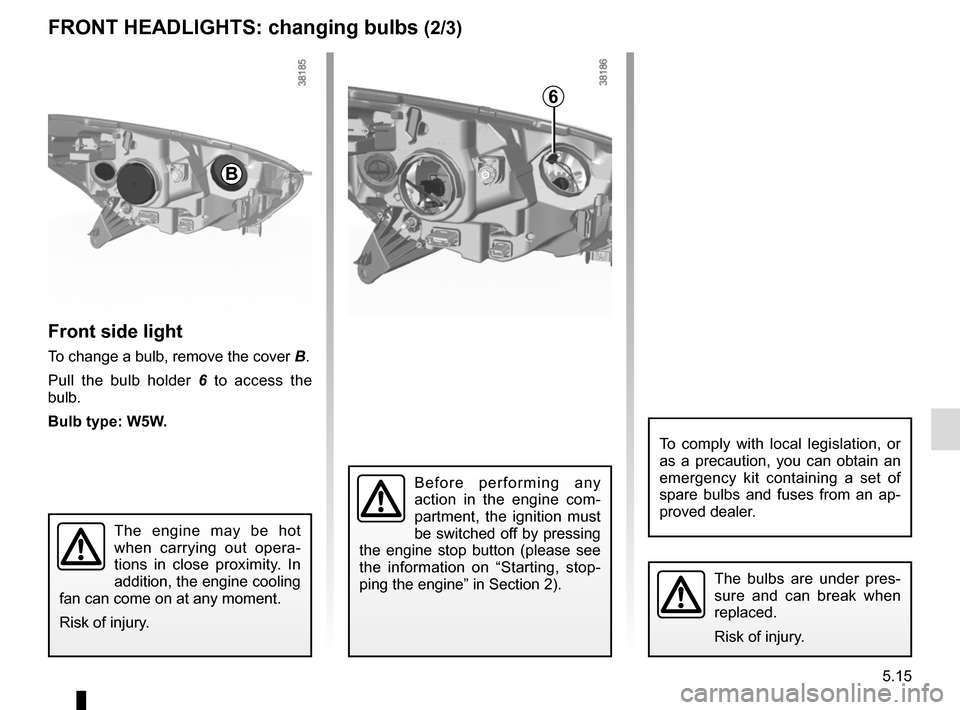
Front side light
To change a bulb, remove the cover B.
Pull the bulb holder 6 to access the
bulb.
Bulb type: W5W.
The bulbs are under pres-
sure and can break when
replaced.
Risk of injury.
FRONT HEADLIGHTS: changing bulbs (2/3)
The engine may be hot
when carrying out opera-
tions in close proximity. In
addition, the engine cooling
fan can come on at any moment.
Risk of injury.
To comply with local legislation, or
as a precaution, you can obtain an
emergency kit containing a set of
spare bulbs and fuses from an ap-
proved dealer.
6
B
Before performing any
action in the engine com-
partment, the ignition must
be switched off by pressing
the engine stop button (please see
the information on “Starting, stop-
ping the engine” in Section 2).
Page 198 of 248
5.16
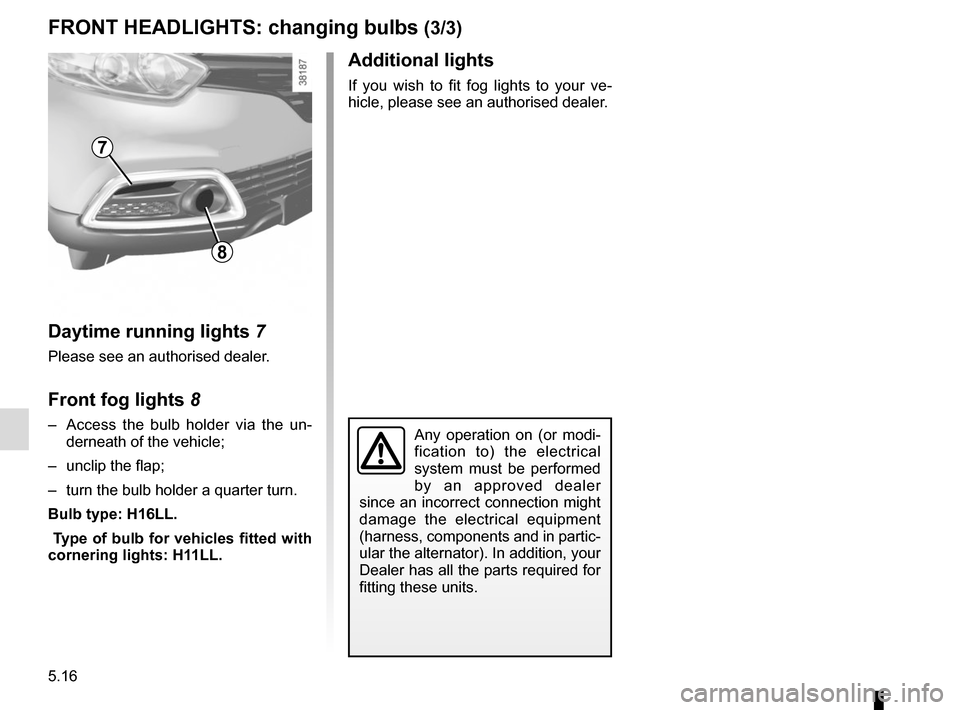
Daytime running lights 7
Please see an authorised dealer.
Front fog lights 8
– Access the bulb holder via the un-
derneath of the vehicle;
– unclip the flap;
– turn the bulb holder a quarter turn.
Bulb type: H16LL.
Type of bulb for vehicles fitted with
cornering lights: H11LL.
Additional lights
If you wish to fit fog lights to your ve-
hicle, please see an authorised dealer.
Any operation on (or modi-
fication to) the electrical
system must be performed
by an approved dealer
since an incorrect connection might
damage the electrical equipment
(harness, components and in partic-
ular the alternator). In addition, your
Dealer has all the parts required for
fitting these units.
FRONT HEADLIGHTS: changing bulbs (3/3)
7
8
Page 199 of 248
5.17
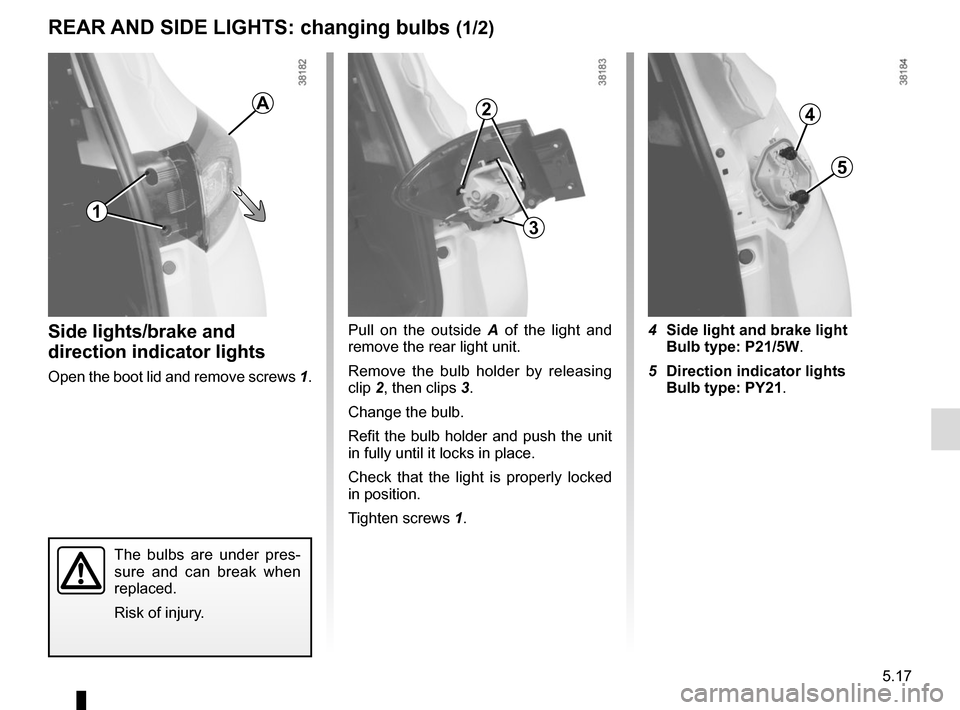
Pull on the outside A of the light and
remove the rear light unit.
Remove the bulb holder by releasing
clip 2, then clips 3.
Change the bulb.
Refit the bulb holder and push the unit
in fully until it locks in place.
Check that the light is properly locked
in position.
Tighten screws 1.
The bulbs are under pres-
sure and can break when
replaced.
Risk of injury.
4 Side light and brake light
Bulb type: P21/5W.
5 Direction indicator lights
Bulb type: PY21.Side lights/brake and
direction indicator lights
Open the boot lid and remove screws 1.
REAR AND SIDE LIGHTS: changing bulbs (1/2)
4
5
1
A2
3
Page 200 of 248
5.18
REAR AND SIDE LIGHTS: changing bulbs (2/2)
The bulbs are under pres-
sure and can break when
replaced.
Risk of injury.
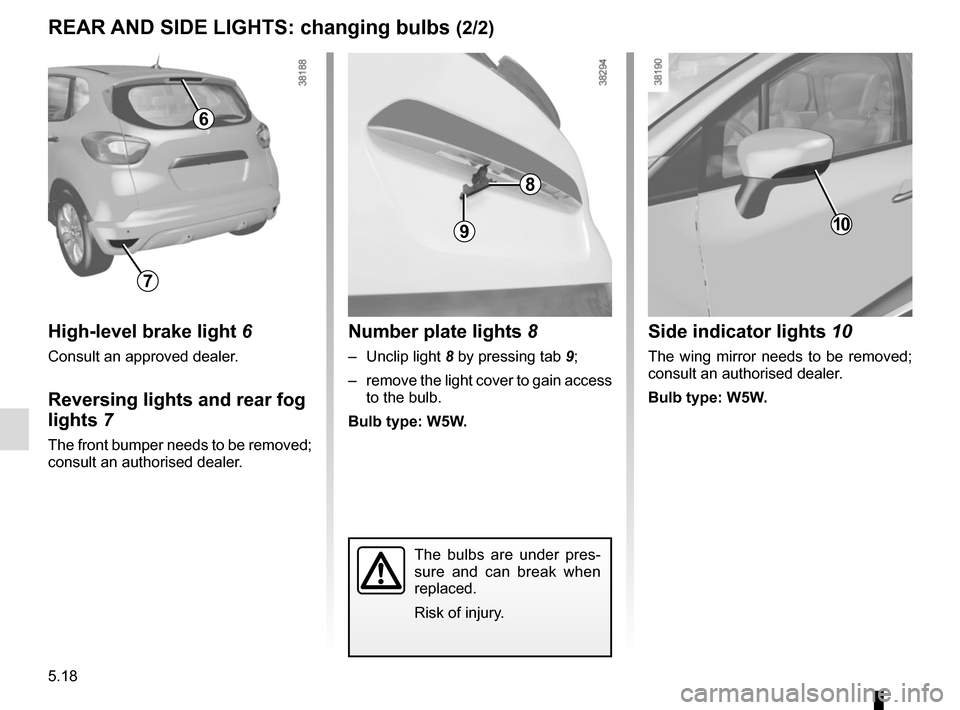
Side indicator lights 10
The wing mirror needs to be removed;
consult an authorised dealer.
Bulb type: W5W.
10
Number plate lights 8
– Unclip light 8 by pressing tab 9;
– remove the light cover to gain access to the bulb.
Bulb type: W5W.
9
8
High-level brake light 6
Consult an approved dealer.
Reversing lights and rear fog
lights 7
The front bumper needs to be removed;
consult an authorised dealer.
7
6
Page 201 of 248
5.19
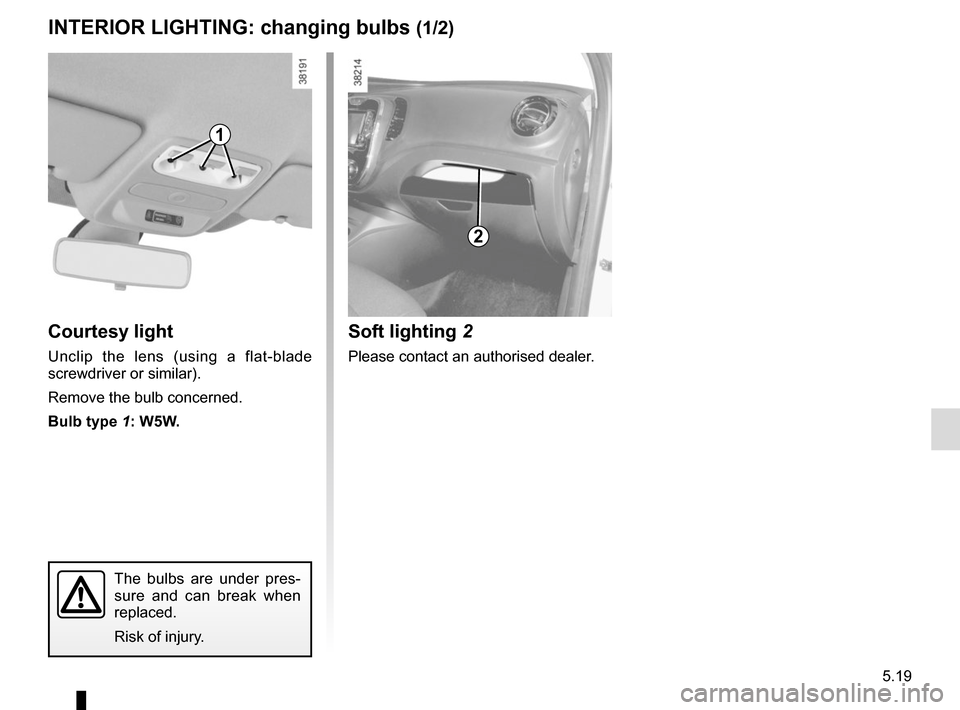
Courtesy light
Unclip the lens (using a flat-blade
screwdriver or similar).
Remove the bulb concerned.
Bulb type 1: W5W.
INTERIOR LIGHTING: changing bulbs (1/2)
The bulbs are under pres-
sure and can break when
replaced.
Risk of injury.
1
Soft lighting 2
Please contact an authorised dealer.
2
Page 202 of 248
5.20
3
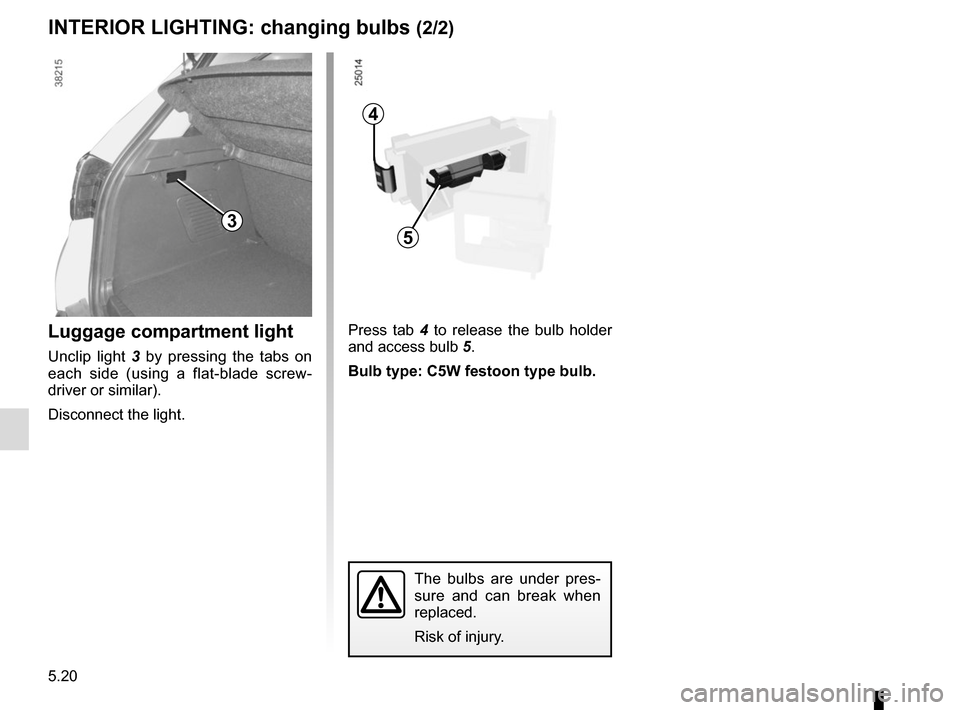
Luggage compartment light
Unclip light 3 by pressing the tabs on
each side (using a flat-blade screw-
driver or similar).
Disconnect the light.
4
5
Press tab 4 to release the bulb holder
and access bulb 5.
Bulb type: C5W festoon type bulb.
The bulbs are under pres-
sure and can break when
replaced.
Risk of injury.
INTERIOR LIGHTING: changing bulbs (2/2)
Page 207 of 248
5.25
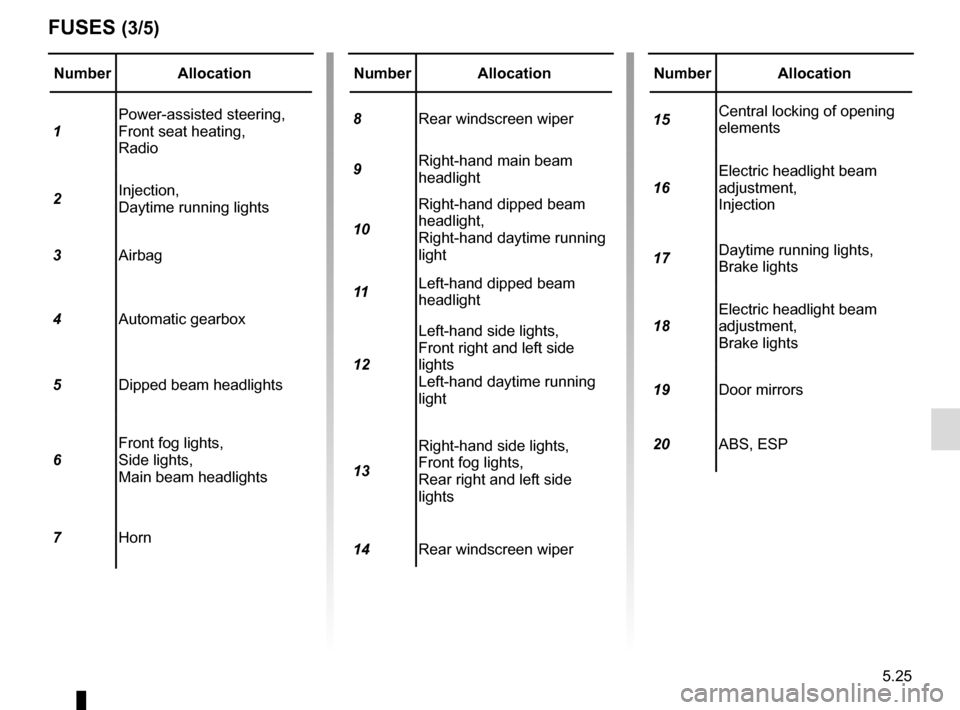
Number Allocation
1 Power-assisted steering,
Front seat heating,
Radio
2 Injection,
Daytime running lights
3 Airbag
4 Automatic gearbox
5 Dipped beam headlights
6 Front fog lights,
Side lights,
Main beam headlights
7 Horn
FUSES (3/5)
Number Allocation
8 Rear windscreen wiper
9 Right-hand main beam
headlight
10 Right-hand dipped beam
headlight,
Right-hand daytime running
light
11 Left-hand dipped beam
headlight
12 Left-hand side lights,
Front right and left side
lights
Left-hand daytime running
light
13 Right-hand side lights,
Front fog lights,
Rear right and left side
lights
14 Rear windscreen wiperNumber Allocation
15 Central locking of opening
elements
16 Electric headlight beam
adjustment,
Injection
17 Daytime running lights,
Brake lights
18 Electric headlight beam
adjustment,
Brake lights
19 Door mirrors
20 ABS, ESP