lights RENAULT CAPTUR 2018 Workshop Manual
[x] Cancel search | Manufacturer: RENAULT, Model Year: 2018, Model line: CAPTUR, Model: RENAULT CAPTUR 2018Pages: 258, PDF Size: 7.15 MB
Page 207 of 258

5.17
REAR LIGHTS AND SIDE LIGHTS: replacing the bulbs (1/3)
Brake lights and direction indicator
lights
Open the boot lid and remove screws 1.Pull on the outside A
of the light and
remove the rear light unit.
Remove the bulb holder by releasing
clips 2, then clips 3.
Change the bulb.
Refit the bulb holder and push the unit
in fully until it locks in place.
Check that the light is properly locked
in position.
Tighten screws 1. 4
Direction indicator lights
Bulb type: PY21W.
5 Brake light
Bulb type: P21W.
The bulbs are under pres-
sure and can break when
replaced.
Risk of injury.
1
A
2
3
4
5
Page 208 of 258
5.18
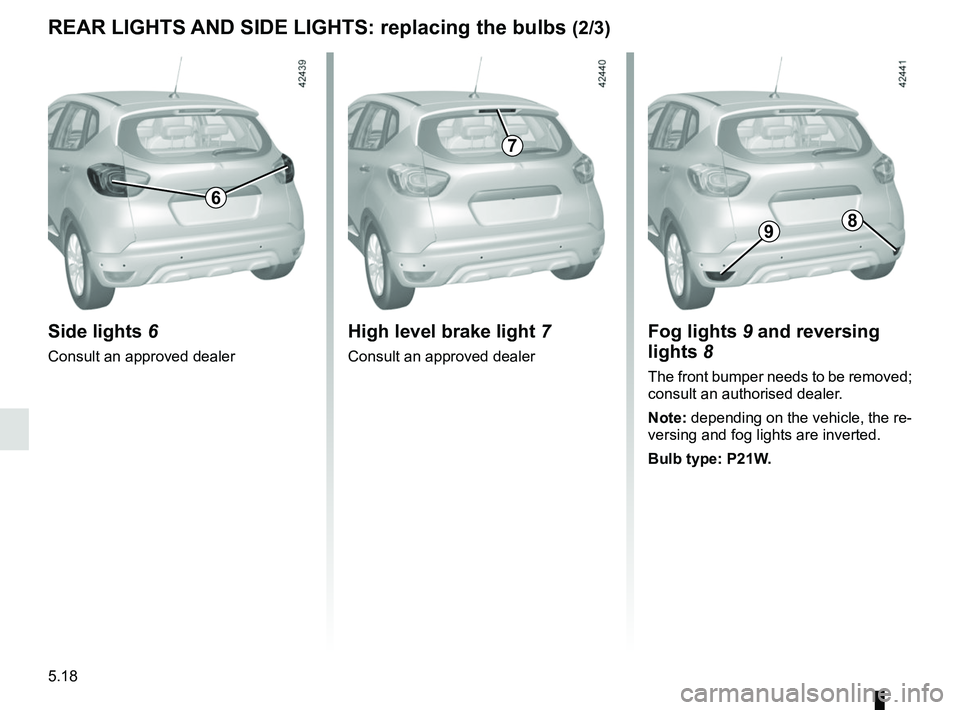
Side lights 6
Consult an approved dealer
REAR LIGHTS AND SIDE LIGHTS: replacing the bulbs (2/3)
High level brake light 7
Consult an approved dealer
Fog lights 9 and reversing
lights 8
The front bumper needs to be removed;
consult an authorised dealer.
Note: depending on the vehicle, the re-
versing and fog lights are inverted.
Bulb type: P21W.
6
7
98
Page 209 of 258

5.19
Number plate lights 10
– Unclip light 10 by pressing tab 11 ;
– remove the light cover to gain access to the bulb.
Bulb type: W5W.
REAR LIGHTS AND SIDE LIGHTS: replacing the bulbs (3/3)
The bulbs are under pres-
sure and can break when
replaced.
Risk of injury.
Side repeaters with bulbs 12
– Unclip the repeater 12 (using a
flat-blade screwdriver type tool po-
sitioned at B to tilt the repeater to-
wards the front of the vehicle);
– turn the bulb holder a quarter of a turn and take out the bulb.
Bulb type: WY5W.
LED side repeaters(depending on vehicle)
Consult an approved dealer.
1211
10
B
Page 210 of 258
5.20
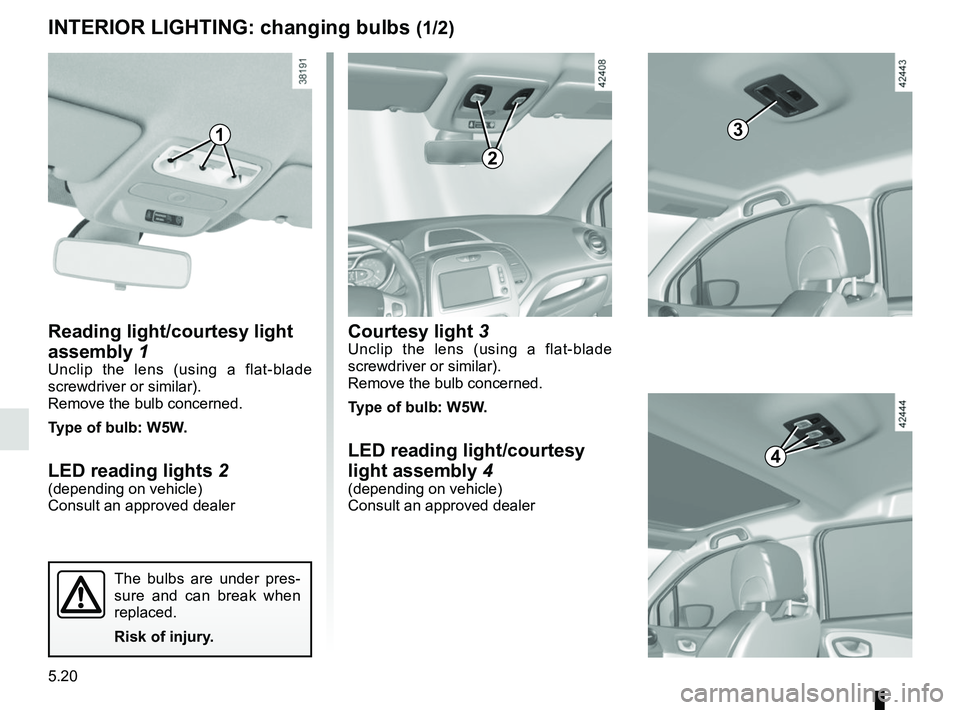
Reading light/courtesy light
assembly 1
Unclip the lens (using a flat-blade
screwdriver or similar).
Remove the bulb concerned.
Type of bulb: W5W.
LED reading lights 2(depending on vehicle)
Consult an approved dealer
INTERIOR LIGHTING: changing bulbs (1/2)
The bulbs are under pres-
sure and can break when
replaced.
Risk of injury.
1
Courtesy light 3Unclip the lens (using a flat-blade
screwdriver or similar).
Remove the bulb concerned.
Type of bulb: W5W.
LED reading light/courtesy
light assembly 4
(depending on vehicle)
Consult an approved dealer
2
3
4
Page 215 of 258
5.25
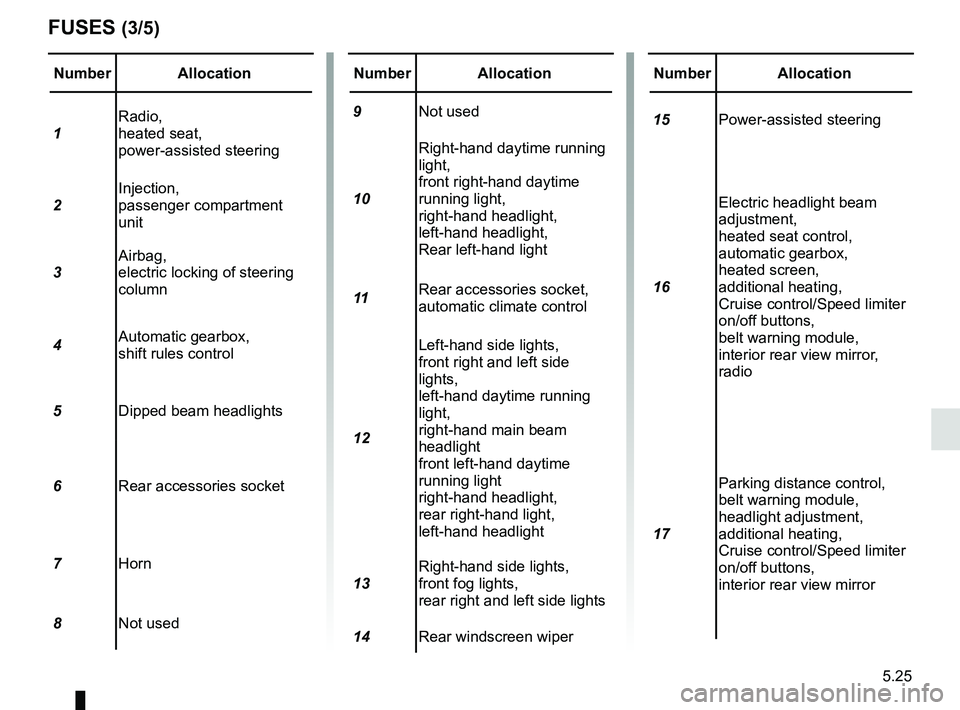
Number Allocation
1 Radio,
heated seat,
power-assisted steering
2 Injection,
passenger compartment
unit
3 Airbag,
electric locking of steering
column
4 Automatic gearbox,
shift rules control
5 Dipped beam headlights
6 Rear accessories socket
7 Horn
8 Not used
FUSES (3/5)
Number Allocation
9 Not used
10 Right-hand daytime running
light,
front right-hand daytime
running light,
right-hand headlight,
left-hand headlight,
Rear left-hand light
11 Rear accessories socket,
automatic climate control
12 Left-hand side lights,
front right and left side
lights,
left-hand daytime running
light,
right-hand main beam
headlight
front left-hand daytime
running light
right-hand headlight,
rear right-hand light,
left-hand headlight
13 Right-hand side lights,
front fog lights,
rear right and left side lights
14 Rear windscreen wiperNumber Allocation
15 Power-assisted steering
16 Electric headlight beam
adjustment,
heated seat control,
automatic gearbox,
heated screen,
additional heating,
Cruise control/Speed limiter
on/off buttons,
belt warning module,
interior rear view mirror,
radio
17 Parking distance control,
belt warning module,
headlight adjustment,
additional heating,
Cruise control/Speed limiter
on/off buttons,
interior rear view mirror
Page 217 of 258
5.27
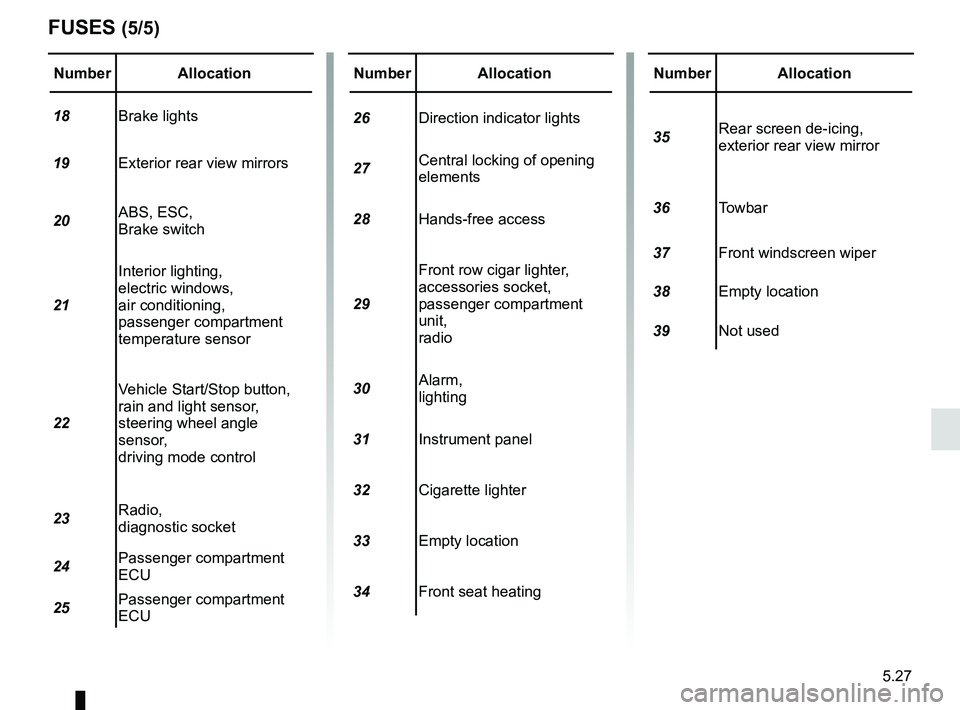
Number Allocation
18 Brake lights
19 Exterior rear view mirrors
20 ABS, ESC,
Brake switch
21 Interior lighting,
electric windows,
air conditioning,
passenger compartment
temperature sensor
22 Vehicle Start/Stop button,
rain and light sensor,
steering wheel angle
sensor,
driving mode control
23 Radio,
diagnostic socket
24 Passenger compartment
ECU
25 Passenger compartment
ECU
FUSES (5/5)
Number Allocation
26 Direction indicator lights
27 Central locking of opening
elements
28 Hands-free access
29 Front row cigar lighter,
accessories socket,
passenger compartment
unit,
radio
30 Alarm,
lighting
31 Instrument panel
32 Cigarette lighter
33 Empty location
34 Front seat heatingNumber Allocation
35 Rear screen de-icing,
exterior rear view mirror
36 Towbar
37 Front windscreen wiper
38 Empty location
39 Not used
Page 219 of 258

5.29
BATTERY: breakdown recovery (1/2)
To avoid all risk of sparks:
– Ensure that any electrical consumers (courtesy lights, etc.) are switched
off before disconnecting or recon-
necting the battery.
– When charging, stop the charger before connecting or disconnecting
the battery.
– Do not place metal objects on the battery to avoid creating a short cir-
cuit between the terminals.
– Always wait at least one minute after the engine has been switched off
before disconnecting a battery.
– Make sure that you reconnect the battery terminals after refitting.
Connecting a battery charger
The battery charger must be com-
patible with a battery with nominal
voltage of 12 volts.
Do not disconnect the battery when the
engine is running. Follow the instruc-
tions given by the manufacturer of
the battery charger you are using.
Special procedures may be
required to charge some
batteries. Contact your ap-
proved dealer.
Avoid all risk of sparks which may
cause an immediate explosion, and
charge the battery in a well-venti-
lated area. Risk of serious injury.
Handle the battery with care
as it contains sulphuric acid,
which must not come into
contact with eyes or skin. If
it does, wash the affected area with
plenty of cold water. If necessary,
consult a doctor.
Ensure that naked flames, red hot
objects and sparks do not come into
contact with the battery as there is a
risk of explosion.
The engine may be hot when car-
rying out operations in close prox-
imity. In addition, the engine cooling
fan can come on at any moment.
Risk of injury.
Before performing any
action in the engine com-
partment, the ignition must
be switched off by pressing
the engine stop button (please see
the information on “Starting, stop-
ping the engine” in Section 2).
Page 224 of 258

5.34
TOWING: breakdown recovery (1/2)
Before towing, unlock the steering
column: with the clutch depressed,
engage first gear (lever in position N
or R for vehicles with automatic gear-
boxes), insert the RENAULT card in the
card reader, then press the engine start
button for two seconds.
Reposition the lever to neutral (posi-
tion N for vehicles fitted with an auto-
matic gearbox).
The column is unlocked, the acces-
sory functions are supplied: the vehi-
cle lights can be used (indicators, brake
lights etc.). At night the vehicle must
have its lights on.
Once you have finished towing, press
the engine start button twice (risk of
running down the battery). The speed specified by current legis-
lation for towing must always be ob-
served. If your vehicle is the towing
vehicle, do not exceed the maximum
towing weight for your vehicle (refer to
the information on “Weights” in Section
6).
Towing a vehicle with an
automatic gearbox
With the engine switched off, the trans-
mission is no longer lubricated. It is
preferable to tow this type of vehicle on
a trailer or tow it with the front wheels
off the ground.
Under
exceptional circumstances, you
may tow the vehicle with all four wheels
on the ground, only going forward, with
the gear lever in the neutral N position,
and for a distance not exceeding
30 miles (50 km).
Do not remove the
RENAULT card from the
reader when the vehicle is
being towed.
1
2
If the lever is stuck in P , even though
you are depressing the brake pedal, the
lever can be released manually. To do
this, unclip the base of the lever, then
insert a tool (with a hard rod to it) into
the slot 1 and press the button 2 at the
same time in order to unlock the lever.
Contact an authorised dealer as soon
as possible.
Page 227 of 258

5.37
OPERATING FAULTS (2/6)
The starter is activatedPOSSIBLE CAUSES WHAT TO DO
The instrument panel indicator lights are
weak or fail to light up and the starter
does not turn. Battery terminals not tight,
battery terminals discon-
nected or oxidised.Retighten or reconnect the terminals, or clean them if
they are oxidised.
Discharged battery or not
operational. Connect another battery to the faulty battery. Refer to
information on “Battery: troubleshooting” in Section 5
or replace the battery if necessary.
Do not push the vehicle if the steering column is
locked.
Faulty circuit. Consult an approved dealer.
The engine will not start. Starting conditions are not
fulfilled.Please refer to the information on “Starting, stopping
the engine” in Section 2.
The RENAULT “hands-free”
card does not work. Insert the card in the card reader in order to start the
engine.
Please refer to the information on “Starting, stopping
the engine” in Section 2.
The engine cannot be switched off. Card not detected. Insert the card in card reader.
Electronic fault. Press the starter button quickly five times.
The steering column remains locked. Steering wheel locked. Move the steering wheel while pressing the engine
start button (please refer to Section 2 “Starting, stop-
ping the engine”).
Faulty circuit. Consult an approved dealer.
Page 230 of 258

5.40
OPERATING FAULTS (5/6)
Electrical equipmentPOSSIBLE CAUSESWHAT TO DO
The wipers do not work. Wiper blades stuck. Free the blades before using the wipers.
Faulty electrical circuit. Consult an approved dealer.
Fuse damaged. Replace the fuse or have it replaced; refer
to the information in the “Fuses” section.
The wiper does not stop. Faulty electrical controls.Consult an approved dealer.
Direction indicators flashing more
quickly. Blown bulb.
See information on “Headlights: changing
bulbs” or “Rear and side lights: changing
bulbs”.
The direction indicators do not work. Faulty electrical circuit or control. Consult an approved dealer. Fuse damaged.Replace the fuse or have it replaced; refer
to the information in the “Fuses” section.
The lights do not come on or go off. Faulty electrical circuit or control. Consult an approved dealer.
Fuse damaged.Replace the fuse or have it replaced; refer
to the information in the “Fuses” section.