warning RENAULT CLIO 2012 X85 / 3.G Workshop Manual
[x] Cancel search | Manufacturer: RENAULT, Model Year: 2012, Model line: CLIO, Model: RENAULT CLIO 2012 X85 / 3.GPages: 268, PDF Size: 8.73 MB
Page 148 of 268
Downloaded from www.Manualslib.com manuals search engine demistingwindscreen ....................................................... (current page)
3.14
ENG_UD19787_3
Air conditionné automatique (X85 - B85 - C85 - S85 - K85 - Renault)\
ENG_NU_853-7_BCSK85_Renault_3
Jaune NoirNoir texte
aUtOMatiC CLiMate COntrOL (7/8)
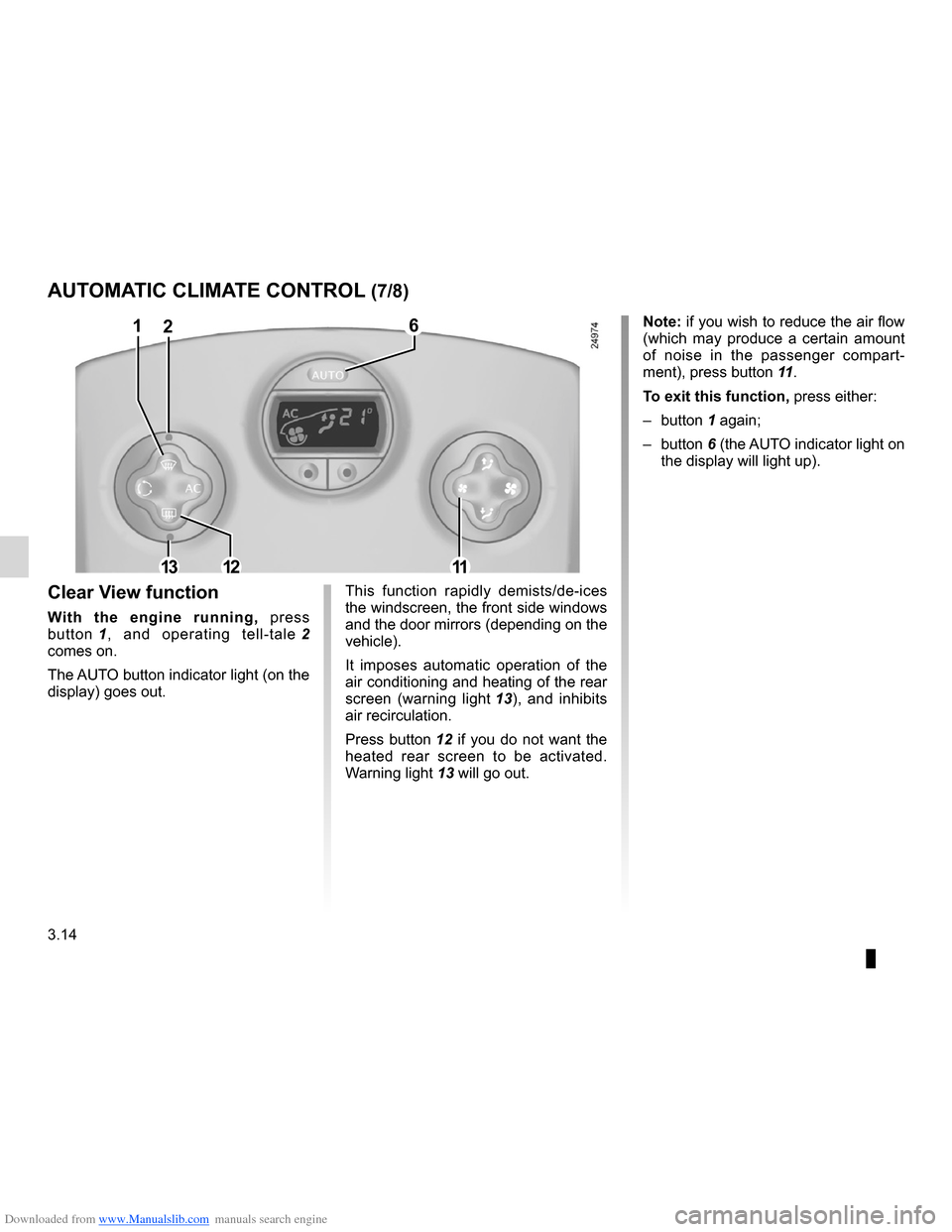
note: if you wish to reduce the air flow
(which may produce a certain amount
of noise in the passenger compart -
ment), press button 11.
t o exit this function, press either:
– button 1 again;
– button 6 (the AUTO indicator light on
the display will light up).
This function rapidly demists/de-ices
the windscreen, the front side windows
and the door mirrors (depending on the
vehicle).
It imposes automatic operation of the
air conditioning and heating of the rear
screen (warning light 13 ), and inhibits
air recirculation.
Press button 12 if you do not want the
heated rear screen to be activated.
Warning light 13 will go out.
Clear view function
With the engine running, press
button 1 , and operating tell-tale 2
comes on.
The AUTO button indicator light (on the
display) goes out.
126
111213
Page 180 of 268
Downloaded from www.Manualslib.com manuals search engine maintenance:mechanical ...................................... (up to the end of the DU)
engine oil level ...................................... (up to the end of the DU)
engine oil .............................................. (up to the end of the DU)
4.4
ENG_UD22490_3
Niveau huile moteur : généralités (X85 - B85 - C85 - S85 - K85\
- Renault)
ENG_NU_853-7_BCSK85_Renault_4
Jaune NoirNoir texte
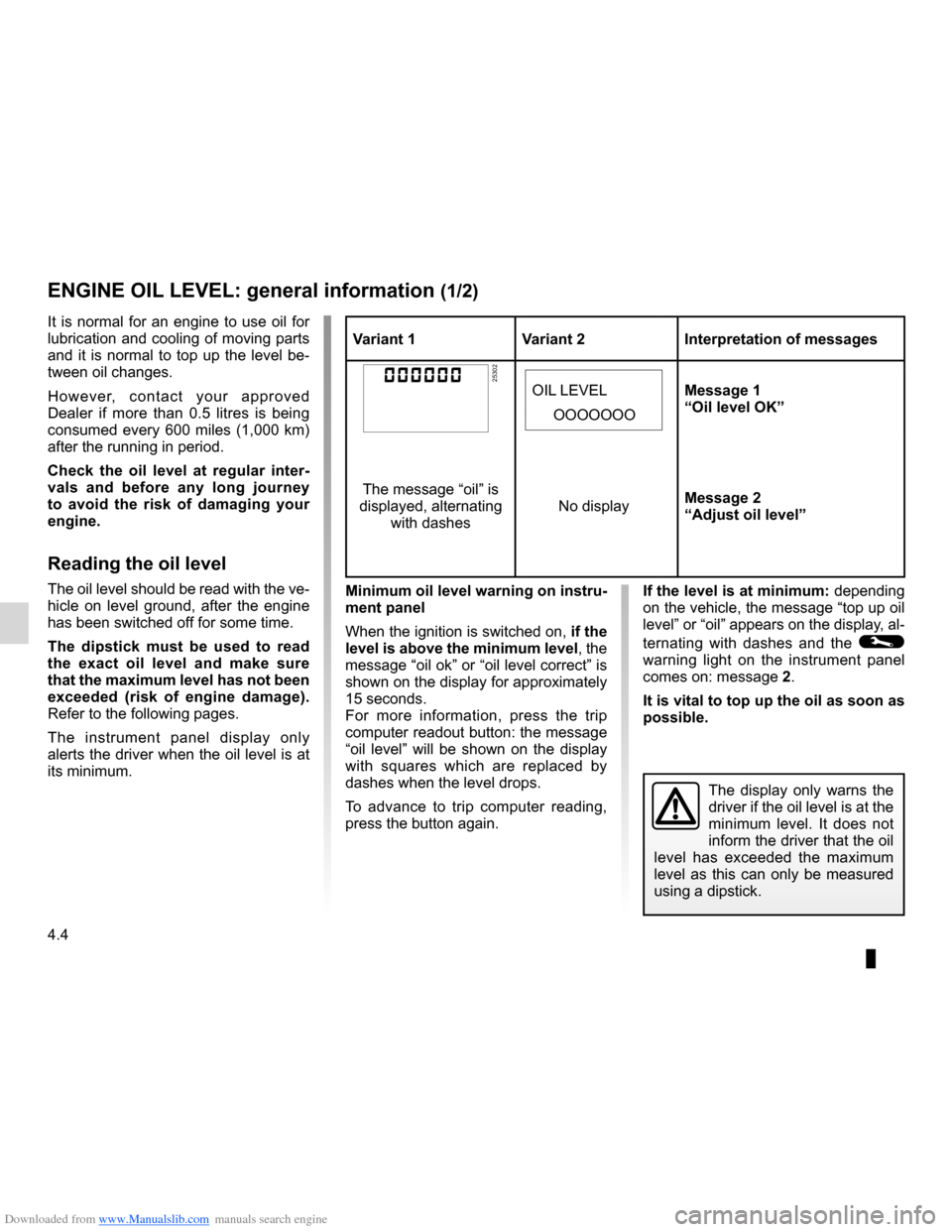
Variant 1 Variant 2Interpretation of messages
25302Message 1
“Oil level OK”
OIL LEVEL
OOOOOOO
The message “oil” is
displayed, alternating with dashes No display
Message 2
“Adjust oil level”
If the level is at minimum: depending
on the vehicle, the message “top up oil
level” or “oil” appears on the display, al-
ternating with dashes and the
©
warning light on the instrument panel
comes on: message 2.
It is vital to top up the oil as soon as
possible.
Engine oil level: general information
The display only warns the
driver if the oil level is at the
minimum level. It does not
inform the driver that the oil
level has exceeded the maximum
level as this can only be measured
using a dipstick.
Minimum oil level warning on instru-
ment panel
When the ignition is switched on, if the
level is above the minimum level, the
message “oil ok” or “oil level correct” is
shown on the display for approximately
15 seconds.
For more information, press the trip
computer readout button: the message
“oil level” will be shown on the display
with squares which are replaced by
dashes when the level drops.
To advance to trip computer reading,
press the button again.
It is normal for an engine to use oil for
lubrication and cooling of moving parts
and it is normal to top up the level be-
tween oil changes.
However, contact your approved
Dealer if more than 0.5 litres is being
consumed every 600 miles (1,000 km)
after the running in period.
Check the oil level at regular inter
-
vals and before any long journey
to avoid the risk of damaging your
engine.
Reading the oil level
The oil level should be read with the ve-
hicle on level ground, after the engine
has been switched off for some time.
The dipstick must be used to read
the exact oil level and make sure
that the maximum level has not been
exceeded (risk of engine damage).
Refer to the following pages.
The instrument panel display only
alerts the driver when the oil level is at
its minimum.
ENGINE OIL LEVEL: general information (1/2)
Page 199 of 268

ENG_NU_853-7_BCSK85_Renault_5")
Downloaded from www.Manualslib.com manuals search engine JauneNoirNoir texte
5.7
ENG_UD22318_3
Kit de gonflage des pneumatiques (X85 - B85 - C85 - S85 - K85 - Renault\
)
ENG_NU_853-7_BCSK85_Renault_5
TYRE PRESSURE KIT (2/3)
Depending on the vehicle, in the event
of a puncture, use the kit located under -
neath the luggage compartment carpet.
Open the kit, remove the caps 1 and 4
(it is essential not to remove the burst-
ing disc from the bottle) and screw
bottle 2 in place of cap 4.
With the engine running and the
parking brake applied,
– unscrew the valve cap of the wheel
concerned and screw on the inflation
adapter 6;
– adapter 8 must be connected to ve-
hicle accessories socket 9;
– press switch 3 to inflate the tyre to
the recommended pressure (refer to
the information on “Tyre pressure”);
– after a maximum of 5 minutes, stop
inflating and read the pressure (on
pressure gauge 5). Note: while the bottle is emptying (ap-
proximately 30 seconds), the pressure
gauge
5 will indicate briefly a pressure
of 6 bar, then the pressure drops.
1
3
4
5
6
7
8
9
Before using this kit, park
the vehicle at a sufficient
distance from traffic, switch
on the hazard warning
lights, apply the handbrake, ask all
passengers to leave the vehicle and
keep them away from traffic.
2
If the vehicle is parked on
the hard shoulder, you must
warn other road users of
your vehicle’s presence
with a warning triangle or with other
devices as per the legislation apply-
ing to the country you are in.
Page 204 of 268
Downloaded from www.Manualslib.com manuals search engine 5.12
ENG_UD19793_3
Changement de roue (X85 - B85 - C85 - S85 - K85 - Renault)
ENG_NU_853-7_BCSK85_Renault_5
Anti-theft bolt
If you use anti-theft bolts, fit these
nearest the valve (otherwise it may
not be possible to fit the wheel trim).
If you have a puncture, re -
place the wheel as soon as
possible.
A tyre which has been punc-
tured should always be inspected
(and repaired, where possible) by a
specialist.
If the vehicle is parked on
the hard shoulder, you must
warn other road users of
your vehicle’s presence
with a warning triangle or with other
devices as per the legislation apply-
ing to the country you are in.
CHANGING A WHEEL (2/2)
Undo the bolts and take off the wheel.
Fit the emergency spare wheel on the
central hub and turn it to locate the
mounting holes in the wheel and the
hub.
Tighten the bolts and lower the jack.
With the wheel on the ground, tighten
the screws as fully as possible and
check the tightness as soon as possi -
ble (tightening torque 110 N.m).
Page 205 of 268
Downloaded from www.Manualslib.com manuals search engine tyres ...................................................... (up to the end of the DU)
wheels (safety) ..................................... (up to the end of the DU)
5.13
ENG_UD22328_2
Pneumatiques (X85 - B85 - C85 - S85 - K85 - Renault)
ENG_NU_853-7_BCSK85_Renault_5
Tyre and wheel safety
The tyres are the only contact between
the vehicle and the road, so it is essen-
tial to keep them in good condition.
You must make sure that your tyres
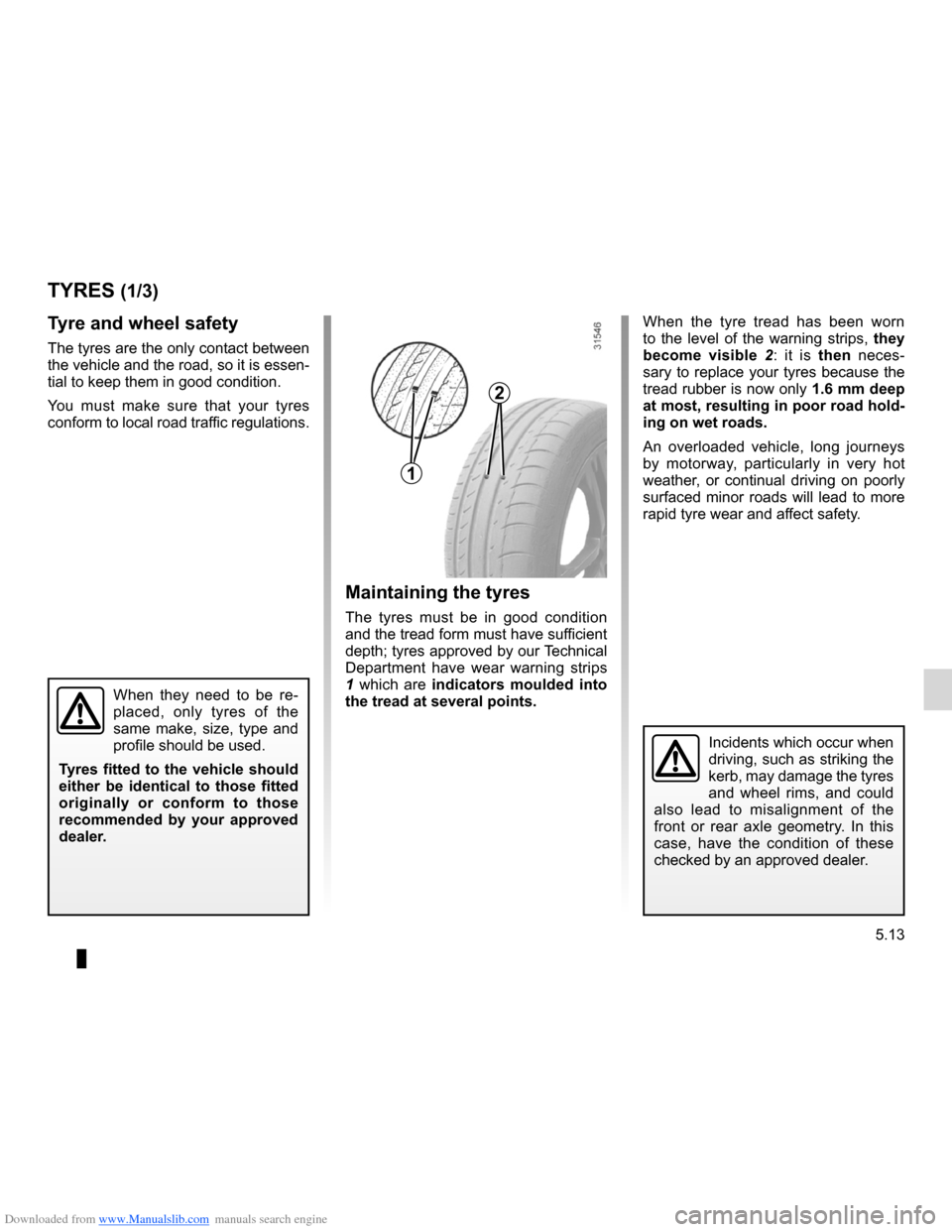
conform to local road traffic regulations. When the tyre tread has been worn
to the level of the warning strips, they
become visible
2: it is then neces -
sary to replace your tyres because the
tread rubber is now only 1.6 mm deep
at most, resulting in poor road hold -
ing on wet roads.
An overloaded vehicle, long journeys
by motorway, particularly in very hot
weather, or continual driving on poorly
surfaced minor roads will lead to more
rapid tyre wear and affect safety.
Tyres (tyre and wheel safety, use in winter)
Maintaining the tyres
The tyres must be in good condition
and the tread form must have sufficient
depth; tyres approved by our Technical
Department have wear warning strips
1 which are indicators moulded into
the tread at several points.
TYRES (1/3)
When they need to be re -
placed, only tyres of the
same make, size, type and
profile should be used.
Tyres fitted to the vehicle should
either be identical to those fitted
originally or conform to those
recommended by your approved
dealer.
Incidents which occur when
driving, such as striking the
kerb, may damage the tyres
and wheel rims, and could
also lead to misalignment of the
front or rear axle geometry. In this
case, have the condition of these
checked by an approved dealer.
1
2
Page 207 of 268
Downloaded from www.Manualslib.com manuals search engine JauneNoirNoir texte
5.15
ENG_UD22328_2
Pneumatiques (X85 - B85 - C85 - S85 - K85 - Renault)
ENG_NU_853-7_BCSK85_Renault_5
Snow or Winter tyres
We would recommend that these be
fitted to all four wheels to ensure that
your vehicle retains maximum road
holding.
Warning: These tyres sometimes have
a specific direction of rotation and a
maximum speed index which may be
lower than the maximum speed of your
vehicle.Use in winter
Chains
For safety reasons, fitting snow
chains to the rear axle is strictly for-
bidden.
Chains cannot be fitted to tyres which
are larger than those originally fitted to
the vehicle.
Special features of ver -
sions fitted with 165/65
R15 tyres
If you wish to fit studded
tyres, you must use special equip-
ment.
Consult an approved dealer.
TYRES (3/3)
Studded tyres
This type of equipment may only be
used for a limited period and as laid
down by local legislation.
It is necessary to observe the speed
specified by current legislation.
These tyres must, at a minimum, be
fitted to the two front wheels.
Chains may only be fitted
to tyres of the same size
as those originally fitted to
your vehicle.
In all cases, we would recommend
that you contact an approved dealer
who will be able to advise you on
the choice of equipment which is
most suitable for your vehicle.
Page 230 of 268
Downloaded from www.Manualslib.com manuals search engine towing hitch........................................... (up to the end of the DU)
towing breakdown ...................................... (up to the end of the DU)
5.38
ENG_UD16944_3
Remorquage : dépannage (X85 - B85 - C85 - S85 - K85 - Renault)
ENG_NU_853-7_BCSK85_Renault_5
Jaune NoirNoir texte
Insert the key in the ignition switch, or
the card in the reader, to unlock the
steering wheel and use the signalling
lights (brake lights, hazard warning
lights, etc.). The towed vehicle’s lights
must be switched on at night.
The speed specified by current legis -
lation for towing must always be ob -
served. If your vehicle is the towing
vehicle, do not exceed the maximum
towing weight for your vehicle (refer to
the information on “Weights” in Section
6).
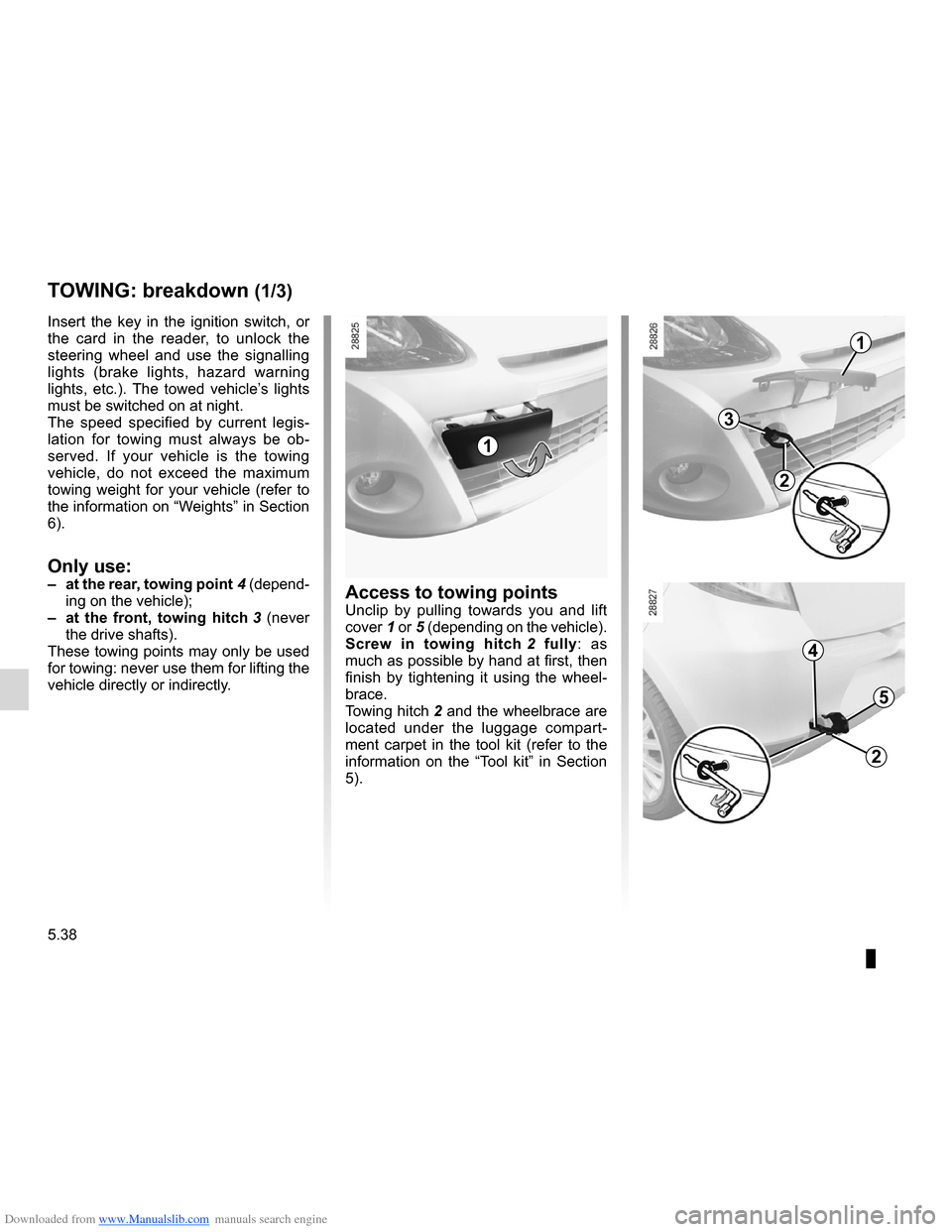
Only use:– at the rear, towing point 4 (depend-
ing on the vehicle);
– at the front, towing hitch 3 (never
the drive shafts).
These towing points may only be used
for towing: never use them for lifting the
vehicle directly or indirectly.Access to towing pointsUnclip by pulling towards you and lift
cover 1 or 5 (depending on the vehicle).
Screw in towing hitch 2 fully : as
much as possible by hand at first, then
finish by tightening it using the wheel -
brace.
Towing hitch 2 and the wheelbrace are
located under the luggage compart -
ment carpet in the tool kit (refer to the
information on the “Tool kit” in Section
5).
Towing
TOWING: breakdown (1/3)
3
1
2
1
5
2
4
1
Page 234 of 268
Downloaded from www.Manualslib.com manuals search engine 5.42
ENG_UD13707_1
Anomalies de fonctionnement (L38 - X38 - Renault)
ENG_NU_853-7_BCSK85_Renault_5
Jaune NoirNoir texte
OPERATING FAULTS (2/8)
The starter is activated POSSIBLE CAUSESACTION REQUIRED
There is no response, the warning lights
fail to light up and the starter does not
turn. Discharged battery.
Connect another battery to the faulty bat-
tery.
Battery unserviceable. Replace battery.
Warning lights go dim and starter turns
very slowly. Battery terminals not tight,
battery terminals corroded.Retighten, reconnect or clean them if
they are oxidised.
Battery discharged or unserviceable. Connect another battery to the faulty
battery. Refer to the paragraph “battery:
troubleshooting” in section 5 or replace
the battery if necessary.
Do not push the vehicle if the steering
column is locked.
Page 237 of 268
Downloaded from www.Manualslib.com manuals search engine JauneNoirNoir texte
5.45
ENG_UD13707_1
Anomalies de fonctionnement (L38 - X38 - Renault)
ENG_NU_853-7_BCSK85_Renault_5
OPERATING FAULTS (5/8)
On the road POSSIBLE CAUSESACTION REQUIRED
Smoke under the bonnet. Short circuit or cooling circuit leak.Stop, switch off the ignition, stand away
from the vehicle and contact an ap-
proved Dealer.
Coolant circuit fault. Consult an approved dealer.
The oil pressure warning light comes on:
– while turning or braking, The level is too low. Top up the engine oil level (refer to the
information on “Engine oil level: topping
up/filling” in Section 4).
– at idle speed, Low oil pressure. Consult the nearest approved Dealer.
– is slow to go out or remains lit when
accelerating. Loss of oil pressure.
Stop the vehicle and contact an ap-
proved Dealer.
Loss of engine power. Clogged air filter.Replace the cartridge.
Fuel supply fault. Check the fuel level.
Faulty spark plugs, incorrect electrode
gaps. Consult an approved dealer.
Unstable idle speed or the engine stalls. Poor compression (spark plugs, ignition,
air leak).Consult an approved dealer.
Page 238 of 268
Downloaded from www.Manualslib.com manuals search engine 5.46
ENG_UD13707_1
Anomalies de fonctionnement (L38 - X38 - Renault)
ENG_NU_853-7_BCSK85_Renault_5
Jaune NoirNoir texte
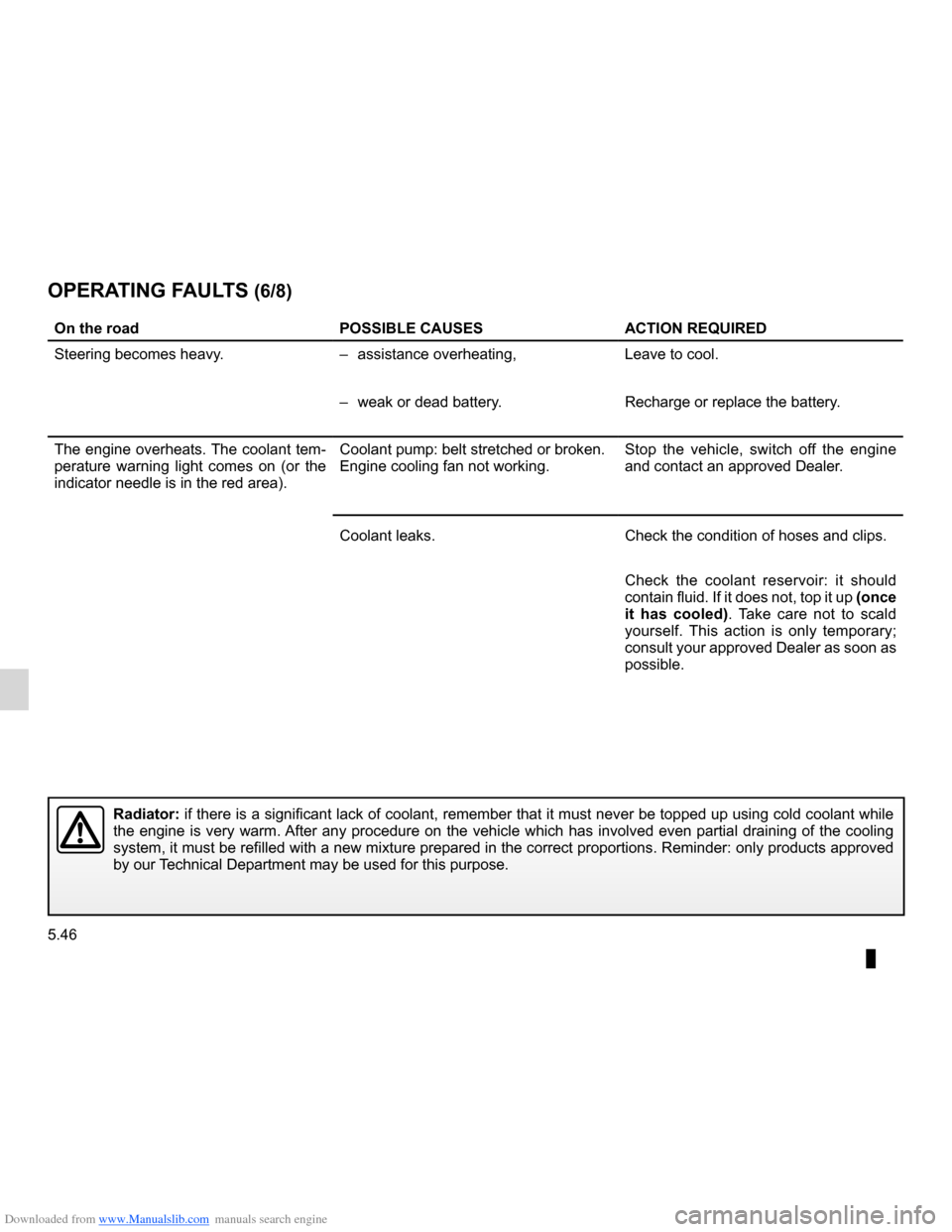
On the road POSSIBLE CAUSESACTION REQUIRED
Steering becomes heavy. – assistance overheating, Leave to cool.
– weak or dead battery. Recharge or replace the battery.
The engine overheats. The coolant tem-
perature warning light comes on (or the
indicator needle is in the red area). Coolant pump: belt stretched or broken.
Engine cooling fan not working.
Stop the vehicle, switch off the engine
and contact an approved Dealer.
Coolant leaks. Check the condition of hoses and clips.
Check the coolant reservoir: it should
contain fluid. If it does not, top it up (once
it has cooled) . Take care not to scald
yourself. This action is only temporary;
consult your approved Dealer as soon as
possible.
OPERATING FAULTS (6/8)
Radiator: if there is a significant lack of coolant, remember that it must never be topped up using cold coolant while
the engine is very warm. After any procedure on the vehicle which has involved even partial draining of the cooling
system, it must be refilled with a new mixture prepared in the correct proportions. Reminder: only products approved
by our Technical Department may be used for this purpose.