lock RENAULT CLIO 2012 X85 / 3.G Manual PDF
[x] Cancel search | Manufacturer: RENAULT, Model Year: 2012, Model line: CLIO, Model: RENAULT CLIO 2012 X85 / 3.GPages: 268, PDF Size: 8.73 MB
Page 221 of 268
Downloaded from www.Manualslib.com manuals search engine JauneNoirNoir texte
5.29
ENG_UD12592_2
Batterie : dépannage (X85 - B85 - C85 - S85 - K85 - Renault)
ENG_NU_853-7_BCSK85_Renault_5
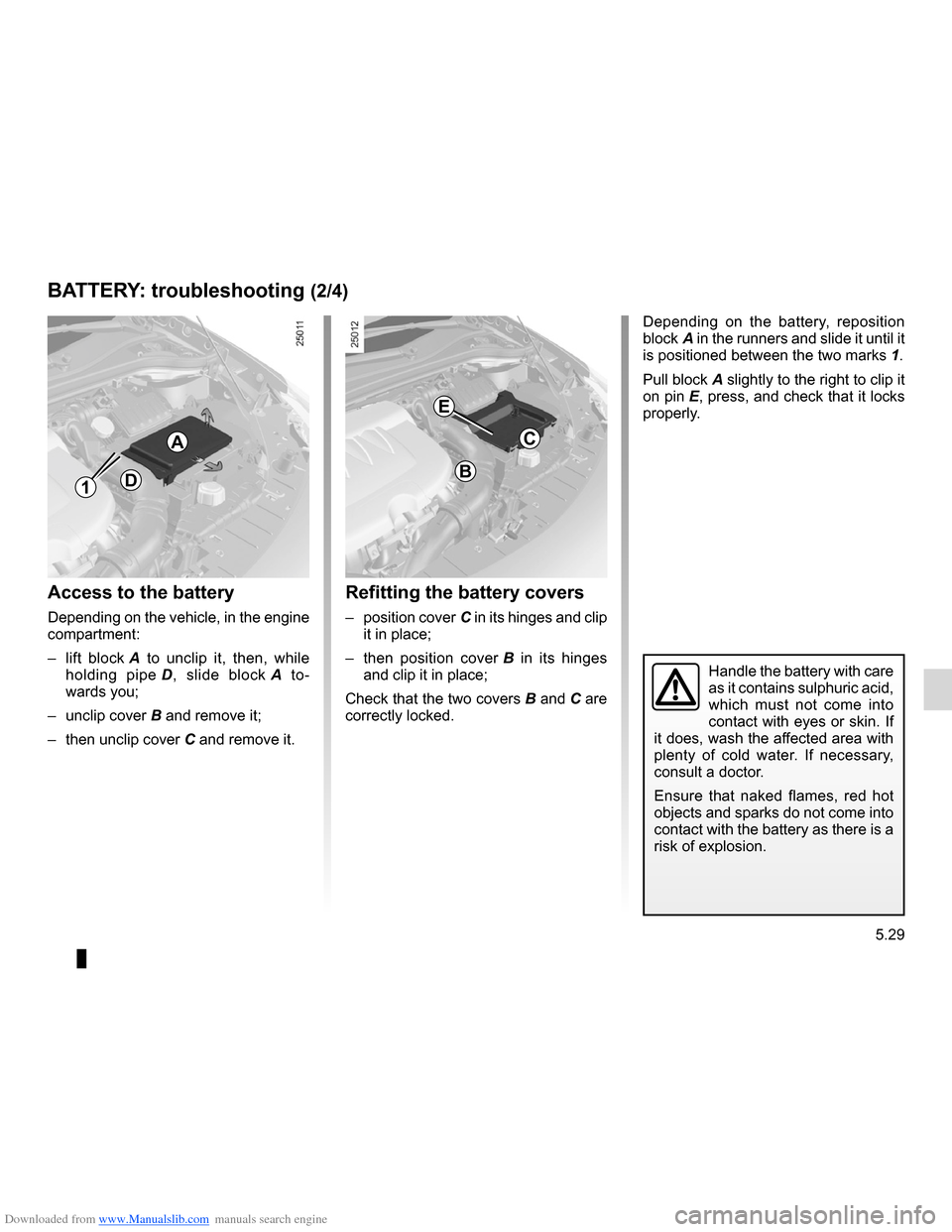
Depending on the battery, reposition
block A in the runners and slide it until it
is positioned between the two marks 1.
Pull block A slightly to the right to clip it
on pin E, press, and check that it locks
properly.
Refitting the battery covers
– position cover C in its hinges and clip
it in place;
– then position cover B in its hinges
and clip it in place;
Check that the two covers B and C are
correctly locked.
Access to the battery
Depending on the vehicle, in the engine
compartment:
– lift block A to unclip it, then, while
holding pipe D , slide block A to -
wards you;
– unclip cover B and remove it;
– then unclip cover C and remove it.
BATTERY: troubleshooting (2/4)
D
A
B
C
E
1
Handle the battery with care
as it contains sulphuric acid,
which must not come into
contact with eyes or skin. If
it does, wash the affected area with
plenty of cold water. If necessary,
consult a doctor.
Ensure that naked flames, red hot
objects and sparks do not come into
contact with the battery as there is a
risk of explosion.
Page 222 of 268
Downloaded from www.Manualslib.com manuals search engine 5.30
ENG_UD12592_2
Batterie : dépannage (X85 - B85 - C85 - S85 - K85 - Renault)
ENG_NU_853-7_BCSK85_Renault_5
Jaune NoirNoir texte
BATTERY: troubleshooting (3/4)
Special procedures may be
required to charge some
batteries. Contact your ap-
proved Dealer.
Avoid all risk of sparks which may
cause an immediate explosion and
charge the battery in a well-venti -
lated area. Risk of serious injury.
If your vehicle is to be left stationary for
a relatively long time, disconnect the
battery or have it recharged regularly,
particularly during cold weather. It will
then be necessary, with the engine run-
ning, to move the steering wheel slowly,
from lock to lock and to reprogram the
electronic equipment with a memory
feature, radio, etc. The battery should
be stored in a cool and dry location pro-
tected from frost.
Note: if you have disconnected or re -
charged a battery, move the steering
wheel slowly from lock to lock to reset
the system.
Have the battery’s charge status
checked regularly:
–
especially if you use your vehicle for
short journeys or for frequent driving
in town;
– when the exterior temperature drops
(in winter), the charge decreases .
In winter, only use the electrical
equipment that is really necessary;
– finally, you should understand that
the charge decreases naturally as a
result of certain permanent electrical
consumers such as the clock, after-
sales accessories, etc.
When many accessories are fitted to
the vehicle, have them connected to
the + after ignition feed. In this case, it
is advisable to have your vehicle fitted
with a battery which has an increased
nominal capacity. Contact an approved
Dealer.Connecting a battery charger
The battery charger must be com -
patible with a battery with nominal
voltage of 12 volts.
Switch the engine off and then discon -
nect both battery leads starting with
the negative terminal.
Do not disconnect the battery when the
engine is running. Follow the instruc-
tions given by the manufacturer for
the battery charger you are using.
Only a fully charged and well-main -
tained battery will have a long and
useful life and enable you to start the
vehicle’s engine normally.
The battery must be kept clean and dry.
Page 228 of 268
Downloaded from www.Manualslib.com manuals search engine wiper blades ......................................... (up to the end of the DU)
wipers blades ............................................. (up to the end of the DU)
5.36
ENG_UD19909_3
Balais d essuie-vitres (X85 - B85 - C85 - S85 - K85 - Renault)
ENG_NU_853-7_BCSK85_Renault_5
Jaune NoirNoir texte
Wipers (replacing blades)
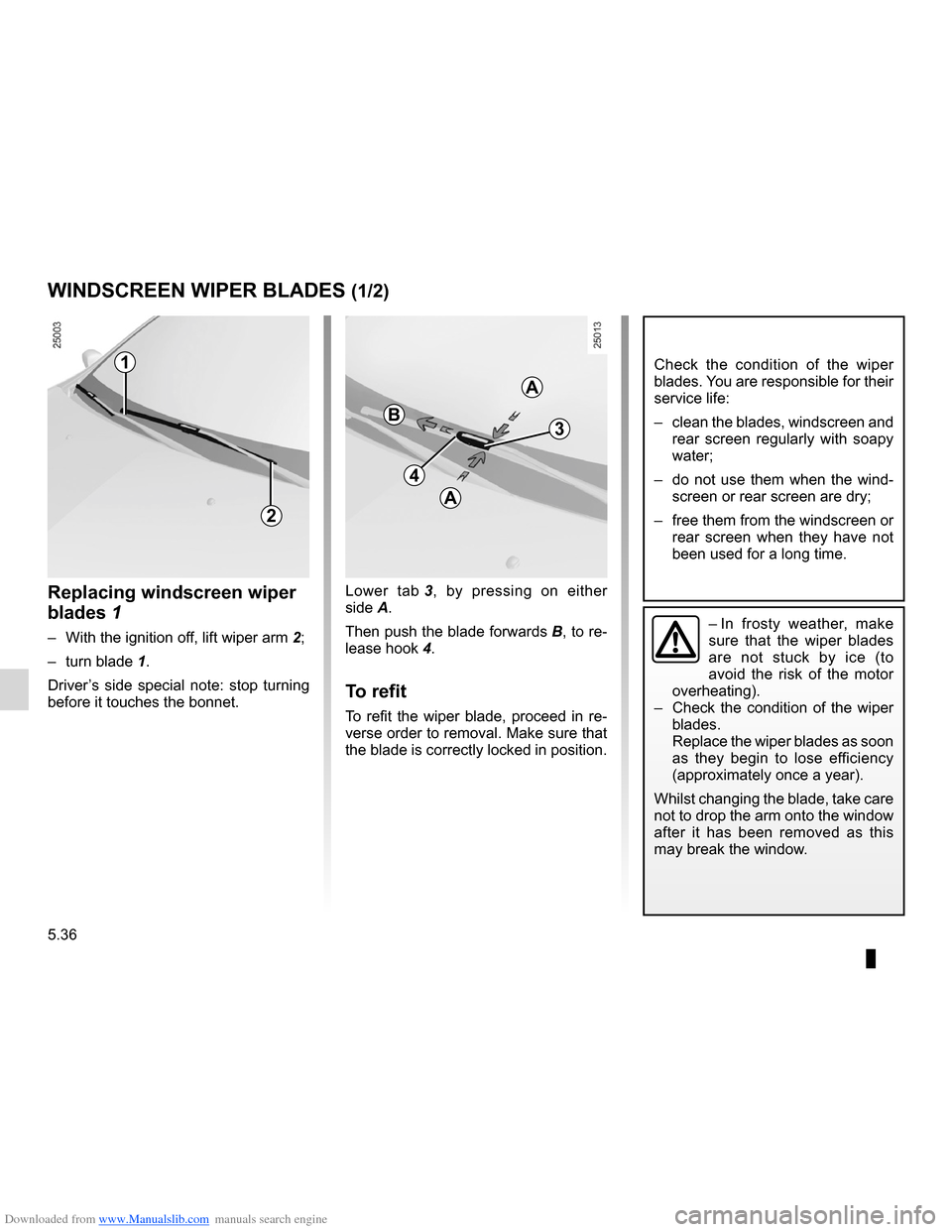
Lower tab 3 , by pressing on either
side A.
Then push the blade forwards B, to re-
lease hook 4.
To refit
To refit the wiper blade, proceed in re-
verse order to removal. Make sure that
the blade is correctly locked in position.
Replacing windscreen wiper
blades 1
– With the ignition off, lift wiper arm 2;
– turn blade 1.
Driver’s side special note: stop turning
before it touches the bonnet.
WINDSCREEN WIPER BLADES (1/2)
2
1
4
3B
A
A
– In frosty weather, make
sure that the wiper blades
are not stuck by ice (to
avoid the risk of the motor
overheating).
– Check the condition of the wiper
blades.
Replace the wiper blades as soon
as they begin to lose efficiency
(approximately once a year).
Whilst changing the blade, take care
not to drop the arm onto the window
after it has been removed as this
may break the window.
Check the condition of the wiper
blades. You are responsible for their
service life:
– clean the blades, windscreen and
rear screen regularly with soapy
water;
– do not use them when the wind-
screen or rear screen are dry;
– free them from the windscreen or
rear screen when they have not
been used for a long time.
Page 229 of 268
Downloaded from www.Manualslib.com manuals search engine JauneNoirNoir texte
5.37
ENG_UD19909_3
Balais d essuie-vitres (X85 - B85 - C85 - S85 - K85 - Renault)
ENG_NU_853-7_BCSK85_Renault_5
To refit
To refit the wiper blade, proceed in re-
verse order to removal. Make sure that
the blade is correctly locked in position.
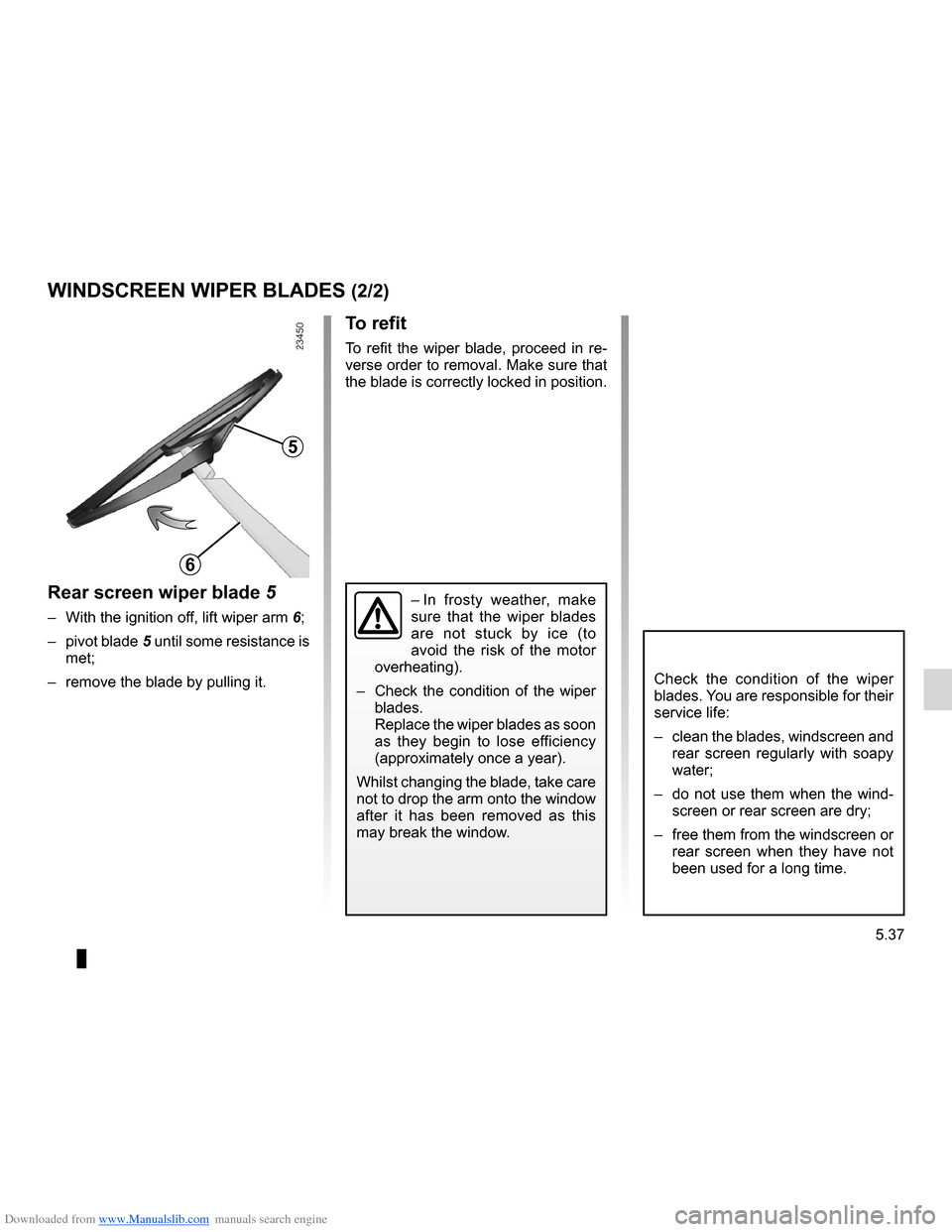
Rear screen wiper blade 5
– With the ignition off, lift wiper arm 6;
– pivot blade 5 until some resistance is
met;
– remove the blade by pulling it.
WINDSCREEN WIPER BLADES (2/2)
5
6
– In frosty weather, make
sure that the wiper blades
are not stuck by ice (to
avoid the risk of the motor
overheating).
– Check the condition of the wiper
blades.
Replace the wiper blades as soon
as they begin to lose efficiency
(approximately once a year).
Whilst changing the blade, take care
not to drop the arm onto the window
after it has been removed as this
may break the window.
Check the condition of the wiper
blades. You are responsible for their
service life:
– clean the blades, windscreen and
rear screen regularly with soapy
water;
– do not use them when the wind-
screen or rear screen are dry;
– free them from the windscreen or
rear screen when they have not
been used for a long time.
Page 230 of 268
Downloaded from www.Manualslib.com manuals search engine towing hitch........................................... (up to the end of the DU)
towing breakdown ...................................... (up to the end of the DU)
5.38
ENG_UD16944_3
Remorquage : dépannage (X85 - B85 - C85 - S85 - K85 - Renault)
ENG_NU_853-7_BCSK85_Renault_5
Jaune NoirNoir texte
Insert the key in the ignition switch, or
the card in the reader, to unlock the
steering wheel and use the signalling
lights (brake lights, hazard warning
lights, etc.). The towed vehicle’s lights
must be switched on at night.
The speed specified by current legis -
lation for towing must always be ob -
served. If your vehicle is the towing
vehicle, do not exceed the maximum
towing weight for your vehicle (refer to
the information on “Weights” in Section
6).
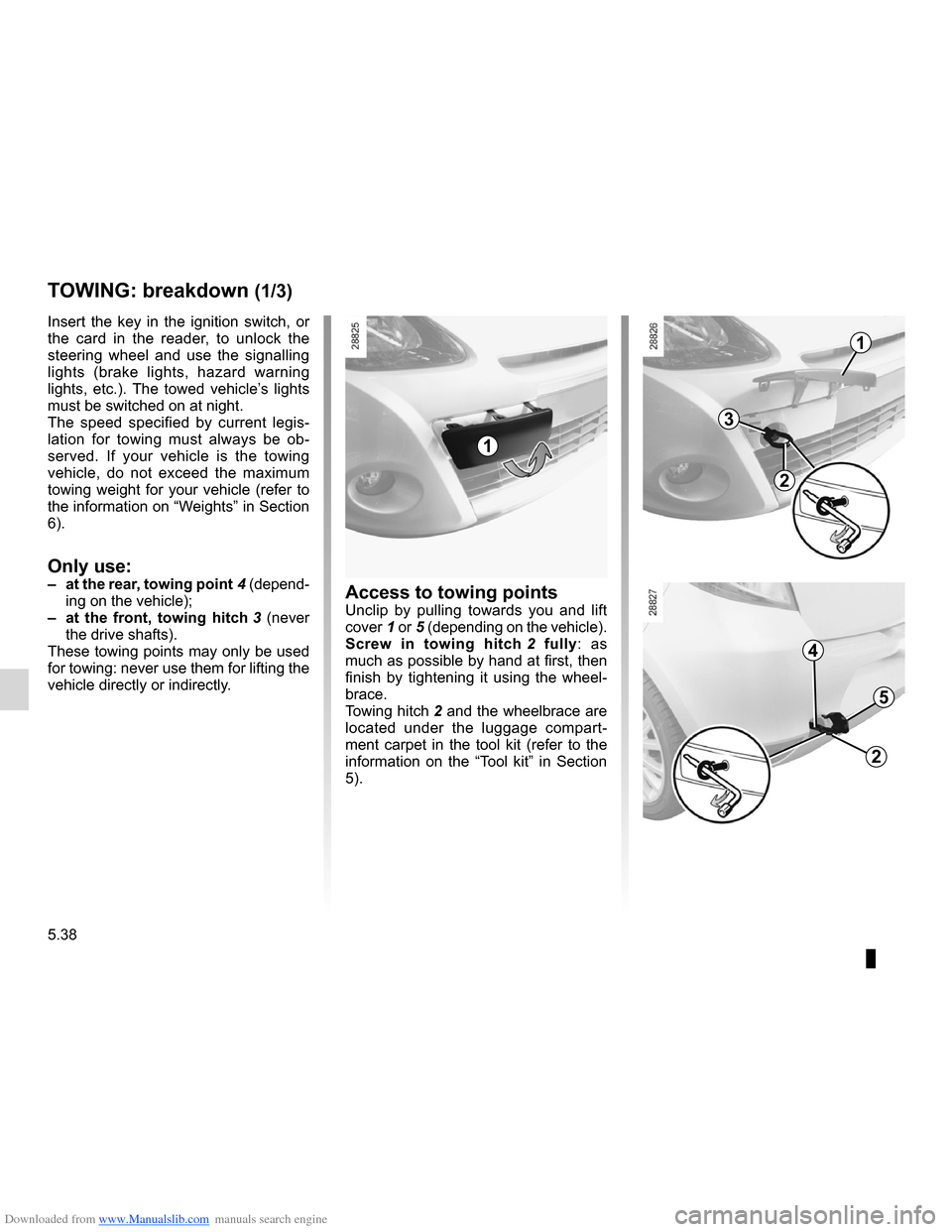
Only use:– at the rear, towing point 4 (depend-
ing on the vehicle);
– at the front, towing hitch 3 (never
the drive shafts).
These towing points may only be used
for towing: never use them for lifting the
vehicle directly or indirectly.Access to towing pointsUnclip by pulling towards you and lift
cover 1 or 5 (depending on the vehicle).
Screw in towing hitch 2 fully : as
much as possible by hand at first, then
finish by tightening it using the wheel -
brace.
Towing hitch 2 and the wheelbrace are
located under the luggage compart -
ment carpet in the tool kit (refer to the
information on the “Tool kit” in Section
5).
Towing
TOWING: breakdown (1/3)
3
1
2
1
5
2
4
1
Page 231 of 268
Downloaded from www.Manualslib.com manuals search engine JauneNoirNoir texte
5.39
ENG_UD16944_3
Remorquage : dépannage (X85 - B85 - C85 - S85 - K85 - Renault)
ENG_NU_853-7_BCSK85_Renault_5
Towing a vehicle with an
automatic gearbox
With the engine switched off: the
transmission is no longer lubricated. It
is preferable to tow this type of vehi -
cle on a trailer or tow it with the front
wheels off the ground.
Under exceptional circumstances,
you may tow the vehicle with all four
wheels on the ground, only going
forward, with the gear lever in the
Neutral position, and for a distance
not exceeding 30 miles (50 km).
If the lever is stuck in P,
even though you are de -
pressing the brake pedal,
the lever can be released
manually.
To do this, unclip the upper section
of the cover at the base of the lever.
Press simultaneously on the mark
on the gaiter and the unlocking
button on the lever.
– Use a rigid towing bar.
If a rope or cable is used
(where the law allows this),
the vehicle being towed
must be able to brake.
– A vehicle must not be towed if it is
not fit to be driven.
– Avoid accelerating or braking
suddenly when towing, as this
may result in damage being
caused to the vehicle.
– When towing a vehicle, it is ad -
visable not to exceed 15 mph (25
km/h).
– Do not push the vehicle if the
steering column is locked.
Towing procedure
Before any towing, check that the steer-
ing column is not locked.
If it is locked, insert the RENAULT card
into the reader and press the Start/Stop
button for five seconds without press-
ing on the pedals. The steering column
unlocks and the vehicle accessories
functions are supplied.
Leave the card in the reader while
towing.
Press the Start/Stop button twice in
succession once towing is finished (risk
of running down the battery).
TOWING: breakdown (2/3)
Do not leave the tools unse-
cured inside the vehicle as
they may come loose under
braking.
W h e n t h e e n g i n e i s
stopped, steering and brak-
ing assistance are not op -
erational.
Do not remove the key from
the ignition switch or the
card from the reader during
towing.
Page 233 of 268
Downloaded from www.Manualslib.com manuals search engine operating faults ..................................... (up to the end of the DU)
faults operating faults ............................... (up to the end of the DU)
5.41
ENG_UD13707_1
Anomalies de fonctionnement (L38 - X38 - Renault)
ENG_NU_853-7_BCSK85_Renault_5
Operating faults
OPERATING FAULTS (1/8)
The following advice will enable you to carry out quick, temporary repairs. For safety reasons you should always contact
an approved dealer as soon as possible.
Using the RENAULT card POSSIBLE CAUSES ACTION REQUIRED
The RENAULT card does not lock or
unlock the doors. Card battery is flat.
Use the emergency key (refer to the in-
formation on the Emergency key in
Section 1).
Use of appliances operating on the same
frequency as the card (mobile phone, etc.). Stop using the equipment or use the emer-
gency key (refer to the information on the
Emergency key in Section 1).
Vehicle located in a high electromagnetic
radiation zone.
Discharged battery. Replace the battery. You can still lock/
unlock and start your vehicle (refer to the
information on “Locking/unlocking the
doors” in Section 1 and “Starting/Stopping
the engine” in Section 2).
The remote control does not lock or
unlock the doors. The remote control battery is flat.
Use the emergency key.
Use of appliances operating on the same
frequency as the remote control (mobile
phone, etc.). Stop using the devices or use the key.
Vehicle located in a high electromagnetic
radiation zone.
Discharged battery. Replace the battery. You can still lock/
unlock and start your vehicle (refer to the
information on “Locking/unlocking the
doors” in Section 1 and “Starting/Stopping
the engine” in Section 2).
Page 234 of 268
Downloaded from www.Manualslib.com manuals search engine 5.42
ENG_UD13707_1
Anomalies de fonctionnement (L38 - X38 - Renault)
ENG_NU_853-7_BCSK85_Renault_5
Jaune NoirNoir texte
OPERATING FAULTS (2/8)
The starter is activated POSSIBLE CAUSESACTION REQUIRED
There is no response, the warning lights
fail to light up and the starter does not
turn. Discharged battery.
Connect another battery to the faulty bat-
tery.
Battery unserviceable. Replace battery.
Warning lights go dim and starter turns
very slowly. Battery terminals not tight,
battery terminals corroded.Retighten, reconnect or clean them if
they are oxidised.
Battery discharged or unserviceable. Connect another battery to the faulty
battery. Refer to the paragraph “battery:
troubleshooting” in section 5 or replace
the battery if necessary.
Do not push the vehicle if the steering
column is locked.
Page 235 of 268
Downloaded from www.Manualslib.com manuals search engine JauneNoirNoir texte
5.43
ENG_UD13707_1
Anomalies de fonctionnement (L38 - X38 - Renault)
ENG_NU_853-7_BCSK85_Renault_5
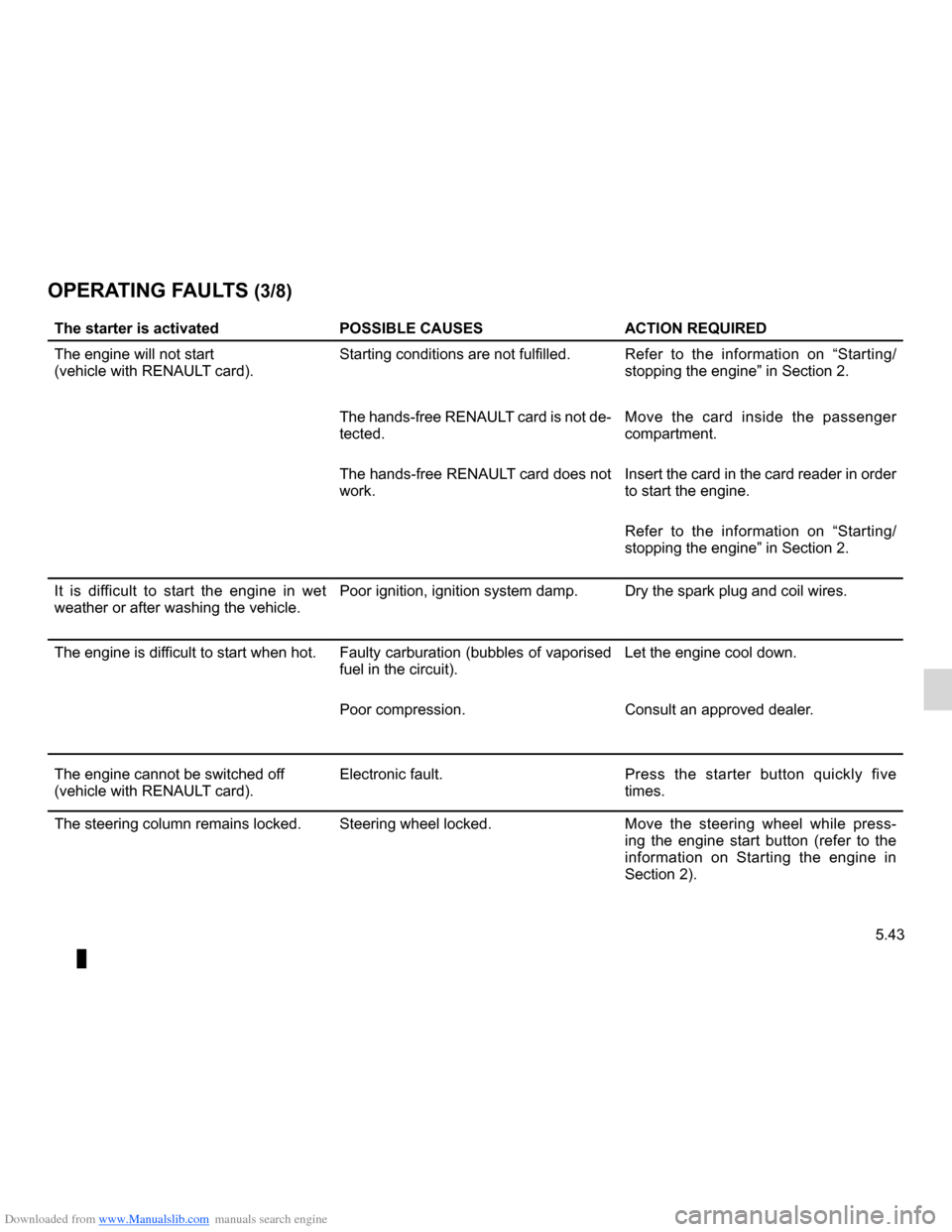
OPERATING FAULTS (3/8)
The starter is activated POSSIBLE CAUSESACTION REQUIRED
The engine will not start
(vehicle with RENAULT card). Starting conditions are not fulfilled.
Refer to the information on “Starting/
stopping the engine” in Section 2.
The hands-free RENAULT card is not de-
tected. Move the card inside the passenger
compartment.
The hands-free RENAULT card does not
work. Insert the card in the card reader in order
to start the engine.
Refer to the information on “Starting/
stopping the engine” in Section 2.
It is difficult to start the engine in wet
weather or after washing the vehicle. Poor ignition, ignition system damp.
Dry the spark plug and coil wires.
The engine is difficult to start when hot. Faulty carburation (bubbles of vaporised
fuel in the circuit).Let the engine cool down.
Poor compression. Consult an approved dealer.
The engine cannot be switched off
(vehicle with RENAULT card). Electronic fault.
Press the starter button quickly five
times.
The steering column remains locked. Steering wheel locked.Move the steering wheel while press-
ing the engine start button (refer to the
information on Starting the engine in
Section 2).
Page 261 of 268
Downloaded from www.Manualslib.com manuals search engine 7.1
FRA_UD25613_8
Index (X85 - B85 - C85 - S85 - K85 - Renault)
ENG_NU_853-7_BCSK85_Renault_7
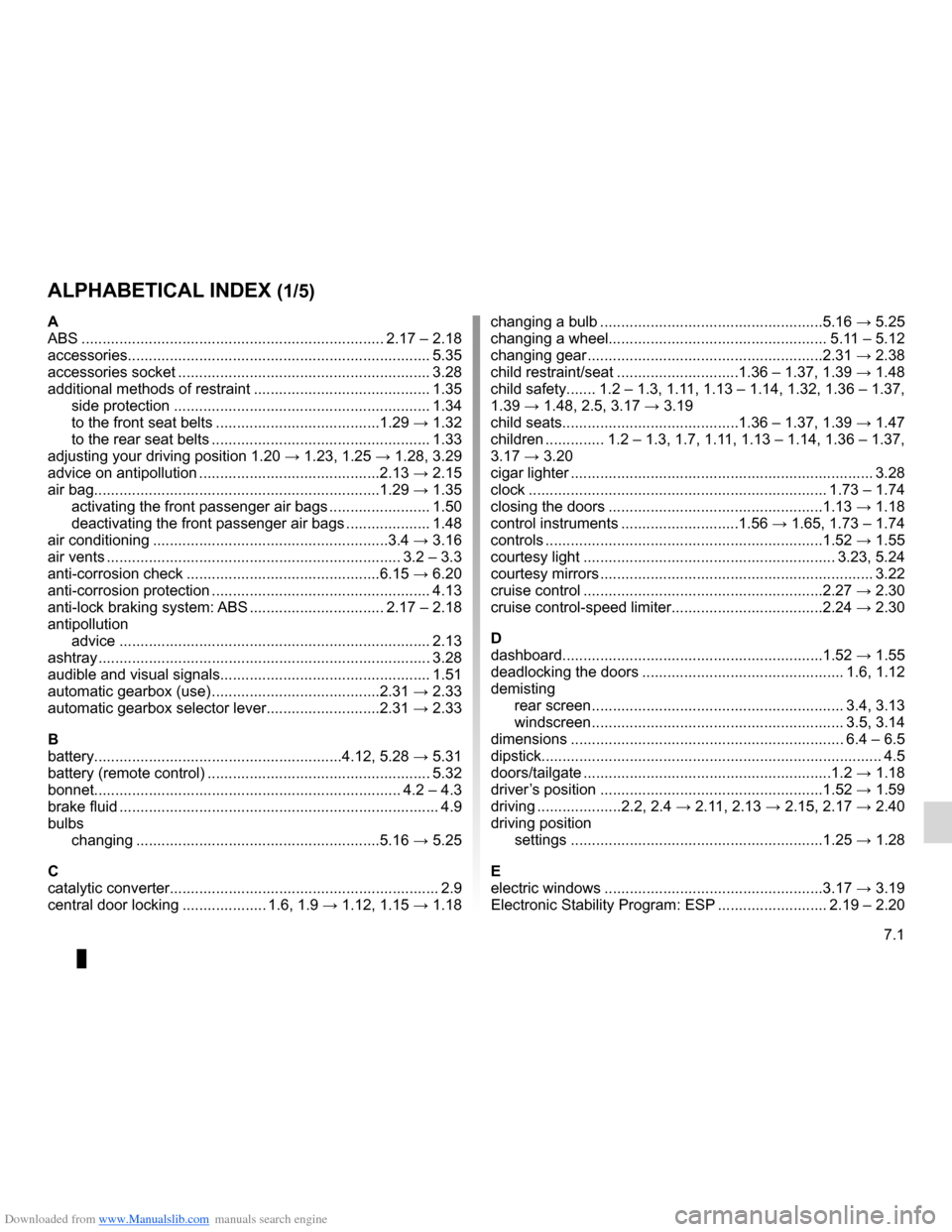
AlphAbeticAl index (1/5)
A
ABS ........................................................................\
2.17 – 2.18
accessories........................................................................\
5.35
accessories socket ............................................................ 3.28
additional methods of restraint .......................................... 1.35
side protection ............................................................. 1.34
to the front seat belts ....................................... 1.29 → 1.32
to the rear seat belts .................................................... 1.33
adjusting your driving position 1.20 → 1.23, 1.25 → 1.28, 3.29
advice on antipollution ........................................... 2.13 → 2.15
air bag .................................................................... 1.29 → 1.35
activating the front passenger air bags ........................ 1.50
deactivating the front passenger air bags .................... 1.48
air conditioning ........................................................ 3.4 → 3.16
air vents ...................................................................... 3.2 – 3.3
anti-corrosion check .............................................. 6.15 → 6.20
anti-corrosion protection .................................................... 4.13
anti-lock braking system: ABS ................................2.17 – 2.18
antipollution advice .......................................................................... 2.13
ashtray ........................................................................\
....... 3.28
audible and visual signals .................................................. 1.51
automatic gearbox (use) ........................................ 2.31 → 2.33
automatic gearbox selector lever ...........................2.31 → 2.33
b
battery ........................................................... 4.12, 5.28 → 5.31
battery (remote control) ..................................................... 5.32
bonnet ........................................................................\
. 4.2 – 4.3
brake fluid ........................................................................\
.... 4.9
bulbs changing .......................................................... 5.16 → 5.25
c
catalytic converter ................................................................ 2.9
central door locking .................... 1.6, 1.9 → 1.12, 1.15 → 1.18 changing a bulb
..................................................... 5.16 → 5.25
changing a wheel .................................................... 5.11 – 5.12
changing gear ........................................................ 2.31 → 2.38
child restraint/seat ............................. 1.36 – 1.37, 1.39 → 1.48
child safety .......1.2 – 1.3, 1.11, 1.13 – 1.14, 1.32, 1.36 – 1.37,
1.39 → 1.48, 2.5, 3.17 → 3.19
child seats .......................................... 1.36 – 1.37, 1.39 → 1.47
children .............. 1.2 – 1.3, 1.7, 1.11, 1.13 – 1.14, 1.36 – 1.37,
3.17 → 3.20
cigar lighter ........................................................................\
3.28
clock ....................................................................... 1.73 – 1.74
closing the doors ................................................... 1.13 → 1.18
control instruments ............................ 1.56 → 1.65, 1.73 – 1.74
controls .................................................................. 1.52 → 1.55
courtesy light ............................................................ 3.23, 5.24
courtesy mirrors ................................................................. 3.22
cruise control ......................................................... 2.27 → 2.30
cruise control-speed limiter.................................... 2.24 → 2.30
d
dashboard .............................................................. 1.52 → 1.55
deadlocking the doors ................................................ 1.6, 1.12
demisting rear screen ............................................................ 3.4, 3.13
windscreen ............................................................ 3.5, 3.14
dimensions ................................................................. 6.4 – 6.5
dipstick........................................................................\
......... 4.5
doors/tailgate ........................................................... 1.2 → 1.18
driver’s position ..................................................... 1.52 → 1.59
driving .................... 2.2, 2.4 → 2.11, 2.13 → 2.15, 2.17 → 2.40
driving position settings ............................................................ 1.25 → 1.28
e
electric windows .................................................... 3.17 → 3.19
Electronic Stability Program: ESP .......................... 2.19 – 2.20