Esc RENAULT CLIO 2016 X98 / 4.G User Guide
[x] Cancel search | Manufacturer: RENAULT, Model Year: 2016, Model line: CLIO, Model: RENAULT CLIO 2016 X98 / 4.GPages: 258, PDF Size: 2.51 MB
Page 173 of 258
4.5
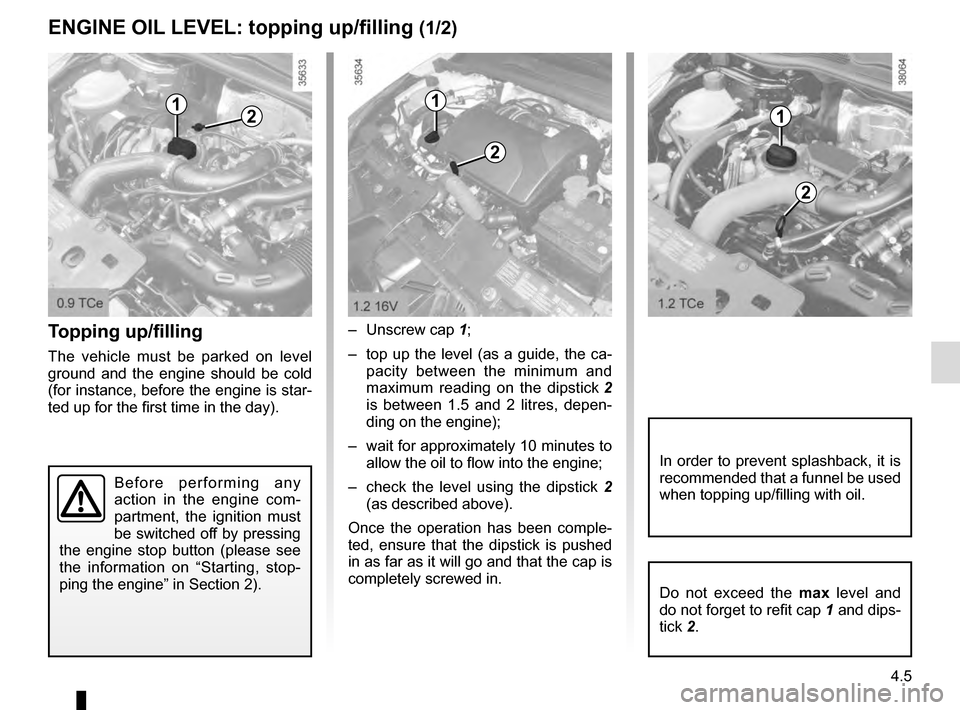
Topping up/filling
The vehicle must be parked on level
ground and the engine should be cold
(for instance, before the engine is star-
ted up for the first time in the day).– Unscrew cap
1;
– top up the level (as a guide, the ca- pacity between the minimum and
maximum reading on the dipstick 2
is between 1.5 and 2 litres, depen-
ding on the engine);
– wait for approximately 10 minutes to allow the oil to flow into the engine;
– check the level using the dipstick 2
(as described above).
Once the operation has been comple-
ted, ensure that the dipstick is pushed
in as far as it will go and that the cap is
completely screwed in.
ENGINE OIL LEVEL: topping up/filling (1/2)
12
Do not exceed the max level and
do not forget to refit cap 1 and dips-
tick 2.
In order to prevent splashback, it is
recommended that a funnel be used
when topping up/filling with oil.
1
2
1
2
Before performing any
action in the engine com-
partment, the ignition must
be switched off by pressing
the engine stop button (please see
the information on “Starting, stop-
ping the engine” in Section 2).
Page 192 of 258
5.8
TYRE PRESSURE KIT (3/3)
If a minimum pressure of 1.8 bar is
not reached after 15 minutes, repair
is not possible; do not drive the ve-
hicle but contact an approved dealer.
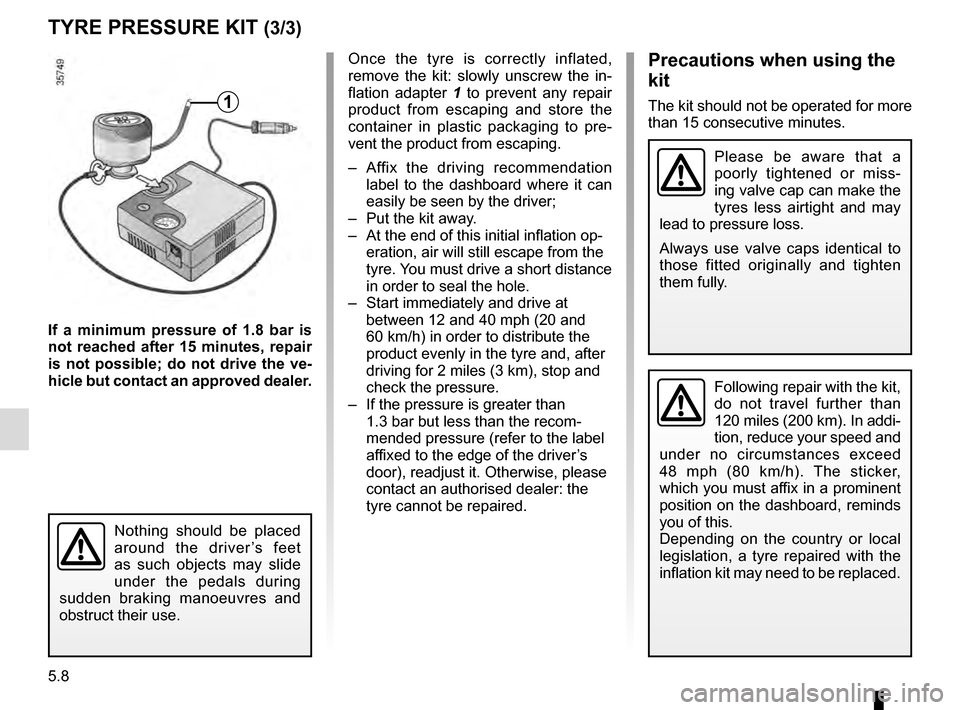
Once the tyre is correctly inflated,
remove the kit: slowly unscrew the in-
flation adapter 1 to prevent any repair
product from escaping and store the
container in plastic packaging to pre-
vent the product from escaping.
– Affix the driving recommendation label to the dashboard where it can
easily be seen by the driver;
– Put the kit away.
– At the end of this initial inflation op- eration, air will still escape from the
tyre. You must drive a short distance
in order to seal the hole.
– Start immediately and drive at between 12 and 40 mph (20 and
60 km/h) in order to distribute the
product evenly in the tyre and, after
driving for 2 miles (3 km), stop and
check the pressure.
– If the pressure is greater than 1.3 bar but less than the recom-
mended pressure (refer to the label
affixed to the edge of the driver’s
door), readjust it. Otherwise, please
contact an authorised dealer: the
tyre cannot be repaired.Precautions when using the
kit
The kit should not be operated for more
than 15 consecutive minutes.
Nothing should be placed
around the driver’s feet
as such objects may slide
under the pedals during
sudden braking manoeuvres and
obstruct their use.
1
Please be aware that a
poorly tightened or miss-
ing valve cap can make the
tyres less airtight and may
lead to pressure loss.
Always use valve caps identical to
those fitted originally and tighten
them fully.
Following repair with the kit,
do not travel further than
120 miles (200 km). In addi-
tion, reduce your speed and
under no circumstances exceed
48 mph (80 km/h). The sticker,
which you must affix in a prominent
position on the dashboard, reminds
you of this.
Depending on the country or local
legislation, a tyre repaired with the
inflation kit may need to be replaced.
Page 213 of 258
5.29
Number Allocation
1 Front windscreen wiper,
controls under steering
wheel
2 Front left-hand daytime
running lights,
right-hand side lights,
left-hand main beam
headlight,
right-hand dipped beam
headlight,
front fog lights
3 Interior lighting,
registration plate lighting,
fog lights
4 Right-hand side lights,
rear side lights
5 Left-hand side lights,
front side lights
FUSES (3/5)
Number Allocation
6 Dipped beams,
front right-hand daytime
running light,
left-hand side lights,
right-hand main beam
headlight
7 Left-hand dipped beam
headlight
8 Right-hand main beam
headlight
9 Left-hand main beam
headlight,
steering column controls
10 Steering column controls,
speed limiter/cruise control,
interior rear-view mirror,
belt warning module,
Parking sensor,
additional heating,
electric headlight beam
adjustment,
rear screen de-icerNumber Allocation
11 Central door locking,
rain and light sensor,
steering wheel angle
sensor,
vehicle start button,
electric rear windows
12 Courtesy light,
boot light,
air conditioning,
electric windows
13 ABS-ESC,
brake switch
14 Steering column controls,
brake switch
15 Horn
16 Rear fog lights
17 Cigarette lighter
Page 252 of 258
7.2
ALPHABETICAL INDEX (2/5)
driving ........2.2 → 2.5, 2.10 – 2.11, 2.13 → 2.17, 2.20 → 2.26,
2.24 → 2.39, 2.42 → 2.44
driving position settings ............................................................1.2\
0 → 1.23
driving recommendations ......................................2.13 → 2.17
E
ECO driving ...........................................................2.13 → 2.17
ECO mode .................................................................. 2.15, 3.9
electric beam height adjustment ........................................ 1.80
electric windows ..................................................... 3.12 – 3.13
electronic stability control: ESC .............................2.27 → 2.30
emergency brake assist.........................................2.27 → 2.30
emergency braking ................................................2.27 → 2.30
emergency key ..........................................................1.2 → 1.4
emergency spare wheel ............................................5.2 → 5.5
engine technical specifications .................................................. 6.6
engine coolant ..................................................................... 4.7
engine oil ...................................................................4.4 → 4.6
engine oil capacity ...................................................... 4.5 – 4.6
engine oil level ...........................................................4.4 → 4.6
engine specifications .................................................... 6.3, 6.6
engine standby ..........................................................2.6 → 2.9
engine start/stop button .............................................2.3 → 2.5
environment ............................................................\
........... 2.19
ESC: electronic stability control ....................1.58, 2.27 → 2.30
external temperature ......................................................... 1.74
F
faults operating faults ................................................5.40 → 5.45
filter air filter ........................................................................\
... 4.9
oil filter .................................................................. 4.5 – 4.6
passenger compartment filter ........................................ 4.9 fitting a radio ...................................................................... 5.34
fittings ...............................................................\
.....3.16 → 3.19
front passenger air bag deactivation ................................. 1.48
front seat adjustment .............................................1.17 → 1.19
front seats adjustment .......................................................1.16 → 1.20
fuel advice on fuel economy ...................................2.13 → 2.17
consumption ...........................................2.13 → 2.15, 2.17
filling ........................................................1.56, 1.84 → 1.86
grade ................................................................1.\
84 → 1.86
fuel consumption ..........................................2.13 → 2.15, 2.17
fuel economy .........................................................2.13 → 2.17
fuel filler cap ..........................................................1.84 → 1.86
fuel level ................................................................1.56 → 1.61
fuel tank capacity ...............................................................\
......... 1.84
fuel tank capacity ...................................................1.84 → 1.86
fuses ..................................................................\
....5.27 → 5.31
G
gear lever..............................................................\
............. 2.12
H
handbrake...............................................................\
........... 2.12
hands-free telephone integrated control ............................
3.32
hazard warning lights signal .............................................. 1.79
headlight beam adjustment ............................................... 1.80
headrest................................................................\
.... 1.16, 3.21
heated seats ...................................................................... 1.17
heated windscreen ..................................................3.7 → 3.10
heating and air conditioning system ........................ 3.4 → 3.11
heating system ........................................................ 3.4 → 3.11
Hill Start Assist.......................................................2.27 → 2.30
horn ...................................................................\
................ 1.79