gearbox RENAULT DUSTER 2016 User Guide
[x] Cancel search | Manufacturer: RENAULT, Model Year: 2016, Model line: DUSTER, Model: RENAULT DUSTER 2016Pages: 256, PDF Size: 6.49 MB
Page 121 of 256
2.45
AUTOMATIC GEARBOX (1/4)
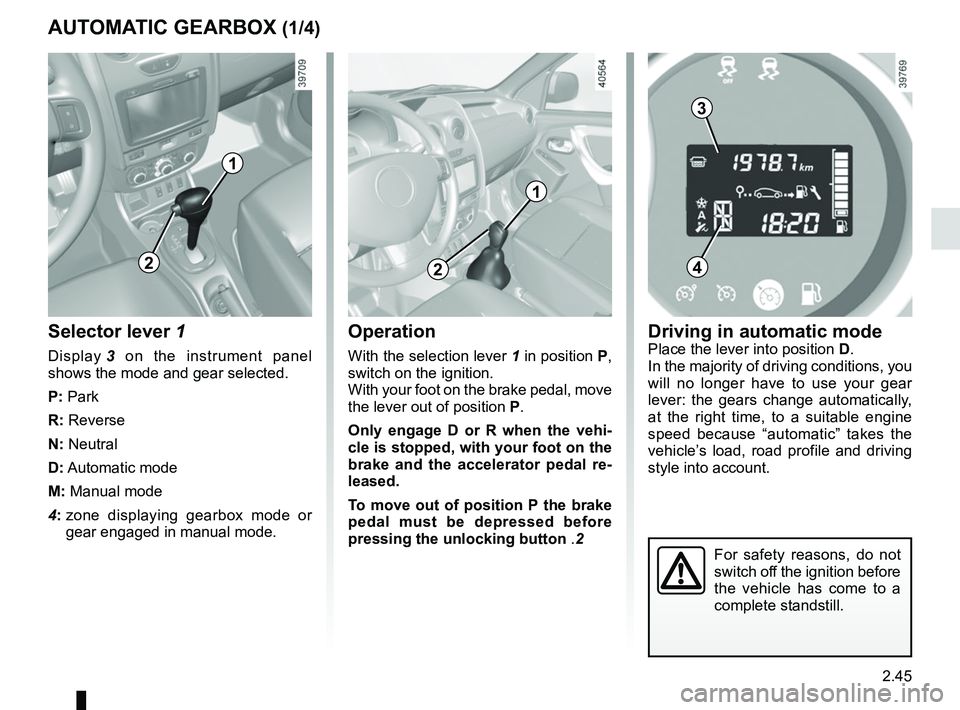
Selector lever 1
Display 3 on the instrument panel
shows the mode and gear selected.
P: Park
R: Reverse
N: Neutral
D: Automatic mode
M: Manual mode
4: zone displaying gearbox mode or
gear engaged in manual mode.
Operation
With the selection lever 1 in position P,
switch on the ignition.
With your foot on the brake pedal, move
the lever out of position P.
Only engage D or R when the vehi-
cle is stopped, with your foot on the
brake and the accelerator pedal re-
leased.
To move out of position P the brake
pedal must be depressed before
pressing the unlocking button .2
For safety reasons, do not
switch off the ignition before
the vehicle has come to a
complete standstill.
1
2
3
4
Driving in automatic modePlace the lever into position D.
In the majority of driving conditions, you
will no longer have to use your gear
lever: the gears change automatically,
at the right time, to a suitable engine
speed because “automatic” takes the
vehicle’s load, road profile and driving
style into account.
2
1
Page 122 of 256
2.46
AUTOMATIC GEARBOX (2/4)
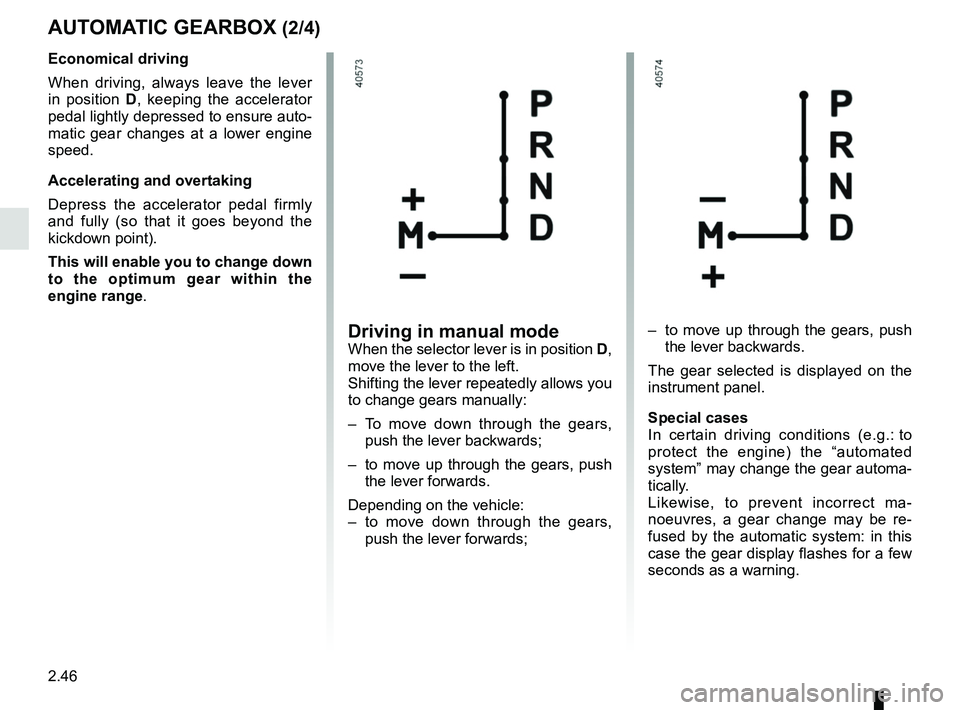
Driving in manual modeWhen the selector lever is in position D,
move the lever to the left.
Shifting the lever repeatedly allows you
to change gears manually:
– To move down through the gears, push the lever backwards;
– to move up through the gears, push the lever forwards.
Depending on the vehicle:
– to move down through the gears, push the lever forwards; – to move up through the gears, push
the lever backwards.
The gear selected is displayed on the
instrument panel.
Special cases
In certain driving conditions (e.g.: to
protect the engine) the “automated
system” may change the gear automa-
tically.
Likewise, to prevent incorrect ma-
noeuvres, a gear change may be re-
fused by the automatic system: in this
case the gear display flashes for a few
seconds as a warning.
Economical driving
When driving, always leave the lever
in position D, keeping the accelerator
pedal lightly depressed to ensure auto-
matic gear changes at a lower engine
speed.
Accelerating and overtaking
Depress the accelerator pedal firmly
and fully (so that it goes beyond the
kickdown point).
This will enable you to change down
to the optimum gear within the
engine range.
Page 123 of 256
2.47
AUTOMATIC GEARBOX (3/4)
Special circumstances
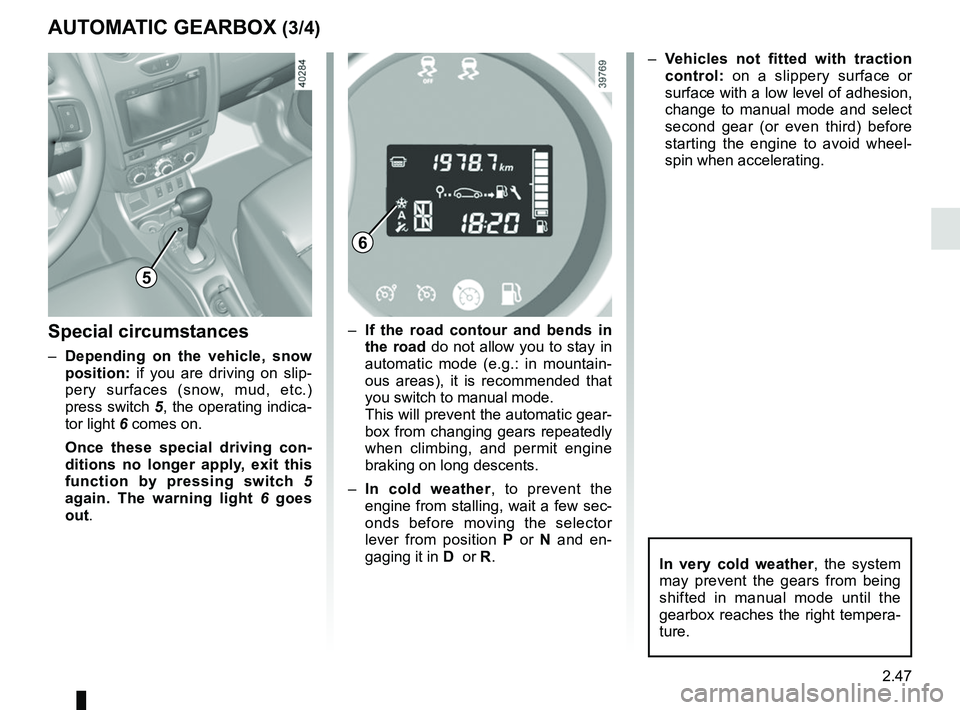
– Depending on the vehicle, snow position: if you are driving on slip-
pery surfaces (snow, mud, etc.)
press switch 5, the operating indica-
tor light 6 comes on.
Once these special driving con-
ditions no longer apply, exit this
function by pressing switch 5
again. The warning light 6 goes
out.
5
– If the road contour and bends in
the road do not allow you to stay in
automatic mode (e.g.: in mountain-
ous areas), it is recommended that
you switch to manual mode.
This will prevent the automatic gear-
box from changing gears repeatedly
when climbing, and permit engine
braking on long descents.
– In cold weather , to prevent the
engine from stalling, wait a few sec-
onds before moving the selector
lever from position P or N and en-
gaging it in D or R. –
Vehicles not fitted with traction
control: on a slippery surface or
surface with a low level of adhesion,
change to manual mode and select
second gear (or even third) before
starting the engine to avoid wheel-
spin when accelerating.
In very cold weather, the system
may prevent the gears from being
shifted in manual mode until the
gearbox reaches the right tempera-
ture.
6
Page 124 of 256
2.48
AUTOMATIC GEARBOX (4/4)
Parking the vehicle
When the vehicle is stopped, move the
lever to position P while keeping your
foot on the brake pedal: the gearbox is
in neutral and the drive wheels are me-
chanically locked by the driveshaft.
Apply the handbrake.
Operating faults
If a vehicle with an automatic gear-
box breaks down, please refer to the
information on “Towing” in Section 5.
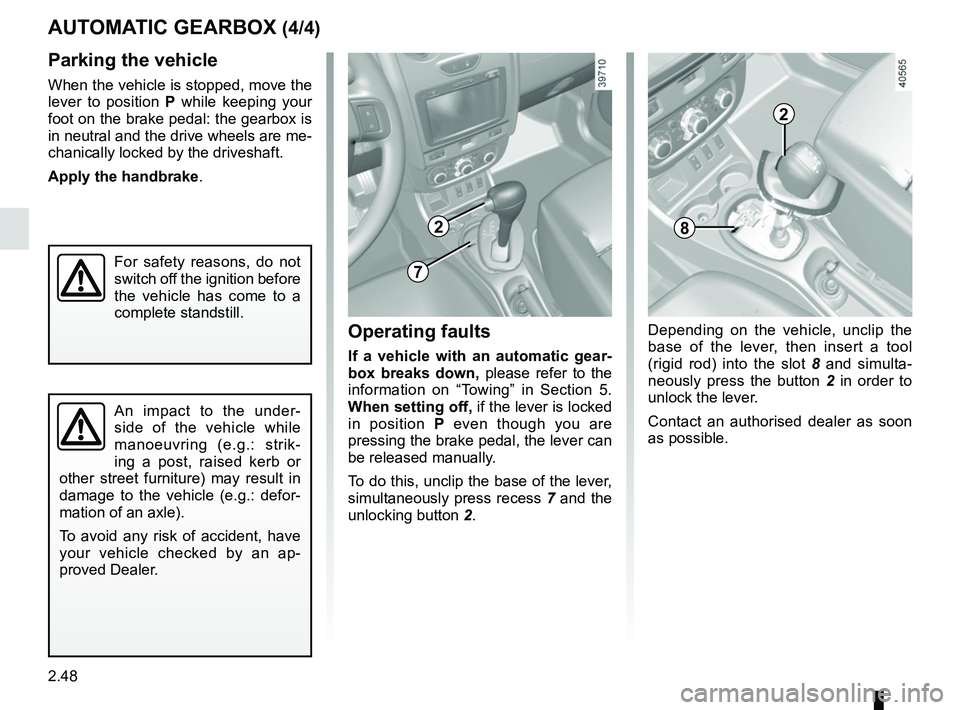
When setting off, if the lever is locked
in position P even though you are
pressing the brake pedal, the lever can
be released manually.
To do this, unclip the base of the lever,
simultaneously press recess 7 and the
unlocking button 2.
An impact to the under-
side of the vehicle while
manoeuvring (e.g.: strik-
ing a post, raised kerb or
other street furniture) may result in
damage to the vehicle (e.g.: defor-
mation of an axle).
To avoid any risk of accident, have
your vehicle checked by an ap-
proved Dealer.
For safety reasons, do not
switch off the ignition before
the vehicle has come to a
complete standstill.
2
7
Depending on the vehicle, unclip the
base of the lever, then insert a tool
(rigid rod) into the slot 8 and simulta-
neously press the button 2 in order to
unlock the lever.
Contact an authorised dealer as soon
as possible.
8
2
Page 209 of 256
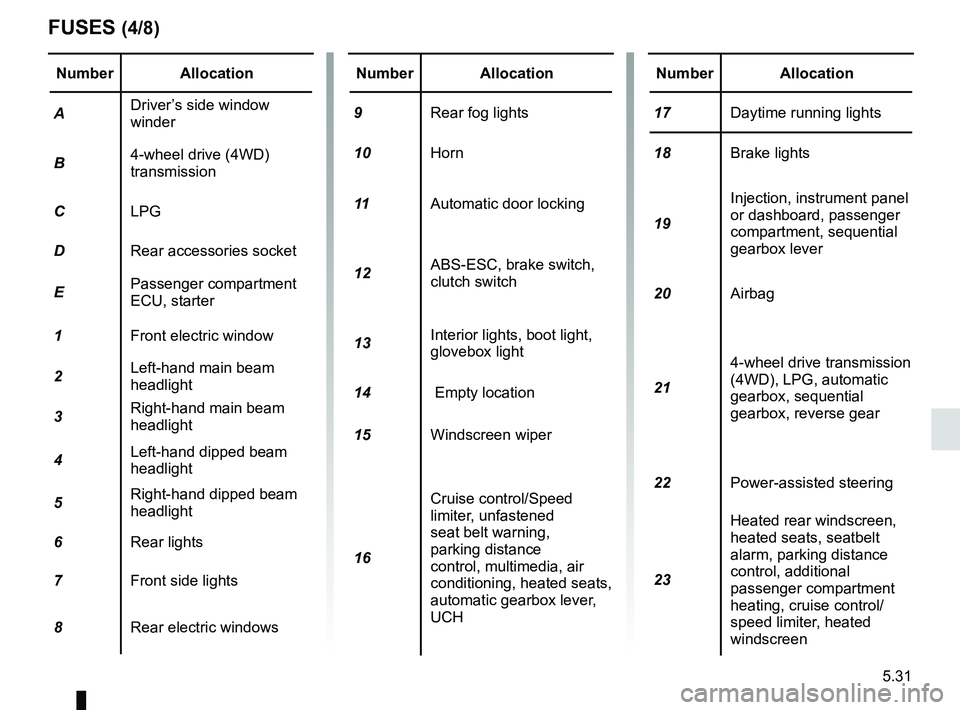
5.31
Number Allocation
A Driver’s side window
winder
B 4-wheel drive (4WD)
transmission
C LPG
D Rear accessories socket
E Passenger compartment
ECU, starter
1 Front electric window
2 Left-hand main beam
headlight
3 Right-hand main beam
headlight
4 Left-hand dipped beam
headlight
5 Right-hand dipped beam
headlight
6 Rear lights
7 Front side lights
8 Rear electric windowsNumber Allocation
9 Rear fog lights
10 Horn
11 Automatic door locking
12 ABS-ESC, brake switch,
clutch switch
13 Interior lights, boot light,
glovebox light
14 Empty location
15 Windscreen wiper
16 Cruise control/Speed
limiter, unfastened
seat belt warning,
parking distance
control, multimedia, air
conditioning, heated seats,
automatic gearbox lever,
UCHNumber Allocation
17 Daytime running lights
18 Brake lights
19 Injection, instrument panel
or dashboard, passenger
compartment, sequential
gearbox lever
20 Airbag
21 4-wheel drive transmission
(4WD), LPG, automatic
gearbox, sequential
gearbox, reverse gear
22 Power-assisted steering
23 Heated rear windscreen,
heated seats, seatbelt
alarm, parking distance
control, additional
passenger compartment
heating, cruise control/
speed limiter, heated
windscreen
FUSES (4/8)
Page 212 of 256
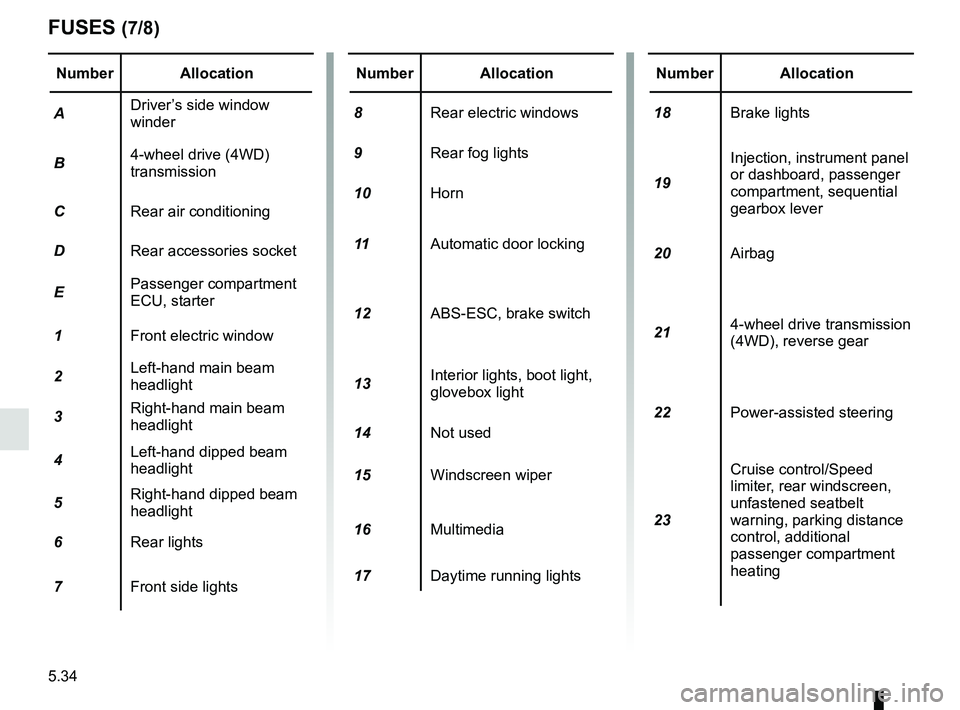
5.34
FUSES (7/8)
Number Allocation
A Driver’s side window
winder
B 4-wheel drive (4WD)
transmission
C Rear air conditioning
D Rear accessories socket
E Passenger compartment
ECU, starter
1 Front electric window
2 Left-hand main beam
headlight
3 Right-hand main beam
headlight
4 Left-hand dipped beam
headlight
5 Right-hand dipped beam
headlight
6 Rear lights
7 Front side lightsNumber Allocation
8 Rear electric windows
9 Rear fog lights
10 Horn
11 Automatic door locking
12 ABS-ESC, brake switch
13 Interior lights, boot light,
glovebox light
14 Not used
15 Windscreen wiper
16 Multimedia
17 Daytime running lightsNumber Allocation
18 Brake lights
19 Injection, instrument panel
or dashboard, passenger
compartment, sequential
gearbox lever
20 Airbag
21 4-wheel drive transmission
(4WD), reverse gear
22 Power-assisted steering
23 Cruise control/Speed
limiter, rear windscreen,
unfastened seatbelt
warning, parking distance
control, additional
passenger compartment
heating
Page 218 of 256
5.40
TOWING: breakdown (1/3)
Before any towing, put the gears into
neutral (neutral position for vehicles
equipped with a manual gearbox or N
position for vehicles equipped with an
automatic gearbox).
Unlock the steering column; the igni-
tion key must be in “M” position (ig-
nition) to enable signalling (“Stop”
lights, hazard warning lights, etc.).
Always switch on the lights when
driving at night.
Release the parking brake.
It is also essential to observe the towing
regulations imposed by current legisla-
tion in your country. Please contact an
authorised dealer.
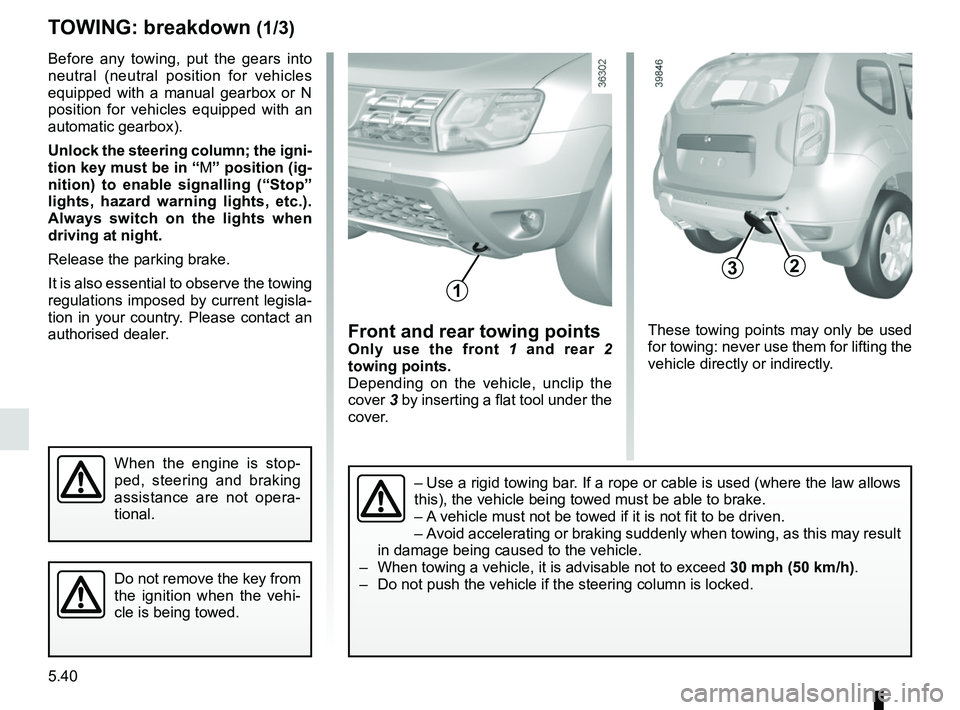
Front and rear towing pointsOnly use the front 1 and rear 2
towing points.
Depending on the vehicle, unclip the
cover 3 by inserting a flat tool under the
cover.
When the engine is stop-
ped, steering and braking
assistance are not opera-
tional.
Do not remove the key from
the ignition when the vehi-
cle is being towed.
– Use a rigid towing bar. If a rope or cable is used (where the law allows
this), the vehicle being towed must be able to brake.
– A vehicle must not be towed if it is not fit to be driven.
– Avoid accelerating or braking suddenly when towing, as this may result
in damage being caused to the vehicle.
– When towing a vehicle, it is advisable not to exceed 30 mph (50 km/h).
– Do not push the vehicle if the steering column is locked.
These towing points may only be used
for towing: never use them for lifting the
vehicle directly or indirectly.
1
23
Page 219 of 256
5.41
TOWING: breakdown (2/3)
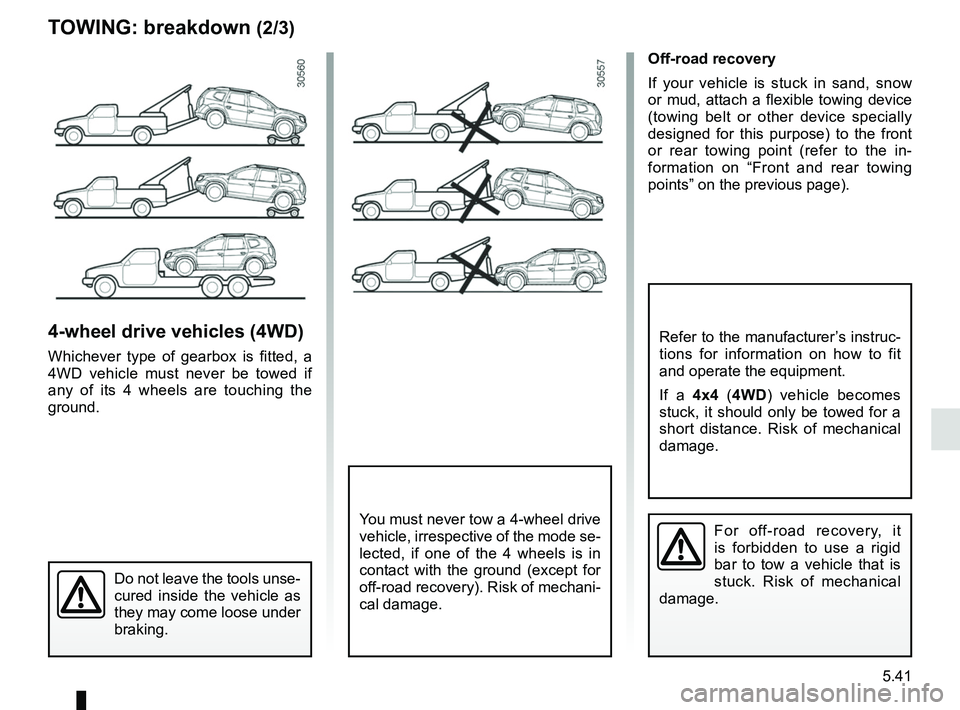
4-wheel drive vehicles (4WD)
Whichever type of gearbox is fitted, a
4WD vehicle must never be towed if
any of its 4 wheels are touching the
ground.
Off-road recovery
If your vehicle is stuck in sand, snow
or mud, attach a flexible towing device
(towing belt or other device specially
designed for this purpose) to the front
or rear towing point (refer to the in-
formation on “Front and rear towing
points” on the previous page).
For off-road recovery, it
is forbidden to use a rigid
bar to tow a vehicle that is
stuck. Risk of mechanical
damage.You must never tow a 4-wheel drive
vehicle, irrespective of the mode se-
lected, if one of the 4 wheels is in
contact with the ground (except for
off-road recovery). Risk of mechani-
cal damage.
Refer to the manufacturer’s instruc-
tions for information on how to fit
and operate the equipment.
If a 4x4 ( 4WD) vehicle becomes
stuck, it should only be towed for a
short distance. Risk of mechanical
damage.
Do not leave the tools unse-
cured inside the vehicle as
they may come loose under
braking.
Page 220 of 256
5.42
TOWING: breakdown (3/3)
When storing the tools,
ensure they are securely re-
placed in the luggage com-
partment, in their original
position.
Do not leave the tools unsecured
inside the vehicle as they may come
loose under braking.
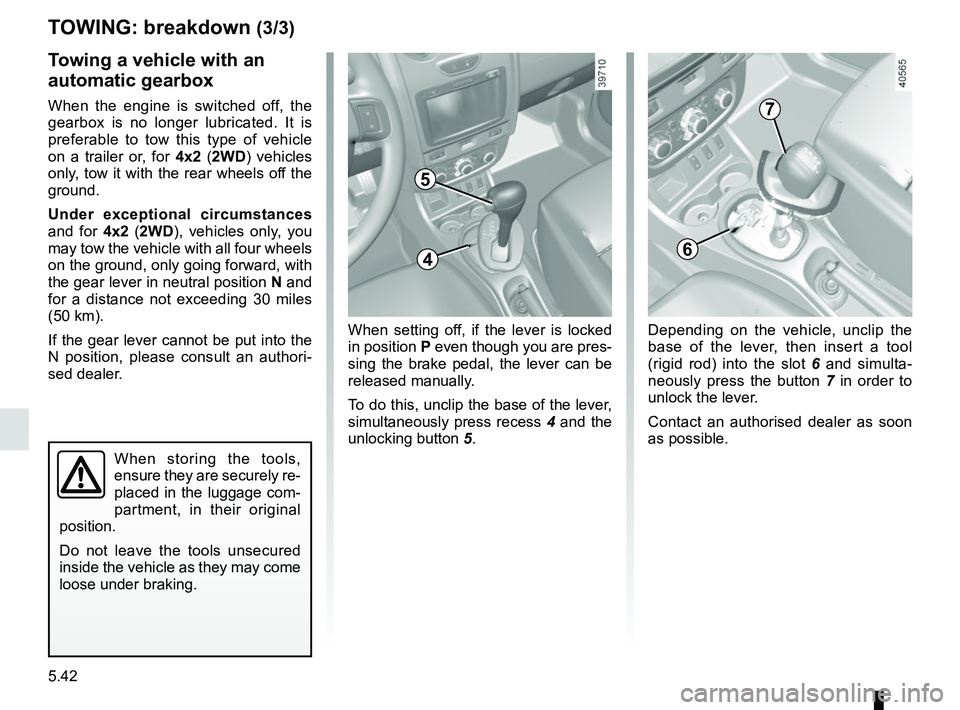
4
5
Towing a vehicle with an
automatic gearbox
When the engine is switched off, the
gearbox is no longer lubricated. It is
preferable to tow this type of vehicle
on a trailer or, for 4x2 (2WD) vehicles
only, tow it with the rear wheels off the
ground.
Under exceptional circumstances
and for 4x2 ( 2WD), vehicles only, you
may tow the vehicle with all four wheels
on the ground, only going forward, with
the gear lever in neutral position N and
for a distance not exceeding 30 miles
(50 km).
If the gear lever cannot be put into the
N position, please consult an authori-
sed dealer.
When setting off, if the lever is locked
in position P even though you are pres-
sing the brake pedal, the lever can be
released manually.
To do this, unclip the base of the lever,
simultaneously press recess 4 and the
unlocking button 5. Depending on the vehicle, unclip the
base of the lever, then insert a tool
(rigid rod) into the slot
6 and simulta-
neously press the button 7 in order to
unlock the lever.
Contact an authorised dealer as soon
as possible.
6
7
Page 249 of 256

A
ABS ....................................................................\
...2.34 → 2.37
accessories.............................................................\
....")
7.1
ALPHABETICAL INDEX (1/5)
A
ABS ....................................................................\
...2.34 → 2.37
accessories.............................................................\
........... 5.44
accessories socket ............................................................ 3.14
adjusting your driving position ...............................1.13 → 1.16
advice on antipollution ....................................................... 2.20
air bag.................................................................\
...1.17 → 1.21
deactivating the front passenger air bags .................... 1.33
air conditioning ..........................................................3.2 → 3.7
air vents ...................................................................... 3.2 – 3.3
anti-corrosion check ..............................................6.15 → 6.19
anti-corrosion protection .................................................... 4.16
anti-lock braking system: ABS ...............................2.34 → 2.37
antipollution advice .................................................................\
......... 2.20
armrest ................................................................\
.............. 3.19
ashtrays ...............................................................\
.............. 3.14
automatic gearbox (use) ...............................2.45 → 2.48, 5.42
automatic gearbox selector lever...........................2.45 → 2.48
B
battery.................................................................\
.... 4.14 – 4.15 troubleshooting ................................................. 5.36 – 5.37
battery (remote control) ..................................................... 5.38
bonnet..................................................................\
....... 4.2 – 4.3
brake fluid ........................................................................\
.... 4.8
bulbs changing ..........................................................5.16 \
→ 5.27
C
capacity of mechanical components........................... 4.4, 4.14
catalytic converter.....................................................\
......... 2.10
central door locking .................................................... 1.5 – 1.6
changing a bulb .....................................................5.16 → 5.27
changing a wheel.................................................... 5.10 – 5.11
changing fuel while driving ....................................2.12 → 2.14changing gear ...............................................2.29, 2.45
→ 2.48
child booster seat ..................................................1.22 → 1.24
child restraint/seat .................................................1.22 → 1.32
child safety.................. 1.2, 1.8 – 1.9, 1.22 → 1.32, 3.8 → 3.10
child seats.............................................................\
.1.22 → 1.32
children ....................................................... 1.5 – 1.6, 1.8 – 1.9
children (safety) .......................................................3.8 → 3.10
cigar lighter ........................................................................\
3.14
cleaning: inside the vehicle .............................................. 4.18 – 4.19
clock ..................................................................\
................ 1.57
closing the doors ........................................................ 1.8 – 1.9
control instruments ............................1.41 → 1.55, 1.59 – 1.60
controls ...............................................................\
...1.37 → 1.40
courtesy light .......................................................... 3.11 – 3.12
cruise control .........................................................2.41 → 2.44
cruise control-speed limiter....................................2.38 → 2.44
D
dashboard..............................................................1\
.37 → 1.40
dimensions .............................................................\
............. 6.5
dipstick................................................................\
................. 4.4
doors...................................................................\
.......1.5 → 1.9
driver’s position .....................................................1.37 → 1.40
driving .........2.2 → 2.6, 2.10 – 2.11, 2.15 → 2.19, 2.29 → 2.50
E
ECO driving ..................................... 1.41 → 1.47, 2.15 → 2.19
electric beam height adjustment ............................. 1.61 – 1.62
electric door locking .................................................... 1.5 – 1.6
electric windows ......................................................3.8 →
3.10
electronic stability control: ESC .............................2.34 → 2.37
emergency brake assist.........................................2.34 → 2.37
emergency braking ................................................2.34 → 2.37
emergency spare wheel ........................5.3 – 5.4, 5.12 → 5.15