window RENAULT DUSTER 2016 User Guide
[x] Cancel search | Manufacturer: RENAULT, Model Year: 2016, Model line: DUSTER, Model: RENAULT DUSTER 2016Pages: 256, PDF Size: 6.49 MB
Page 130 of 256
3.2
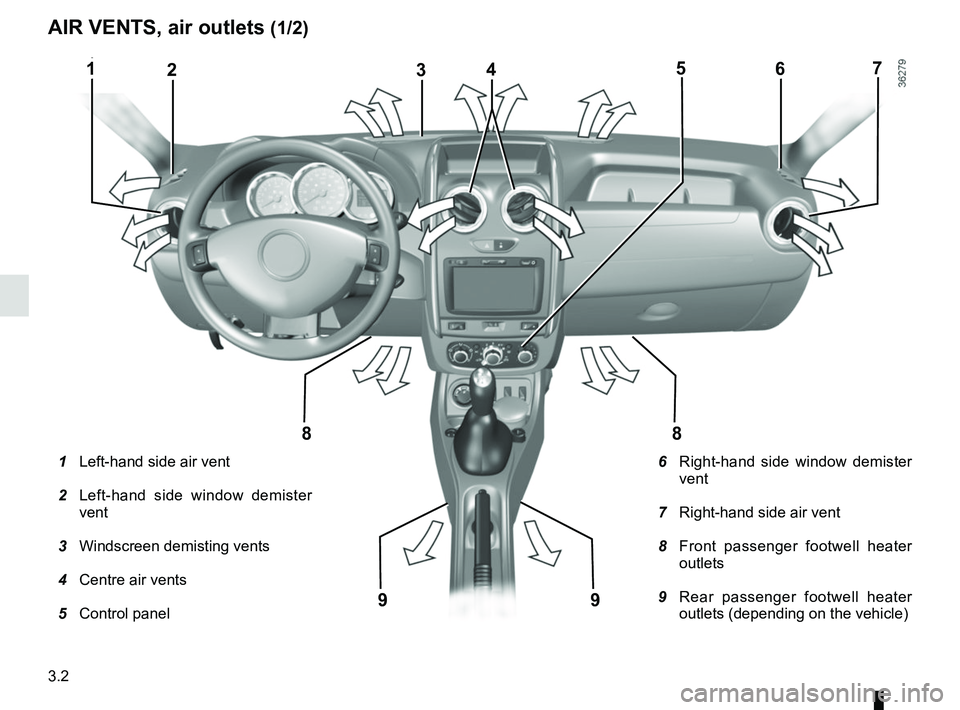
1 Left-hand side air vent
2 Left-hand side window demister
vent
3 Windscreen demisting vents
4 Centre air vents
5 Control panel
6 Right-hand side window demister
vent
7 Right-hand side air vent
8 Front passenger footwell heater
outlets
9 Rear passenger footwell heater
outlets (depending on the vehicle)
AIR VENTS, air outlets (1/2)
1234567
88
99
Page 133 of 256
3.5
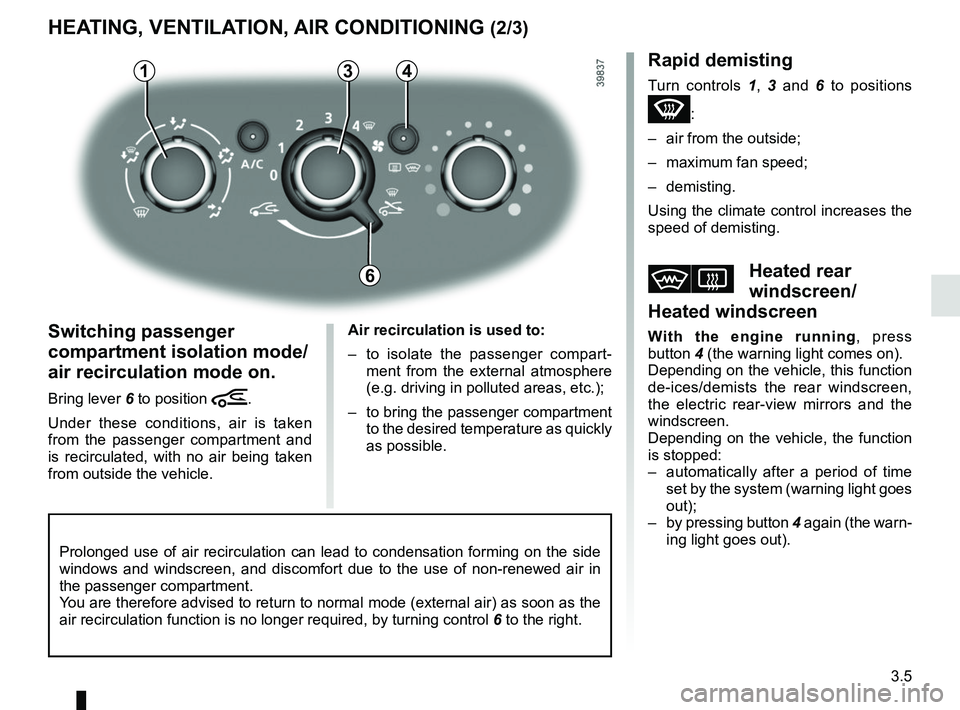
HEATING, VENTILATION, AIR CONDITIONING (2/3)
43
Switching passenger
compartment isolation mode/
air recirculation mode on.
Bring lever 6 to position â.
Under these conditions, air is taken
from the passenger compartment and
is recirculated, with no air being taken
from outside the vehicle. Air recirculation is used to:
– to isolate the passenger compart-
ment from the external atmosphere
(e.g. driving in polluted areas, etc.);
– to bring the passenger compartment to the desired temperature as quickly
as possible.
Rapid demisting
Turn controls 1, 3 and 6 to positions
W:
– air from the outside;
– maximum fan speed;
– demisting.
Using the climate control increases the
speed of demisting.
VHeated rear
windscreen/
Heated windscreen
With the engine running , press
button 4 (the warning light comes on).
Depending on the vehicle, this function
de-ices/demists the rear windscreen,
the electric rear-view mirrors and the
windscreen.
Depending on the vehicle, the function
is stopped:
– automatically after a period of time set by the system (warning light goes
out);
– by pressing button 4 again (the warn-
ing light goes out).
Prolonged use of air recirculation can lead to condensation forming on t\
he side
windows and windscreen, and discomfort due to the use of non-renewed air\
in
the passenger compartment.
You are therefore advised to return to normal mode (external air) as so\
on as the
air recirculation function is no longer required, by turning control 6 to the right.
1
6
Page 134 of 256
3.6
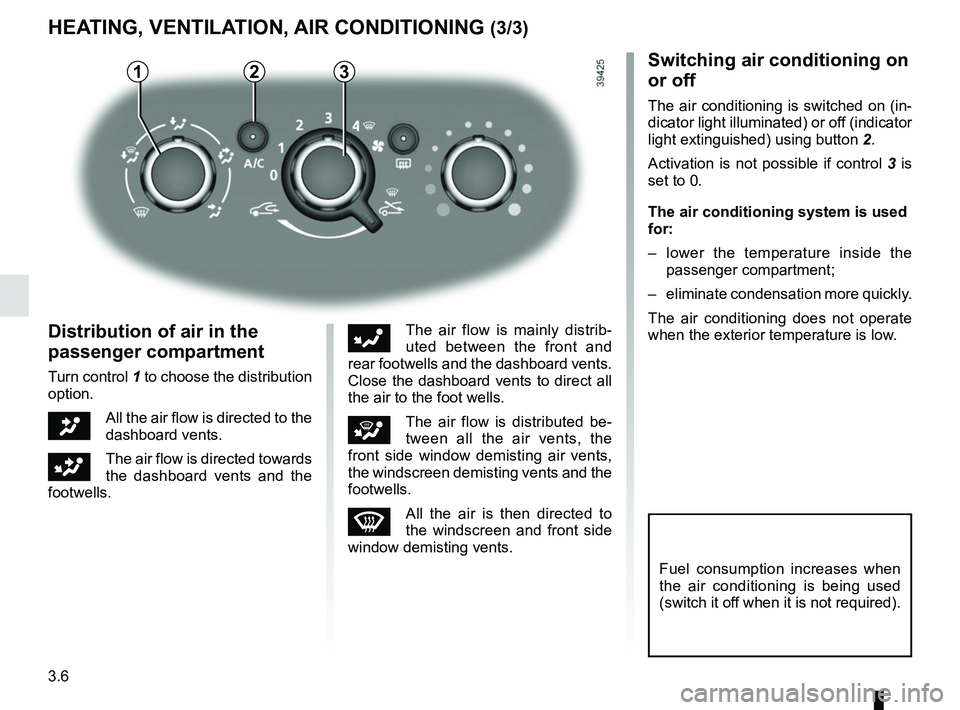
HEATING, VENTILATION, AIR CONDITIONING (3/3)
2
Distribution of air in the
passenger compartment
Turn control 1 to choose the distribution
option.
JAll the air flow is directed to the
dashboard vents.
GThe air flow is directed towards
the dashboard vents and the
footwells.
FThe air flow is mainly distrib-
uted between the front and
rear footwells and the dashboard vents.
Close the dashboard vents to direct all
the air to the foot wells.
iThe air flow is distributed be-
tween all the air vents, the
front side window demisting air vents,
the windscreen demisting vents and the
footwells.
WAll the air is then directed to
the windscreen and front side
window demisting vents.
Switching air conditioning on
or off
The air conditioning is switched on (in-
dicator light illuminated) or off (indicator
light extinguished) using button 2.
Activation is not possible if control 3 is
set to 0.
The air conditioning system is used
for:
– lower the temperature inside the passenger compartment;
– eliminate condensation more quickly.
The air conditioning does not operate
when the exterior temperature is low.
Fuel consumption increases when
the air conditioning is being used
(switch it off when it is not required).
13
Page 135 of 256
3.7
AIR CONDITIONING: information and advice on use
Fuel consumption
You will normally notice an increase
in fuel consumption (especially
when driving in town) when the air
conditioning is operating.
For vehicles fitted with air condition-
ing with no automatic mode, switch
off the system when it is not re-
quired.
Advice for reducing consumption
and helping to preserve the envi-
ronment
Drive with the air vents open and
the windows closed.
If the vehicle has been parked in
the sun, open the doors for a few
moments to let the hot air escape
before starting the engine. Operating faults
As a general rule, contact your ap-
proved dealer in the event of an op-
erating fault.
– Reduction in de-icing, demist-
ing or air conditioning per-
formance.
This may be caused by the pas-
senger compartment filter car-
tridge becoming clogged.
– No cold air is being produced .
Check that the controls are set
correctly and that the fuses are
sound. Otherwise, switch off the
system.
Do not open the refriger-
ant fluid circuit. The fluid
may damage eyes or skin.Presence of water under the ve-
hicle. After prolonged use of the air
conditioning system, it is normal for
water to be present under the vehi-
cle. This is caused by condensation.Maintenance
Refer to the Maintenance Document
for your vehicle for the inspection
frequency.
Page 136 of 256
3.8
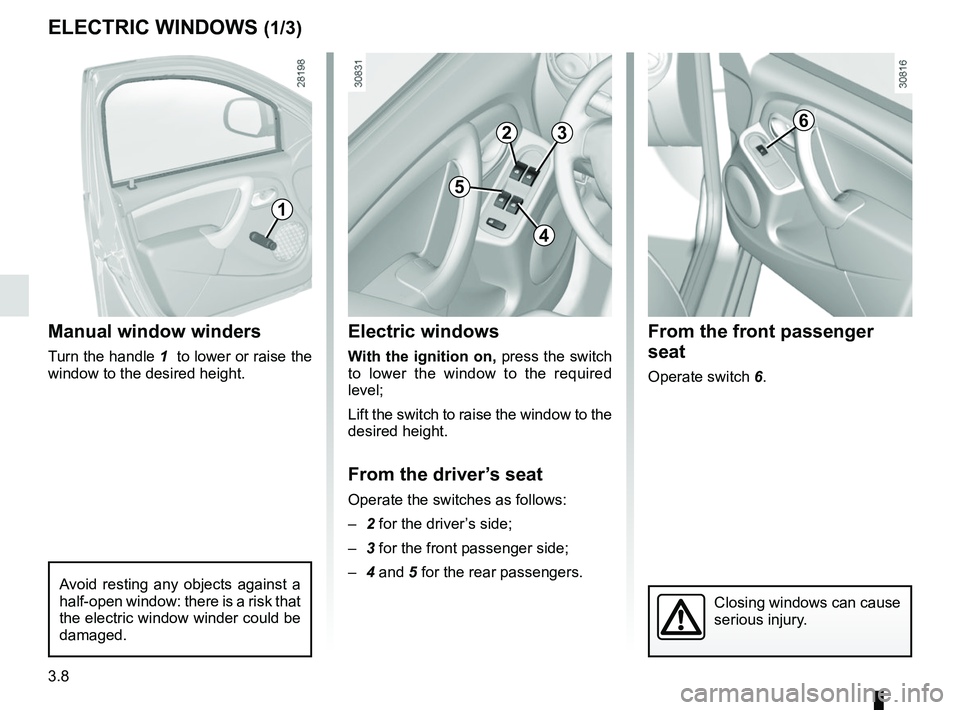
From the front passenger
seat
Operate switch 6.
ELECTRIC WINDOWS (1/3)
Manual window winders
Turn the handle 1 to lower or raise the
window to the desired height.
Electric windows
With the ignition on, press the switch
to lower the window to the required
level;
Lift the switch to raise the window to the
desired height.
From the driver’s seat
Operate the switches as follows:
– 2 for the driver’s side;
– 3 for the front passenger side;
– 4 and 5 for the rear passengers.
Avoid resting any objects against a
half-open window: there is a risk that
the electric window winder could be
damaged.
Closing windows can cause
serious injury.
1
23
5
4
6
Page 137 of 256
3.9
ELECTRIC WINDOWS (2/3)
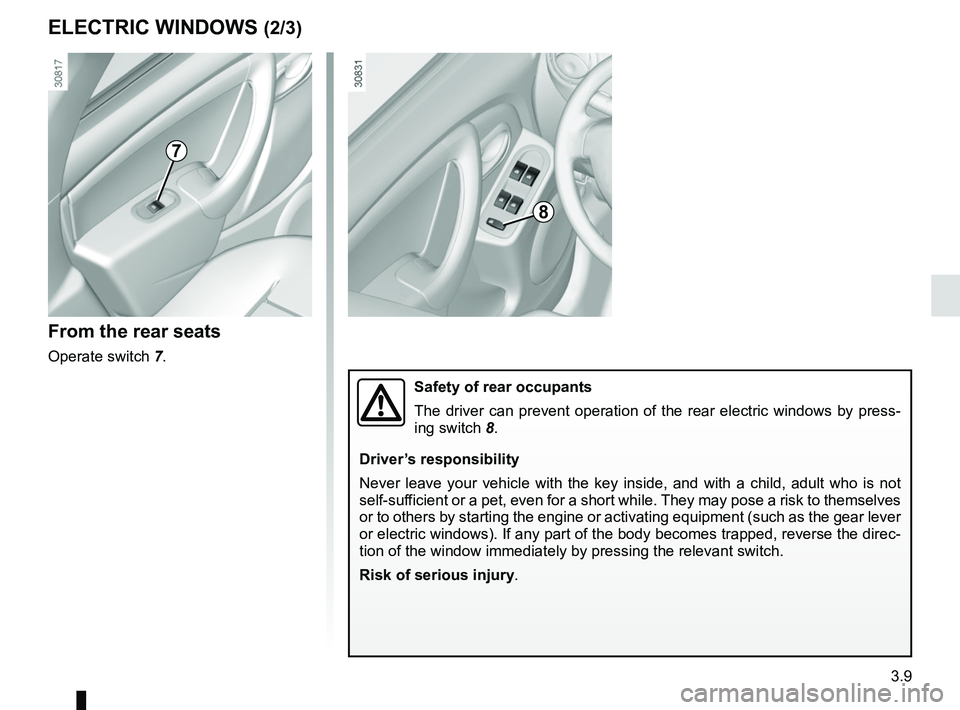
From the rear seats
Operate switch 7.
7
8
Safety of rear occupants
The driver can prevent operation of the rear electric windows by press-
ing switch 8.
Driver’s responsibility
Never leave your vehicle with the key inside, and with a child, adult wh\
o is not
self-sufficient or a pet, even for a short while. They may pose a risk to themselves
or to others by starting the engine or activating equipment (such as th\
e gear lever
or electric windows). If any part of the body becomes trapped, reverse \
the direc-
tion of the window immediately by pressing the relevant switch.
Risk of serious injury .
Page 138 of 256
3.10
ELECTRIC WINDOWS (3/3)
One-touch windows
When the vehicle is equipped with this
function, the one-touch mode works in
addition to the operation of the electric
windows described previously.
It is only fitted to the driver’s window.
– Fully and briefly press down on the
relevant switch down: the window
will open completely.
– Fully and briefly lift the relevant
switch: the window will close com-
pletely.
Pressing the switch again while the
window is moving will stop its move-
ment.
Special features
If the window detects resistance when
closing (e.g.: branch of a tree, etc.) it
stops and then lowers again by a few
centimetres.
If you use the switch while the window
is moving, it stops working.
Operating faults
In case of a fault when closing a window,
the system reverts to normal mode: pull
the switch concerned up to fully close
the window, then hold the switch (still
on the closure side) for three seconds
then lower and raise the window fully to
reinitialise the system.
If necessary, contact an approved
Dealer.
When closing the windows,
ensure that no part of the
body (arm, hand, etc.) is
protruding from the vehicle.
Risk of serious injury.
Avoid resting any objects against
a half-open window: there is a risk
that the electric window could be
damaged.
Page 141 of 256
3.13
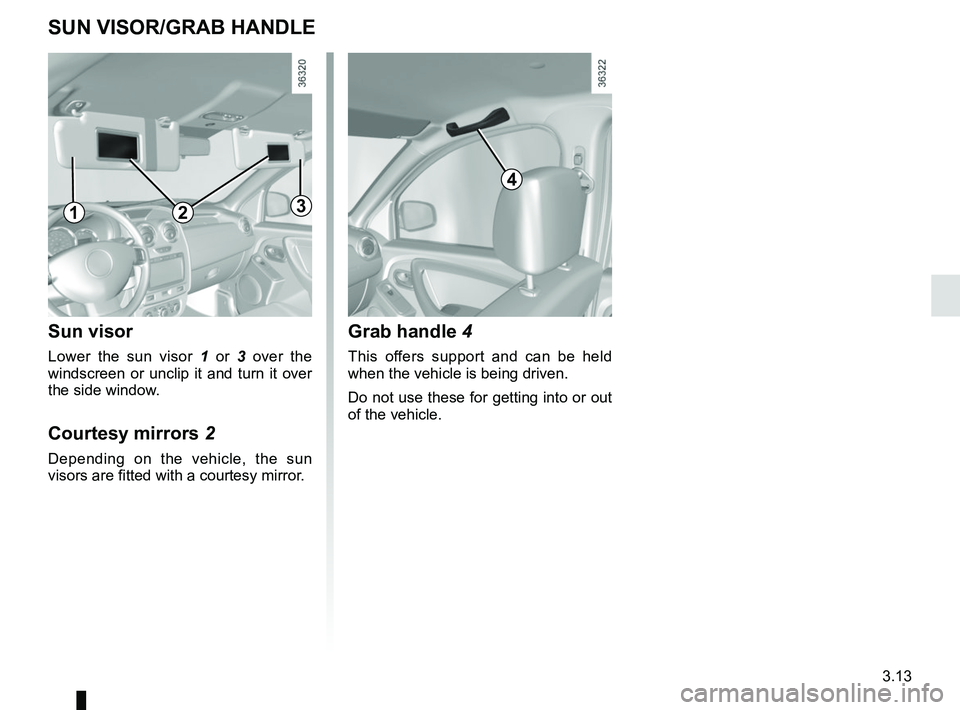
Grab handle 4
This offers support and can be held
when the vehicle is being driven.
Do not use these for getting into or out
of the vehicle.
SUN VISOR/GRAB HANDLE
4
132
Sun visor
Lower the sun visor 1 or 3 over the
windscreen or unclip it and turn it over
the side window.
Courtesy mirrors 2
Depending on the vehicle, the sun
visors are fitted with a courtesy mirror.
Page 209 of 256
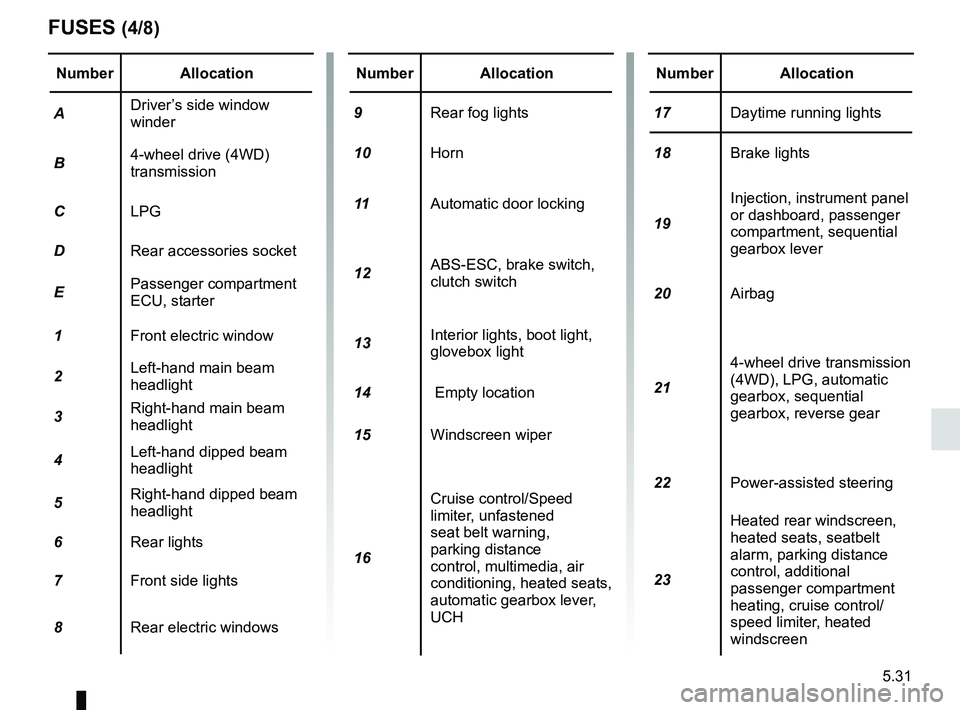
5.31
Number Allocation
A Driver’s side window
winder
B 4-wheel drive (4WD)
transmission
C LPG
D Rear accessories socket
E Passenger compartment
ECU, starter
1 Front electric window
2 Left-hand main beam
headlight
3 Right-hand main beam
headlight
4 Left-hand dipped beam
headlight
5 Right-hand dipped beam
headlight
6 Rear lights
7 Front side lights
8 Rear electric windowsNumber Allocation
9 Rear fog lights
10 Horn
11 Automatic door locking
12 ABS-ESC, brake switch,
clutch switch
13 Interior lights, boot light,
glovebox light
14 Empty location
15 Windscreen wiper
16 Cruise control/Speed
limiter, unfastened
seat belt warning,
parking distance
control, multimedia, air
conditioning, heated seats,
automatic gearbox lever,
UCHNumber Allocation
17 Daytime running lights
18 Brake lights
19 Injection, instrument panel
or dashboard, passenger
compartment, sequential
gearbox lever
20 Airbag
21 4-wheel drive transmission
(4WD), LPG, automatic
gearbox, sequential
gearbox, reverse gear
22 Power-assisted steering
23 Heated rear windscreen,
heated seats, seatbelt
alarm, parking distance
control, additional
passenger compartment
heating, cruise control/
speed limiter, heated
windscreen
FUSES (4/8)
Page 212 of 256
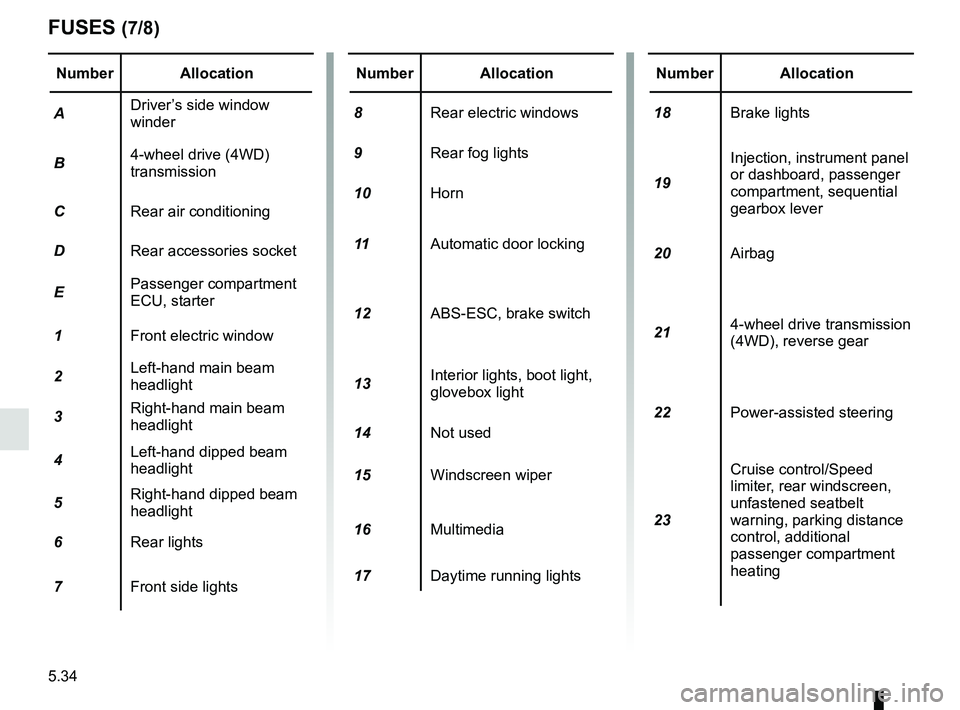
5.34
FUSES (7/8)
Number Allocation
A Driver’s side window
winder
B 4-wheel drive (4WD)
transmission
C Rear air conditioning
D Rear accessories socket
E Passenger compartment
ECU, starter
1 Front electric window
2 Left-hand main beam
headlight
3 Right-hand main beam
headlight
4 Left-hand dipped beam
headlight
5 Right-hand dipped beam
headlight
6 Rear lights
7 Front side lightsNumber Allocation
8 Rear electric windows
9 Rear fog lights
10 Horn
11 Automatic door locking
12 ABS-ESC, brake switch
13 Interior lights, boot light,
glovebox light
14 Not used
15 Windscreen wiper
16 Multimedia
17 Daytime running lightsNumber Allocation
18 Brake lights
19 Injection, instrument panel
or dashboard, passenger
compartment, sequential
gearbox lever
20 Airbag
21 4-wheel drive transmission
(4WD), reverse gear
22 Power-assisted steering
23 Cruise control/Speed
limiter, rear windscreen,
unfastened seatbelt
warning, parking distance
control, additional
passenger compartment
heating