belt RENAULT DUSTER 2016 Owner's Manual
[x] Cancel search | Manufacturer: RENAULT, Model Year: 2016, Model line: DUSTER, Model: RENAULT DUSTER 2016Pages: 256, PDF Size: 6.49 MB
Page 53 of 256
![RENAULT DUSTER 2016 Owners Manual 1.47
WARNING LIGHTS (7/7)
Warning lights on console B
]Front passenger air bag de-
activation warning light.
Refer to the information on “Child
safety: deactivating, activating the front
passenger](/img/7/58396/w960_58396-52.png "RENAULT DUSTER 2016 Owners Manual 1.47
WARNING LIGHTS (7/7)
Warning lights on console B
]Front passenger air bag de-
activation warning light.
Refer to the information on “Child
safety: deactivating, activating the front
passenger")
1.47
WARNING LIGHTS (7/7)
Warning lights on console B
]Front passenger air bag de-
activation warning light.
Refer to the information on “Child
safety: deactivating, activating the front
passenger airbag".
B
ßSeat belt reminder light
It comes on when the engine
is started if the driver and/or passenger
seat belt is not fastened (depending on
the vehicle). When the vehicle is being
driven, it comes on and a beep sounds
for approximately 2 minutes until the
driver’s seat belt is fastened.
The presence and operation of the warning lights DEPEND ON THE EQUIPMENT\
AND COUNTRY.
Page 80 of 256
2.4
vehicles with an automatic
gearbox
Before starting, move the lever to posi-
tion P.
Refer to the information on the
“Automatic gearbox” in Section 2.
Stopping the engine
With the engine idling, turn the key
back to “Stop” position St.
Special note
Depending on the vehicle, accessories
(e.g. radio) stop working either when
the engine is switched off or when the
driver’s door is opened or when the
doors are locked.Driver’s responsibility
Never leave an animal,
child or adult who is not
self-sufficient alone on your
vehicle, even for a short time.
They may pose a risk to themselves
or to others by starting the engine,
activating equipment such as the
electric windows or locking the
doors, for example.
Also, in hot and/or sunny weather,
please remember that the tempera-
ture inside the passenger compart-
ment increases very quickly.
Never switch off the ignition
before the vehicle has stopped
completely . Switching off the
engine disables the assistance
equipment: brakes, steering, etc.,
and additional seatbelt devices.
The steering is locked when the key
is removed.
RISK OF DEATH OR SERIOUS
INJURY.
STARTING, STOPPING THE ENGINE (2/4)
Do not park the vehicle or
run the engine in locations
where combustible sub-
stances or materials such
as grass or leaves can come into
contact with a hot exhaust system.
Page 94 of 256
2.18
DRIVING ADVICE, ECO-DRIVING (4/5)
Your vehicle has a greater
ground clearance than an
ordinary passenger vehicle.
This gives it a higher centre
of gravity, making it more suscep-
tible to rolling during sudden or ag-
gressive manoeuvres, or when cor-
nering at high speeds.
Take extra care when the vehicle is
loaded (in particular when the load
is on the roof).
Ensure that all passengers are wea-
ring their seat belts.
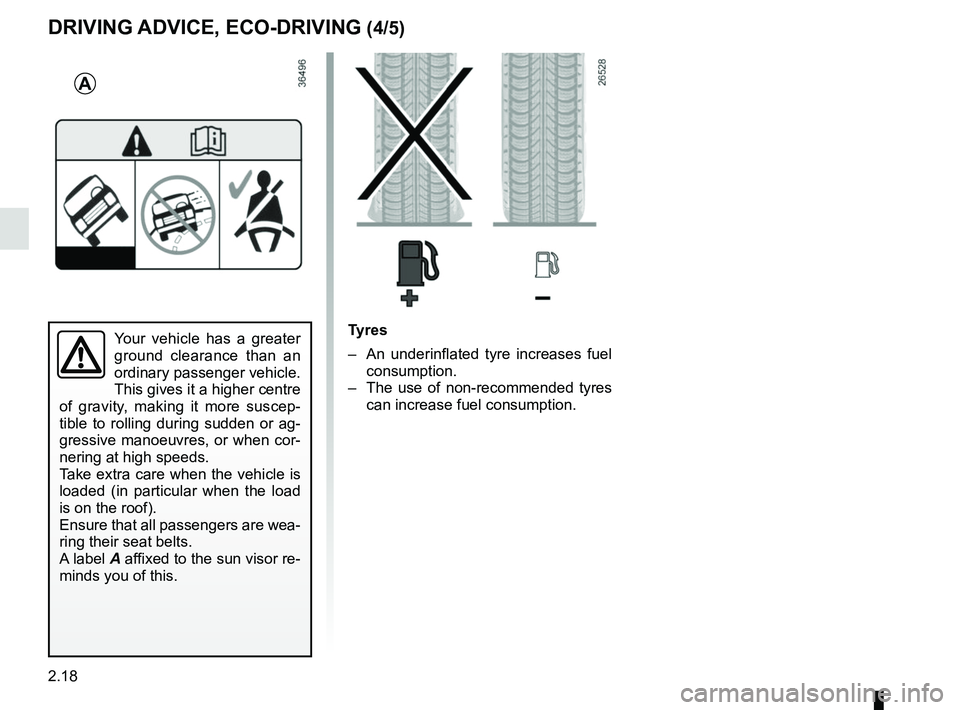
A label A affixed to the sun visor re-
minds you of this.
A
Tyres
– An underinflated tyre increases fuel consumption.
– The use of non-recommended tyres can increase fuel consumption.
Page 148 of 256
3.20
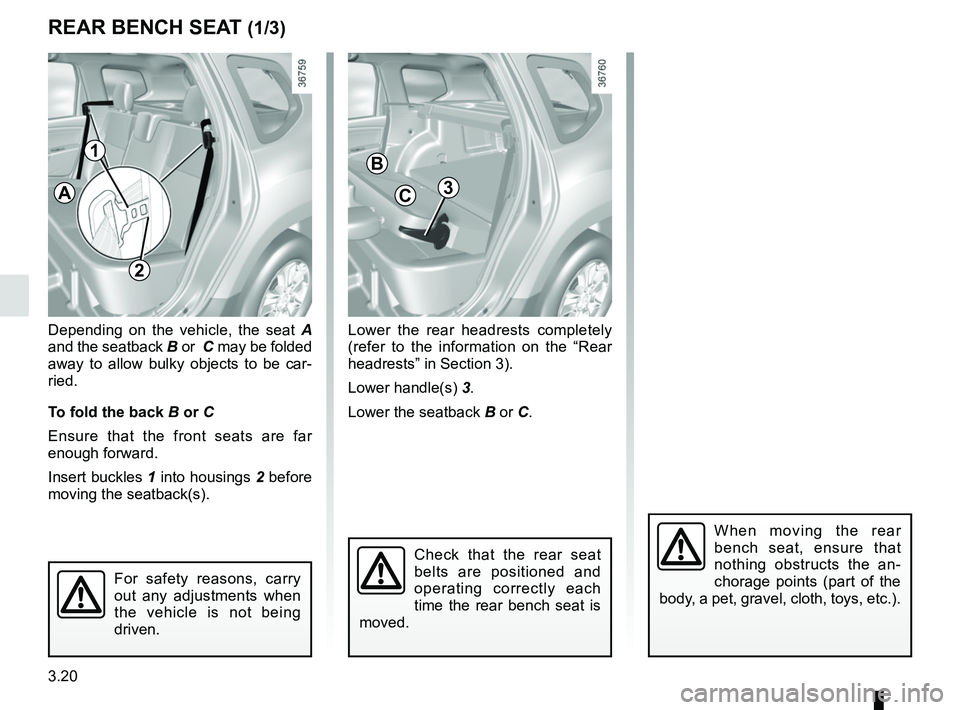
Lower the rear headrests completely
(refer to the information on the “Rear
headrests” in Section 3).
Lower handle(s) 3.
Lower the seatback B or C.Depending on the vehicle, the seat A
and the seatback B or C may be folded
away to allow bulky objects to be car-
ried.
To fold the back B or C
Ensure that the front seats are far
enough forward.
Insert buckles 1 into housings 2 before
moving the seatback(s).
For safety reasons, carry
out any adjustments when
the vehicle is not being
driven.
REAR BENCH SEAT (1/3)
When moving the rear
bench seat, ensure that
nothing obstructs the an-
chorage points (part of the
body, a pet, gravel, cloth, toys, etc.).
B
C3
1
2
A
Check that the rear seat
belts are positioned and
operating correctly each
time the rear bench seat is
moved.
Page 149 of 256
3.21
REAR BENCH SEAT (2/3)
When refitting the seat-
back, make sure it is cor-
rectly locked in place.
If seat covers are fitted,
make sure these do not prevent the
seatback latch from locking in.
Make sure that the seat belts are
positioned correctly.
Reposition the headrests.
Check that the rear seat
belts are positioned and
operating correctly each
time the rear bench seat is
moved.For safety reasons, carry
out any adjustments when
the vehicle is not being
driven.
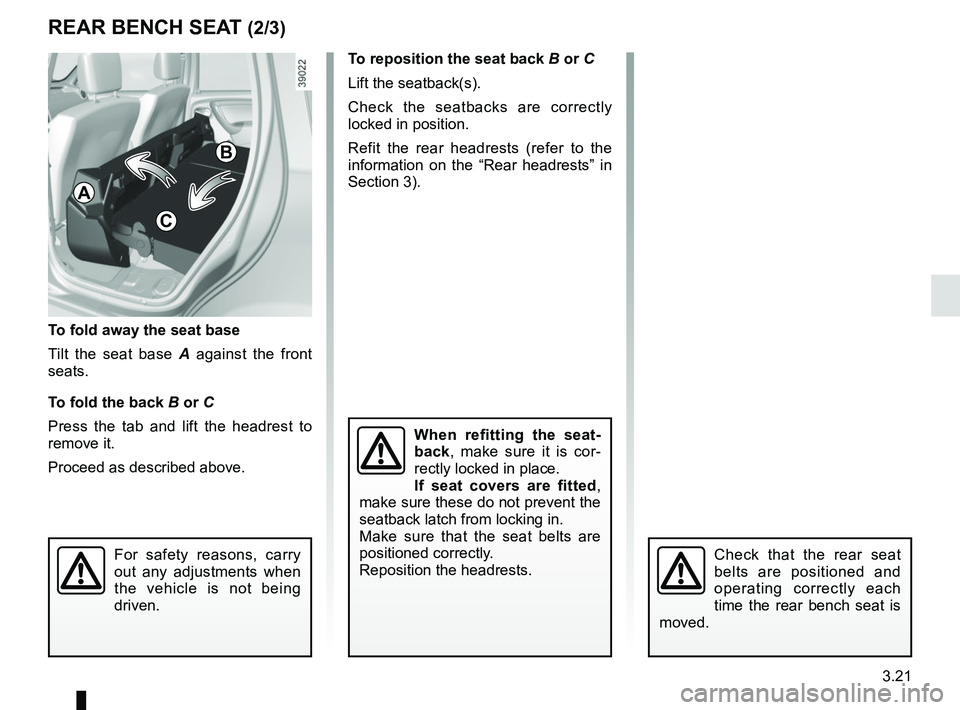
To reposition the seat back B or C
Lift the seatback(s).
Check the seatbacks are correctly
locked in position.
Refit the rear headrests (refer to the
information on the “Rear headrests” in
Section 3).
To fold away the seat base
Tilt the seat base A against the front
seats.
To fold the back B or C
Press the tab and lift the headrest to
remove it.
Proceed as described above.
A
B
C
Page 150 of 256
3.22
REAR BENCH SEAT (3/3)
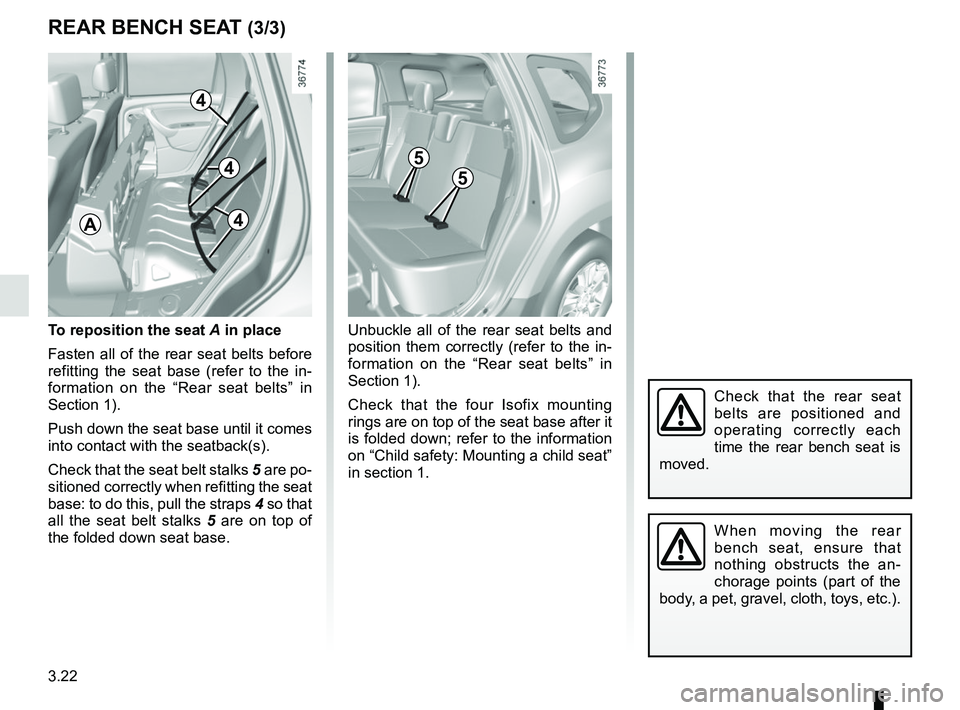
To reposition the seat A in place
Fasten all of the rear seat belts before
refitting the seat base (refer to the in-
formation on the “Rear seat belts” in
Section 1).
Push down the seat base until it comes
into contact with the seatback(s).
Check that the seat belt stalks 5 are po-
sitioned correctly when refitting the seat
base: to do this, pull the straps 4 so that
all the seat belt stalks 5 are on top of
the folded down seat base. Unbuckle all of the rear seat belts and
position them correctly (refer to the in-
formation on the “Rear seat belts” in
Section 1).
Check that the four Isofix mounting
rings are on top of the seat base after it
is folded down; refer to the information
on “Child safety: Mounting a child seat”
in section 1.
When moving the rear
bench seat, ensure that
nothing obstructs the an-
chorage points (part of the
body, a pet, gravel, cloth, toys, etc.).
Check that the rear seat
belts are positioned and
operating correctly each
time the rear bench seat is
moved.
5
5
4
4
4
A
Page 152 of 256
3.24
TRANSPORTING OBJECTS IN THE BOOT (1/2)
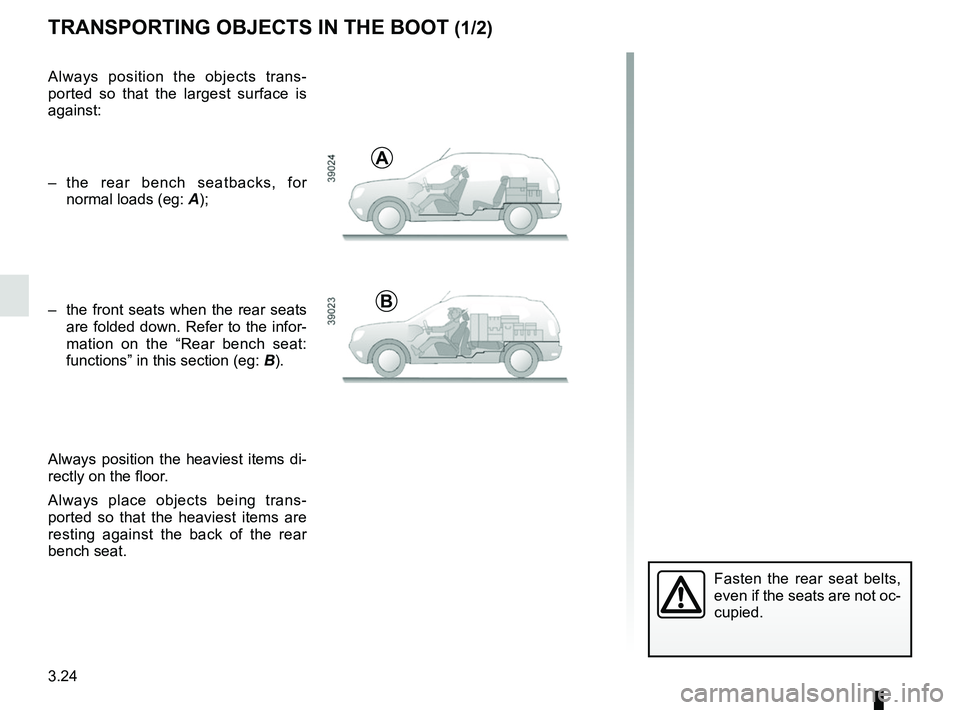
Always position the objects trans-
ported so that the largest surface is
against:
– the rear bench seatbacks, for normal loads (eg: A);
– the front seats when the rear seats
are folded down. Refer to the infor-
mation on the “Rear bench seat:
functions” in this section (eg: B).
Always position the heaviest items di-
rectly on the floor.
Always place objects being trans-
ported so that the heaviest items are
resting against the back of the rear
bench seat.
Fasten the rear seat belts,
even if the seats are not oc-
cupied.
A
B
Page 176 of 256
4.18
Glass instrument panel(e.g.: instrument panel, clock, exterior
temperature display, radio display, mul-
timedia or multifunction display etc.)
Use a soft cloth (or cotton wool).
If this does not clean them properly,
use a soft cloth (or cotton wool) slightly
moistened with soapy water and then
wipe clean with another soft damp cloth
or cotton wool.
Finally, carefully dry off with a soft dry
cloth.
Do not use products containing alco-
hol and/or spray fluids on the area.
Seat belts
These must be kept clean.
Use products selected by our Technical
Department (Approved outlets) or
warm, soapy water and a sponge and
wipe with a dry cloth.
Detergents or dyes must not be used
under any circumstances.
INTERIOR TRIM MAINTENANCE (1/2)
Textiles (seats, door trim, etc)
Vacuum-clean the textiles regularly.
Liquid stain
Use soapy water.
Dab lightly (never rub) with a soft cloth,
rinse and remove the excess.
Solid or pasty stain
Carefully remove the excess solid or
pasty material immediately with a
spatula (working from the edges to the
centre to avoid spreading the stain).
Clean as for a liquid stain.
Special instructions for sweets or
chewing gum
Put an ice cube on the stain to solidify
it, then proceed as for a solid stain.
A well-maintained vehicle will last
longer. It is therefore recommended to
maintain the interior of the vehicle regu-
larly.
A stain should always be dealt with
swiftly.
Whatever type of stain is on the trim,
use
cold (or warm) soapy water with
natural soap.
Detergents (washing-up liquid, pow-
dered products, alcohol-based prod-
ucts) should not be used.
Use a soft cloth.
Rinse and soak up the excess.
For further recommendations for
maintaining the interior, and/or for
any unsatisfactory results, please
see an authorised dealer.
Page 209 of 256
5.31
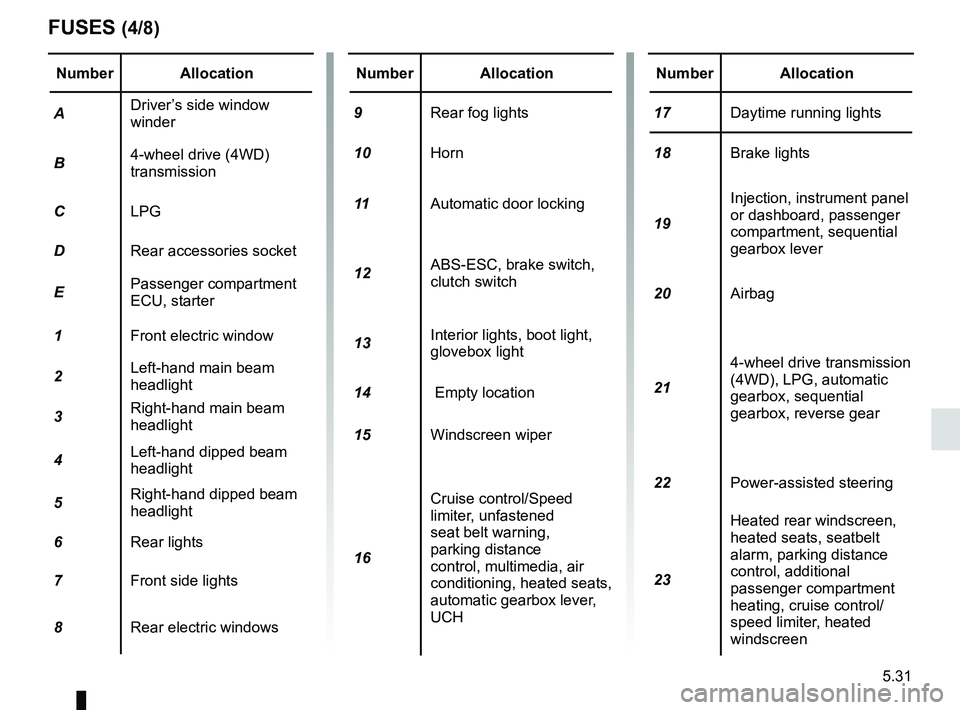
Number Allocation
A Driver’s side window
winder
B 4-wheel drive (4WD)
transmission
C LPG
D Rear accessories socket
E Passenger compartment
ECU, starter
1 Front electric window
2 Left-hand main beam
headlight
3 Right-hand main beam
headlight
4 Left-hand dipped beam
headlight
5 Right-hand dipped beam
headlight
6 Rear lights
7 Front side lights
8 Rear electric windowsNumber Allocation
9 Rear fog lights
10 Horn
11 Automatic door locking
12 ABS-ESC, brake switch,
clutch switch
13 Interior lights, boot light,
glovebox light
14 Empty location
15 Windscreen wiper
16 Cruise control/Speed
limiter, unfastened
seat belt warning,
parking distance
control, multimedia, air
conditioning, heated seats,
automatic gearbox lever,
UCHNumber Allocation
17 Daytime running lights
18 Brake lights
19 Injection, instrument panel
or dashboard, passenger
compartment, sequential
gearbox lever
20 Airbag
21 4-wheel drive transmission
(4WD), LPG, automatic
gearbox, sequential
gearbox, reverse gear
22 Power-assisted steering
23 Heated rear windscreen,
heated seats, seatbelt
alarm, parking distance
control, additional
passenger compartment
heating, cruise control/
speed limiter, heated
windscreen
FUSES (4/8)
Page 212 of 256
5.34
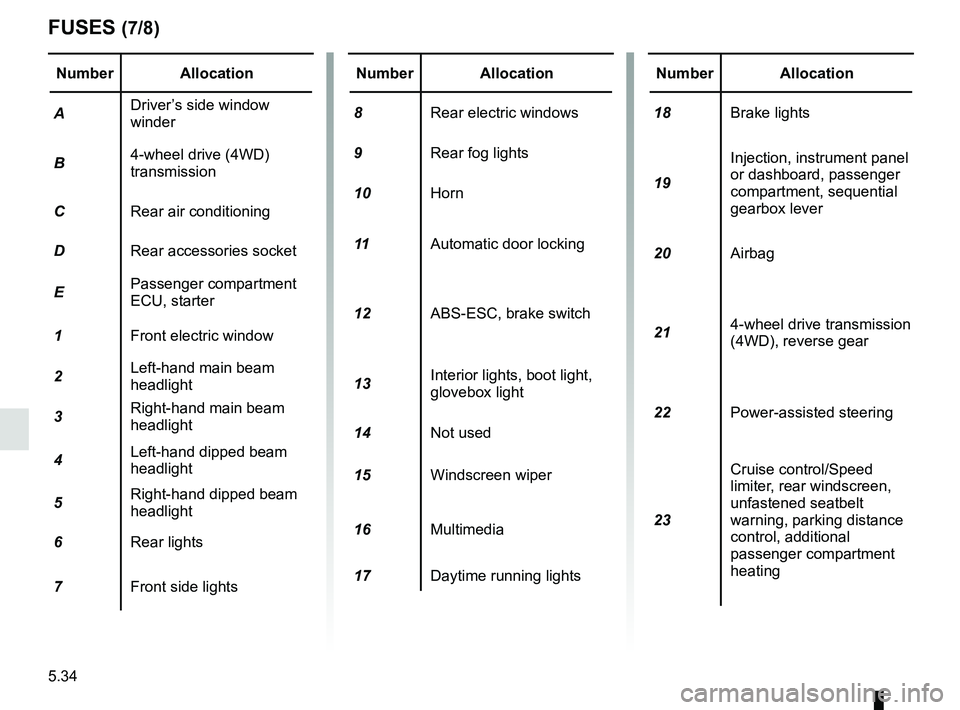
FUSES (7/8)
Number Allocation
A Driver’s side window
winder
B 4-wheel drive (4WD)
transmission
C Rear air conditioning
D Rear accessories socket
E Passenger compartment
ECU, starter
1 Front electric window
2 Left-hand main beam
headlight
3 Right-hand main beam
headlight
4 Left-hand dipped beam
headlight
5 Right-hand dipped beam
headlight
6 Rear lights
7 Front side lightsNumber Allocation
8 Rear electric windows
9 Rear fog lights
10 Horn
11 Automatic door locking
12 ABS-ESC, brake switch
13 Interior lights, boot light,
glovebox light
14 Not used
15 Windscreen wiper
16 Multimedia
17 Daytime running lightsNumber Allocation
18 Brake lights
19 Injection, instrument panel
or dashboard, passenger
compartment, sequential
gearbox lever
20 Airbag
21 4-wheel drive transmission
(4WD), reverse gear
22 Power-assisted steering
23 Cruise control/Speed
limiter, rear windscreen,
unfastened seatbelt
warning, parking distance
control, additional
passenger compartment
heating