engine RENAULT DUSTER 2016 Owner's Manual
[x] Cancel search | Manufacturer: RENAULT, Model Year: 2016, Model line: DUSTER, Model: RENAULT DUSTER 2016Pages: 256, PDF Size: 6.49 MB
Page 73 of 256
1.67
FUEL TANK (3/6)
Filling with fuel
Insert the nozzle to open the valve and
insert it fully before turning it on to fill
the fuel tank (risk of splashing).
Keep the nozzle in this position
throughout the entire filling operation.
When the pump cuts out automatically
at the end of the filling procedure, a
maximum of two further filling attempts
may be made, as there must be suffi-
cient space in the fuel tank to allow for
expansion.
Make sure that no water enters the fuel
tank during filling. The valve and its sur-
round must remain clean.
Persistent fuel odour
If you notice a persistent
smell of fuel you should:
– stop the vehicle when traffic conditions allow it and switch off
the ignition;
– switch on the hazard warning lights and ask your passengers to
leave the vehicle and stay clear
of the traffic;
– contact an authorised dealer.
Petrol versions
Using leaded petrol will damage the
antipollution system and may lead to a
loss of warranty.
To ensure that the fuel tank is not filled
with leaded petrol, the fuel tank filler
neck contains a restrictor fitted with a
foolproof system which only allows
the nozzle for unleaded petrol to be
used (at the pump).
Vehicle fitted with the Stop and
Start function
To fill up with fuel, the engine must
be stopped (and not on standby):
stop the engine (please refer to the
information on “Starting and stop-
ping the engine” in Section 2).
Page 74 of 256
1.68
LPG versions
Useful capacity of fuel tank: approx.
34 litres.
Filling up with LPG
Engage the handbrake, stop the engine,
switch off the ignition and switch off the
lights.
Always respect the safety instructions
given at filling stations.
It is always advisable to completely fill
the tank.
When the pump stops delivering LPG,
or when the pump flow reduces sig-
nificantly, the maximum LPG level has
been reached.
At this point, do not attempt to carry on
filling.
If you exceed the LPG tank capacity when filling completely, please go
to an accredited garage or your authorised dealer to check the automatic\
filler device.
FUEL TANK (4/6)
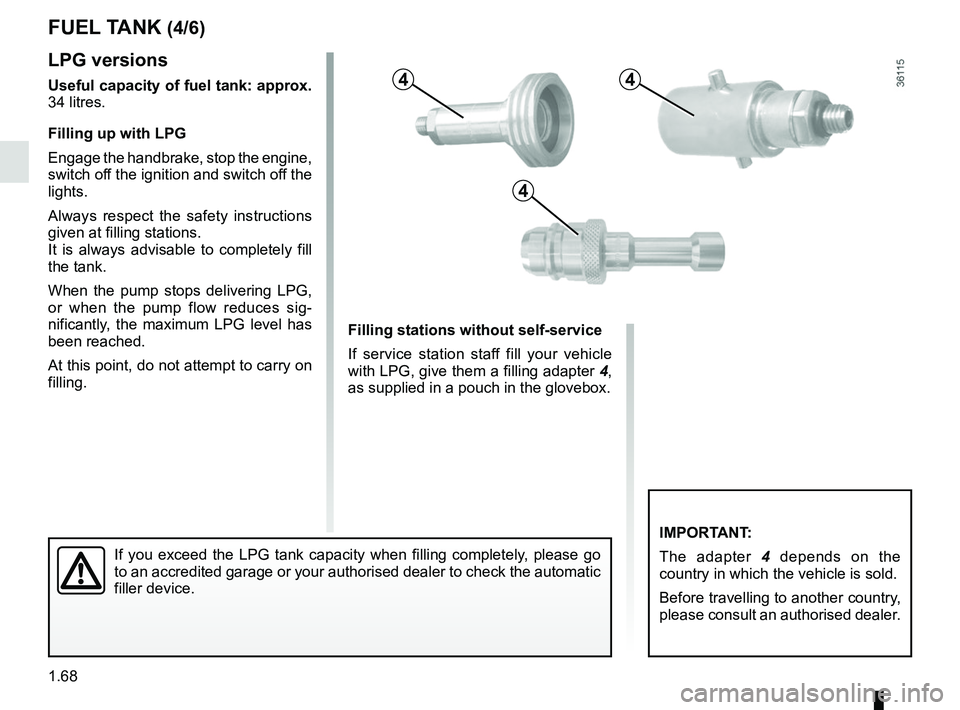
Filling stations without self-service
If service station staff fill your vehicle
with LPG, give them a filling adapter 4,
as supplied in a pouch in the glovebox.
IMPORTANT:
The adapter 4 depends on the
country in which the vehicle is sold.
Before travelling to another country,
please consult an authorised dealer.
44
4
Page 76 of 256
1.70
No modifications what-
soever are permitted on
any part of the fuel supply
system (computers, wiring,
fuel circuit, injector, protection
covers, etc.) as this may be danger-
ous (such work must be undertaken
by qualified Network personnel).
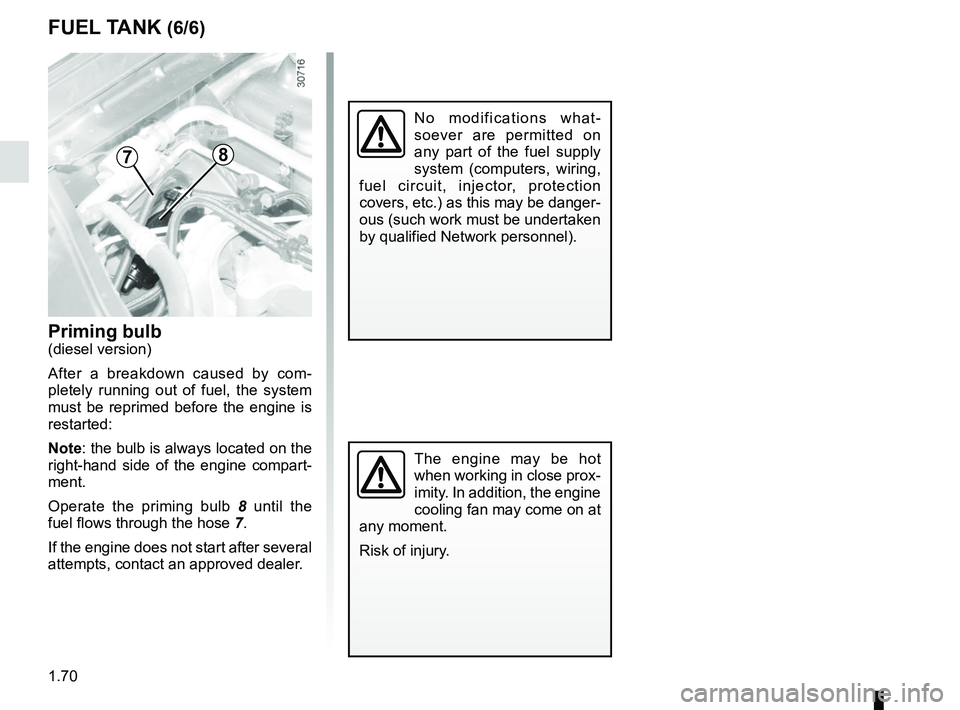
Priming bulb (diesel version)
After a breakdown caused by com-
pletely running out of fuel, the system
must be reprimed before the engine is
restarted:
Note: the bulb is always located on the
right-hand side of the engine compart-
ment.
Operate the priming bulb 8 until the
fuel flows through the hose 7.
If the engine does not start after several
attempts, contact an approved dealer.
The engine may be hot
when working in close prox-
imity. In addition, the engine
cooling fan may come on at
any moment.
Risk of injury.
FUEL TANK (6/6)
78
Page 77 of 256

Running in, Ignition switch . . . . . . . . . . . . . . . . . . . . . . . . . . . . . . . . . . . . \
. . . . . . .")
2.1
Section 2: Driving
(Advice on use relating to fuel economy and the environment)
Running in, Ignition switch . . . . . . . . . . . . . . . . . . . . . . . . . . . . . . . . . . . . \
. . . . . . . . . . . . . . . . . . . . . 2.2
Starting/stopping the engine . . . . . . . . . . . . . . . . . . . . . . . . . . . . . . . . . . . .\
. . . . . . . . . . . . . . . . . . . 2.3
Stop and Start Function . . . . . . . . . . . . . . . . . . . . . . . . . . . . . . . . . . . . \
. . . . . . . . . . . . . . . . . . . . . . . 2.7
Special features of petrol versions . . . . . . . . . . . . . . . . . . . . . . . . . . . . . . . . . . . .\
. . . . . . . . . . . . . . 2.10
Special features of diesel versions . . . . . . . . . . . . . . . . . . . . . . . . . . . . . . . . . . . .\
. . . . . . . . . . . . . . 2.11
Special features of LPG versions . . . . . . . . . . . . . . . . . . . . . . . . . . . . . . . . . . . .\
. . . . . . . . . . . . . . . 2.12
Driving advice, eco-driving . . . . . . . . . . . . . . . . . . . . . . . . . . . . . . . . . . . .\
. . . . . . . . . . . . . . . . . . . . 2.15
Maintenance and antipollution advice . . . . . . . . . . . . . . . . . . . . . . . . . . . . . . . . . . . . \
. . . . . . . . . . . . 2.20
Environment . . . . . . . . . . . . . . . . . . . . . . . . . . . . . . . . . . . .\
. . . . . . . . . . . . . . . . . . . . . . . . . . . . . . . 2.21
Tyre pressure loss warning . . . . . . . . . . . . . . . . . . . . . . . \
. . . . . . . . . . . . . . . . . . . . . . . . . . . . . . . . . 2.22
Gear lever, Handbrake . . . . . . . . . . . . . . . . . . . . . . . . . . . . . . . . . . . .\
. . . . . . . . . . . . . . . . . . . . . . . 2.29
Transmission: 4-wheel drive (4WD) . . . . . . . . . . . . . . . . . . . . . . . . . . . . . . . . . . . .\
. . . . . . . . . . . . . 2.30
Driver correction devices/aids . . . . . . . . . . . . . . . . . . . . . . . . . . . . . . . . . . . . \
. . . . . . . . . . . . . . . . . . 2.34
Speed limiter . . . . . . . . . . . . . . . . . . . . . . . . . . . . . \
. . . . . . . . . . . . . . . . . . . . . . . . . . . . . . . . . . . . . . 2.38
Cruise control . . . . . . . . . . . . . . . . . . . . . . . . . . . . . . . . . . . .\
. . . . . . . . . . . . . . . . . . . . . . . . . . . . . . 2.41
Automatic gearbox. . . . . . . . . . . . . . . . . . . . . . . . . . . .\
. . . . . . . . . . . . . . . . . . . . . . . . . . . . . . . . . . . 2.45
Parking distance control . . . . . . . . . . . . . . . . . . . . . . . . . . . . . . . . . . . .\
. . . . . . . . . . . . . . . . . . . . . . 2.49
Reversing camera . . . . . . . . . . . . . . . . . . . . . . . . . . . . . . . . . . . . \
. . . . . . . . . . . . . . . . . . . . . . . . . . . 2.51
Page 78 of 256
2.2
Petrol version
For the first 600 miles (1,000 km), do
not exceed 78 mph (130 km/h) in the
highest gear, or 3,000 to 3,500 rpm.
You may only expect top performance
from your vehicle after approximately
1,800 miles (3,000 km).
Service intervals: refer to the
Maintenance Document for the vehicle.
Diesel version
For the first 1,000 miles (1,500 km),
do not exceed 80 mph (130 km/h) in
the highest gear, or 2,500 rpm. After
completing this mileage you may drive
faster, although you may only expect
top performance after approximately
3,600 miles (6,000 km).
During the running in period, do not ac-
celerate hard while the engine is still
cold and do not let the engine over-rev.
Service intervals: refer to the
Maintenance Document for your vehi-
cle.
RUNNING IN, IGNITION SWITCH
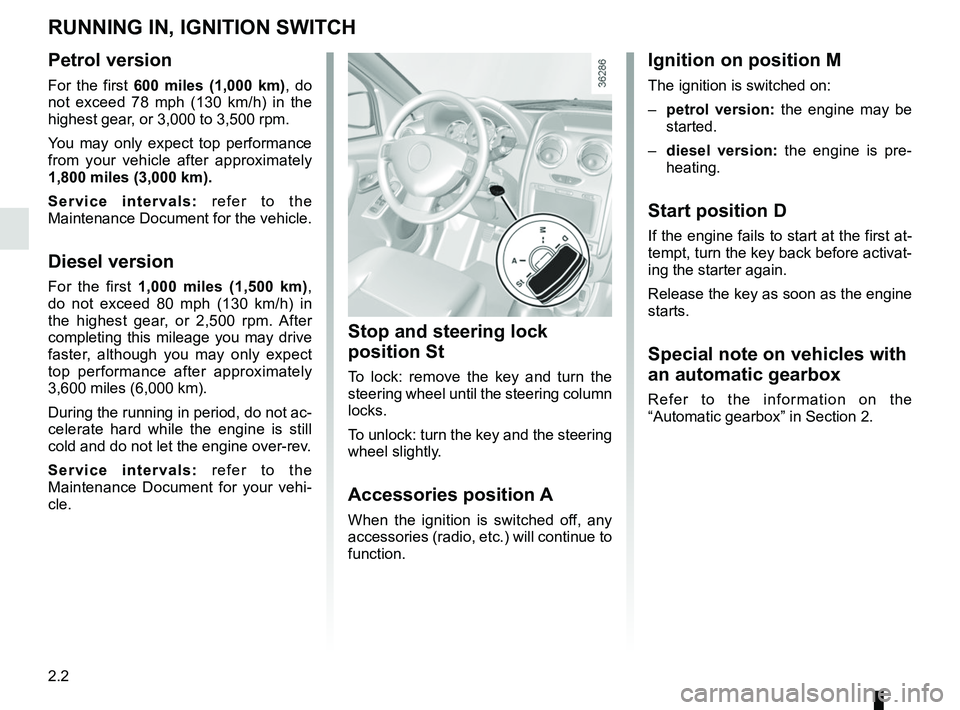
Stop and steering lock
position St
To lock: remove the key and turn the
steering wheel until the steering column
locks.
To unlock: turn the key and the steering
wheel slightly.
Accessories position A
When the ignition is switched off, any
accessories (radio, etc.) will continue to
function.
Ignition on position M
The ignition is switched on:
– petrol version: the engine may be
started.
– diesel version: the engine is pre-
heating.
Start position D
If the engine fails to start at the first at-
tempt, turn the key back before activat-
ing the starter again.
Release the key as soon as the engine
starts.
Special note on vehicles with
an automatic gearbox
Refer to the information on the
“Automatic gearbox” in Section 2.
Page 79 of 256
2.3
LPG versions
The engine is always started using
petrol:
– activate the starter without accelerat-ing;
– release the key as soon as the engine starts.
The system will automatically deter-
mine the switchover from petrol to LPG.
When operating on LPG, the fuel gauge
may indicate a drop in the petrol level
and the on-board computer will not op-
erate.
Under certain winter conditions the
system may delay or disable operation
with LPG.
After stopping the engine, if the envi-
ronmental conditions are once again
suitable, the system may once again
permit LPG mode.
Starting the engineIn very cold conditions (temperatures
below –20°C): so that it is easier to
start the engine, switch on the ignition
for several seconds before starting the
engine.
When starting the engine, if the outdoor
temperature is very low (below -10°C):
hold down the clutch pedal until the
engine starts.
Make sure the engine immobiliser is not
activated. Refer to the information on
the “Engine immobiliser” in Section 1.
Petrol injection
– Turn the key to the start position without depressing the accelera-
tor.
– Release the key as soon as the engine starts.
ÉDiesel injection
Turn the ignition key to ignition “On” po-
sition M, and hold this position until the
preheating warning light goes out.
Turn the key to starter position D with-
out depressing the accelerator
pedal.
Release the key as soon as the engine
starts.
STARTING, STOPPING THE ENGINE (1/4)
At temperatures close to 0°C or less, it
is recommended to use ECO mode to
maximise the use of LPG. Please refer
to the information on “Driving advice,
Eco-driving” in Section 2.
To enable the system to operate
smoothly and to prevent any wear to
the vehicle’s electric petrol pump, the
petrol tank should always be around
1/4 full.
Page 80 of 256
2.4
vehicles with an automatic
gearbox
Before starting, move the lever to posi-
tion P.
Refer to the information on the
“Automatic gearbox” in Section 2.
Stopping the engine
With the engine idling, turn the key
back to “Stop” position St.
Special note
Depending on the vehicle, accessories
(e.g. radio) stop working either when
the engine is switched off or when the
driver’s door is opened or when the
doors are locked.Driver’s responsibility
Never leave an animal,
child or adult who is not
self-sufficient alone on your
vehicle, even for a short time.
They may pose a risk to themselves
or to others by starting the engine,
activating equipment such as the
electric windows or locking the
doors, for example.
Also, in hot and/or sunny weather,
please remember that the tempera-
ture inside the passenger compart-
ment increases very quickly.
Never switch off the ignition
before the vehicle has stopped
completely . Switching off the
engine disables the assistance
equipment: brakes, steering, etc.,
and additional seatbelt devices.
The steering is locked when the key
is removed.
RISK OF DEATH OR SERIOUS
INJURY.
STARTING, STOPPING THE ENGINE (2/4)
Do not park the vehicle or
run the engine in locations
where combustible sub-
stances or materials such
as grass or leaves can come into
contact with a hot exhaust system.
Page 81 of 256
2.5
STARTING, STOPPING THE ENGINE (3/4)
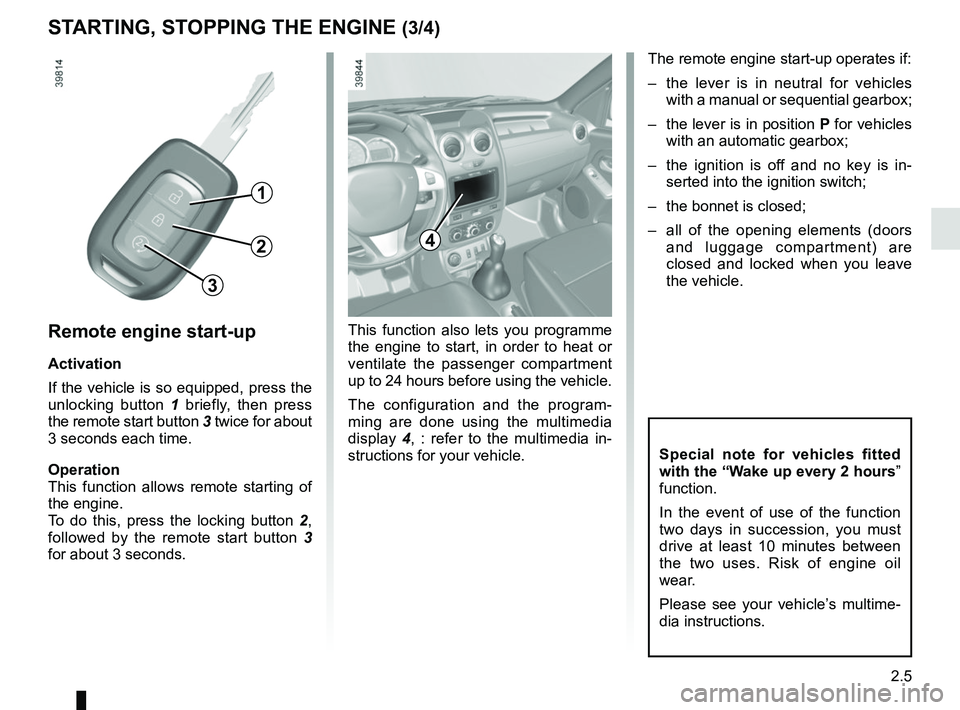
Remote engine start-up
Activation
If the vehicle is so equipped, press the
unlocking button 1 briefly, then press
the remote start button 3 twice for about
3 seconds each time.
Operation
This function allows remote starting of
the engine.
To do this, press the locking button 2,
followed by the remote start button 3
for about 3 seconds.
2
3
The remote engine start-up operates if:
– the lever is in neutral for vehicles with a manual or sequential gearbox;
– the lever is in position P for vehicles
with an automatic gearbox;
– the ignition is off and no key is in- serted into the ignition switch;
– the bonnet is closed;
– all of the opening elements (doors and luggage compartment) are
closed and locked when you leave
the vehicle.
This function also lets you programme
the engine to start, in order to heat or
ventilate the passenger compartment
up to 24 hours before using the vehicle.
The configuration and the program-
ming are done using the multimedia
display 4, : refer to the multimedia in-
structions for your vehicle.
1
4
Special note for vehicles fitted
with the “Wake up every 2 hours ”
function.
In the event of use of the function
two days in succession, you must
drive at least 10 minutes between
the two uses. Risk of engine oil
wear.
Please see your vehicle’s multime-
dia instructions.
Page 82 of 256
2.6
STARTING, STOPPING THE ENGINE (4/4)
Do not use the engine remote start-up function or its programming when:
– the vehicle is in a garage or in a confined space.
Risk of poisoning or suffocation by exhaust gas emissions.
– the vehicle is covered with a protective cover. Fire hazard.
– the bonnet is open or before it opens. Risk of burns or serious injury .
Depending on the country, the use of the remote starting function or its programming can be proh\
ibited by the legis-
lation and/or the regulations in force.
Before using this function, check the legislation and/or the regulations\
for the country in force .
Page 83 of 256
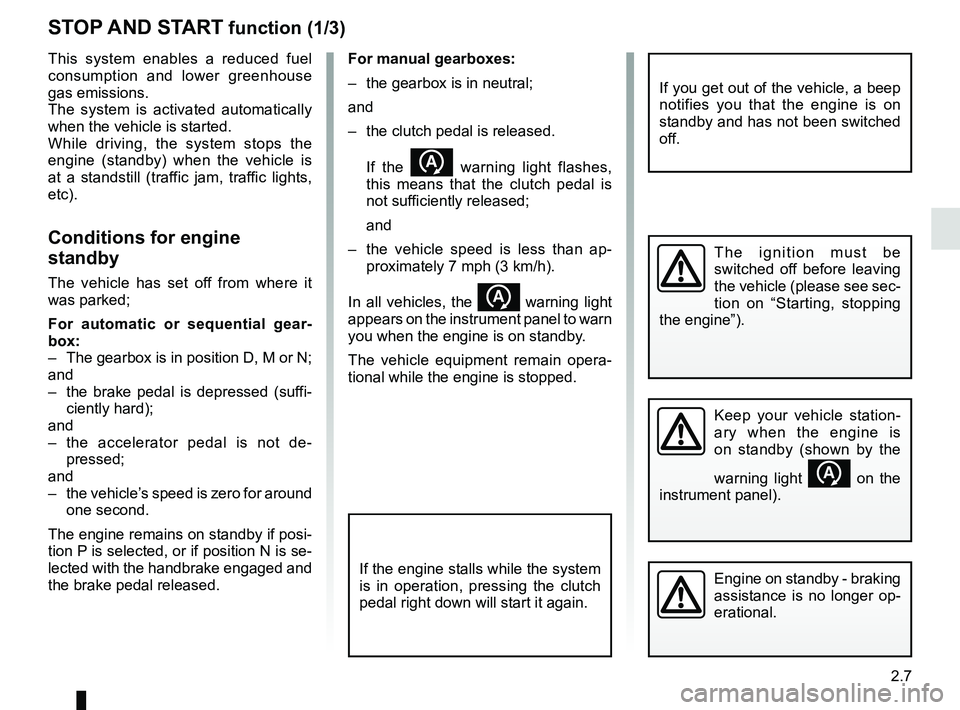
2.7
For manual gearboxes:
– the gearbox is in neutral;
and
– the clutch pedal is released.If the
warning light flashes,
this means that the clutch pedal is
not sufficiently released;
and
– the vehicle speed is less than ap- proximately 7 mph (3 km/h).
In all vehicles, the
warning light
appears on the instrument panel to warn
you when the engine is on standby.
The vehicle equipment remain opera-
tional while the engine is stopped.
STOP AND START function (1/3)
This system enables a reduced fuel
consumption and lower greenhouse
gas emissions.
The system is activated automatically
when the vehicle is started.
While driving, the system stops the
engine (standby) when the vehicle is
at a standstill (traffic jam, traffic lights,
etc).
Conditions for engine
standby
The vehicle has set off from where it
was parked;
For automatic or sequential gear-
box:
– The gearbox is in position D, M or N;
and
– the brake pedal is depressed (suffi- ciently hard);
and
– the accelerator pedal is not de- pressed;
and
– the vehicle’s speed is zero for around one second.
The engine remains on standby if posi-
tion P is selected, or if position N is se-
lected with the handbrake engaged and
the brake pedal released.
Engine on standby - braking
assistance is no longer op-
erational.
The ignition must be
switched off before leaving
the vehicle (please see sec-
tion on “Starting, stopping
the engine”).
Keep your vehicle station-
ary when the engine is
on standby (shown by the
warning light
on the
instrument panel).
If you get out of the vehicle, a beep
notifies you that the engine is on
standby and has not been switched
off.
If the engine stalls while the system
is in operation, pressing the clutch
pedal right down will start it again.