tow RENAULT DUSTER 2016 Owner's Manual
[x] Cancel search | Manufacturer: RENAULT, Model Year: 2016, Model line: DUSTER, Model: RENAULT DUSTER 2016Pages: 256, PDF Size: 6.49 MB
Page 172 of 256
4.14
BATTERY (1/2)
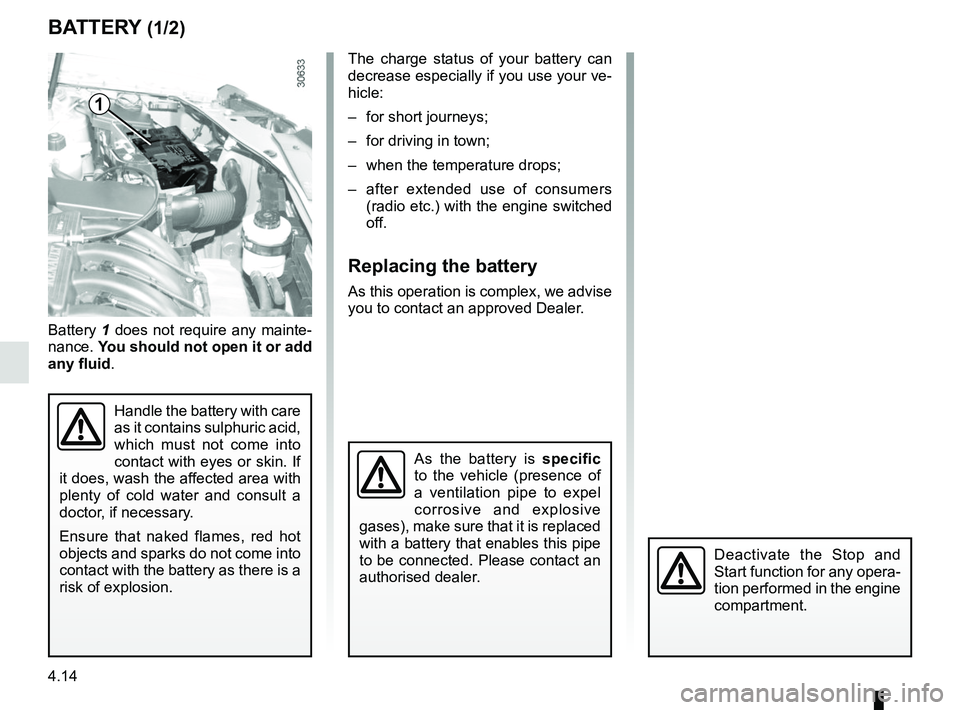
Battery 1 does not require any mainte-
nance. You should not open it or add
any fluid .
Handle the battery with care
as it contains sulphuric acid,
which must not come into
contact with eyes or skin. If
it does, wash the affected area with
plenty of cold water and consult a
doctor, if necessary.
Ensure that naked flames, red hot
objects and sparks do not come into
contact with the battery as there is a
risk of explosion.
1
The charge status of your battery can
decrease especially if you use your ve-
hicle:
– for short journeys;
– for driving in town;
– when the temperature drops;
– after extended use of consumers (radio etc.) with the engine switched
off.
Replacing the battery
As this operation is complex, we advise
you to contact an approved Dealer.
As the battery is specific
to the vehicle (presence of
a ventilation pipe to expel
corrosive and explosive
gases), make sure that it is replaced
with a battery that enables this pipe
to be connected. Please contact an
authorised dealer.
Deactivate the Stop and
Start function for any opera-
tion performed in the engine
compartment.
Page 179 of 256

5.1
Section 5: Practical advice
Tools . . . . . . . . . . . . . . . . . . . . . . . . . . . . . . . . . . . .\
. . . . . . . . . . . . . . . . . . . . . . . . . . . . . . . . . . . . . 5.2
Puncture . . . . . . . . . . . . . . . . . . . . . . . . . . . . . . . . . . . .\
. . . . . . . . . . . . . . . . . . . . . . . . . . . . . . . . . . 5.3
Tyre inflation kit . . . . . . . . . . . . . . . . . . . . . . . . . . . \
. . . . . . . . . . . . . . . . . . . . . . . . . . . . . . . . . . . . . . 5.5
Wheel trim/Wheels . . . . . . . . . . . . . . . . . . . . . . . . . . . . . . . . . . . .\
. . . . . . . . . . . . . . . . . . . . . . . . . . 5.9
Changing a wheel . . . . . . . . . . . . . . . . . . . . . . . . . . . . . . . . . . . .\
. . . . . . . . . . . . . . . . . . . . . . . . . . . 5.10
Tyres . . . . . . . . . . . . . . . . . . . . . . . . . . . . . . . . . . . . \
. . . . . . . . . . . . . . . . . . . . . . . . . . . . . . . . . . . . . 5.12
Changing bulbs . . . . . . . . . . . . . . . . . . . . . . . . . . . . .\
. . . . . . . . . . . . . . . . . . . . . . . . . . . . . . . . . . . . 5.16Front lights . . . . . . . . . . . . . . . . . . . . . . . . . . . . . . . . . . . . \
. . . . . . . . . . . . . . . . . . . . . . . . . . . 5.16
Fog lights . . . . . . . . . . . . . . . . . . . . . . . . . . . . . . . . . . . .\
. . . . . . . . . . . . . . . . . . . . . . . . . . . . 5.17
Rear lights . . . . . . . . . . . . . . . . . . . . . . . . . . . . . . . . . . . .\
. . . . . . . . . . . . . . . . . . . . . . . . . . . 5.18
Side indicator lights . . . . . . . . . . . . . . . . . . . . . . . . . . . . . . . . . . . .\
. . . . . . . . . . . . . . . . . . . . 5.23
Interior lights . . . . . . . . . . . . . . . . . . . . . . . . . . . . . . . . . . . . \
. . . . . . . . . . . . . . . . . . . . . . . . . . 5.24
Fuses . . . . . . . . . . . . . . . . . . . . . . . . . . . . . . . . . . . . \
. . . . . . . . . . . . . . . . . . . . . . . . . . . . . . . . . . . . . 5.28
Battery: troubleshooting. . . . . . . . . . . . . . . . . . . . . . . . \
. . . . . . . . . . . . . . . . . . . . . . . . . . . . . . . . . . . 5.36
Radio frequency remote control: batteries. . . . . . . . . . . . . . . . . . . . . . . . . . . . . . . . . . . . \
. . . . . . . . . 5.38
Wiper blades . . . . . . . . . . . . . . . . . . . . . . . . . . . . . .\
. . . . . . . . . . . . . . . . . . . . . . . . . . . . . . . . . . . . . 5.39
Towing: breakdown . . . . . . . . . . . . . . . . . . . . . . . . . . . . . . . . . . . .\
. . . . . . . . . . . . . . . . . . . . . . . . . . 5.40
Fitting a radio . . . . . . . . . . . . . . . . . . . . . . . . . . . . . . . . . . . . \
. . . . . . . . . . . . . . . . . . . . . . . . . . . . . . . 5.43
Accessories . . . . . . . . . . . . . . . . . . . . . . . . . . . . . . . . . . . . \
. . . . . . . . . . . . . . . . . . . . . . . . . . . . . . . . 5.44
Operating faults . . . . . . . . . . . . . . . . . . . . . . . . . . . . . . . . . . . . \
. . . . . . . . . . . . . . . . . . . . . . . . . . . . . 5.45
Page 201 of 256
5.23
INDICATOR LIGHTS: changing bulbs
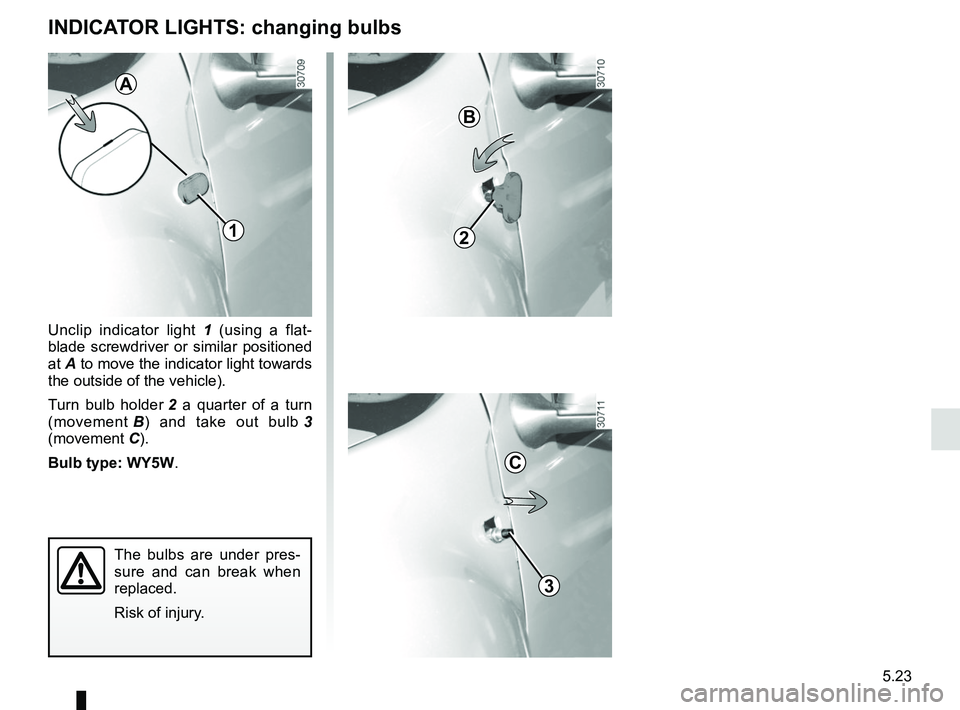
Unclip indicator light 1 (using a flat-
blade screwdriver or similar positioned
at A to move the indicator light towards
the outside of the vehicle).
Turn bulb holder 2 a quarter of a turn
(movement B ) and take out bulb 3
(movement C).
Bulb type: WY5W.
The bulbs are under pres-
sure and can break when
replaced.
Risk of injury.
A
1
B
2
3
C
Page 204 of 256
5.26
INTERIOR LIGHTING: changing bulbs (3/4)
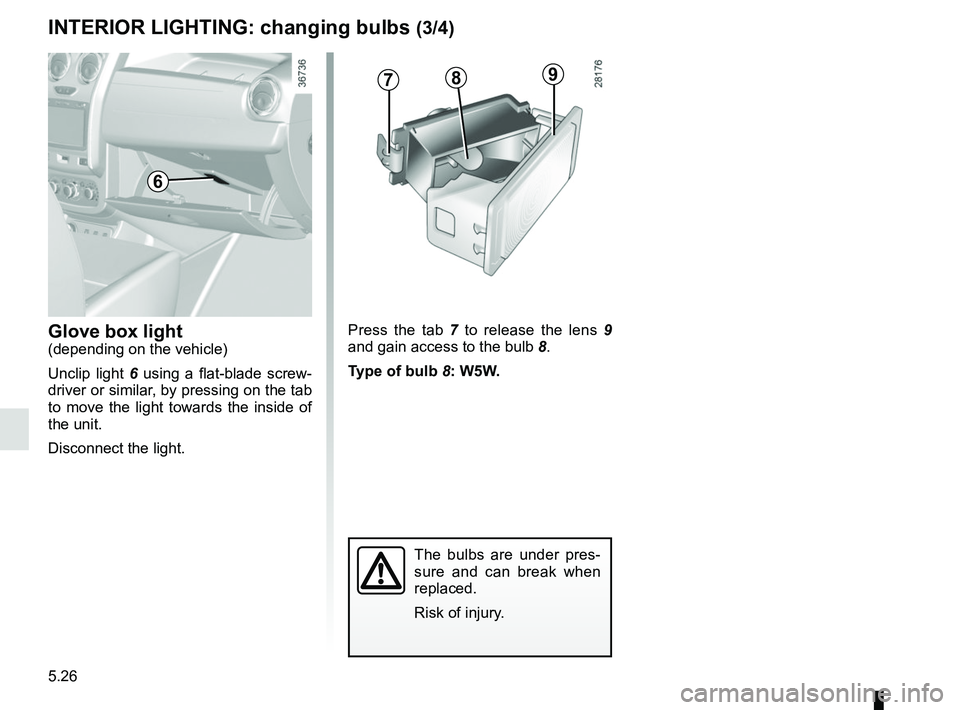
Glove box light(depending on the vehicle)
Unclip light 6 using a flat-blade screw-
driver or similar, by pressing on the tab
to move the light towards the inside of
the unit.
Disconnect the light. Press the tab 7
to release the lens 9
and gain access to the bulb 8.
Type of bulb 8: W5W.
The bulbs are under pres-
sure and can break when
replaced.
Risk of injury.
789
6
Page 205 of 256
5.27
INTERIOR LIGHTING: changing bulbs (4/4)
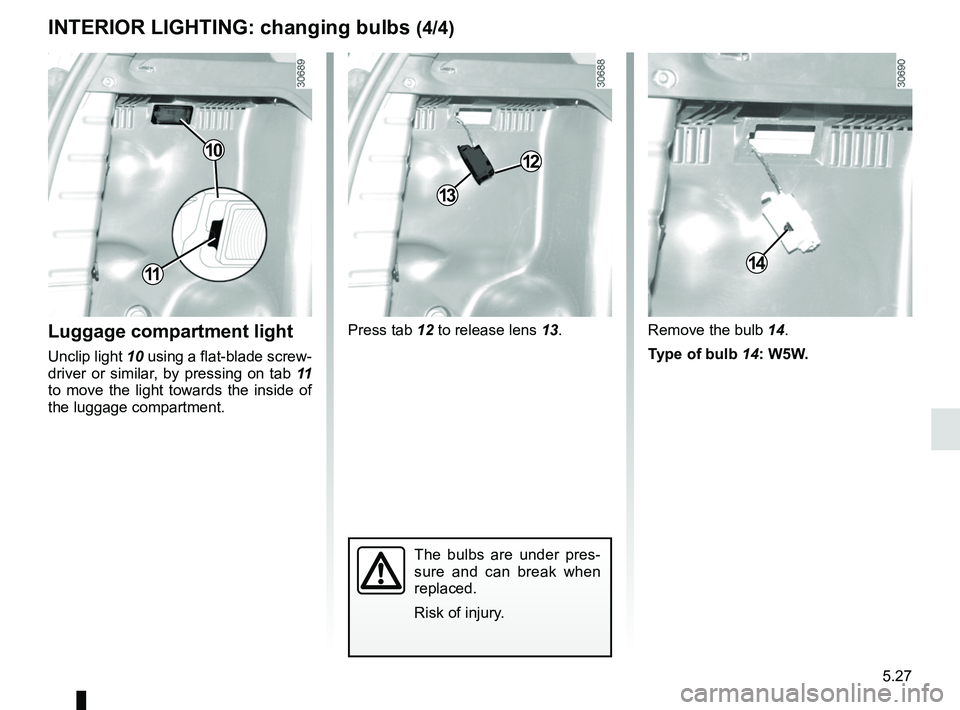
Luggage compartment light
Unclip light 10 using a flat-blade screw-
driver or similar, by pressing on tab 11
to move the light towards the inside of
the luggage compartment. Press tab 12 to release lens
13.Remove the bulb 14.
Type of bulb 14: W5W.
The bulbs are under pres-
sure and can break when
replaced.
Risk of injury.
10
11
13
14
12
Page 218 of 256
5.40
TOWING: breakdown (1/3)
Before any towing, put the gears into
neutral (neutral position for vehicles
equipped with a manual gearbox or N
position for vehicles equipped with an
automatic gearbox).
Unlock the steering column; the igni-
tion key must be in “M” position (ig-
nition) to enable signalling (“Stop”
lights, hazard warning lights, etc.).
Always switch on the lights when
driving at night.
Release the parking brake.
It is also essential to observe the towing
regulations imposed by current legisla-
tion in your country. Please contact an
authorised dealer.
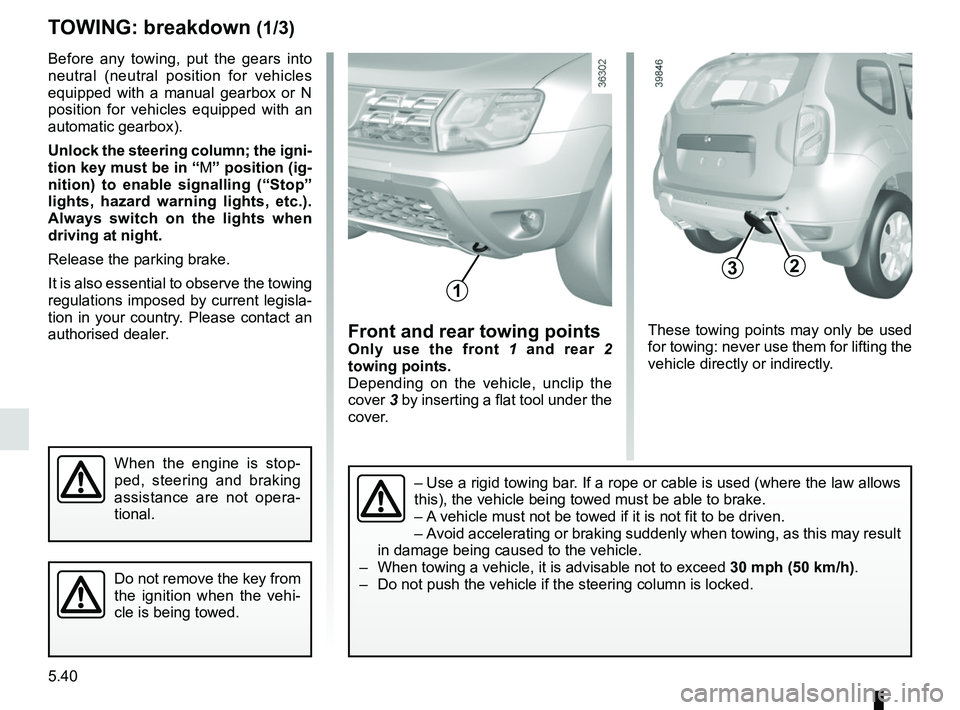
Front and rear towing pointsOnly use the front 1 and rear 2
towing points.
Depending on the vehicle, unclip the
cover 3 by inserting a flat tool under the
cover.
When the engine is stop-
ped, steering and braking
assistance are not opera-
tional.
Do not remove the key from
the ignition when the vehi-
cle is being towed.
– Use a rigid towing bar. If a rope or cable is used (where the law allows
this), the vehicle being towed must be able to brake.
– A vehicle must not be towed if it is not fit to be driven.
– Avoid accelerating or braking suddenly when towing, as this may result
in damage being caused to the vehicle.
– When towing a vehicle, it is advisable not to exceed 30 mph (50 km/h).
– Do not push the vehicle if the steering column is locked.
These towing points may only be used
for towing: never use them for lifting the
vehicle directly or indirectly.
1
23
Page 219 of 256
5.41
TOWING: breakdown (2/3)
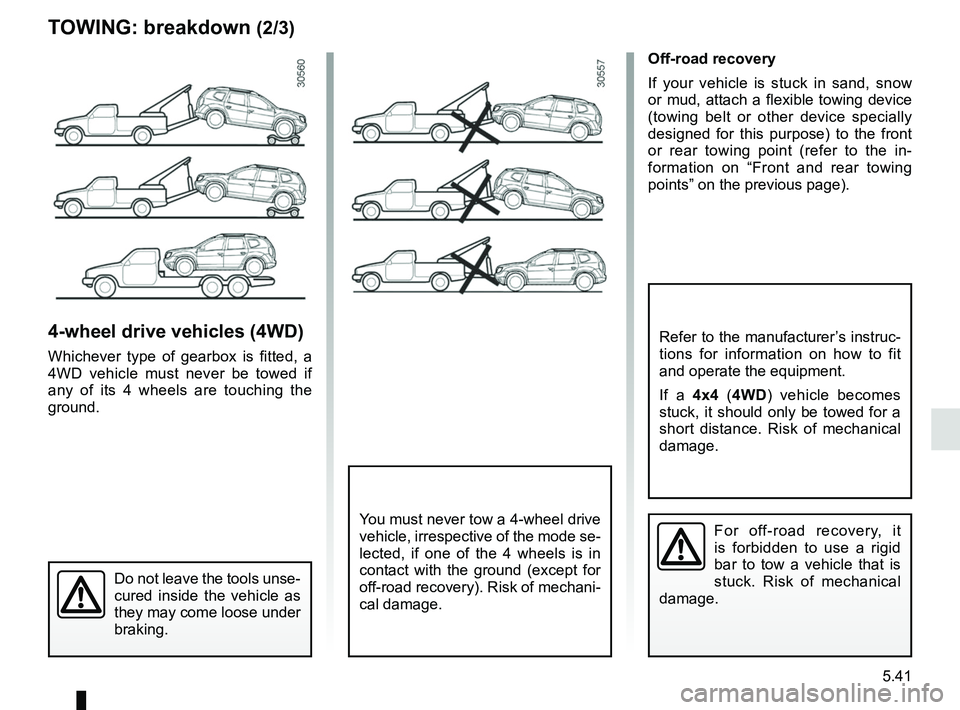
4-wheel drive vehicles (4WD)
Whichever type of gearbox is fitted, a
4WD vehicle must never be towed if
any of its 4 wheels are touching the
ground.
Off-road recovery
If your vehicle is stuck in sand, snow
or mud, attach a flexible towing device
(towing belt or other device specially
designed for this purpose) to the front
or rear towing point (refer to the in-
formation on “Front and rear towing
points” on the previous page).
For off-road recovery, it
is forbidden to use a rigid
bar to tow a vehicle that is
stuck. Risk of mechanical
damage.You must never tow a 4-wheel drive
vehicle, irrespective of the mode se-
lected, if one of the 4 wheels is in
contact with the ground (except for
off-road recovery). Risk of mechani-
cal damage.
Refer to the manufacturer’s instruc-
tions for information on how to fit
and operate the equipment.
If a 4x4 ( 4WD) vehicle becomes
stuck, it should only be towed for a
short distance. Risk of mechanical
damage.
Do not leave the tools unse-
cured inside the vehicle as
they may come loose under
braking.
Page 220 of 256
5.42
TOWING: breakdown (3/3)
When storing the tools,
ensure they are securely re-
placed in the luggage com-
partment, in their original
position.
Do not leave the tools unsecured
inside the vehicle as they may come
loose under braking.
4
5
Towing a vehicle with an
automatic gearbox
When the engine is switched off, the
gearbox is no longer lubricated. It is
preferable to tow this type of vehicle
on a trailer or, for 4x2 (2WD) vehicles
only, tow it with the rear wheels off the
ground.
Under exceptional circumstances
and for 4x2 ( 2WD), vehicles only, you
may tow the vehicle with all four wheels
on the ground, only going forward, with
the gear lever in neutral position N and
for a distance not exceeding 30 miles
(50 km).
If the gear lever cannot be put into the
N position, please consult an authori-
sed dealer.
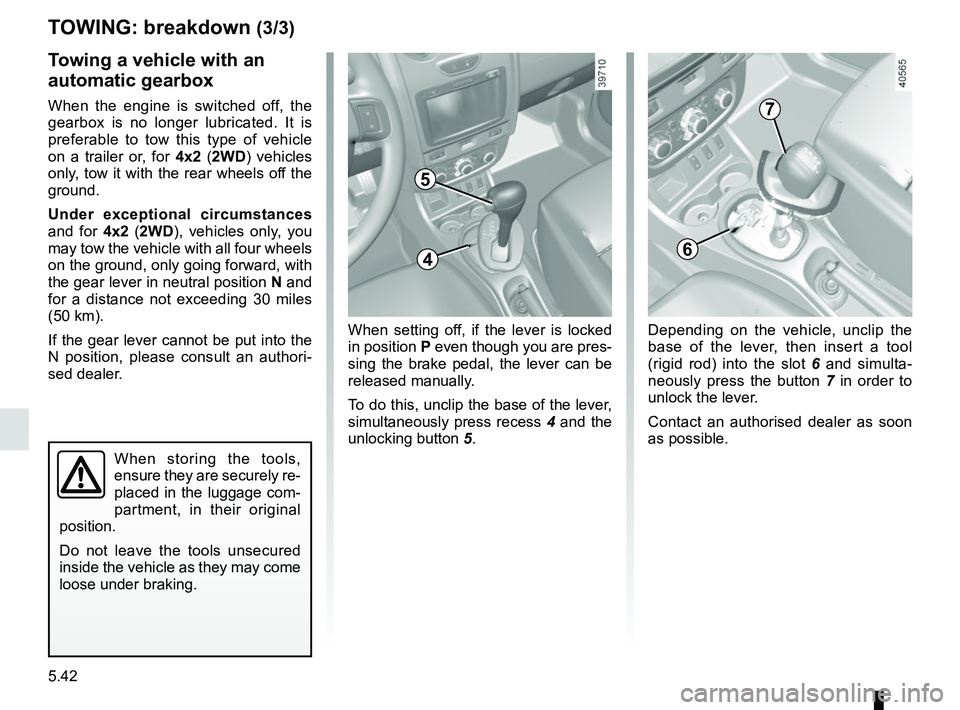
When setting off, if the lever is locked
in position P even though you are pres-
sing the brake pedal, the lever can be
released manually.
To do this, unclip the base of the lever,
simultaneously press recess 4 and the
unlocking button 5. Depending on the vehicle, unclip the
base of the lever, then insert a tool
(rigid rod) into the slot
6 and simulta-
neously press the button 7 in order to
unlock the lever.
Contact an authorised dealer as soon
as possible.
6
7
Page 229 of 256

6.1
Section 6: Technical specifications
Vehicle identification plate . . . . . . . . . . . . . . . . . . . . . . . . . . . . . . . . . . . . \
. . . . . . . . . . . . . . . . . . . . . 6.2
Engine identification plate . . . . . . . . . . . . . . . . . . . . . . . . . . . . . . . . . . . .\
. . . . . . . . . . . . . . . . . . . . . 6.3
Dimensions . . . . . . . . . . . . . . . . . . . . . . . . . . . . . . . . . . . .\
. . . . . . . . . . . . . . . . . . . . . . . . . . . . . . . . 6.5
Engine specifications . . . . . . . . . . . . . . . . . . . . . . . . . . . . . . . . . . . . \
. . . . . . . . . . . . . . . . . . . . . . . . . 6.6
Weights/Towing weights . . . . . . . . . . . . . . . . . . . . . . . . . . . . . . . . . . . .\
. . . . . . . . . . . . . . . . . . . . . . 6.7
Replacement parts and repairs . . . . . . . . . . . . . . . . . . . . . . . . . . . . . . . . . . . . \
. . . . . . . . . . . . . . . . . 6.8
Service sheets . . . . . . . . . . . . . . . . . . . . . . . . . . . . . . . . . . . . \
. . . . . . . . . . . . . . . . . . . . . . . . . . . . . . 6.9
Anticorrosion check . . . . . . . . . . . . . . . . . . . . . . . . . . . . . . . . . . . . \
. . . . . . . . . . . . . . . . . . . . . . . . . . 6.15
Page 235 of 256
6.7
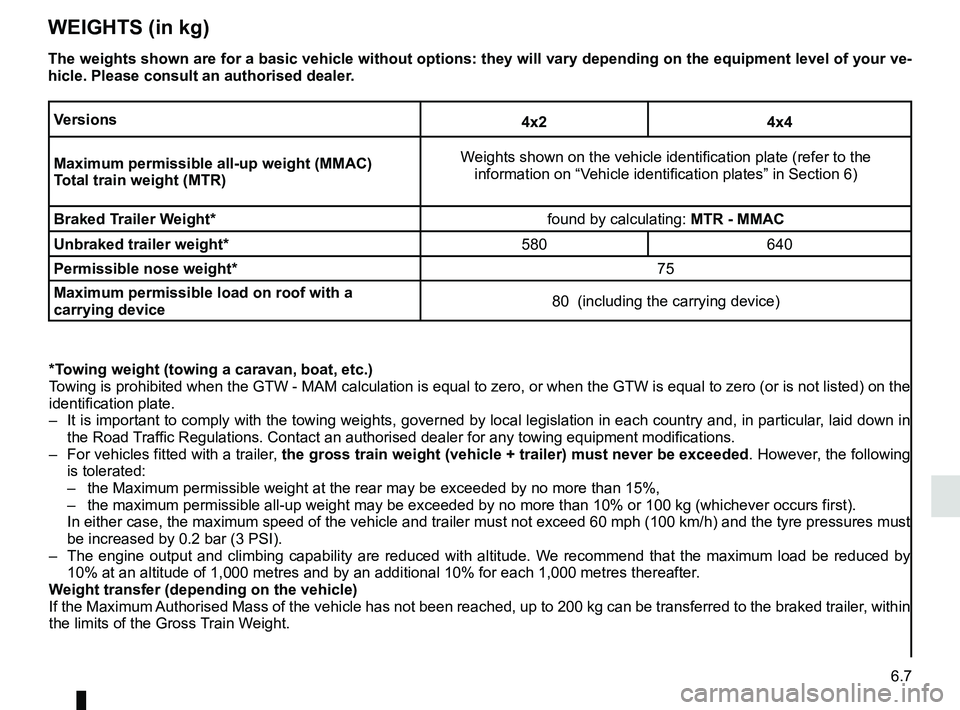
WEIGHTS (in kg)
Versions4x2 4x4
Maximum permissible all-up weight (MMAC)
Total train weight (MTR) Weights shown on the vehicle identification plate (refer to the
information on “Vehicle identification plates” in Section 6)
Braked Trailer Weight* found by calculating: MTR - MMAC
Unbraked trailer weight* 580 640
Permissible nose weight* 75
Maximum permissible load on roof with a
carrying device 80 (including the carrying device)
*Towing weight (towing a caravan, boat, etc.)
Towing is prohibited when the GTW - MAM calculation is equal to zero, or \
when the GTW is equal to zero (or is not listed) on th e
identification plate.
– It is important to comply with the towing weights, governed by local leg\
islation in each country and, in particular, laid down in the Road Traffic Regulations. Contact an authorised dealer for any towing equipment m\
odifications.
– For vehicles fitted with a trailer, the gross train weight (vehicle + trailer) must never be exceeded. However, the following
is tolerated:
– the Maximum permissible weight at the rear may be exceeded by no more th\
an 15%,
– the maximum permissible all-up weight may be exceeded by no more than 10\
% or 100 kg (whichever occurs first).
In either case, the maximum speed of the vehicle and trailer must not ex\
ceed 60 mph (100 km/h) and the tyre pressures must be increased by 0.2 bar (3 PSI).
– The engine output and climbing capability are reduced with altitude. We recommend that the maximum load be reduced by 10% at an altitude of 1,000 metres and by an additional 10% for each 1,0\
00 metres thereafter.
Weight transfer (depending on the vehicle)
If the Maximum Authorised Mass of the vehicle has not been reached, up to 200 kg can be\
transferred to the braked trailer, with in
the limits of the Gross Train Weight.
The weights shown are for a basic vehicle without options: they will var\
y depending on the equipment level of your ve-
hicle. Please consult an authorised dealer.