brake light RENAULT ESPACE 2012 J81 / 4.G User Guide
[x] Cancel search | Manufacturer: RENAULT, Model Year: 2012, Model line: ESPACE, Model: RENAULT ESPACE 2012 J81 / 4.GPages: 267, PDF Size: 8.95 MB
Page 102 of 267
Electronic Stability Program: ESP ........ (up to the end of the DU)
ESP: Electronic Stability Program ........ (up to the end of the DU)
2.20
ENG_UD20371_1
Contrôle dynamique de conduite : E.S.P. avec contrôle de sous-virage (X81 - J81 - Renault)
ENG_NU_932-3_X81ph3_Renault_2
Electronic Stability Program: ESP
ELEcTRONIc STABILITY PROGRAM: ESP
This system helps to keep control of
the vehicle in critical driving situations
(avoiding an obstacle, loss of grip when
cornering, etc.) and works in conjunc -
tion with the understeer control system.
This function is an addi -
tional aid in the event of
critical driving conditions,
enabling the vehicle behav -
iour to be adapted to suit the driving
conditions.
However, the function does not take
the place of the driver. It does not
increase the vehicle’s limits and
should not encourage you to
drive more quickly.
Therefore, it can under no circum -
stances replace the vigilance or re-
sponsibility of the driver when ma -
noeuvring the vehicle (the driver
must always be ready for sudden in-
cidents which may occur when driv-
ing).
Operating principle
A sensor in the steering wheel detects
the direction selected by the driver.
Other sensors throughout the vehicle
measure the actual direction.
The system compares the direction se-
lected by the driver and the actual di -
rection of the vehicle and corrects this
as necessary by applying the brakes
selectively and/or acting on the engine
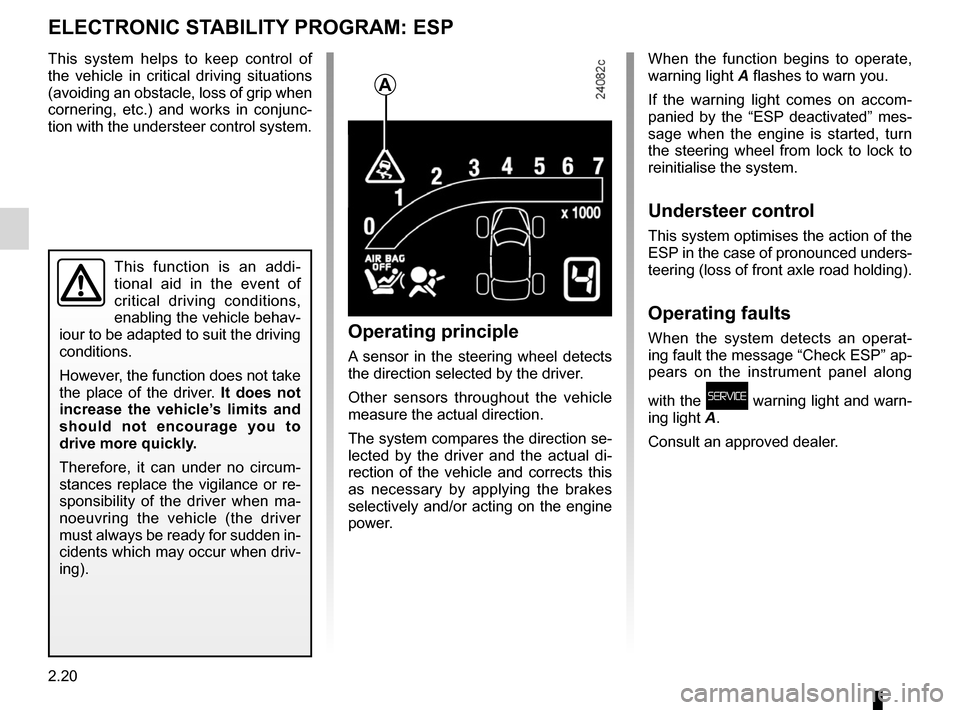
power. When the function begins to operate,
warning light
A flashes to warn you.
If the warning light comes on accom -
panied by the “ESP deactivated” mes -
sage when the engine is started, turn
the steering wheel from lock to lock to
reinitialise the system.
Understeer control
This system optimises the action of the
ESP in the case of pronounced unders-
teering (loss of front axle road holding).
Operating faults
When the system detects an operat -
ing fault the message “Check ESP” ap-
pears on the instrument panel along
with the
ú warning light and warn-
ing light A.
Consult an approved dealer.
A
Page 103 of 267
traction control ...................................... (up to the end of the DU)
traction control: ASR .............................(up to the end of the DU)
driving ................................................... (up to the end of the DU)
2.21
ENG_UD20372_1
Système antipatinage : A.S.R. (X81 - J81 - Renault)
ENG_NU_932-3_X81ph3_Renault_2
Traction control: ASR
TRAcTION cONTROL: ASR (1/2)
This system helps to limit wheelspin of
the drive wheels and to control the vehi-
cle when pulling away or accelerating.
This function is an addi -
tional aid in the event of
critical driving conditions,
enabling the vehicle behav -
iour to be adapted to suit the driving
conditions.
However, the function does not take
the place of the driver. It does not
increase the vehicle’s limits and
should not encourage you to
drive more quickly.
Therefore, it can under no circum -
stances replace the vigilance or re-
sponsibility of the driver when ma -
noeuvring the vehicle (the driver
must always be ready for sudden in-
cidents which may occur when driv-
ing).
Operating principle
Using the wheel sensors, the system
measures and compares the speed of
the drive wheels at all times and slows
down their over-rotation.
If a wheel is starting to slip, the system
brakes automatically until the drive sup-
plied becomes compatible with the level
of grip under the wheel again. The system also adjusts the engine
speed to the grip available under the
wheels, independently of the pressure
exerted on the accelerator pedal.
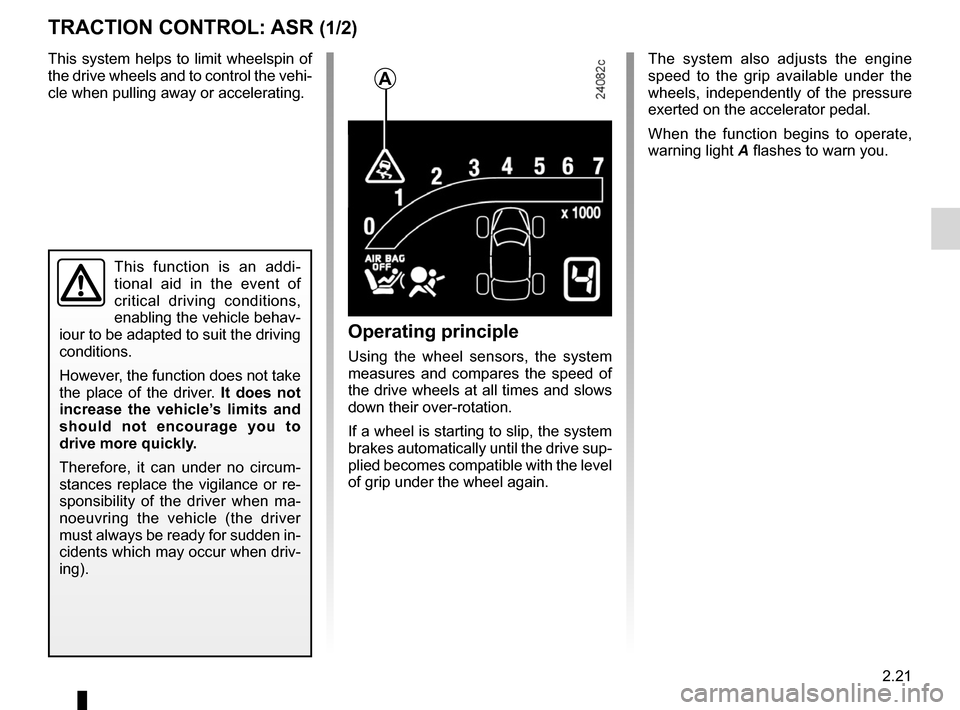
When the function begins to operate,
warning light
A flashes to warn you.
A
Page 106 of 267
2.24
ENG_UD20373_1
Système antiblocage des roues (ABS) (X81 - J81 - Renault)
ENG_NU_932-3_X81ph3_Renault_2
ANTI-LOcK BRAKING SYSTEM: ABS (continued)
One of two situations may arise if there
is a fault in the ABS system:
1 – Orange warning light
x is lit
on the instrument panel.
Braking is still performed, but without
the ABS system. Contact an approved
Dealer as soon as possible.
2 – Orange warning light
x and red brake cir -
c u i t i n c i d e n t w a r n i n g
light
D are lit on the instru -
ment panel.
This indicates that both the brak -
ing system and the ABS system
are faulty. Your braking systems are
only partially operational. However,
it is dangerous to brake suddenly
and it is essential to stop immedi -
ately, as soon as traffic conditions
allow. Contact an approved Dealer.
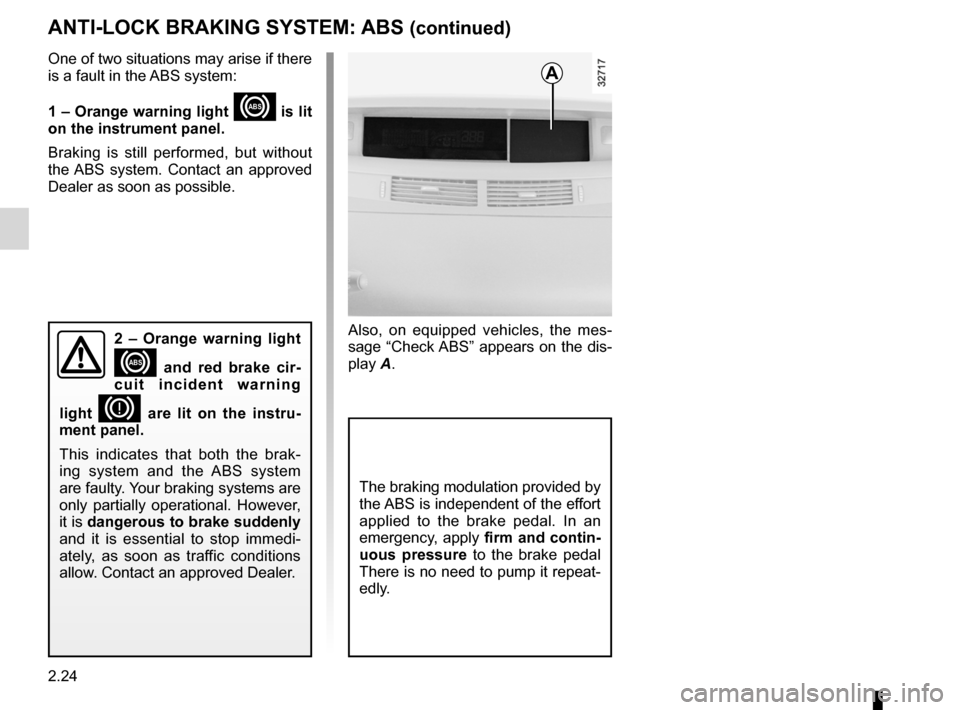
Also, on equipped vehicles, the mes -
sage “Check ABS” appears on the dis-
play A.
The braking modulation provided by
the ABS is independent of the effort
applied to the brake pedal. In an
emergency, apply firm and contin-
uous pressure to the brake pedal
There is no need to pump it repeat-
edly.
A
Page 107 of 267
emergency brake assist......................................... (current page)
emergency braking ............................... (up to the end of the DU)
driving ................................................... (up to the end of the DU)
2.25
ENG_UD1792_1
Assistance au freinage d’urgence (X81 - Renault)
ENG_NU_932-3_X81ph3_Renault_2
Assistance au freinage d’urgence
EMERGENcY BRAKE ASSIST
This system is complementary to the
ABS and helps reduce vehicle stopping
distances.
Operating principle
The system allows an emergency brak-
ing situation to be detected via a sensor
that measures the speed with which the
brake pedal is depressed. In this case,
the braking assistance instantly pro -
vides its maximum power.
ABS braking is maintained as long as
the brake pedal is applied.
Hazard warning lights
activation
These may light up in the event of rapid
deceleration.
In this case, the hazard warning lights
may be switched off by pressing the
hazard warning lights switch twice.
This function is an addi -
tional aid in the event of
critical driving conditions,
enabling the vehicle behav -
iour to be adapted to suit the driving
conditions.
However, the function does not take
the place of the driver. It does not
increase the vehicle’s limits and
should not encourage you to
drive more quickly.
Therefore, it can under no circum -
stances replace the vigilance or re-
sponsibility of the driver when ma -
noeuvring the vehicle (the driver
must always be ready for sudden in-
cidents which may occur when driv-
ing).
Page 114 of 267

ENG_NU_932-3_X81ph3_Renault_2
cRUISE cONTROL - SPEED LIMITER: cruise control function (continued)
Putting th")
2.32
ENG_UD1794_1
Régulateur-Limiteur de vitesse : fonction régulateur (X81 - Renau\
lt)
ENG_NU_932-3_X81ph3_Renault_2
cRUISE cONTROL - SPEED LIMITER: cruise control function (continued)
Putting the function on
standby
The function is interrupted when you:
– depress the brake pedal,
– depress the clutch pedal or shift into
neutral if the vehicle has an auto -
matic gearbox,
– press button 4.
In all three cases, the cruising speed is
memorised.
Recalling the cruising speed
If a speed has been memorised, it is
possible to recall it by pressing button 3,
on condition that you are driving faster
than 18 mph (30 km/h) and that you
are sure that the driving conditions are
suitable (traffic, road surface condition,
weather conditions, etc.).
Switching off the function
Press on/off switch 1 : in this case, the
speed is no longer stored.
The instrument panel indicator light
goes out, confirming that the function is
stopped.
Pressing button 2 or 5 reactivates
the cruise control function without
taking into account the memorised
speed: it is the speed at which the
vehicle is moving that is taken into
account.Putting the cruise control
on standby or switching it
off does not cause a rapid
reduction in speed: you
must brake by depressing the brake
pedal.
2
5
3
41
Page 118 of 267
2.36
ENG_UD20377_1
Aide au parking (X81 - J81 - Renault)
ENG_NU_932-3_X81ph3_Renault_2
PARKING DISTANcE cONTROL (continued)
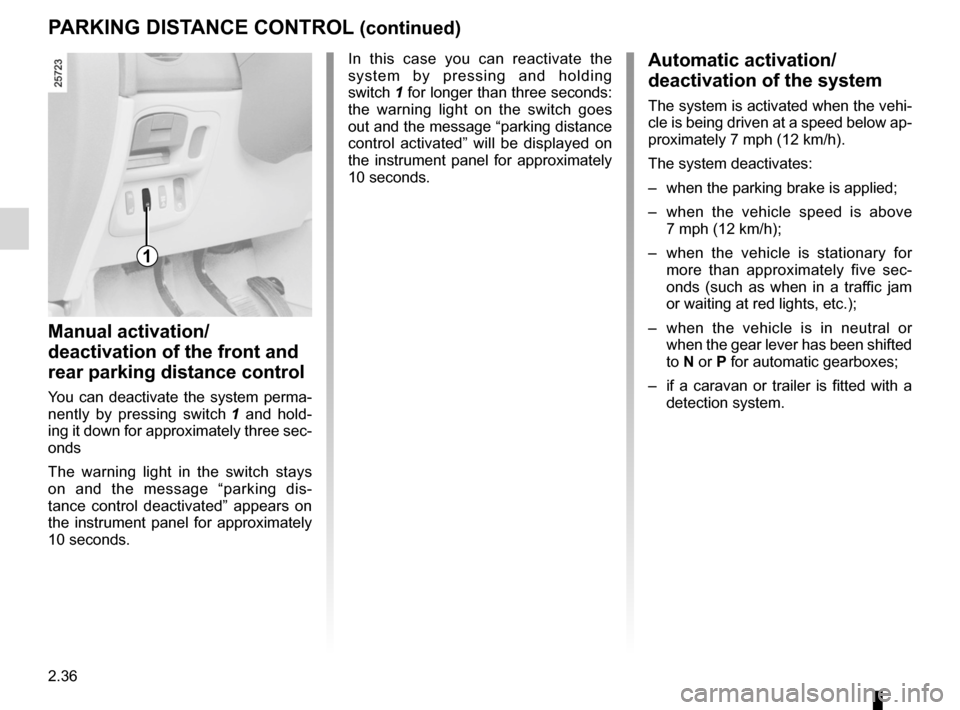
Manual activation/
deactivation of the front and
rear parking distance control
You can deactivate the system perma-
nently by pressing switch 1 and hold -
ing it down for approximately three sec-
onds
The warning light in the switch stays
on and the message “parking dis -
tance control deactivated” appears on
the instrument panel for approximately
10 seconds. In this case you can reactivate the
system by pressing and holding
switch 1 for longer than three seconds:
the warning light on the switch goes
out and the message “parking distance
control activated” will be displayed on
the instrument panel for approximately
10 seconds.
Automatic activation/
deactivation of the system
The system is activated when the vehi-
cle is being driven at a speed below ap-
proximately 7 mph (12 km/h).
The system deactivates:
–
when the parking brake is applied;
– when the vehicle speed is above
7 mph (12 km/h);
– when the vehicle is stationary for
more than approximately five sec -
onds (such as when in a traffic jam
or waiting at red lights, etc.);
– when the vehicle is in neutral or
when the gear lever has been shifted
to N or P for automatic gearboxes;
– if a caravan or trailer is fitted with a
detection system.
1
Page 119 of 267
automatic gearbox (use) ....................... (up to the end of the DU)
driving ................................................... (up to the end of the DU)
automatic gearbox selector lever ..........(up to the end of the DU)
2.37
ENG_UD24090_2
Boîte automatique (X81 - J81 - Renault)
ENG_NU_932-3_X81ph3_Renault_2
Using the automatic gearbox
AUTOMATIc GEARBOX
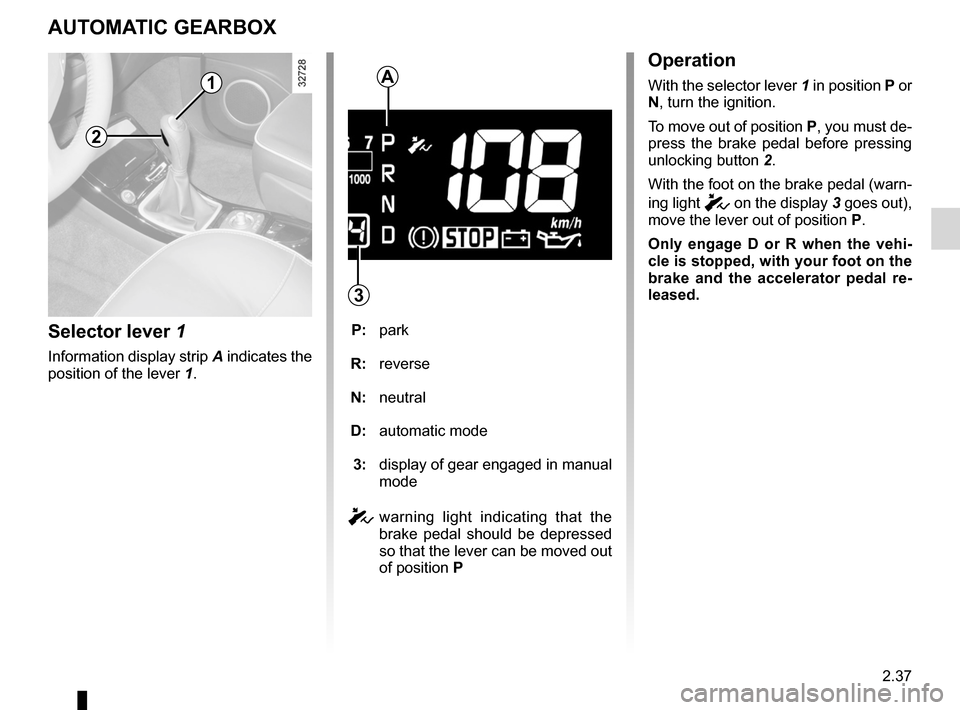
Selector lever 1
Information display strip A indicates the
position of the lever 1.
P: park
R: reverse
N: neutral
D: automatic mode
3: display of gear engaged in manual
mode
c warning light indicating that the
brake pedal should be depressed
so that the lever can be moved out
of position P
2
1A
3
Operation
With the selector lever 1 in position P or
N, turn the ignition.
To move out of position P, you must de-
press the brake pedal before pressing
unlocking button 2.
With the foot on the brake pedal (warn-
ing light
c on the display 3 goes out),
move the lever out of position P.
Only engage D or R when the vehi -
cle is stopped, with your foot on the
brake and the accelerator pedal re -
leased.
Page 183 of 267
4.1
ENG_UD25603_4
Sommaire 4 (X81 - J81 - Renault)
ENG_NU_932-3_X81ph3_Renault_4
Section 4: Maintenance
Bonnet . . . . . . . . . . . . . . . . . . . . . . . . . . . . . . . . . . . . . . . . . . . . . . . . . . . . . . . . . . . . . . . . . . . . . . . . 4.2
Engine oil level/Engine oil change . . . . . . . . . . . . . . . . . . . . . . . . . . . . . . . . . . . . . . . . . . . . . . . . . . . 4.4
Levels . . . . . . . . . . . . . . . . . . . . . . . . . . . . . . . . . . . . . . . . . . . . . . . . . . . . . . . . . . . . . . . . . . . . . . . . 4.8
coolant . . . . . . . . . . . . . . . . . . . . . . . . . . . . . . . . . . . . . . . . . . . . . . . . . . . . . . . . . . . . . . . . . . 4.8
power-assisted steering pump . . . . . . . . . . . . . . . . . . . . . . . . . . . . . . . . . . . . . . . . . . . . . . . . 4.9
brake fluid . . . . . . . . . . . . . . . . . . . . . . . . . . . . . . . . . . . . . . . . . . . . . . . . . . . . . . . . . . . . . . . . 4.10
windscreen/headlight washer reservoir . . . . . . . . . . . . . . . . . . . . . . . . . . . . . . . . . . . . . . . . . 4.11
Filters . . . . . . . . . . . . . . . . . . . . . . . . . . . . . . . . . . . . . . . . . . . . . . . . . . . . . . . . . . . . . . . . . . . . . . . . . 4.11
Tyre pressure. . . . . . . . . . . . . . . . . . . . . . . . . . . . . . . . . . . . \
. . . . . . . . . . . . . . . . . . . . . . . . . . . . . . . 4.12
Battery . . . . . . . . . . . . . . . . . . . . . . . . . . . . . . . . . . . . . . . . . . . . . . . . . . . . . . . . . . . . . . . . . . . . . . . . 4.13
Bodywork maintenance . . . . . . . . . . . . . . . . . . . . . . . . . . . . . . . . . . . . . . . . . . . . . . . . . . . . . . . . . . . 4.14
Interior trim maintenance . . . . . . . . . . . . . . . . . . . . . . . . . . . . . . . . . . . . . . . . . . . . . . . . . . . . . . . . . . 4.16
Page 192 of 267
brake fluid .............................................................. (current page)
tanks and reservoirs brake fluid ........................................................ (current page)
levels: brake fluid ........................................................ (current page)
4.10
ENG_UD24345_4
Niveaux/Filtres (X81 - Renault)
ENG_NU_932-3_X81ph3_Renault_4
Jaune NoirNoir texte
brake fluid
LeVeLS (3/4)
3
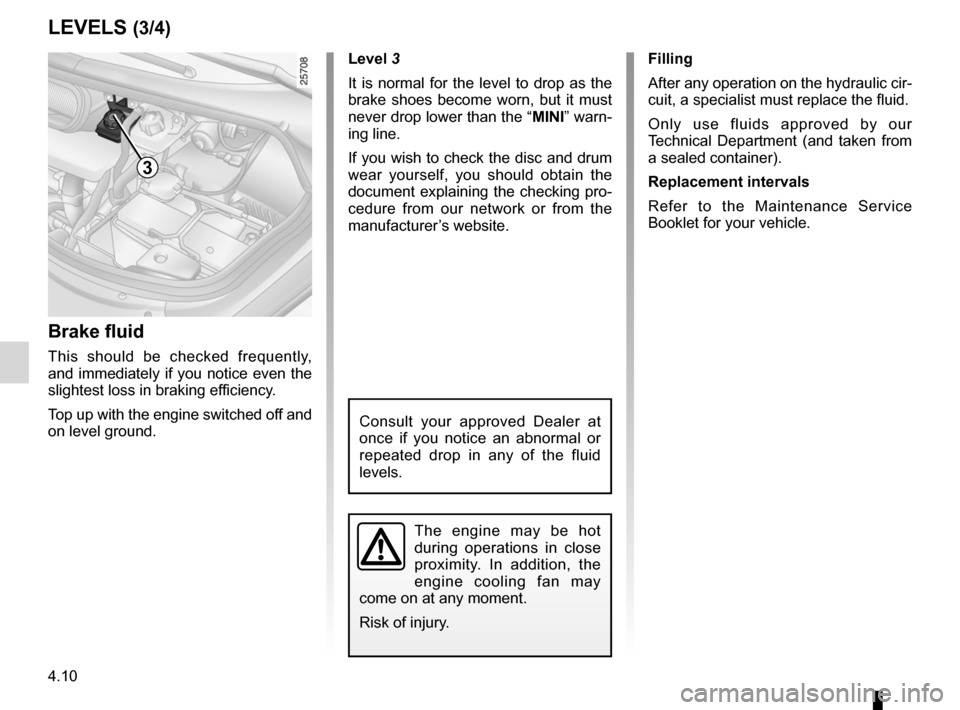
Brake fluid
This should be checked frequently,
and immediately if you notice even the
slightest loss in braking efficiency.
Top up with the engine switched off and
on level ground.
Level 3
It is normal for the level to drop as the
brake shoes become worn, but it must
never drop lower than the “MInI” warn-
ing line.
If you wish to check the disc and drum
wear yourself, you should obtain the
document explaining the checking pro-
cedure from our network or from the
manufacturer’s website.Filling
After any operation on the hydraulic cir-
cuit, a specialist must replace the fluid.
Only use fluids approved by our
Technical Department (and taken from
a sealed container).
Replacement intervals
Refer to the Maintenance Service
Booklet for your vehicle.
Consult your approved Dealer at
once if you notice an abnormal or
repeated drop in any of the fluid
levels.
The engine may be hot
during operations in close
proximity. In addition, the
engine cooling fan may
come on at any moment.
Risk of injury.
Page 205 of 267
JauneNoirNoir texte
5.5
ENG_UD24347_2
Add J81 kit de gonflage (X81 - J81 - Renault)
ENG_NU_932-3_X81ph3_Renault_5
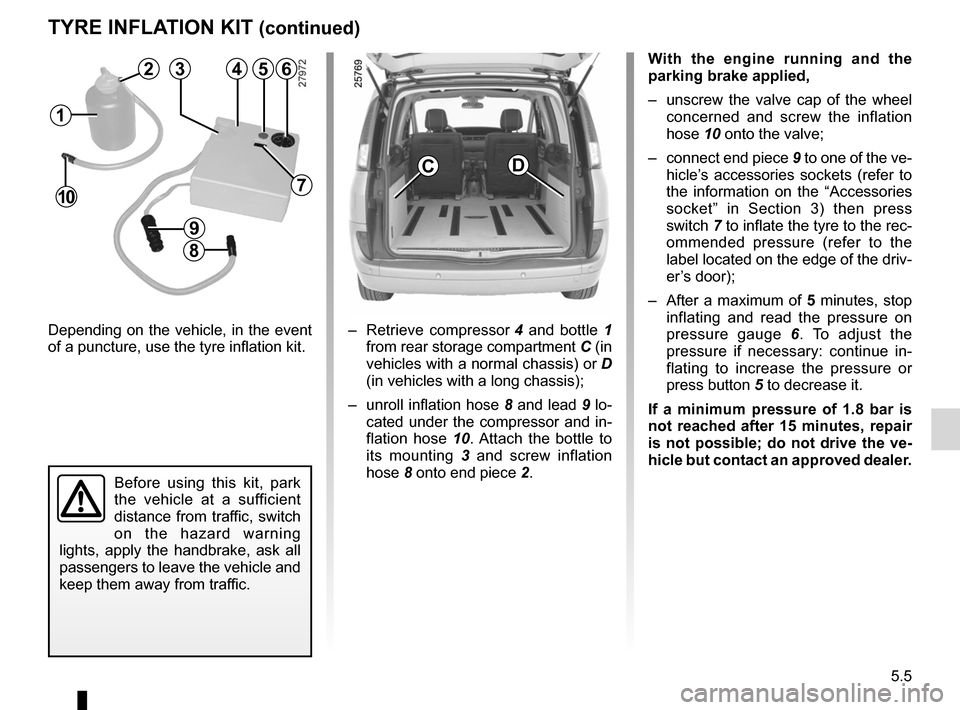
tYre InFLA tIOn KIt (continued)
Depending on the vehicle, in the event
of a puncture, use the tyre inflation kit.– Retrieve compressor 4 and bottle 1
from rear storage compartment C (in
vehicles with a normal chassis) or D
(in vehicles with a long chassis);
– unroll inflation hose 8 and lead 9 lo-
cated under the compressor and in-
flation hose 10 . Attach the bottle to
its mounting 3 and screw inflation
hose 8 onto end piece 2.With the engine running and the
parking brake applied,
–
unscrew the valve cap of the wheel
concerned and screw the inflation
hose 10 onto the valve;
– connect end piece 9 to one of the ve-
hicle’s accessories sockets (refer to
the information on the “Accessories
socket” in Section 3) then press
switch 7 to inflate the tyre to the rec-
ommended pressure (refer to the
label located on the edge of the driv-
er’s door);
– After a maximum of 5 minutes, stop
inflating and read the pressure on
pressure gauge 6 . To adjust the
pressure if necessary: continue in -
flating to increase the pressure or
press button 5 to decrease it.
If a minimum pressure of 1.8 bar is
not reached after 15 minutes, repair
is not possible; do not drive the ve-
hicle but contact an approved dealer.
Before using this kit, park
the vehicle at a sufficient
distance from traffic, switch
on the hazard warning
lights, apply the handbrake, ask all
passengers to leave the vehicle and
keep them away from traffic.
1
23456
7
8
9
10
cD