tyre pressure RENAULT ESPACE 2012 J81 / 4.G User Guide
[x] Cancel search | Manufacturer: RENAULT, Model Year: 2012, Model line: ESPACE, Model: RENAULT ESPACE 2012 J81 / 4.GPages: 267, PDF Size: 8.95 MB
Page 183 of 267
4.1
ENG_UD25603_4
Sommaire 4 (X81 - J81 - Renault)
ENG_NU_932-3_X81ph3_Renault_4
Section 4: Maintenance
Bonnet . . . . . . . . . . . . . . . . . . . . . . . . . . . . . . . . . . . . . . . . . . . . . . . . . . . . . . . . . . . . . . . . . . . . . . . . 4.2
Engine oil level/Engine oil change . . . . . . . . . . . . . . . . . . . . . . . . . . . . . . . . . . . . . . . . . . . . . . . . . . . 4.4
Levels . . . . . . . . . . . . . . . . . . . . . . . . . . . . . . . . . . . . . . . . . . . . . . . . . . . . . . . . . . . . . . . . . . . . . . . . 4.8
coolant . . . . . . . . . . . . . . . . . . . . . . . . . . . . . . . . . . . . . . . . . . . . . . . . . . . . . . . . . . . . . . . . . . 4.8
power-assisted steering pump . . . . . . . . . . . . . . . . . . . . . . . . . . . . . . . . . . . . . . . . . . . . . . . . 4.9
brake fluid . . . . . . . . . . . . . . . . . . . . . . . . . . . . . . . . . . . . . . . . . . . . . . . . . . . . . . . . . . . . . . . . 4.10
windscreen/headlight washer reservoir . . . . . . . . . . . . . . . . . . . . . . . . . . . . . . . . . . . . . . . . . 4.11
Filters . . . . . . . . . . . . . . . . . . . . . . . . . . . . . . . . . . . . . . . . . . . . . . . . . . . . . . . . . . . . . . . . . . . . . . . . . 4.11
Tyre pressure. . . . . . . . . . . . . . . . . . . . . . . . . . . . . . . . . . . . \
. . . . . . . . . . . . . . . . . . . . . . . . . . . . . . . 4.12
Battery . . . . . . . . . . . . . . . . . . . . . . . . . . . . . . . . . . . . . . . . . . . . . . . . . . . . . . . . . . . . . . . . . . . . . . . . 4.13
Bodywork maintenance . . . . . . . . . . . . . . . . . . . . . . . . . . . . . . . . . . . . . . . . . . . . . . . . . . . . . . . . . . . 4.14
Interior trim maintenance . . . . . . . . . . . . . . . . . . . . . . . . . . . . . . . . . . . . . . . . . . . . . . . . . . . . . . . . . . 4.16
Page 194 of 267
tyre pressure......................................... (up to the end of the DU)
tyre pressures ....................................... (up to the end of the DU)
tyres ...................................................... (up to the end of the DU)
4.12
ENG_UD11257_1
Pression de gonflage des pneumatiques (X81 - Renault)
ENG_NU_932-3_X81ph3_Renault_4
Tyre Pressure
tyRe PReSSURe
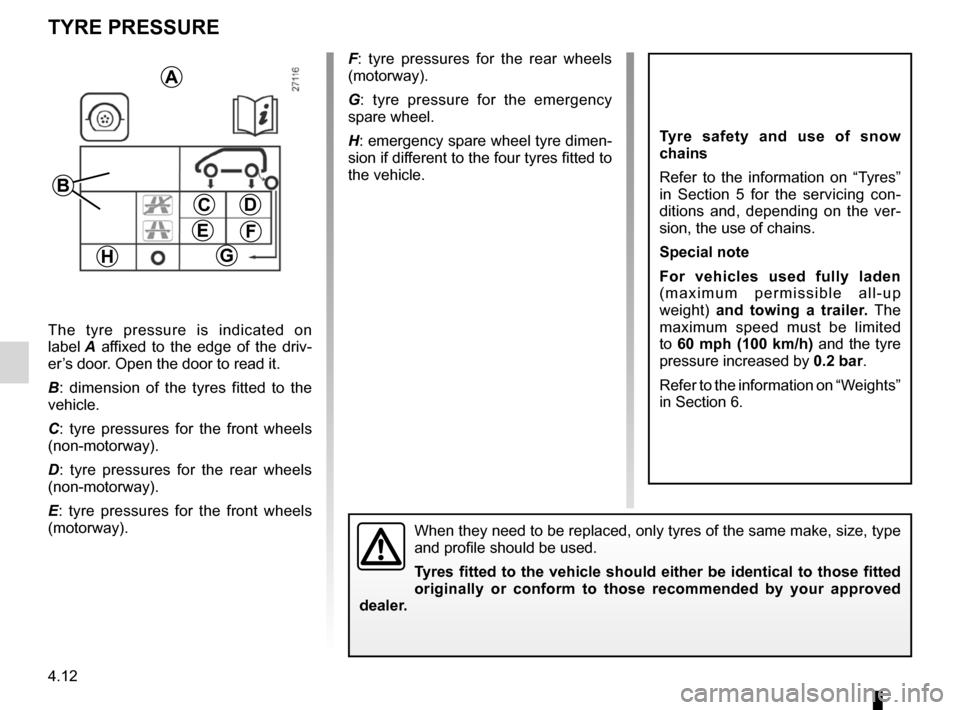
The tyre pressure is indicated on
label A affixed to the edge of the driv -
er’s door. Open the door to read it.
B : dimension of the tyres fitted to the
vehicle.
C : tyre pressures for the front wheels
(non-motorway).
D : tyre pressures for the rear wheels
(non-motorway).
E : tyre pressures for the front wheels
(motorway). F
: tyre pressures for the rear wheels
(motorway).
G : tyre pressure for the emergency
spare wheel.
H: emergency spare wheel tyre dimen -
sion if different to the four tyres fitted to
the vehicle.
t yre safety and use of snow
chains
Refer to the information on “Tyres”
in Section 5 for the servicing con -
ditions and, depending on the ver -
sion, the use of chains.
Special note
For vehicles used fully laden
( m a x i m u m p e r m i s s i b l e a l l - u p
weight) and towing a trailer. The
maximum speed must be limited
to 60 mph (100 km/h) and the tyre
pressure increased by 0.2 bar.
Refer to the information on “Weights”
in Section 6.
CD
Fe
G
A
H
B
When they need to be replaced, only tyres of the same make, size, type
and profile should be used.
t yres fitted to the vehicle should either be identical to those fitted
originally or conform to those recommended by your approved
dealer.
Page 203 of 267
JauneNoirNoir texte
5.3
ENG_UD24346_2
Roue de secours (X81 - J81 - Renault)
ENG_NU_932-3_X81ph3_Renault_5
Puncture/eMerGencY SPAre WHeeL (2/2)
t o refit the emergency spare
wheel
Proceed in the reverse order.
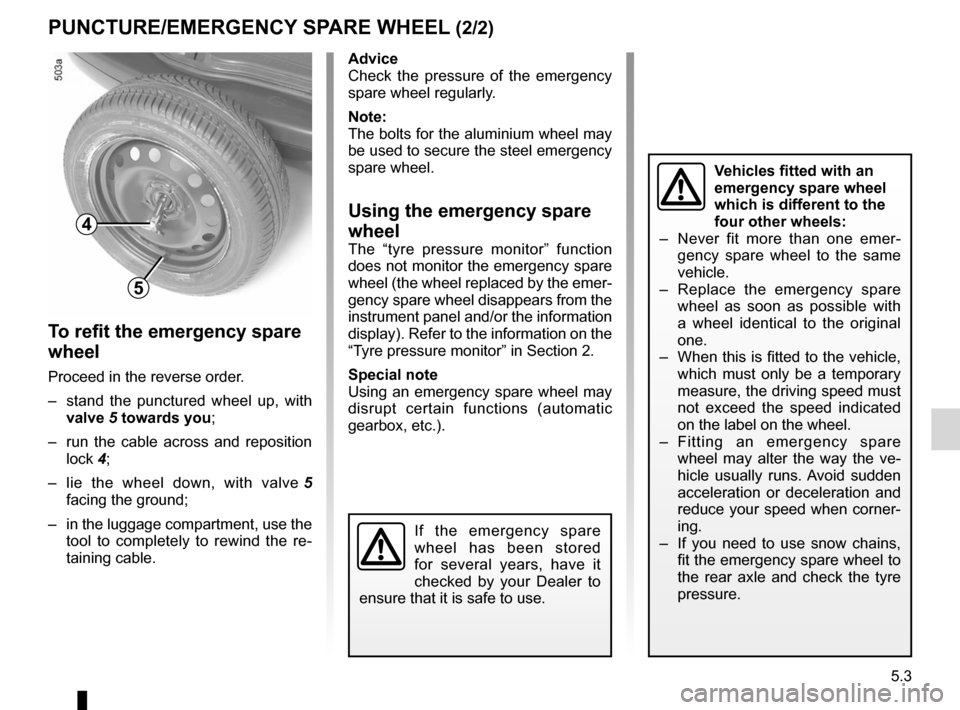
– stand the punctured wheel up, with
valve 5 towards you;
– run the cable across and reposition
lock 4;
– lie the wheel down, with valve 5
facing the ground;
– in the luggage compartment, use the
tool to completely to rewind the re -
taining cable. Advice
Check the pressure of the emergency
spare wheel regularly.
note:
The bolts for the aluminium wheel may
be used to secure the steel emergency
spare wheel.
using the emergency spare
wheel
The “tyre pressure monitor” function
does not monitor the emergency spare
wheel (the wheel replaced by the emer-
gency spare wheel disappears from the
instrument panel and/or the information
display). Refer to the information on the
“Tyre pressure monitor” in Section 2.
Special note
Using an emergency spare wheel may
disrupt certain functions (automatic
gearbox, etc.).
If the emergency spare
wheel has been stored
for several years, have it
checked by your Dealer to
ensure that it is safe to use.
4
5
Vehicles fitted with an
emergency spare wheel
which is different to the
four other wheels:
– Never fit more than one emer -
gency spare wheel to the same
vehicle.
– Replace the emergency spare
wheel as soon as possible with
a wheel identical to the original
one.
– When this is fitted to the vehicle,
which must only be a temporary
measure, the driving speed must
not exceed the speed indicated
on the label on the wheel.
– Fitting an emergency spare
wheel may alter the way the ve -
hicle usually runs. Avoid sudden
acceleration or deceleration and
reduce your speed when corner-
ing.
– If you need to use snow chains,
fit the emergency spare wheel to
the rear axle and check the tyre
pressure.
Page 205 of 267
JauneNoirNoir texte
5.5
ENG_UD24347_2
Add J81 kit de gonflage (X81 - J81 - Renault)
ENG_NU_932-3_X81ph3_Renault_5
tYre InFLA tIOn KIt (continued)
Depending on the vehicle, in the event
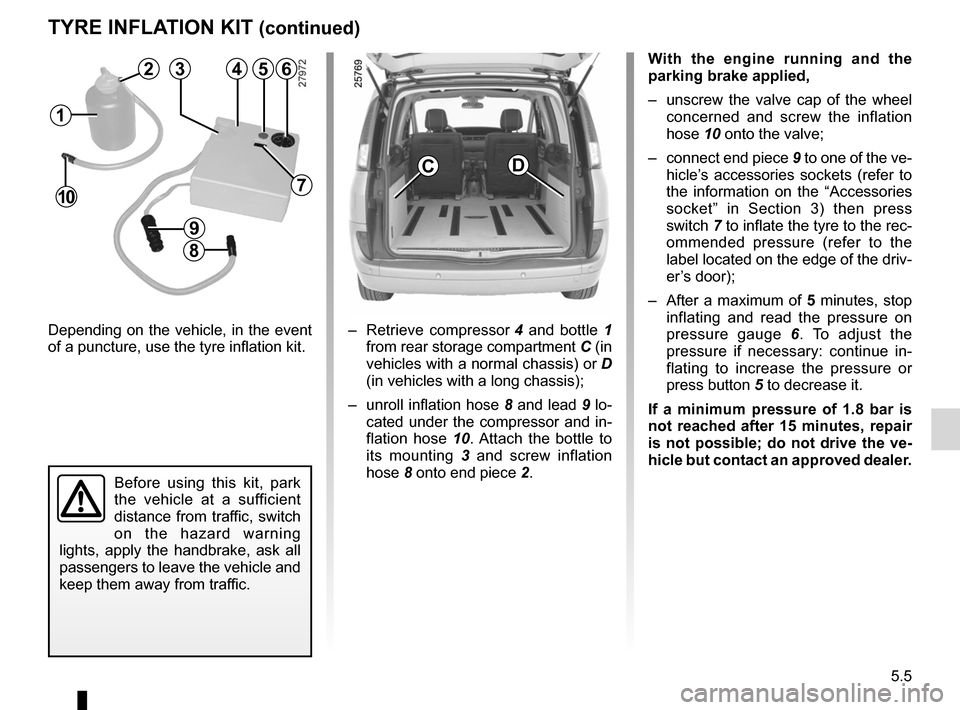
of a puncture, use the tyre inflation kit.– Retrieve compressor 4 and bottle 1
from rear storage compartment C (in
vehicles with a normal chassis) or D
(in vehicles with a long chassis);
– unroll inflation hose 8 and lead 9 lo-
cated under the compressor and in-
flation hose 10 . Attach the bottle to
its mounting 3 and screw inflation
hose 8 onto end piece 2.With the engine running and the
parking brake applied,
–
unscrew the valve cap of the wheel
concerned and screw the inflation
hose 10 onto the valve;
– connect end piece 9 to one of the ve-
hicle’s accessories sockets (refer to
the information on the “Accessories
socket” in Section 3) then press
switch 7 to inflate the tyre to the rec-
ommended pressure (refer to the
label located on the edge of the driv-
er’s door);
– After a maximum of 5 minutes, stop
inflating and read the pressure on
pressure gauge 6 . To adjust the
pressure if necessary: continue in -
flating to increase the pressure or
press button 5 to decrease it.
If a minimum pressure of 1.8 bar is
not reached after 15 minutes, repair
is not possible; do not drive the ve-
hicle but contact an approved dealer.
Before using this kit, park
the vehicle at a sufficient
distance from traffic, switch
on the hazard warning
lights, apply the handbrake, ask all
passengers to leave the vehicle and
keep them away from traffic.
1
23456
7
8
9
10
cD
Page 206 of 267
5.6
ENG_UD24347_2
Add J81 kit de gonflage (X81 - J81 - Renault)
ENG_NU_932-3_X81ph3_Renault_5
tYre InFLA tIOn KIt (continued)
Once the tyre is inflated correctly:
– stop using the kit;
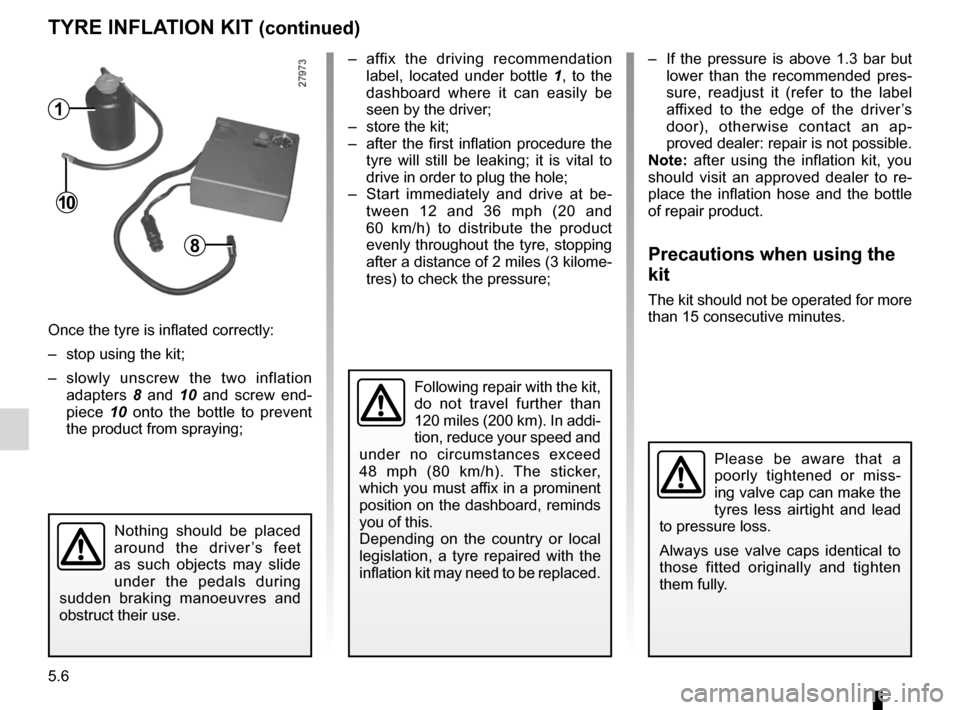
– slowly unscrew the two inflation
adapters 8 and 10 and screw end -
piece 10 onto the bottle to prevent
the product from spraying;
– affix the driving recommendation
label, located under bottle 1 , to the
dashboard where it can easily be
seen by the driver;
– store the kit;
– after the first inflation procedure the
tyre will still be leaking; it is vital to
drive in order to plug the hole;
– Start immediately and drive at be -
tween 12 and 36 mph (20 and
60 km/h) to distribute the product
evenly throughout the tyre, stopping
after a distance of 2 miles (3 kilome-
tres) to check the pressure; –
If the pressure is above 1.3 bar but
lower than the recommended pres -
sure, readjust it (refer to the label
affixed to the edge of the driver ’s
door), otherwise contact an ap -
proved dealer: repair is not possible.
n ote: after using the inflation kit, you
should visit an approved dealer to re -
place the inflation hose and the bottle
of repair product.
Precautions when using the
kit
The kit should not be operated for more
than 15 consecutive minutes.
Following repair with the kit,
do not travel further than
120 miles (200 km). In addi -
tion, reduce your speed and
under no circumstances exceed
48 mph (80 km/h). The sticker,
which you must affix in a prominent
position on the dashboard, reminds
you of this.
Depending on the country or local
legislation, a tyre repaired with the
inflation kit may need to be replaced.
Nothing should be placed
around the driver ’s feet
as such objects may slide
under the pedals during
sudden braking manoeuvres and
obstruct their use.
Please be aware that a
poorly tightened or miss -
ing valve cap can make the
tyres less airtight and lead
to pressure loss.
Always use valve caps identical to
those fitted originally and tighten
them fully.
1
8
10
Page 212 of 267
tyre pressure.......................................................... (current page)
5.12
ENG_UD24348_3
Pneumatiques (X81 - Renault)
ENG_NU_932-3_X81ph3_Renault_5
Jaune NoirNoir texte
tYreS (2/3)
t yre pressures
Tyre pressures must be adhered to (in-
cluding the emergency spare wheel).
Pressures must be checked at least
once a month and always before a long
journey (refer to the label affixed to the
edge of the driver’s door).
Incorrect tyre pressures
lead to abnormal tyre wear
and unusually hot running.
These are factors which
may seriously affect safety and lead
to:
– poor road holding;
– the risk of blow-outs or of throw-
ing a tread.
Tyre pressures depend on the load
and the driving speed. Adjust the
pressures according to the condi -
tions of use (refer to the label affixed
to the edge of the driver’s door).
Pressures should be checked when the
tyres are cold; ignore higher pressures
which may be reached in hot weather
or following a fast journey.
If tyre pressures cannot be checked
when the tyres are cold, the normal
pressures must be increased by 0.2 to
0.3 bar (or 3 PSI).
never deflate a hot tyre.
n ote: depending on the vehicle, the
tyre pressures are indicated on a label
affixed to the edge of the driver’s door.
changing wheels around
This practice is not recommended.
Each of the sensors incor -
porated in the valves is
dedicated to a single wheel:
under no circumstances
should you swap the wheels.
There is a risk of incorrect informa-
tion which could have serious con -
sequences.
Please be aware that a
poorly tightened or miss -
ing valve cap can make the
tyres less airtight and lead
to pressure loss.
Always use valve caps identical to
those fitted originally and tighten
them fully.
Page 239 of 267

ENG_NU_932-3_X81ph3_Renault_5
OPerA tInG FAuL tS (3/5)")
JauneNoirNoir texte
5.39
ENG_UD22228_7
Anomalies de fonctionnement (J81 - X84 - B84 - C84 - L84 - K84 - J84 - \
R84 - X91 - B91 - K91 - Renault)
ENG_NU_932-3_X81ph3_Renault_5
OPerA tInG FAuL tS (3/5)
On the road POSSIBLe cAuSeSWHAt tO DO
Vibrations. Tyres not inflated to correct pres-
sures, incorrectly balanced or dam -
aged. Check the tyre pressures: if this is not the
problem, have them checked by an ap
-
proved dealer.
White smoke from the exhaust. This is not necessarily a fault. Smoke
may be caused by regeneration of the
particle filter.Refer to the information on “Special fea
-
tures of diesel versions” in Section 2.
Smoke under the bonnet. Short-circuit or cooling system leak.Stop, switch off the ignition, stand away
from the vehicle and contact an approved
dealer.
The oil pressure warning light comes
on: on a bend or when braking. The level is too low. Top up the engine oil (refer to the informa-
tion on “Engine oil level – Topping up/refill-
ing” in Section 4).
is slow to go out or remains lit
when accelerating. Loss of oil pressure.
Stop the vehicle and contact an approved
Dealer.
Page 247 of 267
technical specifications .......................................... (current page)
towing a caravan ................................................... (current page)
towing weights ....................................................... (current page)
weights .................................................................. (current page)
load permitted on the roof ......................................(current page)
transporting objects on the roof ........................................................ (current page)
6.5
ENG_UD24351_2
Masses (en kg) (X81 - J81 - Renault)
ENG_NU_932-3_X81ph3_Renault_6
Weights
Towing weights
WEIgHTs (in kg)
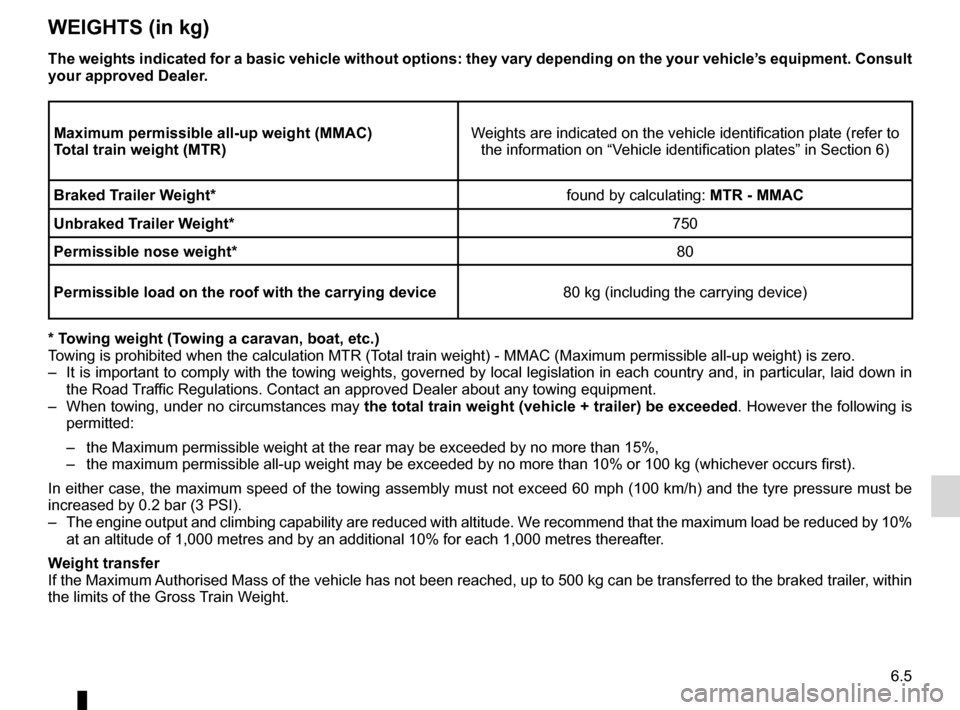
The weights indicated for a basic vehicle without options: they vary depending on the your vehicle’s equipment. Consult
your approved Dealer.
Maximum permissible all-up weight (MMAC)
Total train weight (MTR) Weights are indicated on the vehicle identification plate (refer to
the information on “Vehicle identification plates” in Section 6)
Braked Trailer Weight* found by calculating: MTR - MMAC
Unbraked Trailer Weight* 750
permissible nose weight* 80
permissible load on the roof with the carrying device 80 kg (including the carrying device)
* Towing weight (Towing a caravan, boat, etc.)
Towing is prohibited when the calculation MTR (Total train weight) - MMAC (Maximum permissible all-up weight) is zero\
.
– It is important to comply with the towing weights, governed by local legislation in each country and, in particular, laid down in
the Road Traffic Regulations. Contact an approved Dealer about any towing equipment.
– When towing, under no circumstances may the total train weight (vehicle + trailer) be exceeded . However the following is
permitted:
– the Maximum permissible weight at the rear may be exceeded by no more than 15%,
– the maximum permissible all-up weight may be exceeded by no more than 10% or 100 kg (whichever occu\
rs first).
In either case, the maximum speed of the towing assembly must not exceed 60 mph (100 km/h) and the tyre pressure must be
increased by 0.2 bar (3 PSI).
– The engine output and climbing capability are reduced with altitude. We recommend that the maximum load be reduced by 10%
at an altitude of 1,000 metres and by an additional 10% for each 1,000 m\
etres thereafter.
Weight transfer
If the Maximum Authorised Mass of the vehicle has not been reached, up to 500 kg can be transferred to the braked trailer, within
the limits of the Gross Train Weight.
Page 264 of 267
7.4
FRA_UD25606_4
Index (X81 - J81 - Renault)
ENG_NU_932-3_X81ph3_Renault_7
Jaune NoirNoir texte
AlphAbeticAl index (4/5)
reverse gear
selecting ....................................................................... 2.11
roof bars ................................................................. 3.57 – 3.58
roof rack roof bars ............................................................ 3.57 – 3.58
running in ........................................................................\
..... 2.2
S
seat belt pretensioners front seat belt ............................................................... 1.23
seat belts ...................................................... 1.20 → 1.22, 1.48
service sheets .......................................................... 6.8 → 6.13
side protection devices ...................................................... 1.27
signals and lights ...................................................... 1.66, 1.70
special features of diesel versions .......................................2.7
special features of petrol vehicles ....................................... 2.6
speed limiter ................................................. 1.48, 2.26 → 2.28
starting the engine ..................................................... 2.2 → 2.5
steering wheel adjustment ................................................................... 1.41
storage compartment ............................................. 3.37 → 3.40
storage compartments ........................................... 3.37 → 3.40
storing the driver’s seat position ........................................ 1.18
sun blinds ............................................................... 3.33 – 3.34
sun visor ........................................................................\
.... 3.33
sunroof .................................................................... 3.31 – 3.32
t
tailgate ........................................................................\
....... 3.51
tanks and reservoirs brake fluid .................................................................... 4.10
coolant ........................................................................... 4.8
tanks and reservoirs: windscreen washer ...................................................... 4.11
technical specifications .......................................... 6.2, 6.5, 6.7
temperature regulation ............................................ 3.2 → 3.25tool kit
........................................................................\
. 5.7 – 5.8
towing breakdown ........................................................ 5.34 – 5.35
towing a caravan .......................................................... 5.36
towing a caravan ................................................................. 6.5
towing hitch ............................................................. 5.34 – 5.35
towing rings ....................................................................... 3.55
towing weights ..................................................................... 6.5
traction control ........................................................ 2.21 – 2.22
traction control: ASR ............................................... 2.21 – 2.22
transporting children .......................... 1.29 – 1.30, 1.32 → 1.37
transporting objects in the luggage compartment ........................................ 3.55
luggage net .................................................................. 3.56
on the roof ...................................................................... 6.5
trims ........................................................................\
............. 5.8
trip computer and warning system ..........................1.52 – 1.53
tyre inflation kit ........................................................... 5.4 → 5.6
tyre pressure .................................................... 2.16, 4.12, 5.12
tyre pressure monitor ......................................................... 2.16
tyre pressures .................................................................... 4.12
tyres ..................................... 2.16, 4.12, 5.8 – 5.9, 5.11 → 5.13
V
vehicle identification ............................................................ 6.2
vehicle identification plates ......................................... 6.2 – 6.3
ventilation ................................................................ 3.2 → 3.25
W
warning buzzer .................................................................. 1.68
warning lights ......................................................... 1.46 → 1.53
washing .................................................................. 4.14 – 4.15
weights ........................................................................\
........ 6.5
wheelbrace ........................................................................\
.. 5.8
wheels (safety) ...................... 5.2 – 5.3, 5.8 – 5.9, 5.11 → 5.13
windscreen ........................................................................\
3.30