ignition RENAULT ESPACE 2012 J81 / 4.G Owner's Manual
[x] Cancel search | Manufacturer: RENAULT, Model Year: 2012, Model line: ESPACE, Model: RENAULT ESPACE 2012 J81 / 4.GPages: 267, PDF Size: 8.95 MB
Page 73 of 267

lights:dipped beam headlights ................................... (current page)
lights: side lights ......................................................... (current page)
1.67
ENG_UD20353_1
Eclairage et signalisation extérieure (X81 - J81 - Renault)
ENG_NU_932-3_X81ph3_Renault_1
Lighting and exterior signals
eXTerIOr LIGHTInG and sIGnaLs (1/3)
kdipped beam
headlights
automatic operation
With the engine running, the dipped
beam headlights are switched on or off
automatically depending on the level of
ambient light, without the need to oper-
ate stalk 1 (position 0).
This function can be deactivated or re-
activated.
– To deactivate it, with the ignition
on and engine switched off , turn
stalk 1 twice consecutively from po -
sition 0 to side lights. This action is
confirmed by an audible signal.
– To activate it, with the ignition
switched on and engine running or
off, turn stalk 1 twice consecutively
from position 0 to side lights. This
action is confirmed by an audible
signal.
– To select the main beam headlights,
pull stalk 1 towards you. To return to
the dipped beam headlight position,
pull the stalk towards you again.
– The lights go out when the engine
is stopped, when the driver’s door is
opened or when the vehicle is locked
with the RENAULT card.
Manual operation
Turn the end of stalk 1 until the symbol
is opposite mark 3.
An indicator light lights up on the instru-
ment panel in all cases.
daytime running lights
The daytime running lights come on
when the engine is started if stalk 1 is
in position 0.
If the dipped beam headlights oper -
ate automatically, the daytime running
lights only come on if the side lights are
off
1
2
1
3
uside lights
Turn the end of stalk 1 until the
symbol is opposite mark 3.
The instrument panel lights up, the
brightness can be adjusted by using
control knob 2.
Page 74 of 267
warning buzzer ...................................................... (current page)
lights: fog lights .......................................................... (current page)
lights: main beam headlights ...................................... (current page)
1.68
ENG_UD20353_1
Eclairage et signalisation extérieure (X81 - J81 - Renault)
ENG_NU_932-3_X81ph3_Renault_1
Jaune NoirNoir texte
eXTerIOr LIGHTInG and sIGnaLs (2/3)
áMain beam headlights
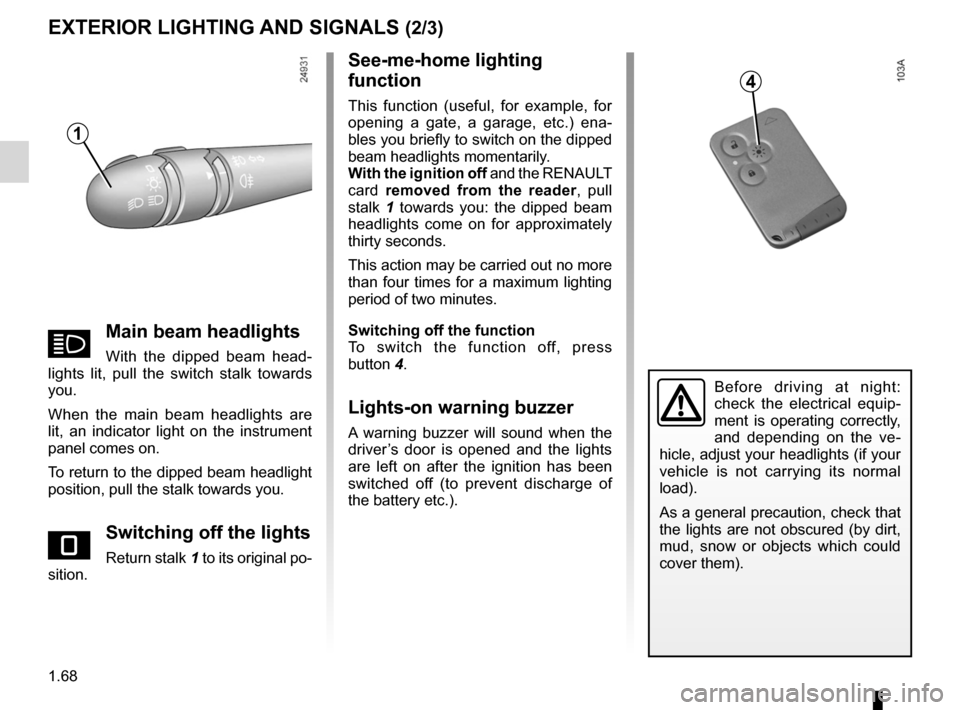
With the dipped beam head -
lights lit, pull the switch stalk towards
you.
When the main beam headlights are
lit, an indicator light on the instrument
panel comes on.
To return to the dipped beam headlight
position, pull the stalk towards you.
eswitching off the lights
Return stalk 1 to its original po-
sition.
see-me-home lighting
function
This function (useful, for example, for
opening a gate, a garage, etc.) ena -
bles you briefly to switch on the dipped
beam headlights momentarily.
With the ignition off and the RENAULT
card removed from the reader , pull
stalk 1 towards you: the dipped beam
headlights come on for approximately
thirty seconds.
This action may be carried out no more
than four times for a maximum lighting
period of two minutes.
switching off the function
To switch the function off, press
button 4.
Lights-on warning buzzer
A warning buzzer will sound when the
driver’s door is opened and the lights
are left on after the ignition has been
switched off (to prevent discharge of
the battery etc.).
Before driving at night:
check the electrical equip -
ment is operating correctly,
and depending on the ve -
hicle, adjust your headlights (if your
vehicle is not carrying its normal
load).
As a general precaution, check that
the lights are not obscured (by dirt,
mud, snow or objects which could
cover them).
1
4
Page 77 of 267
wipers ................................................... (up to the end of the DU)
windscreen washer ............................... (up to the end of the DU)
1.71
ENG_UD20355_1
Essuie-vitre/lave-vitre avant (X81 - J81 - Renault)
ENG_NU_932-3_X81ph3_Renault_1
Wash/Wipe
WIndscreen W asH/WIPe (1/2)
nVehicle fitted
with intermittent
windscreen wipers
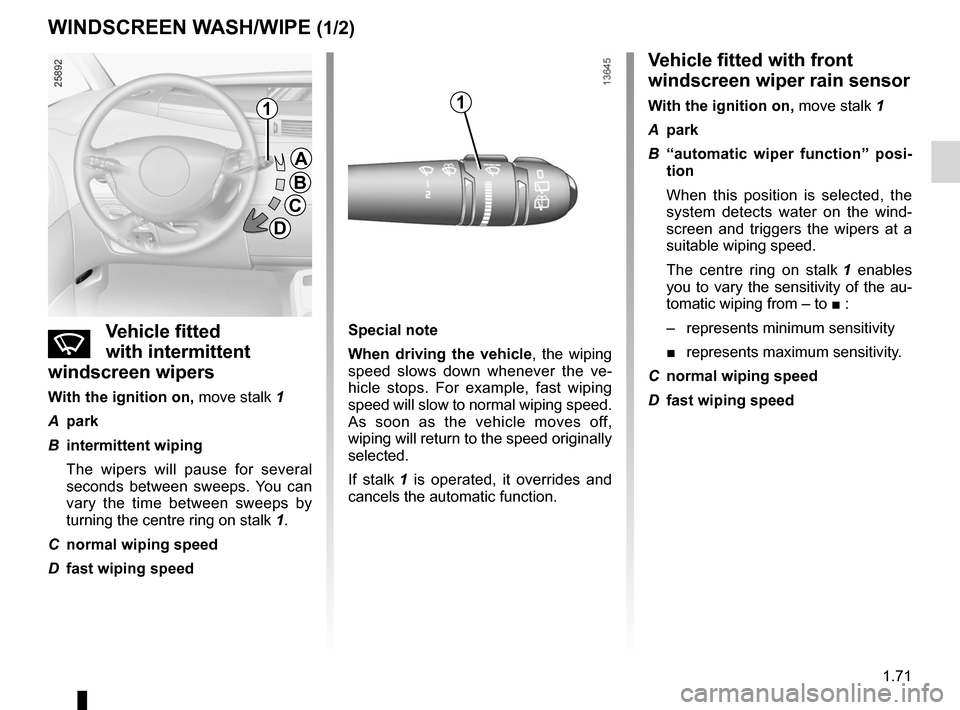
With the ignition on, move stalk 1
A park
B intermittent wiping
The wipers will pause for several
seconds between sweeps. You can
vary the time between sweeps by
turning the centre ring on stalk 1.
C normal wiping speed
D fast wiping speed
Vehicle fitted with front
windscreen wiper rain sensor
With the ignition on, move stalk 1
A park
B “automatic wiper function” posi -
tion
When this position is selected, the
system detects water on the wind -
screen and triggers the wipers at a
suitable wiping speed.
The centre ring on stalk 1 enables
you to vary the sensitivity of the au-
tomatic wiping from – to ■ :
– represents minimum sensitivity
■ represents maximum sensitivity.
C normal wiping speed
D fast wiping speed1
a
B
c
d
special note
When driving the vehicle , the wiping
speed slows down whenever the ve -
hicle stops. For example, fast wiping
speed will slow to normal wiping speed.
As soon as the vehicle moves off,
wiping will return to the speed originally
selected.
If stalk 1 is operated, it overrides and
cancels the automatic function.
1
Page 78 of 267
1.72
ENG_UD20355_1
Essuie-vitre/lave-vitre avant (X81 - J81 - Renault)
ENG_NU_932-3_X81ph3_Renault_1
WIndscreen W asH/WIPe (2/2)
Windscreen washer,
headlight washers
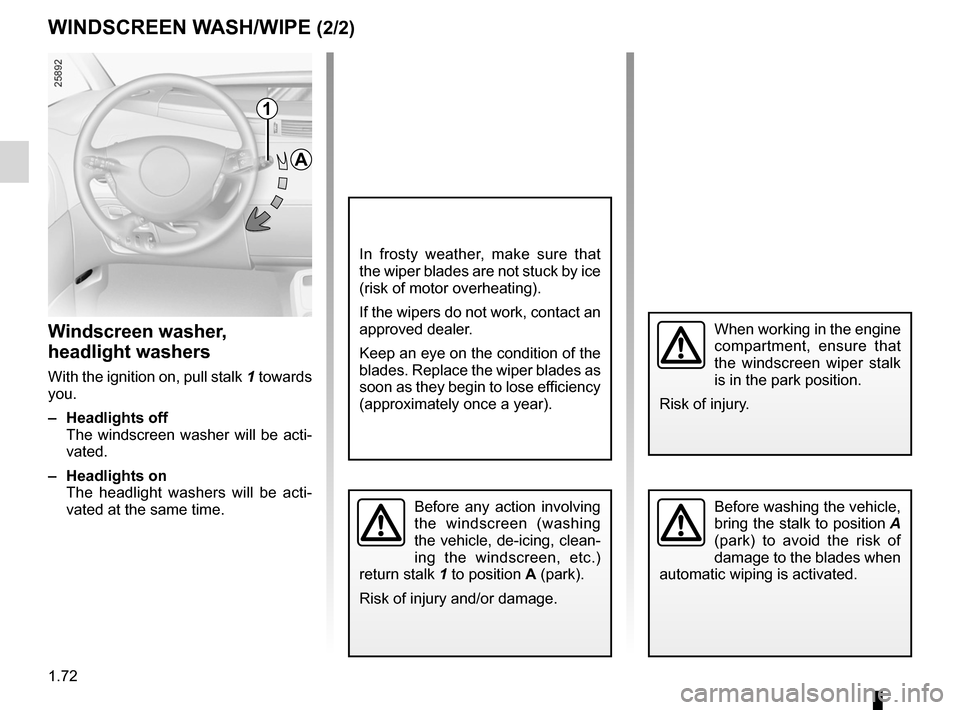
With the ignition on, pull stalk 1 towards
you.
– Headlights off
The windscreen washer will be acti-
vated.
– Headlights on
The headlight washers will be acti -
vated at the same time.
1
a
Before washing the vehicle,
bring the stalk to position A
(park) to avoid the risk of
damage to the blades when
automatic wiping is activated.Before any action involving
the windscreen (washing
the vehicle, de-icing, clean -
ing the windscreen, etc.)
return stalk 1 to position a (park).
Risk of injury and/or damage.
When working in the engine
compartment, ensure that
the windscreen wiper stalk
is in the park position.
Risk of injury.
In frosty weather, make sure that
the wiper blades are not stuck by ice
(risk of motor overheating).
If the wipers do not work, contact an
approved dealer.
Keep an eye on the condition of the
blades. Replace the wiper blades as
soon as they begin to lose efficiency
(approximately once a year).
Page 79 of 267
wipers ................................................... (up to the end of the DU)
windscreen washer ............................... (up to the end of the DU)
1.73
ENG_UD20356_1
Essuie-vitre/lave-vitre arrière (X81 - J81 - Renault)
ENG_NU_932-3_X81ph3_Renault_1
rear screen W asH/WIPe
Yrear screen wiper with
timer
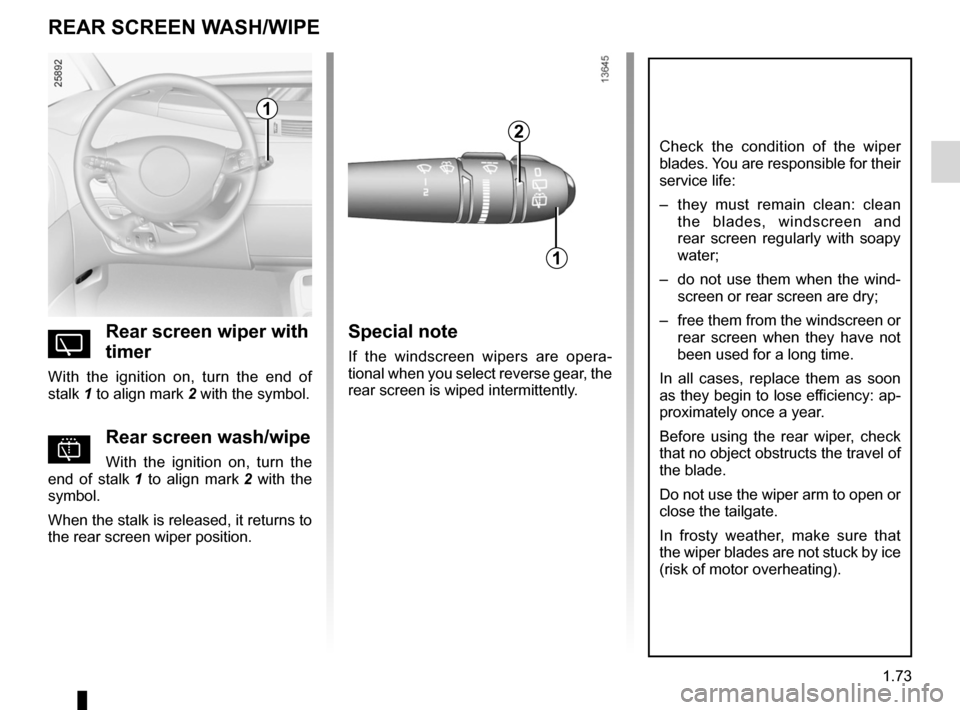
With the ignition on, turn the end of
stalk 1 to align mark 2 with the symbol.
prear screen wash/wipe
With the ignition on, turn the
end of stalk 1 to align mark 2 with the
symbol.
When the stalk is released, it returns to
the rear screen wiper position.
special note
If the windscreen wipers are opera -
tional when you select reverse gear, the
rear screen is wiped intermittently.
1
2
1
Check the condition of the wiper
blades. You are responsible for their
service life:
– they must remain clean: clean
the blades, windscreen and
rear screen regularly with soapy
water;
– do not use them when the wind-
screen or rear screen are dry;
– free them from the windscreen or
rear screen when they have not
been used for a long time.
In all cases, replace them as soon
as they begin to lose efficiency: ap-
proximately once a year.
Before using the rear wiper, check
that no object obstructs the travel of
the blade.
Do not use the wiper arm to open or
close the tailgate.
In frosty weather, make sure that
the wiper blades are not stuck by ice
(risk of motor overheating).
Page 81 of 267
JauneNoirNoir texte
1.75
ENG_UD24089_2
Réservoir à carburant (X81 - J81 - Renault)
ENG_NU_932-3_X81ph3_Renault_1
Vehicles running on ethanol -
based fuel
It is essential to use unleaded petrol or
fuel containing a maximum of 85% eth-
anol (E85).
In very cold conditions, it may be very
difficult or even impossible to start the
engine. To avoid this problem, use un-
leaded petrol or, on equipped vehicles,
use the heater integrated in the engine:
connect the special end of the exten -
sion piece supplied into the socket in -
tegrated into the radiator grille and the
other end into a 220V socket for at least
6 hours before starting.
nB: you may notice an increase in fuel
consumption with this type of fuel.
fUeL T anK (2/3)
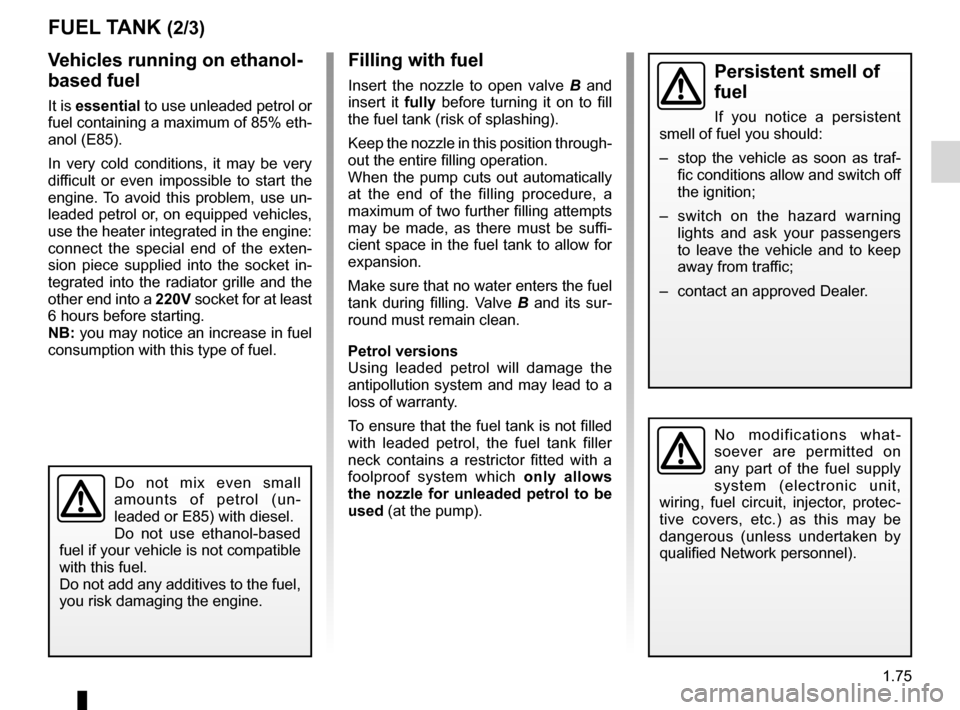
filling with fuel
Insert the nozzle to open valve B and
insert it fully before turning it on to fill
the fuel tank (risk of splashing).
Keep the nozzle in this position through -
out the entire filling operation.
When the pump cuts out automatically
at the end of the filling procedure, a
maximum of two further filling attempts
may be made, as there must be suffi -
cient space in the fuel tank to allow for
expansion.
Make sure that no water enters the fuel
tank during filling. Valve B and its sur-
round must remain clean.
Petrol versions
Using leaded petrol will damage the
antipollution system and may lead to a
loss of warranty.
To ensure that the fuel tank is not filled
with leaded petrol, the fuel tank filler
neck contains a restrictor fitted with a
foolproof system which only allows
the nozzle for unleaded petrol to be
used (at the pump).
No modifications what -
soever are permitted on
any part of the fuel supply
system (electronic unit,
wiring, fuel circuit, injector, protec -
tive covers, etc.) as this may be
dangerous (unless undertaken by
qualified Network personnel).
Persistent smell of
fuel
If you notice a persistent
smell of fuel you should:
– stop the vehicle as soon as traf-
fic conditions allow and switch off
the ignition;
– switch on the hazard warning
lights and ask your passengers
to leave the vehicle and to keep
away from traffic;
– contact an approved Dealer.
Do not mix even small
amounts of petrol (un -
leaded or E85) with diesel.
Do not use ethanol-based
fuel if your vehicle is not compatible
with this fuel.
Do not add any additives to the fuel,
you risk damaging the engine.
Page 84 of 267
ignition switch ........................................................ (current page)
starting the engine ................................................. (current page)
running in ............................................................... (current page)
driving ................................................... (up to the end of the DU)
2.2
ENG_UD25549_3
Rodage (X81 - Renault)
ENG_NU_932-3_X81ph3_Renault_2
Running in
RUNNING IN
– Petrol version
For the first 600 miles (1,000 km), do
not exceed 78 mph (130 km/h) in the
highest gear, or 3,000 to 3,500 rpm.
You may only expect top performance
from your vehicle after 1,800 miles
(3,000 km).
Service intervals: please refer to your
vehicle’s maintenance document. –
Diesel version
For the first 900 miles (1,500 km) ,
do not exceed 2,500 rpm. After com -
pleting this mileage you may drive
faster, although you may only expect
top performance after approximately
3,600 miles (6,000 km).
During the running in period, do not ac-
celerate hard while the engine is still
cold and do not let the engine over-rev.
Service intervals: please refer to your
vehicle’s maintenance document.
Page 85 of 267
engine start/stop button ........................ (up to the end of the DU)
ignition switch ....................................... (up to the end of the DU)
starting the engine ................................ (up to the end of the DU)
driving ................................................... (up to the end of the DU)
2.3
ENG_UD25550_3
Démarrage/arrêt moteur avec carte RENAULT mains libres (X81 - J81 - Renault)
ENG_NU_932-3_X81ph3_Renault_2
Starting/stopping the engine
STARTING/STOPPING THE ENGINE (1/3)
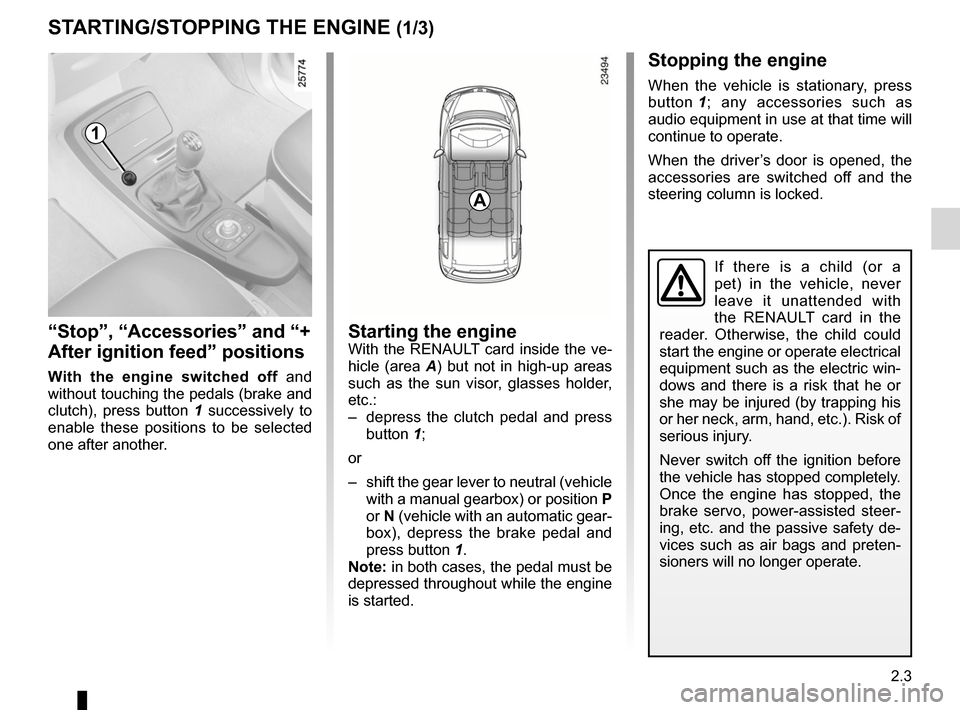
“Stop”, “Accessories” and “+
After ignition feed” positions
With the engine switched off and
without touching the pedals (brake and
clutch), press button 1 successively to
enable these positions to be selected
one after another.
Starting the engineWith the RENAULT card inside the ve-
hicle (area A) but not in high-up areas
such as the sun visor, glasses holder,
etc.:
– depress the clutch pedal and press
button 1;
or
– shift the gear lever to neutral (vehicle
with a manual gearbox) or position P
or N (vehicle with an automatic gear-
box), depress the brake pedal and
press button 1.
Note: in both cases, the pedal must be
depressed throughout while the engine
is started.
Stopping the engine
When the vehicle is stationary, press
button 1 ; any accessories such as
audio equipment in use at that time will
continue to operate.
When the driver’s door is opened, the
accessories are switched off and the
steering column is locked.
If there is a child (or a
pet) in the vehicle, never
leave it unattended with
the RENAULT card in the
reader. Otherwise, the child could
start the engine or operate electrical
equipment such as the electric win-
dows and there is a risk that he or
she may be injured (by trapping his
or her neck, arm, hand, etc.). Risk of
serious injury.
Never switch off the ignition before
the vehicle has stopped completely.
Once the engine has stopped, the
brake servo, power-assisted steer -
ing, etc. and the passive safety de-
vices such as air bags and preten -
sioners will no longer operate.
A
1
Page 87 of 267
JauneNoirNoir texte
2.5
ENG_UD25550_3
Démarrage/arrêt moteur avec carte RENAULT mains libres (X81 - J81 - Renault)
ENG_NU_932-3_X81ph3_Renault_2
3
1
STARTING/STOPPING THE ENGINE (3/3)
“Engine start” position
(continued)
For diesel versions, wait for the pre -
heating warning light
É to go out
on the instrument panel before press -
ing button 1.
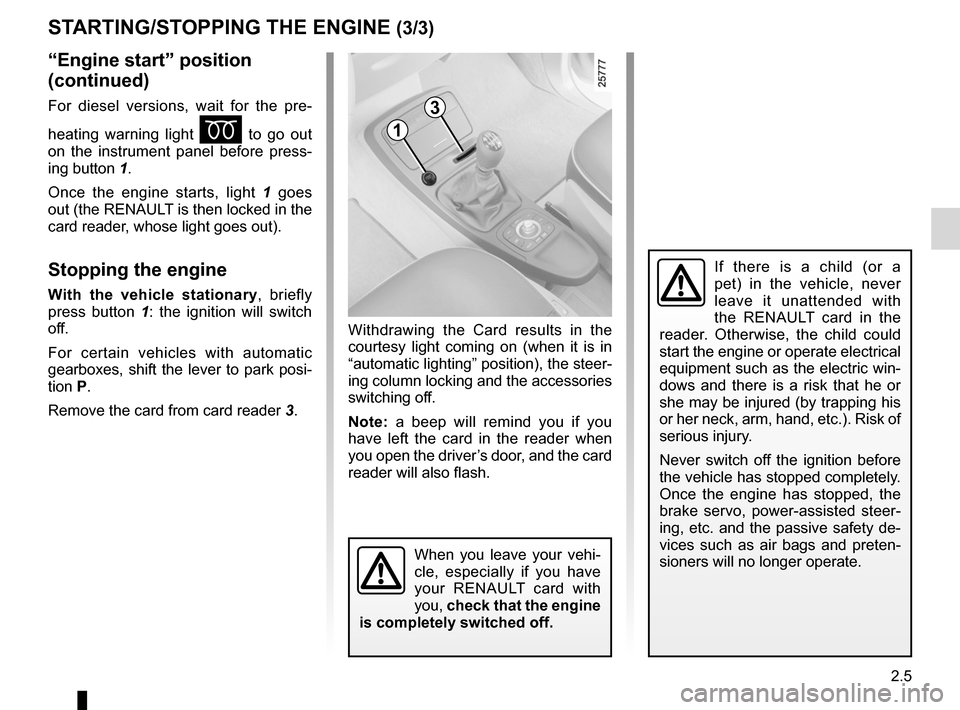
Once the engine starts, light 1 goes
out (the RENAULT is then locked in the
card reader, whose light goes out).
Stopping the engine
With the vehicle stationary , briefly
press button 1 : the ignition will switch
off.
For certain vehicles with automatic
gearboxes, shift the lever to park posi-
tion P.
Remove the card from card reader 3.Withdrawing the Card results in the
courtesy light coming on (when it is in
“automatic lighting” position), the steer-
ing column locking and the accessories
switching off.
Note:
a beep will remind you if you
have left the card in the reader when
you open the driver’s door, and the card
reader will also flash.
When you leave your vehi -
cle, especially if you have
your RENAULT card with
you, check that the engine
is completely switched off.
If there is a child (or a
pet) in the vehicle, never
leave it unattended with
the RENAULT card in the
reader. Otherwise, the child could
start the engine or operate electrical
equipment such as the electric win-
dows and there is a risk that he or
she may be injured (by trapping his
or her neck, arm, hand, etc.). Risk of
serious injury.
Never switch off the ignition before
the vehicle has stopped completely.
Once the engine has stopped, the
brake servo, power-assisted steer -
ing, etc. and the passive safety de-
vices such as air bags and preten -
sioners will no longer operate.
Page 88 of 267

ENG_NU_932-3_X81ph3_Renault_2
Special features of petrol versions
SPEcIAL FEATURES OF PETROL vERSIONS")
2.6
ENG_UD13142_3
Particularités des versions essence (X45 - H45 - X95 - B95 - D95 - R\
enault)
ENG_NU_932-3_X81ph3_Renault_2
Special features of petrol versions
SPEcIAL FEATURES OF PETROL vERSIONS
Do not park the vehicle or
run the engine in locations
where combustible sub -
stances or materials such
as grass or leaves can come into
contact with the hot exhaust system.
The following operating conditions
should be avoided:
– driving for long periods when the low
fuel level warning light is lit up,
– using leaded petrol,
– using fuel or lubrication additives
which are not approved.
Or operating faults such as:
– faulty ignition system, running out of
fuel or disconnected spark plugs re-
sulting in the engine misfiring or cut-
ting out when driving;
– loss of power,
may cause the catalytic converter to
overheat, reducing its efficiency which
may irreparably damage it and cause
heat damage to the vehicle. If you notice any of the above operating
faults, have the necessary repairs car-
ried out as soon as possible by an ap-
proved dealer.
These faults may be avoided by regu
-
larly taking your vehicle to an approved
Dealer at the intervals specified in the
Maintenance Service Booklet.
Starting problems
To avoid damaging the catalytic con -
verter, do not keep trying to start the
engine (using the start button, or by
pushing or towing the vehicle) without
having identified and corrected the
cause of the fault.
If the fault cannot be identified, do not
continue to try and start the engine, but
contact an approved dealer.