tow RENAULT ESPACE 2012 J81 / 4.G Owner's Manual
[x] Cancel search | Manufacturer: RENAULT, Model Year: 2012, Model line: ESPACE, Model: RENAULT ESPACE 2012 J81 / 4.GPages: 267, PDF Size: 8.95 MB
Page 207 of 267
tool kit ................................................... (up to the end of the DU)
practical advice ..................................... (up to the end of the DU)
puncture ................................................ (up to the end of the DU)
jack ....................................................... (up to the end of the DU)
5.7
ENG_UD20692_3
Bloc outil (X81 - Renault)
ENG_NU_932-3_X81ph3_Renault_5
Tool kit (Jack - Wheelbrace)
t OOL KIt (1/2)
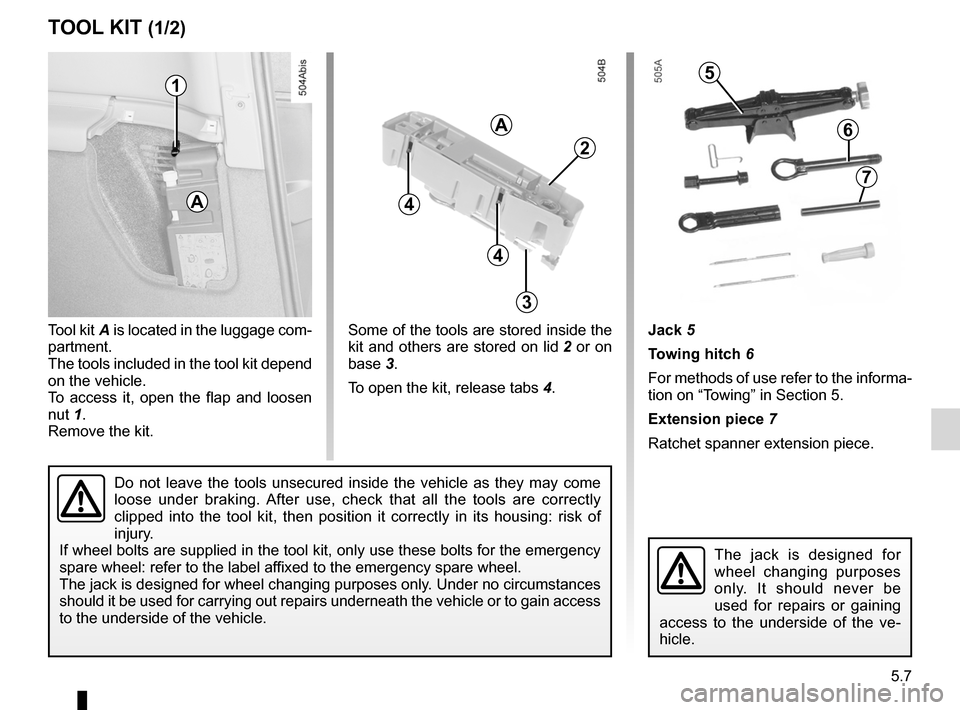
Tool kit A is located in the luggage com-
partment.
The tools included in the tool kit depend
on the vehicle.
To access it, open the flap and loosen
nut 1.
Remove the kit.Some of the tools are stored inside the
kit and others are stored on lid 2 or on
base 3.
To open the kit, release tabs 4.
1
A4
A
2
4
3
Jack 5
t owing hitch 6
For methods of use refer to the informa-
tion on “Towing” in Section 5.
extension piece 7
Ratchet spanner extension piece.
5
6
7
The jack is designed for
wheel changing purposes
only. It should never be
used for repairs or gaining
access to the underside of the ve -
hicle.
Do not leave the tools unsecured inside the vehicle as they may come
loose under braking. After use, check that all the tools are correctly
clipped into the tool kit, then position it correctly in its housing: risk of
injury.
If wheel bolts are supplied in the tool kit, only use these bolts for the emergency
spare wheel: refer to the label affixed to the emergency spare wheel.
The jack is designed for wheel changing purposes only. Under no circumstances
should it be used for carrying out repairs underneath the vehicle or to gain access
to the underside of the vehicle.
Page 218 of 267
bulbschanging ......................................... (up to the end of the DU)
fog lights ............................................... (up to the end of the DU)
changing a bulb .................................... (up to the end of the DU)
indicators ............................................................... (current page)
practical advice ...................................................... (current page)
lights: direction indicators ........................................... (current page)
lights: side lights ......................................................... (current page)
lights: reversing lights ................................................. (current page)
lights: brake lights ...................................................... (current page)
bulbs changing ......................................... (up to the end of the DU)
5.18
ENG_UD20424_1
Feux arrière : remplacement des lampes (X81 - J81 - Renault)
ENG_NU_932-3_X81ph3_Renault_5
Jaune NoirNoir texte
Rear lights (changing bulbs)
reAr LIGHtS: changing bulbs
upper light unit
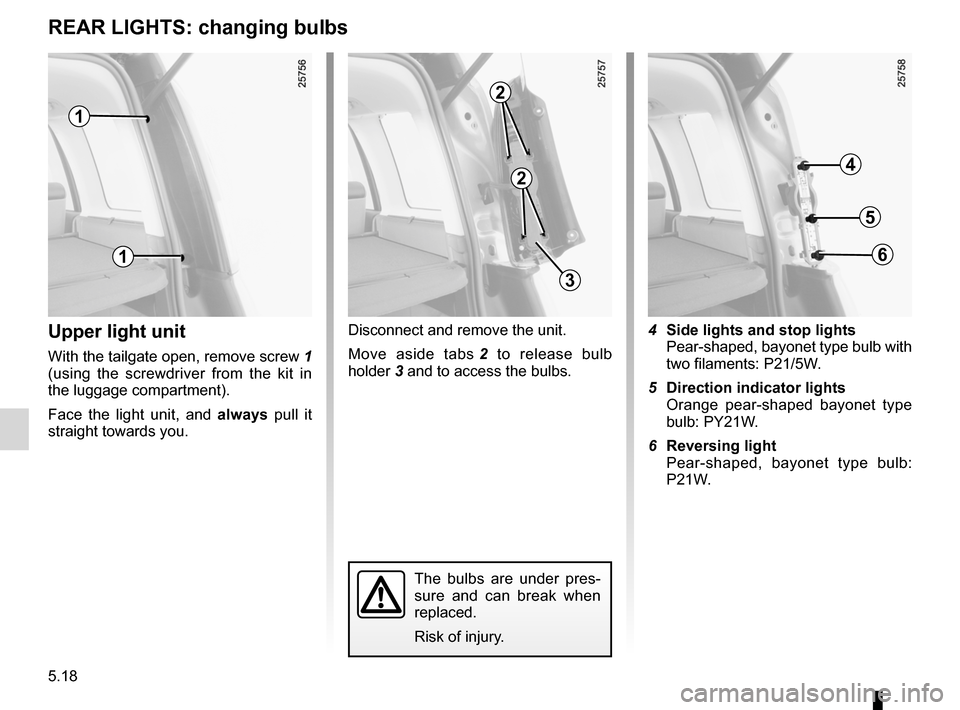
With the tailgate open, remove screw 1
(using the screwdriver from the kit in
the luggage compartment).
Face the light unit, and always pull it
straight towards you. Disconnect and remove the unit.
Move aside tabs
2 to release bulb
holder 3 and to access the bulbs. 4
Side lights and stop lights
Pear-shaped, bayonet type bulb with
two filaments: P21/5W.
5 Direction indicator lights
Orange pear-shaped bayonet type
bulb: PY21W.
6 reversing light
Pear-shaped, bayonet type bulb:
P21W.
The bulbs are under pres -
sure and can break when
replaced.
Risk of injury.
1
1
2
2
3
4
5
6
Page 230 of 267
5.30
ENG_UD20429_1
Batterie : dépannage (X81 - J81 - Renault)
ENG_NU_932-3_X81ph3_Renault_5
Jaune NoirNoir texte
BAtter Y: troubleshooting (continued)
connecting a battery charger
t he battery charger must be com -
patible with a battery with a nominal
voltage of 12 volts.
It is essential to disconnect both bat -
tery leads from the terminals (engine
stopped) starting with the negative
terminal.
Do not disconnect the battery when the
engine is running. Follow the instruc-
tions given by the manufacturer of
the battery charger you are using.
Only a fully charged and well-main -
tained battery will have a long and
useful life and enable you to start the
vehicle’s engine normally.
The battery must be kept clean and dry.
Have the battery’s charge status
checked regularly:
– Especially if you use your vehicle for
short journeys or for frequent driving
in town. –
When the exterior temperature drops
(in winter), the charge decreases.
In winter, only use electrical equip -
ment which is really necessary.
– Finally, you should understand that
the charge decreases naturally as a
result of certain permanent electrical
consumers such as the clock, after-
sales accessories, etc.
When a large number of accessories
are fitted to the vehicle, have them con-
nected to the + after ignition feed. In
this case, it is advisable to have your
vehicle fitted with a battery which has
an increased nominal capacity. Contact
an approved dealer. If your vehicle is to be left stationary
for a relatively long time, disconnect
the battery or have it recharged regu
-
larly, particularly during cold weather.
The equipment with a memory, radio
etc. will then have to be reprogrammed.
The battery must be stored in a cool dry
place, protected from frost.
Special procedures may be
required to charge some
batteries. Contact your ap -
proved dealer.
Avoid all risk of sparks which may
cause an immediate explosion, and
charge the battery in a well-venti -
lated area. Risk of serious injury.
Page 234 of 267
towing hitch........................................... (up to the end of the DU)
practical advice ..................................... (up to the end of the DU)
towing breakdown ...................................... (up to the end of the DU)
5.34
ENG_UD24496_2
Remorquage : dépannage (X81 - J81 - Renault)
ENG_NU_932-3_X81ph3_Renault_5
Jaune NoirNoir texte
Towing
tOWInG: breakdown
Insert the card fully into the card
reader to unlock the steering wheel
and to be able to use the signal
lights (brake lights, indicators, etc.).
the towed vehicle’s lights must be
switched on at night.
The speed specified by current legis -
lation for towing must always be ob -
served. If your vehicle is the towing
vehicle, do not exceed the maximum
towing weight for your vehicle (refer
to the information on “Weights” in
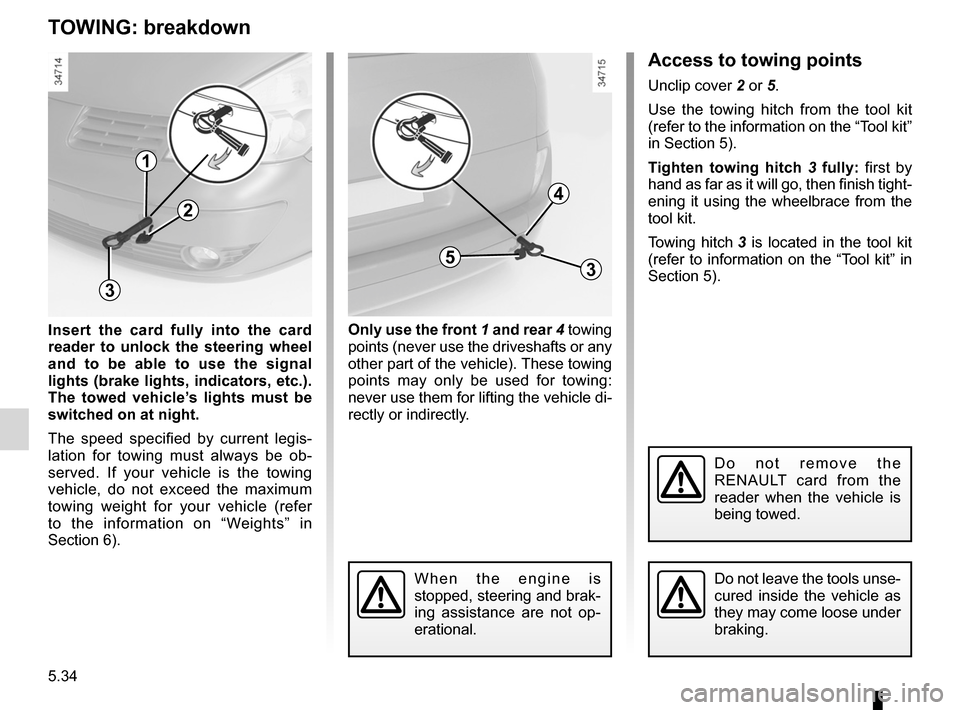
Section 6). Only use the front
1 and rear 4 towing
points (never use the driveshafts or any
other part of the vehicle). These towing
points may only be used for towing:
never use them for lifting the vehicle di-
rectly or indirectly.
Access to towing points
Unclip cover 2 or 5.
Use the towing hitch from the tool kit
(refer to the information on the “Tool kit”
in Section 5).
t ighten towing hitch 3 fully: first by
hand as far as it will go, then finish tight-
ening it using the wheelbrace from the
tool kit.
Towing hitch 3 is located in the tool kit
(refer to information on the “Tool kit” in
Section 5).
W h e n t h e e n g i n e i s
stopped, steering and brak-
ing assistance are not op -
erational.
1
2
3
4
53
Do not leave the tools unse-
cured inside the vehicle as
they may come loose under
braking.
D o n o t r e m o v e t h e
RENAULT card from the
reader when the vehicle is
being towed.
Page 235 of 267

JauneNoirNoir texte
5.35
ENG_UD24496_2
Remorquage : dépannage (X81 - J81 - Renault)
ENG_NU_932-3_X81ph3_Renault_5
t OWInG: breakdown (continued)
towing a vehicle with an
automatic transmission:
special features
With the engine switched off: the
gearbox is no longer lubricated. It is
preferable to tow this type of vehicle on
a trailer or tow it with the front wheels
off the ground.
u nder exceptional circumstances ,
you may tow the vehicle with all four
wheels on the ground, only going for -
ward, with the gear lever in the n posi-
tion, and for a distance not exceeding
30 miles (50 km).
W h e n t h e e n g i n e i s
stopped, steering and brak-
ing assistance are not op -
erational.
2
1
3
– Use a rigid towing bar.
If a rope or cable is used
(where the law allows this),
the vehicle being towed
must be able to brake.
– A vehicle must not be towed if it is
not fit to be driven.
– Avoid accelerating or braking
suddenly when towing, as this
may result in damage being
caused to the vehicle.
– When towing a vehicle, it is ad -
visable not to exceed 15 mph
(25 km/h).
If the lever is stuck in P,
even though you are de -
pressing the brake pedal,
the lever can be released
manually.
To do this, unclip the cover at the
base of the lever.
Press simultaneously on button 2
and on the unlocking button on
lever 1.
Page 236 of 267
5.36
ENG_UD1852_1
Remorquage : attelage (X81 - Renault)
ENG_NU_932-3_X81ph3_Renault_5
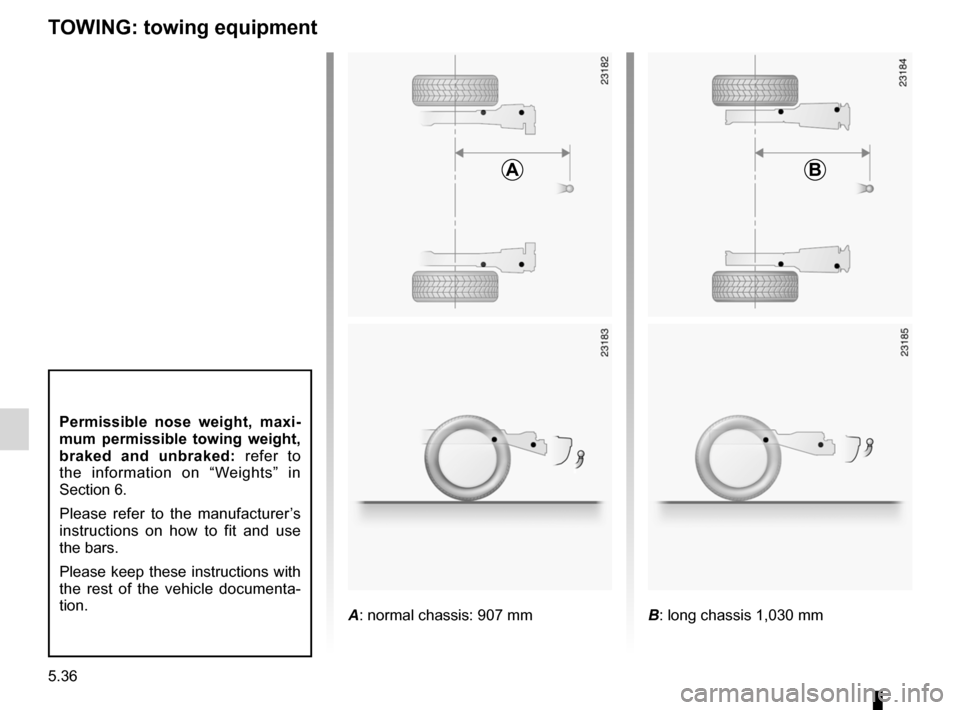
t OWInG: towing equipment
Permissible nose weight, maxi -
mum permissible towing weight,
braked and unbraked: refer to
the information on “Weights” in
Section 6.
Please refer to the manufacturer’s
instructions on how to fit and use
the bars.
Please keep these instructions with
the rest of the vehicle documenta -
tion.
AB
A: normal chassis: 907 mm B: long chassis 1,030 mm
Page 243 of 267
6.1
ENG_UD25605_4
Sommaire 6 (X81 - J81 - Renault)
ENG_NU_932-3_X81ph3_Renault_6
Section 6: Technical specifications
Vehicle identification plates . . . . . . . . . . . . . . . . . . . . . . . . . . . . . . . . . . . . . . . . . . . . . . . . . . . . . . . . 6.2
Engine identification plates . . . . . . . . . . . . . . . . . . . . . . . . . . . . . . . . . . . . . . . . . . . . . . . . . . . . . . . . 6.3
Engine specifications . . . . . . . . . . . . . . . . . . . . . . . . . . . . . . . . . . . . . . . . . . . . . . . . . . . . . . . . . . . . . 6.4
Weights . . . . . . . . . . . . . . . . . . . . . . . . . . . . . . . . . . . . . . . . . . . . . . . . . . . . . . . . . . . . . . . . . . . . . . . 6.5
Towing weights . . . . . . . . . . . . . . . . . . . . . . . . . . . . . . . . . . . . . . . . . . . . . . . . . . . . . . . . . . . . . . . . . 6.5
Dimensions . . . . . . . . . . . . . . . . . . . . . . . . . . . . . . . . . . . . . . . . . . . . . . . . . . . . . . . . . . . . . . . . . . . . 6.6
Replacement parts and repairs . . . . . . . . . . . . . . . . . . . . . . . . . . . . . . . . . . . . . . . . . . . . . . . . . . . . . 6.7
Service sheets . . . . . . . . . . . . . . . . . . . . . . . . . . . . . . . . . . . . . . . . . . . . . . . . . . . . . . . . . . . . . . . . . . 6.8
Anti-corrosion check . . . . . . . . . . . . . . . . . . . . . . . . . . . . . . . . . . . . . . . . . . . . . . . . . . . . . . . . . . . . . 6.14
Page 247 of 267
technical specifications .......................................... (current page)
towing a caravan ................................................... (current page)
towing weights ....................................................... (current page)
weights .................................................................. (current page)
load permitted on the roof ......................................(current page)
transporting objects on the roof ........................................................ (current page)
6.5
ENG_UD24351_2
Masses (en kg) (X81 - J81 - Renault)
ENG_NU_932-3_X81ph3_Renault_6
Weights
Towing weights
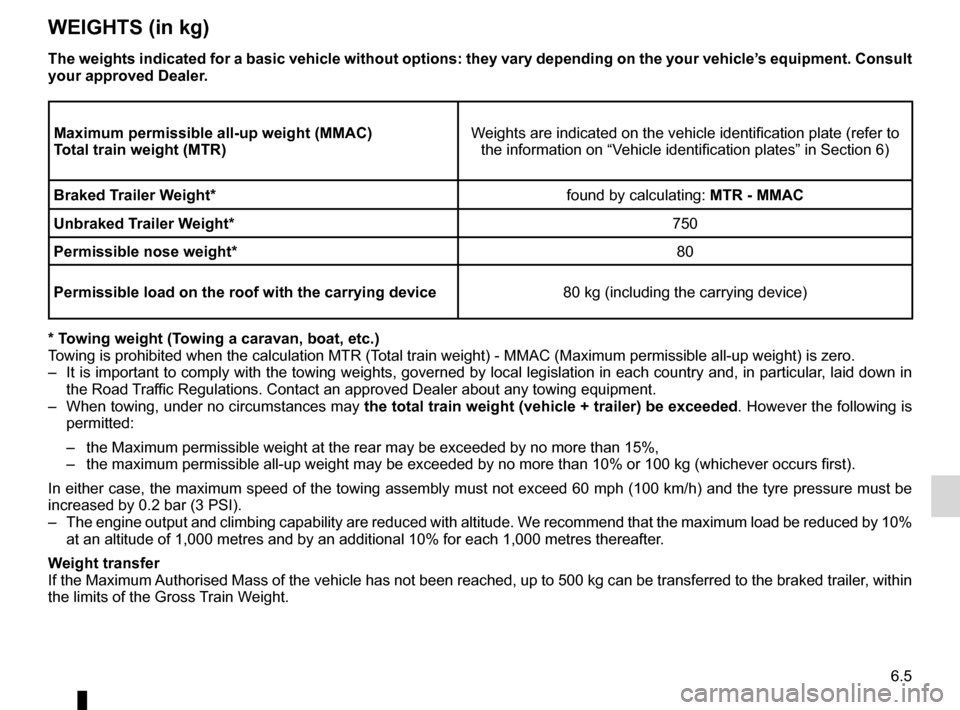
WEIgHTs (in kg)
The weights indicated for a basic vehicle without options: they vary depending on the your vehicle’s equipment. Consult
your approved Dealer.
Maximum permissible all-up weight (MMAC)
Total train weight (MTR) Weights are indicated on the vehicle identification plate (refer to
the information on “Vehicle identification plates” in Section 6)
Braked Trailer Weight* found by calculating: MTR - MMAC
Unbraked Trailer Weight* 750
permissible nose weight* 80
permissible load on the roof with the carrying device 80 kg (including the carrying device)
* Towing weight (Towing a caravan, boat, etc.)
Towing is prohibited when the calculation MTR (Total train weight) - MMAC (Maximum permissible all-up weight) is zero\
.
– It is important to comply with the towing weights, governed by local legislation in each country and, in particular, laid down in
the Road Traffic Regulations. Contact an approved Dealer about any towing equipment.
– When towing, under no circumstances may the total train weight (vehicle + trailer) be exceeded . However the following is
permitted:
– the Maximum permissible weight at the rear may be exceeded by no more than 15%,
– the maximum permissible all-up weight may be exceeded by no more than 10% or 100 kg (whichever occu\
rs first).
In either case, the maximum speed of the towing assembly must not exceed 60 mph (100 km/h) and the tyre pressure must be
increased by 0.2 bar (3 PSI).
– The engine output and climbing capability are reduced with altitude. We recommend that the maximum load be reduced by 10%
at an altitude of 1,000 metres and by an additional 10% for each 1,000 m\
etres thereafter.
Weight transfer
If the Maximum Authorised Mass of the vehicle has not been reached, up to 500 kg can be transferred to the braked trailer, within
the limits of the Gross Train Weight.
Page 264 of 267
7.4
FRA_UD25606_4
Index (X81 - J81 - Renault)
ENG_NU_932-3_X81ph3_Renault_7
Jaune NoirNoir texte
AlphAbeticAl index (4/5)
reverse gear
selecting ....................................................................... 2.11
roof bars ................................................................. 3.57 – 3.58
roof rack roof bars ............................................................ 3.57 – 3.58
running in ........................................................................\
..... 2.2
S
seat belt pretensioners front seat belt ............................................................... 1.23
seat belts ...................................................... 1.20 → 1.22, 1.48
service sheets .......................................................... 6.8 → 6.13
side protection devices ...................................................... 1.27
signals and lights ...................................................... 1.66, 1.70
special features of diesel versions .......................................2.7
special features of petrol vehicles ....................................... 2.6
speed limiter ................................................. 1.48, 2.26 → 2.28
starting the engine ..................................................... 2.2 → 2.5
steering wheel adjustment ................................................................... 1.41
storage compartment ............................................. 3.37 → 3.40
storage compartments ........................................... 3.37 → 3.40
storing the driver’s seat position ........................................ 1.18
sun blinds ............................................................... 3.33 – 3.34
sun visor ........................................................................\
.... 3.33
sunroof .................................................................... 3.31 – 3.32
t
tailgate ........................................................................\
....... 3.51
tanks and reservoirs brake fluid .................................................................... 4.10
coolant ........................................................................... 4.8
tanks and reservoirs: windscreen washer ...................................................... 4.11
technical specifications .......................................... 6.2, 6.5, 6.7
temperature regulation ............................................ 3.2 → 3.25tool kit
........................................................................\
. 5.7 – 5.8
towing breakdown ........................................................ 5.34 – 5.35
towing a caravan .......................................................... 5.36
towing a caravan ................................................................. 6.5
towing hitch ............................................................. 5.34 – 5.35
towing rings ....................................................................... 3.55
towing weights ..................................................................... 6.5
traction control ........................................................ 2.21 – 2.22
traction control: ASR ............................................... 2.21 – 2.22
transporting children .......................... 1.29 – 1.30, 1.32 → 1.37
transporting objects in the luggage compartment ........................................ 3.55
luggage net .................................................................. 3.56
on the roof ...................................................................... 6.5
trims ........................................................................\
............. 5.8
trip computer and warning system ..........................1.52 – 1.53
tyre inflation kit ........................................................... 5.4 → 5.6
tyre pressure .................................................... 2.16, 4.12, 5.12
tyre pressure monitor ......................................................... 2.16
tyre pressures .................................................................... 4.12
tyres ..................................... 2.16, 4.12, 5.8 – 5.9, 5.11 → 5.13
V
vehicle identification ............................................................ 6.2
vehicle identification plates ......................................... 6.2 – 6.3
ventilation ................................................................ 3.2 → 3.25
W
warning buzzer .................................................................. 1.68
warning lights ......................................................... 1.46 → 1.53
washing .................................................................. 4.14 – 4.15
weights ........................................................................\
........ 6.5
wheelbrace ........................................................................\
.. 5.8
wheels (safety) ...................... 5.2 – 5.3, 5.8 – 5.9, 5.11 → 5.13
windscreen ........................................................................\
3.30