wheel RENAULT ESPACE 2012 J81 / 4.G Owner's Manual
[x] Cancel search | Manufacturer: RENAULT, Model Year: 2012, Model line: ESPACE, Model: RENAULT ESPACE 2012 J81 / 4.GPages: 267, PDF Size: 8.95 MB
Page 105 of 267
ABS ...................................................... (up to the end of the DU)
anti-lock braking system: ABS ..............(up to the end of the DU)
driving ................................................... (up to the end of the DU)
2.23
ENG_UD20373_1
Système antiblocage des roues (ABS) (X81 - J81 - Renault)
ENG_NU_932-3_X81ph3_Renault_2
Anti-lock braking system: ABS
ANTI-LOcK BRAKING SYSTEM: ABS
Under heavy braking, the essential re-
quirements are to limit the stopping
distance and keep your vehicle under
control. However, there is a risk that
roadholding and directional control
may be lost and the wheels may lock
under braking, depending on the nature
of the ground, weather conditions and
your reactions. The Anti-lock Braking
System (ABS) has been designed to
combat this danger.
The safety enhancement is that the
brake control system prevents the
wheels from locking, even if the brakes
are applied too sharply, and allows the
vehicle to be steered and thus its direc-
tion to be controlled. Under these cir -
cumstances it is quite possible for the
driver to steer the vehicle and to avoid
an obstacle whilst at the same time ap-
plying the brake. This system also allows you to optimise
stopping distances when the grip of one
or more wheels may be lost (wet roads,
slippery or varying road surfaces).
Although this system allows you to ben-
efit from optimum stopping distances,
even with the ABS you must still take
account of the actual condition of the
road surface. It is still essential to follow
the rules of good driving practice (such
as driving at a safe distance from the
vehicle in front).
The fact that the ve-
hicle’s safety has been increased
should not encourage you to take
risks.You will feel pulsing through the brake
pedal each time the system is activated.
These tangible signs will warn you that
the adhesion between the tyres and the
ground has reached its limit and enable
you to adapt your driving style to suit
the road conditions.
Page 120 of 267
2.38
ENG_UD24090_2
Boîte automatique (X81 - J81 - Renault)
ENG_NU_932-3_X81ph3_Renault_2
Jaune NoirNoir texte
AUTOMATIc GEARBOX (continued)
Driving in automatic mode
Select position D. In the majority of
traffic conditions, you will not have to
touch the gear selector lever again: the
gear will be changed automatically at
the right time and at the most suitable
engine speed because the automatic
system takes into account the vehicle
load and road contour and adjusts itself
to the particular driving style you have
chosen.
Economical driving
When driving, always leave the lever
in position D, keeping the accelerator
pedal lightly depressed to ensure auto-
matic gear changes at a lower engine
speed.
Accelerating and overtaking
Depress the accelerator pedal firmly
and fully (so that it goes beyond the
kickdown point).
This will enable you to change down
to the optimum gear within the
engine range.
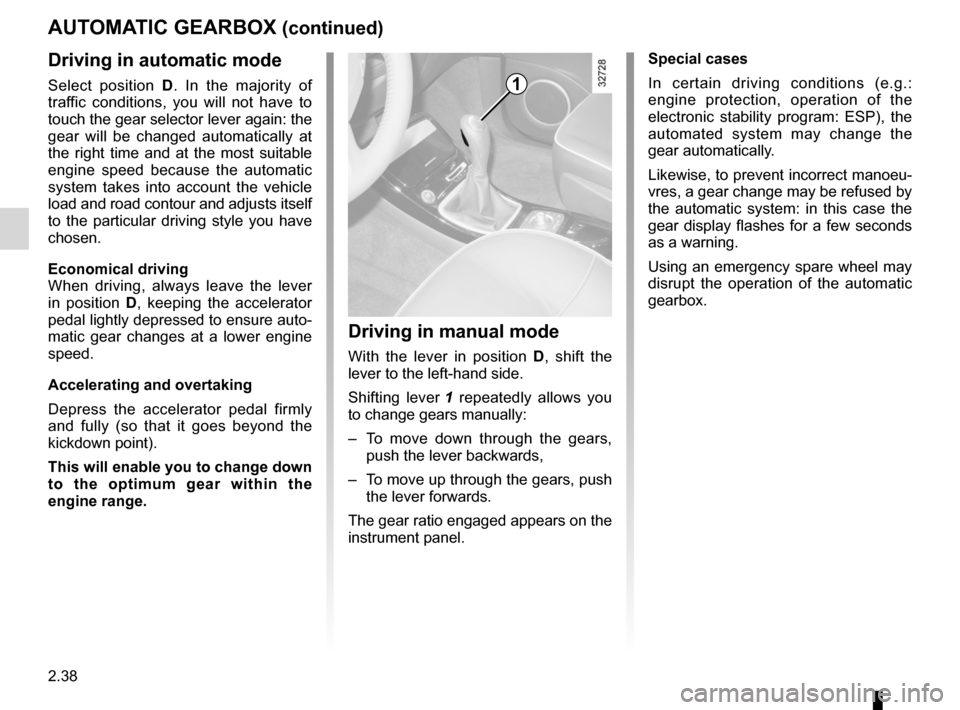
Driving in manual mode
With the lever in position D, shift the
lever to the left-hand side.
Shifting lever 1 repeatedly allows you
to change gears manually:
– To move down through the gears,
push the lever backwards,
– To move up through the gears, push
the lever forwards.
The gear ratio engaged appears on the
instrument panel. Special cases
In certain driving conditions (e.g.:
engine protection, operation of the
electronic stability program: ESP), the
automated system may change the
gear automatically.
Likewise, to prevent incorrect manoeu
-
vres, a gear change may be refused by
the automatic system: in this case the
gear display flashes for a few seconds
as a warning.
Using an emergency spare wheel may
disrupt the operation of the automatic
gearbox.
1
Page 121 of 267
JauneNoirNoir texte
2.39
ENG_UD24090_2
Boîte automatique (X81 - J81 - Renault)
ENG_NU_932-3_X81ph3_Renault_2
AUTOMATIc GEARBOX (continued)
Special circumstances
– If the bends and road surface do
not allow you to stay in automatic
mode (e.g. in the mountains), we
recommend that you change to
manual mode.
This will prevent the automatic gear-
box from changing gear repeatedly
when climbing, and permit engine
braking on long descents.
– In cold weather, start the engine
and wait a few seconds before
moving the selector lever from posi-
tion P or N and engaging it in D or R
to prevent the engine stalling.
– v ehicles not fitted with traction
control: on a slippery surface or
surface with a low level of adhesion,
change to manual mode and select
second gear (or even third) before
starting the engine to avoid wheel -
spin when starting.
Parking the vehicle
When the vehicle is stopped, move the
lever to position P while keeping your
foot on the brake pedal: the gearbox is
in neutral and the drive wheels are me-
chanically locked by the driveshaft.
check that the parking brake is prop-
erly applied (refer to the information on
the “Parking brake” in Section 2).
Page 181 of 267

3.59
ENG_UD20404_1
Commandes intégré de téléphone mains libres (X81 - J81 - Re\
nault)
ENG_NU_932-3_X81ph3_Renault_3
Hands-f")
hands-free telephone integrated control ................ (current page)
3.59
ENG_UD20404_1
Commandes intégré de téléphone mains libres (X81 - J81 - Re\
nault)
ENG_NU_932-3_X81ph3_Renault_3
Hands-free telephone integrated control
HANDS-FREE TELEPHONE INTEGRATED CONTROL
Telephone holder
For vehicles fitted with a telephone
holder, it is located behind the gear
lever.
As each telephone has its own tech-
nical specifications, it is essen-
tial to select the correct holder for
the vehicle. Contact an approved
dealer.
Position for microphone 3
Refer to the manufacturer’s instruc-
tions for information on how to oper-
ate this equipment.
Please keep these instructions with
the rest of the vehicle documenta -
tion.
Steering wheel controls 1
and 2
Using the telephone
We remind you of the need
to conform to the legislation
in force concerning the use
of such equipment.
12
3
Page 194 of 267
tyre pressure......................................... (up to the end of the DU)
tyre pressures ....................................... (up to the end of the DU)
tyres ...................................................... (up to the end of the DU)
4.12
ENG_UD11257_1
Pression de gonflage des pneumatiques (X81 - Renault)
ENG_NU_932-3_X81ph3_Renault_4
Tyre Pressure
tyRe PReSSURe
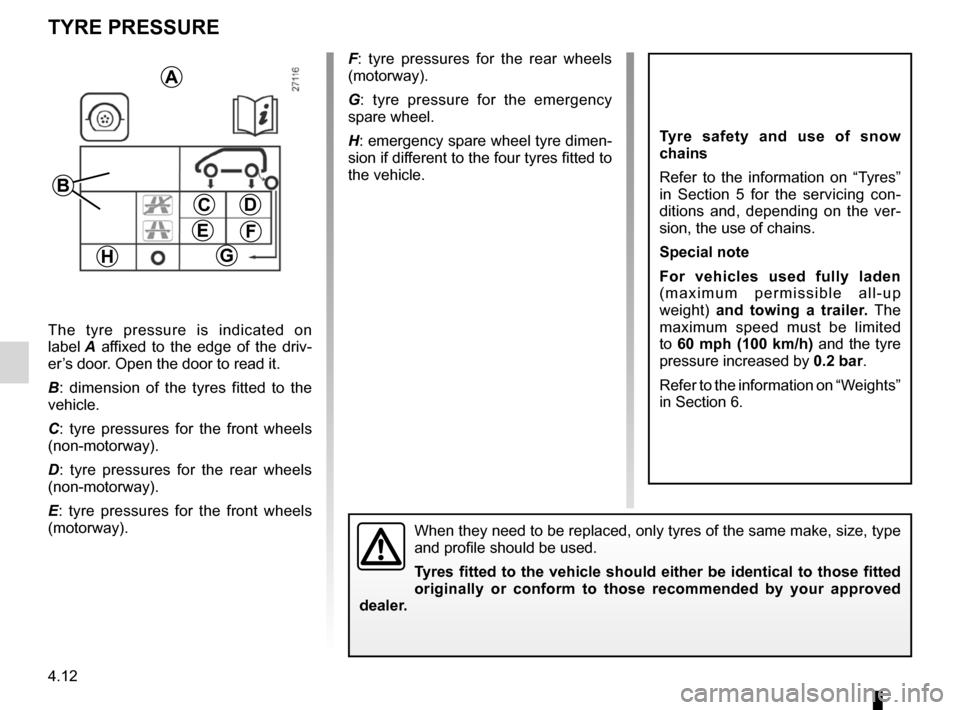
The tyre pressure is indicated on
label A affixed to the edge of the driv -
er’s door. Open the door to read it.
B : dimension of the tyres fitted to the
vehicle.
C : tyre pressures for the front wheels
(non-motorway).
D : tyre pressures for the rear wheels
(non-motorway).
E : tyre pressures for the front wheels
(motorway). F
: tyre pressures for the rear wheels
(motorway).
G : tyre pressure for the emergency
spare wheel.
H: emergency spare wheel tyre dimen -
sion if different to the four tyres fitted to
the vehicle.
t yre safety and use of snow
chains
Refer to the information on “Tyres”
in Section 5 for the servicing con -
ditions and, depending on the ver -
sion, the use of chains.
Special note
For vehicles used fully laden
( m a x i m u m p e r m i s s i b l e a l l - u p
weight) and towing a trailer. The
maximum speed must be limited
to 60 mph (100 km/h) and the tyre
pressure increased by 0.2 bar.
Refer to the information on “Weights”
in Section 6.
CD
Fe
G
A
H
B
When they need to be replaced, only tyres of the same make, size, type
and profile should be used.
t yres fitted to the vehicle should either be identical to those fitted
originally or conform to those recommended by your approved
dealer.
Page 196 of 267
maintenance:bodywork ........................................ (up to the end of the DU)
washing ................................................ (up to the end of the DU)
paintwork maintenance ................................... (up to the end of the DU)
anti-corrosion protection ........................................ (current page)
4.14
ENG_UD25392_1
Entretien de la carrosserie (X95 - J95 - R95 - Renault)
ENG_NU_932-3_X81ph3_Renault_4
Jaune NoirNoir texte
Bodywork maintenance
BoDyWoRk MAIntenAnCe (1/2)
Allow rust to form following minor im -
pacts.
Use solvents not approved by our
Technical Department to remove stains
as this could damage the paintwork.
Drive frequently in snow or muddy con-
ditions without washing the vehicle,
particularly under the wheel arches and
body.
Minor impacts
You should take a minimum number of
precautions in order to safeguard your
vehicle against such risks and not to
lose the benefit of your vehicle’s anti
-
corrosion protection.
What you should not do
Do not degrease or clean mechanical
components (e.g. the engine compart -
ment), underneath the body, parts with
hinges (e.g. inside the charging flap)
and painted plastic external fittings
(e.g. bumpers) using high-pressure
cleaning equipment or by spraying on
products not approved by our Technical
Department. If adequate precautions
are not taken, this could give rise to cor-
rosion or operational faults.
Wash the vehicle in bright sunlight or
freezing temperatures.
Scrape off mud or dirt without pre-wet-
ting.
Allow dirt to accumulate on the exterior.
A well-maintained vehicle will last
longer. It is therefore recommended to
maintain the exterior of the vehicle reg-
ularly.
Protection against the effects
of corrosive agents
Although your vehicle has been treated
with very effective anti-corrosion prod
-
ucts, it nevertheless remains subject to
the effects of different parameters.
Corrosive agents in the
atmosphere:
– atmospheric pollution (built-up and
industrial areas);
– saline atmospheres (near the sea,
particularly in hot weather);
– seasonal and damp weather condi -
tions, (e.g. road salt in winter, water
from road cleaners, etc.).
Abrasive action
Wind-borne dust and sand, mud, road
grit thrown up by other vehicles, etc.
Page 197 of 267
JauneNoirNoir texte
4.15
ENG_UD25392_1
Entretien de la carrosserie (X95 - J95 - R95 - Renault)
ENG_NU_932-3_X81ph3_Renault_4
– bird droppings , which cause a
chemical reaction with the paint that
rapidly discolours paintwork and
may even cause the paint to peel
off;
Wash the vehicle immediately to
remove these marks since it is im -
possible to remove them by polish -
ing;
– salt, particularly in the wheel arches
and underneath the body after driv -
ing in areas where the roads have
been gritted.
Using a roller type car wash
Return the windscreen wiper stalk to
the Park position (refer to the informa-
tion on the “Windscreen washer, wiper”
in Section 1). Check the mounting of
external accessories, additional lights
and mirrors, and ensure that the wiper
blades are secured with adhesive tape.
Remove the radio aerial mast if your
vehicle is fitted with this equipment.
Remember to remove the tape and refit
the antenna after washing.y ou should
Observe the vehicle stopping distances
when driving on gravelled surfaces to
prevent paint damage.
Repair, or have repaired quickly, areas
where the paint has been damaged, to
prevent corrosion spreading.
Remember to visit the body shop pe -
riodically in order to maintain your
anti-corrosion warranty. Refer to the
Maintenance Service Booklet.
Respect local regulations about wash -
ing vehicles (e.g. do not wash your ve-
hicle on a public highway).
Wash your car frequently, with the
engine off, with cleaning products rec-
ommended by the manufacturer (never
use abrasive products). Rinse thor -
oughly beforehand with a jet:
– spots of tree resin and industrial
grime;
– mud in the wheel arches and under -
neath the body which forms damp
patches;
BoDyWoRk MAIntenAnCe (2/2)
If it is necessary to clean mechani -
cal components, hinges, etc., spray
them with products approved by our
Technical Department to protect them
after they have been cleaned.
Cleaning the headlights
As the headlights are made of plastic
“glass”, use a soft cloth or cotton wool
to clean them. If this does not clean
them properly, moisten the cloth with
soapy water, then wipe clean with a soft
damp cloth or cotton wool.
Finally, carefully dry off with a soft dry
cloth.
Cleaning products containing alco -
hol must not be used.
We have selected special products
to care for your vehicle and you can
obtain these from the manufactur -
er’s accessory outlets.
Page 201 of 267
5.1
ENG_UD25604_4
Sommaire 5 (X81 - J81 - Renault)
ENG_NU_932-3_X81ph3_Renault_5
Section 5: Practical advice
Puncture . . . . . . . . . . . . . . . . . . . . . . . . . . . . . . . . . . . . . . . . . . . . . . . . . . . . . . . . . . . . . . . . . . . . . . 5.2
Emergency spare wheel . . . . . . . . . . . . . . . . . . . . . . . . . . . . . . . . . . . . . . . . . . . . . . . . . . . . . . . . . . 5.2
Tyre inflation kit . . . . . . . . . . . . . . . . . . . . . . . . . . . . . . . . . . . . . . . . . . . . . . . . . . . . . . . . . . . . . . . . . 5.4
Tool kit (jack, wheelbrace) . . . . . . . . . . . . . . . . . . . . . . . . . . . . . . . . . . . . . . . . . . . . . . . . . . . . . . . . . 5.7
Wheel trims – Wheel . . . . . . . . . . . . . . . . . . . . . . . . . . . . . . . . . . . . . . . . . . . . . . . . . . . . . . . . . . . . . 5.8
Changing a wheel . . . . . . . . . . . . . . . . . . . . . . . . . . . . . . . . . . . . . . . . . . . . . . . . . . . . . . . . . . . . . . . 5.9
Tyres (tyre and wheel safety, use in winter) . . . . . . . . . . . . . . . . . . . . . . . . . . . . . . . . . . . . . . . . . . . 5.11
Headlights (changing bulbs) . . . . . . . . . . . . . . . . . . . . . . . . . . . . . . . . . . . . . . . . . . . . . . . . . . . . . . . 5.14
Rear lights (changing bulbs) . . . . . . . . . . . . . . . . . . . . . . . . . . . . . . . . . . . . . . . . . . . . . . . . . . . . . . . 5.18
Indicator lights (changing bulbs) . . . . . . . . . . . . . . . . . . . . . . . . . . . . . . . . . . . . . . . . . . . . . . . . . . . . 5.21
Interior lighting (changing bulbs) . . . . . . . . . . . . . . . . . . . . . . . . . . . . . . . . . . . . . . . . . . . . . . . . . . . . 5.22
Fuses . . . . . . . . . . . . . . . . . . . . . . . . . . . . . . . . . . . . . . . . . . . . . . . . . . . . . . . . . . . . . . . . . . . . . . . . . 5.26
RENAULT card: battery . . . . . . . . . . . . . . . . . . . . . . . . . . . . . . . . . . . . . . . . . . . . . . . . . . . . . . . . . . . 5.28
Battery . . . . . . . . . . . . . . . . . . . . . . . . . . . . . . . . . . . . . . . . . . . . . . . . . . . . . . . . . . . . . . . . . . . . . . . . 5.29
Wipers (replacing blades) . . . . . . . . . . . . . . . . . . . . . . . . . . . . . . . . . . . . . . . . . . . . . . . . . . . . . . . . . 5.32
Accessories . . . . . . . . . . . . . . . . . . . . . . . . . . . . . . . . . . . . . . . . . . . . . . . . . . . . . . . . . . . . . . . . . . . . 5.33
Towing . . . . . . . . . . . . . . . . . . . . . . . . . . . . . . . . . . . . . . . . . . . . . . . . . . . . . . . . . . . . . . . . . . . . . . . . 5.34
Operating faults . . . . . . . . . . . . . . . . . . . . . . . . . . . . . . . . . . . . . . . . . . . . . . . . . . . . . . . . . . . . . . . . . 5.37
Page 202 of 267
practical advice ..................................... (up to the end of the DU)
puncture ................................................ (up to the end of the DU)
emergency spare wheel ....................... (up to the end of the DU)
wheels (safety) ..................................... (up to the end of the DU)
5.2
ENG_UD24346_2
Roue de secours (X81 - J81 - Renault)
ENG_NU_932-3_X81ph3_Renault_5
Jaune NoirNoir texte
Puncture
Emergency spare wheel
Puncture/eMerGencY SPAre WHeeL (1/2)
In the event of a puncture,
depending on the vehicle,
you will have:
An emergency spare wheel or tyre in -
flation kit (refer to the information on the
following pages).
If you have an emergency spare wheel,
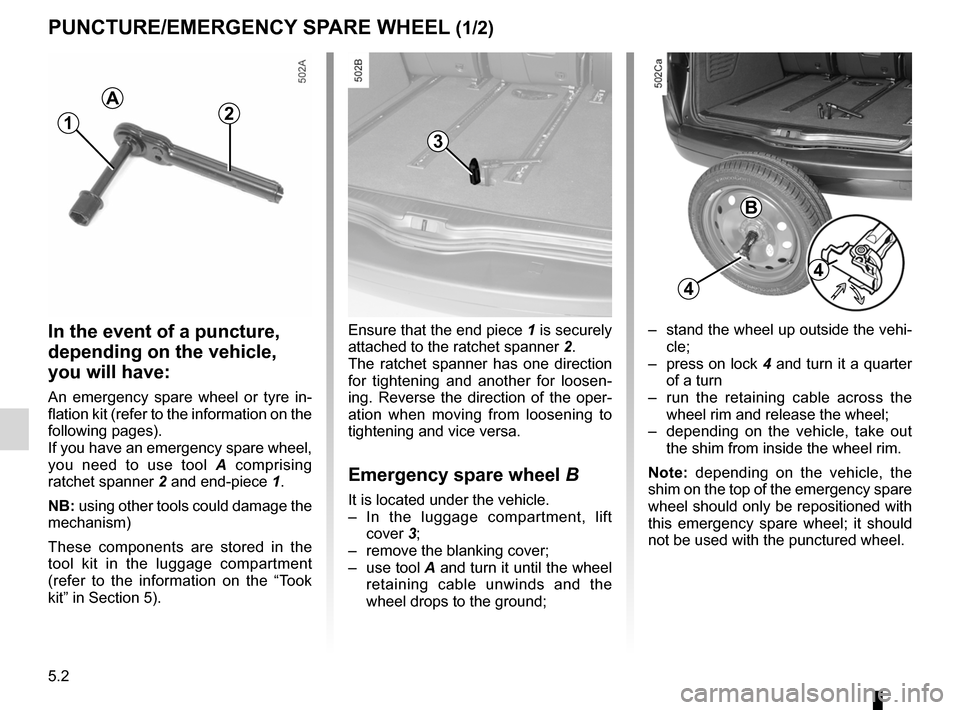
you need to use tool A comprising
ratchet spanner 2 and end-piece 1.
nB: using other tools could damage the
mechanism)
These components are stored in the
tool kit in the luggage compartment
(refer to the information on the “Took
kit” in Section 5). Ensure that the end piece 1 is securely
attached to the ratchet spanner
2.
The ratchet spanner has one direction
for tightening and another for loosen -
ing. Reverse the direction of the oper -
ation when moving from loosening to
tightening and vice versa.
emergency spare wheel B
It is located under the vehicle.
– In the luggage compartment, lift
cover 3;
– remove the blanking cover;
– use tool A and turn it until the wheel
retaining cable unwinds and the
wheel drops to the ground; –
stand the wheel up outside the vehi-
cle;
– press on lock 4 and turn it a quarter
of a turn
– run the retaining cable across the
wheel rim and release the wheel;
– depending on the vehicle, take out
the shim from inside the wheel rim.
n ote: depending on the vehicle, the
shim on the top of the emergency spare
wheel should only be repositioned with
this emergency spare wheel; it should
not be used with the punctured wheel.
12
3
B
4
A
4
Page 203 of 267
JauneNoirNoir texte
5.3
ENG_UD24346_2
Roue de secours (X81 - J81 - Renault)
ENG_NU_932-3_X81ph3_Renault_5
Puncture/eMerGencY SPAre WHeeL (2/2)
t o refit the emergency spare
wheel
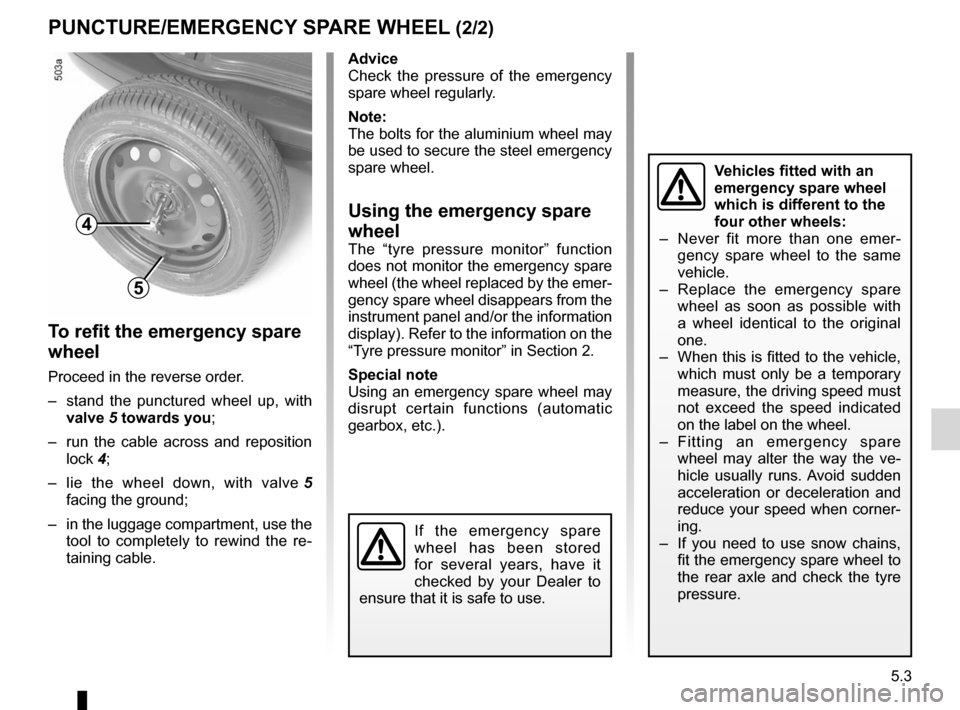
Proceed in the reverse order.
– stand the punctured wheel up, with
valve 5 towards you;
– run the cable across and reposition
lock 4;
– lie the wheel down, with valve 5
facing the ground;
– in the luggage compartment, use the
tool to completely to rewind the re -
taining cable. Advice
Check the pressure of the emergency
spare wheel regularly.
note:
The bolts for the aluminium wheel may
be used to secure the steel emergency
spare wheel.
using the emergency spare
wheel
The “tyre pressure monitor” function
does not monitor the emergency spare
wheel (the wheel replaced by the emer-
gency spare wheel disappears from the
instrument panel and/or the information
display). Refer to the information on the
“Tyre pressure monitor” in Section 2.
Special note
Using an emergency spare wheel may
disrupt certain functions (automatic
gearbox, etc.).
If the emergency spare
wheel has been stored
for several years, have it
checked by your Dealer to
ensure that it is safe to use.
4
5
Vehicles fitted with an
emergency spare wheel
which is different to the
four other wheels:
– Never fit more than one emer -
gency spare wheel to the same
vehicle.
– Replace the emergency spare
wheel as soon as possible with
a wheel identical to the original
one.
– When this is fitted to the vehicle,
which must only be a temporary
measure, the driving speed must
not exceed the speed indicated
on the label on the wheel.
– Fitting an emergency spare
wheel may alter the way the ve -
hicle usually runs. Avoid sudden
acceleration or deceleration and
reduce your speed when corner-
ing.
– If you need to use snow chains,
fit the emergency spare wheel to
the rear axle and check the tyre
pressure.