lock RENAULT ESPACE 2016 5.G User Guide
[x] Cancel search | Manufacturer: RENAULT, Model Year: 2016, Model line: ESPACE, Model: RENAULT ESPACE 2016 5.GPages: 318, PDF Size: 3.32 MB
Page 17 of 318
1.11
OPENING AND CLOSING THE DOORS (1/3)
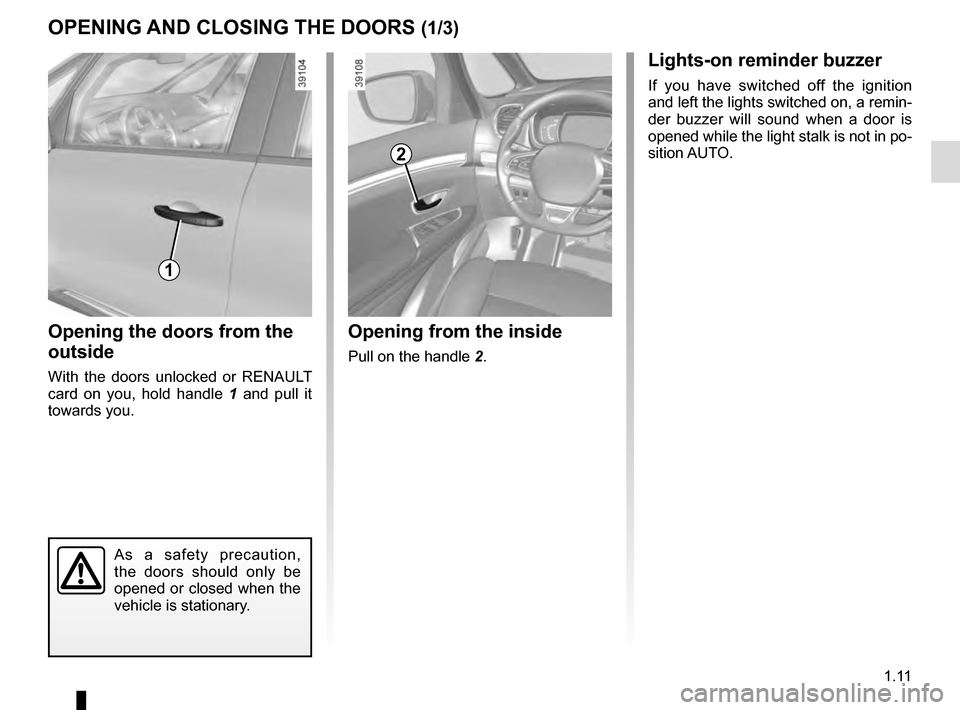
Opening the doors from the
outside
With the doors unlocked or RENAULT
card on you, hold handle 1 and pull it
towards you.
Opening from the inside
Pull on the handle 2.
2
As a safety precaution,
the doors should only be
opened or closed when the
vehicle is stationary.
1
Lights-on reminder buzzer
If you have switched off the ignition
and left the lights switched on, a remin-
der buzzer will sound when a door is
opened while the light stalk is not in po-
sition AUTO.
Page 19 of 318
1.13
OPENING AND CLOSING THE DOORS (3/3)
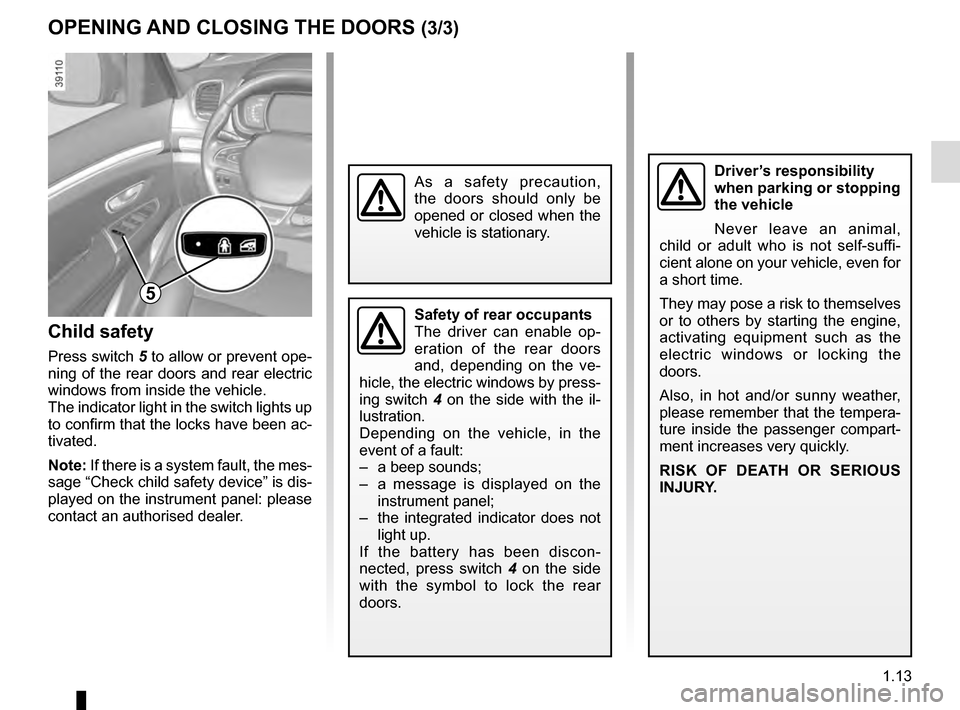
Child safety
Press switch 5 to allow or prevent ope-
ning of the rear doors and rear electric
windows from inside the vehicle.
The indicator light in the switch lights up
to confirm that the locks have been ac-
tivated.
Note: If there is a system fault, the mes-
sage “Check child safety device” is dis-
played on the instrument panel: please
contact an authorised dealer.
Safety of rear occupants
The driver can enable op-
eration of the rear doors
and, depending on the ve-
hicle, the electric windows by press-
ing switch 4 on the side with the il-
lustration.
Depending on the vehicle, in the
event of a fault:
– a beep sounds;
– a message is displayed on the instrument panel;
– the integrated indicator does not light up.
If the battery has been discon-
nected, press switch 4 on the side
with the symbol to lock the rear
doors.
Driver’s responsibility
when parking or stopping
the vehicle
Never leave an animal,
child or adult who is not self-suffi-
cient alone on your vehicle, even for
a short time.
They may pose a risk to themselves
or to others by starting the engine,
activating equipment such as the
electric windows or locking the
doors.
Also, in hot and/or sunny weather,
please remember that the tempera-
ture inside the passenger compart-
ment increases very quickly.
RISK OF DEATH OR SERIOUS
INJURY.
5
As a safety precaution,
the doors should only be
opened or closed when the
vehicle is stationary.
Page 20 of 318
1.14
AUTOMATIC LOCKING WHEN DRIVING
Operating principleAfter the vehicle is started, the system
automatically locks the doors when you
are driving at approximately 6 mph
(10 km/h) and over.
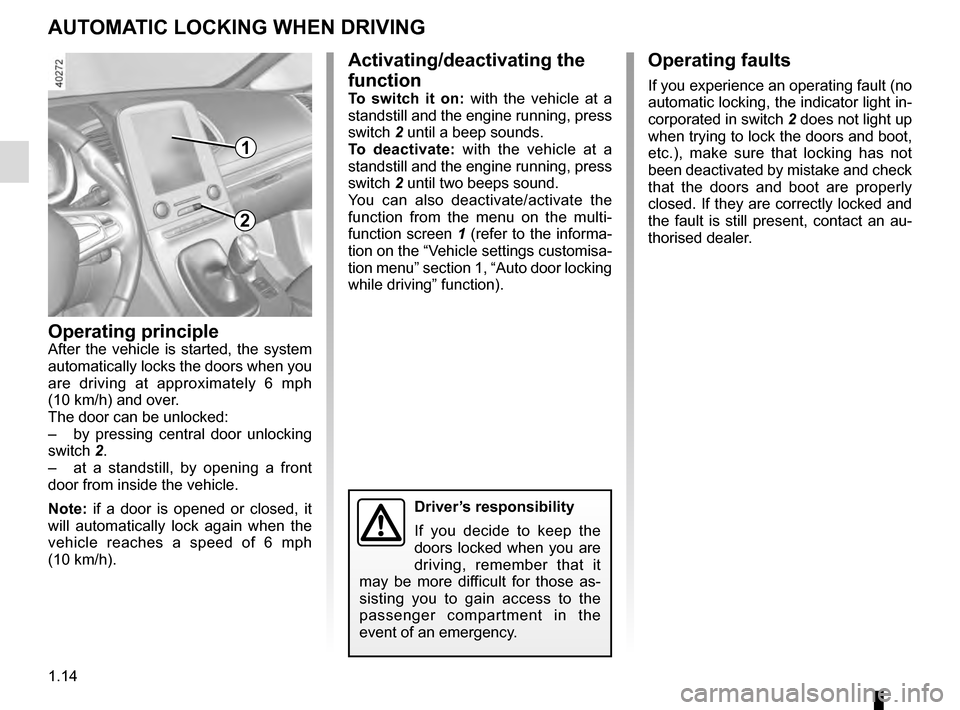
The door can be unlocked:
– by pressing central door unlocking
switch 2.
– at a standstill, by opening a front
door from inside the vehicle.
Note: if a door is opened or closed, it
will automatically lock again when the
vehicle reaches a speed of 6 mph
(10 km/h).
Activating/deactivating the
function
To switch it on: with the vehicle at a
standstill and the engine running, press
switch 2 until a beep sounds.
To deactivate: with the vehicle at a
standstill and the engine running, press
switch 2 until two beeps sound.
You can also deactivate/activate the
function from the menu on the multi-
function screen 1 (refer to the informa-
tion on the “Vehicle settings customisa-
tion menu” section 1, “Auto door locking
while driving” function).
Operating faults
If you experience an operating fault (no
automatic locking, the indicator light in-
corporated in switch 2 does not light up
when trying to lock the doors and boot,
etc.), make sure that locking has not
been deactivated by mistake and check
that the doors and boot are properly
closed. If they are correctly locked and
the fault is still present, contact an au-
thorised dealer.
2
Driver’s responsibility
If you decide to keep the
doors locked when you are
driving, remember that it
may be more difficult for those as-
sisting you to gain access to the
passenger compartment in the
event of an emergency.
1
Page 21 of 318
1.15
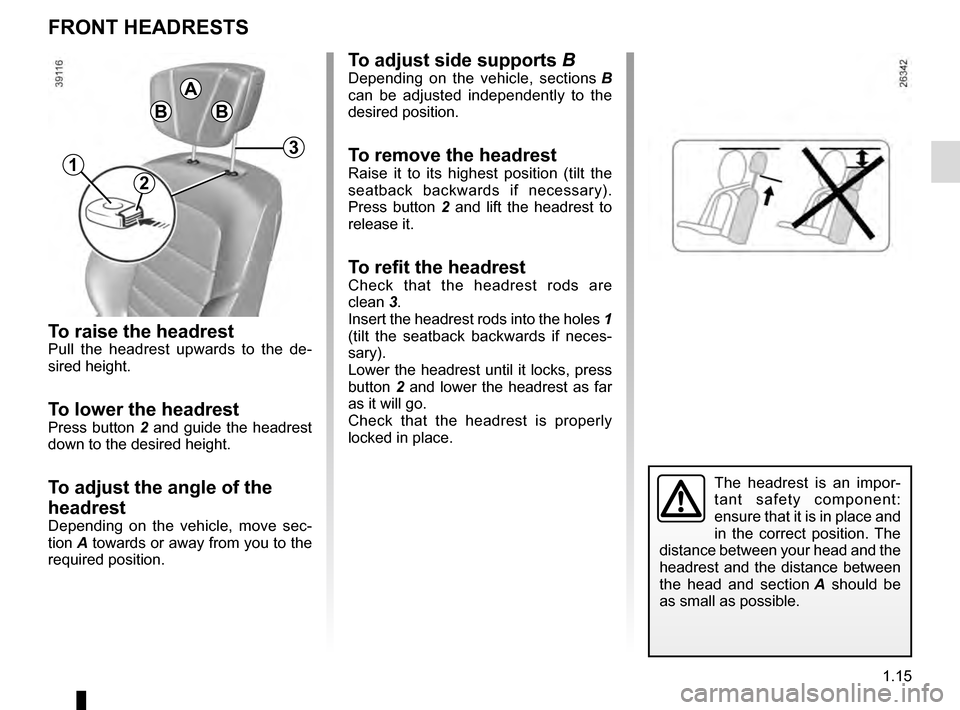
To raise the headrestPull the headrest upwards to the de-
sired height.
To lower the headrestPress button 2 and guide the headrest
down to the desired height.
To adjust the angle of the
headrest
Depending on the vehicle, move sec-
tion A towards or away from you to the
required position.
To adjust side supports BDepending on the vehicle, sections B
can be adjusted independently to the
desired position.
To remove the headrest
Raise it to its highest position (tilt the
seatback backwards if necessary).
Press button 2 and lift the headrest to
release it.
To refit the headrestCheck that the headrest rods are
clean 3.
Insert the headrest rods into the holes 1
(tilt the seatback backwards if neces-
sary).
Lower the headrest until it locks, press
button 2 and lower the headrest as far
as it will go.
Check that the headrest is properly
locked in place.
FRONT HEADRESTS
The headrest is an impor-
tant safety component:
ensure that it is in place and
in the correct position. The
distance between your head and the
headrest and the distance between
the head and section A should be
as small as possible.
B
A
B
2
3
1
Page 22 of 318
1.16
FRONT SEATS WITH MANUAL CONTROL (1/2)
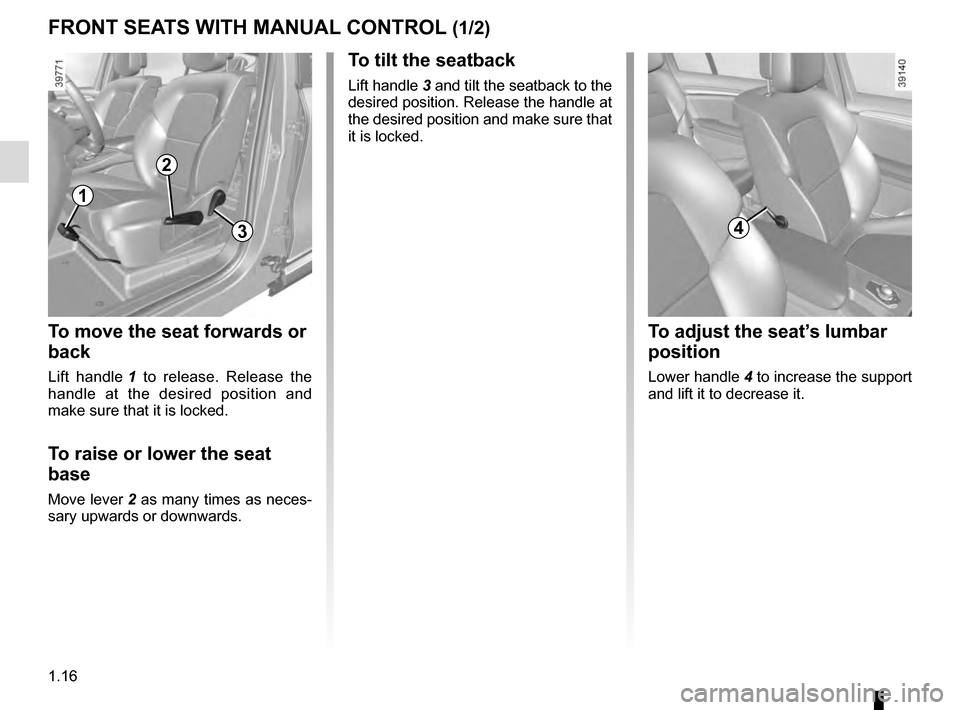
To move the seat forwards or
back
Lift handle 1 to release. Release the
handle at the desired position and
make sure that it is locked.
To raise or lower the seat
base
Move lever 2 as many times as neces-
sary upwards or downwards.
To tilt the seatback
Lift handle 3 and tilt the seatback to the
desired position. Release the handle at
the desired position and make sure that
it is locked.
1
2
34
To adjust the seat’s lumbar
position
Lower handle 4 to increase the support
and lift it to decrease it.
Page 24 of 318
1.18
DRIVER’S SEAT WITH ELECTRIC CONTROLS (1/2)
For safety reasons, carry
out any adjustments when
the vehicle is not being
driven.
Make sure that the seatbacks are
correctly locked in place.
We would advise you not to recline
the seatbacks too far to ensure that
the effectiveness of the seat belts is
not reduced.
No object should be placed on the
floor (in front of the driver). such
objects may slide under the pedals
during sudden braking manoeuvres
and obstruct their use.
12
3
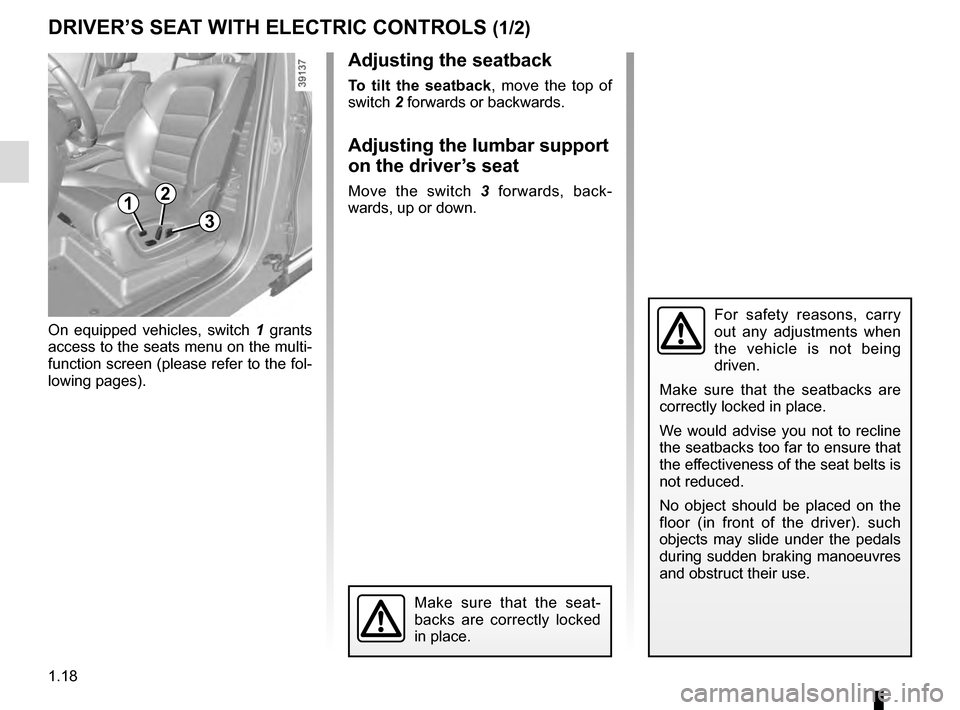
On equipped vehicles, switch 1 grants
access to the seats menu on the multi-
function screen (please refer to the fol-
lowing pages).
Make sure that the seat-
backs are correctly locked
in place.
Adjusting the seatback
To tilt the seatback, move the top of
switch 2 forwards or backwards.
Adjusting the lumbar support
on the driver’s seat
Move the switch 3 forwards, back-
wards, up or down.
Page 25 of 318
1.19
DRIVER’S SEAT WITH ELECTRIC CONTROLS (2/2)
5
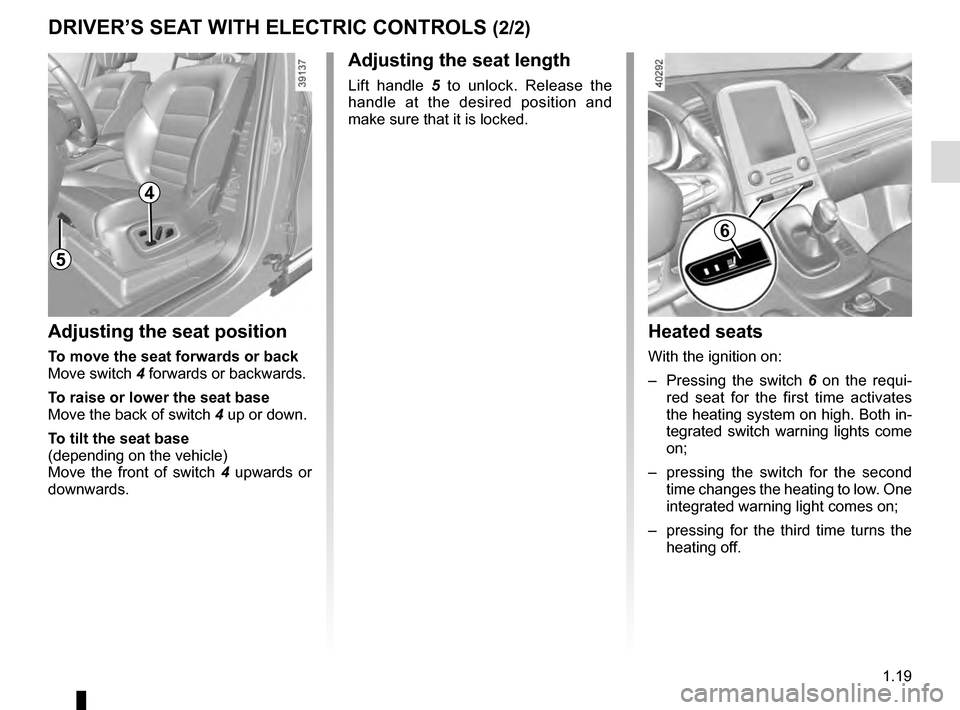
Heated seats
With the ignition on:
– Pressing the switch 6 on the requi-
red seat for the first time activates
the heating system on high. Both in-
tegrated switch warning lights come
on;
– pressing the switch for the second time changes the heating to low. One
integrated warning light comes on;
– pressing for the third time turns the heating off.
Adjusting the seat position
To move the seat forwards or back
Move switch 4 forwards or backwards.
To raise or lower the seat base
Move the back of switch 4 up or down.
To tilt the seat base
(depending on the vehicle)
Move the front of switch 4 upwards or
downwards.
Adjusting the seat length
Lift handle 5 to unlock. Release the
handle at the desired position and
make sure that it is locked.
6
4
Page 29 of 318
1.23
Always wear your seat belt when tra-
velling in your vehicle. You must also
comply with the legislation of the parti-
cular country you are in.
SEAT BELTS (1/3)
Make sure that the rear seats are
locked in position properly so that
the rear seat belts will operate effi-
ciently. Refer to the information on
“rear seat functions” and “adjusting
the rear seats” in Section 3.
Seat belts which are incor-
rectly adjusted or twisted
may cause injuries in the
event of an accident.
Use one seat belt per person,
whether child or adult.
Even pregnant women should wear
a seat belt. In this case, ensure that
the lap belt is not exerting too much
pressure on the abdomen, but do
not allow any slack.
Before starting, first adjust your dri-
ving position, then ask all occupants
to adjust their seat belts to ensure
optimum protection.
Adjusting your driving
position
– Sit well back in your seat (having
first removed your coat or jacket).
This is essential to ensure your back
is positioned correctly;
– adjust the distance between the seat and the pedals. Your seat
should be as far back as possible
while still allowing you to depress
the clutch pedal fully. The seatback
should be adjusted so that your arms
are slightly bent when you hold the
steering wheel;
– adjust the position of your head- rest. For maximum safety, your head
must be as close as possible to the
headrest;
– adjust the height of the seat. This
adjustment allows you to select the
seat position which offers you the
best possible view;
– adjust the position of the steering
wheel.
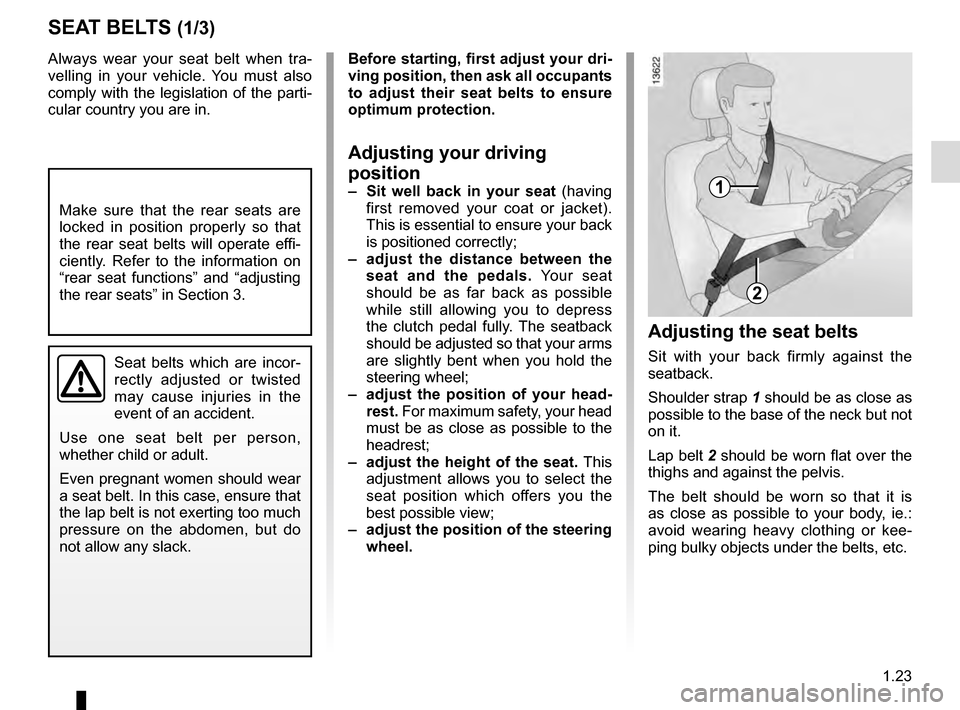
Adjusting the seat belts
Sit with your back firmly against the
seatback.
Shoulder strap 1 should be as close as
possible to the base of the neck but not
on it.
Lap belt 2 should be worn flat over the
thighs and against the pelvis.
The belt should be worn so that it is
as close as possible to your body, ie.:
avoid wearing heavy clothing or kee-
ping bulky objects under the belts, etc.
1
2
Page 30 of 318
1.24
SEAT BELTS (2/3)
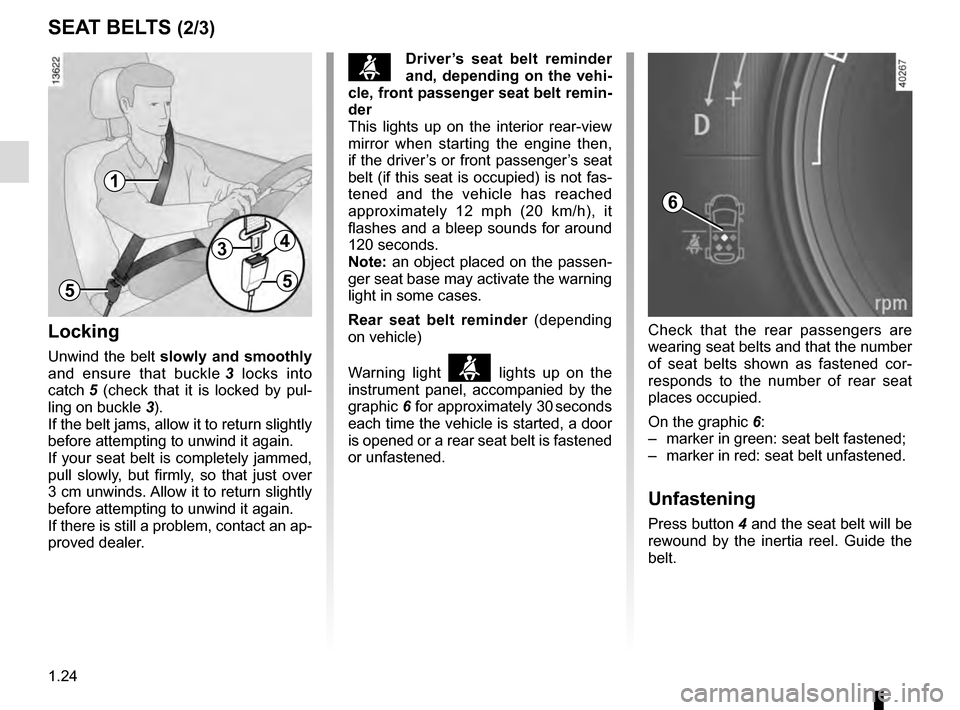
Locking
Unwind the belt slowly and smoothly
and ensure that buckle 3 locks into
catch 5 (check that it is locked by pul-
ling on buckle 3).
If the belt jams, allow it to return slightly
before attempting to unwind it again.
If your seat belt is completely jammed,
pull slowly, but firmly, so that just over
3 cm unwinds. Allow it to return slightly
before attempting to unwind it again.
If there is still a problem, contact an ap-
proved dealer.
ßDriver’s seat belt reminder
and, depending on the vehi-
cle, front passenger seat belt remin-
der
This lights up on the interior rear-view
mirror when starting the engine then,
if the driver’s or front passenger’s seat
belt (if this seat is occupied) is not fas-
tened and the vehicle has reached
approximately 12 mph (20 km/h), it
flashes and a bleep sounds for around
120 seconds.
Note: an object placed on the passen-
ger seat base may activate the warning
light in some cases.
Rear seat belt reminder (depending
on vehicle)
Warning light
ß lights up on the
instrument panel, accompanied by the
graphic 6 for approximately 30 seconds
each time the vehicle is started, a door
is opened or a rear seat belt is fastened
or unfastened.
1
34
55
Check that the rear passengers are
wearing seat belts and that the number
of seat belts shown as fastened cor-
responds to the number of rear seat
places occupied.
On the graphic 6:
– marker in green: seat belt fastened;
– marker in red: seat belt unfastened.
Unfastening
Press button 4 and the seat belt will be
rewound by the inertia reel. Guide the
belt.
6
Page 31 of 318
1.25
SEAT BELTS (3/3)
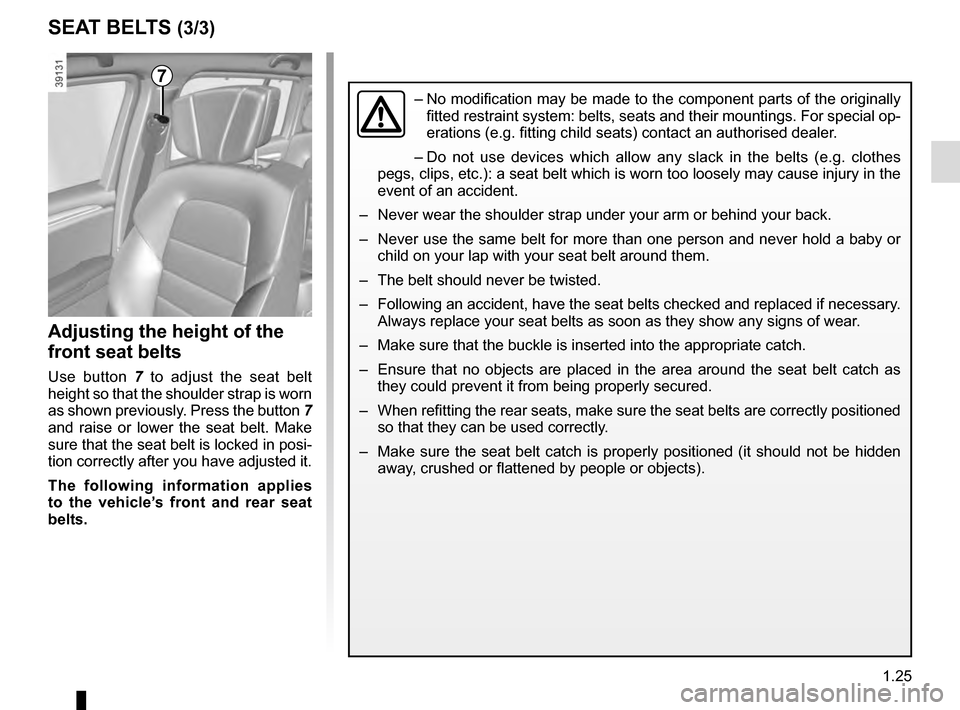
Adjusting the height of the
front seat belts
Use button 7 to adjust the seat belt
height so that the shoulder strap is worn
as shown previously. Press the button 7
and raise or lower the seat belt. Make
sure that the seat belt is locked in posi-
tion correctly after you have adjusted it.
The following information applies
to the vehicle’s front and rear seat
belts.
7
– No modification may be made to the component parts of the originally
fitted restraint system: belts, seats and their mountings. For special o\
p-
erations (e.g. fitting child seats) contact an authorised dealer.
– Do not use devices which allow any slack in the belts (e.g. clothes
pegs, clips, etc.): a seat belt which is worn too loosely may cause inj\
ury in the
event of an accident.
– Never wear the shoulder strap under your arm or behind your back.
– Never use the same belt for more than one person and never hold a baby o\
r child on your lap with your seat belt around them.
– The belt should never be twisted.
– Following an accident, have the seat belts checked and replaced if neces\
sary. Always replace your seat belts as soon as they show any signs of wear.
– Make sure that the buckle is inserted into the appropriate catch.
– Ensure that no objects are placed in the area around the seat belt catch\
as they could prevent it from being properly secured.
– When refitting the rear seats, make sure the seat belts are correctly po\
sitioned so that they can be used correctly.
– Make sure the seat belt catch is properly positioned (it should not be \
hidden away, crushed or flattened by people or objects).