gear RENAULT ESPACE 2016 5.G Owner's Guide
[x] Cancel search | Manufacturer: RENAULT, Model Year: 2016, Model line: ESPACE, Model: RENAULT ESPACE 2016 5.GPages: 318, PDF Size: 3.32 MB
Page 185 of 318
2.77
AUTOMATIC GEARBOX (4/6)
Driving in manual mode
Driving in temporary manual mode
Temporary manual mode can only be
selected when automatic mode D has
been engaged and the vehicle speed
is over around 6 mph (10 km/h).
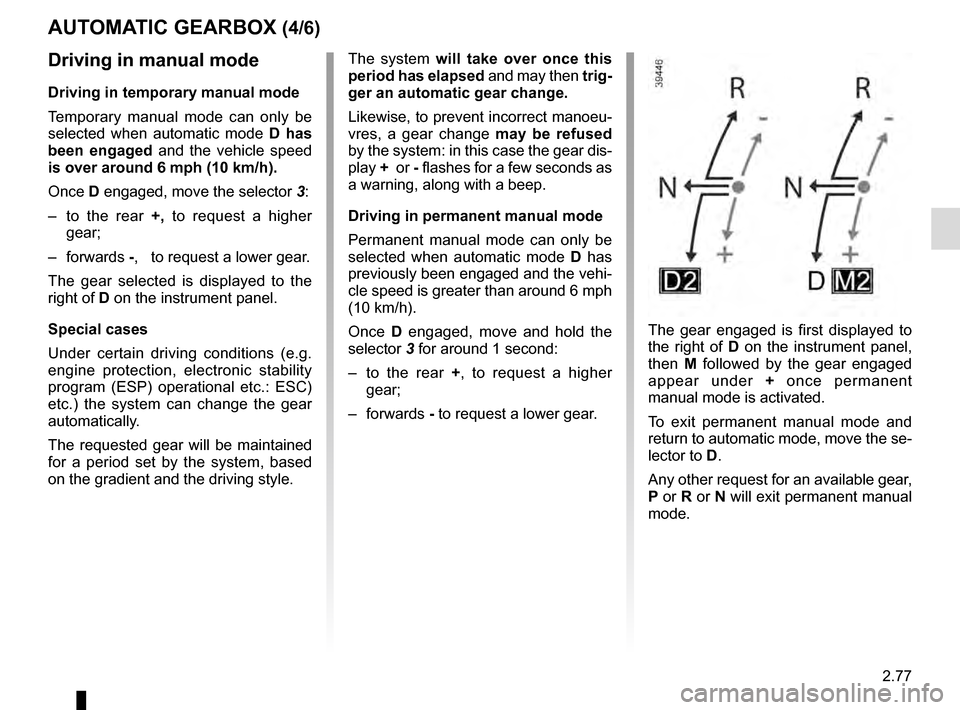
Once D engaged, move the selector 3:
– to the rear +, to request a higher gear;
– forwards -, to request a lower gear.
The gear selected is displayed to the
right of D on the instrument panel.
Special cases
Under certain driving conditions (e.g.
engine protection, electronic stability
program (ESP) operational etc.: ESC)
etc.) the system can change the gear
automatically.
The requested gear will be maintained
for a period set by the system, based
on the gradient and the driving style. The system will take over once this
period has elapsed
and may then trig-
ger an automatic gear change.
Likewise, to prevent incorrect manoeu-
vres, a gear change may be refused
by the system: in this case the gear dis-
play + or - flashes for a few seconds as
a warning, along with a beep.
Driving in permanent manual mode
Permanent manual mode can only be
selected when automatic mode D has
previously been engaged and the vehi-
cle speed is greater than around 6 mph
(10 km/h).
Once D engaged, move and hold the
selector 3 for around 1 second:
– to the rear + , to request a higher
gear;
– forwards - to request a lower gear. The gear engaged is first displayed to
the right of D on the instrument panel,
then
M followed by the gear engaged
appear under + once permanent
manual mode is activated.
To exit permanent manual mode and
return to automatic mode, move the se-
lector to D.
Any other request for an available gear,
P or R or N will exit permanent manual
mode.
Page 186 of 318
2.78
AUTOMATIC GEARBOX (5/6)
Special cases
As position P is automatically en-
gaged when the engine is stopped, it is
sometimes necessary to place the vehi-
cle in position N for some car washes,
for example.
Position N can be engaged before
opening the driver’s door, and a maxi-
mum of around 25 seconds after the
engine is stopped.
After this time or after opening the
driver’s door, it will be necessary to turn
on the ignition again to disengage posi-
tion P.
In the event of a loss of in-
formation on the instrument
panel, stop and immobilise
the vehicle using the elec-
tronic parking brake or button P.
Special cases
In certain driving cases (eg: protect-
ing the engine), a gear change can be
performed automatically in the event of
over-revving or approaching under-rev-
ving. Permanent manual mode remains
activated. Similarly, to avoid making the
"wrong move", a gear change may be
refused by the gearbox. In this case,
the display for the requested gear + or –
flashes for a few seconds to warn you.
Parking the vehicleUpon stopping the engine by press-
ing the engine stop button, position P
is automatically engaged, along with
the electronic parking brake for vehi-
cles equipped with this device. P is dis-
played on the instrument panel and the
warning light on button P comes on.
Never leave the vehicle with
the engine running without
previously engaging the
Park position P.
With the engine running, the automatic
gearbox in D or R or N or M and with-
out your foot on the brake, messages
“P not engaged” and “Select P” are dis-
played on the instrument panel as soon
as the driver’s door is open.
With the engine stopped, the automatic
gearbox in N (neutral), the message “P
not engaged” is displayed on the instru-
ment panel.
Special feature related to the Stop and Start function: if you are going\
to unfasten the driver's seat belt before the
engine goes into standby due to the Stop and Start function, make sure t\
he gearbox is in position P. The P warning
light will light up on the instrument panel to confirm this. Risk of loss of immobilisation.
Page 187 of 318
2.79
AUTOMATIC GEARBOX (6/6)
Special circumstances
– If the bends and road surface
do not allow you to stay in auto-
matic mode (e.g. in the mountains),
we recommend that you change
to either temporary or permanent
manual mode.
This will prevent the automatic gear-
box from changing gear repeatedly
when climbing, and permit engine
braking on long descents.
– In cold weather, wait a few seconds
before disengaging position P or N
and engage the lever in D or R to
prevent the engine stalling.
Operating faults
– When driving , if the “Check auto
gearbox” message appears on the
instrument panel, it indicates a fault.
Contact your approved Dealer as
soon as possible.
– When driving , if the message
“Gearbox overheating” appears on
the instrument panel, stop the ve-
hicle to allow the gearbox to cool
down.
Contact your approved Dealer as
soon as possible.
– If a vehicle with an automatic
gearbox breaks down, please refer
to the information on “Towing” in
Section 5.
An impact to the under-
side of the vehicle while
manoeuvring (e.g.: strik-
ing a post, raised kerb or
other street furniture) may result in
damage to the vehicle (e.g.: defor-
mation of an axle).
To avoid any risk of accident, have
your vehicle checked by an ap-
proved Dealer.
In very cold weather, the system
may prevent the gears from being
shifted in manual mode until the
gearbox reaches the right tempera-
ture.
Page 190 of 318
3.2
MULTI-SENSE (1/2)
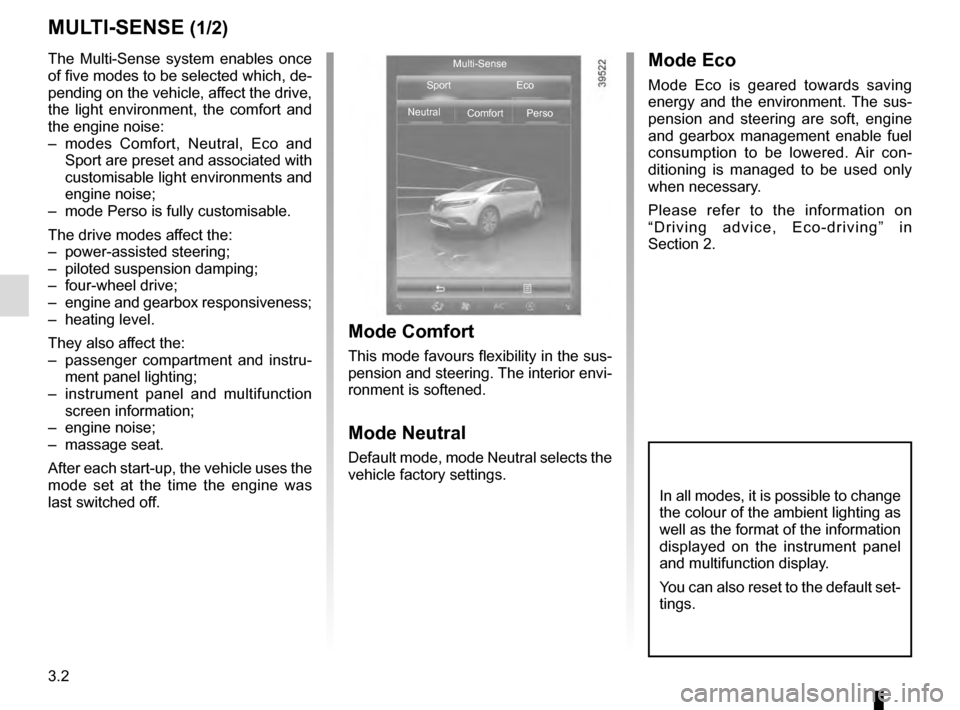
The Multi-Sense system enables once
of five modes to be selected which, de-
pending on the vehicle, affect the drive,
the light environment, the comfort and
the engine noise:
– modes Comfort, Neutral, Eco and Sport are preset and associated with
customisable light environments and
engine noise;
– mode Perso is fully customisable.
The drive modes affect the:
– power-assisted steering;
– piloted suspension damping;
– four-wheel drive;
– engine and gearbox responsiveness;
– heating level.
They also affect the:
– passenger compartment and instru- ment panel lighting;
– instrument panel and multifunction screen information;
– engine noise;
– massage seat.
After each start-up, the vehicle uses the
mode set at the time the engine was
last switched off.
Mode Comfort
This mode favours flexibility in the sus-
pension and steering. The interior envi-
ronment is softened.
Mode Neutral
Default mode, mode Neutral selects the
vehicle factory settings.
Mode Eco
Mode Eco is geared towards saving
energy and the environment. The sus-
pension and steering are soft, engine
and gearbox management enable fuel
consumption to be lowered. Air con-
ditioning is managed to be used only
when necessary.
Please refer to the information on
“Driving advice, Eco-driving” in
Section 2.
Multi-Sense
Sport Eco
Neutral Comfort Perso
In all modes, it is possible to change
the colour of the ambient lighting as
well as the format of the information
displayed on the instrument panel
and multifunction display.
You can also reset to the default set-
tings.
Page 191 of 318
3.3
MULTI-SENSE (2/2)Accessing the menu
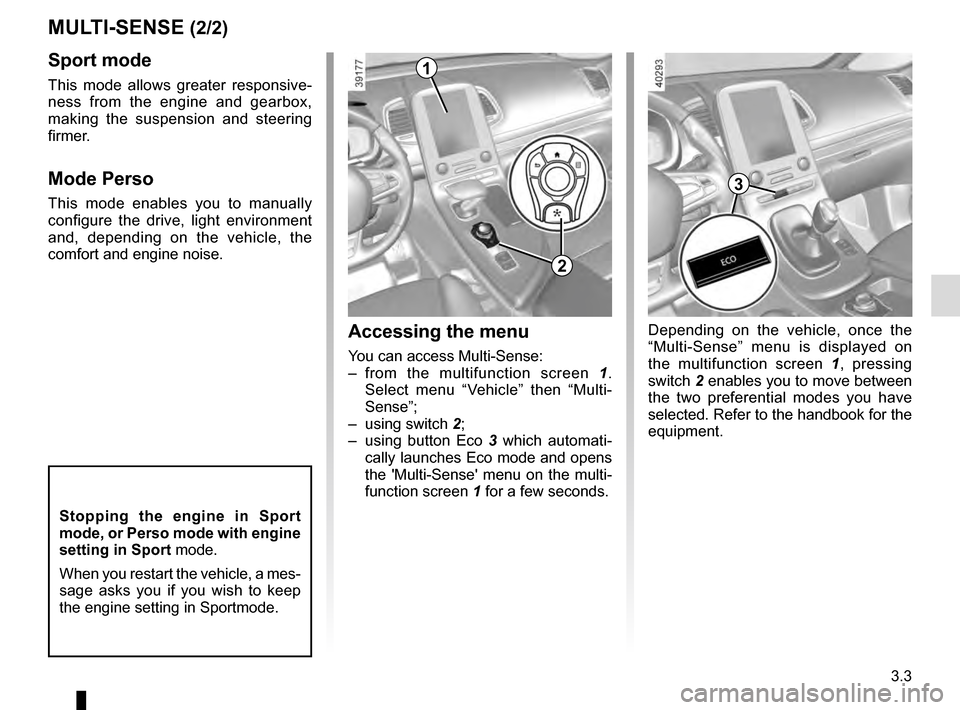
You can access Multi-Sense:
– from the multifunction screen 1.
Select menu “Vehicle” then “Multi-
Sense”;
– using switch 2;
– using button Eco 3 which automati-
cally launches Eco mode and opens
the 'Multi-Sense' menu on the multi-
function screen 1 for a few seconds.
Sport mode
This mode allows greater responsive-
ness from the engine and gearbox,
making the suspension and steering
firmer.
Mode Perso
This mode enables you to manually
configure the drive, light environment
and, depending on the vehicle, the
comfort and engine noise.
1
2
3
Depending on the vehicle, once the
“Multi-Sense” menu is displayed on
the multifunction screen 1 , pressing
switch 2 enables you to move between
the two preferential modes you have
selected. Refer to the handbook for the
equipment.
Stopping the engine in Sport
mode, or Perso mode with engine
setting in Sport mode.
When you restart the vehicle, a mes-
sage asks you if you wish to keep
the engine setting in Sportmode.
Page 204 of 318
3.16
ELECTRIC WINDOWS (1/2)
1
2
34
5
6
These systems operate:
– with the engine running;
– with the ignition off until one of the front doors is opened (limited to ap-
proximately 12 minutes).
– with the engine off, front doors closed, after pressing the start
button.
Press the window switch down or pull it
up to lower or raise the window to the
desired height: the rear windows do not
open fully.
Safety of rear occupants
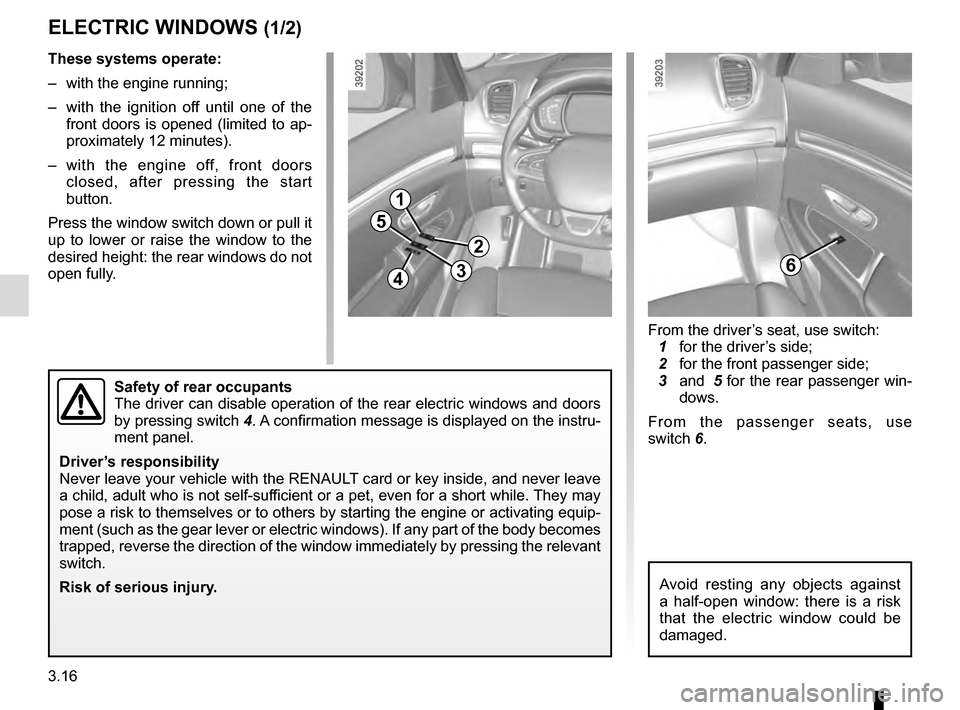
The driver can disable operation of the rear electric windows and doors \
by pressing switch 4. A confirmation message is displayed on the instru-
ment panel.
Driver’s responsibility
Never leave your vehicle with the RENAULT card or key inside, and never leave
a child, adult who is not self-sufficient or a pet, even for a short while. They may
pose a risk to themselves or to others by starting the engine or activat\
ing equip-
ment (such as the gear lever or electric windows). If any part of the \
body becomes
trapped, reverse the direction of the window immediately by pressing the\
relevant
switch.
Risk of serious injury.
Avoid resting any objects against
a half-open window: there is a risk
that the electric window could be
damaged.
From the driver’s seat, use switch:
1 for the driver’s side;
2 for the front passenger side;
3 and 5 for the rear passenger win-
dows.
From the passenger seats, use
switch 6.
Page 266 of 318
5.10
CHANGING A WHEEL (1/2)
4
Vehicles equipped with a jack
and wheelbrace
If necessary, remove the wheel trim.
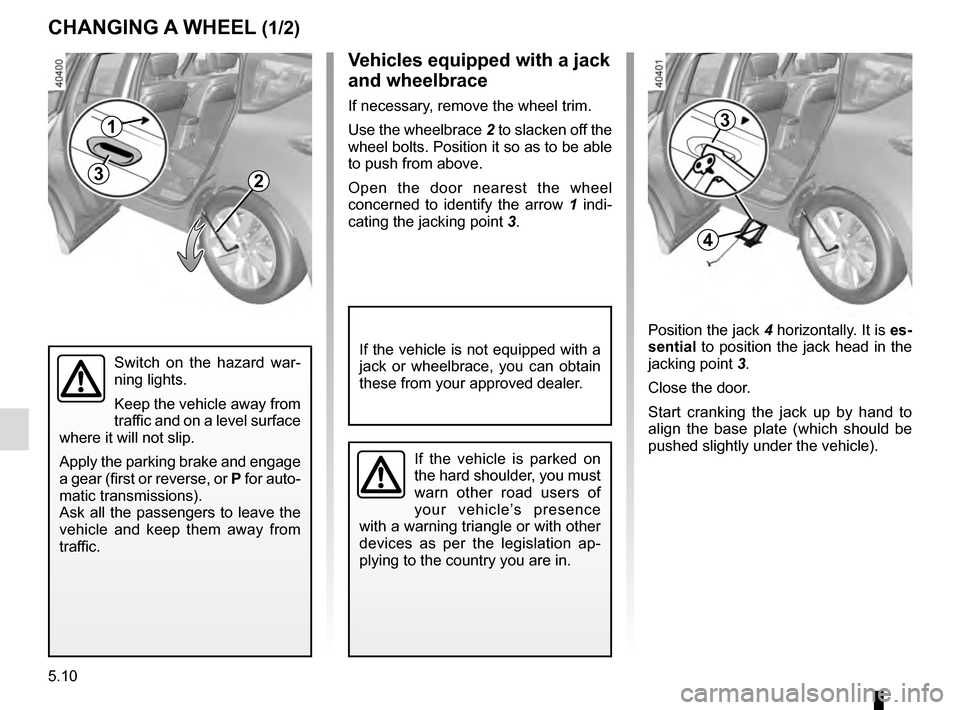
Use the wheelbrace 2 to slacken off the
wheel bolts. Position it so as to be able
to push from above.
Open the door nearest the wheel
concerned to identify the arrow 1 indi-
cating the jacking point 3.
Switch on the hazard war-
ning lights.
Keep the vehicle away from
traffic and on a level surface
where it will not slip.
Apply the parking brake and engage
a gear (first or reverse, or P for auto-
matic transmissions).
Ask all the passengers to leave the
vehicle and keep them away from
traffic.
If the vehicle is parked on
the hard shoulder, you must
warn other road users of
your vehicle’s presence
with a warning triangle or with other
devices as per the legislation ap-
plying to the country you are in.
2
1
3
If the vehicle is not equipped with a
jack or wheelbrace, you can obtain
these from your approved dealer.
Position the jack 4 horizontally. It is es-
sential to position the jack head in the
jacking point 3.
Close the door.
Start cranking the jack up by hand to
align the base plate (which should be
pushed slightly under the vehicle).
3
Page 285 of 318
5.29
TOWING: breakdown (1/2)
Before towing, put the gearbox in neu-
tral, unlock the steering column and re-
lease the parking brake.
For vehicles fitted with an automatic
gearbox, if it is not possible to put the
gear lever into position N, please con-
sult an authorised dealer.
Steering column unlocking
Press the engine starter button for ap-
proximately two seconds , without de-
pressing the pedals.
The column is unlocked, the acces-
sory functions are supplied: the vehi-
cle lights can be used (indicators, brake
lights etc.). Always switch on the lights
when driving at night.
Once you have finished towing, press
the engine start button twice (risk of
running down the battery). The speed specified by current legis-
lation for towing must always be ob-
served. If your vehicle is the towing
vehicle, do not exceed the maximum
towing weight for your vehicle (refer to
the information on “Weights” in
Section 6).
Towing a vehicle with an
automatic gearbox
Transport the vehicle on a trailer or tow
it with the front wheels off the ground.
In exceptional circumstances
, you
may tow it with all four wheels on the
ground, only in a forward gear, with the
gear in neutral position N over a maxi-
mum distance of 50 miles and not ex-
ceeding a speed of 15 mph (25 km/h).
Page 311 of 318

A
ABS ....................................................................\
...2.26 → 2.37
accessories.............................................................\
....")
7.1
ALPHABETICAL INDEX (1/5)
A
ABS ....................................................................\
...2.26 → 2.37
accessories.............................................................\
........... 5.26
accessories socket ................................................... 3.29, 3.50
adaptive cruise control...........................................2.56 → 2.62
additional air conditioning ....................................... 3.12 – 3.13
additional methods of restraint .....................1.27 → 1.30, 1.33
side protection ............................................................. 1.32
to the rear seat belts ........................................1.27 → 1.31
adjusting your driving position ........................................... 1.23
advice on antipollution ....................................................... 2.21
air bag.................................................................\
...1.27 → 1.33
activating the front passenger air bags ........................ 1.57
deactivating the front passenger air bags .................... 1.55
air conditioning ........................................................3.7 → 3.14
air vents .....................................................................3.4 → 3.6
anti-corrosion check ..............................................6.14 → 6.18
anti-corrosion protection .................................................... 4.14
anti-lock braking system: ABS ...............................2.26 → 2.37
antipollution advice .................................................................\
......... 2.21
armrest: front ..................................................................\
............ 3.26
ashtray ................................................................\
............... 3.29
assisted parking............................... 2.63 → 2.66, 2.69 → 2.72
automatic gearbox (use) ........................................2.74 → 2.79
automatic gearbox selector lever...........................2.74 → 2.79
automatic trunk lid .................................................3.37 → 3.41
B
battery.................................................................\
.... 4.10 – 4.11 troubleshooting ................................................. 5.23 – 5.24
blind spot warning signal .......................................2.41 → 2.43
blind spot: warning signal ......................................2.41 → 2.43
bonnet..................................................................\
....... 4.2 – 4.3
brake fluid ........................................................................\
.... 4.8 bulbs
changing ..........................................................5.15 \
→ 5.18
C
catalytic converter................................................... 2.10 – 2.11
central door locking ........................................1.8 → 1.10, 1.14
changing a bulb .....................................................5.15 → 5.18
changing a wheel.................................................... 5.10 – 5.11
changing gear ...............................................2.12, 2.74 → 2.79
child restraint/seat .............................1.35 – 1.36, 1.38 → 1.54
child safety................1.2, 1.13, 1.35 – 1.36, 1.38 → 1.54, 3.16
child seats..........................................1.35 – 1.36, 1.3\
8 → 1.54
children .......................................................... 1.35 – 1.36, 1.36
children (safety) ................................................. 1.2, 1.13, 3.16
cigar lighter ........................................................................\
3.29
cleaning: inside the vehicle .............................................. 4.16 – 4.17
clock ..................................................................\
................ 1.81
closing the doors .....................................................1.8 → 1.13
control instruments ................................................. 1.70 – 1.71
controls ................................................................... 1.58 – 1.59
coolant ................................................................\
................. 4.7
courtesy light ...................................... 3.21 – 3.22, 5.19 – 5.20
courtesy mirrors ................................................................. 3.23
cruise control ................................... 2.46 → 2.48, 2.52 → 2.55
cruise control-speed limiter.............. 2.46 → 2.48, 2.52 → 2.55
customised vehicle settings .............................................. 1.80
customising the vehicle settings ....................................... 1.80
D
dashboard...............................................................\
1.58 – 1.59
daytime running lights..................................................\
...... 1.88
dimensions .............................................................\
............. 6.4
display ..........................................................1.60 → 1.69, 3.49
doors...................................................................\
... 1.11 → 1.14
driver assistance....................................................2.2\
6 → 2.72
Page 312 of 318
7.2
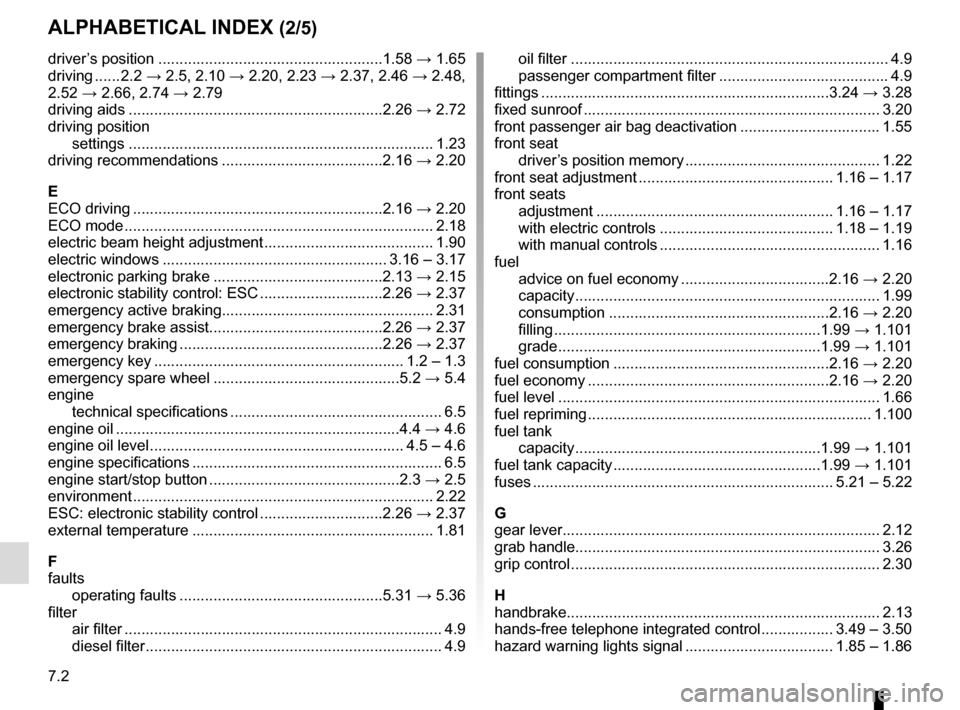
ALPHABETICAL INDEX (2/5)
driver’s position .....................................................1.58 → 1.65
driving ...... 2.2 → 2.5, 2.10 → 2.20, 2.23 → 2.37, 2.46 → 2.48,
2.52 → 2.66, 2.74 → 2.79
driving aids ............................................................2.26 → 2.72
driving position settings ...............................................................\
......... 1.23
driving recommendations ......................................2.16 → 2.20
E
ECO driving ...........................................................2.16 → 2.20
ECO mode ........................................................................\
. 2.18
electric beam height adjustment ........................................ 1.90
electric windows ..................................................... 3.16 – 3.17
electronic parking brake ........................................2.13 → 2.15
electronic stability control: ESC .............................2.26 → 2.37
emergency active braking................................................\
.. 2.31
emergency brake assist.........................................2.26 → 2.37
emergency braking ................................................2.26 → 2.37
emergency key ........................................................... 1.2 – 1.3
emergency spare wheel ............................................5.2 → 5.4
engine technical specifications .................................................. 6.5
engine oil ...................................................................4.4 → 4.6
engine oil level ............................................................ 4.5 – 4.6
engine specifications ........................................................... 6.5
engine start/stop button .............................................2.3 → 2.5
environment ............................................................\
........... 2.22
ESC: electronic stability control .............................2.26 → 2.37
external temperature ......................................................... 1.81
F
faults operating faults ................................................5.31 → 5.36
filter air filter ........................................................................\
... 4.9
diesel filter ...................................................................... 4.9 oil filter ........................................................................\
... 4.9
passenger compartment filter ........................................ 4.9
fittings ...............................................................\
.....3.24 → 3.28
fixed sunroof ...................................................................... 3.20
front passenger air bag deactivation ................................. 1.55
front seat driver’s position memory .............................................. 1.22
front seat adjustment .............................................. 1.16 – 1.17
front seats adjustment ........................................................ 1.16 – 1.17
with electric controls ......................................... 1.18 – 1.19
with manual controls .................................................... 1.16
fuel advice on fuel economy ...................................2.16 → 2.20
capacity ...............................................................\
......... 1.99
consumption ....................................................2.16 → 2.20
filling ...............................................................1\
.99 → 1.101
grade ..............................................................1.99\
→ 1.101
fuel consumption ...................................................2.16 → 2.20
fuel economy .........................................................2.16 → 2.20
fuel level ........................................................................\
.... 1.66
fuel repriming ................................................................... 1.100
fuel tank capacity ..........................................................1.99 \
→ 1.101
fuel tank capacity .................................................1.99 → 1.101
fuses ....................................................................... 5.21 – 5.22
G
gear lever..............................................................\
............. 2.12
grab handle.............................................................\
........... 3.26
grip control ........................................................................\
. 2.30
H
handbrake...............................................................\
...........
2.13
hands-free telephone integrated control ................. 3.49 – 3.50
hazard warning lights signal ................................... 1.85 – 1.86