brake light RENAULT FLUENCE 2012 1.G User Guide
[x] Cancel search | Manufacturer: RENAULT, Model Year: 2012, Model line: FLUENCE, Model: RENAULT FLUENCE 2012 1.GPages: 241, PDF Size: 6.5 MB
Page 119 of 241

ENG_NU_891_892-7_L38-B32_Renault_2
CRUISe CONtROL, SPeeD LIMIteR: cruise control")
JauneNoirNoir texte
2.31
ENG_UD24020_2
Régulateur-limiteur de vitesse : fonction régulateur (L38 - X38 -\
Renault)
ENG_NU_891_892-7_L38-B32_Renault_2
CRUISe CONtROL, SPeeD LIMIteR: cruise control function (4/8)
When the cruise control function is
put on standby, pressing switch 2 (+)
reactivates the cruise control func -
tion without taking into account the
stored speed: it is the speed at
which the vehicle is moving that is
taken into account.Putting the cruise control
on standby or switching it
off does not cause a rapid
reduction in speed: you
must brake by depressing the brake
pedal.
Putting the function on
standby
The function is suspended when you:
– the switch 4 (O);
– the brake pedal;
– depress the clutch pedal or shift into
neutral if the vehicle has an auto -
matic gearbox.
In all three cases, the cruising speed
remains stored and the message
“Memorised ” appears on the instrument
panel.
Standby is confirmed when indicator
light
¦ goes out. Returning to the cruising speed
If a speed is stored, it can be recalled,
once you are sure that the road con
-
ditions are suitable (traffic, road sur -
face, weather conditions, etc.). Press
switch 5 (R) if the vehicle speed is
above 20 mph (30 km/h).
When the stored speed is recalled, acti-
vation of the cruise control is confirmed
by the illumination of the
¦ warn -
ing light.
Note: if the speed previously stored is
much higher than the current speed,
the vehicle will accelerate more rapidly
to reach this threshold.
1
Switching off the function
The cruise control function is deacti -
vated if you press switch 1: in this case
a speed is no longer stored. The green
and ¦ instrument panel indi -
cator lights go out, confirming that the
function is deactivated.
2354
Page 122 of 241

ENG_NU_891_892-7_L38-B32_Renault_2
Jaune NoirNoir texte
CRUISe CONtROL, SPeeD LIMIteR: cruise control")
2.34
ENG_UD24020_2
Régulateur-limiteur de vitesse : fonction régulateur (L38 - X38 -\
Renault)
ENG_NU_891_892-7_L38-B32_Renault_2
Jaune NoirNoir texte
CRUISe CONtROL, SPeeD LIMIteR: cruise control function (7/8)
Adjusting the cruising speed
The cruising speed may be changed by
pressing the following repeatedly:
– switch 2 (+) to increase the speed;
– switch 3 (-) to decrease the speed.
exceeding the cruising speed
The cruising speed may be exceeded
at any time by depressing the acceler-
ator pedal. The cruising speed flashes
on the instrument panel along with the
illumination of zone C in red.
Then, release the accelerator: after a
few seconds, the vehicle will automati-
cally return to its set cruising speed.
Cruising speed cannot be
maintained
If driving up or down a steep gradient,
the system is unable to maintain the
cruising speed: the stored speed on the
instrument panel will flash and zone C
will light up in red to inform you of this
situation.
Putting the function on
standby
The function is suspended when you:
– press switch 4 (O);
– depress the brake pedal;
– depress the clutch pedal or shift into
neutral if the vehicle has an auto -
matic gearbox.
In all three cases, the cruising speed re-
mains stored, it is no longer displayed in
zone 6 and the message “ Memorised”
along with the stored speed will appear
on the instrument panel.
Standby is confirmed when zones A, B
and C go out.
The cruise control function
is in no way linked to the
braking system.
A
BC6
2
3
5
4
Page 123 of 241

ENG_NU_891_892-7_L38-B32_Renault_2
CRUISe CONtROL, SPeeD LIMIteR: cruise control")
JauneNoirNoir texte
2.35
ENG_UD24020_2
Régulateur-limiteur de vitesse : fonction régulateur (L38 - X38 -\
Renault)
ENG_NU_891_892-7_L38-B32_Renault_2
CRUISe CONtROL, SPeeD LIMIteR: cruise control function (8/8)
Returning to the cruising speed
If a speed is stored, it can be recalled,
once you are sure that the road condi -
tions are suitable (traffic, road surface,
weather conditions, etc.).
Press switch 5 (R) if the vehicle speed
is above 20 mph (30 km/h).
When recalling the stored speed
zone A lights up to confirm activation.
Zone B lights up as soon as the cruis-
ing speed is reached. Note: if the speed previously stored is
much higher than the current speed,
the vehicle will accelerate more rapidly
to reach this threshold.Switching off the function
The cruise control function is deacti
-
vated if you press switch 1: in this case
a speed is no longer stored. The instru-
ment panel green indicator light 7 and
zones A , B and C go out, confirming
that the function is deactivated.
When the cruise control function is
put on standby, pressing switch 2 (+)
reactivates the cruise control func -
tion without taking into account the
stored speed: it is the speed at
which the vehicle is moving that is
taken into account.Putting the cruise control
on standby or switching it
off does not cause a rapid
reduction in speed: you
must brake by depressing the brake
pedal.
A
BC
2
3
5
4
1
7
Page 126 of 241
automatic gearbox (use) ....................... (up to the end of the DU)
automatic gearbox selector lever ..........(up to the end of the DU)
changing gear ....................................... (up to the end of the DU)
reverse gear selecting .......................................... (up to the end of the DU)
driving ................................................... (up to the end of the DU)
2.38
ENG_UD27296_4
Boîte automatique (L38 - X38 - Renault)
ENG_NU_891_892-7_L38-B32_Renault_2
Jaune NoirNoir texte
Automatic gearbox
AUtOMA tIC tRANSMISSION (1/3)
Driving in automatic mode
Select position D. In most traffic con -
ditions, you will not have to touch the
gear selector lever again: the gears will
change automatically at the right time
and at the most suitable engine speed
because the automatic system takes
into account the vehicle load and road
contour and adjusts itself to the particu-
lar driving style you have chosen.
economical driving
When driving, always leave the lever
in position D, keeping the accelerator
pedal lightly depressed to ensure auto-
matic gear changes at a lower engine
speed.
Accelerating and overtaking
Depress the accelerator pedal firmly
and fully (so that it goes beyond the
kickdown point).
this will enable you to change down
to the optimum gear within the
engine range.
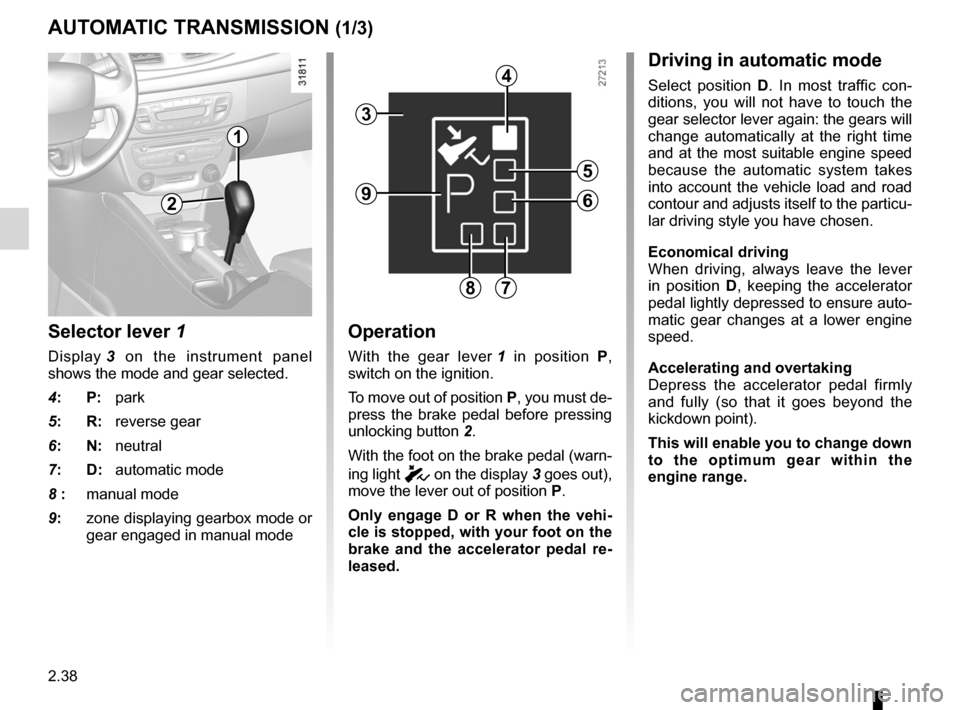
3
2
1
4
5
6
78
9
Selector lever 1
Display 3 on the instrument panel
shows the mode and gear selected.
4: P: park
5: R: reverse gear
6: N: neutral
7: D: automatic mode
8 : manual mode
9: zone displaying gearbox mode or
gear engaged in manual mode
Operation
With the gear lever 1 in position P,
switch on the ignition.
To move out of position P, you must de-
press the brake pedal before pressing
unlocking button 2.
With the foot on the brake pedal (warn-
ing light
c on the display 3 goes out),
move the lever out of position P.
Only engage D or R when the vehi -
cle is stopped, with your foot on the
brake and the accelerator pedal re -
leased.
Page 151 of 241
rear parcel shelf .................................... (up to the end of the DU)
tailgate .................................................. (up to the end of the DU)
rear parcel shelf .................................... (up to the end of the DU)
3.23
ENG_UD21357_2
Tablette arrière (L38 - X38 - Renault)
ENG_NU_891_892-7_L38-B32_Renault_3
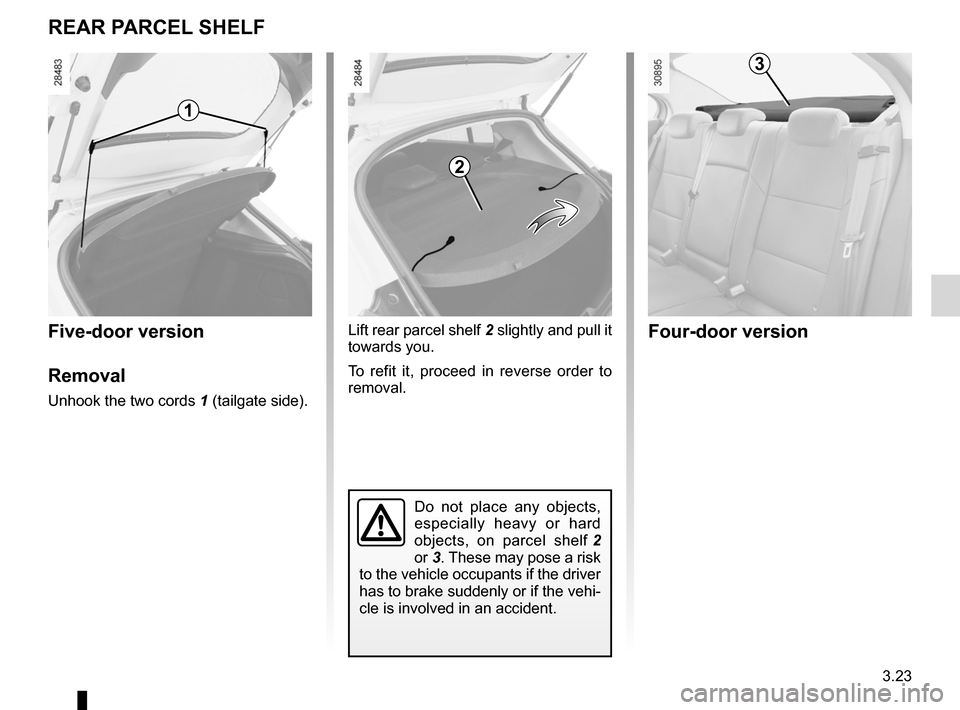
Lift rear parcel shelf 2 slightly and pull it
towards you.
To refit it, proceed in reverse order to
removal.Five-door version
Removal
Unhook the two cords 1 (tailgate side).
Rear parcel shelf
Do not place any objects,
especially heavy or hard
objects, on parcel shelf 2
or 3. These may pose a risk
to the vehicle occupants if the driver
has to brake suddenly or if the vehi-
cle is involved in an accident.
REAR PARcEl ShElF
1
Four-door version
2
3
Page 157 of 241
4.1
ENG_UD27183_7
Sommaire 4 (L38 - X38 - Renault)
ENG_NU_891_892-7_L38-B32_Renault_4
Section 4: Maintenance
Bonnet . . . . . . . . . . . . . . . . . . . . . . . . . . . . . . . . . . . . . . . . . . . . . . . . . . . . . . . . . . . . . . . . . . . . . . . . 4.2
Engine oil level: . . . . . . . . . . . . . . . . . . . . . . . . . . . . . . . . . . . . . . . . . . . . . . . . . . . . . . . . . . . . . . . . . 4.4
general information . . . . . . . . . . . . . . . . . . . . . . . . . . . . . . . . . . . . . . . . . . . . . . . . . . . . . . . . 4.4
topping up, filling . . . . . . . . . . . . . . . . . . . . . . . . . . . . . . . . . . . . . . . . . . . . . . . . . . . . . . . . . . 4.6
Engine oil change . . . . . . . . . . . . . . . . . . . . . . . . . . . . . . . . . . . . . . . . . . . . . . . . . . . . . . . . . . . . . . . 4.7
Levels: . . . . . . . . . . . . . . . . . . . . . . . . . . . . . . . . . . . . . . . . . . . . . . . . . . . . . . . . . . . . . . . . . . . . . . . . 4.8
engine coolant . . . . . . . . . . . . . . . . . . . . . . . . . . . . . . . . . . . . . . . . . . . . . . . . . . . . . . . . . . . . 4.8
brake fluid . . . . . . . . . . . . . . . . . . . . . . . . . . . . . . . . . . . . . . . . . . . . . . . . . . . . . . . . . . . . . . . . 4.9
windscreen/headlight washer reservoir . . . . . . . . . . . . . . . . . . . . . . . . . . . . . . . . . . . . . . . . . 4.10
Filters . . . . . . . . . . . . . . . . . . . . . . . . . . . . . . . . . . . . . . . . . . . . . . . . . . . . . . . . . . . . . . . . . . . . . . . . . 4.10
Tyre pressure. . . . . . . . . . . . . . . . . . . . . . . . . . . . . . . . . . . . \
. . . . . . . . . . . . . . . . . . . . . . . . . . . . . . . 4.11
Battery . . . . . . . . . . . . . . . . . . . . . . . . . . . . . . . . . . . . . . . . . . . . . . . . . . . . . . . . . . . . . . . . . . . . . . . . 4.12
Bodywork maintenance . . . . . . . . . . . . . . . . . . . . . . . . . . . . . . . . . . . . . . . . . . . . . . . . . . . . . . . . . . . 4.13
Interior trim maintenance . . . . . . . . . . . . . . . . . . . . . . . . . . . . . . . . . . . . . . . . . . . . . . . . . . . . . . . . . . 4.15
Page 165 of 241
JauneNoirNoir texte
4.9
ENG_UD18857_2
Niveaux / filtres (L38 - X38 - Renault)
ENG_NU_891_892-7_L38-B32_Renault_4
brake fluid
levelS (2/3)
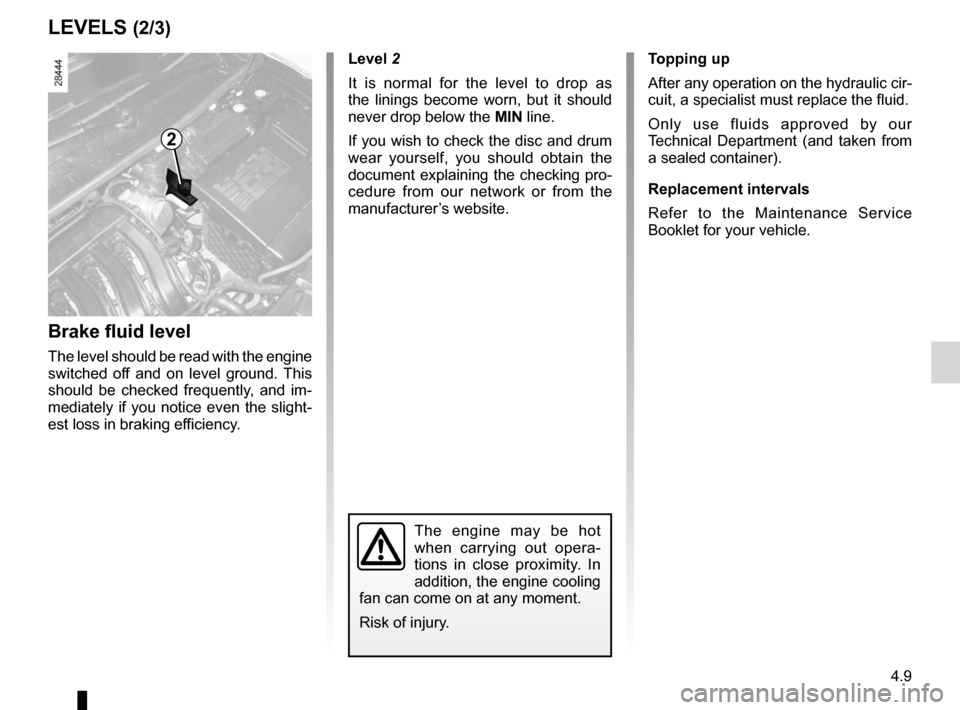
Brake fluid level
The level should be read with the engine
switched off and on level ground. This
should be checked frequently, and im -
mediately if you notice even the slight-
est loss in braking efficiency. level 2
It is normal for the level to drop as
the linings become worn, but it should
never drop below the
Min line.
If you wish to check the disc and drum
wear yourself, you should obtain the
document explaining the checking pro-
cedure from our network or from the
manufacturer’s website. t
opping up
After any operation on the hydraulic cir-
cuit, a specialist must replace the fluid.
Only use fluids approved by our
Technical Department (and taken from
a sealed container).
Replacement intervals
Refer to the Maintenance Service
Booklet for your vehicle.
2
The engine may be hot
when carrying out opera -
tions in close proximity. In
addition, the engine cooling
fan can come on at any moment.
Risk of injury.
Page 177 of 241
JauneNoirNoir texte
5.5
ENG_UD21559_4
Kit de gonflage (X95 - B95 - D95 - L38 - X38 - X32 - B32 - Renault)
ENG_NU_891_892-7_L38-B32_Renault_5
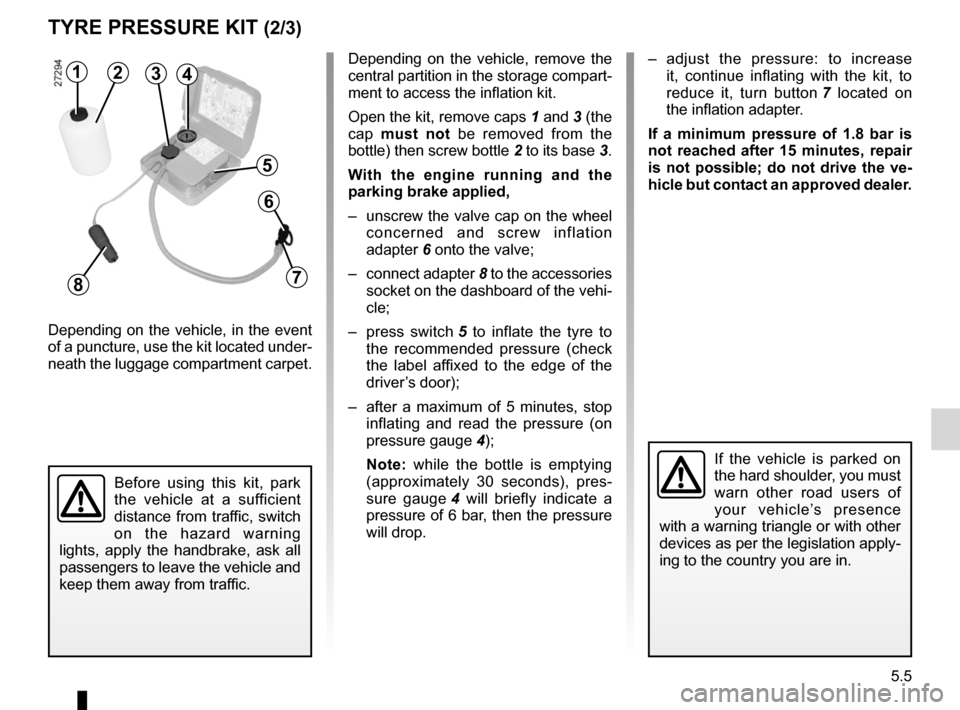
Depending on the vehicle, remove the
central partition in the storage compart-
ment to access the inflation kit.
Open the kit, remove caps 1 and 3 (the
cap must not be removed from the
bottle) then screw bottle 2 to its base 3.
w ith the engine running and the
parking brake applied,
– unscrew the valve cap on the wheel
concerned and screw inflation
adapter 6 onto the valve;
– connect adapter 8 to the accessories
socket on the dashboard of the vehi-
cle;
– press switch 5 to inflate the tyre to
the recommended pressure (check
the label affixed to the edge of the
driver’s door);
– after a maximum of 5 minutes, stop
inflating and read the pressure (on
pressure gauge 4);
n ote: while the bottle is emptying
(approximately 30 seconds), pres -
sure gauge 4 will briefly indicate a
pressure of 6 bar, then the pressure
will drop.
tyre Pressure KIt (2/3)
143
5
6
78
2– adjust the pressure: to increase
it, continue inflating with the kit, to
reduce it, turn button 7 located on
the inflation adapter.
If a minimum pressure of 1.8 bar is
not reached after 15 minutes, repair
is not possible; do not drive the ve-
hicle but contact an approved dealer.
Depending on the vehicle, in the event
of a puncture, use the kit located under -
neath the luggage compartment carpet.
Before using this kit, park
the vehicle at a sufficient
distance from traffic, switch
on the hazard warning
lights, apply the handbrake, ask all
passengers to leave the vehicle and
keep them away from traffic.
If the vehicle is parked on
the hard shoulder, you must
warn other road users of
your vehicle’s presence
with a warning triangle or with other
devices as per the legislation apply-
ing to the country you are in.
Page 181 of 241
changing a wheel.................................. (up to the end of the DU)
puncture ................................................ (up to the end of the DU)
lifting the vehicle changing a wheel ............................ (up to the end of the DU)
5.9
ENG_UD21374_3
Changement de roue (L38 - X38 - Renault)
ENG_NU_891_892-7_L38-B32_Renault_5
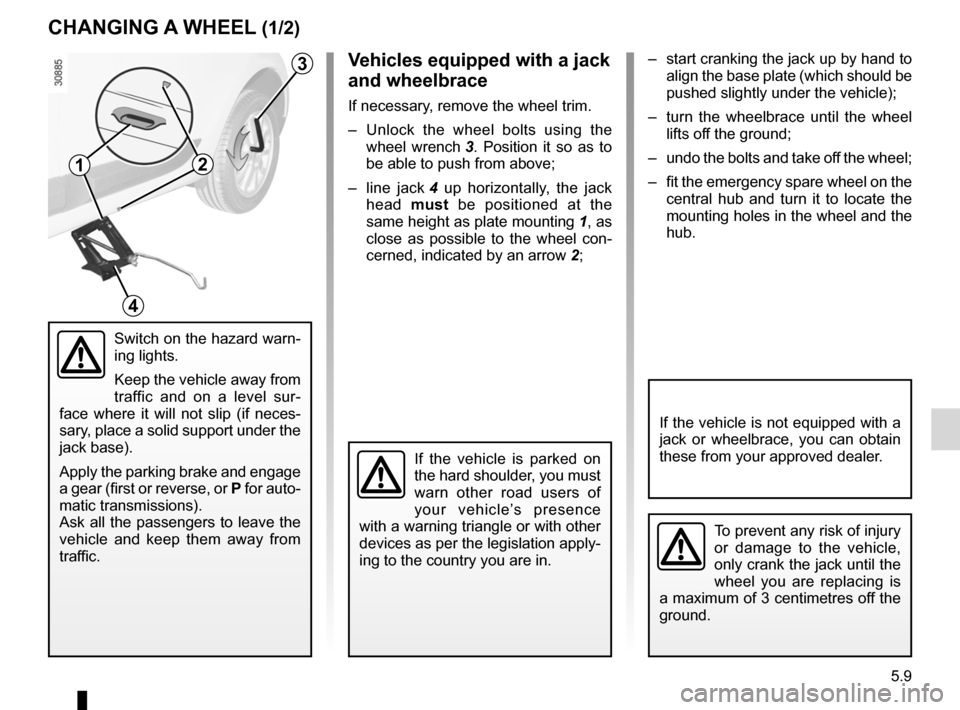
Vehicles equipped with a jack
and wheelbrace
If necessary, remove the wheel trim.
– Unlock the wheel bolts using the
wheel wrench 3. Position it so as to
be able to push from above;
– line jack 4 up horizontally, the jack
head must be positioned at the
same height as plate mounting 1, as
close as possible to the wheel con -
cerned, indicated by an arrow 2;
– start cranking the jack up by hand to
align the base plate (which should be
pushed slightly under the vehicle);
– turn the wheelbrace until the wheel
lifts off the ground;
– undo the bolts and take off the wheel;
– fit the emergency spare wheel on the
central hub and turn it to locate the
mounting holes in the wheel and the
hub.
Changing a wheel
changIng a wheel (1/2)
Switch on the hazard warn-
ing lights.
Keep the vehicle away from
traffic and on a level sur -
face where it will not slip (if neces -
sary, place a solid support under the
jack base).
Apply the parking brake and engage
a gear (first or reverse, or P for auto-
matic transmissions).
Ask all the passengers to leave the
vehicle and keep them away from
traffic.
3
4
12
To prevent any risk of injury
or damage to the vehicle,
only crank the jack until the
wheel you are replacing is
a maximum of 3 centimetres off the
ground.
If the vehicle is not equipped with a
jack or wheelbrace, you can obtain
these from your approved dealer.
If the vehicle is parked on
the hard shoulder, you must
warn other road users of
your vehicle’s presence
with a warning triangle or with other
devices as per the legislation apply-
ing to the country you are in.
Page 191 of 241
bulbschanging ......................................... (up to the end of the DU)
changing a bulb .................................... (up to the end of the DU)
lights: direction indicators ........................................... (current page)
lights: side lights ......................................................... (current page)
lights: brake lights ...................................................... (current page)
lights: reversing lights ................................................. (current page)
lights: fog lights .......................................................... (current page)
indicators: direction indicators ........................................... (current page)
bulbs changing ......................................... (up to the end of the DU)
5.19
ENG_UD21378_2
Feux arrière et latéraux : remplacement des lampes (L38 - X38 - R\
enault)
ENG_NU_891_892-7_L38-B32_Renault_5
Rear lights (changing bulbs)
rear lIghts anD InDIcatOr lIghts: changing bulbs (1/5)
6
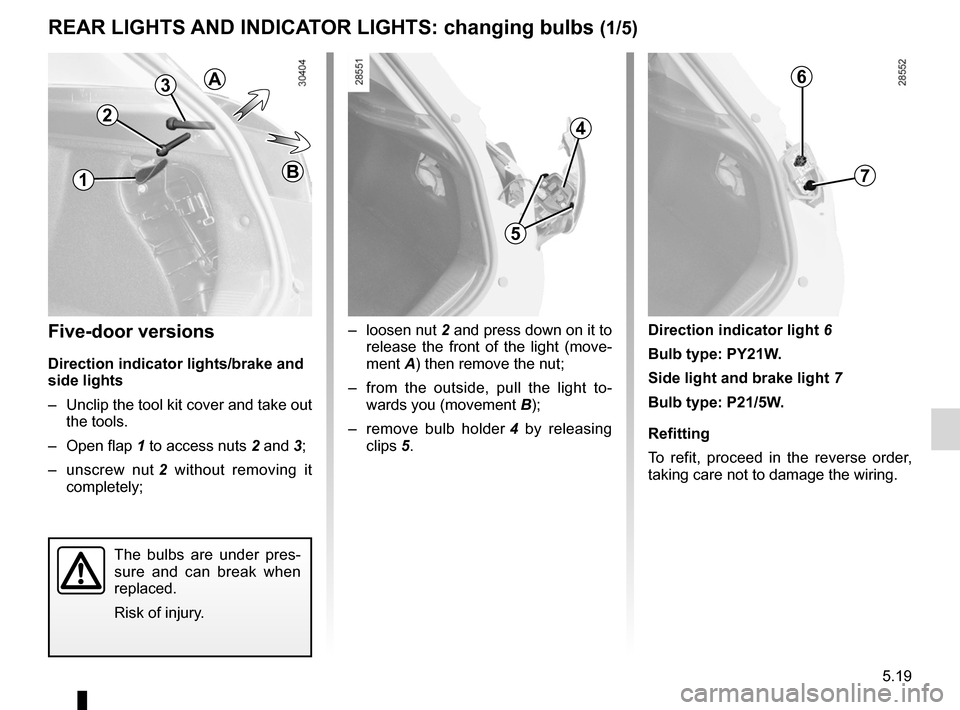
– loosen nut 2 and press down on it to
release the front of the light (move -
ment A) then remove the nut;
– from the outside, pull the light to -
wards you (movement B);
– remove bulb holder 4 by releasing
clips 5. Direction indicator light
6
Bulb type: Py21w .
side light and brake light 7
Bulb type: P21/5w .
refitting
To refit, proceed in the reverse order,
taking care not to damage the wiring.Five-door versions
Direction indicator lights/brake and
side lights
– Unclip the tool kit cover and take out
the tools.
– Open flap 1 to access nuts 2 and 3;
– unscrew nut 2 without removing it
completely;
The bulbs are under pres -
sure and can break when
replaced.
Risk of injury.
5
7
a
B1
24
3