fuel RENAULT FLUENCE 2012 1.G Owner's Manual
[x] Cancel search | Manufacturer: RENAULT, Model Year: 2012, Model line: FLUENCE, Model: RENAULT FLUENCE 2012 1.GPages: 241, PDF Size: 6.5 MB
Page 101 of 241

JauneNoirNoir texte
2.13
ENG_UD20973_7
Conseils antipollution, économie de carburant, conduite (X45 - H45 -\
X85 - B85 - C85 - S85 - X91 - X83 - X61 - F61 - K61 - K85 - X95 - B95 -\
D95 - J95 - R95 - L38 - X61
ENG_NU_891_892-7_L38-B32_Renault_2
ADVICe: antipollution, fuel economy and driving (3/3)
Advice on use
– Electricity is fuel; switch off all the
electrical components which are
not really needed. however (safety
first), keep your lights on when the
visibility is bad (“see and be seen”).
– Use the air vents. Driving with the
windows open at 60 mph (100 km/h)
will increase fuel consumption by
4%.
– Avoid using the car for door-to-door
calls (short journeys with long waits
in between) because the engine
never reaches its normal operating
temperature.
tyres
– An underinflated tyre increases fuel
consumption.
– The use of non-recommended tyres
can increase fuel consumption.
–
In vehicles fitted with air condi -
tioning, it is normal to observe an
increase in fuel consumption (es -
pecially in urban conditions) when
it is used. For vehicles fitted with
manual air conditioning, switch off
the system when it is not required.
Advice for reducing consumption
and therefore helping to preserve
the environment:
If the vehicle has been parked in the
sun, open the doors for a few mo -
ments to let the hot air escape before
starting the engine.
– Never fill the fuel tank right to the
brim to avoid overflow.
– Do not leave an empty roof rack
fitted to the vehicle.
– It is better to fit a trailer for bulky ob-
jects.
– When towing a caravan, fit a wind
deflector and adjust it carefully.
Page 102 of 241

2.14
ENG_UD25716_1
Environnement (sans marque) (X44 - X45 - X77 - X81 - X85 - X90 - X91 \
- X83 - X61 - TEST - X95 - J9")
environment .......................................... (up to the end of the DU)
2.14
ENG_UD25716_1
Environnement (sans marque) (X44 - X45 - X77 - X81 - X85 - X90 - X91 \
- X83 - X61 - TEST - X95 - J95 - R95 - F90 Ph2 - X33 - X47 - X43 - X38 - H79 - X62 - X32 -\
X09 -
ENG_NU_891_892-7_L38-B32_Renault_2
Environment
eNVIRONMeNt
emissions
Your vehicle has been designed to emit
fewer greenhouse gases (CO2) while in
use, and therefore to consume less fuel
(eg. 140 g/km, equivalent to 5.3 l/100
km for a diesel vehicle).
Our vehicles are also equipped with a
particle filter system including a cata -
lytic converter, an oxygen sensor and
an active carbon filter (the latter pre -
vents vapour from the fuel tank being
released into the open air).
For certain diesel vehicles, this system
also has a particle filter to reduce the
volume of soot particles emitted.
Please make your own
contribution towards
protecting the environment
too
– Worn parts replaced in the course of
routine vehicle maintenance (vehi -
cle battery, oil filter, air filter, batter -
ies, etc.) and oil containers (empty or
filled with used oil) must be disposed
of through specialist organisations. –
At the end of the vehicle’s service
life, it should be sent to approved
centres to ensure that it is recycled.
– In all cases, comply with local legis -
lation.
Recycling
Your vehicle is 85% recyclable and
95% recoverable.
To achieve these objectives, many of
the vehicle components have been de-
signed to enable them to be recycled.
The materials and structures have
been carefully designed to allow these
components to be easily removed and
reprocessed by specialist companies.
In order to preserve raw material re -
sources, this vehicle incorporates nu -
merous parts made from recycled plas-
tics or renewable materials (vegetable
or animal-derived materials such as
cotton or wool).
Your vehicle has been designed with
respect for the
environment in mind for
its entire service life: during production,
use and at the end of its life.
This commitment is illustrated by the of
the manufacturer eco² signature.Manufacture
Your vehicle has been manufactured at
a factory which complies with a policy
to reduce the environmental impact
on the surrounding areas (reduction of
water and energy consumption, visual
and noise pollution, atmospheric emis-
sions and waste water; sorting and re-
using waste).
Page 139 of 241
air conditioning ..................................... (up to the end of the DU)
heating and air conditioning system ...................... (current page)
air conditioning ..................................... (up to the end of the DU)
3.11
ENG_UD10101_2
Air conditionné : informations et conseils d’utilisation (X95 - B\
95 - D95 - Renault)
ENG_NU_891_892-7_L38-B32_Renault_3
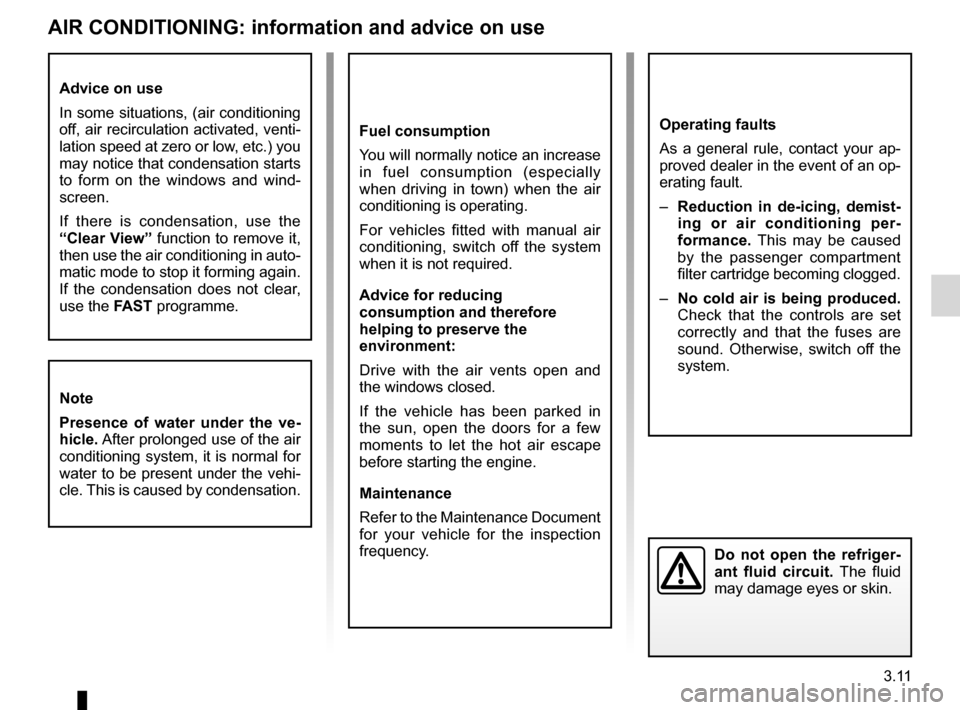
Air conditioning: information and advice on use
AIR coNDITIoNINg: information and advice on use
Fuel consumption
You will normally notice an increase
in fuel consumption (especially
when driving in town) when the air
conditioning is operating.
For vehicles fitted with manual air
conditioning, switch off the system
when it is not required.
Advice for reducing
consumption and therefore
helping to preserve the
environment:
Drive with the air vents open and
the windows closed.
If the vehicle has been parked in
the sun, open the doors for a few
moments to let the hot air escape
before starting the engine.
Maintenance
Refer to the Maintenance Document
for your vehicle for the inspection
frequency.operating faults
As a general rule, contact your ap-
proved dealer in the event of an op-
erating fault.
– Reduction in de-icing, demist -
ing or air conditioning per -
formance. This may be caused
by the passenger compartment
filter cartridge becoming clogged.
– No cold air is being produced.
Check that the controls are set
correctly and that the fuses are
sound. Otherwise, switch off the
system.
Advice on use
In some situations, (air conditioning
off, air recirculation activated, venti-
lation speed at zero or low, etc.) you
may notice that condensation starts
to form on the windows and wind -
screen.
If there is condensation, use the
“clear View” function to remove it,
then use the air conditioning in auto-
matic mode to stop it forming again.
If the condensation does not clear,
use the FAST programme.
Do not open the refriger -
ant fluid circuit. The fluid
may damage eyes or skin.
Note
Presence of water under the ve -
hicle. After prolonged use of the air
conditioning system, it is normal for
water to be present under the vehi-
cle. This is caused by condensation.
Page 166 of 241
4.10
ENG_UD18857_2
Niveaux / filtres (L38 - X38 - Renault)
ENG_NU_891_892-7_L38-B32_Renault_4
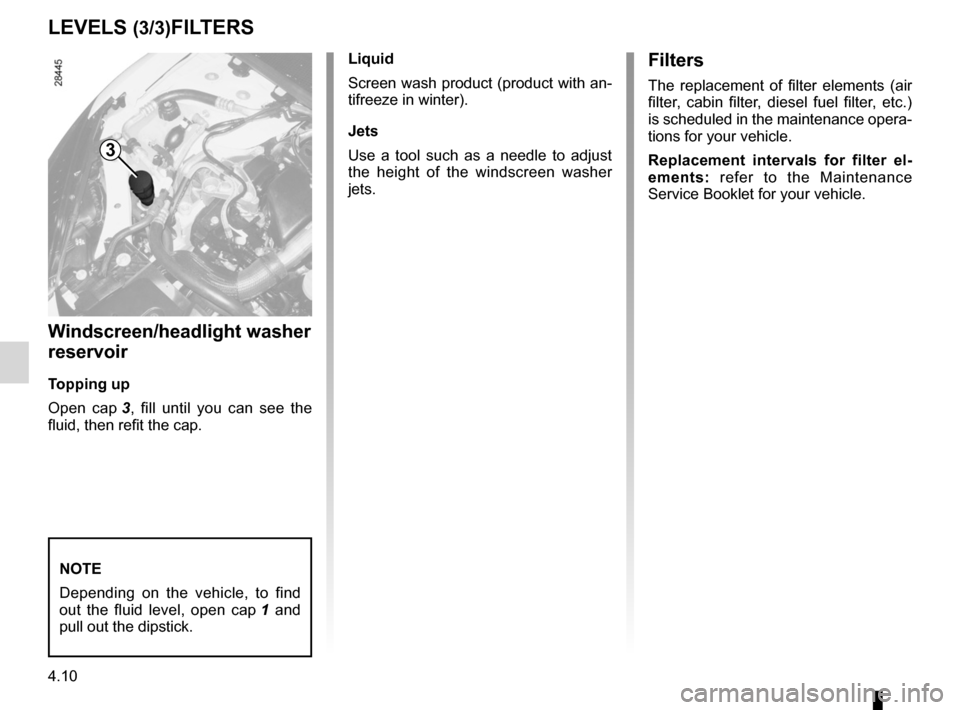
windscreen/headlight washer reservoir
Filters
levelS (3/3)FilteRS
Windscreen/headlight washer
reservoir
t opping up
Open cap 3 , fill until you can see the
fluid, then refit the cap. liquid
Screen wash product (product with an-
tifreeze in winter).
Jets
Use a tool such as a needle to adjust
the height of the windscreen washer
jets.
nOte
Depending on the vehicle, to find
out the fluid level, open cap
1 and
pull out the dipstick.
Filters
The replacement of filter elements (air
filter, cabin filter, diesel fuel filter, etc.)
is scheduled in the maintenance opera -
tions for your vehicle.
Replacement intervals for filter el -
ements: refer to the Maintenance
Service Booklet for your vehicle.
3
Page 211 of 241
JauneNoirNoir texte
5.39
ENG_UD17941_2
Anomalies de fonctionnement (X85 - L38 - X38 - Renault)
ENG_NU_891_892-7_L38-B32_Renault_5
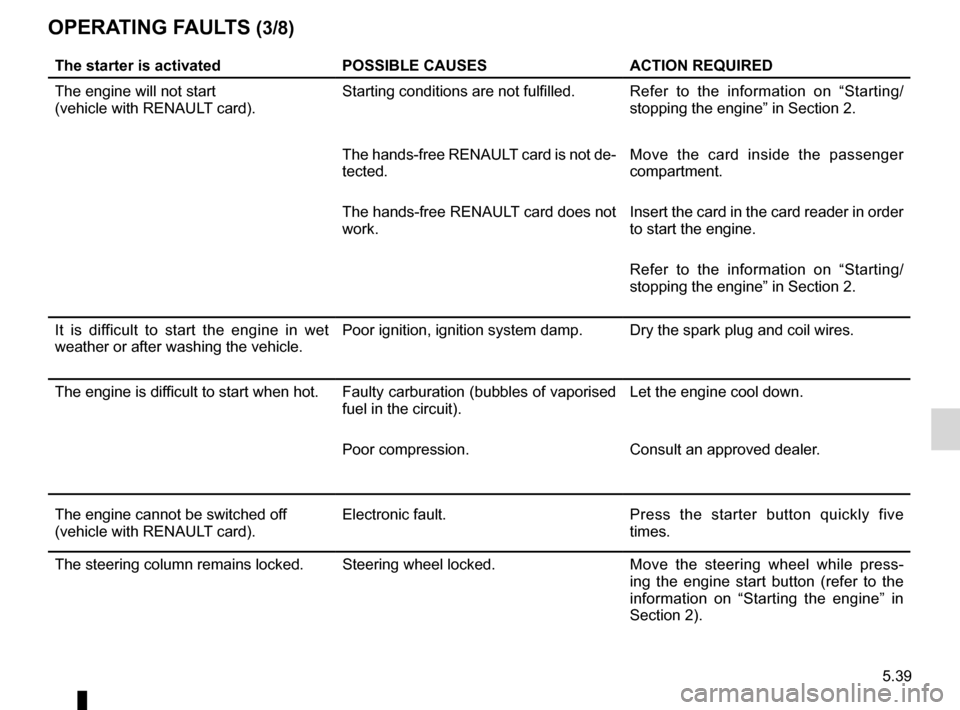
OPeratIng F aults (3/8)
the starter is activated POssIBle causesactIOn requIreD
The engine will not start
(vehicle with RENAULT card). Starting conditions are not fulfilled.
Refer to the information on “Starting/
stopping the engine” in Section 2.
The hands-free RENAULT card is not de-
tected. Move the card inside the passenger
compartment.
The hands-free RENAULT card does not
work. Insert the card in the card reader in order
to start the engine.
Refer to the information on “Starting/
stopping the engine” in Section 2.
It is difficult to start the engine in wet
weather or after washing the vehicle. Poor ignition, ignition system damp.
Dry the spark plug and coil wires.
The engine is difficult to start when hot. Faulty carburation (bubbles of vaporised
fuel in the circuit).Let the engine cool down.
Poor compression. Consult an approved dealer.
The engine cannot be switched off
(vehicle with RENAULT card). Electronic fault.
Press the starter button quickly five
times.
The steering column remains locked. Steering wheel locked.Move the steering wheel while press-
ing the engine start button (refer to the
information on “Starting the engine” in
Section 2).
Page 213 of 241
JauneNoirNoir texte
5.41
ENG_UD17941_2
Anomalies de fonctionnement (X85 - L38 - X38 - Renault)
ENG_NU_891_892-7_L38-B32_Renault_5
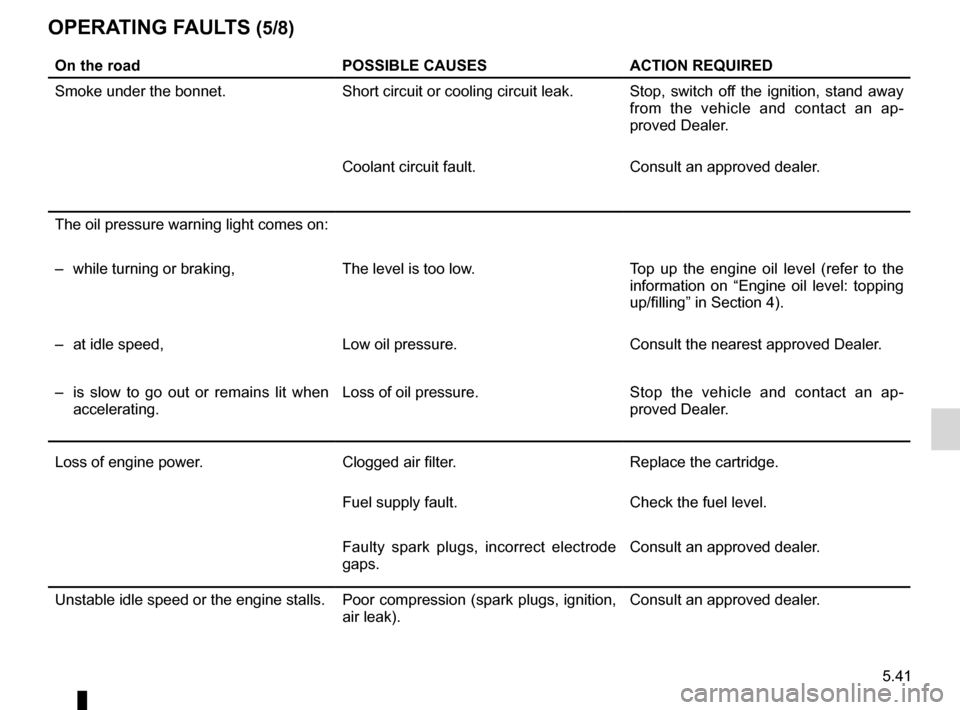
OPeratIng F aults (5/8)
On the road POssIBle causesactIOn requIreD
Smoke under the bonnet. Short circuit or cooling circuit leak.Stop, switch off the ignition, stand away
from the vehicle and contact an ap-
proved Dealer.
Coolant circuit fault. Consult an approved dealer.
The oil pressure warning light comes on:
– while turning or braking, The level is too low. Top up the engine oil level (refer to the
information on “Engine oil level: topping
up/filling” in Section 4).
– at idle speed, Low oil pressure. Consult the nearest approved Dealer.
– is slow to go out or remains lit when
accelerating. Loss of oil pressure.
Stop the vehicle and contact an ap-
proved Dealer.
Loss of engine power. Clogged air filter.Replace the cartridge.
Fuel supply fault. Check the fuel level.
Faulty spark plugs, incorrect electrode
gaps. Consult an approved dealer.
Unstable idle speed or the engine stalls. Poor compression (spark plugs, ignition,
air leak).Consult an approved dealer.
Page 222 of 241
6.6
ENG_UD13712_1
Caractéristiques moteurs (L38 - X38 - Renault)
ENG_NU_891_892-7_L38-B32_Renault_6
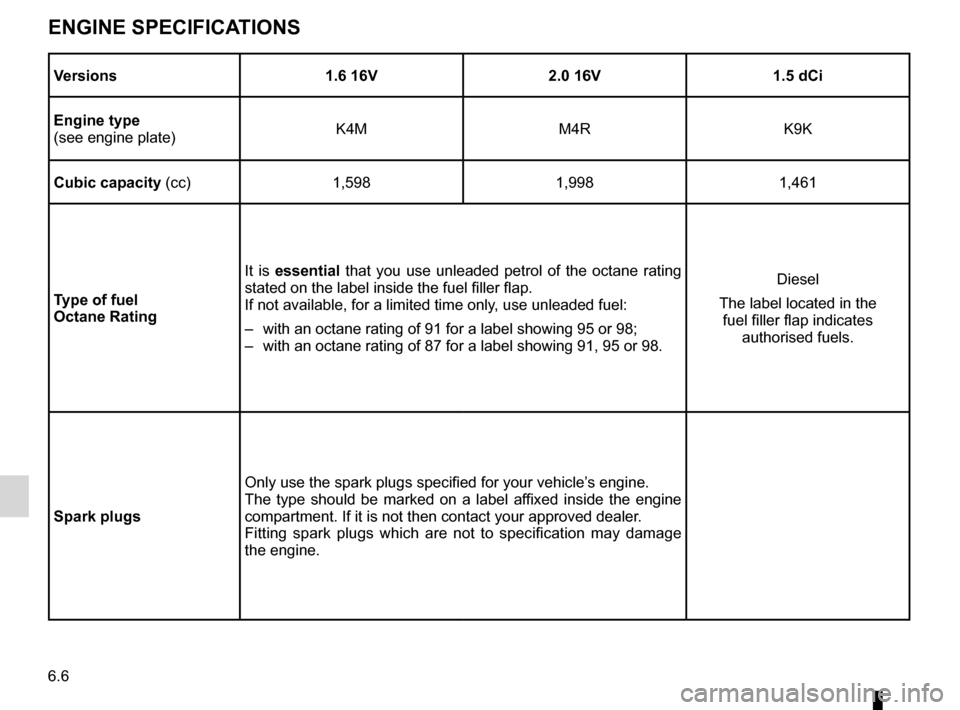
Engine specifications
Versions 1.6 16V2.0 16V 1.5 dci
engine type
(see engine plate) K4M
M4R K9K
cubic capacity (cc) 1,5981,9981,461
t ype of fuel
octane Rating It is
essential that you use unleaded petrol of the octane rating
stated on the label inside the fuel filler flap.
If not available, for a limited time only, use unleaded fuel:
– with an octane rating of 91 for a label showing 95 or 98;
– with an octane rating of 87 for a label showing 91, 95 or 98. Diesel
The label located in the fuel filler flap indicates authorised fuels.
spark plugs Only use the spark plugs specified for your vehicle’s engine.
The type should be marked on a label affixed inside the engine
compartment. If it is not then contact your approved dealer.
Fitting spark plugs which are not to specification may damage
the engine.
engine specifications
Page 238 of 241
7.2
FRA_UD27191_7
Index (L38 - X38 - Renault)
ENG_NU_891_892-7_L38-B32_Renault_7
Jaune NoirNoir texte
AlphAbeticAl index (2/5)
driving ......................................... 2.2, 2.5 → 2.13, 2.15 → 2.40
driving position settings ............................................................ 1.19 → 1.21
e
electric beam height adjustment ........................................ 1.78
electric windows .................................................... 3.12 → 3.14
electronic stability control: ESC .............................2.18 → 2.21
emergency brake assist ......................................... 2.18 → 2.21
emergency braking ................................................ 2.18 → 2.21
emergency key ........................................................... 1.4 – 1.5
emergency spare wheel ............................. 5.2 – 5.3, 5.7 – 5.8
engine oil .......................................................... 1.52, 4.4 → 4.7
engine oil capacity ...................................................... 4.6 – 4.7
engine oil level ........................................................... 4.4 → 4.7
engine start/stop button ............................................. 2.5 → 2.7
environment ....................................................................... 2.14
ESC: electronic stability control .............................2.18 → 2.21
external temperature .............................................. 1.70 – 1.71
F
faults operating faults ................................................ 5.37 → 5.44
filter air filter ......................................................................... 4.10
diesel filter .................................................................... 4.10
oil filter .................................................................. 4.7, 4.10
particle filter ................................................................. 1.52
passenger compartment filter ...................................... 4.10
fitting a radio ...................................................................... 5.32
fittings .................................................................... 3.17 → 3.19
fog lights ........................................................................\
.... 5.18
front passenger air bag deactivation ................................. 1.42
front seat adjustment ......................................................... 1.18
front seats adjustment ..............................................1.16, 1.18 → 1.21 with manual controls
.................................................... 1.18
fuel advice on fuel economy ............................................... 2.11
capacity ........................................................................ 1.82
filling ........................................................ 1.52, 1.82 → 1.84
grade ................................................................ 1.82 → 1.84
fuel economy ......................................................... 2.11 → 2.13
fuel filler cap .......................................................... 1.82 → 1.84
fuel level ........................................................................\
.... 1.54
fuel tank capacity ............................................................ 1.82 → 1.84
fuel tank capacity ................................................... 1.82 → 1.84
fuses ....................................................................... 5.26 – 5.27
G
gear lever ........................................................................\
... 2.10
glove box ........................................................................\
... 3.19
h
handbrake ................................................................. 1.50, 2.10
hands-free telephone integrated control ............................ 3.27
hazard warning lights signal ................................... 1.74 – 1.75
headlight beam adjustment ............................................... 1.78
headlight flashers .............................................................. 1.74
headlight washer ............................................................... 1.80
headrest .................................................................. 1.16 – 1.17
heating and air conditioning system .................................. 3.11
heating system ........................................................ 3.4 → 3.10
hill descent control ................................................. 2.18 → 2.21
Hill Start Assist....................................................... 2.18 → 2.21
horn ........................................................................\
........... 1.74
horn: flash ............................................................................. 1.74
sounding the horn ........................................................ 1.74
hubcap tool ........................................................................\
.. 5.8
Page 239 of 241
JauneNoirNoir texte
7.3
FRA_UD27191_7
Index (L38 - X38 - Renault)
ENG_NU_891_892-7_L38-B32_Renault_7
AlphAbeticAl index (3/5)
i
ignition switch ............................................................. 2.3 – 2.4
indicators ............................................. 1.50, 1.74, 5.14 → 5.18
indicators: direction indicators .............................................. 1.74, 5.19
exterior temperature indicator ...................................... 1.70
instrument panel .............................................. 1.50 → 1.60
instrument panel ........................................... 1.50 → 1.60, 1.75
instrument panel messages ...................................1.58 → 1.60
interior trim maintenance ..................................................... 4.15 – 4.16
J
jack ........................................................................\
..... 5.7 – 5.8
K
keys ........................................................................\
.... 1.2 – 1.3
l
levels: brake fluid ...................................................................... 4.9
coolant .................................................................. 1.54, 4.8
fuel ............................................................................... 1.54
windscreen washer reservoir ....................................... 4.10
lifting the vehicle changing a wheel ................................................ 5.9 – 5.10
lighting: exterior ............................................................. 1.75 → 1.77
instrument panel .......................................................... 1.75
interior ........................................... 3.15 – 3.16, 5.24 – 5.25
lights additional ..................................................................... 5.18
adjustment ................................................................... 1.78
changing bulbs ................................................. 5.14 → 5.18
fog lights ...................................................................... 5.18
front .................................................................. 5.14 → 5.18mobile directional
......................................................... 1.76
lights: adjusting ...................................................................... 1.78
brake lights .................................................................. 5.19
dipped beam headlights .................1.50, 1.75, 5.14 → 5.18
direction indicators ......................... 1.50, 1.74, 5.14 → 5.19
fog lights ......................................... 1.50, 1.77, 5.18 – 5.19
hazard warning ............................................................ 1.74
main beam headlights .................... 1.50, 1.76, 5.14 → 5.18
number plate lights ...................................................... 5.23
reversing lights ............................................................. 5.19
side lights ............................................................ 1.75, 5.19
locking the doors ............................................ 1.2 → 1.12, 1.15
M
maintenance: bodywork .......................................................... 4.13 – 4.14
interior trim ........................................................ 4.15 – 4.16
mechanical .........................................4.2 – 4.3, 6.9 → 6.14
mileage before service ....................................... 6.9 → 6.14
map reading lights .................................................. 3.15 – 3.16
menu for customising the vehicle settings ......................... 1.69
methods of restraint in addition to the front seat belts ..............
1.22 → 1.24
methods of restraint in addition to the seat belts ... 1.22 → 1.27
multimedia equipment ....................................................... 3.27
n
navigation ........................................................................\
.. 3.27
navigation system .............................................................. 3.27
O
oil change .................................................................. 4.4 → 4.7
opening the doors .................................................. 1.11 → 1.14
operating faults ................................ 1.50 → 1.53, 5.37 → 5.44