wind RENAULT FLUENCE 2012 1.G Owner's Manual
[x] Cancel search | Manufacturer: RENAULT, Model Year: 2012, Model line: FLUENCE, Model: RENAULT FLUENCE 2012 1.GPages: 241, PDF Size: 6.5 MB
Page 120 of 241

ENG_NU_891_892-7_L38-B32_Renault_2
Jaune NoirNoir texte
CRUISe CONtROL, SPeeD LIMIteR: cruise control")
2.32
ENG_UD24020_2
Régulateur-limiteur de vitesse : fonction régulateur (L38 - X38 -\
Renault)
ENG_NU_891_892-7_L38-B32_Renault_2
Jaune NoirNoir texte
CRUISe CONtROL, SPeeD LIMIteR: cruise control function (5/8)
Instrument panel B
The cruise control function helps you to
maintain your driving speed at a speed
that you choose, called the cruising
speed.
This cruising speed may be set at any
speed above 20 mph (30 km/h).
Controls
1 Main “On/Off” switch.
2 Limit speed activation, storage and
increase switch (+).
3 Decrease cruising speed (-).
4 Switch the function to standby
(with memorisation of the gov -
erned cruising speed) (O).
5 Activation with recall of stored gov-
erned cruising speed (R).
This function is an addi -
tional driving aid. However,
the function does not take
the place of the driver.
Therefore, it can under no circum -
stances replace the driver’s respon-
sibility to respect speed limits and to
be vigilant (the driver must always
be ready to brake). Cruise control
must not be used in heavy traffic, on
undulating or slippery roads (black
ice, aquaplaning, gravel) and during
bad weather (fog, rain, side winds
etc.).
There is a risk of accidents.
The cruise control function
is in no way linked to the
braking system.
12
3
5
4
B
Page 129 of 241

ENG_NU_891_892-7_L38-B32_Renault_3
Section 3: Your comfort
Air vents. . . . . . . . . . . . . . . . . . . . . . . . . . . . . . . . . . . . \
. . . .")
3.1
ENG_UD27182_7
Sommaire 3 (L38 - X38 - Renault)
ENG_NU_891_892-7_L38-B32_Renault_3
Section 3: Your comfort
Air vents. . . . . . . . . . . . . . . . . . . . . . . . . . . . . . . . . . . . \
. . . . . . . . . . . . . . . . . . . . . . . . . . . . . . . . . . . 3.2
Manual air conditioning . . . . . . . . . . . . . . . . . . . . . . . . . . . . . . . . . . . . . . . . . . . . . . . . . . . . . . . . . . . 3.4
Automatic climate control . . . . . . . . . . . . . . . . . . . . . . . . . . . . . . . . . . . . . . . . . . . . . . . . . . . . . . . . . 3.6
Air conditioning: information and advice on use . . . . . . . . . . . . . . . . . . . . . . . . . . . . . . . . . . . . . . . . 3.11
Electric windows, electric sunroof . . . . . . . . . . . . . . . . . . . . . . . . . . . . . . . . . . . . . . . . . . . . . . . . . . . 3.12
Manual window winder controls . . . . . . . . . . . . . . . . . . . . . . . . . . . . . . . . . . . . \
. . . . . . . . . . . . . . . . . 3.15
Interior lighting . . . . . . . . . . . . . . . . . . . . . . . . . . . . . . . . . . . . . . . . . . . . . . . . . . . . . . . . . . . . . . . . . . 3.15
Sun visor . . . . . . . . . . . . . . . . . . . . . . . . . . . . . . . . . . . . . . . . . . . . . . . . . . . . . . . . . . . . . . . . . . . . . . 3.16
Passenger compartment storage space and fittings . . . . . . . . . . . . . . . . . . . . . . . . . . . . . . . . . . . . . 3.17
Accessories socket . . . . . . . . . . . . . . . . . . . . . . . . . . . . . . . . . . . . . . . . . . . . . . . . . . . . . . . . . . . . . . 3.20
Ashtray – Cigarette lighter . . . . . . . . . . . . . . . . . . . . . . . . . . . . . . . . . . . . . . . . . . . . . . . . . . . . . . . . . 3.20
Rear bench seat . . . . . . . . . . . . . . . . . . . . . . . . . . . . . . . . . . . . . . . . . . . . . . . . . . . . . . . . . . . . . . . . 3.21
Boot . . . . . . . . . . . . . . . . . . . . . . . . . . . . . . . . . . . . . . . . . . . . . . . . . . . . . . . . . . . . . . . . . . . . . . . . . . 3.22
Rear parcel shelf . . . . . . . . . . . . . . . . . . . . . . . . . . . . . . . . . . . . . . . . . . . . . . . . . . . . . . . . . . . . . . . . 3.23
Luggage compartment storage space and fittings . . . . . . . . . . . . . . . . . . . . . . . . . . . . . . . . . . . . . . 3.24
Transporting objects in the boot/towing (towing equipment) . . . . . . . . . . . . . . . . . . . . . . . . . . . . . . . 3.25
Roof bars . . . . . . . . . . . . . . . . . . . . . . . . . . . . . . . . . . . . . . . . . . . . . . . . . . . . . . . . . . . . . . . . . . . . . . 3.26
Multimedia equipment . . . . . . . . . . . . . . . . . . . . . . . . . . . . . . . . . . . . . . . . . . . . . . . . . . . . . . . . . . . . 3.27
Page 130 of 241
air vents ................................................ (up to the end of the DU)
3.2
ENG_UD18856_2
Aérateurs (sorties d’air) (L38 - X38 - Renault)ENG_NU_891_892-7_L38-B32_Renault_3
Jaune NoirNoir texte
Air vents
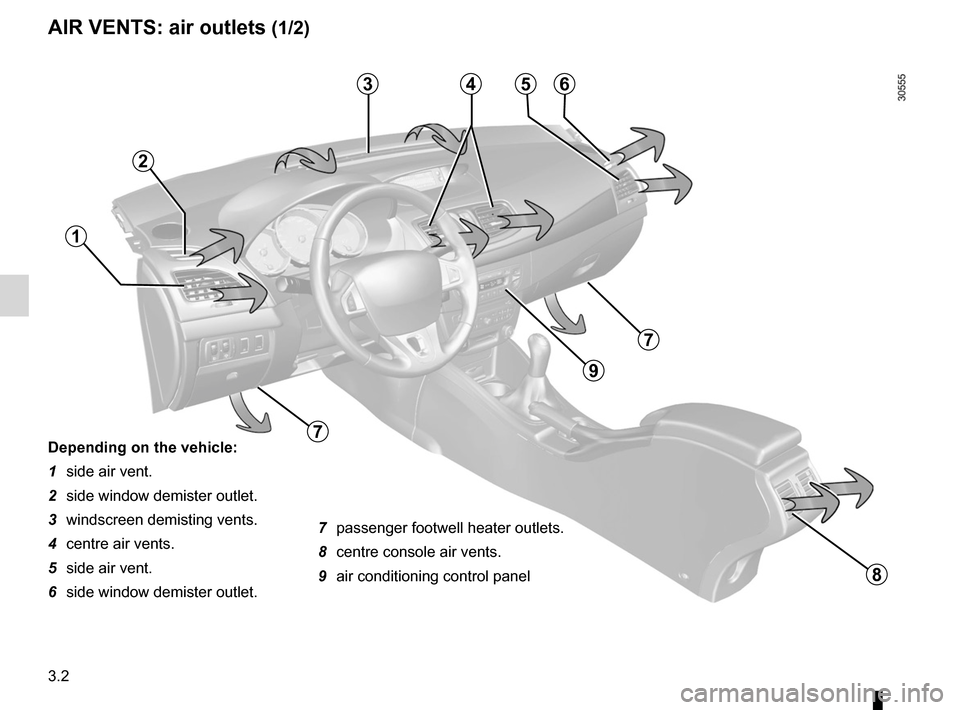
AIR VENTS: air outlets (1/2)
Depending on the vehicle:
1 side air vent.
2 side window demister outlet.
3 windscreen demisting vents.
4 centre air vents.
5 side air vent.
6 side window demister outlet. 7
passenger footwell heater outlets.
8 centre console air vents.
9 air conditioning control panel
1
2
356
7
7
9
8
4
Page 132 of 241
3.4
ENG_UD13665_1
Air conditionné (L38 - X38 - Renault)
ENG_NU_891_892-7_L38-B32_Renault_3
Jaune NoirNoir texte
Manual air conditioning
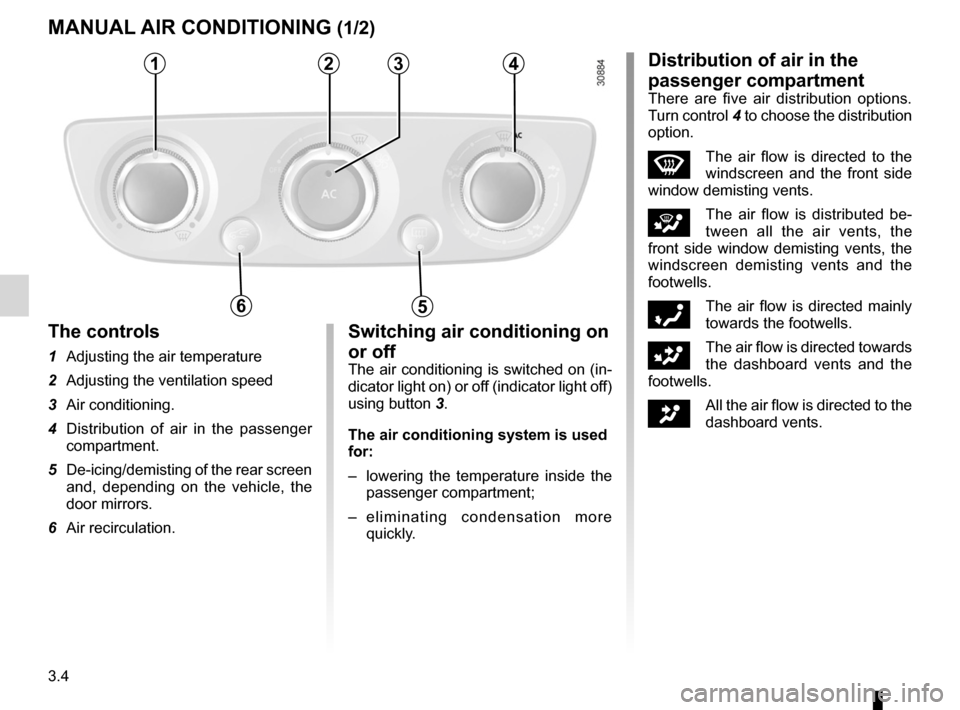
MANuAl AIR coNDITIoNINg (1/2)
1234
56
The controls
1 Adjusting the air temperature
2 Adjusting the ventilation speed
3 Air conditioning.
4 Distribution of air in the passenger
compartment.
5 De-icing/demisting of the rear screen
and, depending on the vehicle, the
door mirrors.
6 Air recirculation.
Switching air conditioning on
or off
The air conditioning is switched on (in-
dicator light on) or off (indicator light off)
using button 3.
The air conditioning system is used
for:
– lowering the temperature inside the
passenger compartment;
– e l i m i n a t i n g c o n d e n s a t i o n m o r e
quickly.
Distribution of air in the
passenger compartment
There are five air distribution options.
Turn control 4 to choose the distribution
option.
WThe air flow is directed to the
windscreen and the front side
window demisting vents.
iThe air flow is distributed be -
tween all the air vents, the
front side window demisting vents, the
windscreen demisting vents and the
footwells.
óThe air flow is directed mainly
towards the footwells.
GThe air flow is directed towards
the dashboard vents and the
footwells.
JAll the air flow is directed to the
dashboard vents.
Page 133 of 241
JauneNoirNoir texte
3.5
ENG_UD13665_1
Air conditionné (L38 - X38 - Renault)
ENG_NU_891_892-7_L38-B32_Renault_3
Adjusting the ventilation
speed
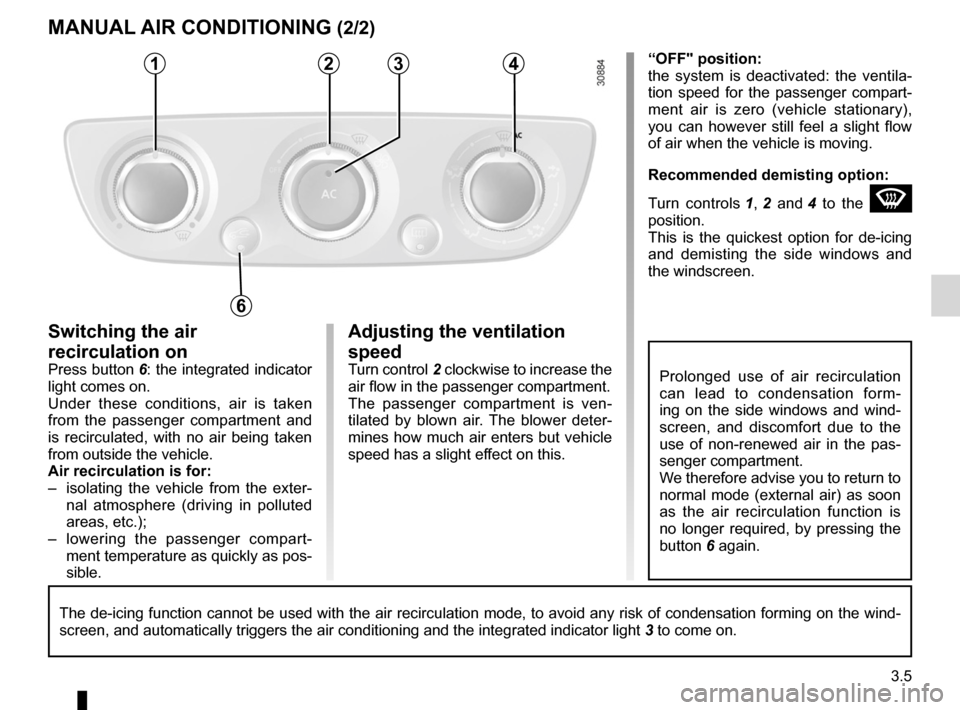
Turn control 2 clockwise to increase the
air flow in the passenger compartment.
The passenger compartment is ven -
tilated by blown air. The blower deter -
mines how much air enters but vehicle
speed has a slight effect on this.
Switching the air
recirculation on
Press button 6: the integrated indicator
light comes on.
Under these conditions, air is taken
from the passenger compartment and
is recirculated, with no air being taken
from outside the vehicle.
Air recirculation is for:
– isolating the vehicle from the exter -
nal atmosphere (driving in polluted
areas, etc.);
– lowering the passenger compart -
ment temperature as quickly as pos-
sible. “oFF" position:
the system is deactivated: the ventila
-
tion speed for the passenger compart-
ment air is zero (vehicle stationary),
you can however still feel a slight flow
of air when the vehicle is moving.
Recommended demisting option:
Turn controls 1 , 2 and 4 to the
W
position.
This is the quickest option for de-icing
and demisting the side windows and
the windscreen.
MANuAl AIR coNDITIoNINg (2/2)
Prolonged use of air recirculation
can lead to condensation form -
ing on the side windows and wind -
screen, and discomfort due to the
use of non-renewed air in the pas -
senger compartment.
We therefore advise you to return to
normal mode (external air) as soon
as the air recirculation function is
no longer required, by pressing the
button 6 again.
The de-icing function cannot be used with the air recirculation mode, to avoid any risk of condensation forming on the wind -
screen, and automatically triggers the air conditioning and the integrat\
ed indicator light 3 to come on.
1234
6
Page 135 of 241

ENG_NU_891_892-7_L38-B32_Renault_3
AuT oMATIc clIMATE coNTRol (2/5)
Varying the")
JauneNoirNoir texte
3.7
ENG_UD14525_3
Air conditionné automatique (X95 - B95 - D95 - L38 - X38 - X32 - B32\
- Renault)
ENG_NU_891_892-7_L38-B32_Renault_3
AuT oMATIc clIMATE coNTRol (2/5)
Varying the ventilation speed
In automatic mode, the system uses
the most suitable amount of air to reach
and maintain the desired comfort level.
You can still adjust the ventilation speed
by pressing buttons 12 to increase or
reduce the ventilation speed.
In this case, the ventilation speed,
which is no longer controlled automat-
ically, appears in zone A on the dis -
play 13.
Some buttons have an operating
tell-tale which indicates the operat -
ing status.
121
3
Temperature adjustment
Press one of the buttons 1 or 6 to in -
crease or reduce the temperature
on the left-hand side 1 or right-hand
side 6. Pressing button 3 for more than
2 seconds sets the passenger tempera-
ture to the driver’s temperature.
Special note: the highest and lowest
settings allow the system to produce
maximum hot or cold temperature
levels (“LO” and “HI” on display 13).
6
A13
clear View function
Press button 10 : the integrated indica -
tor light comes on.
This function quickly demists and de -
ices the windscreen, the rear screen,
the front side windows, and the door
mirrors (depending on the vehicle). The
air conditioning and rear screen de -ic -
ing functions must be activated.
Press button 9 to stop the heated rear
screen operating; the integrated indica -
tor goes out.
You can change the ventilation speed
by pressing button 12.
To exit this function, press:
– button 10 again,
– one of either button 2, 3 or 4.
109
24
Page 137 of 241

rear screen de-icing/demisting .............................. (current page)
windscreen de-icing/demisting .............................. (current page)
JauneNoirNoir texte
3.9
ENG_UD14525_3
Air conditionné automatique (X95 - B95 - D95 - L38 - X38 - X32 - B32\
- Renault)
ENG_NU_891_892-7_L38-B32_Renault_3
AuT oMATIc clIMATE coNTRol (4/5)
Rear screen de-icing/
demisting
Press button 9 : the integrated indica -
tor light comes on. This function per -
mits rapid demisting/de-icing of the rear
screen and de-icing of the door mirrors
(on equipped vehicles).
To exit this function, press button 9
again. Demisting automatically stops
by default.
12
WThe air flow is directed to the
windscreen and the front side
window demisting vents.
×The air flow is distributed be -
tween all the air vents, the
front side window demisting vents, the
windscreen demisting vents and the
footwells.
¿The air flow is directed mainly
towards the footwells.
¾The air flow is directed towards
the dashboard vents and the
footwells.
½All the air flow is directed to the
dashboard vents.
In this situation, the distribution of air in
the passenger compartment, which is
no longer automatically controlled, ap -
pears on the display.9
Adjusting the distribution
of air in the passenger
compartment
There are five air distribution options.
Press switch 5 to scroll through them.
The arrows located in area B on the
display 13 combine to show you the
distribution selected:
5
B13
Page 138 of 241

ENG_NU_891_892-7_L38-B32_Renault_3
Manual use
Pressing button 11 allows air recircula -
tion t")
3.10
ENG_UD14525_3
Air conditionné automatique (X95 - B95 - D95 - L38 - X38 - X32 - B32\
- Renault)
ENG_NU_891_892-7_L38-B32_Renault_3
Manual use
Pressing button 11 allows air recircula -
tion to be forced, in this case, the inte-
grated indicator comes on .
Prolonged use of this position may lead
to odours, caused by non-renewal of
air, and the formation of condensation
on the windows.
We therefore advise you to return to au-
tomatic mode as soon as the air recir-
culation function is no longer required,
by pressing button 11 again.Stopping the system
Press button 7 to switch off the system;
in this case “OFF” is shown on the dis-
play 13. To switch the system on, press
one of the 2, 3 or 4 switches.
Recycling
This function is controlled automati -
cally, but it can also be activated manu-
ally.
Note:
– during recirculation, air is taken from
the passenger compartment and
is recycled, with no air being taken
from outside the vehicle;
– air recirculation allows the external
atmosphere to be cut off (when driv-
ing in polluted areas, etc.);
– lowering the passenger compart -
ment temperature as quickly as pos-
sible.
AuT oMATIc clIMATE coNTRol (5/5)
The demisting/de-icing will still take
priority over the air recirculation.
11
234
713
Page 139 of 241
air conditioning ..................................... (up to the end of the DU)
heating and air conditioning system ...................... (current page)
air conditioning ..................................... (up to the end of the DU)
3.11
ENG_UD10101_2
Air conditionné : informations et conseils d’utilisation (X95 - B\
95 - D95 - Renault)
ENG_NU_891_892-7_L38-B32_Renault_3
Air conditioning: information and advice on use
AIR coNDITIoNINg: information and advice on use
Fuel consumption
You will normally notice an increase
in fuel consumption (especially
when driving in town) when the air
conditioning is operating.
For vehicles fitted with manual air
conditioning, switch off the system
when it is not required.
Advice for reducing
consumption and therefore
helping to preserve the
environment:
Drive with the air vents open and
the windows closed.
If the vehicle has been parked in
the sun, open the doors for a few
moments to let the hot air escape
before starting the engine.
Maintenance
Refer to the Maintenance Document
for your vehicle for the inspection
frequency.operating faults
As a general rule, contact your ap-
proved dealer in the event of an op-
erating fault.
– Reduction in de-icing, demist -
ing or air conditioning per -
formance. This may be caused
by the passenger compartment
filter cartridge becoming clogged.
– No cold air is being produced.
Check that the controls are set
correctly and that the fuses are
sound. Otherwise, switch off the
system.
Advice on use
In some situations, (air conditioning
off, air recirculation activated, venti-
lation speed at zero or low, etc.) you
may notice that condensation starts
to form on the windows and wind -
screen.
If there is condensation, use the
“clear View” function to remove it,
then use the air conditioning in auto-
matic mode to stop it forming again.
If the condensation does not clear,
use the FAST programme.
Do not open the refriger -
ant fluid circuit. The fluid
may damage eyes or skin.
Note
Presence of water under the ve -
hicle. After prolonged use of the air
conditioning system, it is normal for
water to be present under the vehi-
cle. This is caused by condensation.
Page 140 of 241
electric windows ................................... (up to the end of the DU)
child safety ............................................................. (current page)
children (safety) ..................................................... (current page)
sunroof .................................................. (up to the end of the DU)
3.12
ENG_UD21430_2
Lève-vitres électriques (L38 - X38 - Renault)
ENG_NU_891_892-7_L38-B32_Renault_3
Jaune NoirNoir texte
These systems operate with the igni -
tion on or off, until one of the front doors
is opened (limited to about 3 minutes).
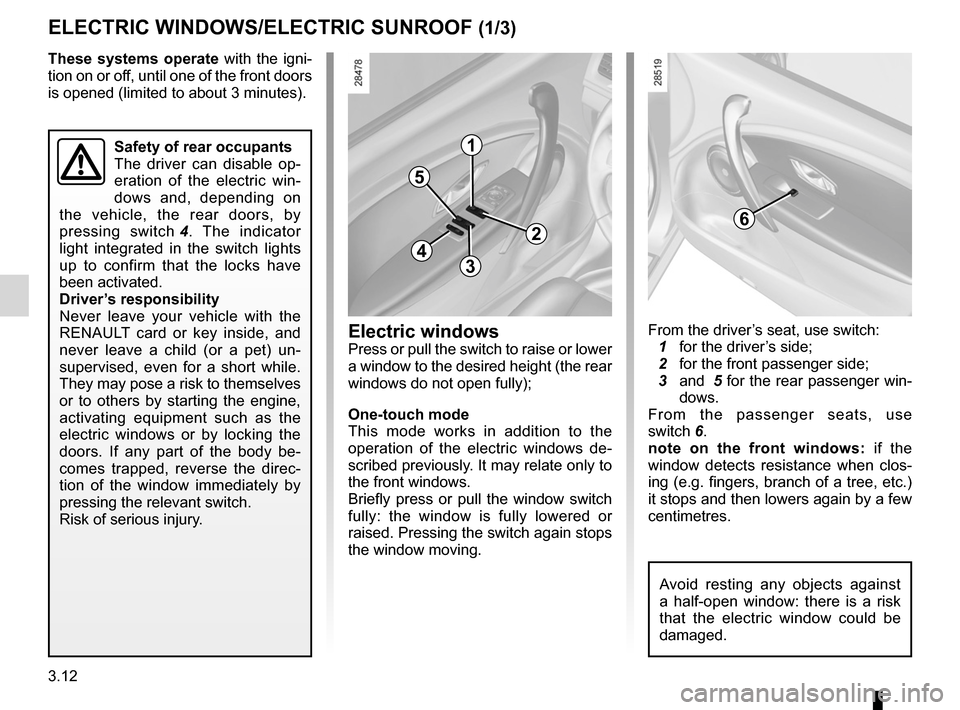
From the driver’s seat, use switch:
1 for the driver’s side;
2 for the front passenger side;
3 and 5 for the rear passenger win-
dows.
From the passenger seats, use
switch 6.
note on the front windows: if the
window detects resistance when clos -
ing (e.g. fingers, branch of a tree, etc.)
it stops and then lowers again by a few
centimetres.
Electric windows/Electric sunroof
ElEcTRIc wINDowS/ElEcTRIc SuNRooF (1/3)
Electric windows
Press or pull the switch to raise or lower
a window to the desired height (the rear
windows do not open fully);
one-touch mode
This mode works in addition to the
operation of the electric windows de -
scribed previously. It may relate only to
the front windows.
Briefly press or pull the window switch
fully: the window is fully lowered or
raised. Pressing the switch again stops
the window moving.
1
2
34
5
6
Safety of rear occupants
The driver can disable op -
eration of the electric win -
dows and, depending on
the vehicle, the rear doors, by
pressing switch 4 . The indicator
light integrated in the switch lights
up to confirm that the locks have
been activated.
Driver’s responsibility
Never leave your vehicle with the
RENAULT card or key inside, and
never leave a child (or a pet) un -
supervised, even for a short while.
They may pose a risk to themselves
or to others by starting the engine,
activating equipment such as the
electric windows or by locking the
doors. If any part of the body be -
comes trapped, reverse the direc -
tion of the window immediately by
pressing the relevant switch.
Risk of serious injury.
Avoid resting any objects against
a half-open window: there is a risk
that the electric window could be
damaged.