seats RENAULT FLUENCE Z.E. 2012 User Guide
[x] Cancel search | Manufacturer: RENAULT, Model Year: 2012, Model line: FLUENCE Z.E., Model: RENAULT FLUENCE Z.E. 2012Pages: 195, PDF Size: 5.23 MB
Page 44 of 195

ENG_NU_914-")
1.39
ENG_UD20772_3
S curit enfants : choix du si ge enfant (X35 - L35 - X45 - H45 - X6\
5 - X77 - X81 - X85 - X91 - X83 - X61 - X77 ph2 - X95 - L38 - E33 - X33 \
- X38 - X62 - Renault)
ENG_NU_914-4_L38e_Renault_1
chilD SAFetY : choosing a child seat
rear-facing child seats
A baby’s head is, proportionally, heavier
than that of an adult and its neck is very
fragile. Transport the child in this po -
sition for as long as possible (until the
age of 2 at the very least). It supports
both the head and the neck.
Choose a bucket type seat for best side
protection and change it as soon as the
child’s head is higher than the shell.Forward-facing child seats
The child’s head and abdomen need to
be protected as a priority. A forward-fac-
ing child seat which is firmly attached to
the vehicle will reduce the risk of impact
to the head. Ensure your child travels in
a forward-facing seat with a harness or
buckle for as long as their size permits.
Choose a bucket type seat for optimum
side protection.w Booster cushions
From 15 kg or 4 years, the child can
travel using a booster seat, which will
enable the seat belt to be adapted
to suit his/her size and shape. The
booster seat cushion must be fitted with
guides to position the seat belt on the
child’s thighs rather than the stomach.
It is recommended that you use a seat-
back fitted with a belt strap guide which
can be adjusted in terms of height to
position the seat belt in the centre of the
shoulder. It must never rest on the neck
or on the arm.
Choose a bucket type seat for optimum
side protection.
Page 45 of 195

towing rings .......................................... (up to the end of the DU)
child restraint/seat ................................ (up to the end of the DU)
child restraint/seat ................................ (up to the end of the DU)
child safety ............................................ (up to the end of the DU)
child seats ............................................. (up to the end of the DU)
child restraint/seat ................................ (up to the end of the DU)
transporting children ............................. (up to the end of the DU)
1.40
ENG_UD23036_3
Sécurité enfants : choix de la fixation du siège enfant (L38 é\
lectrique - Renault)
ENG_NU_914-4_L38e_Renault_1
Jaune NoirNoir texte
Choosing a child seat mounting
chilD SAFetY : choosing a child/baby seat mounting (1/2)
There are two ways of attaching child
seats: via the seat belt or using the
ISOFIX system.
Attachment via the seat belt
The seat belt must be adjusted to
ensure that it is effective in the event of
harsh braking or an impact.
Ensure that the strap paths indicated
by the child seat manufacturer are re-
spected.
Always check that the seat belt is cor-
rectly fastened by pulling it up, then
pulling it out fully whilst pressing on the
child seat.
Check that the seat is correctly held by
moving it from side to side and back
to front: the seat should remain firmly
fixed.
Check that the child seat has not been
installed at an angle and that it is not
resting against a window. Attachment using the iSOFiX
system
Authorised ISOFIX child seats are ap
-
proved in accordance with regulation
ECE-R44 in one of the three following
scenarios:
– ISOFIX universal 3-point forwardfac-
ing seat
– ISOFIX semi-universal 2-point seat
– specific
For the latter two, check that your child
seat can be installed by consulting the
list of compatible vehicles.
Attach the child seat with the ISOFIX
locks, if these are provided. The ISOFIX
system allows quick, easy, safe fitting.
The ISOFIX system consists of 2 rings
and, in some cases, a third ring.
Before using an ISOFIX
child seat that you pur -
chased for another vehicle,
check that its installation is
authorised. Consult the list of ve -
hicles which can be fitted with the
seat from the equipment manufac -
turer.
No modifications may be
made to the component
parts of the restraint system
(ISOFIX seat belts, seats
and their mountings) originally fitted.
The seat belt must never
be twisted or the tension
relieved. Never pass the
shoulder strap under the
arm or behind the back.
Check that the seat belt has not
been damaged by sharp edges.
If the seat belt does not operate nor-
mally, it will not protect the child.
Consult an approved dealer. Do not
use this seat until the seat belt has
been repaired.
Do not use the child seat
if it may unfasten the seat
belt restraining it: the base
of the seat must not rest on
the buckle and/or catch of the seat
belt.
Page 46 of 195

ENG_NU_914-4_L38e_Renault_1
chilD SAFetY : choosing a child/baby seat mo")
JauneNoirNoir texte
1.41
ENG_UD23036_3
Sécurité enfants : choix de la fixation du siège enfant (L38 é\
lectrique - Renault)
ENG_NU_914-4_L38e_Renault_1
chilD SAFetY : choosing a child/baby seat mounting (2/2)
The ISOFIX anchorage
points have been exclu-
sively designed for child
seats with the ISOFIX
system. Never fit a different type of
child seat, seat belt or other objects
to these anchorage points.
Check that nothing is obstructing
the anchorage points.
If your vehicle has been involved in
a road accident, have the ISOFIX
anchorage points checked and re -
place your child seat.
The third ring is used to attach the
upper strap on some child seats.
Raise headrest A and pass the belt be-
tween the headrest guides.
Raise cover 3 on the rear parcel shelf.
Fix hook 5 to ring 4.
Pull the belt so that the back of the child
seat comes into contact with the vehicle
seatback.
The two rings
1 are located between
the seatback and the seat base of the
seat and are identified by a marking.
To ensure your child seat can be easily
fitted and locked on rings 1, use access
guides 2 on the child seat.
1
2
3
4
4
A
5
Page 47 of 195
child restraint/seat ................................ (up to the end of the DU)
child restraint/seat ................................ (up to the end of the DU)
child restraint/seat ................................ (up to the end of the DU)
child safety ............................................ (up to the end of the DU)
child seats ............................................. (up to the end of the DU)
transporting children ............................. (up to the end of the DU)
1.42
ENG_UD21488_3
Sécurité enfants : installation du siège enfant (L38 - X38 - R\
enault)
ENG_NU_914-4_L38e_Renault_1
Jaune NoirNoir texte
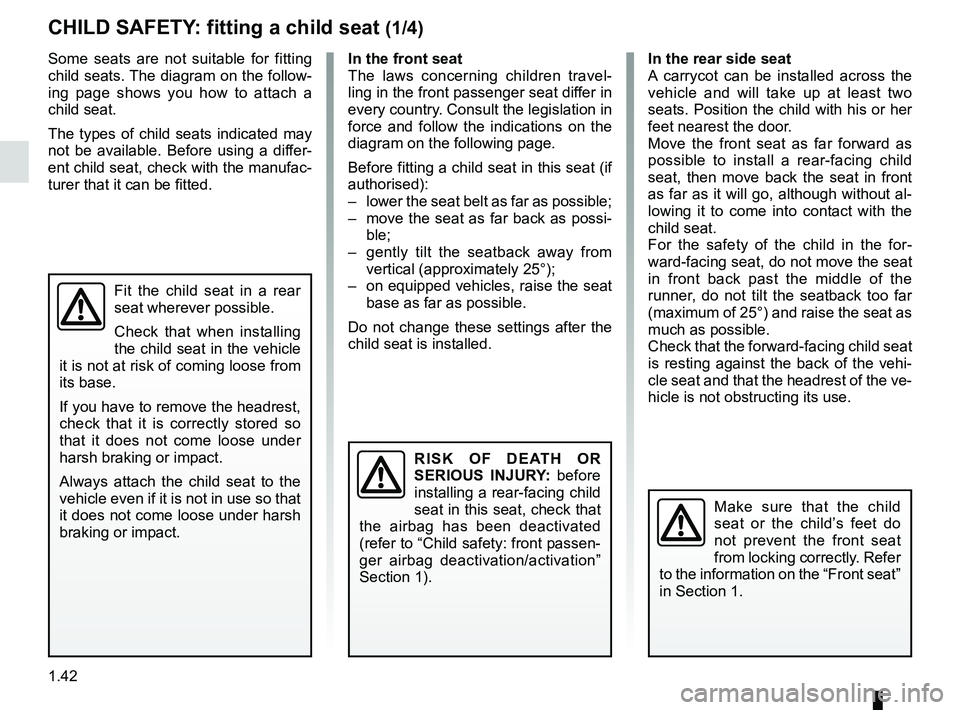
Some seats are not suitable for fitting
child seats. The diagram on the follow -
ing page shows you how to attach a
child seat.
The types of child seats indicated may
not be available. Before using a differ-
ent child seat, check with the manufac-
turer that it can be fitted.
fitting a child seat
chilD SAFetY : fitting a child seat (1/4)
in the rear side seat
A carrycot can be installed across the
vehicle and will take up at least two
seats. Position the child with his or her
feet nearest the door.
Move the front seat as far forward as
possible to install a rear-facing child
seat, then move back the seat in front
as far as it will go, although without al-
lowing it to come into contact with the
child seat.
For the safety of the child in the for -
ward-facing seat, do not move the seat
in front back past the middle of the
runner, do not tilt the seatback too far
(maximum of 25°) and raise the seat as
much as possible.
Check that the forward-facing child seat
is resting against the back of the vehi-
cle seat and that the headrest of the ve-
hicle is not obstructing its use.
in the front seat
The laws concerning children travel
-
ling in the front passenger seat differ in
every country. Consult the legislation in
force and follow the indications on the
diagram on the following page.
Before fitting a child seat in this seat (if
authorised):
– lower the seat belt as far as possible;
– move the seat as far back as possi-
ble;
– gently tilt the seatback away from
vertical (approximately 25°);
– on equipped vehicles, raise the seat
base as far as possible.
Do not change these settings after the
child seat is installed.
r i S K O F D eAt h O r
S eri OUS iNJU rY: before
installing a rear-facing child
seat in this seat, check that
the airbag has been deactivated
(refer to “Child safety: front passen-
ger airbag deactivation/activation”
Section 1).
Fit the child seat in a rear
seat wherever possible.
Check that when installing
the child seat in the vehicle
it is not at risk of coming loose from
its base.
If you have to remove the headrest,
check that it is correctly stored so
that it does not come loose under
harsh braking or impact.
Always attach the child seat to the
vehicle even if it is not in use so that
it does not come loose under harsh
braking or impact.
Make sure that the child
seat or the child’s feet do
not prevent the front seat
from locking correctly. Refer
to the information on the “Front seat”
in Section 1.
Page 48 of 195

ENG_NU_914-4_L38e_Renault_1
² Seat not suitable for fitting child
seats.
child")
JauneNoirNoir texte
1.43
ENG_UD21488_3
Sécurité enfants : installation du siège enfant (L38 - X38 - R\
enault)
ENG_NU_914-4_L38e_Renault_1
² Seat not suitable for fitting child
seats.
child seat attached using the belt
¬Seat which allows a child seat
with “Universal” approval to be at -
tached by a seat belt.
−Seat which only allows a rear-
facing standardised “Universal” seat to
be installed using a seat belt.
³ Check the status of the air bag
before fitting a child seat or allowing a
passenger to use the seat.
r i S K O F D eAt h O r
S eri OUS iNJU rY: Before
fitting a rear-facing child
seat on the front passenger
seat, check that the airbag has been
deactivated (refer to the information
on “Child safety: deactivating/acti -
vating the front passenger airbag”
at the end of the section).
child seat attached using the iSOFiX
mounting
ü Seat which allows an ISOFIX
child seat to be fitted.
± The rear seats are fitted with
an anchorage point which allows a
forward-facing ISOFIX child seat with
universal approval to be fitted. The an-
chorage points are located in the lug -
gage compartment and are visible.
The size of the ISOFIX child seat is in-
dicated by a letter:
– A, B and B1: for forward-facing seats
in group 1 (9 to 18 kg);
– C: rear-facing seats in group 1 (9 to
18 kg);
– D and E: shell seat or rear-facing
seats in group 0 or 0+ (less than 13
kg);
– F and G: carrycots in group 0 (less
than 10 kg).
Using a child safety system which is not approved for this vehicle will not
correctly protect the baby or child. They risk serious or even fatal injury.
chilD SAFetY : fitting a child seat (2/4)
Page 49 of 195

ENG_NU_914-4_L38e_Renault_1
Jaune NoirNoir texte
chilD SAFetY : fitting a child seat (3/4)
the table belo")
1.44
ENG_UD21488_3
Sécurité enfants : installation du siège enfant (L38 - X38 - R\
enault)
ENG_NU_914-4_L38e_Renault_1
Jaune NoirNoir texte
chilD SAFetY : fitting a child seat (3/4)
the table below summarises the information already shown on the diagram on the previous page, to ensure the regula-
tions in force are respected.
type of child seat Weight of
the child Seat sizeFront passenger
seat (1) (2) rear side seats
rear centre seat
carrycot fitted across the ve-
hicle
Group 0 < 10 kg
F, GXU - IL (3) U (3)
rear-facing shell seat
Group 0 or 0+ <
13 kg and 9 to
18 kg E, D
UU - IL (4) U (4)
rear-facing seat
Group 0+ and 1 9 to 18 kg
CUU - IL (4) U (4)
Forward-facing seat
Group 1 9 to 18 kg
A, B, B1XU - IUF - IL (5) U (5)
Booster seat
Group 2 and 3 15 to 25 kg and 22
to 36 kg
-
X U (5) U (5)
(1) riSK OF DeA th Or SeriOUS iNJUrY: before installing a child seat on the front passenger seat, check that the
airbag has been deactivated (refer to “Child safety: front passenger\
airbag deactivation/activation” Section 1).
Page 50 of 195

ENG_NU_914-4_L38e_Renault_1
X = Seat not suitable for fitting child seats.
U = Sea")
JauneNoirNoir texte
1.45
ENG_UD21488_3
Sécurité enfants : installation du siège enfant (L38 - X38 - R\
enault)
ENG_NU_914-4_L38e_Renault_1
X = Seat not suitable for fitting child seats.
U = Seat which allows a child seat with “Universal” approval to be ins\
talled using a seat belt; check that it can be fitted.
iUF/il = On equipped vehicles, seat which allows an approved “Universal/semi-universal or vehicle specific” child seat to be at-
tached using the ISOFIX system; check that it can be fitted.
(2) Only a rear-facing child seat can be fitted in this seat: raise the seat to the maximum and position it as far back as possible,
tilting the seatback slightly (approximately 25°).
(3) A carrycot can be installed across the vehicle and will take up at least two seats. Position the child with his or her feet nearest
the door.
(4) Move the front seat as far forward as possible to install a rear-facing child seat, then move back the seat in front as far as it will
go, although without allowing it to come into contact with the child sea\
t.
(5) Forward-facing child seat; position the seatback of the child seat in contact with the seatback of the vehicle seat. Adjust the
headrest, or remove it if necessary. Do not push the front seat more than halfway back on its runners and do not recline the
seatback more than 25°.
chilD SAFetY : fitting a child seat (4/4)
Page 115 of 195

electric windows ................................... (up to the end of the DU)
child safety ............................................................. (current page)
children (safety) ..................................................... (current page)
3.12
ENG_UD28762_3
Lève-vitres électriques (L38 - X38 - Renault)
ENG_NU_914-4_L38e_Renault_3
Jaune NoirNoir texte
These systems operate with the igni -
tion on or off, until one of the front doors
is opened (limited to about 3 minutes).
From the driver’s seat, use switch:
1 for the driver’s side;
2 for the front passenger side;
3 and 5 for the rear passengers.
From the passenger seats, use
switch 6.
Front window features: If the window
detects resistance when closing (e.g.
fingers, etc.) it stops and then lowers
again by a few centimetres.
Electric windows
ElEcTRIc wINDowS (1/2)
Electric windows
Press the window switch down or pull it
up to lower or raise the window to the
desired height: the rear windows do not
open fully.
one-touch mode
This mode works in addition to the
operation of the electric windows de -
scribed previously. It either operates on
the front windows only, or on all the win-
dows.
Briefly press or pull the window switch
fully: the window is fully lowered or
raised. Pressing the switch again stops
the window moving.
1
2
34
5
6
Safety of rear occupants
The driver can disable op -
eration of the electric win -
dows and, depending on
the vehicle, the rear doors, by
pressing switch 4. The indicator light
integrated in the switch lights up to
confirm that the locks have been ac-
tivated.
Driver’s responsibility
Never leave your vehicle with the
key inside and never leave a child
(or a pet) unsupervised, even for a
short while. They may pose a risk
to themselves or to others by start-
ing the engine, activating equipment
such as the electric windows or by
locking the doors. If a body part
gets trapped, reverse the direction
of travel of the window as soon as
possible by pressing the relevant
switch.
Risk of serious injury.
Avoid resting any objects against
a half-open window: there is a risk
that the electric window could be
damaged.
Page 136 of 195
maintenance:interior trim ...................................... (up to the end of the DU)
interior trim maintenance ................................... (up to the end of the DU)
cleaning: inside the vehicle ............................ (up to the end of the DU)
4.11
ENG_UD22866_8
Entretien des garnitures intérieures (X35 - X45 - X65 - J77 - X81 - \
J81 - X85 - X91 - B91 - K91 - D91 - X83 - X61 - X77 ph2 - X95 - B95 - D9\
5 - E95 - K95 - J95 - R95 -
ENG_NU_914-4_L38e_Renault_4
Interior trim maintenance
Glass instrument panel(e.g. instrument panel, clock, exterior
temperature display, radio display, etc.)
Use a soft cloth (or cotton wool).
If this does not clean it properly, use a
soft cloth (or cotton wool) slightly mois-
tened with soapy water and then wipe
clean with a soft damp cloth or cotton
wool.
Finally, carefully dry off with a soft dry
cloth.
Cleaning products containing alco -
hol must not be used under any cir-
cumstances.
seat belts
These must be kept clean.
Use products selected by our Technical
Department (Approved outlets) or
warm, soapy water and a sponge and
wipe with a dry cloth.
Detergents or dyes must not be used
under any circumstances.
InteRIOR tRIM MaIntenanCe (1/2)
textiles (seats, door trim, etc)
Vacuum-clean the textiles regularly.
Liquid stain
Use soapy water.
Dab lightly (never rub) with a soft cloth,
rinse and remove the excess.
solid or pasty stain
Carefully remove the excess solid or
pasty material immediately with a
spatula (working from the edges to the
centre to avoid spreading the stain).
Clean as for a liquid stain.
special instructions for sweets or
chewing gum
Put an ice cube on the stain to solidify
it, then proceed as for a solid stain.
A well-maintained vehicle will last
longer. It is therefore recommended to
maintain the interior of the vehicle regu-
larly.
A stain should always be dealt with
swiftly.
Whatever type of stain is on the trim,
use
cold (or warm) soapy water with
natural soap.
Detergents (washing-up liquid, pow -
dered products, alcohol-based prod-
ucts) should not be used.
Use a soft cloth.
Rinse and soak up the excess.
For further recommendations for
maintaining the interior, and/or for
any unsatisfactory results, please
see an authorised dealer.
Page 190 of 195

ENG_NU_914-4_L38e_Renault_7
AlphAbeticAl index (1/5)
A
ABS ........................................................................\
. 2.9 → 2.12
acc")
7.1
FRA_UD29442_4
Index (L38 - X38 - Renault)
ENG_NU_914-4_L38e_Renault_7
AlphAbeticAl index (1/5)
A
ABS ........................................................................\
. 2.9 → 2.12
accessories........................................................................\
5.26
accessories socket ............................................................ 3.19
additional methods of restraint .....................1.29 → 1.32, 1.35
side protection ............................................................. 1.34
to the front seat belts ....................................... 1.29 → 1.32
to the rear seat belts ........................................ 1.29 → 1.33
adjusting your driving position ....................... 1.22 – 1.23, 1.26
air bag .................................................................... 1.29 → 1.35
activating the front passenger air bags ........................ 1.48
deactivating the front passenger air bags .................... 1.46
air conditioning ................................................. 3.4 → 3.8, 3.11
air vents ...................................................................... 3.2 – 3.3
anti-corrosion check .............................................. 6.13 → 6.18
anti-corrosion protection ...................................................... 4.9
anti-lock braking system: ABS .................................2.9 → 2.12
armrest: front .............................................................................. 3.17
ashtray ........................................................................\
....... 3.19
ASR (traction control) .............................................. 2.9 → 2.12
audible and visual signals .................................................. 1.70
b
battery ........................................................................\
........ 1.55
12 volt battery breakdown recovery ......................................... 5.23 – 5.24
maintenance ......................................................... 4.6 – 4.7
12 volt battery ........................ 1.2 → 1.6, 4.6 – 4.7, 5.23 – 5.24
battery (remote control) ..................................................... 5.25
bonnet ........................................................................\
. 4.2 – 4.3
brake fluid ........................................................................\
.... 4.5
bulbs changing .......................................................... 5.14 → 5.18c
central door locking
............................................... 1.19 → 1.21
changing a bulb ..................................................... 5.14 → 5.18
changing a wheel ...................................................... 5.9 – 5.10
changing gear ............................................................. 2.3 – 2.4
charge meter .............................................................. 1.58, 2.8
charging cord ........................................................... 1.8 → 1.13
charging flap ............................................................ 1.7 → 1.13
charging socket ..................................... 1.2 → 1.6, 1.8 → 1.13
child restraint/seat ............................. 1.37 – 1.38, 1.40 → 1.48
child safety ....................... 1.15, 1.37 – 1.38, 1.40 → 1.48, 3.12
child seats .......................................... 1.37 – 1.38, 1.40 → 1.45
children ...................................... 1.15, 1.17 – 1.18, 1.37 – 1.38
children (safety) ................................................................. 3.12
cigar lighter ........................................................................\
3.19
cleaning: inside the vehicle .............................................. 4.11 – 4.12
clock ........................................................................\
.......... 1.49
closing the doors ................................................... 1.17 → 1.20
connected services .............................................................. 1.3
control instruments ................................................ 1.54 → 1.60
controls .................................................................. 1.50 → 1.53
coolant ........................................................................\
......... 4.4
courtesy light ...................................... 3.14 – 3.15, 5.19 – 5.20
courtesy mirrors ................................................................. 3.15
cruise control ................................................ 1.55, 2.13 → 2.19
cruise control-speed limiter.................................... 2.13 → 2.19
customised vehicle settings .............................................. 1.68
customising the vehicle settings ....................................... 1.68
d
dashboard .............................................................. 1.50 → 1.53
daytime running lights ........................................................ 1.71
display ................................................................... 1.54 → 1.58
doors .............................................................. 1.17 – 1.18, 1.21
doors/tailgate ................................................. 1.17 – 1.18, 1.21