wheel RENAULT FLUENCE Z.E. 2012 User Guide
[x] Cancel search | Manufacturer: RENAULT, Model Year: 2012, Model line: FLUENCE Z.E., Model: RENAULT FLUENCE Z.E. 2012Pages: 195, PDF Size: 5.23 MB
Page 75 of 195
warning buzzer ..................................... (up to the end of the DU)
headlight flashers ................................. (up to the end of the DU)
indicators .............................................. (up to the end of the DU)
lights: hazard warning ............................... (up to the end of the DU)
lights: direction indicators .......................... (up to the end of the DU)
indicators: direction indicators .......................... (up to the end of the DU)
hazard warning lights signal ................. (up to the end of the DU)
hazard warning lights signal ................. (up to the end of the DU)
horn ...................................................... (up to the end of the DU)
horn: flash ................................................................. (current page)
horn: sounding the horn ............................................ (current page)
horn ....................................................................... (current page)
audible and visual signals .....................(up to the end of the DU)
1.70
ENG_UD19234_1
Avertisseurs sonore et lumineux (L38 - X38 - Renault)
ENG_NU_914-4_L38e_Renault_1
Audible and visual signals
AUDiBle AND viSUAl SigNAlS
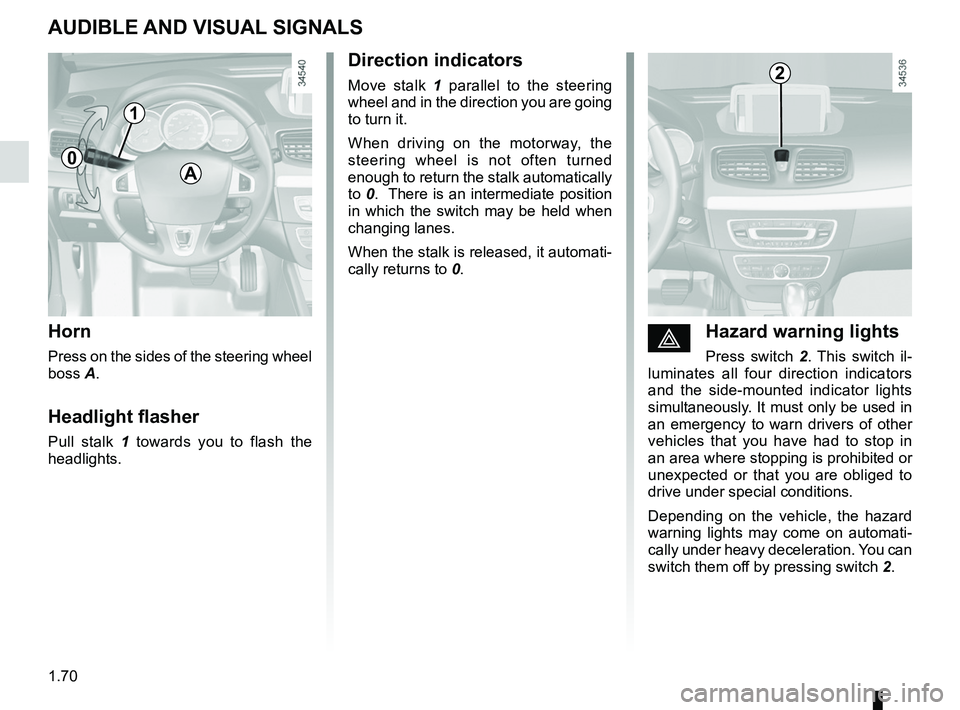
horn
Press on the sides of the steering wheel
boss A.
headlight flasher
Pull stalk 1 towards you to flash the
headlights.
éhazard warning lights
Press switch 2 . This switch il -
luminates all four direction indicators
and the side-mounted indicator lights
simultaneously. It must only be used in
an emergency to warn drivers of other
vehicles that you have had to stop in
an area where stopping is prohibited or
unexpected or that you are obliged to
drive under special conditions.
Depending on the vehicle, the hazard
warning lights may come on automati -
cally under heavy deceleration. You can
switch them off by pressing switch 2.
Direction indicators
Move stalk 1 parallel to the steering
wheel and in the direction you are going
to turn it.
When driving on the motorway, the
steering wheel is not often turned
enough to return the stalk automatically
to 0. There is an intermediate position
in which the switch may be held when
changing lanes.
When the stalk is released, it automati-
cally returns to 0.
A
2
1
0
Page 83 of 195

starting .................................................. (up to the end of the DU)
starting the engine ................................ (up to the end of the DU)
driving ................................................... (up to the end of the DU)
starting the engine ................................ (up to the end of the DU)
stopping the engine .............................. (up to the end of the DU)
2.2
ENG_UD25305_4
Démarrage (L38 électrique - Renault)
ENG_NU_914-4_L38e_Renault_2
Starting, stopping the engine
Start position D
Starting the engine
– Move the gear lever to position P
only ;
– turn the key to position D and re -
lease it.
Warning light
Ṑ may flash on the in -
strument panel, along with a beep. As
soon as light
Ṑ stops flashing and
the beep stops, the vehicle is ready to
drive.
“Stop and steering lock”
position St
To unlock: turn the key and the steering
wheel slightly.
To lock: remove the key and turn the
steering wheel until the steering column
locks.
“Accessories” position AWhen the ignition is switched off, any
accessories (radio, etc.) will continue to
function.
“On” position MThe ignition is switched on:
St Arting, St OPPing the engine
Driver’s responsibility
Never leave your vehi -
cle with the key inside and
never leave a child (or a
pet) unsupervised, even for a short
while.
There is a risk that they could start
the engine or operate electrical
equipment (electric windows etc.)
and trap part of their body (neck,
arms, hands, etc.).
Risk of serious injury.
Never switch off the ignition before
the vehicle has stopped completely.
Once the engine has stopped, the
brake servo, power-assisted steer -
ing, etc., and the passive safety de-
vices such as the airbags and pre -
tensioners will no longer operate.
The vehicle can only be started if
the charging cord is unplugged from
the vehicle.
The vehicle can only be started if
the selection lever is at P. Please
see the information on “Gear con -
trol” in Section 2.
Stopping the engine
Bring the key to “Stop” position.
Warning light
Ṑ goes out.
Page 85 of 195
handbrake.............................................................. (current page)
2.4
ENG_UD23027_2
Boîte de vitesse (L38 électrique - Renault)
ENG_NU_914-4_L38e_Renault_2
Handbrake
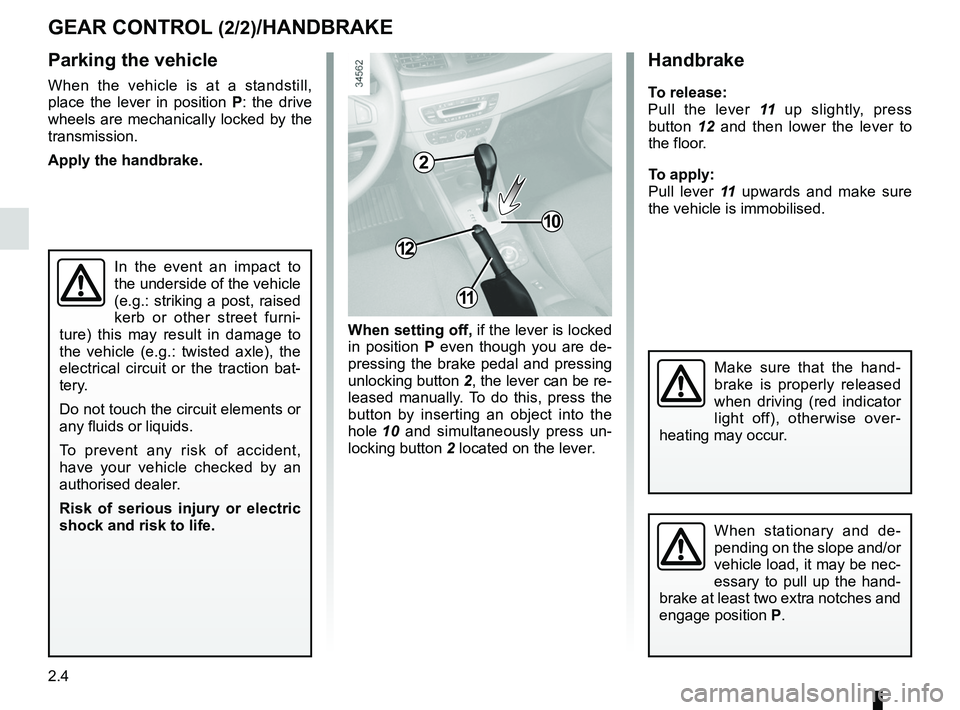
Parking the vehicle
When the vehicle is at a standstill,
place the lever in position P: the drive
wheels are mechanically locked by the
transmission.
Apply the handbrake.
geAr cOntrOl (2/2)/hAnDbrAke
When setting off, if the lever is locked
in position P even though you are de -
pressing the brake pedal and pressing
unlocking button 2, the lever can be re-
leased manually. To do this, press the
button by inserting an object into the
hole 10 and simultaneously press un -
locking button 2 located on the lever.
10
2
In the event an impact to
the underside of the vehicle
(e.g.: striking a post, raised
kerb or other street furni -
ture) this may result in damage to
the vehicle (e.g.: twisted axle), the
electrical circuit or the traction bat -
tery.
Do not touch the circuit elements or
any fluids or liquids.
To prevent any risk of accident,
have your vehicle checked by an
authorised dealer.
r isk of serious injury or electric
shock and risk to life.
handbrake
t o release:
Pull the lever 11 up slightly, press
button 12 and then lower the lever to
the floor.
t o apply:
Pull lever 11 upwards and make sure
the vehicle is immobilised.
When stationary and de -
pending on the slope and/or
vehicle load, it may be nec-
essary to pull up the hand -
brake at least two extra notches and
engage position P.
Make sure that the hand -
brake is properly released
when driving (red indicator
light off), otherwise over -
heating may occur.
12
11
Page 90 of 195

ABS ...................................................... (up to the end of the DU)
anti-lock braking system: ABS ..............(up to the end of the DU)
ESP: Electronic Stability Program ........ (up to the end of the DU)
ASR (traction control) ........................... (up to the end of the DU)
traction control: ASR .............................(up to the end of the DU)
Electronic Stability Program: ESP ........ (up to the end of the DU)
emergency brake assist ........................(up to the end of the DU)
emergency braking ............................... (up to the end of the DU)
traction control: ASR .............................................. (current page)
driving ................................................... (up to the end of the DU)
2.9
ENG_UD23689_2
Dispositifs de correction de conduite (L38 - X38 - Renault)
ENG_NU_914-4_L38e_Renault_2
AbS (anti-lock braking
system)
Under heavy braking, the ABS prevents
the wheels from locking, allowing the
stopping distance to be managed and
keeping control of the vehicle.
Under these circumstances, the vehi -
cle can be steered to avoid an obstacle
whilst braking. In addition, this system
can increase stopping distances, par -
ticularly on roads with low surface grip
(wet ground etc.).
You will feel a pulsation through the
brake pedal each time the system is
activated. The ABS does not in any way
improve the vehicle’s physical perform-
ance relating to the road surface and
roadholding. It is still essential to follow
the rules of good driving practice (such
as driving at a safe distance from the
vehicle in front etc.).
Driving correction devices
These include:
– t h e A bS ( a n t i - l o c k b r a k i n g
system);
– the electronic stability program
eSP with understeer control and
traction control ASr;
– emergency brake assist with, de -
pending on the vehicle, braking
anticipation.
In an emergency, apply firm and
continuous pressure to the brake
pedal. There is no need to pump
it repeatedly. The ABS will modu -
late the force applied in the braking
system.
These functions are an ad-
ditional aid in the event of
critical driving conditions,
enabling the vehicle behav -
iour to be adapted to suit the driving
conditions.
However, the functions do not take
the place of the driver. they do
not increase the vehicle’s limits
and should not encourage you
to drive more quickly. Therefore,
they can under no circumstances
replace the vigilance or responsibil -
ity of the driver when manoeuvring
the vehicle (the driver must always
be ready for sudden incidents which
may occur when driving).
Yo u r b r a k i n g s y s t e m s
are partially operational.
However, it is dangerous
to brake suddenly and
it is essential to stop immediately,
as soon as traffic conditions allow.
Contact an approved dealer.
Operating faults:
–
© and x lit up on the in -
strument panel alongside, depend -
ing on the vehicle, messages “Check
ABS ”, “Check braking system ” and
“Check ESP”: ABS, ESP and emer-
gency brake assist are deactivated.
braking is always enabled;
–
x, D, © and ® lit
up on the instrument panel alongside
the message “Braking system fault”:
this indicates a fault in the braking
system.
In both cases, consult an approved
Dealer.
DriVer cOrrectiOn DeViceS/AiDS (1/4)
Page 91 of 195

2.10
ENG_UD23689_2
Dispositifs de correction de conduite (L38 - X38 - Renault)
ENG_NU_914-4_L38e_Renault_2
Jaune NoirNoir texte
electronic stability program
eSP with understeer control
and traction control ASr
electronic stability program eSP
This system helps you to keep control
of the vehicle in critical driving condi -
tions (avoiding an obstacle, loss of grip
on a bend, etc.).
Operating principle
A sensor in the steering wheel detects
the direction selected by the driver.
Other sensors throughout the vehicle
measure the actual direction.
The system compares driver input to
the actual trajectory of the vehicle and
corrects the trajectory if necessary by
controlling the braking of certain wheels
and/or engine power. In the event that
the system is engaged, indicator light
ù flashes on the instrument panel. Understeer control
This system optimises the action of the
ESP in the case of pronounced unders-
teering (loss of front axle road holding).
t
raction control ASr
This system helps to limit wheelspin of
the drive wheels and to control the ve-
hicle when pulling away accelerating or
decelerating.
Operating principle
Using the wheel sensors, the system
measures and compares the speed of
the drive wheels at all times and slows
down their over-rotation. If a wheel is
starting to slip, the system brakes au -
tomatically until the drive supplied be -
comes compatible with the level of grip
under the wheel again. Operating faults
When the system detects an operat
-
ing fault the message “Check ESP” and
warning light
© appear on the in-
strument panel. In this case, the ESP
and ASR are deactivated.
Consult an approved dealer.
DriVer cOrrectiOn DeViceS/AiDS (2/4)
Page 92 of 195
JauneNoirNoir texte
2.11
ENG_UD23689_2
Dispositifs de correction de conduite (L38 - X38 - Renault)
ENG_NU_914-4_L38e_Renault_2
The traction control ASR offers addi -
tional safety, it is recommended that
you do not drive with the function disa-
bled. Correct this as soon as possible
by pressing switch 1 again.
nb : the function is reactivated auto -
matically when the ignition is switched
on or when a speed of approximately
24 mph (40 km/h) is exceeded.
emergency brake assist
This system supplements the ABS
and helps reduce vehicle stopping dis-
tances.
Operating principle
The system is for detecting an emer -
gency braking situation. In this case,
the braking assistance immediately de-
velops maximum power and may trig -
ger ABS regulation.
ABS braking is maintained as long as
the brake pedal is applied.
hazard warning lights switching on
These may light up in the event of rapid
deceleration.
Operating faults
When the system detects an operat -
ing fault the message “ Check brak-
ing system” appears on the instrument
panel along with the
© warning
light.
Consult an approved dealer.
braking anticipation
Depending on the vehicle, when you
rapidly release the accelerator, the
system anticipates the braking ma -
noeuvre in order to reduce stopping
distances.
Special cases
When using the cruise control:
– if you use the accelerator, when you
release it, the system may be trig -
gered;
– if you do not use the accelerator, the
system will not be triggered.
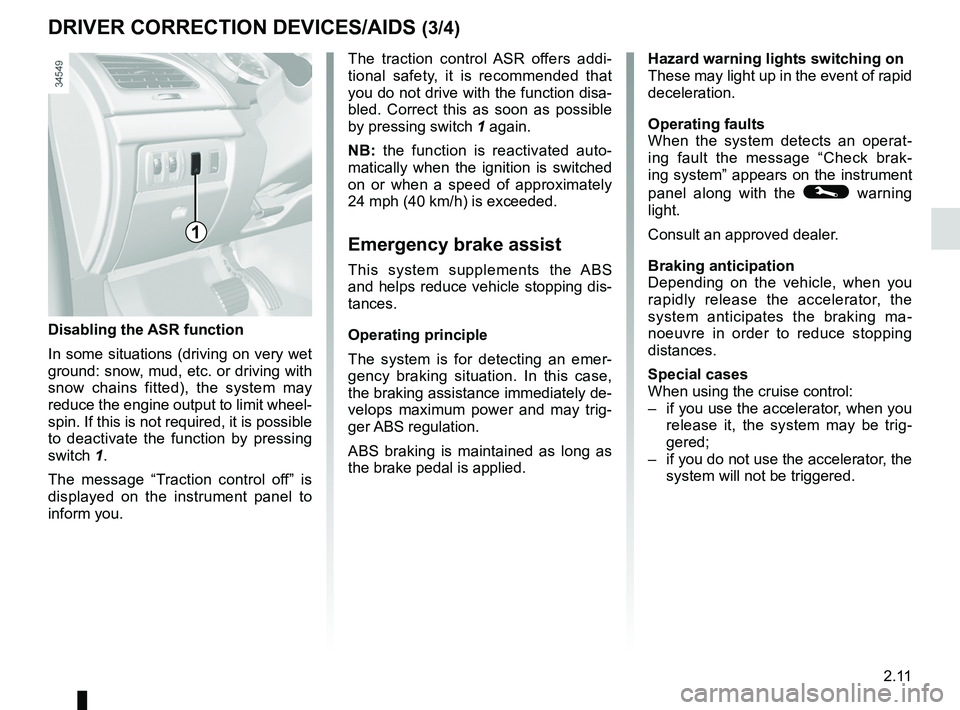
Disabling the ASr function
In some situations (driving on very wet
ground: snow, mud, etc. or driving with
snow chains fitted), the system may
reduce the engine output to limit wheel
-
spin. If this is not required, it is possible
to deactivate the function by pressing
switch 1.
The message “ Traction control off ” is
displayed on the instrument panel to
inform you.
1
DriVer cOrrectiOn DeViceS/AiDS (3/4)
Page 133 of 195
tyre pressure......................................... (up to the end of the DU)
tyre pressures ....................................... (up to the end of the DU)
tyres ...................................................... (up to the end of the DU)
4.8
ENG_UD28763_3
Pression de gonflage des pneumatiques (L38 - X38 - Renault)
ENG_NU_914-4_L38e_Renault_4
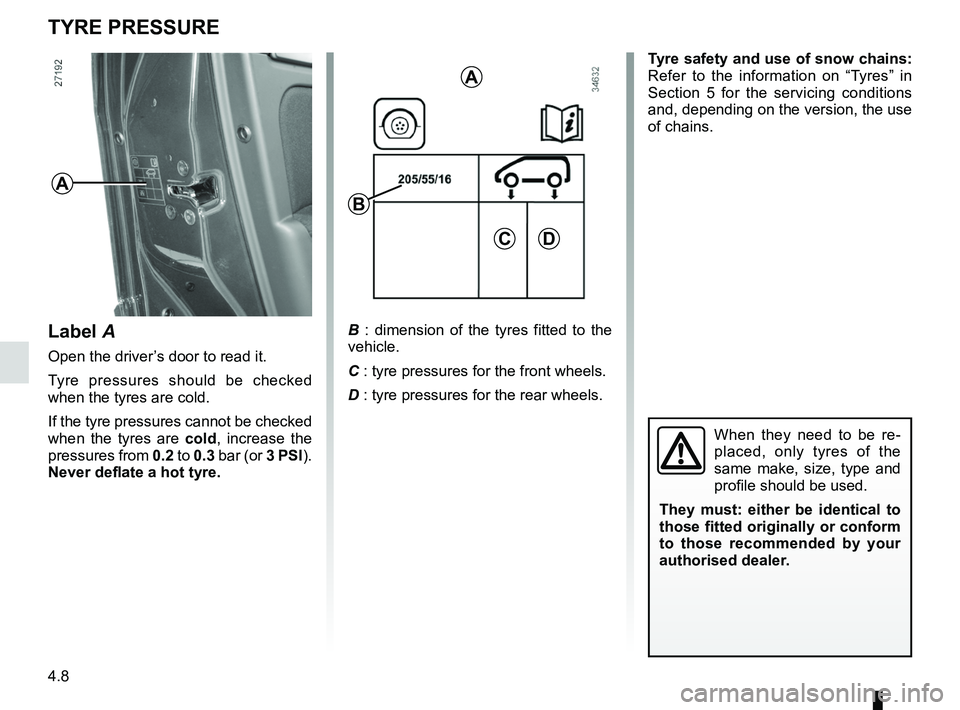
B : dimension of the tyres fitted to the
vehicle.
C : tyre pressures for the front wheels.
D : tyre pressures for the rear wheels.
Tyre pressure
tyRe pRessURe
Label A
Open the driver’s door to read it.
Tyre pressures should be checked
when the tyres are cold.
If the tyre pressures cannot be checked
when the tyres are cold, increase the
pressures from 0.2 to 0.3 bar (or 3 psI).
never deflate a hot tyre.
CD
a
a
When they need to be re -
placed, only tyres of the
same make, size, type and
profile should be used.
t hey must: either be identical to
those fitted originally or conform
to those recommended by your
authorised dealer.
B
t yre safety and use of snow chains:
Refer to the information on “Tyres” in
Section 5 for the servicing conditions
and, depending on the version, the use
of chains.
Page 134 of 195

maintenance:bodywork ........................................ (up to the end of the DU)
washing ................................................ (up to the end of the DU)
paintwork maintenance ................................... (up to the end of the DU)
anti-corrosion protection ........................................ (current page)
4.9
ENG_UD26559_3
Entretien de la carosserie (X61 - X38 - X61 électrique - L38 élec\
trique - X10 - Renault)
ENG_NU_914-4_L38e_Renault_4
Bodywork maintenance
BODyWORk MaIntenanCe (1/2)
What you should not doDo not degrease or clean mechani -
cal components (e.g. the engine com -
partment), underneath the body, parts
with hinges (e.g. inside the doors) and
painted plastic external fittings (e.g.
bumpers) using high-pressure clean -
ing equipment or by spraying on prod-
ucts not approved by our Technical
Department. Doing this could give rise
to corrosion or operational faults.
Wash the vehicle in bright sunlight or
freezing temperatures.
Do not scrape off mud or dirt without
pre-wetting.
Allow dirt to accumulate on the exterior.
Allow rust to form following minor im -
pacts.
Do not use solvents not approved by
our Technical Department to remove
stains as this could damage the paint-
work.
Do not drive in snow or muddy condi -
tions without washing the vehicle, par-
ticularly under the wheel arches and
body.
A well-maintained vehicle will last
longer. It is therefore recommended to
maintain the exterior of the vehicle reg-
ularly.
Your vehicle has been treated with very
effective anti-corrosion products. It is
nevertheless subject to various outside
influences.
Corrosive agents in the atmosphere
–
atmospheric pollution (built-up and
industrial areas),
– saline atmospheres (near the sea,
particularly in hot weather),
– seasonal and damp weather condi -
tions (e.g. road salt in winter, water
from road cleaners, etc.).
Minor impacts
abrasive action
Dust and sand in the air, mud, road grit
thrown up by other vehicles, etc.
You should take a number of minor pre-
cautions in order to safeguard your ve-
hicle against such risks.y ou should
Wash your car frequently, with the
engine off, with cleaning products rec-
ommended by the manufacturer (never
use abrasive products). Rinse thor -
oughly beforehand with a jet:
– spots of tree resin and industrial
grime;
– mud in the wheel arches and under -
neath the body which forms damp
patches;
– bird droppings , which cause a
chemical reaction with the paint that
rapidly discolours paintwork and
may even cause the paint to peel
off;
wash the vehicle immediately to
remove these marks since it is im -
possible to remove them by polish -
ing;
– salt, particularly in the wheel arches
and underneath the body after driv -
ing in areas where the roads have
been gritted.
Withdraw the vegetable falls (resin, film
etc.) from the vehicle regularly.
Page 138 of 195
5.1
ENG_UD29440_4
Sommaire 5 (L38 - X38 - Renault)
ENG_NU_914-4_L38e_Renault_5
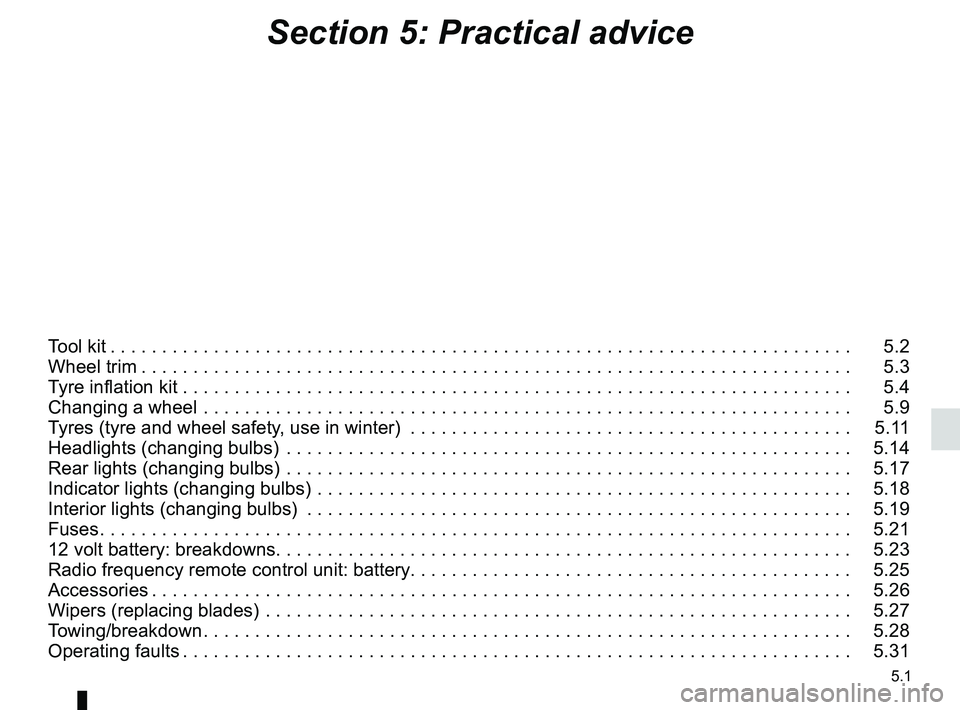
Section 5: Practical advice
Tool kit . . . . . . . . . . . . . . . . . . . . . . . . . . . . . . . . . . . . . . . . . . . . . . . . . . . . . . . . . . . . . . . . . . . . . . . . 5.2
Wheel trim . . . . . . . . . . . . . . . . . . . . . . . . . . . . . . . . . . . . . . . . . . . . . . . . . . . . . . . . . . . . . . . . . . . . . 5.3
Tyre inflation kit . . . . . . . . . . . . . . . . . . . . . . . . . . . . . . . . . . . . . . . . . . . . . . . . . . . . . . . . . . . . . . . . . 5.4
Changing a wheel . . . . . . . . . . . . . . . . . . . . . . . . . . . . . . . . . . . . . . . . . . . . . . . . . . . . . . . . . . . . . . . 5.9
Tyres (tyre and wheel safety, use in winter) . . . . . . . . . . . . . . . . . . . . . . . . . . . . . . . . . . . . . . . . . . . 5.11
Headlights (changing bulbs) . . . . . . . . . . . . . . . . . . . . . . . . . . . . . . . . . . . . . . . . . . . . . . . . . . . . . . . 5.14
Rear lights (changing bulbs) . . . . . . . . . . . . . . . . . . . . . . . . . . . . . . . . . . . . . . . . . . . . . . . . . . . . . . . 5.17
Indicator lights (changing bulbs) . . . . . . . . . . . . . . . . . . . . . . . . . . . . . . . . . . . . . . . . . . . . . . . . . . . . 5.18
Interior lights (changing bulbs) . . . . . . . . . . . . . . . . . . . . . . . . . . . . . . . . . . . . . . . . . . . . . . . . . . . . . 5.19
Fuses . . . . . . . . . . . . . . . . . . . . . . . . . . . . . . . . . . . . . . . . . . . . . . . . . . . . . . . . . . . . . . . . . . . . . . . . . 5.21
12 volt battery: breakdowns . . . . . . . . . . . . . . . . . . . . . . . . . . . . . . . . . . . . \
. . . . . . . . . . . . . . . . . . . . 5.23
Radio frequency remote control unit: battery . . . . . . . . . . . . . . . . . . . . . . . . . . . . . . . . . . . . \
. . . . . . . 5.25
Accessories . . . . . . . . . . . . . . . . . . . . . . . . . . . . . . . . . . . . . . . . . . . . . . . . . . . . . . . . . . . . . . . . . . . . 5.26
Wipers (replacing blades) . . . . . . . . . . . . . . . . . . . . . . . . . . . . . . . . . . . . . . . . . . . . . . . . . . . . . . . . . 5.27
Towing/breakdown . . . . . . . . . . . . . . . . . . . . . . . . . . . . . . . . . . . . . . . . . . . . . . . . . . . . . . . . . . . . . . . 5.28
Operating faults . . . . . . . . . . . . . . . . . . . . . . . . . . . . . . . . . . . . . . . . . . . . . . . . . . . . . . . . . . . . . . . . . 5.31
Page 140 of 195

wheelbrace ............................................................ (current page)
hubcap tool ............................................................ (current page)
jack ........................................................................\
(current page)
wheelbrace ............................................................ (current page)
towing hitch ............................................................ (current page)
trims ....................................................................... (current page)
JauneNoirNoir texte
5.3
ENG_UD23031_2
Bloc outils, kit de gonflage : accès (L38 électrique - Renault)
ENG_NU_914-4_L38e_Renault_5
Wheel trim
TOOL KIT (2/2)/TrIm
ToolsThe composition of the tool kit varies
according to the vehicle.
rear lights key 4
Used to unscrew the rear lights.
Front headlight key 5
Used to unscrew the headlights.
Wheelbrace 6
Never leave tools unsecured in the vehicle: there is a risk that they may
be thrown about during braking. After use, check that all the tools are
correctly clipped into the tool kit, then position it correctly in its housing:
there is a risk of injury.
Jack 7
When replacing the jack, fold it cor -
rectly and position the wheelbrace cor-
rectly before replacing it in its position.7
6
8
9
10
4
The jack is designed for
wheel changing purposes
only. Under no circum -
stances should it be used
for carrying out repairs underneath
the vehicle or to gain access to the
underside of the vehicle.
Hubcap tool 8
This tool is used to remove the wheel
trims.
Wheel bolt guide 9
To finish loosening or starting to tighten
the wheel bolts.
Tow eye 10
Refer to the information on “Towing” in
Section 5.Wheel trim
Remove it using the hubcap tool 8 by
connecting the hook in the recess pro-
vided next to the valve 11 (to attach the
metal clip).
To refit the wheel trim, align it with
valve 11 . Push the retaining hooks in
fully, starting with side C near the valve,
followed by D and E, finishing at F op-
posite the valve.
NB: if you are using anti-theft bolts,
refer to the information on “Changing a
wheel”.
11
C
DE
F
5