Hand brake RENAULT KADJAR 2018 User Guide
[x] Cancel search | Manufacturer: RENAULT, Model Year: 2018, Model line: KADJAR, Model: RENAULT KADJAR 2018Pages: 310, PDF Size: 8.35 MB
Page 212 of 310
3.30
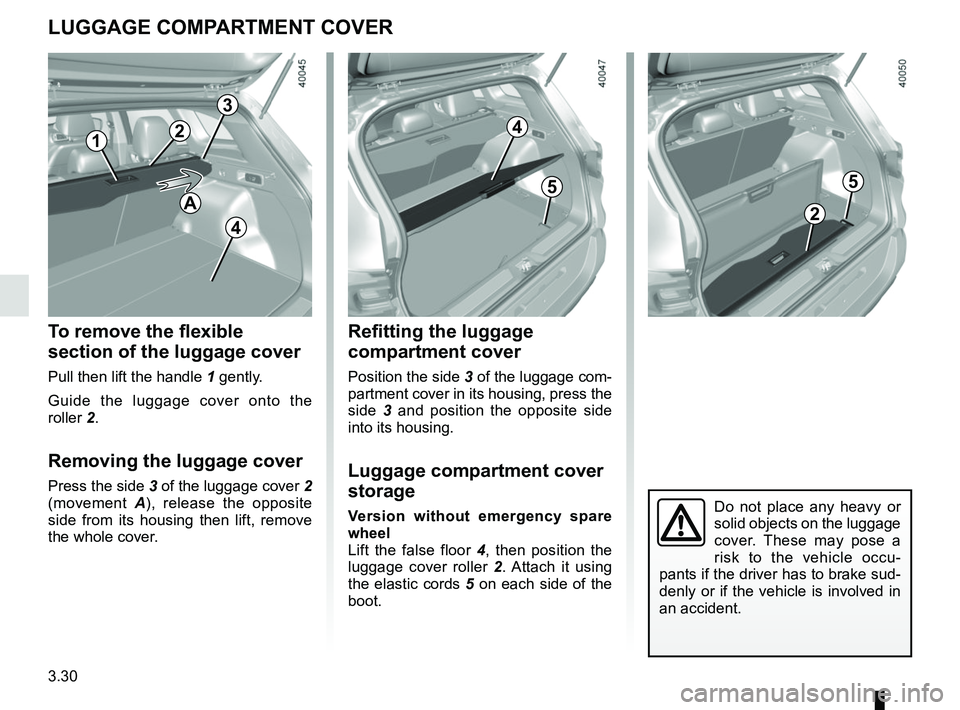
Refitting the luggage
compartment cover
Position the side 3 of the luggage com-
partment cover in its housing, press the
side 3 and position the opposite side
into its housing.
Luggage compartment cover
storage
Version without emergency spare
wheel
Lift the false floor 4, then position the
luggage cover roller 2. Attach it using
the elastic cords 5 on each side of the
boot.
To remove the flexible
section of the luggage cover
Pull then lift the handle 1 gently.
Guide the luggage cover onto the
roller 2.
Removing the luggage cover
Press the side 3 of the luggage cover 2
(movement A), release the opposite
side from its housing then lift, remove
the whole cover.
LUGGAGE COMPARTMENT COVER
3
4
5
2
Do not place any heavy or
solid objects on the luggage
cover. These may pose a
risk to the vehicle occu-
pants if the driver has to brake sud-
denly or if the vehicle is involved in
an accident.
1
2
5
4
A
Page 247 of 310
5.5
TYRE PRESSURE KIT (2/3)
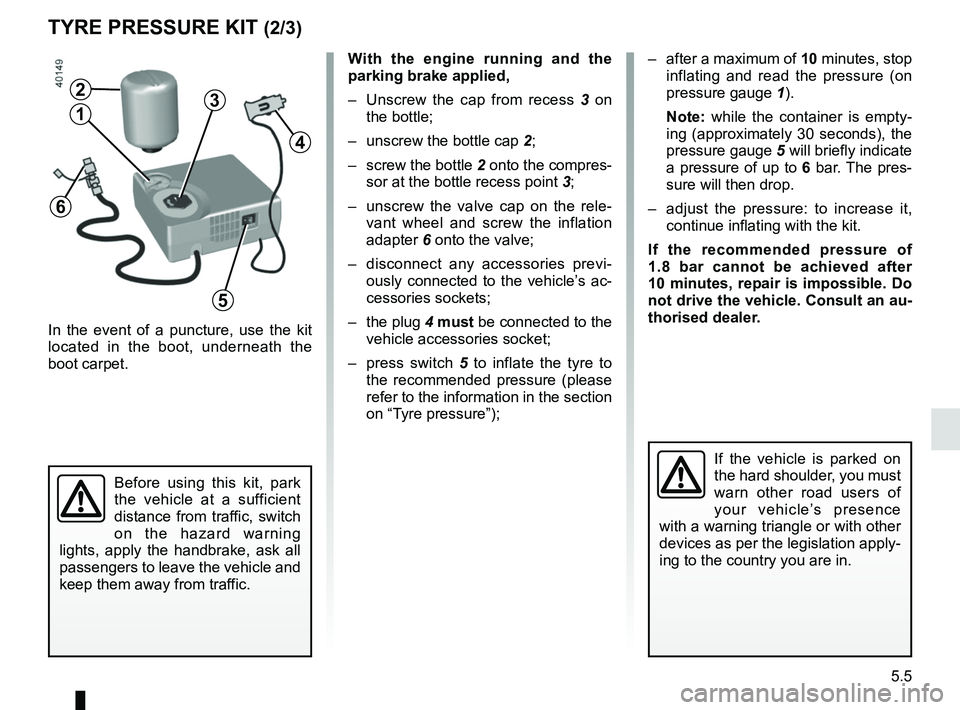
In the event of a puncture, use the kit
located in the boot, underneath the
boot carpet.
With the engine running and the
parking brake applied,
– Unscrew the cap from recess 3 on
the bottle;
– unscrew the bottle cap 2;
– screw the bottle 2 onto the compres- sor at the bottle recess point 3;
– unscrew the valve cap on the rele- vant wheel and screw the inflation
adapter 6 onto the valve;
– disconnect any accessories previ- ously connected to the vehicle’s ac-
cessories sockets;
– the plug 4 must be connected to the
vehicle accessories socket;
– press switch 5 to inflate the tyre to
the recommended pressure (please
refer to the information in the section
on “Tyre pressure”);
Before using this kit, park
the vehicle at a sufficient
distance from traffic, switch
on the hazard warning
lights, apply the handbrake, ask all
passengers to leave the vehicle and
keep them away from traffic.
If the vehicle is parked on
the hard shoulder, you must
warn other road users of
your vehicle’s presence
with a warning triangle or with other
devices as per the legislation apply-
ing to the country you are in.
– after a maximum of 10 minutes, stop inflating and read the pressure (on
pressure gauge 1).
Note: while the container is empty-
ing (approximately 30 seconds), the
pressure gauge 5 will briefly indicate
a pressure of up to 6 bar. The pres-
sure will then drop.
– adjust the pressure: to increase it, continue inflating with the kit.
If the recommended pressure of
1.8 bar cannot be achieved after
10 minutes, repair is impossible. Do
not drive the vehicle. Consult an au-
thorised dealer.
4
2
13
5
6
Page 251 of 310
5.9
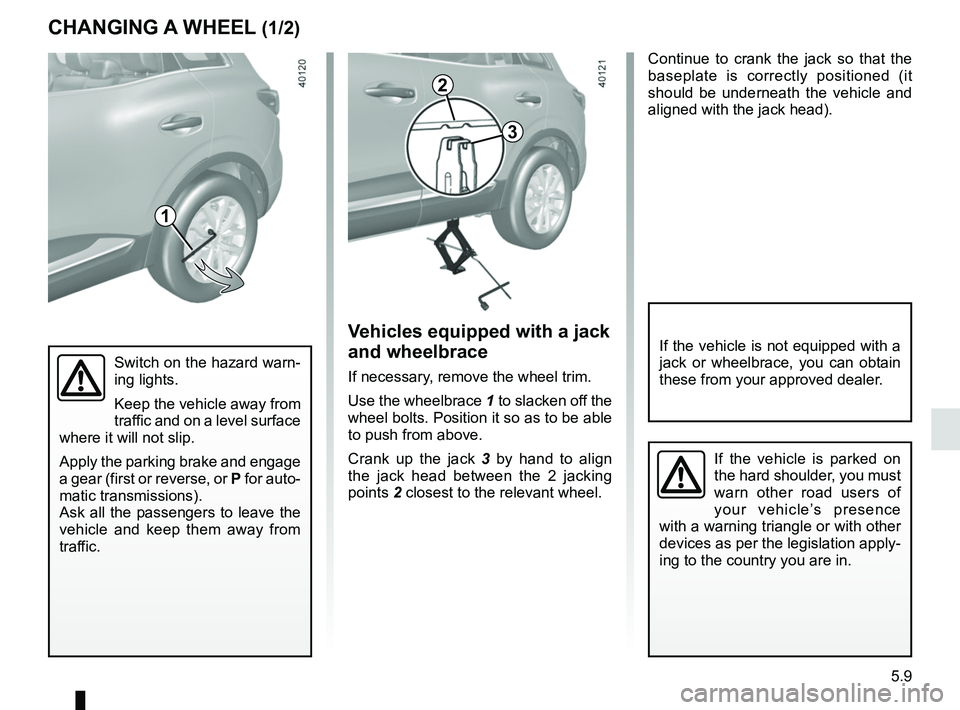
Continue to crank the jack so that the
baseplate is correctly positioned (it
should be underneath the vehicle and
aligned with the jack head).
Switch on the hazard warn-
ing lights.
Keep the vehicle away from
traffic and on a level surface
where it will not slip.
Apply the parking brake and engage
a gear (first or reverse, or P for auto-
matic transmissions).
Ask all the passengers to leave the
vehicle and keep them away from
traffic.
CHANGING A WHEEL (1/2)
Vehicles equipped with a jack
and wheelbrace
If necessary, remove the wheel trim.
Use the wheelbrace 1 to slacken off the
wheel bolts. Position it so as to be able
to push from above.
Crank up the jack 3 by hand to align
the jack head between the 2 jacking
points 2 closest to the relevant wheel.
If the vehicle is not equipped with a
jack or wheelbrace, you can obtain
these from your approved dealer.
If the vehicle is parked on
the hard shoulder, you must
warn other road users of
your vehicle’s presence
with a warning triangle or with other
devices as per the legislation apply-
ing to the country you are in.
1
2
3
Page 275 of 310
5.33
TOWING: breakdown recovery (2/2)
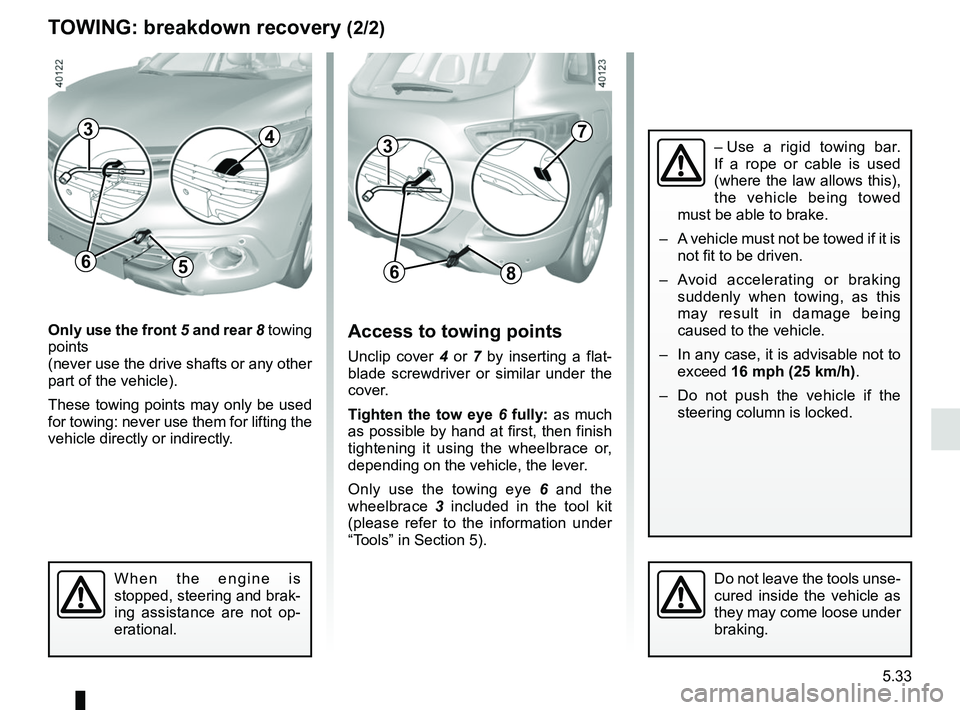
Only use the front 5 and rear 8 towing
points
(never use the drive shafts or any other
part of the vehicle).
These towing points may only be used
for towing: never use them for lifting the
vehicle directly or indirectly.Access to towing points
Unclip cover 4 or 7 by inserting a flat-
blade screwdriver or similar under the
cover.
Tighten the tow eye 6 fully: as much
as possible by hand at first, then finish
tightening it using the wheelbrace or,
depending on the vehicle, the lever.
Only use the towing eye 6 and the
wheelbrace 3 included in the tool kit
(please refer to the information under
“Tools” in Section 5).
When the engine is
stopped, steering and brak-
ing assistance are not op-
erational.Do not leave the tools unse-
cured inside the vehicle as
they may come loose under
braking.
– Use a rigid towing bar.
If a rope or cable is used
(where the law allows this),
the vehicle being towed
must be able to brake.
– A vehicle must not be towed if it is not fit to be driven.
– Avoid accelerating or braking suddenly when towing, as this
may result in damage being
caused to the vehicle.
– In any case, it is advisable not to exceed 16 mph (25 km/h).
– Do not push the vehicle if the steering column is locked.
6
34
568
73
Page 305 of 310

fuel tankcapacity ...............................................................\
......... 1.95
fuel tank capacity ...................................................1.9")
7.3
ALPHABETICAL INDEX (3/5)
fuel tankcapacity ...............................................................\
......... 1.95
fuel tank capacity ...................................................1.95 → 1.97
fuses ..................................................................\
....5.24 → 5.26
G
gear lever........................................................................\
... 2.15
grip control ........................................................................\
. 2.34
H
handbrake........................................................................\
.. 2.16
hands-free telephone integrated control ............................ 3.39
hazard warning lights signal .............................................. 1.84
headlight beam adjustment .................................... 1.85 – 1.86
headrest.................................................................... 1.19, 3.26
heated seats ...................................................................... 1.20
heated windscreen ..................................................3.7 → 3.12
heating and air conditioning system ........................3.4 → 3.13
heating system ........................................................3.4 → 3.12
Hill Start Assist.......................................................2.30 → 2.39
horn ...................................................................\
................ 1.84
horn: flash ..................................................................\
........... 1.84
hubcap tool ................................................................. 5.7 – 5.8
I
ignition switch ...................................................................... 2.3
indicators ......................................................1.84, 5.14 → 5.19
indicators: direction indicators ....................................................... 1.84
instrument panel ..............................................1.54 → 1.63
instrument panel ....................................................1.54 → 1.71
instrument panel messages...................................1.62 → 1.71
interior trim maintenance ..................................................... 4.18 – 4.19
Isofix ....................................................................... 1.37 – 1.38 J
jack ...................................................................\
................... 5.7
K
keys ...................................................................\
........1.2 → 1.5
L
lane departure warning ..........................................2.44 → 2.46
levels .................................................................\
......4.8 → 4.10
levels: brake fluid ...................................................................... 4.9
coolant ................................................................\
........... 4.8
windscreen washer reservoir ....................................... 4.10
lifting the vehicle changing a wheel ................................................ 5.9 – 5.10
lighting: exterior .............................................................1.78 → 1.86
instrument panel .......................................................... 1.78
interior ........................................... 3.18 – 3.19, 5.20 – 5.21
lights adjustment ........................................................ 1.85 – 1.86
changing bulbs .................................................5.14 → 5.16
front ..................................................................\
5.14 → 5.16
lights: adjusting ........................................................... 1.85 – 1.86
brake lights ......................................................5.17 → 5.19
dipped beam headlights .................1.54, 1.78, 5.14 → 5.16
direction indicators .........................1.54, 1.84, 5.14 → 5.17
fog lights .................................................... 1.54, 1.81, 5.19
hazard warning ............................................................ 1.84
main beam headlights ....................1.54, 1.78, 5.14 → 5.16
reversing lights ............................................................. 5.19
side lights ................................................1.78, 5.14 → 5.17
load permitted on the roof.................................................... 6.7
locking the doors ..............................................1.4, 1.6 → 1.18
luggage compartment cover .............................................. 3.30