fuel consumption RENAULT KADJAR 2018 User Guide
[x] Cancel search | Manufacturer: RENAULT, Model Year: 2018, Model line: KADJAR, Model: RENAULT KADJAR 2018Pages: 310, PDF Size: 8.35 MB
Page 195 of 310
3.13
AIR CONDITIONING: information and operating instructions (1/2)
Do not add anything to the
vehicle’s ventilation circuit
(for example, to remove
bad odours).
There is a risk of damage or of
fire.
Do not open the refriger-
ant fluid circuit. The fluid
may damage eyes or skin.
Fuel consumption
You will normally notice an increase in
fuel consumption (especially in town)
when the air conditioning is operating.
For vehicles fitted with air conditioning
with no automatic mode, switch off the
system when it is not required.
Advice for reducing consumption
and helping to preserve the environ-
ment
Drive with the air vents open and the
windows closed.
If the vehicle has been parked in the
sun, open the doors for a few moments
to let the hot air escape before starting
the engine.
Maintenance
Refer to the Maintenance Document
for your vehicle for the inspection fre-
quency.
Operating faults
As a general rule, contact your ap-
proved dealer in the event of an oper-
ating fault.
– Reduction in de-icing, demisting or air conditioning performance.
This may be caused by the passen-
ger compartment filter cartridge be-
coming clogged.
– No cold air is being produced .
Check that the controls are set cor-
rectly and that the fuses are sound.
Otherwise, switch off the system.
Presence of water under the
vehicle
After prolonged use of the air condi-
tioning system, it is normal for water
to be present under the vehicle. This is
caused by condensation.
Advice on use
In some situations (air conditioning off,
air recirculation activated, ventilation
speed at zero or low etc.), you may
notice that condensation starts to form
on the windows and windscreen.
If there is condensation, use the “Clear
View” function to remove it, then use
the air conditioning in automatic mode
to stop it forming again.
Vehicles equipped with ECO
mode: once activated, ECO mode
may reduce the performance of the
air conditioning. Please refer to the
information on “Driving advice, Eco-
driving” in Section 2.
Use the air conditioning system reg-
ularly, even in cold weather, running
it at least once a month for approxi-
mately 5 minutes.
Page 233 of 310
4.11
TYRE PRESSURE (1/2)
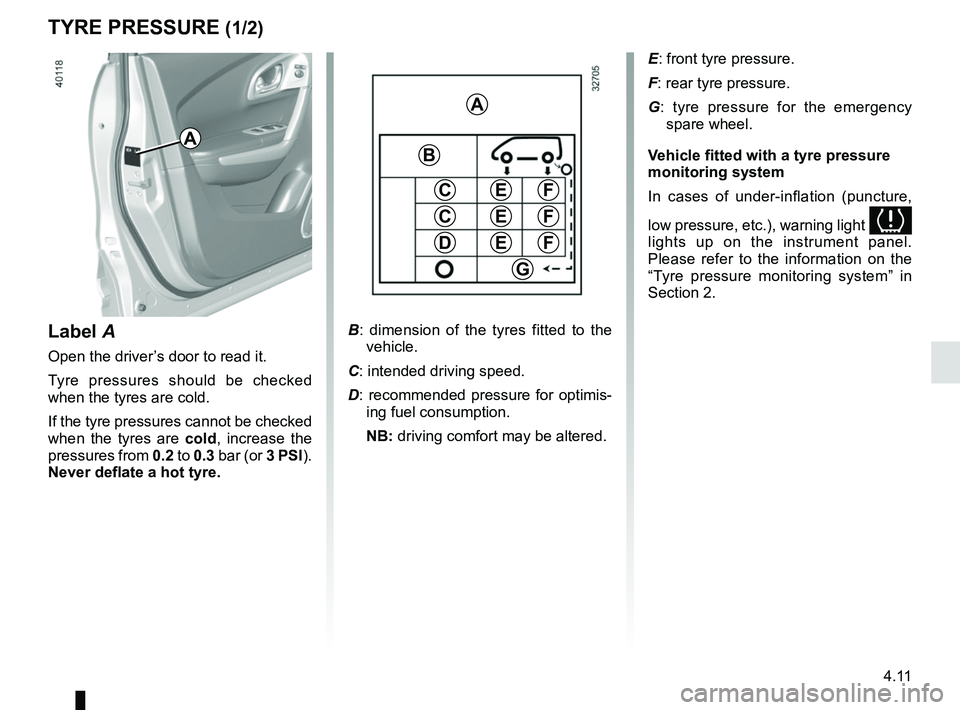
B: dimension of the tyres fitted to the
vehicle.
C: intended driving speed.
D: recommended pressure for optimis- ing fuel consumption.
NB: driving comfort may be altered.
A
C
D
FE
G
B
C
E
E
F
F
E: front tyre pressure.
F: rear tyre pressure.
G : tyre pressure for the emergency
spare wheel.
Vehicle fitted with a tyre pressure
monitoring system
In cases of under-inflation (puncture,
low pressure, etc.), warning light
lights up on the instrument panel.
Please refer to the information on the
“Tyre pressure monitoring system” in
Section 2.
Label A
Open the driver’s door to read it.
Tyre pressures should be checked
when the tyres are cold.
If the tyre pressures cannot be checked
when the tyres are cold, increase the
pressures from 0.2 to 0.3 bar (or 3 PSI).
Never deflate a hot tyre.
A
Page 304 of 310
7.2
ALPHABETICAL INDEX (2/5)
D
dashboard..............................................................1.50 → 1.53
deadlocking the doors ................................................ 1.5, 1.12
demisting rear screen .........................................................3.4 → 3.12
windscreen .........................................................3.4 → 3.12
dimensions .............................................................\
............. 6.4
dipstick................................................................\
................. 4.4
display ................................................................\
...1.54 → 1.61
doors/tailgate ....................................................1.4, 1.6 → 1.18
driver’s position .....................................................1.50 → 1.59
driving ...... 2.2 → 2.7, 2.12 → 2.14, 2.17 → 2.24, 2.30 → 2.43,
2.51 → 2.53, 2.57 → 2.65, 2.72 → 2.74
driving position settings ............................................................1.23 → 1.26
driving recommendations ......................................2.20 → 2.24
E
ECO driving ...........................................................2.20 → 2.24
ECO mode ........................................................................\
. 2.21
electric beam height adjustment ............................. 1.85 – 1.86
electric windows ..................................................... 3.16 – 3.17
electronic parking brake ........................................2.17 → 2.19
electronic stability control: ESC .............................2.30 → 2.39
emergency active braking......................................2.35 → 2.39
emergency brake assist.........................................2.30 → 2.39
emergency braking ................................................2.30 → 2.39
emergency key ........................................................... 1.6 – 1.7
emergency spare wheel ............................................. 5.2 – 5.3
engine technical specifications .................................. 6.5 – 6.6, 6.6
engine coolant ..................................................................... 4.8
engine oil ...................................................................4.4 → 4.7
engine oil capacity .....................................................4.5 → 4.7
engine oil level ...........................................................4.4 → 4.7
engine specifications .................................... 6.3, 6.5 – 6.6, 6.6 engine standby ........................................................ 2.8
→ 2.11
engine start/stop button .............................................2.5 → 2.7
environment ............................................................\
........... 2.26
ESC: electronic stability control ....................1.56, 2.30 → 2.39
F
4 wheel drive (4WD) ..............................................2.40 → 2.43
faults operating faults ................................................5.34 → 5.40
F
filling with reagent ................................................1.98 → 1.101
F
filter air filter ........................................................................\
. 4.10
oil filter .................................................................4.5 → 4.7
particle filter ................................................................. 2.13
passenger compartment filter ...................................... 4.10
fittings ...............................................................\
.....
3.20 → 3.24
fixed sunroof ...................................................................... 3.17
front passenger air bag deactivation ................................. 1.47
front seat adjustment .............................................. 1.20 – 1.21
front seats adjustment ............................................... 1.19 – 1.21, 1.23
with electric controls .................................................... 1.22
fuel advice on fuel economy ...................................2.20 → 2.24
consumption ....................................................2.20 → 2.24
filling ........................................................1.54, 1.95 → 1.97
grade ................................................................1.95 → 1.97
fuel consumption ...................................................2.20 → 2.24
fuel economy .........................................................2.20 → 2.24
fuel filler cap ..........................................................1.95 → 1.97
fuel level ................................................................1.54 → 1.60