trip computer RENAULT KANGOO 2012 X61 / 2.G User Guide
[x] Cancel search | Manufacturer: RENAULT, Model Year: 2012, Model line: KANGOO, Model: RENAULT KANGOO 2012 X61 / 2.GPages: 237, PDF Size: 8.62 MB
Page 72 of 237
trip computer and warning system.........................(current page)
instrument panel messages ...................................(current page)
warning lights ......................................................... (current page)
instrument panel .................................................... (current page)
1.66
ENG_UD26591_3
Ordinateur de bord : messages d’anomalies de fonctionnement (X85 - X61 - F61 - K61 - Renault)
ENG_NU_813-11_FK61_Renault_1
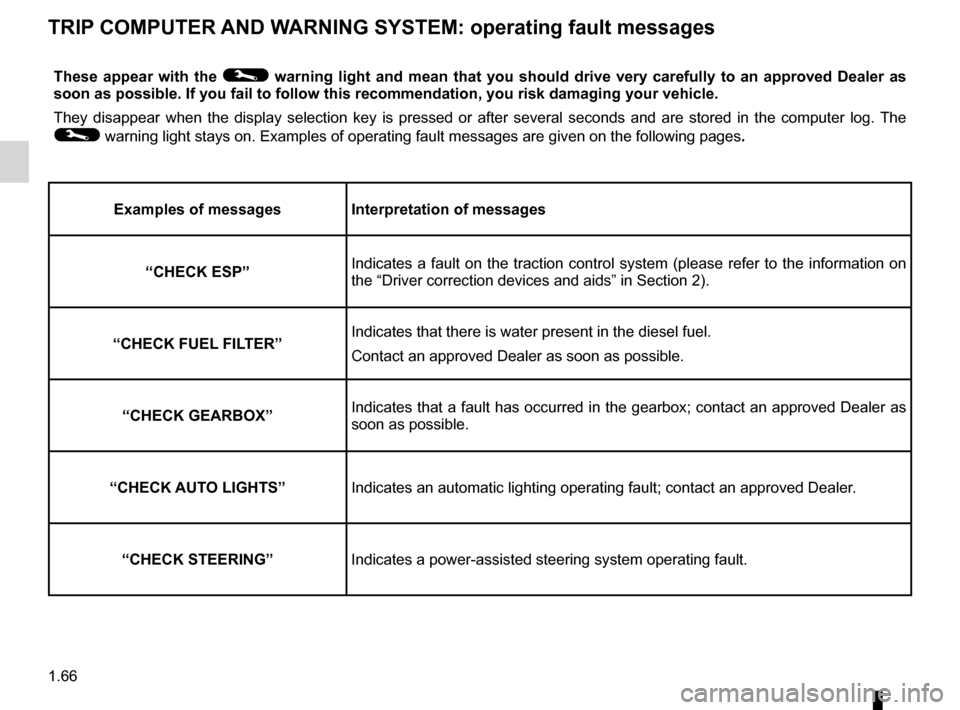
These appear with the © warning light and mean that you should drive very carefully to an approved Dealer as
soon as possible. If you fail to follow this recommendation, you risk damaging your vehicle.
They disappear when the display selection key is pressed or after several seconds and are stored in the computer log. The
© warning light stays on. Examples of operating fault messages are given on the following pages .
examples of messages Interpretation of messages
“CHeCK eSp” Indicates a fault on the traction control system (please refer to the information on
the “Driver correction devices and aids” in Section 2).
“CHeCK FUeL FILTeR” Indicates that there is water present in the diesel fuel.
Contact an approved Dealer as soon as possible.
“CHeCK GeARBOX ”Indicates that a fault has occurred in the gearbox; contact an approved Dealer as
soon as possible.
“CHeCK AUTO LIGHTS ”Indicates an automatic lighting operating fault; contact an approved Dealer .
“CHeCK STeeRING” Indicates a power-assisted steering system operating fault.
TRIp COMpUTeR AND WARNING SySTeM: operating fault messages
Page 73 of 237
trip computer and warning system.........................(current page)
warning lights ......................................................... (current page)
instrument panel messages ...................................(current page)
instrument panel .................................................... (current page)
1.67
ENG_UD23315_2
Ordinateur de bord : messages d’alerte (X61 - F61 - K61 - Renault)
ENG_NU_813-11_FK61_Renault_1
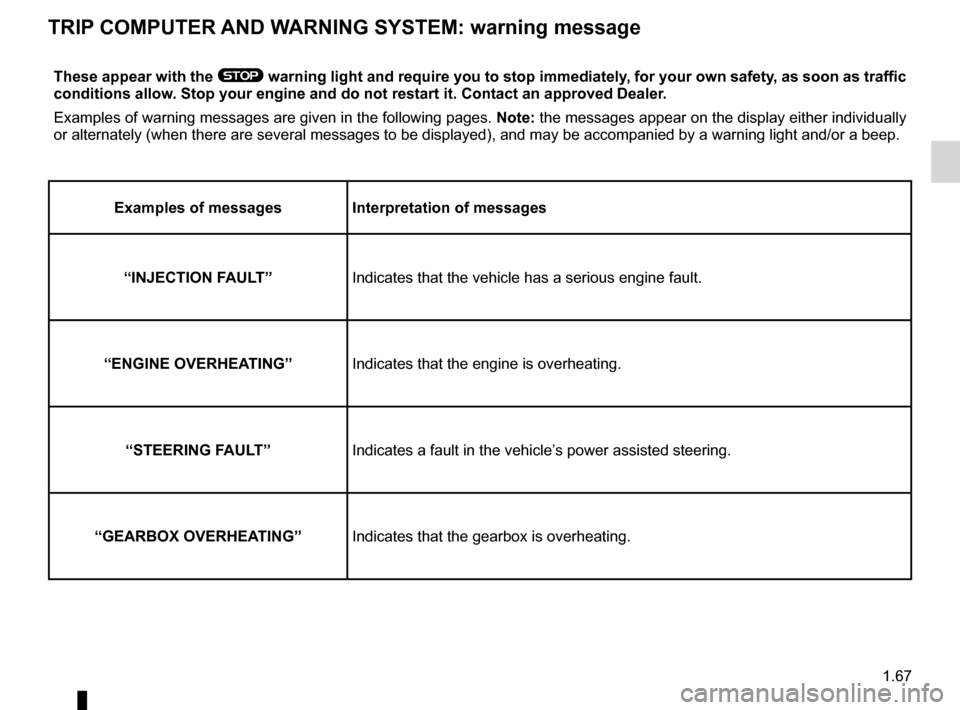
These appear with the ® warning light and require you to stop immediately, for your own safety, as soon as traffic
conditions allow. Stop your engine and do not restart it. Contact an approved Dealer.
Examples of warning messages are given in the following pages. Note: the messages appear on the display either individually
or alternately (when there are several messages to be displayed), and may be accompanied by a warning light and/or a beep.
examples of messages Interpretation of messages
“INJeCTION FAULT” Indicates that the vehicle has a serious engine fault.
“eNGINe OveRHeATING” Indicates that the engine is overheating.
“STeeRING FAULT” Indicates a fault in the vehicle’s power assisted steering.
“GeARBOX OveRHeATING” Indicates that the gearbox is overheating.
TRIp COMpUTeR AND WARNING SySTeM: warning message
Page 156 of 237
maintenance:mechanical ...................................... (up to the end of the DU)
engine oil .............................................. (up to the end of the DU)
dipstick.................................................. (up to the end of the DU)
engine oil level ...................................... (up to the end of the DU)
4.4
ENG_UD25824_5
Niveau huile moteur : généralités (X61 - F61 - K61 - Renault)\
ENG_NU_813-11_FK61_Renault_4
Jaune NoirNoir texte
Engine oil level:
general description
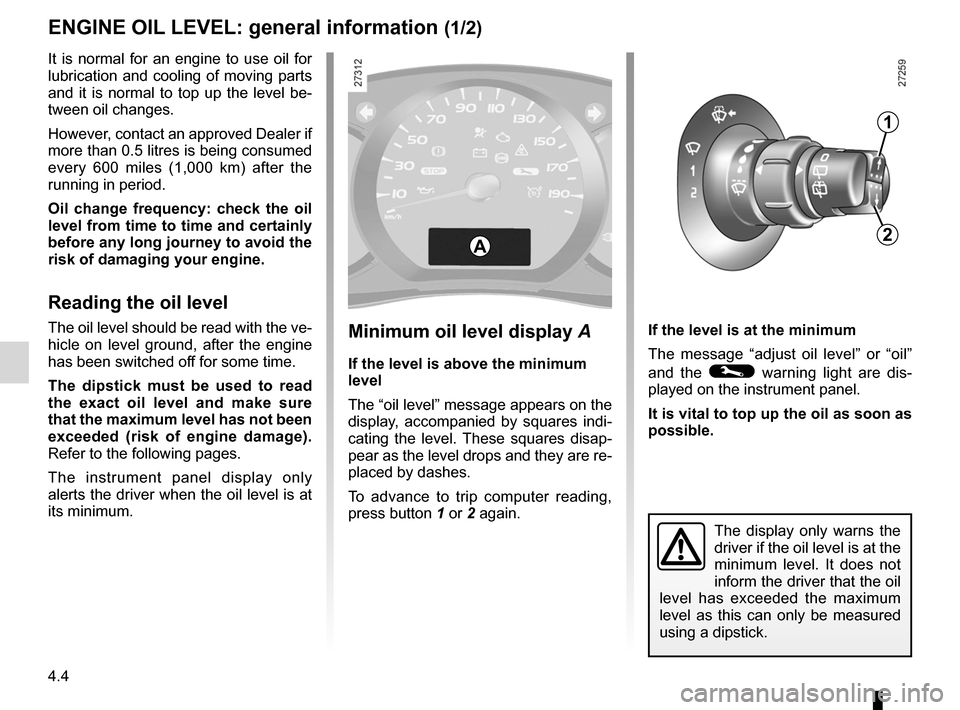
Minimum oil level display A
If the level is above the minimum
level
The “oil level” message appears on the
display, accompanied by squares indi -
cating the level. These squares disap -
pear as the level drops and they are re-
placed by dashes.
To advance to trip computer reading,
press button 1 or 2 again. If the level is at the minimum
The message “adjust oil level” or “oil”
and the © warning light are dis
-
played on the instrument panel.
It is vital to top up the oil as soon as
possible.
The display only warns the
driver if the oil level is at the
minimum level. It does not
inform the driver that the oil
level has exceeded the maximum
level as this can only be measured
using a dipstick.
It is normal for an engine to use oil for
lubrication and cooling of moving parts
and it is normal to top up the level be-
tween oil changes.
However, contact an approved Dealer if
more than 0.5 litres is being consumed
every 600 miles (1,000 km) after the
running in period.
o il change frequency: check the oil
level from time to time and certainly
before any long journey to avoid the
risk of damaging your engine.
Reading the oil level
The oil level should be read with the ve-
hicle on level ground, after the engine
has been switched off for some time.
t he dipstick must be used to read
the exact oil level and make sure
that the maximum level has not been
exceeded (risk of engine damage).
Refer to the following pages.
The instrument panel display only
alerts the driver when the oil level is at
its minimum.
1
2A
engIne oIl level: general information (1/2)
Page 234 of 237
7.4
FRA_UD29767_11
Index (X61 - F61 - K61 - Renault)
ENG_NU_813-11_FK61_Renault_7
Jaune NoirNoir texte
AlphAbeticAl index (4/5)
rear screen
demisting ................................................................ 3.2, 3.4
rear seats functions ........................................................... 3.28 – 3.29
rear view mirrors ................................................................ 1.47
remote control door locking batteries ....................................................................... 5.35
remote control electric door locking .............................. 1.2, 1.4
RENAULT ANTI-INTRUDER DEVICE (RAID) ...................1.13
replacement parts ................................................................ 6.8
reverse gear selecting .................................................... 2.7, 2.27 → 2.29
reversing sensor ..................................................... 2.25 – 2.26
roof bars ............................................................................ 3.34
running in ............................................................................. 2.2
S
seat belts ...................................................... 1.25 → 1.33, 1.53
see-me-home lighting ........................................................ 1.71
service sheets .......................................................... 6.9 → 6.14
side indicator lights changing bulbs ............................................................. 5.21
side protection devices ...................................................... 1.32
side windows ..................................................................... 3.20
signals and lights ................................................... 1.70 → 1.72
speakers ............................................................................ 5.33
special features of diesel versions .....................................2.10
special features of petrol vehicles ....................................... 2.9
speed limiter ................................................. 1.54, 2.18 → 2.20
starting the engine ..................................................... 2.3 → 2.6
steering wheel adjustment ................................................................... 1.24
stopping the engine ................................................... 2.3 → 2.6
storage compartment ............................................. 3.23 → 3.27
storage compartments ........................................... 3.23 → 3.27
sun visor ................................................................... 3.18, 3.24sunroof
............................................................................... 3.21
t
tailgate ................................................. 1.8 → 1.10, 3.30 – 3.31
technical specifications ....................................... 6.2, 6.6 → 6.8
temperature regulation ............................................ 3.4 → 3.15
tool kit .................................................................................. 5.8
towing .................................................................................. 6.5
breakdown ................................................................... 5.30
towing a caravan ................................................................. 6.5
towing equipment fitting ............................................................................ 3.31
towing hitch ................................................................. 5.8, 5.30
towing rings ............................................................ 1.37 – 1.38
towing weights ..................................................................... 6.5
traction control: ASR .............................................. 2.15 → 2.17
transporting children .......................... 1.34 – 1.35, 1.37 → 1.46
transporting objects in the luggage compartment ............................. 3.30 – 3.31
trims ..................................................................................... 5.9
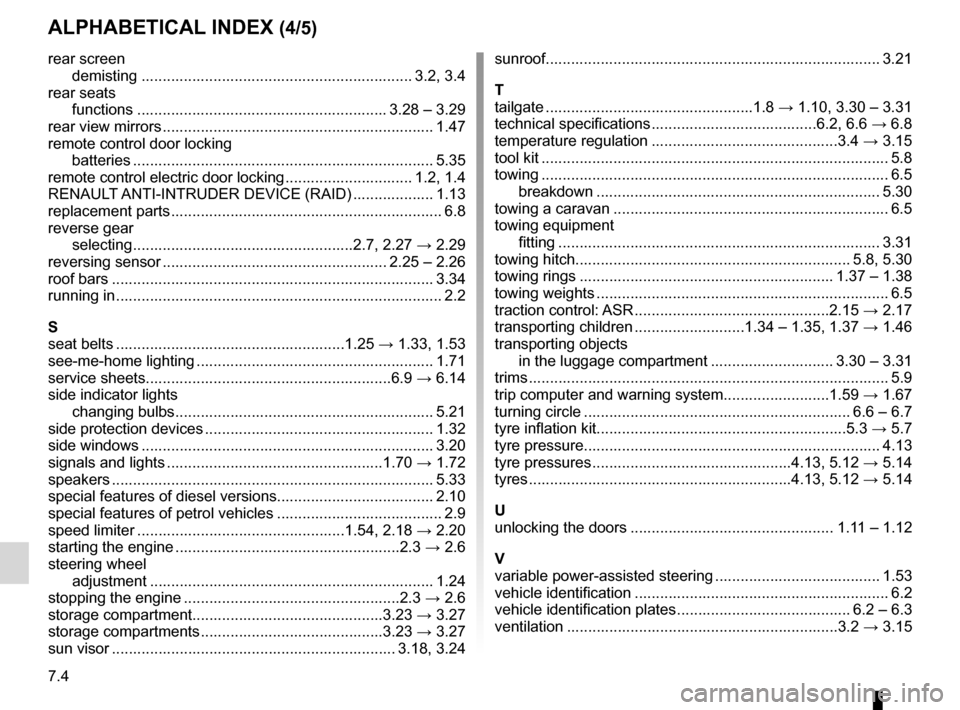
trip computer and warning system .........................1.59 → 1.67
turning circle ............................................................... 6.6 – 6.7
tyre inflation kit ........................................................... 5.3 → 5.7
tyre pressure ...................................................................... 4.13
tyre pressures ............................................... 4.13, 5.12 → 5.14
tyres .............................................................. 4.13, 5.12 → 5.14
U
unlocking the doors ................................................ 1.11 – 1.12
V
variable power-assisted steering ....................................... 1.53
vehicle identification ............................................................ 6.2
vehicle identification plates ......................................... 6.2 – 6.3
ventilation ................................................................ 3.2 → 3.15