lights RENAULT KANGOO 2017 X61 / 2.G Owner's Manual
[x] Cancel search | Manufacturer: RENAULT, Model Year: 2017, Model line: KANGOO, Model: RENAULT KANGOO 2017 X61 / 2.GPages: 260, PDF Size: 5.68 MB
Page 82 of 260
1.76
“See-me-home lighting”
function
(depending on vehicle)
This function (useful, for example, when
opening a gate, garage, etc.) enables
you to switch the dipped headlights on
momentarily.
With the ignition off and the headlights
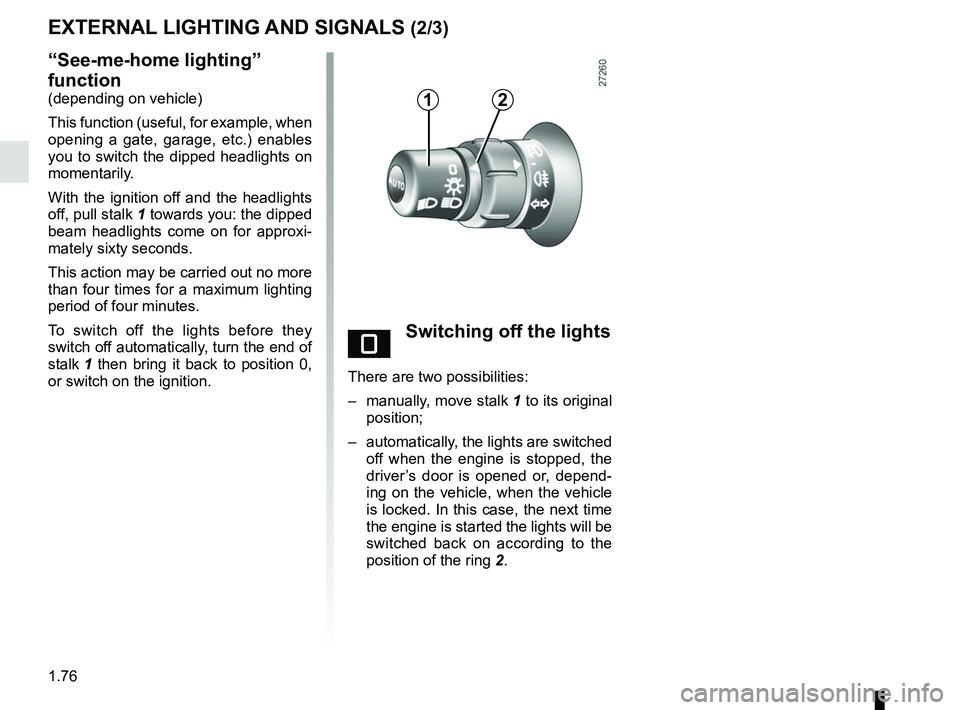
off, pull stalk 1 towards you: the dipped
beam headlights come on for approxi-
mately sixty seconds.
This action may be carried out no more
than four times for a maximum lighting
period of four minutes.
To switch off the lights before they
switch off automatically, turn the end of
stalk 1 then bring it back to position 0, or switch on the ignition.
EXTERNAL LIGHTING AND SIGNALS (2/3)
eSwitching off the lights
There are two possibilities:
– manually, move stalk 1 to its original
position;
– automatically, the lights are switched off when the engine is stopped, the
driver’s door is opened or, depend-
ing on the vehicle, when the vehicle
is locked. In this case, the next time
the engine is started the lights will be
switched back on according to the
position of the ring 2.
12
Page 83 of 260
1.77
fRear fog light
The front fog lights and the
side lights or dipped beam headlights
must be on.
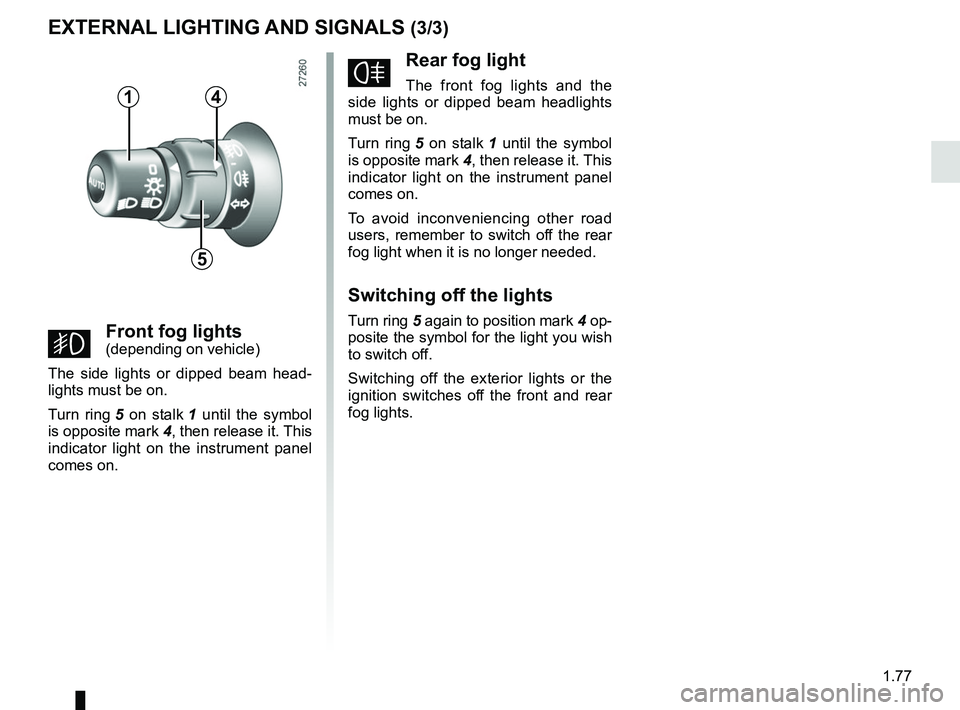
Turn ring 5 on stalk 1 until the symbol
is opposite mark 4, then release it. This
indicator light on the instrument panel
comes on.
To avoid inconveniencing other road
users, remember to switch off the rear
fog light when it is no longer needed.
Switching off the lights
Turn ring 5 again to position mark 4 op-
posite the symbol for the light you wish
to switch off.
Switching off the exterior lights or the
ignition switches off the front and rear
fog lights.
gFront fog lights(depending on vehicle)
The side lights or dipped beam head-
lights must be on.
Turn ring 5 on stalk 1 until the symbol
is opposite mark 4, then release it. This
indicator light on the instrument panel
comes on.
EXTERNAL LIGHTING AND SIGNALS (3/3)
1
5
4
Page 84 of 260
1.78
HEADLIGHT BEAM ADJUSTMENT (1/2)
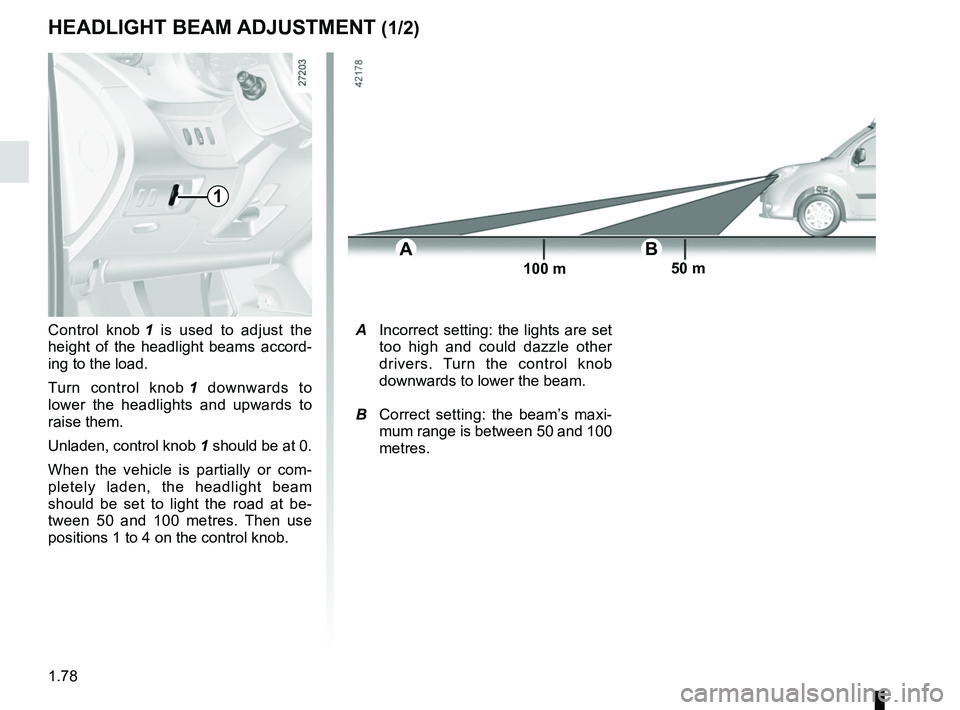
Control knob 1 is used to adjust the
height of the headlight beams accord-
ing to the load.
Turn control knob 1 downwards to
lower the headlights and upwards to
raise them.
Unladen, control knob 1 should be at 0.
When the vehicle is partially or com-
pletely laden, the headlight beam
should be set to light the road at be-
tween 50 and 100 metres. Then use
positions 1 to 4 on the control knob.
AB
100 m 50 m
A Incorrect setting: the lights are set
too high and could dazzle other
drivers. Turn the control knob
downwards to lower the beam.
B Correct setting: the beam’s maxi-
mum range is between 50 and 100
metres.
1
Page 85 of 260
1.79
HEADLIGHT BEAM ADJUSTMENT (2/2)
Temporary adjustment
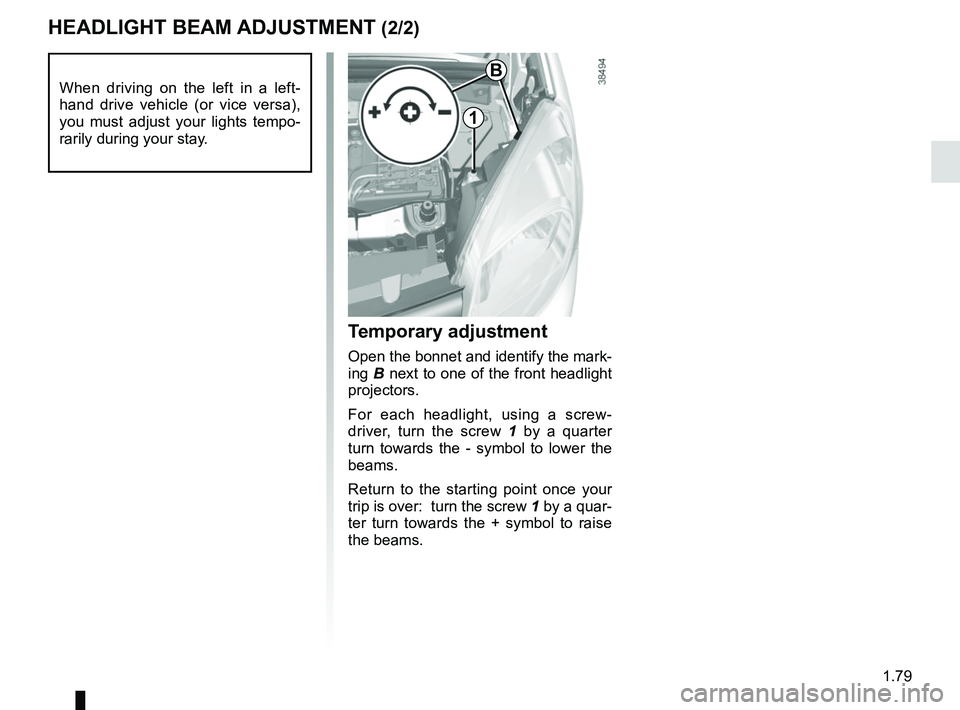
Open the bonnet and identify the mark-
ing B next to one of the front headlight
projectors.
For each headlight, using a screw-
driver, turn the screw 1 by a quarter
turn towards the - symbol to lower the
beams.
Return to the starting point once your
trip is over: turn the screw 1 by a quar-
ter turn towards the + symbol to raise
the beams.
When driving on the left in a left-
hand drive vehicle (or vice versa),
you must adjust your lights tempo-
rarily during your stay.B
1
Page 90 of 260
1.84
No modifications what-
soever are permitted on
any part of the fuel supply
system (electronic unit,
wiring, fuel circuit, injector, protec-
tive covers, etc.) as this may be
dangerous (unless undertaken by
qualified Network personnel).
Filling with fuel
With the ignition off, insert the nozzle
so that the valve opens and then fully
insert it before beginning to fill the tank
(risk of splashback).
Keep the nozzle in this position through-
out the entire filling operation.
When the pump cuts out automatically
at the end of the filling procedure, a
maximum of two further filling attempts
may be made so as to leave sufficient
room for expansion.
Petrol versions
Using leaded petrol will damage the
antipollution system and may lead to a
loss of warranty.
To ensure that the fuel tank is not filled
with leaded petrol, the fuel tank filler
neck consists of a restrictor fitted with
a foolproof system which only allows
a nozzle for unleaded petrol to be
used (at the pump).
FUEL TANK (2/3)
Persistent smell of
fuel
If you notice a persistent
smell of fuel you should:
– stop the vehicle when traffic con-
ditions allow it and switch off the
ignition;
– switch on the hazard warning lights and ask your passengers
to leave the vehicle and to keep
away from the traffic;
– contact an approved Dealer.
Petrol versions
It is essential to use unleaded petrol.
The octane rating (RON) should match
the information given on the label A lo-
cated inside the fuel filler flap. Please
refer to the information on “Engine
specifications” in Section 6.
Vehicles running on ethanol-based
fuel
It is essential to use unleaded petrol or
fuel containing a maximum of 85% eth-
anol (E85).
In very cold conditions, it may be very
difficult or even impossible to start the
engine. To avoid this problem, use un-
leaded petrol or, on equipped vehicles,
use the heater integrated in the engine:
connect the correct end of the exten-
sion piece supplied into the socket in-
tegrated into the radiator grille and the
other end into a 220 V socket for at least 6 hours before starting.
NB: you may notice an increase in fuel
consumption with this type of fuel.
Page 96 of 260
2.4
STOP AND START function (1/3)
Warning light is displayed on the
instrument panel. This notifies you that
the engine is on standby.
The vehicle equipment remain opera-
tional while the engine is stopped.
The engine will restart as soon as you
press the clutch pedal and move into
gear.
This system enables a reduced fuel
consumption and lower greenhouse
gas emissions.
The system is activated automatically
when the vehicle is started.
While driving, the system stops the
engine (standby) when the vehicle is
at a standstill (traffic jam, traffic lights,
etc).
System operating conditionsEngine standby is activated if:
– the vehicle has been driven since its last stop;
– the gearbox is in neutral;
– the clutch pedal is released;
and
– the vehicle is travelling at less than 3 km/h. Special feature of the automatic
engine re-start
Under certain conditions, the engine
can restart on its own in order to guar-
antee your safety and comfort.
This can occur especially when:
– the outdoor temperature is too low or
too high (less than around 0 °C or
higher than around 30 °C);
– the “Clear View” function is acti- vated if fitted on the vehicle (please
see “Automatic Climate Control” in
Section 3);
– the battery is not sufficiently charged;
– the vehicle speed is above 7 km/h (downhill slope, etc.);
– repeated pressing on the brake pedal or braking system require-
ment;
– ...
Engine on standby - braking
assistance is no longer op-
erational.
Do not drive off when the
engine is on standby (warn-
ing light
is displayed
on the instrument panel).
Before getting out of the
vehicle, you must switch
off the ignition (please see
section on “Starting, stop-
ping the engine”).
If you get out of the vehicle, a beep
notifies you that the engine is on
standby and has not been switched
off.
Page 98 of 260
2.6
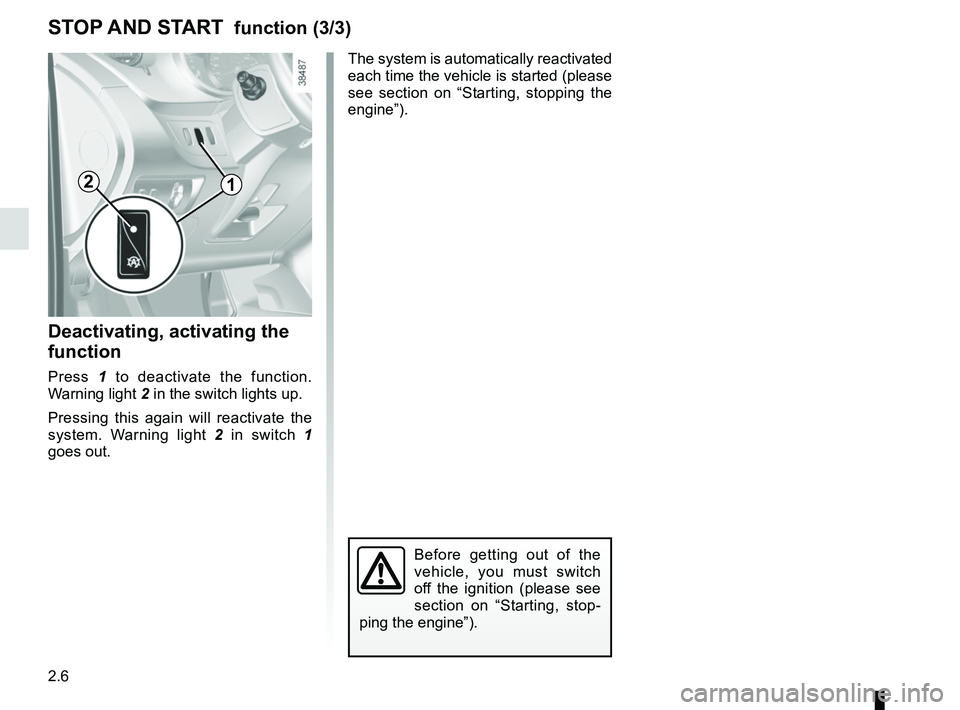
Deactivating, activating the
function
Press 1 to deactivate the function.
Warning light 2 in the switch lights up.
Pressing this again will reactivate the
system. Warning light 2 in switch 1
goes out.
STOP AND START function (3/3)
The system is automatically reactivated
each time the vehicle is started (please
see section on “Starting, stopping the
engine”).
2
Before getting out of the
vehicle, you must switch
off the ignition (please see
section on “Starting, stop-
ping the engine”).
1
Page 99 of 260
2.7
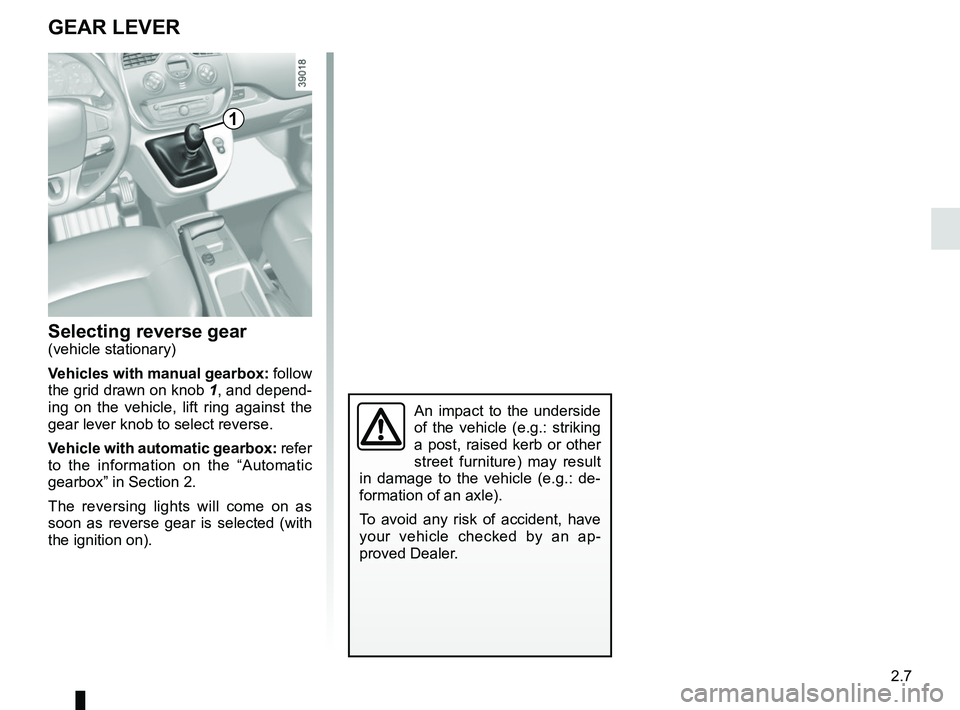
Selecting reverse gear(vehicle stationary)
Vehicles with manual gearbox: follow
the grid drawn on knob 1, and depend-
ing on the vehicle, lift ring against the
gear lever knob to select reverse.
Vehicle with automatic gearbox: refer
to the information on the “Automatic
gearbox” in Section 2.
The reversing lights will come on as
soon as reverse gear is selected (with
the ignition on).
1
GEAR LEVER
An impact to the underside
of the vehicle (e.g.: striking
a post, raised kerb or other
street furniture) may result
in damage to the vehicle (e.g.: de-
formation of an axle).
To avoid any risk of accident, have
your vehicle checked by an ap-
proved Dealer.
Page 102 of 260
2.10
SPECIAL FEATURES OF DIESEL VERSIONS
Do not park the vehicle or
run the engine in locations
where combustible sub-
stances or materials such
as grass or leaves can come into
contact with the hot exhaust system.
Precautions to be taken in
winter
To avoid any faults in icy weather:
– make sure that the battery is always fully charged;
– always keep the diesel tank rela- tively full to prevent water vapour
condensing in it and accumulating at
the bottom of the tank.
Diesel engine speed
Diesel engines are fitted with an injec-
tion pump with an electronic regulator
which prevents overrevving of the
engine irrespective of the gear en-
gaged.
If the
Ä and © warning lights
come on, consult an approved dealer
as soon as possible.
Running out of fuel
You may start the engine normally after
refilling the fuel tank even if you have
completely run out of fuel, provided
that the battery is fully charged.
However, if the engine does not start
after a few seconds and several at-
tempts, refer to the information on the
“Fuel tank” in Section 1.
Page 104 of 260
2.12
DRIVING ADVICE, ECO-DRIVING (2/4)
ECO mode
ECO mode is a function which opti-
mises fuel consumption. It acts upon
certain power consuming systems in
the vehicle (heating, air conditioning,
power-assisted steering, etc.) and on
certain driving actions (acceleration,
gear changing, cruise control, deceler-
ation, etc.).
Activating the function
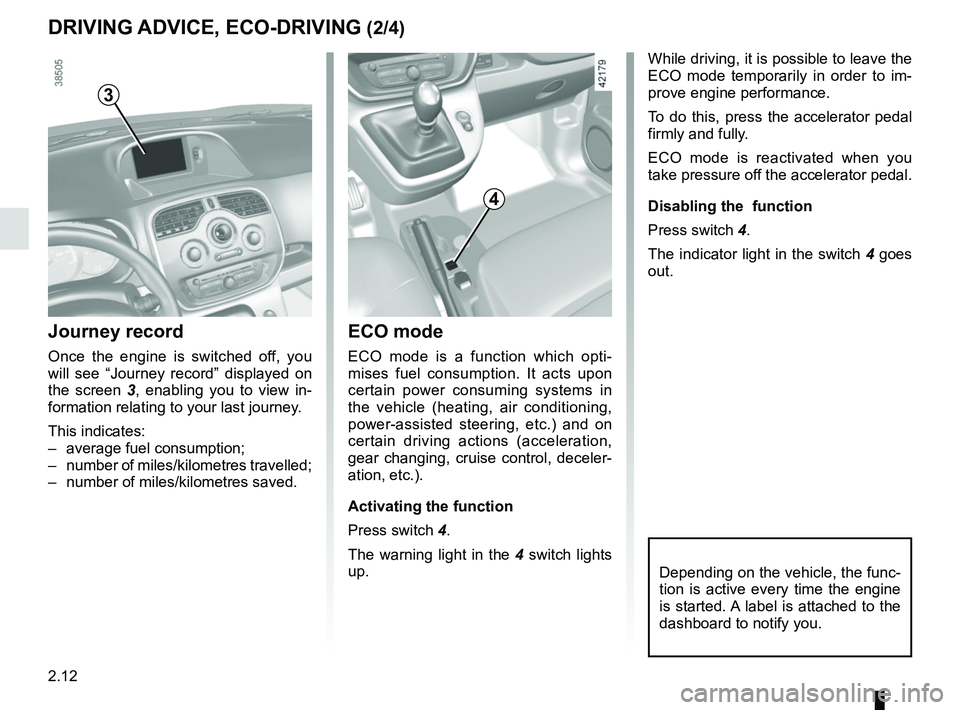
Press switch 4.
The warning light in the 4 switch lights
up.
4
While driving, it is possible to leave the
ECO mode temporarily in order to im-
prove engine performance.
To do this, press the accelerator pedal
firmly and fully.
ECO mode is reactivated when you
take pressure off the accelerator pedal.
Disabling the function
Press switch 4.
The indicator light in the switch 4 goes
out.
Journey record
Once the engine is switched off, you
will see “Journey record” displayed on
the screen 3, enabling you to view in-
formation relating to your last journey.
This indicates:
– average fuel consumption;
– number of miles/kilometres travelled;
– number of miles/kilometres saved.
3
Depending on the vehicle, the func-
tion is active every time the engine
is started. A label is attached to the
dashboard to notify you.