warning lights RENAULT KANGOO 2018 User Guide
[x] Cancel search | Manufacturer: RENAULT, Model Year: 2018, Model line: KANGOO, Model: RENAULT KANGOO 2018Pages: 264, PDF Size: 7.09 MB
Page 60 of 264

If no lights or sounds are apparent, this indicates a fault in the instr\
ument
panel. This indicates that it is essential to stop immediately (as soon as")
1.54
Instrument panel A
WARNING LIGHTS (1/4)
If no lights or sounds are apparent, this indicates a fault in the instr\
ument
panel. This indicates that it is essential to stop immediately (as soon as
traffic conditions allow). Ensure that the vehicle is correctly immobilised\
and contact an approved Dealer.
A
Warning light ® re-
quires you to stop immedi-
ately, for your own safety,
as soon as traffic conditions
allow. Switch off the engine and do
not restart it. Contact an approved
Dealer.
The presence and operation of the warning lights DEPEND ON THE EQUIPMENT\
AND COUNTRY.
The © warning light means
you should drive very carefully to
an approved Dealer as soon as pos-
sible. If you fail to follow this recom-
mendation, you risk damaging your
vehicle.
áMain beam headlight tell-tale
light
kDipped beam headlight tell-
tale
gFront fog light tell-tale light
fRear fog light tell-tale
dDirection indicator tell-tale
light
UVariable power assisted
steering warning light
This lights up when the ignition is
switched on and goes out after a few
seconds.
If it comes on when driving accompa-
nied by a beep, this indicates a fault in
the system.
Contact an approved Dealer as soon as
possible.
Š ‰Gear change indicator.
This lights up to advise you to
change to a higher gear (up arrow) or
lower gear (down arrow).
Page 61 of 264

A
The presence and operation of the warning lights DEPEND ON THE EQUIPMENT\
AND COUNTRY.
© Warning light
It comes on when the ignition is
switched on, sometimes at the sam")
1.55
WARNING LIGHTS (2/4)
A
The presence and operation of the warning lights DEPEND ON THE EQUIPMENT\
AND COUNTRY.
© Warning light
It comes on when the ignition is
switched on, sometimes at the same
time as other warning lights and then
goes out after several seconds.
If the light comes on, you should visit an
approved Dealer immediately.
Depending on the vehicle, this warning
light is accompanied by a message on
the instrument panel.
ÄWarning light for monitoring
exhaust gas
On equipped vehicles, the light comes
on when the ignition is switched on then
goes out.
– If it lights up continuously accom-
panied by the
© indicator light,
consult an approved Dealer as soon
as possible;
– If it flashes, reduce the engine speed until the light stops flashing. Contact
your approved Dealer as soon as
possible.
Refer to “Emission control, fuel econ-
omy and driving advice” in section 2.
ÔCoolant temperature warn-
ing light
If this remains lit while driving accom-
panied by the
® indicator light, it
indicates engine overheating. Stop and
allow the engine to run at idle speed
for a minute or two. The temperature
should drop. If not, stop the engine.
Let the engine cool down, then check
the coolant level. Contact an approved
Dealer if necessary.
DHandbrake “on” warning
light and brake circuit inci-
dent warning light
This comes on when the ignition is
switched on. If it comes on during brak-
ing or when the vehicle is being driven,
accompanied by the
® indicator
light, it means that one of the circuit
levels is too low; it may be dangerous to
continue driving. Consult an approved
Dealer.
® STOP light
It comes on when the ignition is
switched on, sometimes at the same
time as other warning lights and then
goes out after several seconds.
It indicates that it is essential to stop as
soon as traffic conditions allow. Contact
an approved Dealer as soon as possi-
ble.
Depending on the vehicle, this warning
light is accompanied by a message on
the instrument panel.
Page 62 of 264

A
The presence and operation of the warning lights DEPEND ON THE EQUIPMENT\
AND COUNTRY.
xAnti-lock braking warning
light
This lights up when the ignition is
switched on a")
1.56
WARNING LIGHTS (3/4)
A
The presence and operation of the warning lights DEPEND ON THE EQUIPMENT\
AND COUNTRY.
xAnti-lock braking warning
light
This lights up when the ignition is
switched on and goes out after a few
seconds.
If it does not go out after the ignition is
switched on, or lights up when driving,
there is a fault with the ABS. Braking
will then be as normal, without the ABS
system.
Contact an approved Dealer as soon as
possible.
LLow fuel level warning light This comes on when the igni-
tion is switched on and goes out after a
few seconds. If it comes on when driv-
ing and is accompanied by a beep, fill
up with fuel as soon as possible. There
is only approximately 30 miles (50 km)
worth of fuel left after the warning light
first comes on.
ÉPreheating warning light (on
diesel version)
This should come on when the igni-
tion is switched on. It indicates that the
heater plugs are in operation. It goes
out after preheating is sufficient and the
engine can be started.
ÒElectronic fault warning light
If it comes on when driving, it
indicates an electronic or electrical fault
or, for diesel versions, the presence of
water in the diesel fuel.
Contact your approved Dealer as soon
as possible.
åAir bag warning light
This comes on when the igni-
tion is switched on and goes out after
a few seconds. If it does not come on
when the ignition is switched on or if it
flashes, there is a fault in the system.
Contact an approved Dealer as soon as
possible.
ÀOil pressure warning light
If it comes on while you are
driving, stop at once and switch off the
ignition.
Check the oil level (refer to section 4
“Engine oil level”). If the level is normal,
the light has come on for another
reason: contact an approved Dealer as
soon as possible.
Page 63 of 264
1.57
WARNING LIGHTS (4/4)
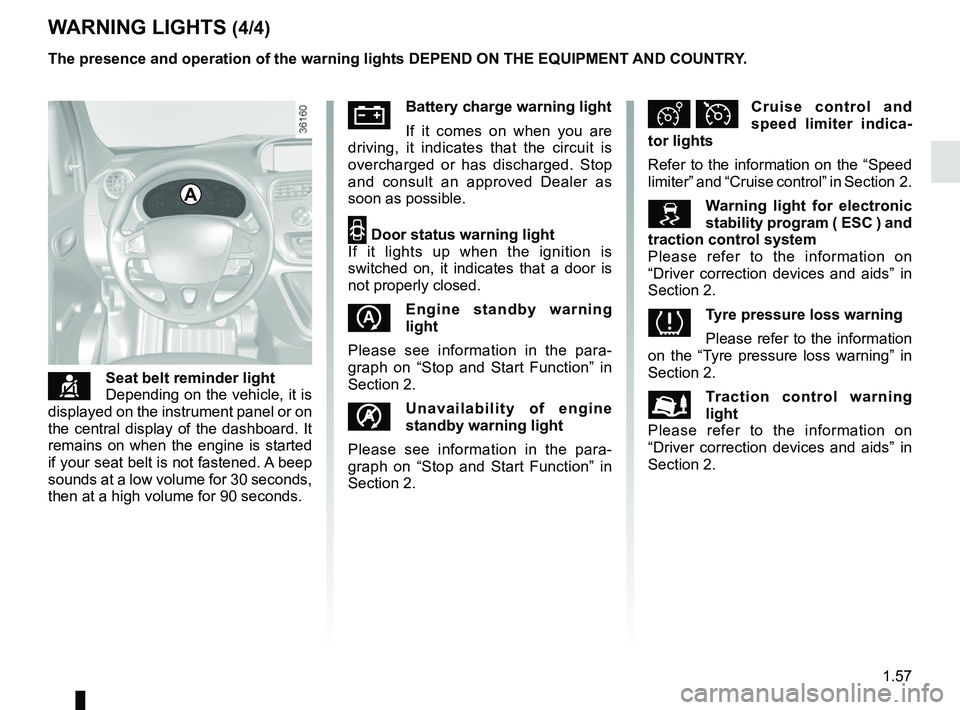
çSeat belt reminder light
Depending on the vehicle, it is
displayed on the instrument panel or on
the central display of the dashboard. It
remains on when the engine is started
if your seat belt is not fastened. A beep
sounds at a low volume for 30 seconds,
then at a high volume for 90 seconds.
A
The presence and operation of the warning lights DEPEND ON THE EQUIPMENT\
AND COUNTRY.
ÚBattery charge warning light
If it comes on when you are
driving, it indicates that the circuit is
overcharged or has discharged. Stop
and consult an approved Dealer as
soon as possible.
2 Door status warning light
If it lights up when the ignition is
switched on, it indicates that a door is
not properly closed.
Engine standby warning
light
Please see information in the para-
graph on “Stop and Start Function” in
Section 2.
Unavailability of engine
standby warning light
Please see information in the para-
graph on “Stop and Start Function” in
Section 2.
Ð ÏCruise control and
speed limiter indica-
tor lights
Refer to the information on the “Speed
limiter” and “Cruise control” in Section 2.
Warning light for electronic
stability program ( ESC ) and
traction control system
Please refer to the information on
“Driver correction devices and aids” in
Section 2.
Tyre pressure loss warning
Please refer to the information
on the “Tyre pressure loss warning” in
Section 2.
\bTraction control warning
light
Please refer to the information on
“Driver correction devices and aids” in
Section 2.
Page 65 of 264
1.59
DISPLAYS AND INDICATORS (2/3)
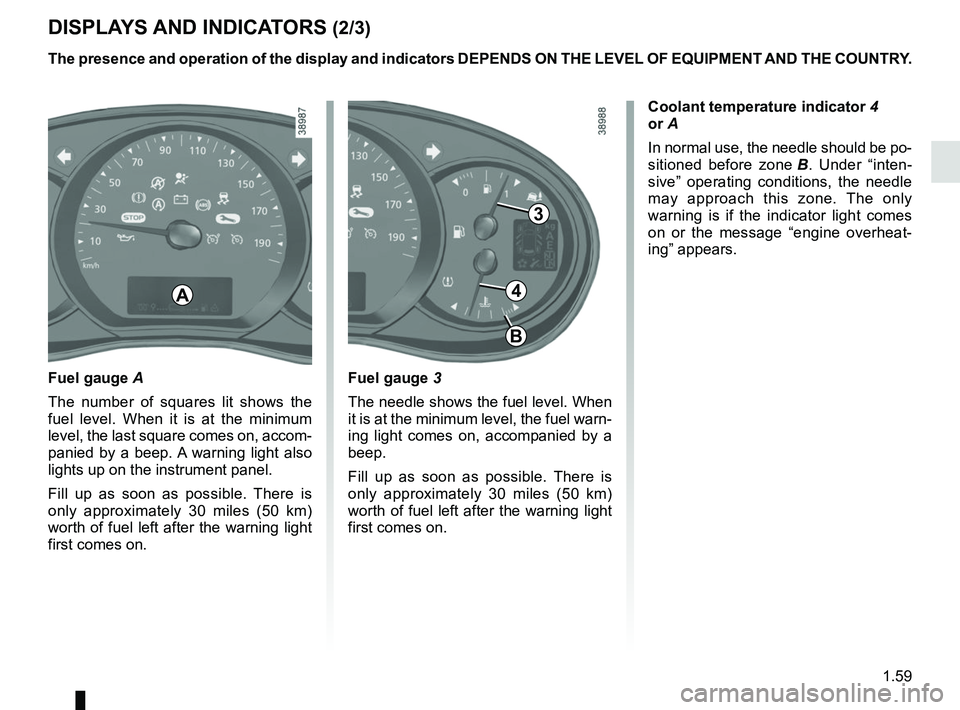
Fuel gauge A
The number of squares lit shows the
fuel level. When it is at the minimum
level, the last square comes on, accom-
panied by a beep. A warning light also
lights up on the instrument panel.
Fill up as soon as possible. There is
only approximately 30 miles (50 km)
worth of fuel left after the warning light
first comes on.
3
4
B
A
Coolant temperature indicator 4
or A
In normal use, the needle should be po-
sitioned before zone B. Under “inten-
sive” operating conditions, the needle
may approach this zone. The only
warning is if the indicator light comes
on or the message “engine overheat-
ing” appears.
The presence and operation of the display and indicators DEPENDS ON THE \
LEVEL OF EQUIPMENT AND THE COUNTRY.
Fuel gauge 3
The needle shows the fuel level. When
it is at the minimum level, the fuel warn-
ing light comes on, accompanied by a
beep.
Fill up as soon as possible. There is
only approximately 30 miles (50 km)
worth of fuel left after the warning light
first comes on.
Page 73 of 264

1.67
Information messagesThese can help in the vehicle starting phase, or give information about \
a selection or a driving status.
Examples of information messages are given in the following pages.Examples of messages Interpretation of messages
« NO MESSAGE AVAILABLE » f) Trip log
Successive display:
– information messages (automatic lighting, etc.),
– operating fault messages (check injection system, etc).
« BOOT OPEN » Indicates that the tailgate has been left open.
« BATTERY MODE : ECONOMY » Indicates that vehicle accessories have been switched off to preserve the battery. « OIL LEVEL CORRECT » Indicates that the oil level is correct when the ignition is switched on\
.
« AUTO LIGHTS DEACTIVATED » Indicates that the automatic lights function is deactivated.
TRIP COMPUTER AND WARNING SYSTEM: information messages
Page 74 of 264

1.68
These appear with the © warning light and mean that you should drive very carefully to an approv\
ed Dealer as
soon as possible. If you fail to follow this recommendation, you risk da\
maging your vehicle.
They disappear when the display selection key is pressed or after severa\
l seconds and are stored in the computer log. The
© warning light stays on. Examples of operating fault messages are given \
on the following pages .
Examples of messages Interpretation of messages « CHECK ESC » Indicates a fault in the Electronic Stability Program and the traction c\
ontrol system
(see “Driver correction devices and aids” in Section 2).
« CHECK FUEL FILTER » Indicates that there is water present in the diesel fuel.
Contact an approved Dealer as soon as possible.
« CHECK GEARBOX » Indicates that a fault has occurred in the gearbox; contact an approved \
Dealer as
soon as possible.
« CHECK AUTO LIGHTS » Indicates an automatic lighting operating fault; contact an approved Dea\
ler.
« CHECK STEERING » Indicates a power-assisted steering system operating fault.
TRIP COMPUTER AND WARNING SYSTEM: operating fault messages
Page 80 of 264

1.74
AUDIBLE AND VISUAL SIGNALS
2
1
0
1
3
éHazard warning lights
Pressing switch 3 illuminates
all four direction indicators and the
side-mounted indicator lights simul-
taneously. It must only be used in an
emergency to warn other drivers that
you have had to stop in an area where
stopping is prohibited or unexpected, or
that you are obliged to drive under spe-
cial conditions.
Depending on the vehicle, the hazard
warning lights may come on automati-
cally under heavy deceleration. You can
switch them off by pressing switch 3.
Horn
Press one of points 2.
Direction indicators
Move stalk 1 parallel to the steering
wheel and in the direction you are going
to turn.
When driving on the motorway, the
steering wheel is not often turned
enough to return the stalk automatically
to 0. There is an intermediate position in
which the switch may be held when
changing lanes.
You can also briefly place stalk
1 in the
intermediate position, causing the indi-
cator light to flash three times.
When the stalk is released, it automati-
cally returns to 0.
Headlight flasher
Pull stalk 1 towards you to flash the
headlights.
Page 83 of 264
1.77
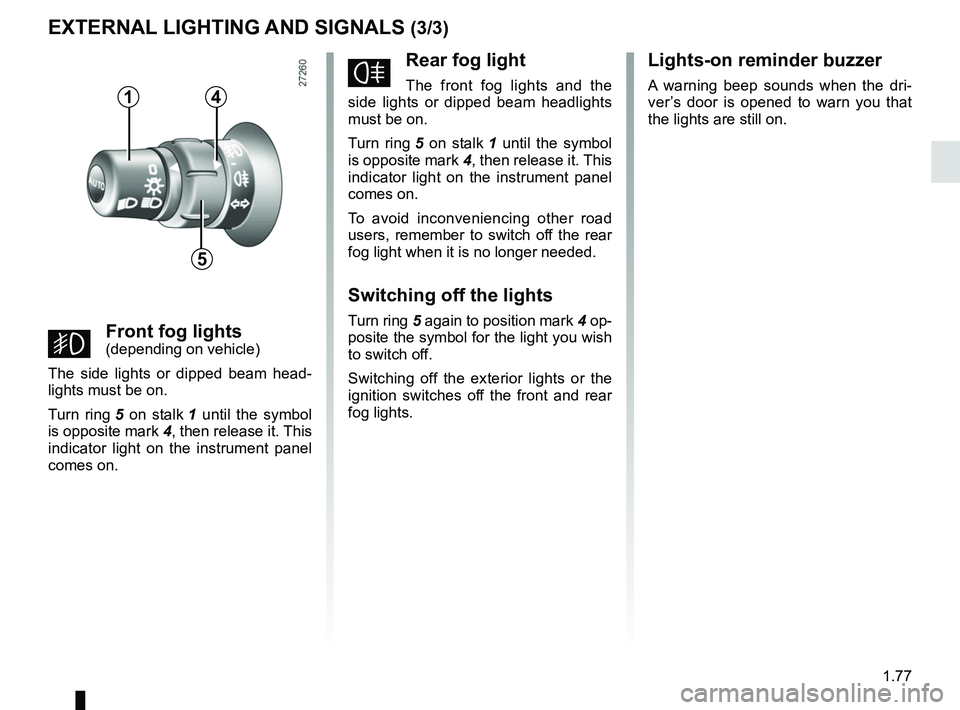
fRear fog light
The front fog lights and the
side lights or dipped beam headlights
must be on.
Turn ring 5 on stalk 1 until the symbol
is opposite mark 4, then release it. This
indicator light on the instrument panel
comes on.
To avoid inconveniencing other road
users, remember to switch off the rear
fog light when it is no longer needed.
Switching off the lights
Turn ring 5 again to position mark 4 op-
posite the symbol for the light you wish
to switch off.
Switching off the exterior lights or the
ignition switches off the front and rear
fog lights.
gFront fog lights(depending on vehicle)
The side lights or dipped beam head-
lights must be on.
Turn ring 5 on stalk 1 until the symbol
is opposite mark 4, then release it. This
indicator light on the instrument panel
comes on.
EXTERNAL LIGHTING AND SIGNALS (3/3)
1
5
4
Lights-on reminder buzzer
A warning beep sounds when the dri-
ver’s door is opened to warn you that
the lights are still on.
Page 90 of 264
1.84
No modifications what-
soever are permitted on
any part of the fuel supply
system (electronic unit,
wiring, fuel circuit, injector, protec-
tive covers, etc.) as this may be
dangerous (unless undertaken by
qualified Network personnel).
Filling with fuel
With the ignition off, insert the nozzle
so that the valve opens and then fully
insert it before beginning to fill the tank
(risk of splashback).
Keep the nozzle in this position through-
out the entire filling operation.
When the pump cuts out automatically
at the end of the filling procedure, a
maximum of two further filling attempts
may be made so as to leave sufficient
room for expansion.
Petrol versions
Using leaded petrol will damage the
antipollution system and may lead to a
loss of warranty.
To ensure that the fuel tank is not filled
with leaded petrol, the fuel tank filler
neck consists of a restrictor fitted with
a foolproof system which only allows
a nozzle for unleaded petrol to be
used (at the pump).
FUEL TANK (2/3)
Persistent smell of
fuel
If you notice a persistent
smell of fuel you should:
– stop the vehicle when traffic con-
ditions allow it and switch off the
ignition;
– switch on the hazard warning lights and ask your passengers
to leave the vehicle and to keep
away from the traffic;
– contact an approved Dealer.
Petrol versions
It is essential to use unleaded petrol.
The octane rating (RON) should match
the information given on the label A lo-
cated inside the fuel filler flap. Please
refer to the information on “Engine
specifications” in Section 6.
Vehicles running on ethanol-based
fuel
It is essential to use unleaded petrol or
fuel containing a maximum of 85% eth-
anol (E85).
In very cold conditions, it may be very
difficult or even impossible to start the
engine. To avoid this problem you can
use unleaded petrol, or you can use
the heater that is integrated into the
engine (on vehicles that are equipped):
Connect the end piece of the extension
provided to the socket fitted in the grille,
and the other end piece to a 220 V
socket for at least 6 hours before start-
ing the vehicle.
NB: you may notice an increase in fuel
consumption with this type of fuel.