ESP RENAULT KANGOO 2018 Owner's Manual
[x] Cancel search | Manufacturer: RENAULT, Model Year: 2018, Model line: KANGOO, Model: RENAULT KANGOO 2018Pages: 264, PDF Size: 7.09 MB
Page 132 of 264
2.40
REVERSING CAMERA (1/2)
Operation
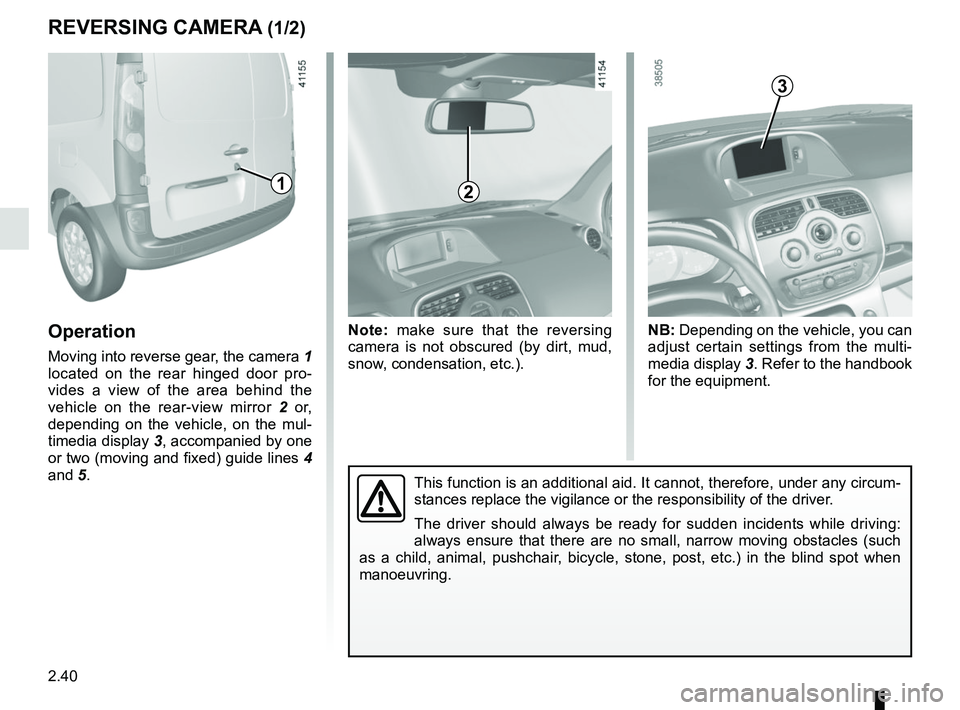
Moving into reverse gear, the camera 1
located on the rear hinged door pro-
vides a view of the area behind the
vehicle on the rear-view mirror 2 or,
depending on the vehicle, on the mul-
timedia display 3, accompanied by one
or two (moving and fixed) guide lines 4
and 5.
Note: make sure that the reversing
camera is not obscured (by dirt, mud,
snow, condensation, etc.). NB: Depending on the vehicle, you can
adjust certain settings from the multi-
media display
3. Refer to the handbook
for the equipment.
This function is an additional aid. It cannot, therefore, under any circ\
um-
stances replace the vigilance or the responsibility of the driver.
The driver should always be ready for sudden incidents while driving:
always ensure that there are no small, narrow moving obstacles (such
as a child, animal, pushchair, bicycle, stone, post, etc.) in the blind spot when
manoeuvring.
2
3
1
Page 135 of 264
2.43
AUTOMATIC GEARBOX (2/3)Driving in manual mode
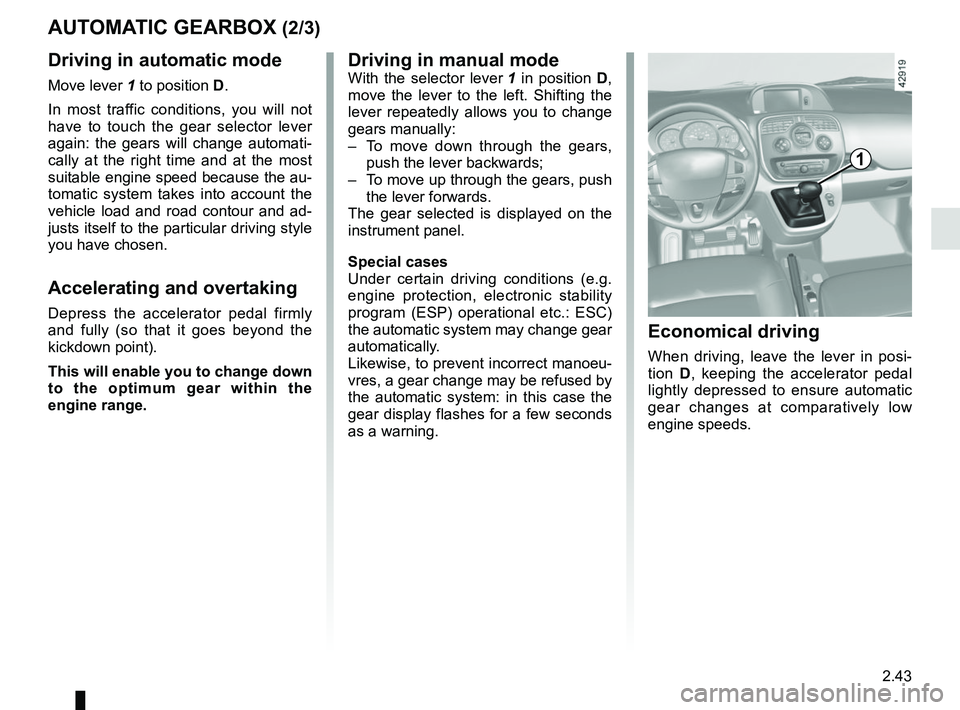
With the selector lever 1 in position D,
move the lever to the left. Shifting the
lever repeatedly allows you to change
gears manually:
– To move down through the gears, push the lever backwards;
– To move up through the gears, push the lever forwards.
The gear selected is displayed on the
instrument panel.
Special cases
Under certain driving conditions (e.g.
engine protection, electronic stability
program (ESP) operational etc.: ESC)
the automatic system may change gear
automatically.
Likewise, to prevent incorrect manoeu-
vres, a gear change may be refused by
the automatic system: in this case the
gear display flashes for a few seconds
as a warning.
1
Economical driving
When driving, leave the lever in posi-
tion D, keeping the accelerator pedal
lightly depressed to ensure automatic
gear changes at comparatively low
engine speeds.
Driving in automatic mode
Move lever 1 to position D.
In most traffic conditions, you will not
have to touch the gear selector lever
again: the gears will change automati-
cally at the right time and at the most
suitable engine speed because the au-
tomatic system takes into account the
vehicle load and road contour and ad-
justs itself to the particular driving style
you have chosen.
Accelerating and overtaking
Depress the accelerator pedal firmly
and fully (so that it goes beyond the
kickdown point).
This will enable you to change down
to the optimum gear within the
engine range.
Page 151 of 264
3.15
Operating faults
As a general rule, contact your ap-
proved dealer in the event of an oper-
ating fault.
– Reduction in de-icing, demisting or air conditioning performance.
This may be caused by the passen-
ger compartment filter cartridge be-
coming clogged.
– No cold air is being produced .
Check that the controls are set cor-
rectly and that the fuses are sound.
Otherwise, switch off the system.
Presence of water under the
vehicle
After prolonged use of the air condi-
tioning system, it is normal for water
to be present under the vehicle. This is
caused by condensation.
AIR CONDITIONING: information and operating instructions (1/2)
Do not open the refriger-
ant fluid circuit. The fluid
may damage eyes or skin.
Fuel consumption
You will normally notice an increase in
fuel consumption (especially in town)
when the air conditioning is operating.
For vehicles fitted with air conditioning
with no automatic mode, switch off the
system when it is not required.
Advice for reducing consumption
and helping to preserve the environ-
ment
Drive with the air vents open and the
windows closed.
If the vehicle has been parked in the
sun, open the doors for a few moments
to let the hot air escape before starting
the engine.
Maintenance
Refer to the Maintenance Document
for your vehicle for the inspection fre-
quency.
Advice on use
In some situations (air conditioning off,
air recirculation activated, ventilation
speed at zero or low etc.), you may
notice that condensation starts to form
on the windows and windscreen.
If there is condensation, use the “Clear
View” function to remove it, then use
the air conditioning in automatic mode
to stop it forming again.
Do not add anything to the
vehicle’s ventilation circuit
(for example, to remove
bad odours).
There is a risk of damage or of
fire.
Use the air conditioning system reg-
ularly, even in cold weather, running
it at least once a month for approxi-
mately 5 minutes.
Vehicles equipped with
modeECO
Once activated, ECO mode may
reduce air conditioning perform-
ance. Please refer to the informa-
tion on “Driving advice, Eco-driving”
in Section 2.
Page 156 of 264
3.20
Electric windows
With the ignition on:
– press the switch for the window concerned to lower it to the desired
height;
– lift the switch for the window con- cerned to raise it to the desired
height.
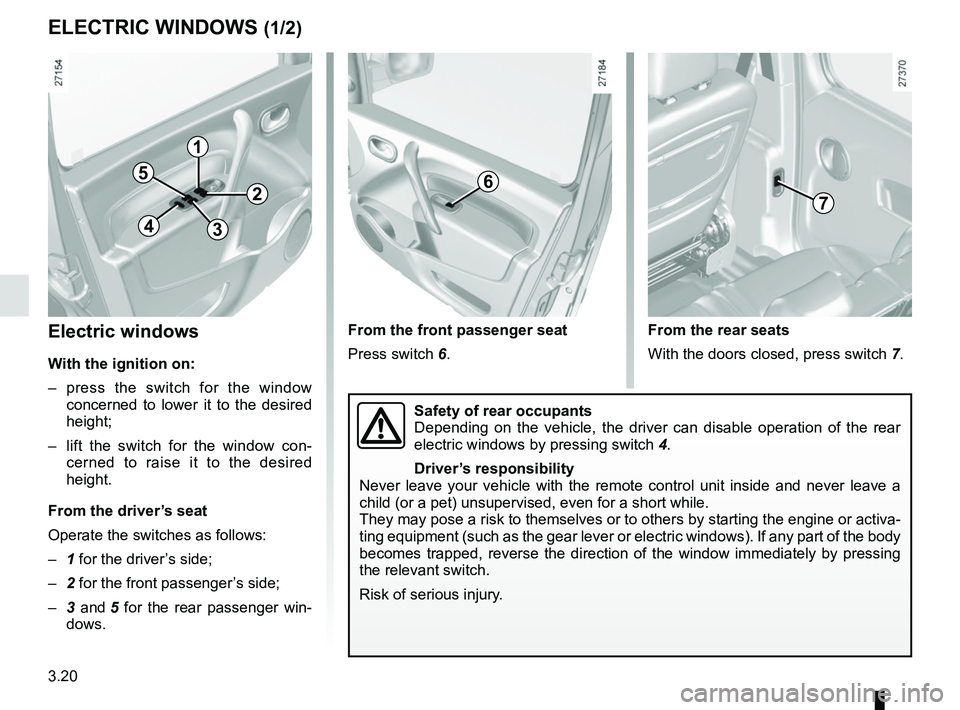
From the driver’s seat
Operate the switches as follows:
– 1 for the driver’s side;
– 2 for the front passenger’s side;
– 3 and 5 for the rear passenger win-
dows.
ELECTRIC WINDOWS (1/2)
From the rear seats
With the doors closed, press switch 7.
From the front passenger seat
Press switch 6.
1
2
34
56
Safety of rear occupants
Depending on the vehicle, the driver can disable operation of the rear
electric windows by pressing switch
4.
Driver’s responsibility
Never leave your vehicle with the remote control unit inside and never l\
eave a
child (or a pet) unsupervised, even for a short while.
They may pose a risk to themselves or to others by starting the engine o\
r activa-
ting equipment (such as the gear lever or electric windows). If any pa\
rt of the body
becomes trapped, reverse the direction of the window immediately by pres\
sing
the relevant switch.
Risk of serious injury.
7
Page 169 of 264
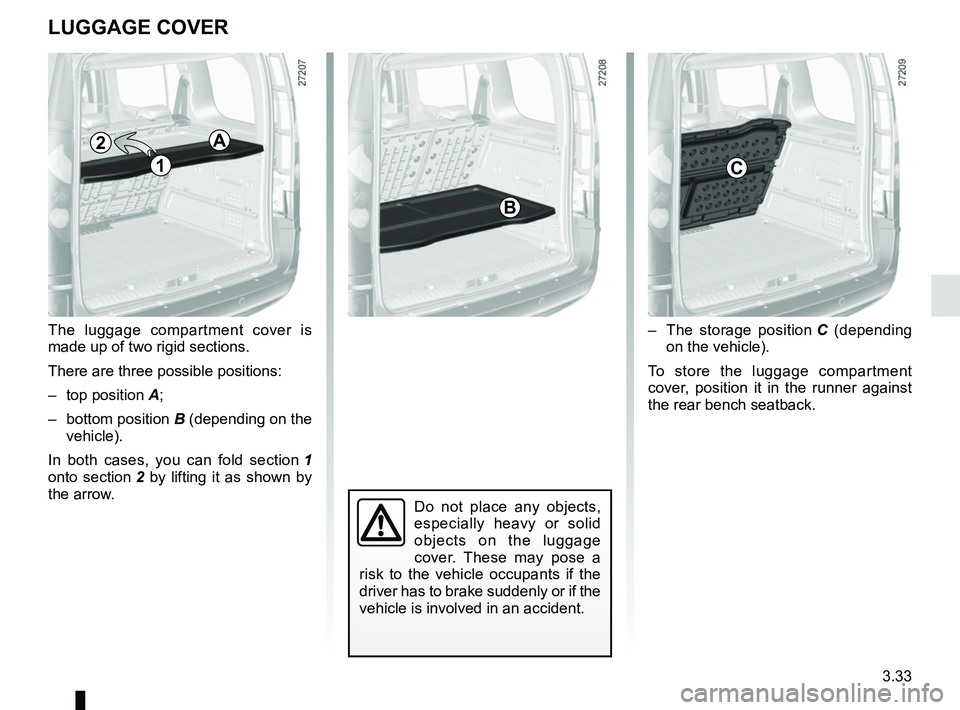
3.33
– The storage position C (depending
on the vehicle).
To store the luggage compartment
cover, position it in the runner against
the rear bench seatback.
The luggage compartment cover is
made up of two rigid sections.
There are three possible positions:
– top position
A;
– bottom position B (depending on the
vehicle).
In both cases, you can fold section 1
onto section 2 by lifting it as shown by
the arrow.
Do not place any objects,
especially heavy or solid
objects on the luggage
cover. These may pose a
risk to the vehicle occupants if the
driver has to brake suddenly or if the
vehicle is involved in an accident.
LUGGAGE COVER
A
C
B
1
2
Page 185 of 264
4.11
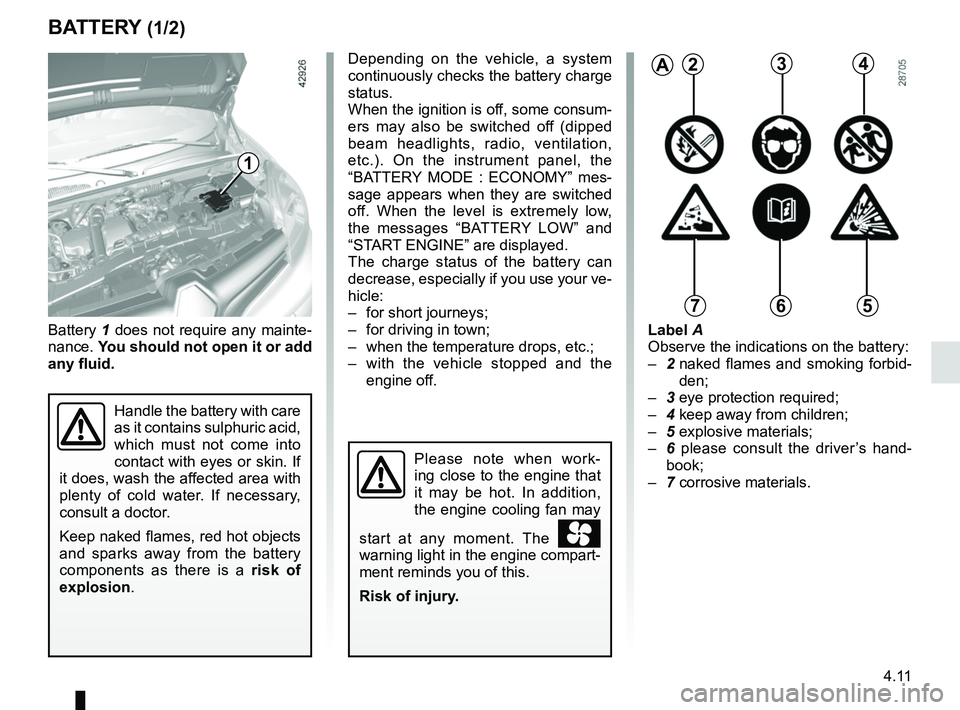
Label A
Observe the indications on the battery:
– 2 naked flames and smoking forbid-
den;
– 3 eye protection required;
– 4 keep away from children;
– 5 explosive materials;
– 6 please consult the driver’s hand-
book;
– 7 corrosive materials.
Battery
1 does not require any mainte-
nance. You should not open it or add
any fluid.
Handle the battery with care
as it contains sulphuric acid,
which must not come into
contact with eyes or skin. If
it does, wash the affected area with
plenty of cold water. If necessary,
consult a doctor.
Keep naked flames, red hot objects
and sparks away from the battery
components as there is a risk of
explosion .
BATTERY (1/2)
Depending on the vehicle, a system
continuously checks the battery charge
status.
When the ignition is off, some consum-
ers may also be switched off (dipped
beam headlights, radio, ventilation,
etc.). On the instrument panel, the
“BATTERY MODE : ECONOMY” mes-
sage appears when they are switched
off. When the level is extremely low,
the messages “BATTERY LOW” and
“START ENGINE” are displayed.
The charge status of the battery can
decrease, especially if you use your ve-
hicle:
– for short journeys;
– for driving in town;
– when the temperature drops, etc.;
– with the vehicle stopped and the
engine off.
Please note when work-
ing close to the engine that
it may be hot. In addition,
the engine cooling fan may
start at any moment. The
warning light in the engine compart-
ment reminds you of this.
Risk of injury.
1
A234
567
Page 189 of 264
4.15
BODYWORK MAINTENANCE (1/3)
You should
Wash your car frequently, with the
engine off, with cleaning products rec-
ommended by the manufacturer (never
use abrasive products). Rinse thor-
oughly beforehand with a jet:
– spots of tree resin and industrial
grime;
– mud in the wheel arches and under-
neath the body which forms damp
patches;
– bird droppings , which cause a
chemical reaction with the paint that
rapidly discolours paintwork and
may even cause the paint to peel
off;
wash the vehicle immediately to
remove these marks since it is im-
possible to remove them by polish-
ing;
– salt, particularly in the wheel arches
and underneath the body after driv-
ing in areas where the roads have
been gritted.
Remove any plant matter (resin, leaves,
etc.) from the vehicle regularly.
A well-maintained vehicle will last
longer. It is therefore recommended to
maintain the exterior of the vehicle reg-
ularly.
Your vehicle has been treated with very
effective anti-corrosion products. It is
nevertheless subject to various outside
influences.
Corrosive agents in the atmosphere
–
atmospheric pollution (built-up and
industrial areas);
– saline atmospheres (near the sea,
particularly in hot weather);
– seasonal and damp weather condi-
tions (e.g. road salt in winter, water
from road cleaners, etc.).
Minor impacts
Abrasive action
Dust and sand in the air, mud, road grit
thrown up by other vehicles, etc.
You should take a number of minor pre-
cautions in order to safeguard your ve-
hicle against such risks. Respect local regulations about wash-
ing vehicles (e.g. do not wash your ve-
hicle on a public highway).
Observe the vehicle stopping distances
when driving on gravelled surfaces to
prevent paint damage.
Repair, or have repaired quickly, areas
where the paint has been damaged, to
prevent corrosion spreading.
Remember to visit the body shop pe-
riodically in order to maintain your
anti-corrosion warranty. Refer to the
Maintenance Document.
If it is necessary to clean mechani-
cal components, hinges, etc., spray
them with products approved by our
Technical Department to protect them
after they have been cleaned.
We have selected special products
to care for your vehicle and you can
obtain these from the manufactur-
er’s accessory outlets.
Page 208 of 264
5.14
TYRES (2/3)
Pressures should be checked when the
tyres are cold; ignore higher pressures
which may be reached in hot weather
or following a fast journey.
If tyre pressures cannot be checked
when the tyres are cold, the normal
pressures must be increased by 0.2 to
0.3 bar (or 3 PSI).
Never deflate a hot tyre.Tyre pressuresRespect the tyre pressures (including
the emergency spare wheel). The tyre
pressures should be checked at least
once a month and additionally before
any long journey (refer to the label af-
fixed to the edge of the driver’s door,
described in the information on “Tyre
pressures” in Section 4).
Incorrect tyre pressures
lead to abnormal tyre wear
and unusually hot running.
These are factors which
may seriously affect safety and lead
to:
– poor road holding;
– risk of bursting or tread separa- tion.
The pressure depends on the load
and the speed of use. Adjust the
pressures according to the condi-
tions of use (refer to the information
on “Tyre pressures”).
Please be aware that a
poorly tightened or miss-
ing valve cap can make the
tyres less airtight and lead
to pressure loss.
Always use valve caps identical to
those fitted originally and tighten
them fully.
Vehicle fitted with a tyre pressure
loss warning system
If under-inflated (puncture, low pres-
sure, etc.), the warning light
lights up on the instrument panel. See
“Tyre pressure loss warning” in
Section 2.
Changing wheels around
This practice is not recommended.
Emergency spare wheel
Refer to the information on the
“Emergency spare wheel” and in-
structions on “Changing a wheel” in
Section 5.
Page 209 of 264
5.15
– Studded tyresThis type of equipment may only be
used for a limited period and as laid
down by local legislation.
It is necessary to observe the speed
specified by current legislation.
These tyres must, at a minimum, be
fitted to the two front wheels.
TYRES (3/3)
Use in winter
– Chains
For safety reasons, fitting snow
chains to the rear axle is strictly
forbidden.
Chains must not be fitted to tyres
which are larger than those originally
fitted to the vehicle.
– Snow or winter tyres We would recommend that these be
fitted to all four wheels to ensure
that your vehicle retains maximum
grip.
Note: be aware that these tyres may
sometimes have:
– a direction of travel ;
– a maximum speed index which
may be lower than the maximum
speed of your vehicle.
Chains may only be fitted to tyres of the same size as those originally
fitted to your vehicle.
Only certain chains can be fitted to tyres. Consult an approved Dealer.
In all cases, we would recommend
that you contact an approved dealer
who will be able to advise you on
the choice of equipment which is
most suitable for your vehicle.
Fitting new tyres
For your safety, please re-
spect the speed limit.
When they need to be re-
placed, only tyres of the
same make, size, type and profile
should be used on a single axle.
They must: either have a load ca-
pacity and a speed capacity at
least equal to the original tyres,
or correspond to those recom-
mended by your authorised
dealer.
Failure to heed these instructions
could endanger your safety and
affect your vehicle’s roadworthi-
ness.
Risk of loss of control of the ve-
hicle.
Page 222 of 264

5.28
FUSES (2/2)
Number Allocation
1 Fuel pump
2 Not used
3 Passenger compartment
engine cooling fan
4 Passenger compartment
engine cooling fan
5 Rear windscreen wiper
6 Horn, diagnostic socket
7 Heated seats
8 Electric rear windows
9 Passenger compartment
ECU
10 Windscreen washer
11 Brake lights
12 Passenger compartment
unit, ABS, ESP
13 Electric windows, child
safety, heating and air
conditioning system, ECO
mode
14 Not used
15 StarterNumber Allocation
16 Brake lights, additional
equipment, navigation,
ABS, ESP, boot light, tyre
pressure warning light,
interior lights, rain and light
sensor
17 Radio, navigation system,
display, alarm
18 Additional equipment
19 Heated door mirrors
20 Hazard lights, rear fog lights
21 Central locking of opening
elements
22 Instrument panel
23 Rear accessories socket
24 ESC, radio, heating and air
conditioning system, heated
seats, stop lights
25 Front accessories socket
26 Towbar
27 Electric front windows
28 Rear-view mirror control
29 De-icing the rear screen and
rear view mirror
12
3456
78910
11121314
15161718
19202122
23242526
27
28
29
Allocation of fusesThe presence of certain fuses de-
pends on the vehicle equipment
level.