belt RENAULT KANGOO 2018 Owner's Manual
[x] Cancel search | Manufacturer: RENAULT, Model Year: 2018, Model line: KANGOO, Model: RENAULT KANGOO 2018Pages: 264, PDF Size: 7.09 MB
Page 49 of 264
1.43
CHILD SAFETY: fitting a child seat (5/7)
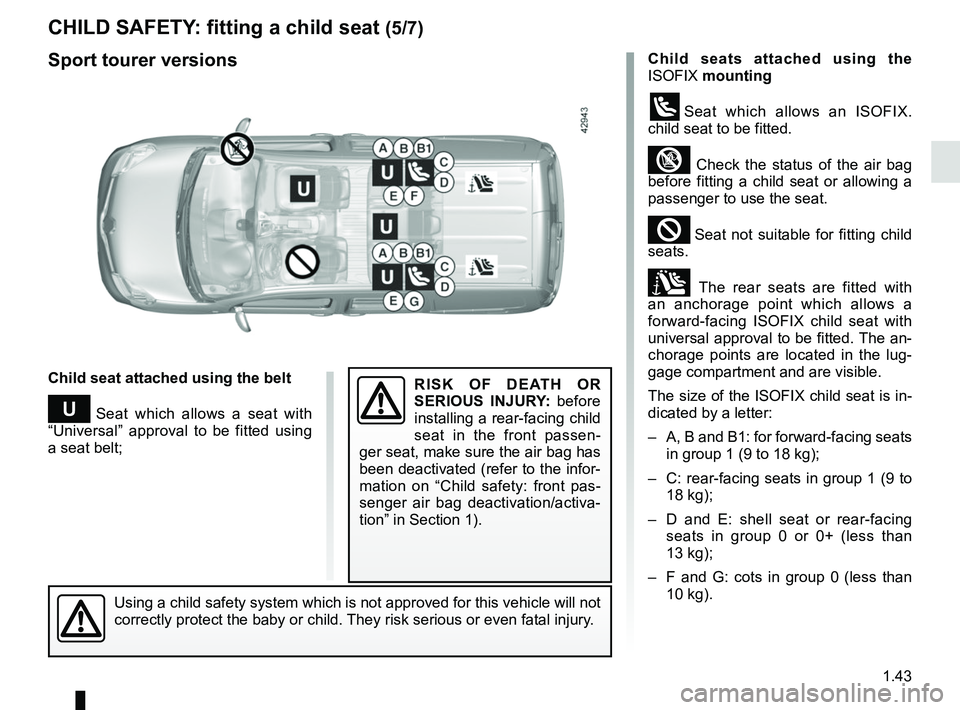
Child seats attached using the
ISOFIX mounting
üSeat which allows an ISOFIX.
child seat to be fitted.
³ Check the status of the air bag
before fitting a child seat or allowing a
passenger to use the seat.
² Seat not suitable for fitting child
seats.
± The rear seats are fitted with
an anchorage point which allows a
forward-facing ISOFIX child seat with
universal approval to be fitted. The an-
chorage points are located in the lug-
gage compartment and are visible.
The size of the ISOFIX child seat is in-
dicated by a letter:
– A, B and B1: for forward-facing seats in group 1 (9 to 18 kg);
– C: rear-facing seats in group 1 (9 to 18 kg);
– D and E: shell seat or rear-facing seats in group 0 or 0+ (less than
13 kg);
– F and G: cots in group 0 (less than 10 kg).
Child seat attached using the belt
¬ Seat which allows a seat with
“Universal” approval to be fitted using
a seat belt;
Using a child safety system which is not approved for this vehicle will \
not
correctly protect the baby or child. They risk serious or even fatal injury.
RISK OF DEATH OR
SERIOUS INJURY: before
installing a rear-facing child
seat in the front passen-
ger seat, make sure the air bag has
been deactivated (refer to the infor-
mation on “Child safety: front pas-
senger air bag deactivation/activa-
tion” in Section 1).
Sport tourer versions
Page 51 of 264

1.45
X = Seat not suitable for fitting child seats.
U = Seat which allows a child seat with “Universal” approval to be ins\
talled using a seat belt; check that it can be fitted.
IUF/IL = On equipped vehicles, seat which allows an approved “Universal/semi-u\
niversal” or “vehicle specific” child seat to be at-
tached using the ISOFIX system; check that it can be fitted.
(2) Only a rear-facing child seat can be fitted in this seat: raise the seat\
to the maximum and position it as far back as possible ,
tilting the seatback slightly (approximately 25°).
(3) A carrycot is fitted crosswise and occupies at least two seats (the chil\
d’s feet are placed nearest the door).
(4) Move the front seat as far forward as possible to install a rear-facing \
child seat, then move back the seat in front as far as it will
go, although without allowing it to come into contact with the child sea\
t.
(5) Forward-facing child seat; position the seatback of the child seat in co\
ntact with the seatback of the vehicle seat. Adjust the
headrest, or remove it if necessary. In addition, do not push the seat in front of the child further than h\
alfway along its runners,
or incline the seatback more than 25°.
CHILD SAFETY: fitting a child seat (7/7)
Page 54 of 264
1.48
The passenger air bag must
only be deactivated or acti-
vated with the ignition off.
If it is interfered with when
the vehicle is being driven, indicator
lights
å and © will come
on.
Switch the ignition off then on again
to reset the air bag in accordance
with the lock.
Operating faults
If the front passenger airbag activation/
deactivation system is faulty, child seats
must not be fitted to the front seat.
Allowing any other passenger to sit in
that seat is not recommended.
Contact your approved Dealer as soon
as possible.
Activation of the front
passenger air bag
You should reactivate the air bag as
soon as you remove the child seat from
the front passenger seat to ensure the
protection of the front passenger in the
event of an impact.
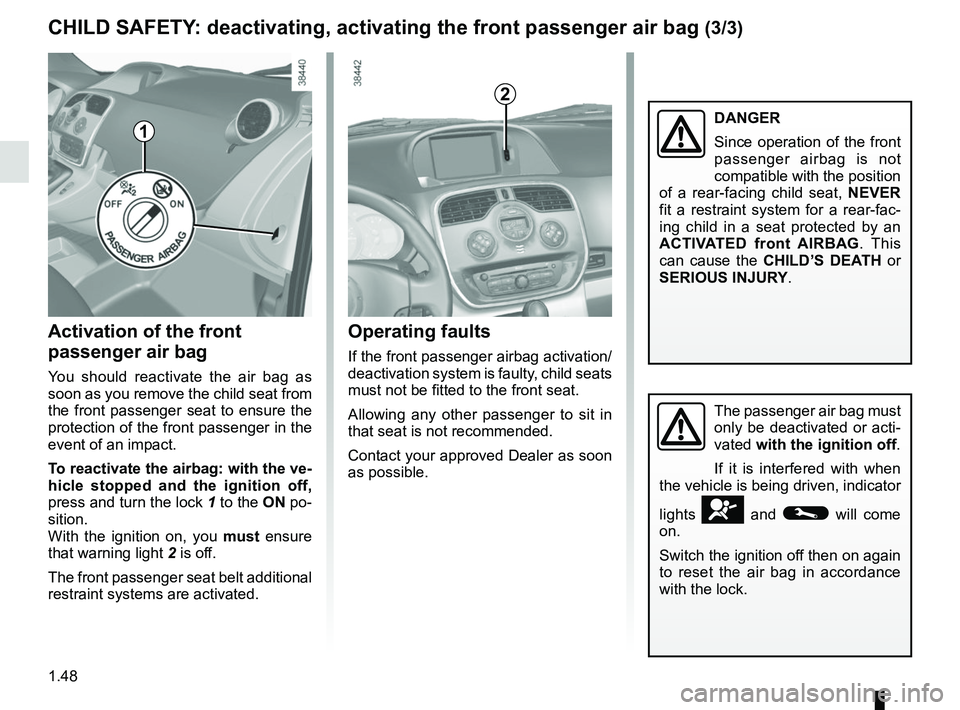
To reactivate the airbag: with the ve-
hicle stopped and the ignition off,
press and turn the lock 1 to the ON po-
sition.
With the ignition on, you must ensure
that warning light 2 is off.
The front passenger seat belt additional
restraint systems are activated.
CHILD SAFETY: deactivating, activating the front passenger air bag (3/3)
1
2
DANGER
Since operation of the front
passenger airbag is not
compatible with the position
of a rear-facing child seat, NEVER
fit a restraint system for a rear-fac-
ing child in a seat protected by an
ACTIVATED front AIRBAG . This
can cause the CHILD’S DEATH or
SERIOUS INJURY.
Page 57 of 264
1.51
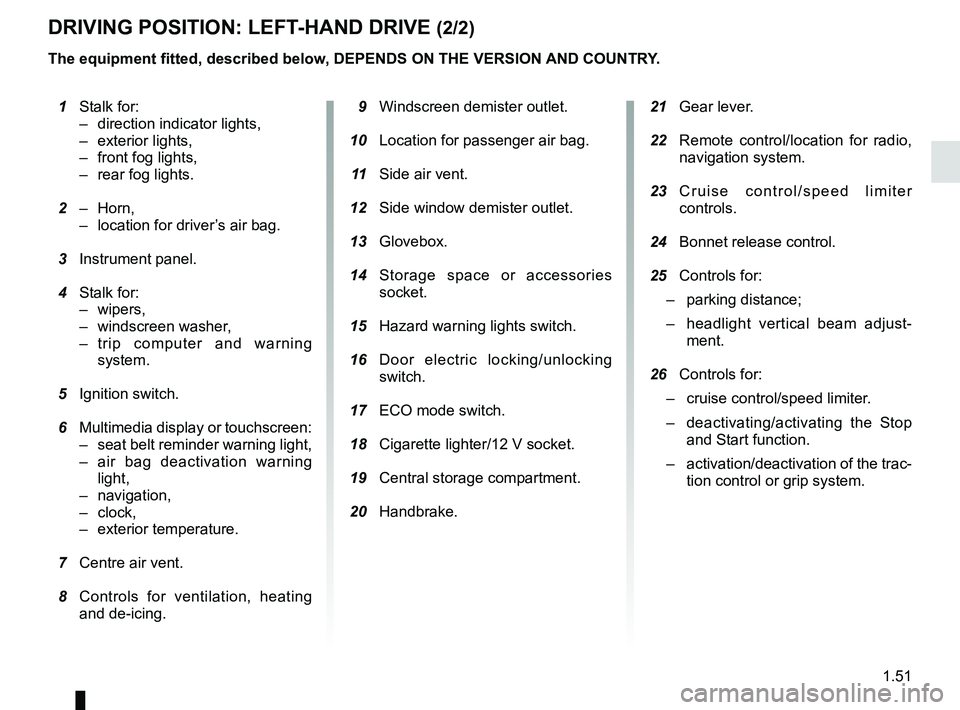
21 Gear lever.
22 Remote control/location for radio,
navigation system.
23 Cruise control/speed limiter
controls.
24 Bonnet release control.
25 Controls for:
– parking distance;
– headlight vertical beam adjust-
ment.
26 Controls for:
– cruise control/speed limiter.
– deactivating/activating the Stop
and Start function.
– activation/deactivation of the trac-
tion control or grip system.
1 Stalk for:
– direction indicator lights,
– exterior lights,
– front fog lights,
– rear fog lights.
2 – Horn,
– location for driver’s air bag.
3 Instrument panel.
4 Stalk for:
– wipers,
– windscreen washer,
– trip computer and warning system.
5 Ignition switch.
6 Multimedia display or touchscreen:
– seat belt reminder warning light,
– air bag deactivation warning light,
– navigation,
– clock,
– exterior temperature.
7 Centre air vent.
8 Controls for ventilation, heating
and de-icing. 9 Windscreen demister outlet.
10 Location for passenger air bag.
11 Side air vent.
12 Side window demister outlet.
13 Glovebox.
14 Storage space or accessories
socket.
15 Hazard warning lights switch.
16 Door electric locking/unlocking
switch.
17 ECO mode switch.
18 Cigarette lighter/12 V socket.
19 Central storage compartment.
20 Handbrake.
DRIVING POSITION: LEFT-HAND DRIVE (2/2)
The equipment fitted, described below, DEPENDS ON THE VERSION AND COUNTRY.
Page 59 of 264
1.53
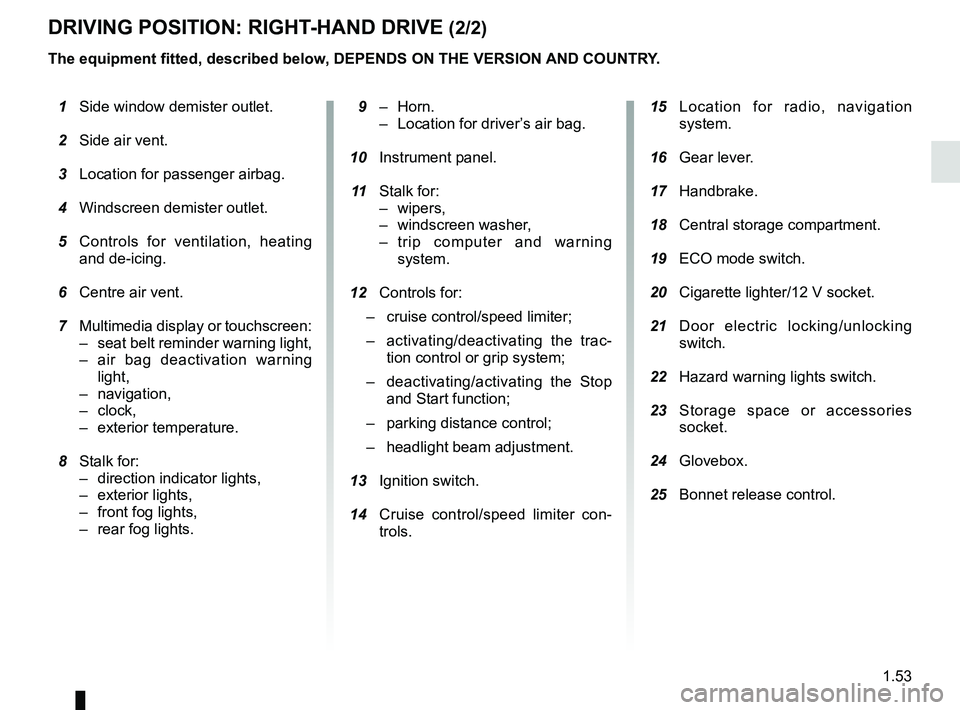
DRIVING POSITION: RIGHT-HAND DRIVE (2/2)
15 Location for radio, navigation
system.
16 Gear lever.
17 Handbrake.
18 Central storage compartment.
19 ECO mode switch.
20 Cigarette lighter/12 V socket.
21 Door electric locking/unlocking
switch.
22 Hazard warning lights switch.
23 Storage space or accessories
socket.
24 Glovebox.
25 Bonnet release control.
9 – Horn.
– Location for driver’s air bag.
10 Instrument panel.
11 Stalk for:
– wipers,
– windscreen washer,
– trip computer and warning system.
12 Controls for:
– cruise control/speed limiter;
– activating/deactivating the trac-
tion control or grip system;
– deactivating/activating the Stop
and Start function;
– parking distance control;
– headlight beam adjustment.
13 Ignition switch.
14 Cruise control/speed limiter con-
trols.
1 Side window demister outlet.
2 Side air vent.
3 Location for passenger airbag.
4 Windscreen demister outlet.
5 Controls for ventilation, heating
and de-icing.
6 Centre air vent.
7 Multimedia display or touchscreen:
– seat belt reminder warning light,
– air bag deactivation warning light,
– navigation,
– clock,
– exterior temperature.
8 Stalk for:
– direction indicator lights,
– exterior lights,
– front fog lights,
– rear fog lights.
The equipment fitted, described below, DEPENDS ON THE VERSION
AND COUNTRY.
Page 63 of 264
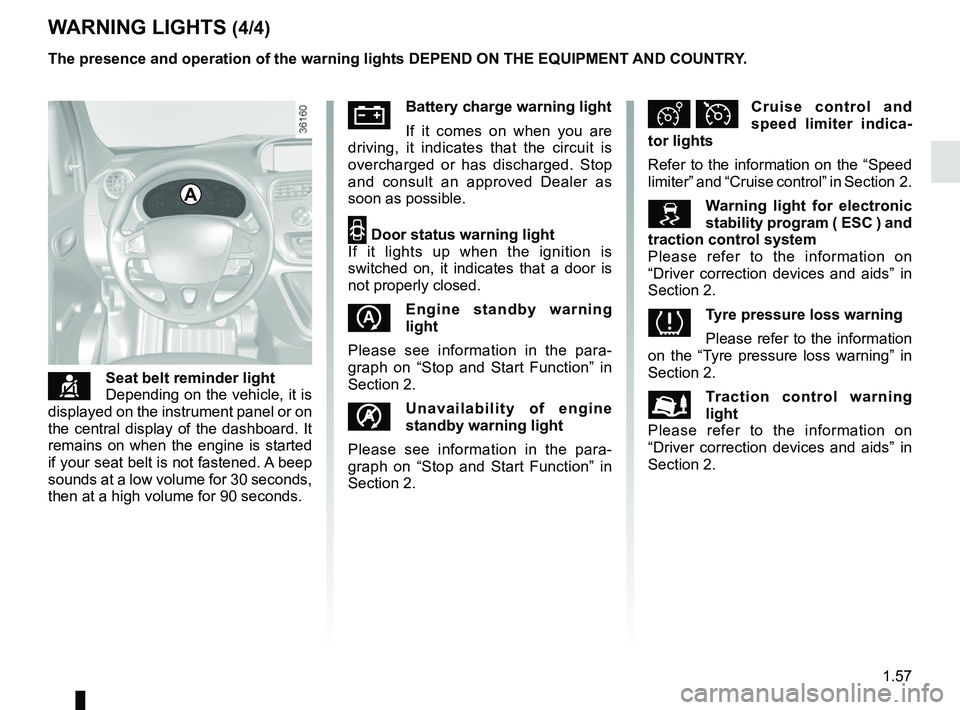
1.57
WARNING LIGHTS (4/4)
çSeat belt reminder light
Depending on the vehicle, it is
displayed on the instrument panel or on
the central display of the dashboard. It
remains on when the engine is started
if your seat belt is not fastened. A beep
sounds at a low volume for 30 seconds,
then at a high volume for 90 seconds.
A
The presence and operation of the warning lights DEPEND ON THE EQUIPMENT\
AND COUNTRY.
ÚBattery charge warning light
If it comes on when you are
driving, it indicates that the circuit is
overcharged or has discharged. Stop
and consult an approved Dealer as
soon as possible.
2 Door status warning light
If it lights up when the ignition is
switched on, it indicates that a door is
not properly closed.
Engine standby warning
light
Please see information in the para-
graph on “Stop and Start Function” in
Section 2.
Unavailability of engine
standby warning light
Please see information in the para-
graph on “Stop and Start Function” in
Section 2.
Ð ÏCruise control and
speed limiter indica-
tor lights
Refer to the information on the “Speed
limiter” and “Cruise control” in Section 2.
Warning light for electronic
stability program ( ESC ) and
traction control system
Please refer to the information on
“Driver correction devices and aids” in
Section 2.
Tyre pressure loss warning
Please refer to the information
on the “Tyre pressure loss warning” in
Section 2.
\bTraction control warning
light
Please refer to the information on
“Driver correction devices and aids” in
Section 2.
Page 165 of 264
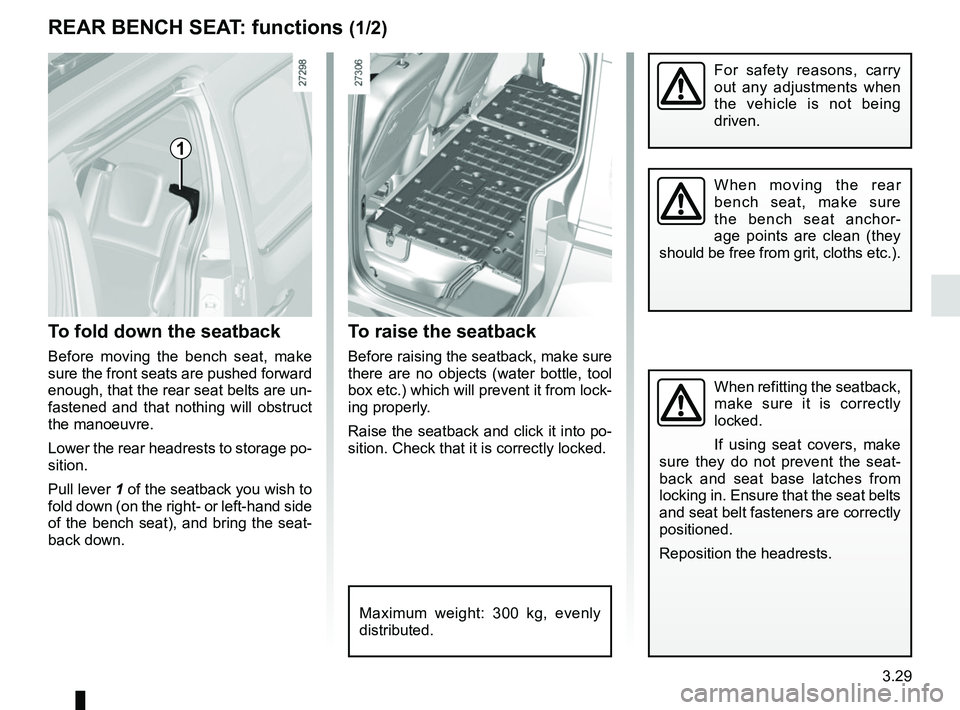
3.29
To raise the seatback
Before raising the seatback, make sure
there are no objects (water bottle, tool
box etc.) which will prevent it from lock-
ing properly.
Raise the seatback and click it into po-
sition. Check that it is correctly locked.
To fold down the seatback
Before moving the bench seat, make
sure the front seats are pushed forward
enough, that the rear seat belts are un-
fastened and that nothing will obstruct
the manoeuvre.
Lower the rear headrests to storage po-
sition.
Pull lever 1 of the seatback you wish to
fold down (on the right- or left-hand side
of the bench seat), and bring the seat-
back down.
REAR BENCH SEAT: functions (1/2)
For safety reasons, carry
out any adjustments when
the vehicle is not being
driven.
When moving the rear
bench seat, make sure
the bench seat anchor-
age points are clean (they
should be free from grit, cloths etc.).
When refitting the seatback,
make sure it is correctly
locked.
If using seat covers, make
sure they do not prevent the seat-
back and seat base latches from
locking in. Ensure that the seat belts
and seat belt fasteners are correctly
positioned.
Reposition the headrests.
Maximum weight: 300 kg, evenly
distributed.
1
Page 167 of 264
3.31
Always position the heavi-
est items directly on the
floor.
Use the lashing points on
the floor of the luggage compart-
ment, if these are fitted to the vehi-
cle.
The luggage should be loaded in
such a way that no items will be
thrown forward and strike the occu-
pants if the driver has to brake sud-
denly.
Fasten the rear seat belts, even if
the seats are not occupied.
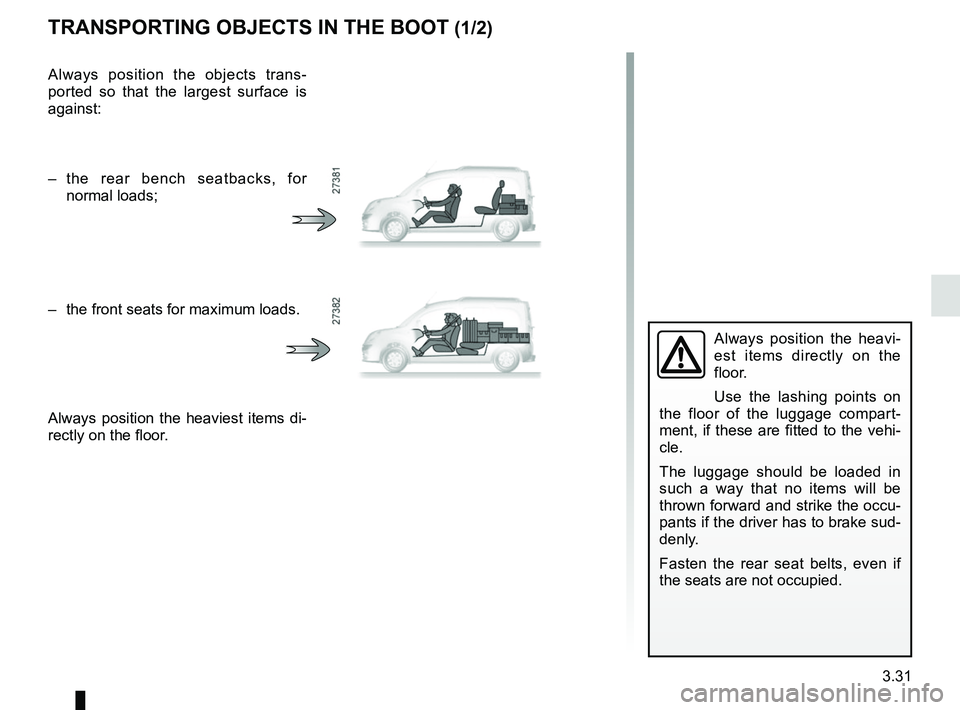
TRANSPORTING OBJECTS IN THE BOOT (1/2)
Always position the objects trans-
ported so that the largest surface is
against:
– the rear bench seatbacks, for normal loads;
– the front seats for maximum loads.
Always position the heaviest items di-
rectly on the floor.
Page 170 of 264
3.34
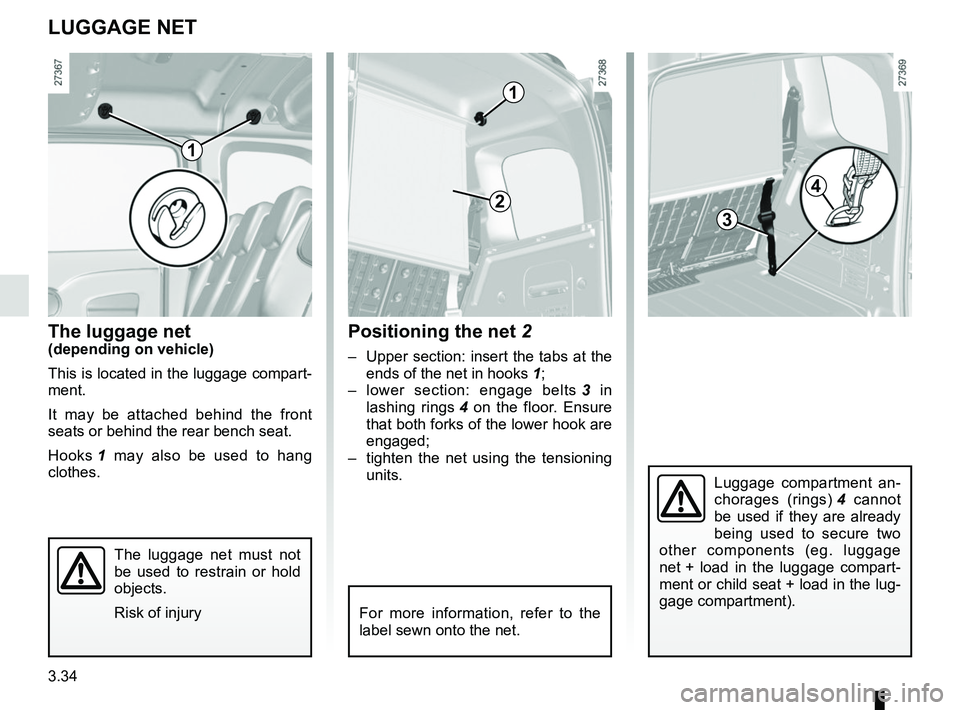
The luggage net(depending on vehicle)
This is located in the luggage compart-
ment.
It may be attached behind the front
seats or behind the rear bench seat.
Hooks 1 may also be used to hang
clothes.
LUGGAGE NET
For more information, refer to the
label sewn onto the net.
1
1
3
4
Positioning the net 2
– Upper section: insert the tabs at the
ends of the net in hooks 1;
– lower section: engage belts 3 in
lashing rings 4 on the floor. Ensure
that both forks of the lower hook are
engaged;
– tighten the net using the tensioning units.
Luggage compartment an-
chorages (rings) 4 cannot
be used if they are already
being used to secure two
other components (eg. luggage
net + load in the luggage compart-
ment or child seat + load in the lug-
gage compartment).
2
The luggage net must not
be used to restrain or hold
objects.
Risk of injury
Page 192 of 264
4.18
Glass instrument panel(e.g. instrument panel, clock, exterior
temperature display, radio display, etc.)
Use a soft cloth (or cotton wool).
If this does not clean them properly,
use a soft cloth (or cotton wool) slightly
moistened with soapy water and then
wipe clean with another soft damp cloth
or cotton wool.
Finally, carefully dry off with a soft dry
cloth.
Do not use products containing alco-
hol and/or spray fluids on the area.
Seat belts
These must be kept clean.
Use products selected by our Technical
Department (Approved outlets) or
warm, soapy water and a sponge and
wipe with a dry cloth.
Detergents or dyes must not be used
under any circumstances.
INTERIOR TRIM MAINTENANCE (1/2)
Textiles (seats, door trim, etc)
Vacuum-clean the textiles regularly.
Liquid stain
Use soapy water.
Dab lightly (never rub) with a soft cloth,
rinse and remove the excess.
Solid or pasty stain
Carefully remove the excess solid or
pasty material immediately with a
spatula (working from the edges to the
centre to avoid spreading the stain).
Clean as for a liquid stain.
Special instructions for sweets or
chewing gum
Put an ice cube on the stain to solidify
it, then proceed as for a solid stain.
A well-maintained vehicle will last
longer. It is therefore recommended to
maintain the interior of the vehicle regu-
larly.
A stain should always be dealt with
swiftly.
Whatever type of stain is on the trim,
use
cold (or warm) soapy water with
natural soap.
Detergents (washing-up liquid, pow-
dered products, alcohol-based prod-
ucts) should not be used.
Use a soft cloth.
Rinse and soak up the excess.
For further recommendations for
maintaining the interior, and/or for
any unsatisfactory results, please
see an authorised dealer.