seats RENAULT KANGOO 2018 Owner's Manual
[x] Cancel search | Manufacturer: RENAULT, Model Year: 2018, Model line: KANGOO, Model: RENAULT KANGOO 2018Pages: 264, PDF Size: 7.09 MB
Page 54 of 264
1.48
The passenger air bag must
only be deactivated or acti-
vated with the ignition off.
If it is interfered with when
the vehicle is being driven, indicator
lights
å and © will come
on.
Switch the ignition off then on again
to reset the air bag in accordance
with the lock.
Operating faults
If the front passenger airbag activation/
deactivation system is faulty, child seats
must not be fitted to the front seat.
Allowing any other passenger to sit in
that seat is not recommended.
Contact your approved Dealer as soon
as possible.
Activation of the front
passenger air bag
You should reactivate the air bag as
soon as you remove the child seat from
the front passenger seat to ensure the
protection of the front passenger in the
event of an impact.
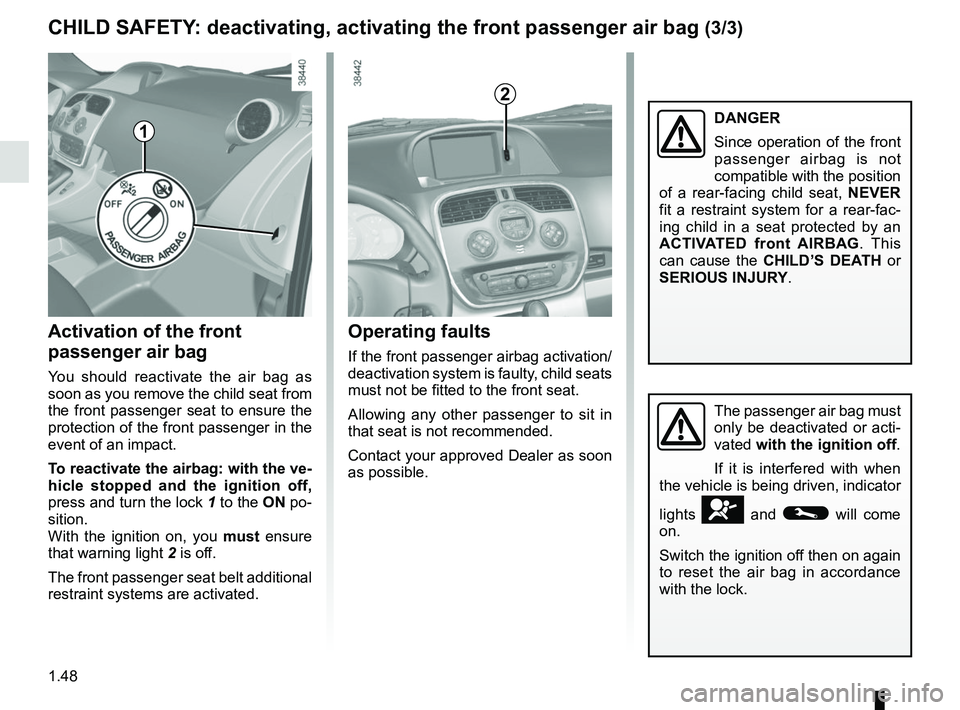
To reactivate the airbag: with the ve-
hicle stopped and the ignition off,
press and turn the lock 1 to the ON po-
sition.
With the ignition on, you must ensure
that warning light 2 is off.
The front passenger seat belt additional
restraint systems are activated.
CHILD SAFETY: deactivating, activating the front passenger air bag (3/3)
1
2
DANGER
Since operation of the front
passenger airbag is not
compatible with the position
of a rear-facing child seat, NEVER
fit a restraint system for a rear-fac-
ing child in a seat protected by an
ACTIVATED front AIRBAG . This
can cause the CHILD’S DEATH or
SERIOUS INJURY.
Page 156 of 264
3.20
Electric windows
With the ignition on:
– press the switch for the window concerned to lower it to the desired
height;
– lift the switch for the window con- cerned to raise it to the desired
height.
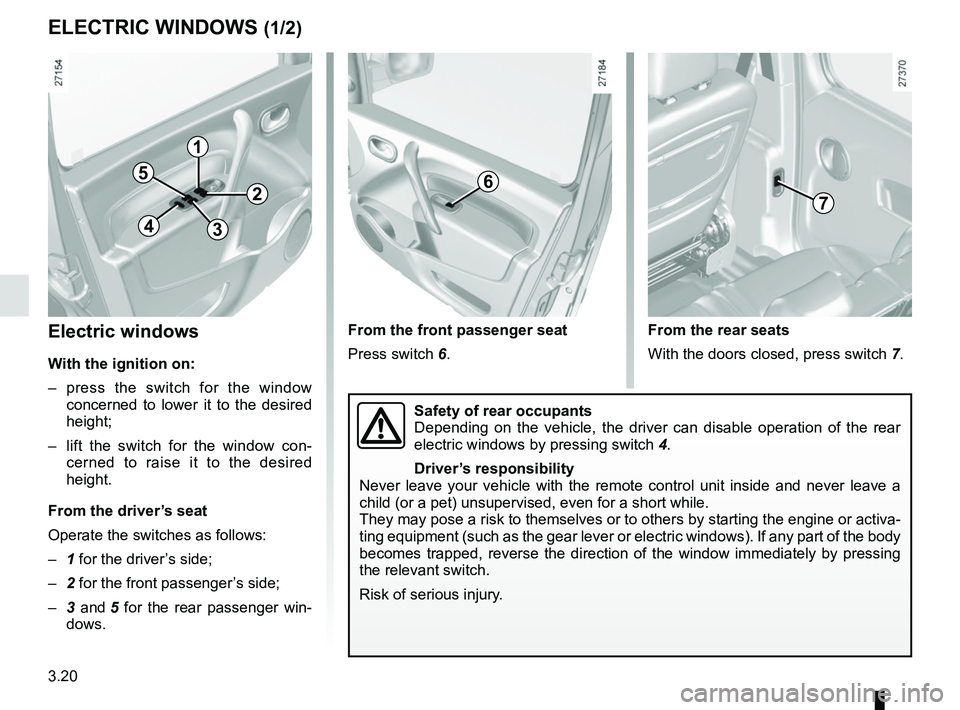
From the driver’s seat
Operate the switches as follows:
– 1 for the driver’s side;
– 2 for the front passenger’s side;
– 3 and 5 for the rear passenger win-
dows.
ELECTRIC WINDOWS (1/2)
From the rear seats
With the doors closed, press switch 7.
From the front passenger seat
Press switch 6.
1
2
34
56
Safety of rear occupants
Depending on the vehicle, the driver can disable operation of the rear
electric windows by pressing switch
4.
Driver’s responsibility
Never leave your vehicle with the remote control unit inside and never l\
eave a
child (or a pet) unsupervised, even for a short while.
They may pose a risk to themselves or to others by starting the engine o\
r activa-
ting equipment (such as the gear lever or electric windows). If any pa\
rt of the body
becomes trapped, reverse the direction of the window immediately by pres\
sing
the relevant switch.
Risk of serious injury.
7
Page 165 of 264
3.29
To raise the seatback
Before raising the seatback, make sure
there are no objects (water bottle, tool
box etc.) which will prevent it from lock-
ing properly.
Raise the seatback and click it into po-
sition. Check that it is correctly locked.
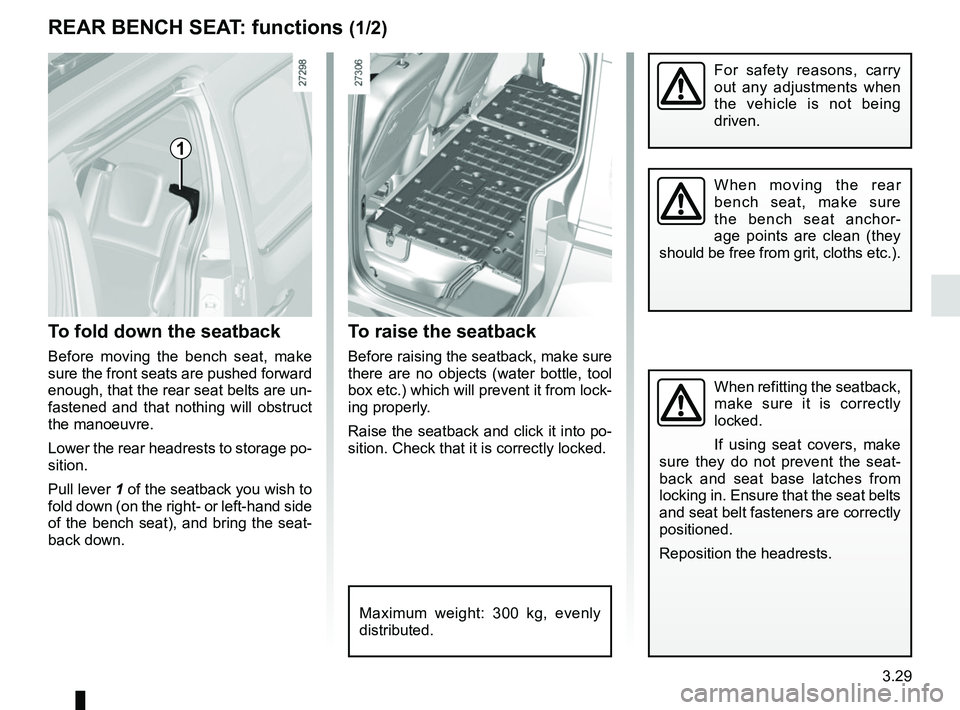
To fold down the seatback
Before moving the bench seat, make
sure the front seats are pushed forward
enough, that the rear seat belts are un-
fastened and that nothing will obstruct
the manoeuvre.
Lower the rear headrests to storage po-
sition.
Pull lever 1 of the seatback you wish to
fold down (on the right- or left-hand side
of the bench seat), and bring the seat-
back down.
REAR BENCH SEAT: functions (1/2)
For safety reasons, carry
out any adjustments when
the vehicle is not being
driven.
When moving the rear
bench seat, make sure
the bench seat anchor-
age points are clean (they
should be free from grit, cloths etc.).
When refitting the seatback,
make sure it is correctly
locked.
If using seat covers, make
sure they do not prevent the seat-
back and seat base latches from
locking in. Ensure that the seat belts
and seat belt fasteners are correctly
positioned.
Reposition the headrests.
Maximum weight: 300 kg, evenly
distributed.
1
Page 167 of 264
3.31
Always position the heavi-
est items directly on the
floor.
Use the lashing points on
the floor of the luggage compart-
ment, if these are fitted to the vehi-
cle.
The luggage should be loaded in
such a way that no items will be
thrown forward and strike the occu-
pants if the driver has to brake sud-
denly.
Fasten the rear seat belts, even if
the seats are not occupied.
TRANSPORTING OBJECTS IN THE BOOT (1/2)
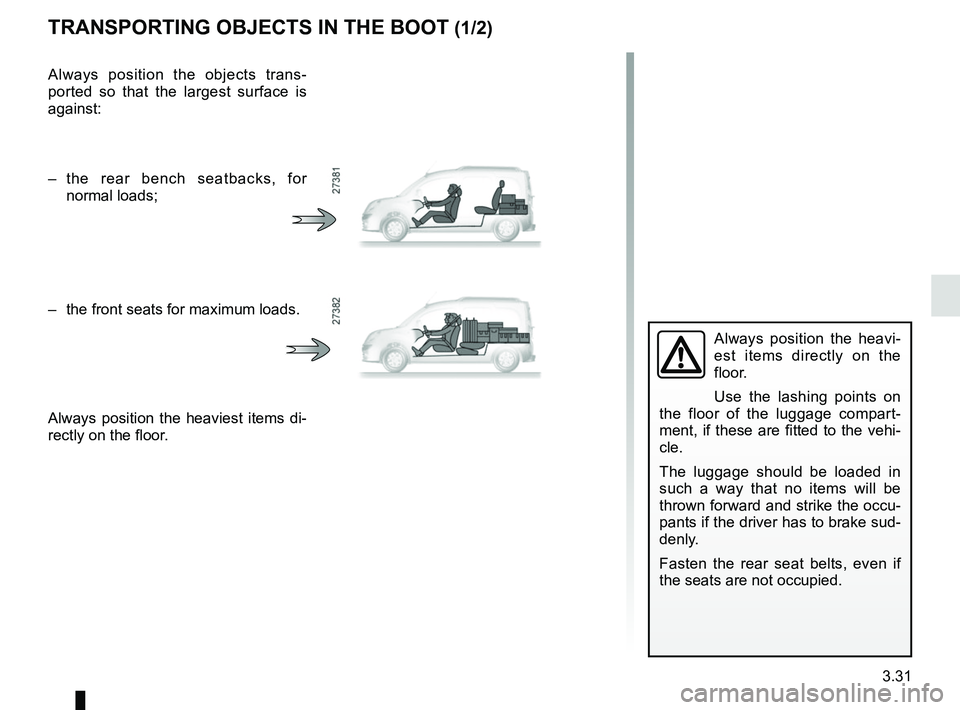
Always position the objects trans-
ported so that the largest surface is
against:
– the rear bench seatbacks, for normal loads;
– the front seats for maximum loads.
Always position the heaviest items di-
rectly on the floor.
Page 170 of 264
3.34
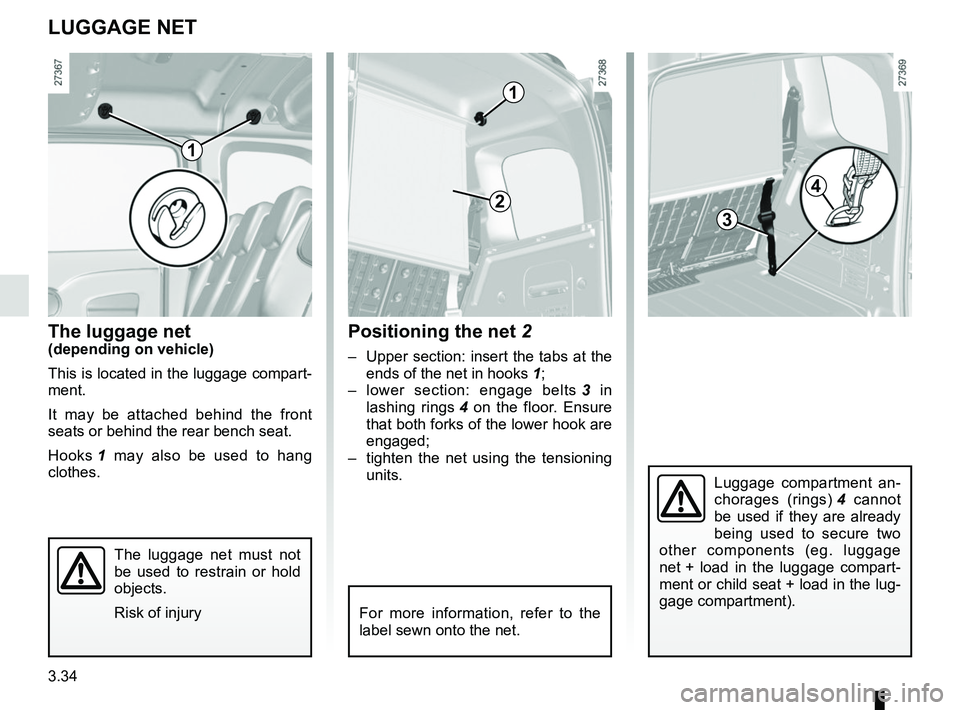
The luggage net(depending on vehicle)
This is located in the luggage compart-
ment.
It may be attached behind the front
seats or behind the rear bench seat.
Hooks 1 may also be used to hang
clothes.
LUGGAGE NET
For more information, refer to the
label sewn onto the net.
1
1
3
4
Positioning the net 2
– Upper section: insert the tabs at the
ends of the net in hooks 1;
– lower section: engage belts 3 in
lashing rings 4 on the floor. Ensure
that both forks of the lower hook are
engaged;
– tighten the net using the tensioning units.
Luggage compartment an-
chorages (rings) 4 cannot
be used if they are already
being used to secure two
other components (eg. luggage
net + load in the luggage compart-
ment or child seat + load in the lug-
gage compartment).
2
The luggage net must not
be used to restrain or hold
objects.
Risk of injury
Page 192 of 264
4.18
Glass instrument panel(e.g. instrument panel, clock, exterior
temperature display, radio display, etc.)
Use a soft cloth (or cotton wool).
If this does not clean them properly,
use a soft cloth (or cotton wool) slightly
moistened with soapy water and then
wipe clean with another soft damp cloth
or cotton wool.
Finally, carefully dry off with a soft dry
cloth.
Do not use products containing alco-
hol and/or spray fluids on the area.
Seat belts
These must be kept clean.
Use products selected by our Technical
Department (Approved outlets) or
warm, soapy water and a sponge and
wipe with a dry cloth.
Detergents or dyes must not be used
under any circumstances.
INTERIOR TRIM MAINTENANCE (1/2)
Textiles (seats, door trim, etc)
Vacuum-clean the textiles regularly.
Liquid stain
Use soapy water.
Dab lightly (never rub) with a soft cloth,
rinse and remove the excess.
Solid or pasty stain
Carefully remove the excess solid or
pasty material immediately with a
spatula (working from the edges to the
centre to avoid spreading the stain).
Clean as for a liquid stain.
Special instructions for sweets or
chewing gum
Put an ice cube on the stain to solidify
it, then proceed as for a solid stain.
A well-maintained vehicle will last
longer. It is therefore recommended to
maintain the interior of the vehicle regu-
larly.
A stain should always be dealt with
swiftly.
Whatever type of stain is on the trim,
use
cold (or warm) soapy water with
natural soap.
Detergents (washing-up liquid, pow-
dered products, alcohol-based prod-
ucts) should not be used.
Use a soft cloth.
Rinse and soak up the excess.
For further recommendations for
maintaining the interior, and/or for
any unsatisfactory results, please
see an authorised dealer.
Page 222 of 264

5.28
FUSES (2/2)
Number Allocation
1 Fuel pump
2 Not used
3 Passenger compartment
engine cooling fan
4 Passenger compartment
engine cooling fan
5 Rear windscreen wiper
6 Horn, diagnostic socket
7 Heated seats
8 Electric rear windows
9 Passenger compartment
ECU
10 Windscreen washer
11 Brake lights
12 Passenger compartment
unit, ABS, ESP
13 Electric windows, child
safety, heating and air
conditioning system, ECO
mode
14 Not used
15 StarterNumber Allocation
16 Brake lights, additional
equipment, navigation,
ABS, ESP, boot light, tyre
pressure warning light,
interior lights, rain and light
sensor
17 Radio, navigation system,
display, alarm
18 Additional equipment
19 Heated door mirrors
20 Hazard lights, rear fog lights
21 Central locking of opening
elements
22 Instrument panel
23 Rear accessories socket
24 ESC, radio, heating and air
conditioning system, heated
seats, stop lights
25 Front accessories socket
26 Towbar
27 Electric front windows
28 Rear-view mirror control
29 De-icing the rear screen and
rear view mirror
12
3456
78910
11121314
15161718
19202122
23242526
27
28
29
Allocation of fusesThe presence of certain fuses de-
pends on the vehicle equipment
level.
Page 236 of 264

5.42
Electrical equipmentPOSSIBLE CAUSESWHAT TO DO
Traces of condensation in the lights
and headlights. Traces of condensation may be a nat-
ural phenomenon caused by varia-
tions in temperature and humidity.
In this case, the traces will disappear
slowly once the lights are switched
on.
The front seat belt reminder light
comes on when the seat belts are
fastened. An object is stuck between the floor
and the seat and is disrupting the op-
eration of the sensor. Remove all objects from underneath the
front seats.
OPERATING FAULTS (6/6)
Page 257 of 264
7.1
ALPHABETICAL INDEX (1/5)
A
ABS ..............................................................1.56, 2.26 → 2.30
accessories........................................................................\
5.35
accessories socket ............................................................ 3.23
additional methods of restraint .......................................... 1.33
advice on antipollution ....................................................... 2.15
air bag...........................................................1.29 → 1.33, 1.56
activating the front passenger air bags ............1.46 → 1.48
deactivating the front passenger air bags ........1.46 → 1.48
air conditioning ........................................................3.4 → 3.16
air vents ...................................................................... 3.2 – 3.3
anti-corrosion check ..............................................6.16 → 6.20
anti-corrosion protection .................................................... 4.15
anti-lock braking system: ABS ...............................2.26 → 2.30
antipollution advice .................................................................\
......... 2.15
ashtrays ...............................................................\
.............. 3.23
audible and visual signals.................................................. 1.74
automatic gearbox (use) ........................................2.42 → 2.44
automatic gearbox selector lever...........................2.42 → 2.44
B
batteries ..............................................................\
............... 5.36
battery............................................................ 1.57, 4.11 – 4.12 troubleshooting ................................................. 5.25 – 5.26
bonnet........................................................................\
. 4.2 – 4.3
brake fluid ........................................................................\
.... 4.8
brake lights changing bulbs .................................................. 5.19 – 5.20
bulbs changing ..........................................................5.16 → 5.24
C
catalytic converter................................................................ 2.9
central door locking ............................................................. 1.6
changing a bulb ............................... 5.16 → 5.18, 5.22 → 5.24changing a wheel............................................................... 5.11
changing gear .................................................2.7, 2.42 → 2.44
child minder mirror ............................................................. 3.19
child restraint/seat .............................1.34 – 1.35, 1.37 → 1.48
child safety....1.2, 1.4, 1.7, 1.34 – 1.35, 1.37 → 1.48, 2.3, 3.20
child seats..........................................1.34 – 1.35, 1.37 → 1.45
children ................................................................... 1.34 – 1.35
cigar lighter ........................................................................\
3.23
cleaning: inside the vehicle .............................................. 4.18 – 4.19
clock ....................................................................... 1.70 – 1.71
closing the doors ..................................................... 1.7 → 1.11
control instruments ................................................1.54 → 1.60
coolant ................................................................\
............... 1.55
courtesy light .......................................................... 3.17 – 3.18
courtesy mirrors ................................................................. 3.19
cruise control ................................................1.57, 2.34 → 2.37
D
dashboard............................................................... 1.50 – 1.51
deadlocking the doors ......................................................... 1.4
demisting rear screen ................................................. 3.4, 3.12 – 3.13
windscreen ............................................................ 3.5, 3.13
dimensions ................................................................. 6.7 – 6.8
dipstick................................................................\
........ 4.4 – 4.5
display ................................................................\
...1.58 → 1.60
doors........................................................................\
1.7 → 1.14
driver’s position ...................................................... 1.50 – 1.51
driving ........ 2.9, 2.13, 2.17 → 2.25, 2.22 → 2.39, 2.42 → 2.44
driving position settings ............................................................1.25 → 1.28
driving recommendations ...................................... 2.11 → 2.14
E
ECO driving ........................................................... 2.11 → 2.14
Page 258 of 264

ECO mode ........................................................................\
. 2.12
electric windows ..................................................... 3.20 – 3")
7.2
ALPHABETICAL INDEX (2/5)
ECO mode ........................................................................\
. 2.12
electric windows ..................................................... 3.20 – 3.21
electronic stability control: ESC .............................2.26 → 2.30
emergency brake assist.........................................2.26 → 2.30
emergency braking ................................................2.26 → 2.30
emergency spare wheel ...................................................... 5.2
engine technical specifications ......................................... 6.4 – 6.5
engine coolant ..................................................................... 4.9
engine oil ..........................................................1.56, 4.4 → 4.7
engine oil capacity ...................................................... 4.6 – 4.7
engine oil level ...........................................................4.4 → 4.7
engine specifications .................................................. 6.4 – 6.5
environment ............................................................\
........... 2.16
ESC: electronic stability control ....................1.57, 2.26 → 2.30
external temperature .............................................. 1.70 – 1.71
F
faults operating faults ................................................5.37 → 5.42
filter .................................................................\
................... 4.10
fitting a radio ........................................................... 5.33 – 5.34
fittings ...............................................................\
.....3.24 → 3.28
fog lights ................................................................... 1.77, 5.18
front lights changing bulbs .................................................. 5.16 – 5.17
front passenger air bag deactivation .....................1.46 → 1.48
front seat adjustment .............................................1.19 → 1.21
front seats adjustment .......................................................1.19 → 1.21
fuel advice on fuel economy ................................... 2.11 → 2.14
capacity ...............................................................\
......... 1.83
consumption .................................................... 2.11 → 2.14
filling ........................................................1.56, 1.83 → 1.85
grade ..................................................................\
.......... 1.83 fuel consumption ................................................... 2.11
→ 2.14
fuel filler cap ..........................................................1.83 → 1.85
fuel tank capacity ............................................................1.83 → 1.85
fuel tank capacity ...................................................1.83 → 1.85
fuses ....................................................................... 5.27 – 5.28
G
gear lever........................................................................\
..... 2.7
glove box ........................................................................\
... 3.24
grip control ........................................................................\
. 2.29
H
handbrake................................................................... 1.55, 2.8
hazard warning lights signal .............................................. 1.74
headlight beam adjustment .................................... 1.78 – 1.79
headrest.................................................................1.15 → 1.18
heated seats ..........................................................1.19 → 1.21
heating and air conditioning system ........................3.4 → 3.15
heating system ........................................................3.4 → 3.16
horn ...................................................................\
................ 1.74
horn: flash ..................................................................\
........... 1.74
sounding the horn ........................................................ 1.74
hubcap tool ........................................................................\
.. 5.8
I
ignition switch ...................................................................... 2.2
indicators ................................................ 1.54, 1.74, 5.17, 5.22
indicators: direction indicators .............................................. 5.17, 5.22
instrument panel ..............................................1.58 → 1.60
instrument panel ....................................................1.54 → 1.69
instrument panel messages...................................1.61 → 1.69
interior lighting: changing bulbs .................................................. 5.23 – 5.24