instrument panel RENAULT KANGOO 2018 Owner's Guide
[x] Cancel search | Manufacturer: RENAULT, Model Year: 2018, Model line: KANGOO, Model: RENAULT KANGOO 2018Pages: 264, PDF Size: 7.09 MB
Page 187 of 264
4.13
TYRE PRESSURE WHEN cold (1/2)
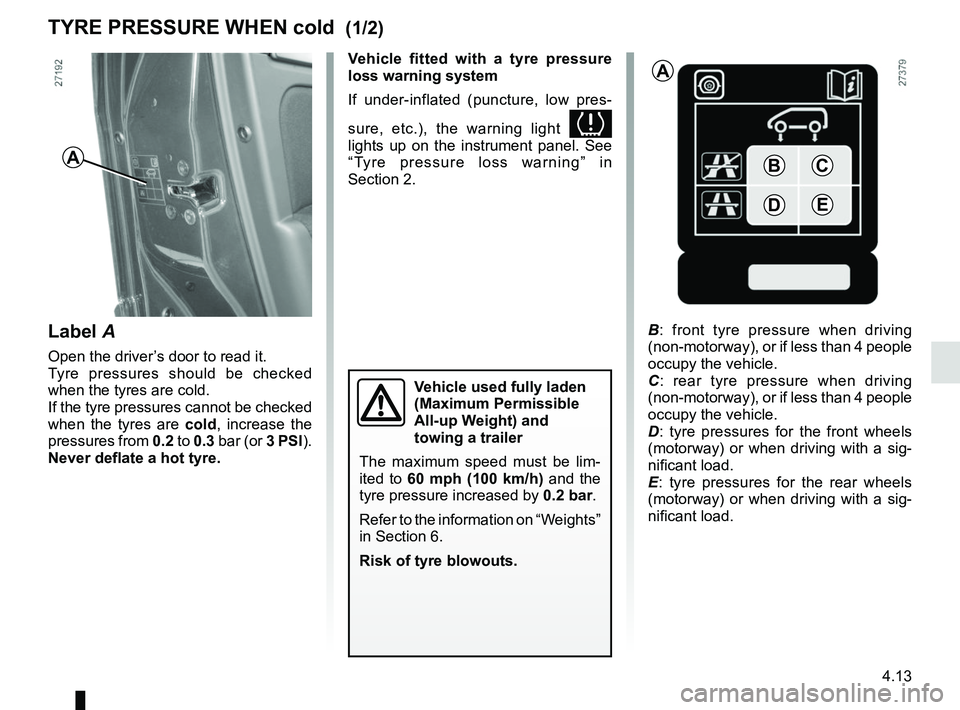
B: front tyre pressure when driving
(non-motorway), or if less than 4 people
occupy the vehicle.
C : rear tyre pressure when driving
(non-motorway), or if less than 4 people
occupy the vehicle.
D : tyre pressures for the front wheels
(motorway) or when driving with a sig-
nificant load.
E : tyre pressures for the rear wheels
(motorway) or when driving with a sig-
nificant load.
C
DE
BA
A
Label A
Open the driver’s door to read it.
Tyre pressures should be checked
when the tyres are cold.
If the tyre pressures cannot be checked
when the tyres are cold, increase the
pressures from 0.2 to 0.3 bar (or 3 PSI).
Never deflate a hot tyre. Vehicle fitted with a tyre pressure
loss warning system
If under-inflated (puncture, low pres-
sure, etc.), the warning light
lights up on the instrument panel. See
“Tyre pressure loss warning” in
Section 2.
Vehicle used fully laden
(Maximum Permissible
All-up Weight) and
towing a trailer
The maximum speed must be lim-
ited to 60 mph (100 km/h) and the
tyre pressure increased by 0.2 bar.
Refer to the information on “Weights”
in Section 6.
Risk of tyre blowouts.
Page 192 of 264
4.18
Glass instrument panel(e.g. instrument panel, clock, exterior
temperature display, radio display, etc.)
Use a soft cloth (or cotton wool).
If this does not clean them properly,
use a soft cloth (or cotton wool) slightly
moistened with soapy water and then
wipe clean with another soft damp cloth
or cotton wool.
Finally, carefully dry off with a soft dry
cloth.
Do not use products containing alco-
hol and/or spray fluids on the area.
Seat belts
These must be kept clean.
Use products selected by our Technical
Department (Approved outlets) or
warm, soapy water and a sponge and
wipe with a dry cloth.
Detergents or dyes must not be used
under any circumstances.
INTERIOR TRIM MAINTENANCE (1/2)
Textiles (seats, door trim, etc)
Vacuum-clean the textiles regularly.
Liquid stain
Use soapy water.
Dab lightly (never rub) with a soft cloth,
rinse and remove the excess.
Solid or pasty stain
Carefully remove the excess solid or
pasty material immediately with a
spatula (working from the edges to the
centre to avoid spreading the stain).
Clean as for a liquid stain.
Special instructions for sweets or
chewing gum
Put an ice cube on the stain to solidify
it, then proceed as for a solid stain.
A well-maintained vehicle will last
longer. It is therefore recommended to
maintain the interior of the vehicle regu-
larly.
A stain should always be dealt with
swiftly.
Whatever type of stain is on the trim,
use
cold (or warm) soapy water with
natural soap.
Detergents (washing-up liquid, pow-
dered products, alcohol-based prod-
ucts) should not be used.
Use a soft cloth.
Rinse and soak up the excess.
For further recommendations for
maintaining the interior, and/or for
any unsatisfactory results, please
see an authorised dealer.
Page 196 of 264
5.2
PUNCTURE, EMERGENCY SPARE WHEEL (1/2)
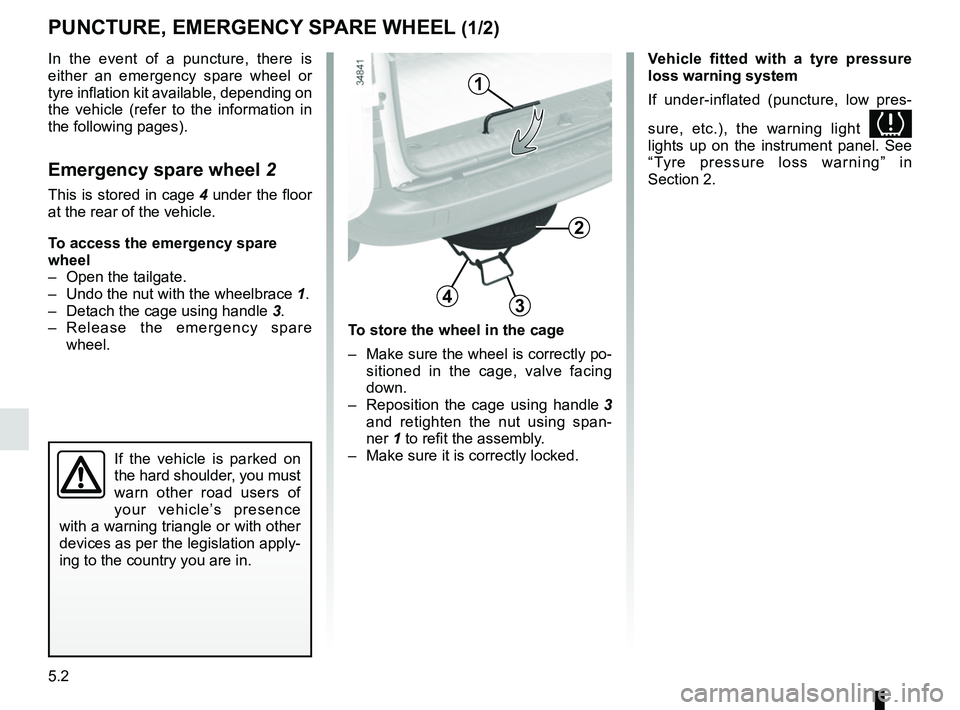
To store the wheel in the cage
– Make sure the wheel is correctly po-sitioned in the cage, valve facing
down.
– Reposition the cage using handle 3
and retighten the nut using span-
ner 1 to refit the assembly.
– Make sure it is correctly locked.
2
3
1
4
In the event of a puncture, there is
either an emergency spare wheel or
tyre inflation kit available, depending on
the vehicle (refer to the information in
the following pages).
Emergency spare wheel 2
This is stored in cage 4 under the floor
at the rear of the vehicle.
To access the emergency spare
wheel
– Open the tailgate.
– Undo the nut with the wheelbrace 1.
– Detach the cage using handle 3.
– Release the emergency spare wheel.
Vehicle fitted with a tyre pressure
loss warning system
If under-inflated (puncture, low pres-
sure, etc.), the warning light
lights up on the instrument panel. See
“Tyre pressure loss warning” in
Section 2.
If the vehicle is parked on
the hard shoulder, you must
warn other road users of
your vehicle’s presence
with a warning triangle or with other
devices as per the legislation apply-
ing to the country you are in.
Page 197 of 264

If the emergency spare wheel has been stored for several years, have it \
checked by your Dealer to ensure that it is
safe to use.
Vehicle fitted with an eme")
5.3
PUNCTURE, EMERGENCY SPARE WHEEL (2/2)
If the emergency spare wheel has been stored for several years, have it \
checked by your Dealer to ensure that it is
safe to use.
Vehicle fitted with an emergency spare wheel that differs from the other \
wheels:
– Never fit more than one emergency spare wheel to the same vehicle.
– As the punctured wheel is wider than the emergency spare wheel, the vehi\
cle’s ground clearance is reduced.
– Replace the emergency spare wheel as soon as possible with a wheel ident\
ical to the original one.
– If wheel bolts are supplied with the emergency spare wheel, it is impera\
tive that they are used and that they are used for th e
emergency spare wheel only: refer to the label affixed to the emergency spare wheel.
– When this is fitted to the vehicle, which must only be a temporary measu\
re, the driving speed must not exceed the speed indicated on the label on the wheel.
– Fitting an emergency spare wheel may alter the way the vehicle usually r\
uns. Avoid sudden acceleration or deceleration and reduce your speed when cornering.
– If you need to use snow chains, fit the emergency spare wheel to the rea\
r axle and check the tyre pressure.
– The warning light
on the instrument panel flashes for several seconds, then stays on.
Page 199 of 264
5.5
TYRE INFLATION KIT (2/4)
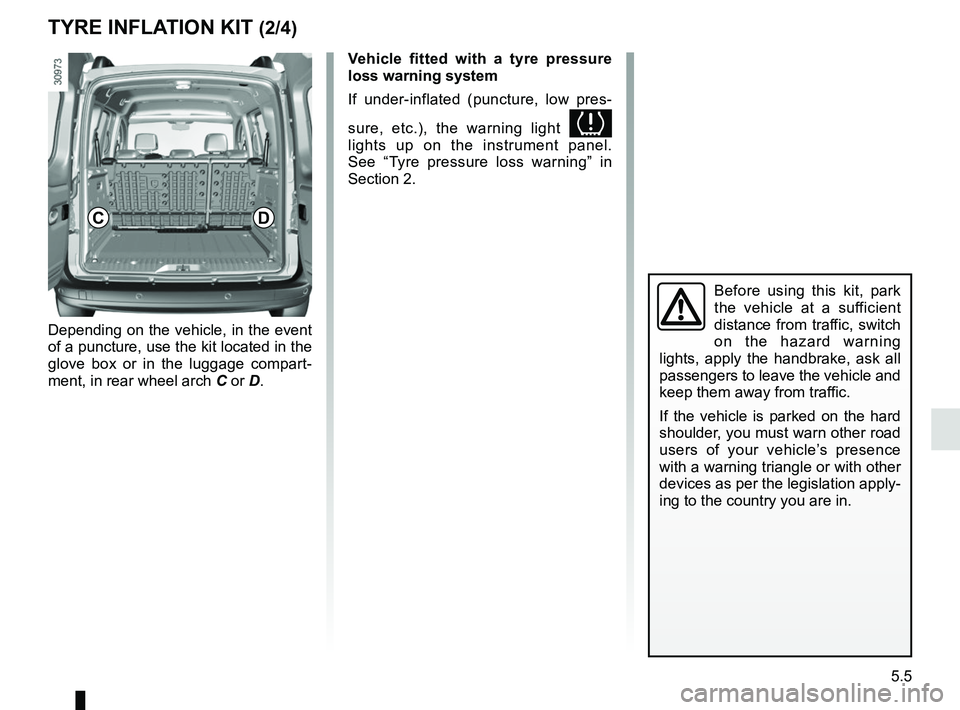
Depending on the vehicle, in the event
of a puncture, use the kit located in the
glove box or in the luggage compart-
ment, in rear wheel arch C or D.
Before using this kit, park
the vehicle at a sufficient
distance from traffic, switch
on the hazard warning
lights, apply the handbrake, ask all
passengers to leave the vehicle and
keep them away from traffic.
If the vehicle is parked on the hard
shoulder, you must warn other road
users of your vehicle’s presence
with a warning triangle or with other
devices as per the legislation apply-
ing to the country you are in.
C
Vehicle fitted with a tyre pressure
loss warning system
If under-inflated (puncture, low pres-
sure, etc.), the warning light
lights up on the instrument panel.
See “Tyre pressure loss warning” in
Section 2.
D
Page 206 of 264
5.12
Undo the bolts and take off the wheel.
For vehicles fitted with alloy wheels,
use the guide bolt located in the tool kit
to finish loosening and start tightening
the bolts.
Fit the emergency spare wheel on
the central hub and turn it to align the
mounting holes in the wheel and the
hub.
Tighten the bolts, checking that the
wheel is correctly positioned on its hub.
Lower the jack.
If bolts are supplied with the emergency
spare wheel, only use these bolts for
the emergency spare wheel.
With the wheel on the ground, tighten
the bolts fully and have the tightness of
the bolts checked and the emergency
spare wheel pressure checked as soon
as possible.
CHANGING A WHEEL (2/2)
Anti-theft bolts
If you use anti-theft bolts, fit these
nearest the valve (wheel trim may
not be able to fit).
If you have a puncture, re-
place the wheel as soon as
possible.
A tyre which has been punc-
tured should always be inspected
(and repaired, where possible) by a
specialist.
Vehicle fitted with a tyre pressure
loss warning system
If under-inflated (puncture, low pres-
sure, etc.), the warning light
lights up on the instrument panel. See
“Tyre pressure loss warning” in
Section 2.
Page 208 of 264
5.14
TYRES (2/3)
Pressures should be checked when the
tyres are cold; ignore higher pressures
which may be reached in hot weather
or following a fast journey.
If tyre pressures cannot be checked
when the tyres are cold, the normal
pressures must be increased by 0.2 to
0.3 bar (or 3 PSI).
Never deflate a hot tyre.Tyre pressuresRespect the tyre pressures (including
the emergency spare wheel). The tyre
pressures should be checked at least
once a month and additionally before
any long journey (refer to the label af-
fixed to the edge of the driver’s door,
described in the information on “Tyre
pressures” in Section 4).
Incorrect tyre pressures
lead to abnormal tyre wear
and unusually hot running.
These are factors which
may seriously affect safety and lead
to:
– poor road holding;
– risk of bursting or tread separa- tion.
The pressure depends on the load
and the speed of use. Adjust the
pressures according to the condi-
tions of use (refer to the information
on “Tyre pressures”).
Please be aware that a
poorly tightened or miss-
ing valve cap can make the
tyres less airtight and lead
to pressure loss.
Always use valve caps identical to
those fitted originally and tighten
them fully.
Vehicle fitted with a tyre pressure
loss warning system
If under-inflated (puncture, low pres-
sure, etc.), the warning light
lights up on the instrument panel. See
“Tyre pressure loss warning” in
Section 2.
Changing wheels around
This practice is not recommended.
Emergency spare wheel
Refer to the information on the
“Emergency spare wheel” and in-
structions on “Changing a wheel” in
Section 5.
Page 222 of 264

5.28
FUSES (2/2)
Number Allocation
1 Fuel pump
2 Not used
3 Passenger compartment
engine cooling fan
4 Passenger compartment
engine cooling fan
5 Rear windscreen wiper
6 Horn, diagnostic socket
7 Heated seats
8 Electric rear windows
9 Passenger compartment
ECU
10 Windscreen washer
11 Brake lights
12 Passenger compartment
unit, ABS, ESP
13 Electric windows, child
safety, heating and air
conditioning system, ECO
mode
14 Not used
15 StarterNumber Allocation
16 Brake lights, additional
equipment, navigation,
ABS, ESP, boot light, tyre
pressure warning light,
interior lights, rain and light
sensor
17 Radio, navigation system,
display, alarm
18 Additional equipment
19 Heated door mirrors
20 Hazard lights, rear fog lights
21 Central locking of opening
elements
22 Instrument panel
23 Rear accessories socket
24 ESC, radio, heating and air
conditioning system, heated
seats, stop lights
25 Front accessories socket
26 Towbar
27 Electric front windows
28 Rear-view mirror control
29 De-icing the rear screen and
rear view mirror
12
3456
78910
11121314
15161718
19202122
23242526
27
28
29
Allocation of fusesThe presence of certain fuses de-
pends on the vehicle equipment
level.
Page 232 of 264
5.38
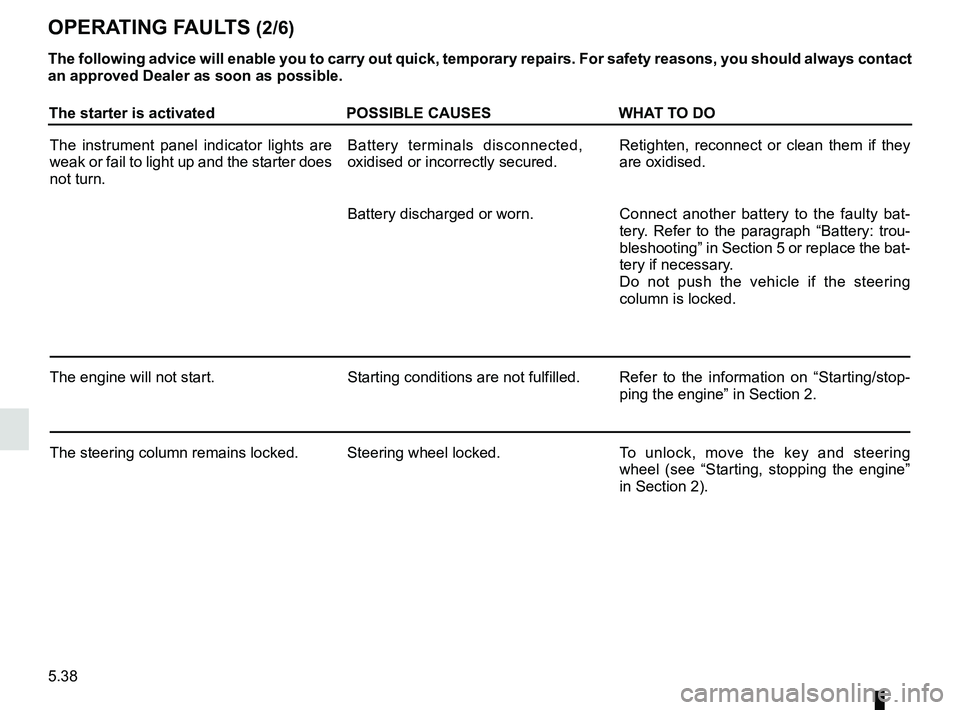
The starter is activatedPOSSIBLE CAUSESWHAT TO DO
The instrument panel indicator lights are
weak or fail to light up and the starter does
not turn. Battery terminals disconnected,
oxidised or incorrectly secured.
Retighten, reconnect or clean them if they
are oxidised.
Battery discharged or worn. Connect another battery to the faulty bat-
tery. Refer to the paragraph “Battery: trou-
bleshooting” in Section 5 or replace the bat-
tery if necessary.
Do not push the vehicle if the steering
column is locked.
The engine will not start. Starting conditions are not fulfilled.Refer to the information on “Starting/stop-
ping the engine” in Section 2.
The steering column remains locked. Steering wheel locked. To unlock, move the key and steering
wheel (see “Starting, stopping the engine”
in Section 2).
OPERATING FAULTS (2/6)
The following advice will enable you to carry out quick, temporary repai\
rs. For safety reasons, you should always contact
an approved Dealer as soon as possible.
Page 258 of 264

ECO mode ........................................................................\
. 2.12
electric windows ..................................................... 3.20 – 3")
7.2
ALPHABETICAL INDEX (2/5)
ECO mode ........................................................................\
. 2.12
electric windows ..................................................... 3.20 – 3.21
electronic stability control: ESC .............................2.26 → 2.30
emergency brake assist.........................................2.26 → 2.30
emergency braking ................................................2.26 → 2.30
emergency spare wheel ...................................................... 5.2
engine technical specifications ......................................... 6.4 – 6.5
engine coolant ..................................................................... 4.9
engine oil ..........................................................1.56, 4.4 → 4.7
engine oil capacity ...................................................... 4.6 – 4.7
engine oil level ...........................................................4.4 → 4.7
engine specifications .................................................. 6.4 – 6.5
environment ............................................................\
........... 2.16
ESC: electronic stability control ....................1.57, 2.26 → 2.30
external temperature .............................................. 1.70 – 1.71
F
faults operating faults ................................................5.37 → 5.42
filter .................................................................\
................... 4.10
fitting a radio ........................................................... 5.33 – 5.34
fittings ...............................................................\
.....3.24 → 3.28
fog lights ................................................................... 1.77, 5.18
front lights changing bulbs .................................................. 5.16 – 5.17
front passenger air bag deactivation .....................1.46 → 1.48
front seat adjustment .............................................1.19 → 1.21
front seats adjustment .......................................................1.19 → 1.21
fuel advice on fuel economy ................................... 2.11 → 2.14
capacity ...............................................................\
......... 1.83
consumption .................................................... 2.11 → 2.14
filling ........................................................1.56, 1.83 → 1.85
grade ..................................................................\
.......... 1.83 fuel consumption ................................................... 2.11
→ 2.14
fuel filler cap ..........................................................1.83 → 1.85
fuel tank capacity ............................................................1.83 → 1.85
fuel tank capacity ...................................................1.83 → 1.85
fuses ....................................................................... 5.27 – 5.28
G
gear lever........................................................................\
..... 2.7
glove box ........................................................................\
... 3.24
grip control ........................................................................\
. 2.29
H
handbrake................................................................... 1.55, 2.8
hazard warning lights signal .............................................. 1.74
headlight beam adjustment .................................... 1.78 – 1.79
headrest.................................................................1.15 → 1.18
heated seats ..........................................................1.19 → 1.21
heating and air conditioning system ........................3.4 → 3.15
heating system ........................................................3.4 → 3.16
horn ...................................................................\
................ 1.74
horn: flash ..................................................................\
........... 1.74
sounding the horn ........................................................ 1.74
hubcap tool ........................................................................\
.. 5.8
I
ignition switch ...................................................................... 2.2
indicators ................................................ 1.54, 1.74, 5.17, 5.22
indicators: direction indicators .............................................. 5.17, 5.22
instrument panel ..............................................1.58 → 1.60
instrument panel ....................................................1.54 → 1.69
instrument panel messages...................................1.61 → 1.69
interior lighting: changing bulbs .................................................. 5.23 – 5.24