door lock RENAULT KANGOO Z.E. 2018 User Guide
[x] Cancel search | Manufacturer: RENAULT, Model Year: 2018, Model line: KANGOO Z.E., Model: RENAULT KANGOO Z.E. 2018Pages: 230, PDF Size: 5.03 MB
Page 32 of 230
1.26
Locking the opening
elements without the remote
control
With the engine and ignition off, the
sliding side doors closed and a front
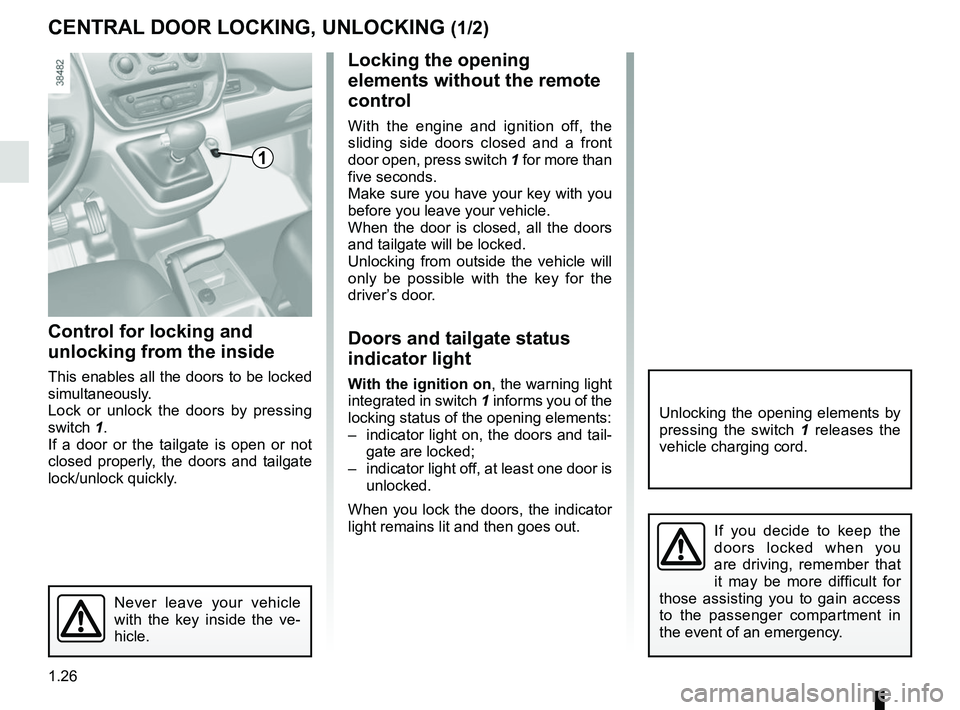
door open, press switch 1 for more than
five seconds.
Make sure you have your key with you
before you leave your vehicle.
When the door is closed, all the doors
and tailgate will be locked.
Unlocking from outside the vehicle will
only be possible with the key for the
driver’s door.
Doors and tailgate status
indicator light
With the ignition on , the warning light
integrated in switch 1 informs you of the
locking status of the opening elements:
– indicator light on, the doors and tail- gate are locked;
– indicator light off, at least one door is unlocked.
When you lock the doors, the indicator
light remains lit and then goes out.
Control for locking and
unlocking from the inside
This enables all the doors to be locked
simultaneously.
Lock or unlock the doors by pressing
switch 1.
If a door or the tailgate is open or not
closed properly, the doors and tailgate
lock/unlock quickly.
CENTRAL DOOR LOCKING, UNLOCKING (1/2)
Never leave your vehicle
with the key inside the ve-
hicle.
If you decide to keep the
doors locked when you
are driving, remember that
it may be more difficult for
those assisting you to gain access
to the passenger compartment in
the event of an emergency.
1
Unlocking the opening elements by
pressing the switch 1 releases the
vehicle charging cord.
Page 33 of 230
1.27
CENTRAL DOOR LOCKING, UNLOCKING (2/2)
2
Manual control
Using the key
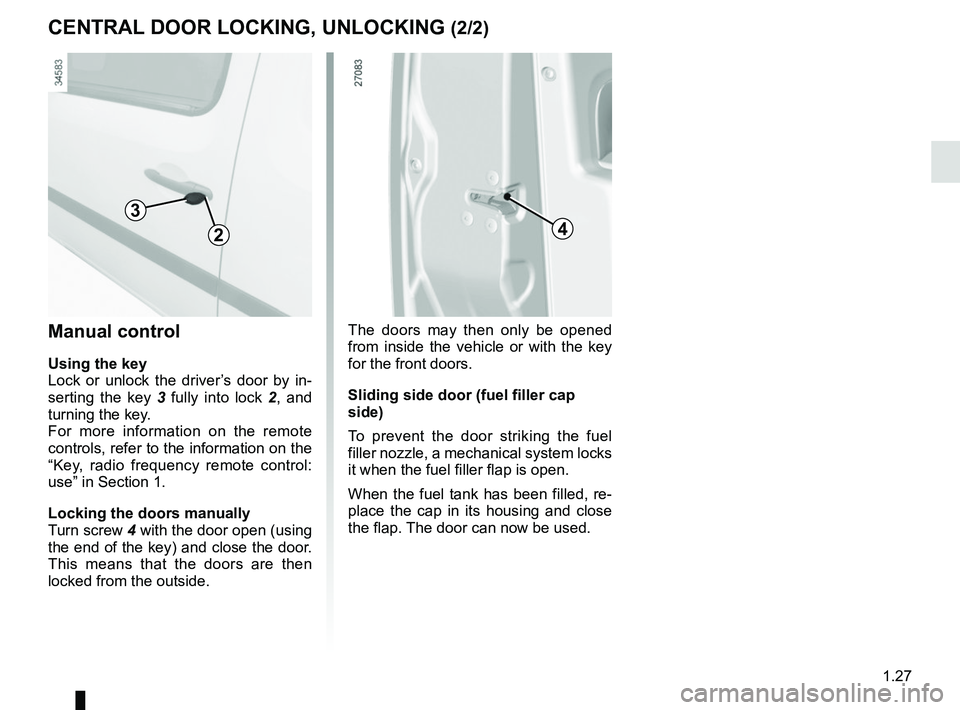
Lock or unlock the driver’s door by in-
serting the key 3 fully into lock 2, and
turning the key.
For more information on the remote
controls, refer to the information on the
“Key, radio frequency remote control:
use” in Section 1.
Locking the doors manually
Turn screw 4 with the door open (using the end of the key) and close the door.
This means that the doors are then
locked from the outside.
The doors may then only be opened
from inside the vehicle or with the key
for the front doors.
Sliding side door (fuel filler cap
side)
To prevent the door striking the fuel
filler nozzle, a mechanical system locks
it when the fuel filler flap is open.
When the fuel tank has been filled, re-
place the cap in its housing and close
the flap. The door can now be used.
4
3
Page 34 of 230
1.28
You must first decide if you want to
activate this function.
To activate
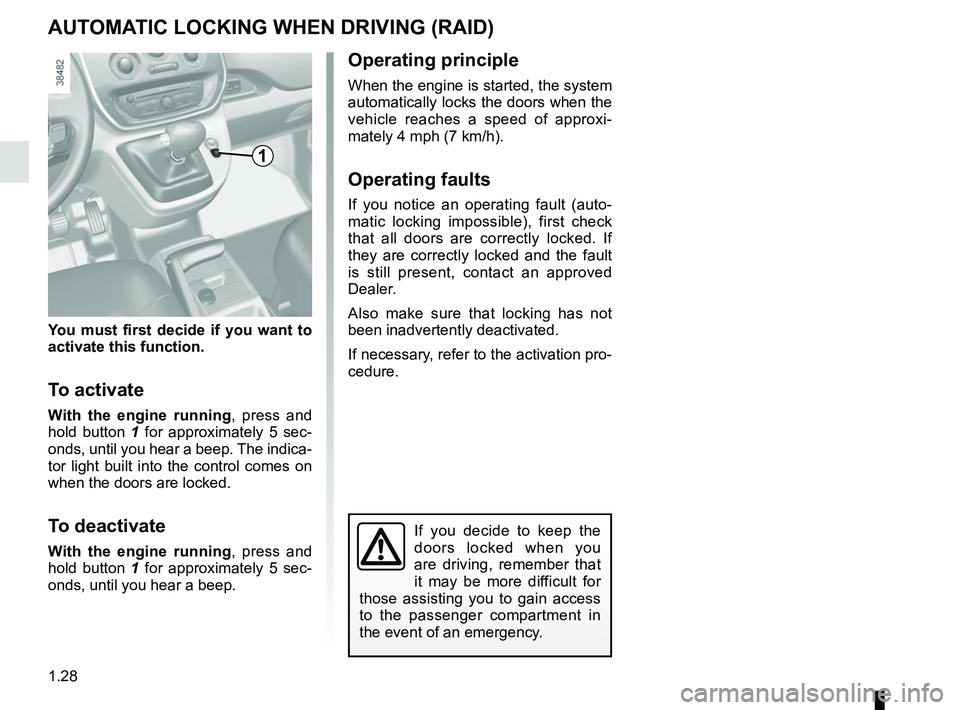
With the engine running, press and
hold button 1 for approximately 5 sec-
onds, until you hear a beep. The indica-
tor light built into the control comes on
when the doors are locked.
To deactivate
With the engine running , press and
hold button 1 for approximately 5 sec-
onds, until you hear a beep.
If you decide to keep the
doors locked when you
are driving, remember that
it may be more difficult for
those assisting you to gain access
to the passenger compartment in
the event of an emergency.
AUTOMATIC LOCKING WHEN DRIVING (RAID)
Operating principle
When the engine is started, the system
automatically locks the doors when the
vehicle reaches a speed of approxi-
mately 4 mph (7 km/h).
Operating faults
If you notice an operating fault (auto-
matic locking impossible), first check
that all doors are correctly locked. If
they are correctly locked and the fault
is still present, contact an approved
Dealer.
Also make sure that locking has not
been inadvertently deactivated.
If necessary, refer to the activation pro-
cedure.
1
Page 39 of 230
1.33
FRONT SEATS(2/2)
Front seats
Operating faults
(depending on vehicle)
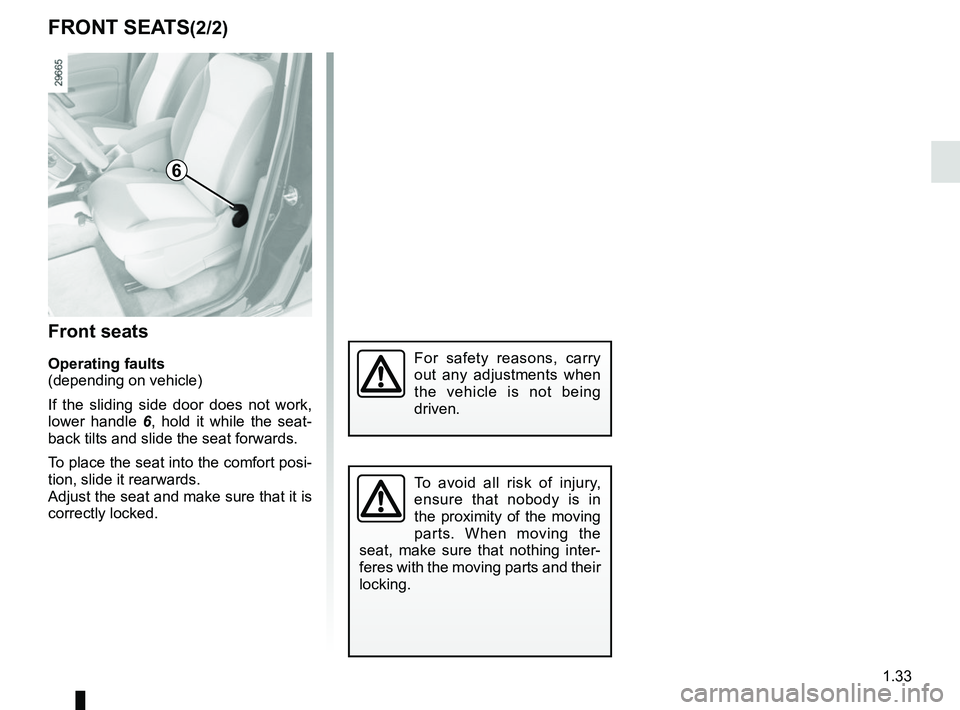
If the sliding side door does not work,
lower handle 6, hold it while the seat-
back tilts and slide the seat forwards.
To place the seat into the comfort posi-
tion, slide it rearwards.
Adjust the seat and make sure that it is
correctly locked.
To avoid all risk of injury,
ensure that nobody is in
the proximity of the moving
parts. When moving the
seat, make sure that nothing inter-
feres with the moving parts and their
locking.
For safety reasons, carry
out any adjustments when
the vehicle is not being
driven.
6
Page 40 of 230
1.34
ROOF FLAP (1/2)
123
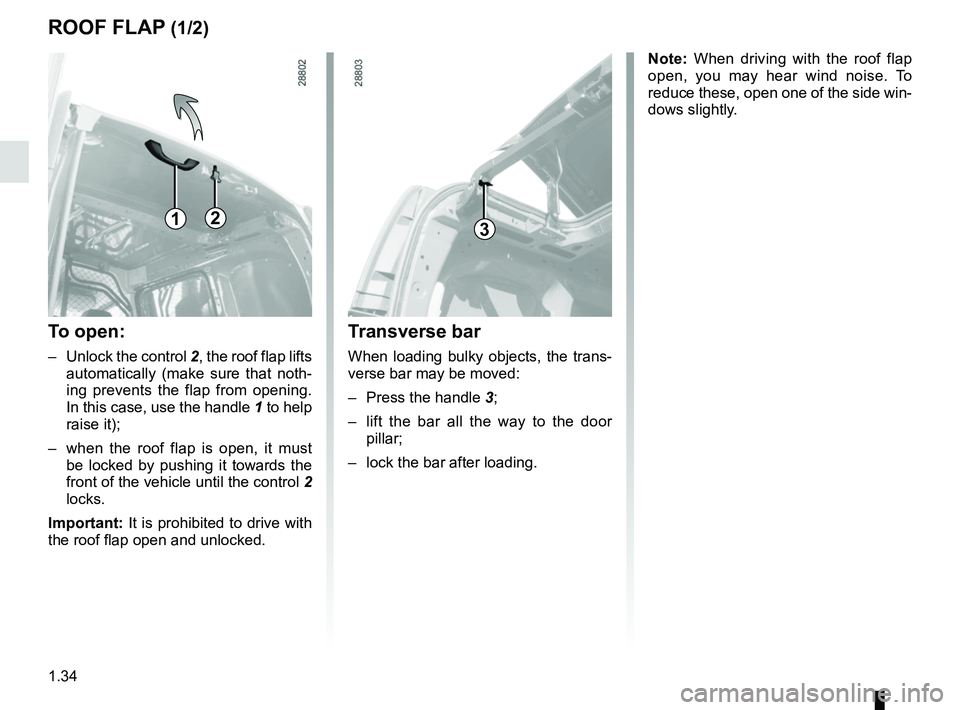
Transverse bar
When loading bulky objects, the trans-
verse bar may be moved:
– Press the handle 3;
– lift the bar all the way to the door pillar;
– lock the bar after loading.
To open:
– Unlock the control 2, the roof flap lifts
automatically (make sure that noth-
ing prevents the flap from opening.
In this case, use the handle 1 to help
raise it);
– when the roof flap is open, it must be locked by pushing it towards the
front of the vehicle until the control 2
locks.
Important: It is prohibited to drive with
the roof flap open and unlocked. Note: When driving with the roof flap
open, you may hear wind noise. To
reduce these, open one of the side win-
dows slightly.
Page 41 of 230
1.35
ROOF FLAP (2/2)
Before starting, always reposition
the transverse bar and ensure it is
correctly locked.
The rear hinged doors can only be
closed with the bar locked.
Remember that the overall vehicle
dimensions may change when you
are transporting bulky objects.
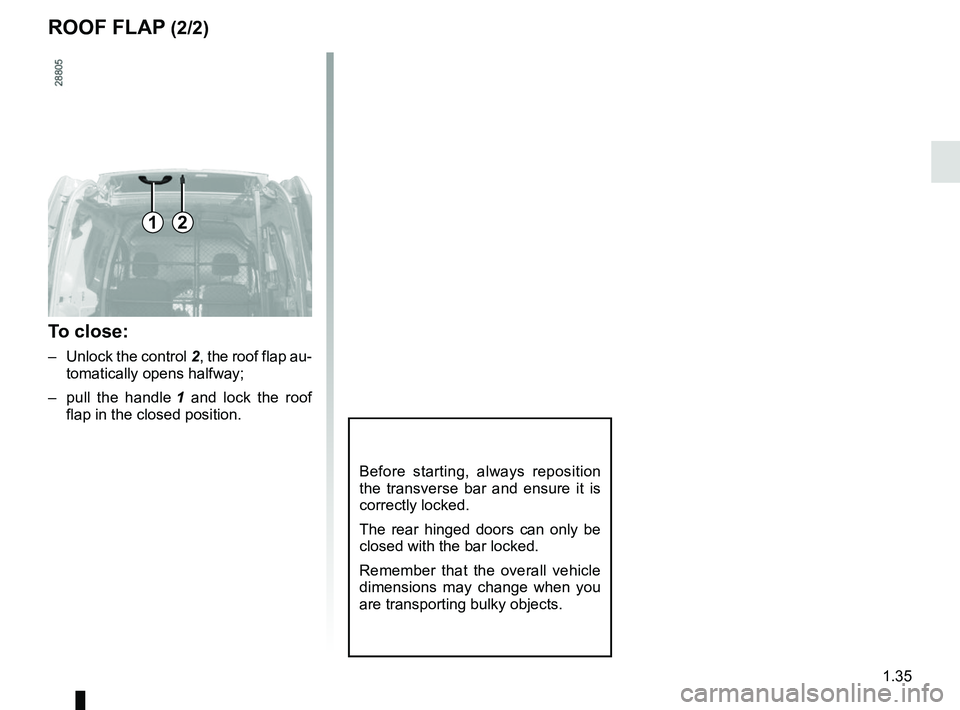
12
To close:
– Unlock the control 2, the roof flap au-
tomatically opens halfway;
– pull the handle 1 and lock the roof
flap in the closed position.
Page 52 of 230
1.46
CHILD SAFETY: General information (1/2)
Carrying children
Please ensure that you comply with the
legislation of your country.
Children, and adults, must be correctly
seated and strapped in for all journeys.
The children being carried in your vehi-
cle are your responsibility.
A child is not a miniature adult. Children
are at risk of specific injuries as their
muscles and bones have not yet fin-
ished growing. The seat belt alone
would not provide suitable protection.
Use an approved child seat and ensure
you use it correctly.
A collision at 30 mph (50
km/h) is the same as fall-
ing a distance of 10 metres.
Transporting a child without
a restraint is the equivalent of allow-
ing him or her to play on a fourth-
floor balcony without railings.
Never travel with a child held in your
arms. In the event of an accident,
you will not be able to keep hold of
the child, even if you yourself are
wearing a seat belt.
If your vehicle has been involved in
a road accident, replace the child
seat and have the seat belts and
ISOFIX anchorage points checked.
To prevent the doors being
opened, use the “Child
safety” device (refer to the
information on “Opening
and closing the doors” in Section 1).
Driver’s responsibility
when parking or stopping
the vehicle
Never leave an animal,
child or adult who is not self-suffi-
cient alone on your vehicle, even for
a short time.
They may pose a risk to themselves
or to others by starting the engine,
activating equipment such as the
electric windows or by locking the
doors.
Also, in hot and/or sunny weather,
please remember that the tempera-
ture inside the passenger compart-
ment increases very quickly.
RISK OF DEATH OR SERIOUS
INJURY.
Page 59 of 230
1.53
In the rear seat
A carrycot can be installed across the
vehicle and will take up at least two
seats. Position the child with his or her
feet nearest the door.
Move the front seat as far forward as
possible to install a rear-facing child
seat, then move back the seat in front
as far as it will go, although without al-
lowing it to come into contact with the
child seat.
For the safety of the child in the for-
ward-facing seat, do not move the seat
in front back past the middle of the
runner, do not tilt the seatback too far
(maximum of 25° ) and raise the seat as
much as possible.
Check that the forward-facing child seat
is resting against the back of the vehi-
cle seat and that the headrest of the ve-
hicle is not obstructing its use.
CHILD SAFETY: fitting a child seat (2/6)
Child’s convertible headrest
If fitted to the vehicle, the child head-
rest and booster cushion can only be
installed on the rear side seats.
For fitting and use, refer to the equip-
ment instructions.
A child seat with a floor
support must never be in-
stalled on the rear centre
seat. RISK OF DEATH OR
SERIOUS INJURY.
When fitting a child seat
(Group 2 or 3 booster seat),
check that the seat belts op-
erate (wind) correctly: refer
to Section 1 “Rear seat belts”. If
necessary, adjust the position of the
vehicle seat.Ensure that the child seat
or the child’s feet do not
prevent the front seat from
locking correctly. Refer to
the information on the “Front seat”
in Section 1 or “Rear seat operation”
in Section 3.
Page 69 of 230
1.63
21 Gear lever.
22 Remote control/location for radio,
navigation system.
23 Cruise control/speed limiter con-
trols.
24 Bonnet release control.
25 Controls for:
– Vertical headlight adjustment;
– Parking distance control.
26 Controls for:
– Cruise control/speed limiter;
– Activating/deactivating the pe-destrian horn;
– additional heating.
1 Stalk for:
– direction indicator lights;
– exterior lights;
– front fog lights;
– rear fog lights.
2 – Horn,
– location for driver’s air bag.
3 Instrument panel.
4 Stalk for:
– windscreen wipers;
– windscreen washer;
– trip computer and warning system.
5 Ignition switch.
6 Multimedia display or touchscreen:
– seat belt reminder warning light;
– airbag deactivation warning light;
– navigation;
– clock;
– exterior temperature.
7 Centre air vent.
8 Controls for ventilation, heating
and de-icing. 9 Windscreen demister outlet.
10 Location for passenger air bag.
11 Speaker.
12 Side air vent.
13 Side window demister outlet.
14 Glove box.
15 Storage space or accessories
socket.
16 Hazard warning lights switch.
17 Central door locking/unlocking
switch.
18 ECO mode switch.
19 Cigarette lighter or accessories
socket.
20 Handbrake.
DRIVING POSITION, LEFT-HAND DRIVER (2/2)
The equipment fitted, described below, DEPENDS ON THE VERSION AND COUNTRY.
Page 71 of 230
1.65
DRIVING POSITION: RIGHT-HAND DRIVE (2/2)
20 Location for radio, navigation
system.
21 Gearstick
22 Handbrake.
23 ECO mode switch.
24 Cigarette lighter or accessories
socket.
25 Door electric locking/unlocking
switch.
26 Hazard warning lights switch.
27 Storage space or accessories
socket.
28 Glovebox.
29 Bonnet release control.
10 – Horn.
– Location for driver’s air bag.
11 Instrument panel.
12 Stalk for:
– windscreen wipers;
– windscreen washer;
– trip computer and warning system.
13 Ignition switch.
14 Cruise control/speed limiter main
control.
15 Additional heating switch.
16 Activation/deactivation control for
the horn.
17 Parking distance control switch.
18 Headlight adjustment control.
19 Cruise control/speed limiter con-
trols.
1 Side window demister outlet.
2 Side air vent.
3 Speaker.
4 Location for passenger air bag.
5 Windscreen demister outlet.
6 Controls for ventilation, heating
and de-icing.
7 Centre air vent.
8 Multimedia display or touchscreen:
– seat belt reminder warning light;
– airbag deactivation warning light;
– navigation;
– clock;
– exterior temperature.
9 Stalk for:
– direction indicator lights,
– exterior lights;
– front fog lights;
–
rear fog lights.
The equipment fitted, described below, DEPENDS ON THE VERSION AND COUNTRY.