light RENAULT KANGOO Z.E. 2018 User Guide
[x] Cancel search | Manufacturer: RENAULT, Model Year: 2018, Model line: KANGOO Z.E., Model: RENAULT KANGOO Z.E. 2018Pages: 230, PDF Size: 5.03 MB
Page 26 of 230
1.20
2
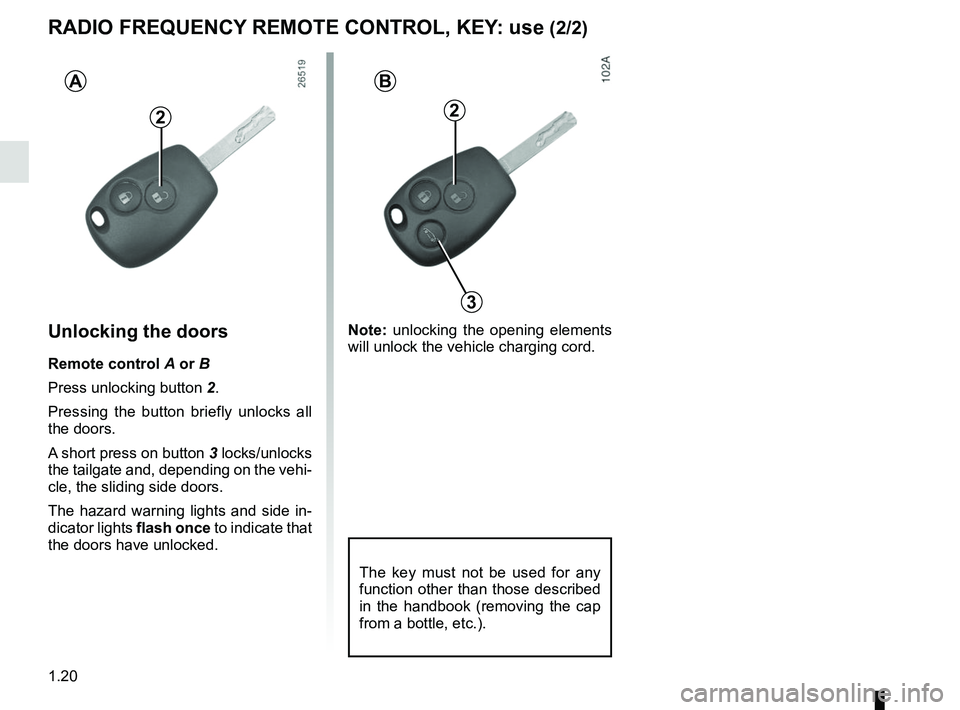
Unlocking the doors
Remote control A or B
Press unlocking button 2.
Pressing the button briefly unlocks all
the doors.
A short press on button 3 locks/unlocks
the tailgate and, depending on the vehi-
cle, the sliding side doors.
The hazard warning lights and side in-
dicator lights flash once to indicate that
the doors have unlocked.
AB
2
3
RADIO FREQUENCY REMOTE CONTROL, KEY: use (2/2)
The key must not be used for any
function other than those described
in the handbook (removing the cap
from a bottle, etc.).
Note: unlocking the opening elements
will unlock the vehicle charging cord.
Page 27 of 230
1.21
DEADLOCKING
Never use deadlocking if
someone is still inside the
vehicle.
1
If fitted to the vehicle, this allows the
doors to be locked and prevents them
from being opened with the interior
handles (for example, by breaking the
window and then trying to open the
doors from the inside).
2
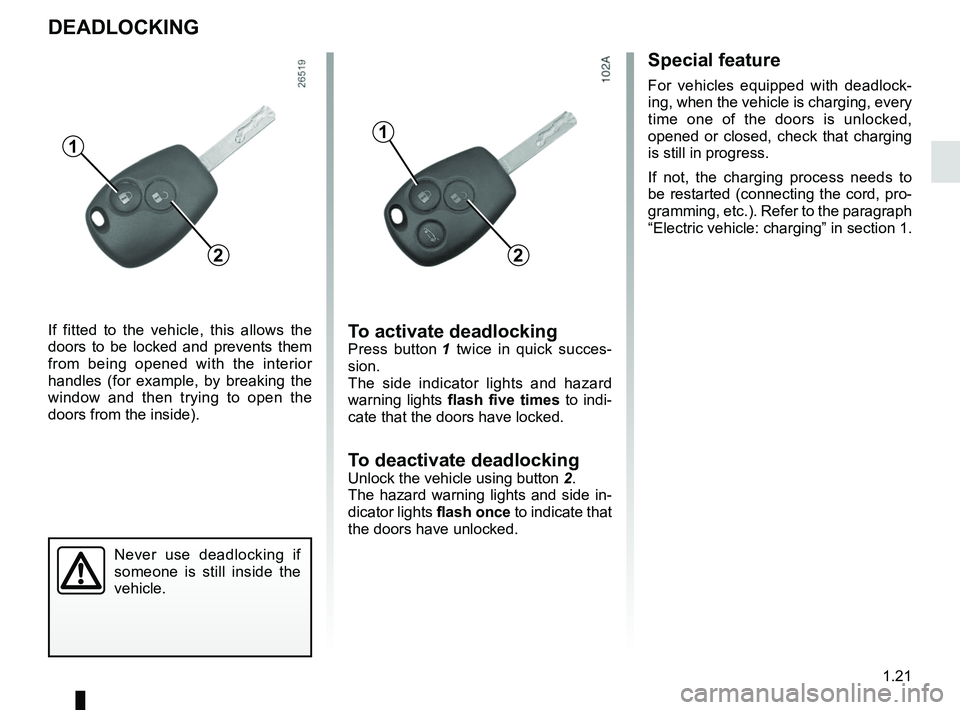
To activate deadlockingPress button 1 twice in quick succes-
sion.
The side indicator lights and hazard
warning lights flash five times to indi-
cate that the doors have locked.
To deactivate deadlocking
Unlock the vehicle using button 2.
The hazard warning lights and side in-
dicator lights flash once to indicate that
the doors have unlocked.
1
2
Special feature
For vehicles equipped with deadlock-
ing, when the vehicle is charging, every
time one of the doors is unlocked,
opened or closed, check that charging
is still in progress.
If not, the charging process needs to
be restarted (connecting the cord, pro-
gramming, etc.). Refer to the paragraph
“Electric vehicle: charging” in section 1.
Page 28 of 230
1.22
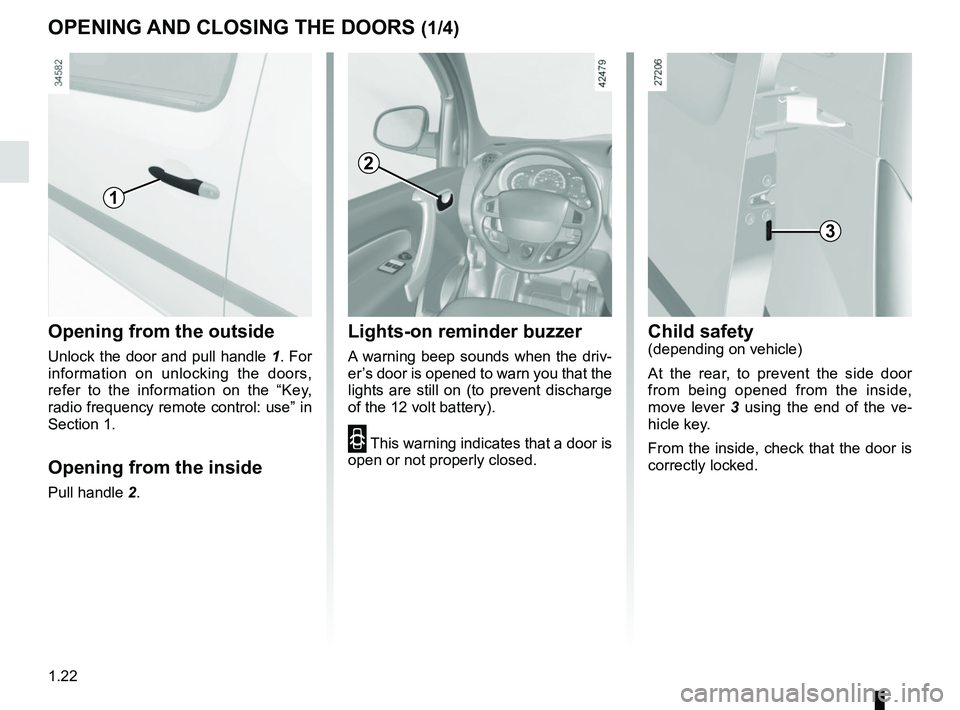
Opening from the outside
Unlock the door and pull handle 1. For
information on unlocking the doors,
refer to the information on the “Key,
radio frequency remote control: use” in
Section 1.
Opening from the inside
Pull handle 2.
OPENING AND CLOSING THE DOORS (1/4)
1
2
Child safety(depending on vehicle)
At the rear, to prevent the side door
from being opened from the inside,
move lever 3 using the end of the ve-
hicle key.
From the inside, check that the door is
correctly locked.
3
Lights-on reminder buzzer
A warning beep sounds when the driv-
er’s door is opened to warn you that the
lights are still on (to prevent discharge
of the 12 volt battery).
2 This warning indicates that a door is
open or not properly closed.
Page 30 of 230
1.24
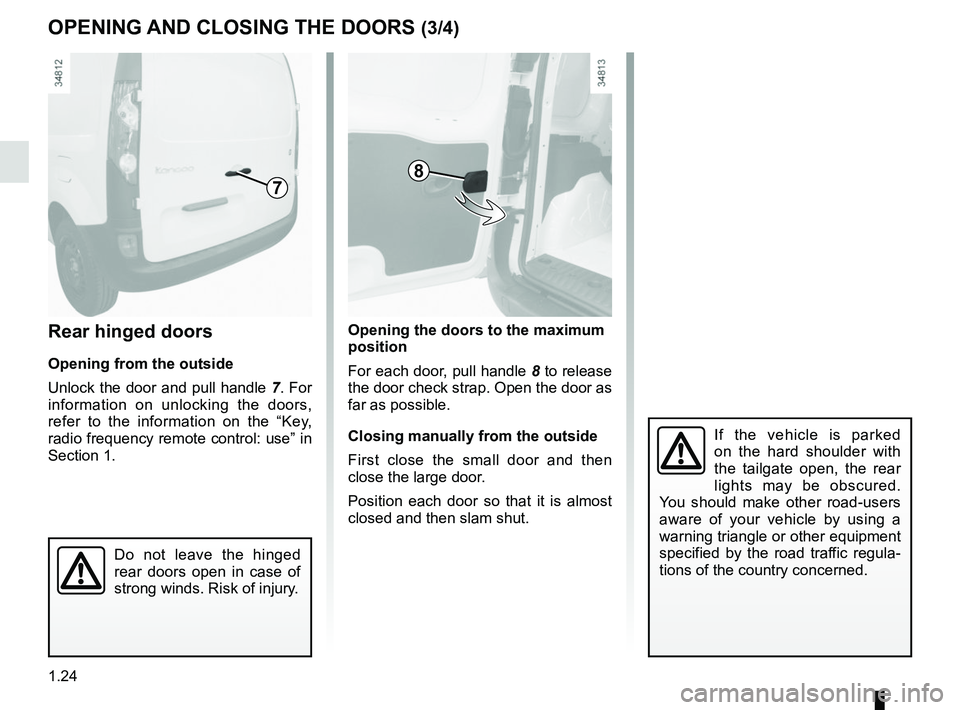
Opening the doors to the maximum
position
For each door, pull handle 8 to release
the door check strap. Open the door as
far as possible.
Closing manually from the outside
First close the small door and then
close the large door.
Position each door so that it is almost
closed and then slam shut.Rear hinged doors
Opening from the outside
Unlock the door and pull handle 7. For
information on unlocking the doors,
refer to the information on the “Key,
radio frequency remote control: use” in
Section 1.
OPENING AND CLOSING THE DOORS (3/4)
If the vehicle is parked
on the hard shoulder with
the tailgate open, the rear
lights may be obscured.
You should make other road-users
aware of your vehicle by using a
warning triangle or other equipment
specified by the road traffic regula-
tions of the country concerned.
Do not leave the hinged
rear doors open in case of
strong winds. Risk of injury.
7
8
Page 32 of 230
1.26
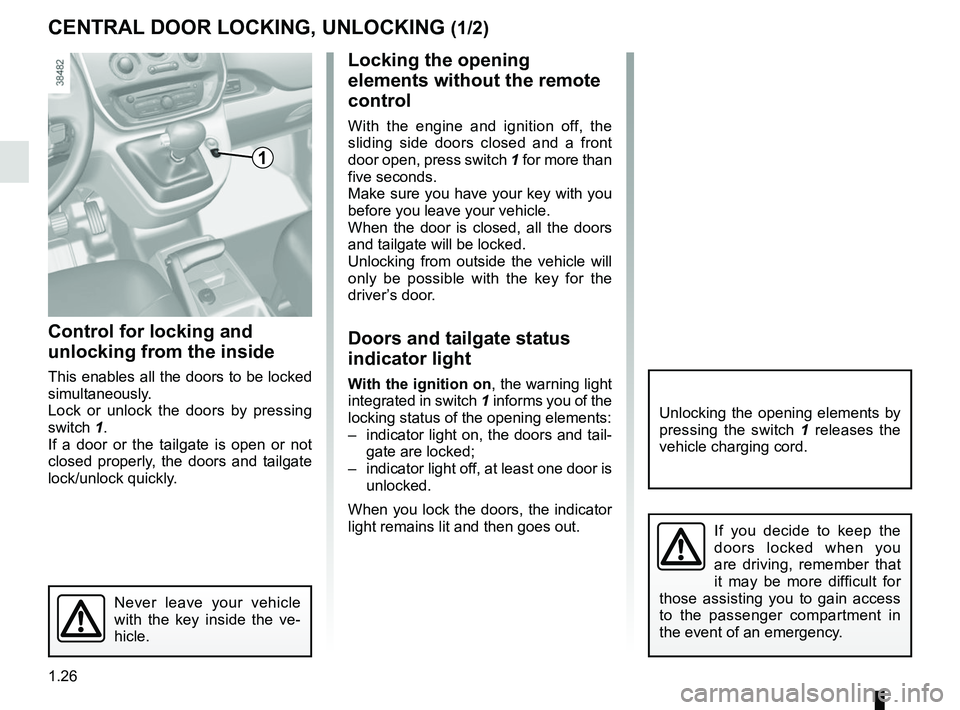
Locking the opening
elements without the remote
control
With the engine and ignition off, the
sliding side doors closed and a front
door open, press switch 1 for more than
five seconds.
Make sure you have your key with you
before you leave your vehicle.
When the door is closed, all the doors
and tailgate will be locked.
Unlocking from outside the vehicle will
only be possible with the key for the
driver’s door.
Doors and tailgate status
indicator light
With the ignition on , the warning light
integrated in switch 1 informs you of the
locking status of the opening elements:
– indicator light on, the doors and tail- gate are locked;
– indicator light off, at least one door is unlocked.
When you lock the doors, the indicator
light remains lit and then goes out.
Control for locking and
unlocking from the inside
This enables all the doors to be locked
simultaneously.
Lock or unlock the doors by pressing
switch 1.
If a door or the tailgate is open or not
closed properly, the doors and tailgate
lock/unlock quickly.
CENTRAL DOOR LOCKING, UNLOCKING (1/2)
Never leave your vehicle
with the key inside the ve-
hicle.
If you decide to keep the
doors locked when you
are driving, remember that
it may be more difficult for
those assisting you to gain access
to the passenger compartment in
the event of an emergency.
1
Unlocking the opening elements by
pressing the switch 1 releases the
vehicle charging cord.
Page 34 of 230
1.28
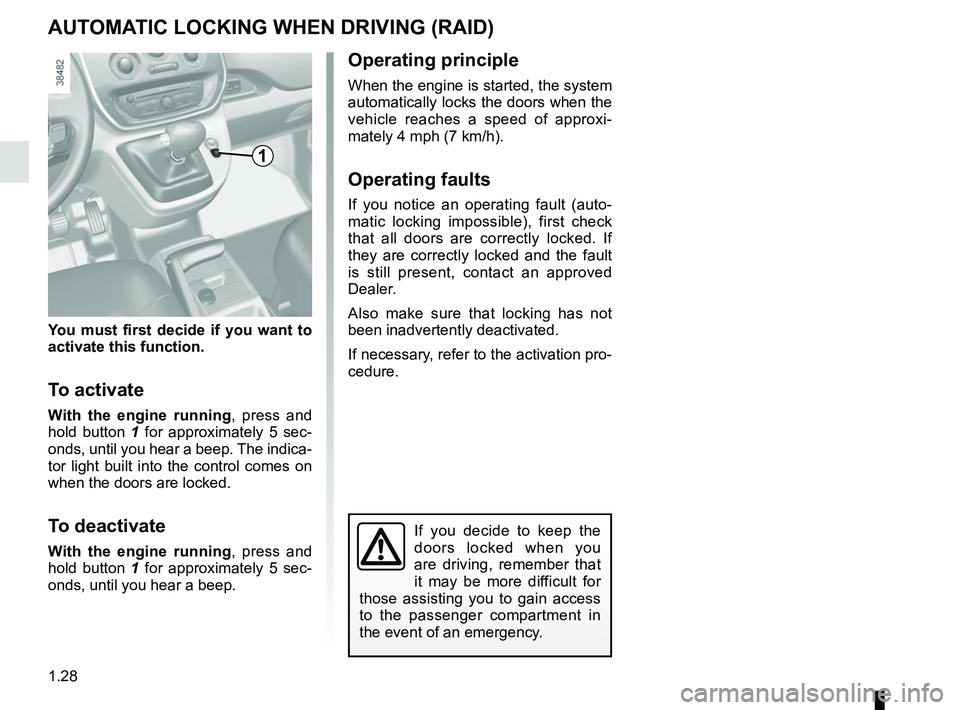
You must first decide if you want to
activate this function.
To activate
With the engine running, press and
hold button 1 for approximately 5 sec-
onds, until you hear a beep. The indica-
tor light built into the control comes on
when the doors are locked.
To deactivate
With the engine running , press and
hold button 1 for approximately 5 sec-
onds, until you hear a beep.
If you decide to keep the
doors locked when you
are driving, remember that
it may be more difficult for
those assisting you to gain access
to the passenger compartment in
the event of an emergency.
AUTOMATIC LOCKING WHEN DRIVING (RAID)
Operating principle
When the engine is started, the system
automatically locks the doors when the
vehicle reaches a speed of approxi-
mately 4 mph (7 km/h).
Operating faults
If you notice an operating fault (auto-
matic locking impossible), first check
that all doors are correctly locked. If
they are correctly locked and the fault
is still present, contact an approved
Dealer.
Also make sure that locking has not
been inadvertently deactivated.
If necessary, refer to the activation pro-
cedure.
1
Page 38 of 230
1.32
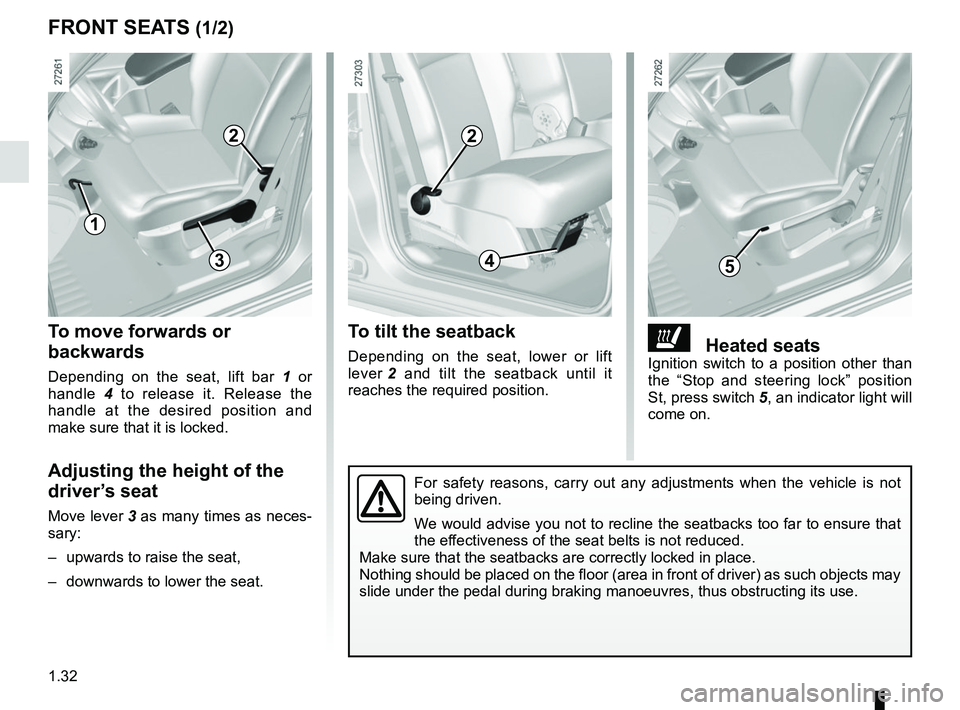
FRONT SEATS (1/2)
1
2
534
2
ðHeated seats Ignition switch to a position other than
the “Stop and steering lock” position
St, press switch 5, an indicator light will
come on.
To tilt the seatback
Depending on the seat, lower or lift
lever 2 and tilt the seatback until it
reaches the required position.
To move forwards or
backwards
Depending on the seat, lift bar 1 or
handle 4 to release it. Release the
handle at the desired position and
make sure that it is locked.
Adjusting the height of the
driver’s seat
Move lever 3 as many times as neces-
sary:
– upwards to raise the seat,
– downwards to lower the seat.
For safety reasons, carry out any adjustments when the vehicle is not
being driven.
We would advise you not to recline the seatbacks too far to ensure that
the effectiveness of the seat belts is not reduced.
Make sure that the seatbacks are correctly locked in place.
Nothing should be placed on the floor (area in front of driver) as suc\
h objects may
slide under the pedal during braking manoeuvres, thus obstructing its us\
e.
Page 40 of 230
1.34
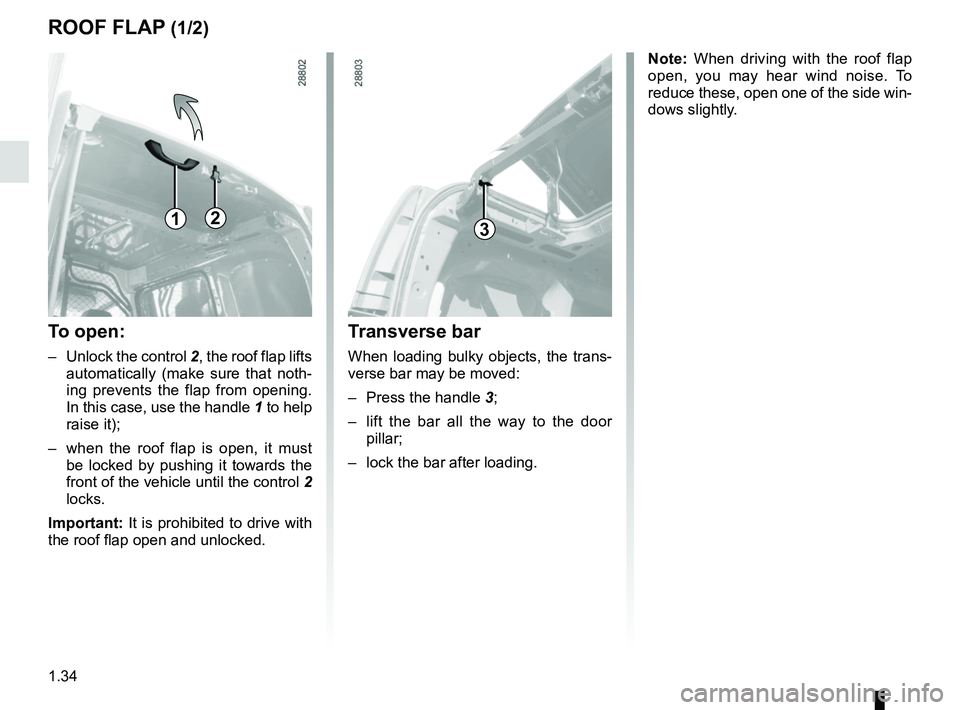
ROOF FLAP (1/2)
123
Transverse bar
When loading bulky objects, the trans-
verse bar may be moved:
– Press the handle 3;
– lift the bar all the way to the door pillar;
– lock the bar after loading.
To open:
– Unlock the control 2, the roof flap lifts
automatically (make sure that noth-
ing prevents the flap from opening.
In this case, use the handle 1 to help
raise it);
– when the roof flap is open, it must be locked by pushing it towards the
front of the vehicle until the control 2
locks.
Important: It is prohibited to drive with
the roof flap open and unlocked. Note: When driving with the roof flap
open, you may hear wind noise. To
reduce these, open one of the side win-
dows slightly.
Page 43 of 230
1.37
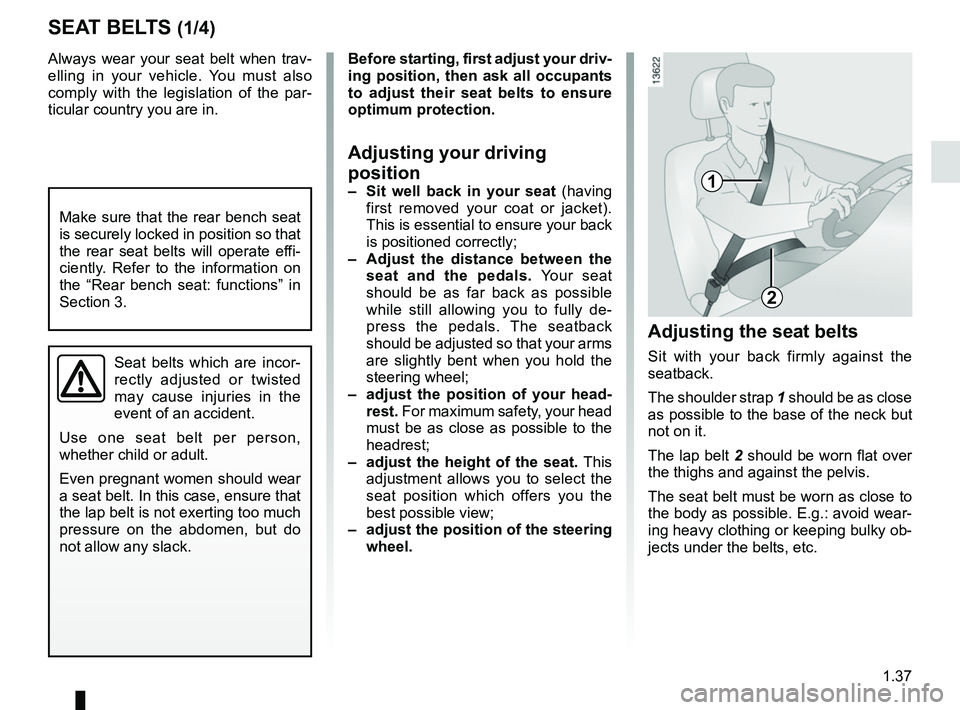
SEAT BELTS (1/4)Adjusting the seat belts
Sit with your back firmly against the
seatback.
The shoulder strap 1 should be as close
as possible to the base of the neck but
not on it.
The lap belt 2 should be worn flat over
the thighs and against the pelvis.
The seat belt must be worn as close to
the body as possible. E.g.: avoid wear-
ing heavy clothing or keeping bulky ob-
jects under the belts, etc.
1
2
Always wear your seat belt when trav-
elling in your vehicle. You must also
comply with the legislation of the par-
ticular country you are in.
Seat belts which are incor-
rectly adjusted or twisted
may cause injuries in the
event of an accident.
Use one seat belt per person,
whether child or adult.
Even pregnant women should wear
a seat belt. In this case, ensure that
the lap belt is not exerting too much
pressure on the abdomen, but do
not allow any slack.
Before starting, first adjust your driv-
ing position, then ask all occupants
to adjust their seat belts to ensure
optimum protection.
Adjusting your driving
position
– Sit well back in your seat (having
first removed your coat or jacket).
This is essential to ensure your back
is positioned correctly;
– Adjust the distance between the seat and the pedals. Your seat
should be as far back as possible
while still allowing you to fully de-
press the pedals. The seatback
should be adjusted so that your arms
are slightly bent when you hold the
steering wheel;
– adjust the position of your head- rest. For maximum safety, your head
must be as close as possible to the
headrest;
– adjust the height of the seat. This
adjustment allows you to select the
seat position which offers you the
best possible view;
– adjust the position of the steering
wheel.
Make sure that the rear bench seat
is securely locked in position so that
the rear seat belts will operate effi-
ciently. Refer to the information on
the “Rear bench seat: functions” in
Section 3.
Page 44 of 230
1.38
SEAT BELTS (2/4)
™Front seat belt reminder
warning light
It remains on when the engine
is started if your seat belt is not fas-
tened. When the vehicle reaches a
speed of 12 mph (20 km/h), the warn-
ing light flashes and a buzzer sounds.
Then, the beep sounds at a low volume
for 30 seconds, then at a high volume
for 90 seconds.
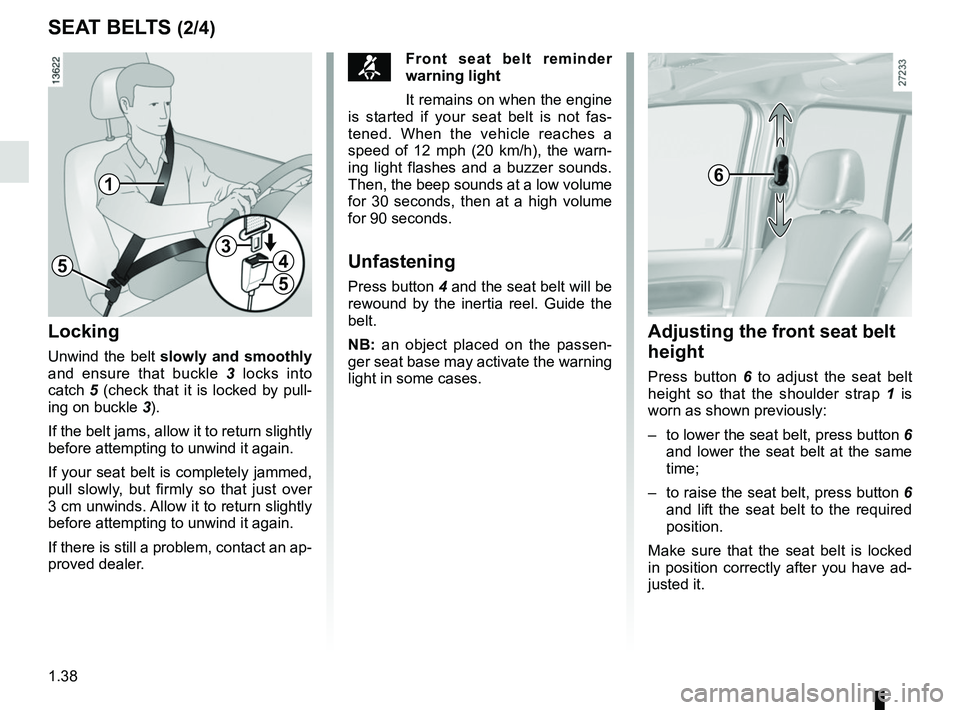
Unfastening
Press button 4 and the seat belt will be
rewound by the inertia reel. Guide the
belt.
NB: an object placed on the passen-
ger seat base may activate the warning
light in some cases.
6
Adjusting the front seat belt
height
Press button 6 to adjust the seat belt
height so that the shoulder strap 1 is
worn as shown previously:
– to lower the seat belt, press button 6 and lower the seat belt at the same
time;
– to raise the seat belt, press button 6 and lift the seat belt to the required
position.
Make sure that the seat belt is locked
in position correctly after you have ad-
justed it.
Locking
Unwind the belt slowly and smoothly
and ensure that buckle 3 locks into
catch 5 (check that it is locked by pull-
ing on buckle 3).
If the belt jams, allow it to return slightly
before attempting to unwind it again.
If your seat belt is completely jammed,
pull slowly, but firmly so that just over
3 cm unwinds. Allow it to return slightly
before attempting to unwind it again.
If there is still a problem, contact an ap-
proved dealer.
1
5
34
5