seats RENAULT KANGOO Z.E. 2018 User Guide
[x] Cancel search | Manufacturer: RENAULT, Model Year: 2018, Model line: KANGOO Z.E., Model: RENAULT KANGOO Z.E. 2018Pages: 230, PDF Size: 5.03 MB
Page 56 of 230
1.50
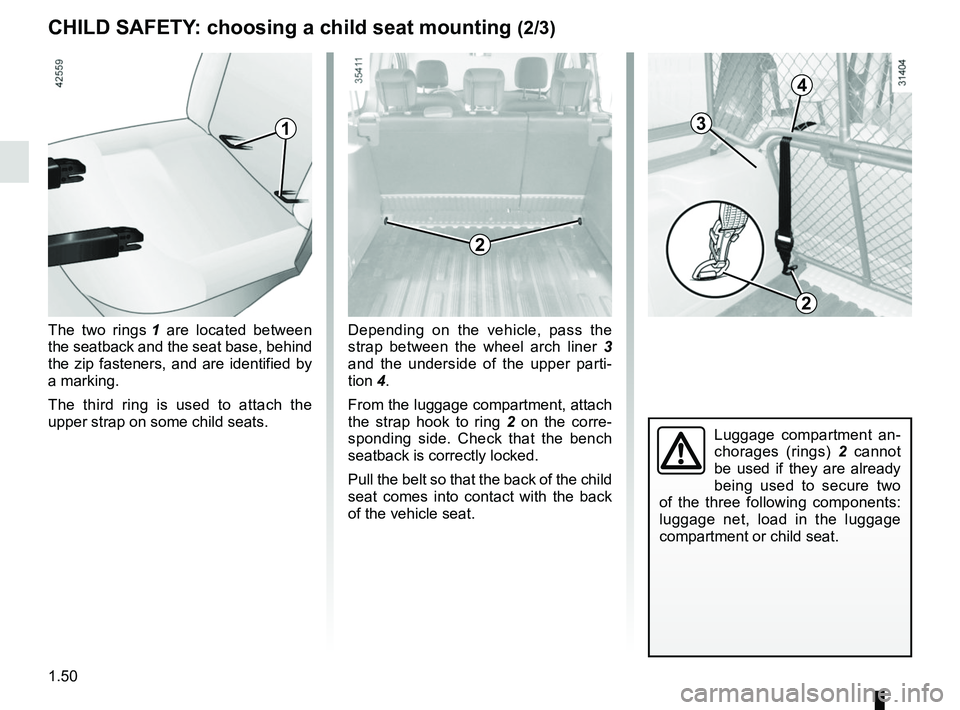
The two rings 1 are located between
the seatback and the seat base, behind
the zip fasteners, and are identified by
a marking.
The third ring is used to attach the
upper strap on some child seats.
2
CHILD SAFETY: choosing a child seat mounting (2/3)
Depending on the vehicle, pass the
strap between the wheel arch liner 3
and the underside of the upper parti-
tion 4.
From the luggage compartment, attach
the strap hook to ring 2 on the corre-
sponding side. Check that the bench
seatback is correctly locked.
Pull the belt so that the back of the child
seat comes into contact with the back
of the vehicle seat.
3
4
2
1
Luggage compartment an-
chorages (rings) 2 cannot
be used if they are already
being used to secure two
of the three following components:
luggage net, load in the luggage
compartment or child seat.
Page 57 of 230
1.51
The ISOFIX anchorage
points have been exclu-
sively designed for child
seats with the ISOFIX
system. Never fit a different type of
child seat, seat belt or other objects
to these anchorage points.
Check that nothing is obstructing
the anchorage points.
If your vehicle has been involved in
a road accident, have the ISOFIX
anchorage points checked and re-
place your child seat.
The child seat strap must
be attached to the corre-
sponding ring.
Do not use any other
mounting point.
CHILD SAFETY: choosing a child seat mounting (3/3)
Page 58 of 230
1.52
Some seats are not suitable for fitting
child seats. The diagrams on the fol-
lowing pages show you how to attach
a child seat.
The types of child seats indicated may
not be available. Before using a differ-
ent child seat, check with the manufac-
turer that it can be fitted.
CHILD SAFETY: fitting a child seat (1/6)
In the front seat
The laws concerning children travel-
ling in the front passenger seat differ in
every country. Consult the legislation in
force and follow the indications on the
diagrams on the following pages.
Before fitting a child seat in this seat (if
authorised):
– lower the seat belt as far as possible;
– move the seat as far back as possi-ble;
– gently tilt the seatback away from vertical (approximately 25°);
– on equipped vehicles, raise the seat base as far as possible.
In all situations, reinsert the headrest to
its full extent so that it does not interfere
with the child seat (see the information
on “Front headrests” in Section 1);
RISK OF DEATH OR
SERIOUS INJURY: before
installing a child seat on this
seat, check that the airbag
has been deactivated (refer to “Child
safety: front passenger airbag deac-
tivation/activation” in Section 1).
Fit the child seat in a rear
seat wherever possible.
Check that when installing
the child seat in the vehicle
it is not at risk of coming loose from
its base.
If you have to remove the headrest,
check that it is correctly stored so
that it does not come loose under
harsh braking or impact.
Always attach the child seat to the
vehicle even if it is not in use so that
it does not come loose under harsh
braking or impact.
After installing the child seat, when this
is possible, you can move the vehi-
cle seat forward if necessary (so as to
leave enough space in the rear seats
for passengers or other child seats). In
the case of a rear-facing child seat, do
not let it touch the dashboard or move it
to the furthest forward position.
Do not change these settings after the
child seat is installed.
Page 59 of 230
1.53
In the rear seat
A carrycot can be installed across the
vehicle and will take up at least two
seats. Position the child with his or her
feet nearest the door.
Move the front seat as far forward as
possible to install a rear-facing child
seat, then move back the seat in front
as far as it will go, although without al-
lowing it to come into contact with the
child seat.
For the safety of the child in the for-
ward-facing seat, do not move the seat
in front back past the middle of the
runner, do not tilt the seatback too far
(maximum of 25° ) and raise the seat as
much as possible.
Check that the forward-facing child seat
is resting against the back of the vehi-
cle seat and that the headrest of the ve-
hicle is not obstructing its use.
CHILD SAFETY: fitting a child seat (2/6)
Child’s convertible headrest
If fitted to the vehicle, the child head-
rest and booster cushion can only be
installed on the rear side seats.
For fitting and use, refer to the equip-
ment instructions.
A child seat with a floor
support must never be in-
stalled on the rear centre
seat. RISK OF DEATH OR
SERIOUS INJURY.
When fitting a child seat
(Group 2 or 3 booster seat),
check that the seat belts op-
erate (wind) correctly: refer
to Section 1 “Rear seat belts”. If
necessary, adjust the position of the
vehicle seat.Ensure that the child seat
or the child’s feet do not
prevent the front seat from
locking correctly. Refer to
the information on the “Front seat”
in Section 1 or “Rear seat operation”
in Section 3.
Page 60 of 230
1.54
CHILD SAFETY: fitting a child seat (3/6)
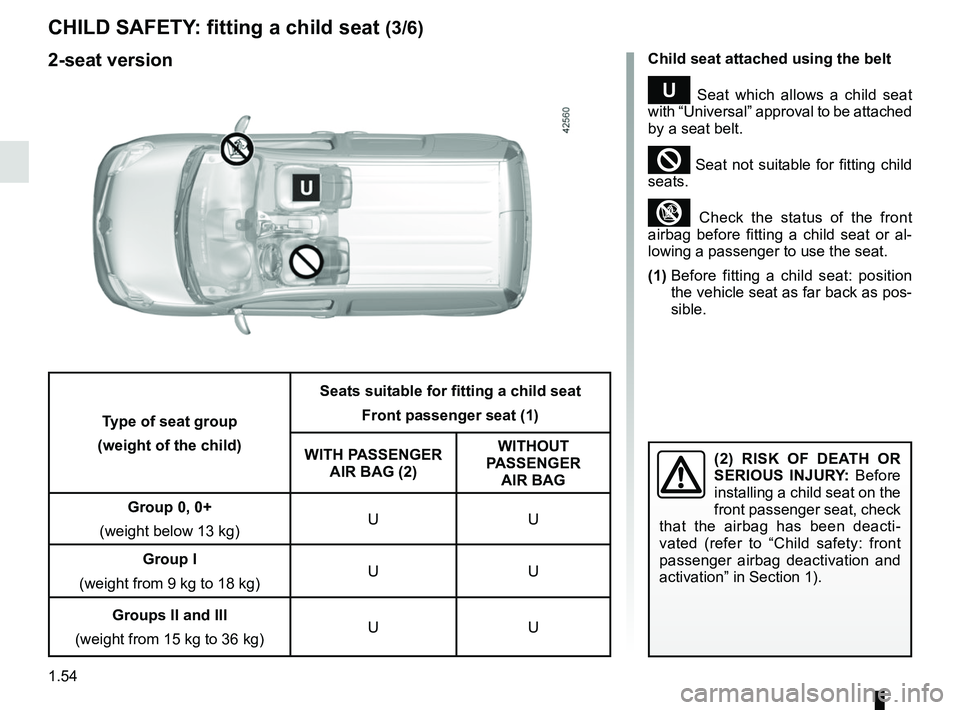
Child seat attached using the belt
¬ Seat which allows a child seat
with “Universal” approval to be attached
by a seat belt.
² Seat not suitable for fitting child
seats.
³ Check the status of the front
airbag before fitting a child seat or al-
lowing a passenger to use the seat.
(1) Before fitting a child seat: position
the vehicle seat as far back as pos-
sible.
Type of seat group
(weight of the child) Seats suitable for fitting a child seat
Front passenger seat (1)
WITH PASSENGER AIR BAG (2) WITHOUT
PASSENGER AIR BAG
Group 0, 0+
(weight below 13 kg) UU
Group I
(weight from 9 kg to 18 kg) UU
Groups II and III
(weight from 15 kg to 36 kg) UU
(2) RISK OF DEATH OR
SERIOUS INJURY: Before
installing a child seat on the
front passenger seat, check
that the airbag has been deacti-
vated (refer to “Child safety: front
passenger airbag deactivation and
activation” in Section 1).
2-seat version
Page 61 of 230
1.55
CHILD SAFETY: fitting a child seat (4/6)
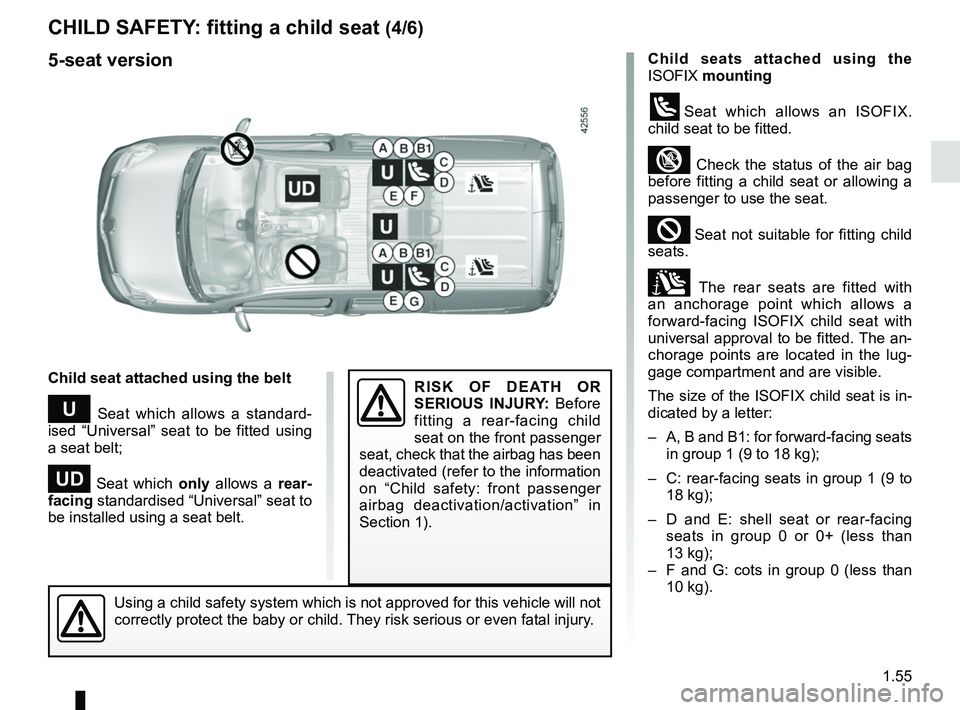
Child seats attached using the
ISOFIX mounting
üSeat which allows an ISOFIX.
child seat to be fitted.
³ Check the status of the air bag
before fitting a child seat or allowing a
passenger to use the seat.
² Seat not suitable for fitting child
seats.
± The rear seats are fitted with
an anchorage point which allows a
forward-facing ISOFIX child seat with
universal approval to be fitted. The an-
chorage points are located in the lug-
gage compartment and are visible.
The size of the ISOFIX child seat is in-
dicated by a letter:
– A, B and B1: for forward-facing seats in group 1 (9 to 18 kg);
– C: rear-facing seats in group 1 (9 to 18 kg);
– D and E: shell seat or rear-facing seats in group 0 or 0+ (less than
13 kg);
– F and G: cots in group 0 (less than 10 kg).
Child seat attached using the belt
¬ Seat which allows a standard-
ised “Universal” seat to be fitted using
a seat belt;
− Seat which only allows a rear-
facing standardised “Universal” seat to
be installed using a seat belt.
Using a child safety system which is not approved for this vehicle will \
not
correctly protect the baby or child. They risk serious or even fatal injury.
RISK OF DEATH OR
SERIOUS INJURY: Before
fitting a rear-facing child
seat on the front passenger
seat, check that the airbag has been
deactivated (refer to the information
on “Child safety: front passenger
airbag deactivation/activation” in
Section 1).
5-seat version
Page 62 of 230
1.56
CHILD SAFETY: fitting a child seat (5/6)
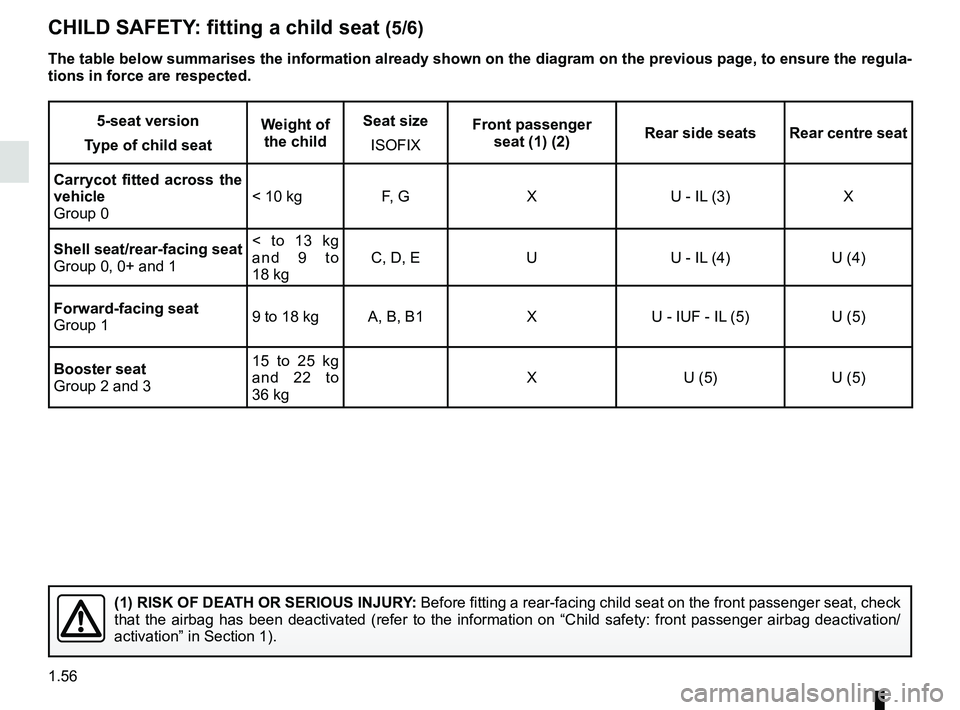
5-seat version
Type of child seat Weight of
the child Seat size
ISOFIX Front passenger
seat (1) (2) Rear side seats Rear centre seat
Carrycot fitted across the
vehicle
Group 0 < 10 kg F, G X U - IL (3) X
Shell seat/rear-facing seat
Group 0, 0+ and 1 < to 13 kg
and 9 to
18 kg
C, D, E U U - IL (4) U (4)
Forward-facing seat
Group 1 9 to 18 kg A, B, B1 X U - IUF - IL (5) U (5)
Booster seat
Group 2 and 3 15 to 25 kg
and 22 to
36 kg
X U (5) U (5)
(1) RISK OF DEATH OR SERIOUS INJURY:
Before fitting a rear-facing child seat on the front passenger seat, ch\
eck
that the airbag has been deactivated (refer to the information on “C\
hild safety: front passenger airbag deactivation/
activation” in Section 1).
The table below summarises the information already shown on the diagram \
on the previous page, to ensure the regula-
tions in force are respected.
Page 63 of 230

1.57
X = Seat not suitable for fitting child seats.
U = Seat which allows a child seat with “Universal” approval to be ins\
talled using a seat belt; check that it can be fitted.
IUF/IL = On equipped vehicles, seat which allows an approved “Universal/semi-u\
niversal” or “vehicle specific” child seat to be at-
tached using the ISOFIX system; check that it can be fitted.
(2) Only a rear-facing child seat can be fitted in this seat: raise the seat\
to the maximum and position it as far back as possible ,
tilting the seatback slightly (approximately 25°).
(3) A carrycot is fitted crosswise and occupies at least two seats (the chil\
d’s feet are placed nearest the door).
(4) Move the front seat as far forward as possible to install a rear-facing \
child seat, then move back the seat in front as far as it will
go, although without allowing it to come into contact with the child sea\
t.
(5) Forward-facing child seat; position the seatback of the child seat in co\
ntact with the seatback of the vehicle seat. Adjust the
headrest, or remove it if necessary. In addition, do not push the seat in front of the child further than h\
alfway along its runners,
or incline the seatback more than 25°.
CHILD SAFETY: fitting a child seat (6/6)
Page 66 of 230
1.60
The passenger airbag must
only be deactivated or acti-
vated when the vehicle is
stationary.
If it is interfered with when the ve-
hicle is being driven, indicator lights
å and © will come on.
Switch the ignition off then on again
to reset the airbag in accordance
with the lock position.
Operating faults
In the event that the front passenger
airbags activation/deactivation system
is faulty, child seats must not be fitted
to the front seat.
Allowing any other passenger to sit in
that seat is not recommended.
Contact your approved Dealer as soon
as possible.
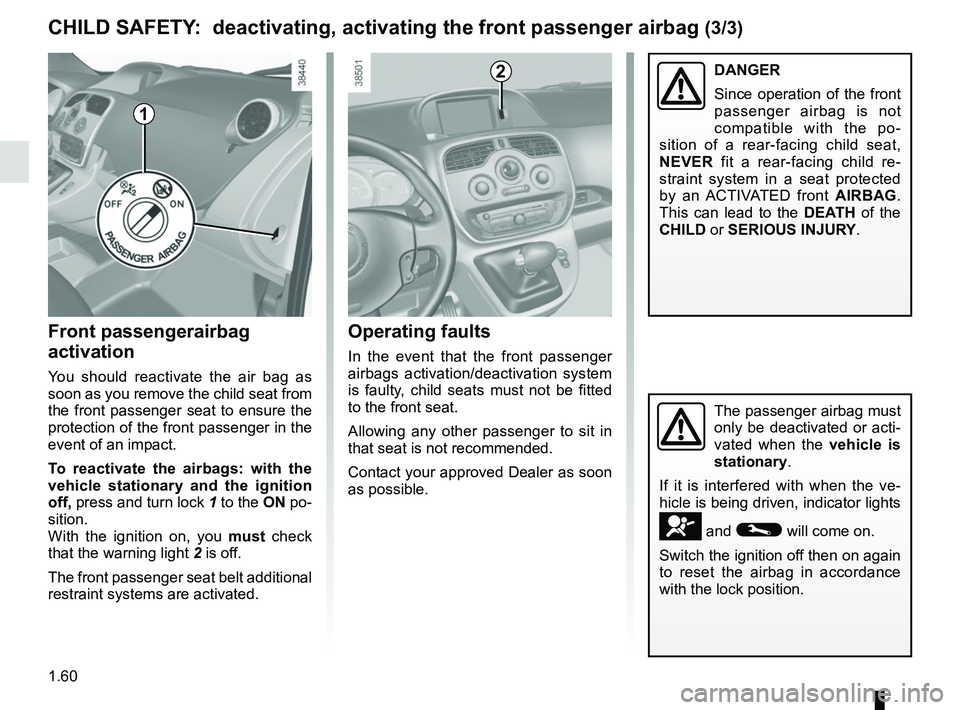
Front passengerairbag
activation
You should reactivate the air bag as
soon as you remove the child seat from
the front passenger seat to ensure the
protection of the front passenger in the
event of an impact.
To reactivate the airbags: with the
vehicle stationary and the ignition
off, press and turn lock 1 to the ON po-
sition.
With the ignition on, you must check
that the warning light 2 is off.
The front passenger seat belt additional
restraint systems are activated.
2
CHILD SAFETY: deactivating, activating the front passenger airbag (3/3)
1
DANGER
Since operation of the front
passenger airbag is not
compatible with the po-
sition of a rear-facing child seat,
NEVER fit a rear-facing child re-
straint system in a seat protected
by an ACTIVATED front AIRBAG. This can lead to the DEATH of the
CHILD or SERIOUS INJURY.
Page 150 of 230
3.22
The headrest is a safety
component; check that it is
fitted and in the correct po-
sition.
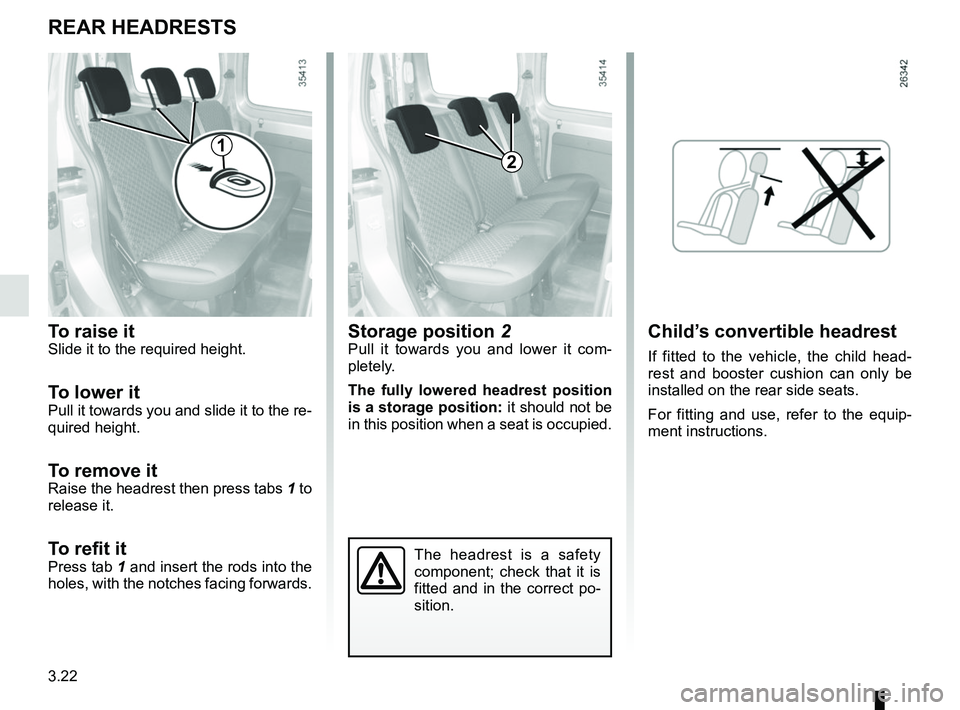
Storage position 2Pull it towards you and lower it com-
pletely.
The fully lowered headrest position
is a storage position: it should not be
in this position when a seat is occupied.To raise itSlide it to the required height.
To lower itPull it towards you and slide it to the re-
quired height.
To remove itRaise the headrest then press tabs 1 to
release it.
To refit itPress tab 1 and insert the rods into the holes, with the notches facing forwards.
REAR HEADRESTS
Child’s convertible headrest
If fitted to the vehicle, the child head-
rest and booster cushion can only be
installed on the rear side seats.
For fitting and use, refer to the equip-
ment instructions.
12