steering RENAULT KANGOO Z.E. 2018 User Guide
[x] Cancel search | Manufacturer: RENAULT, Model Year: 2018, Model line: KANGOO Z.E., Model: RENAULT KANGOO Z.E. 2018Pages: 230, PDF Size: 5.03 MB
Page 103 of 230
2.3
Stopping the engine
With the engine running, turn the key
back to the “Stop” position St. Warning
light
Ṑ goes out.
Driver’s responsibility
when parking or stopping
the vehicle
Never leave an animal,
child or adult who is not self-suffi-
cient alone in your vehicle, even for
a short time.
They may pose a risk to themselves
or to others by starting the engine,
activating equipment such as the
electric windows or locking the
doors, for example.
Also, in hot and/or sunny weather,
please remember that the tempera-
ture inside the passenger compart-
ment increases very quickly.
RISK OF DEATH OR SERIOUS
INJURY.
Never switch off the igni-
tion before the vehicle has
come to a complete stop.
Switching off the engine di-
sables the assistance equipment:
brakes, power-assisted steering,
etc., and the passive safety devices
such as airbagsand pretensioners.
STARTING, STOPPING THE ENGINE (2/2)
Page 106 of 230
2.6
DRIVING ADVICE, ECO-DRIVING (1/2)
The vehicle range depends on vehicle
usage conditions, equipment fitted and
the user’s driving style. To optimise the
energy consumption, please refer to
the following advice.
Depending on the vehicle, you will be
provided with functions which enable
you to lower the energy consumption:
– ECO mode, activated by the ECO button;
– charge meter.
ECO mode
The ECO function optimises vehicle
range by limiting engine performance.
It acts upon certain power consuming
systems in the vehicle (heating, air con-
ditioning, power-assisted steering etc.)
and on certain driving actions (acceler-
ation, cruise control, deceleration etc.). Activating the function
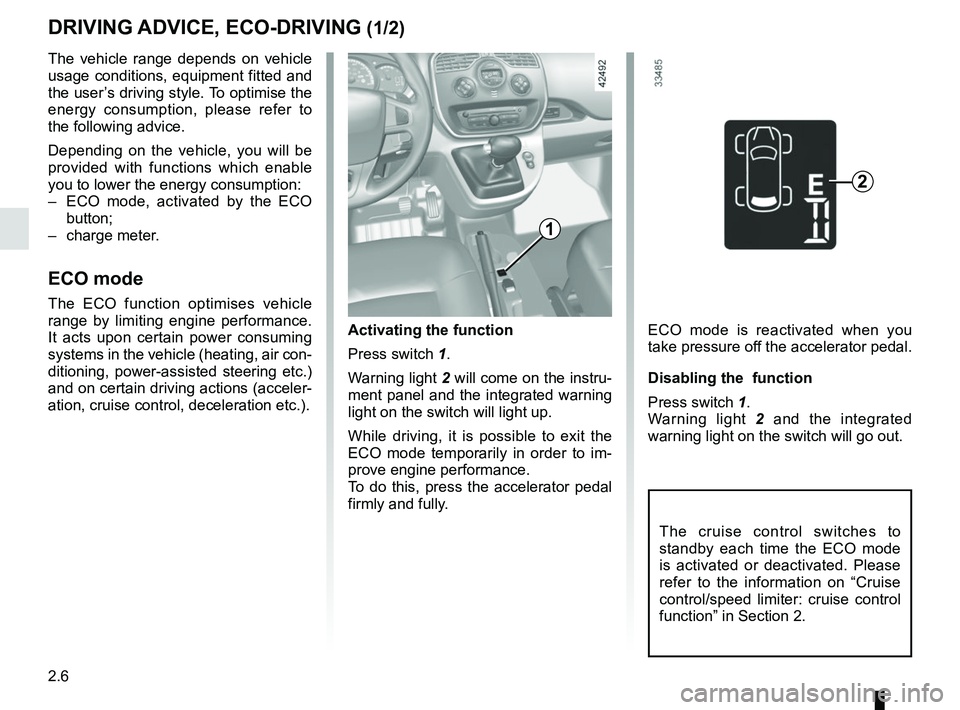
Press switch 1.
Warning light
2 will come on the instru-
ment panel and the integrated warning
light on the switch will light up.
While driving, it is possible to exit the
ECO mode temporarily in order to im-
prove engine performance.
To do this, press the accelerator pedal
firmly and fully.
2
1
ECO mode is reactivated when you
take pressure off the accelerator pedal.
Disabling the function
Press switch 1.
Warning light 2 and the integrated
warning light on the switch will go out.
The cruise control switches to
standby each time the ECO mode
is activated or deactivated. Please
refer to the information on “Cruise
control/speed limiter: cruise control
function” in Section 2.
Page 116 of 230
2.16
DRIVER CORRECTION DEVICES AND AIDS (2/3)
Electronic stability program
ESC with understeer control
and traction control
Electronic stability control ESC
This system helps you to keep control
of the vehicle in critical driving condi-
tions (avoiding an obstacle, loss of grip
on a bend, etc.).
Operating principle
A sensor in the steering wheel detects
the direction selected by the driver.
Other sensors throughout the vehicle
measure the actual direction.
The system compares driver input to
the actual trajectory of the vehicle and
corrects the trajectory if necessary by
controlling the braking of certain wheels
and/or engine power. In the event that
the system is engaged, indicator light
flashes on the instrument panel. Understeer control
This system optimises the action of the
ESC in the case of pronounced under-
steer (loss of front axle road holding).
Traction control
This system helps to limit wheelspin of
the drive wheels and to control the ve-
hicle when pulling away accelerating or
decelerating.
Operating principle
Using the wheel sensors, the system
measures and compares the speed of
the drive wheels at all times and slows
down their over-rotation. If a wheel is
starting to slip, the system brakes au-
tomatically until the drive supplied be-
comes compatible with the level of grip
under the wheel again.
The system also adjusts the engine
speed to the grip available under the
wheels, independently of the pressure
exerted on the accelerator pedal. Operating faults
When the system detects an operating
fault the message “CHECK ESC” and
warning light
© appear on the in-
strument panel. In this case, the ESC
and traction control system are deacti-
vated.
Consult an approved dealer.
Page 128 of 230
2.28
REVERSING CAMERA (2/2)
The screen shows a reverse image.
The frames are a representation
projected onto flat ground; this in-
formation must not be taken into
account when superimposed on a
vertical object or an object on the
ground.
Objects which appear on the edge
of the screen may be deformed.
In very bright light (snow, vehicle in
sunshine etc.), the camera vision
may be adversely affected.
If the rear doors are open or poorly
closed, the camera display disap-
pears and, depending on the ve-
hicle, the message “BOOT OPEN”
appears.
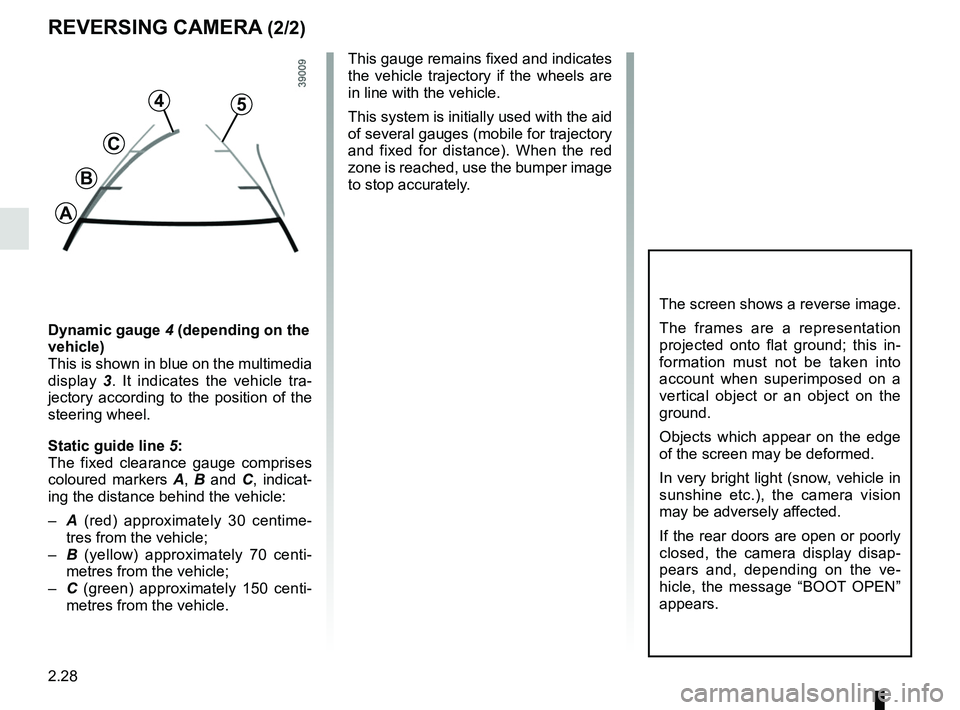
Dynamic gauge 4 (depending on the
vehicle)
This is shown in blue on the multimedia
display 3. It indicates the vehicle tra-
jectory according to the position of the
steering wheel.
Static guide line 5:
The fixed clearance gauge comprises
coloured markers A, B and C , indicat-
ing the distance behind the vehicle:
– A (red) approximately 30 centime-
tres from the vehicle;
– B (yellow) approximately 70 centi-
metres from the vehicle;
– C (green) approximately 150 centi-
metres from the vehicle. This gauge remains fixed and indicates
the vehicle trajectory if the wheels are
in line with the vehicle.
This system is initially used with the aid
of several gauges (mobile for trajectory
and fixed for distance). When the red
zone is reached, use the bumper image
to stop accurately.
4
C
B
A
5
Page 142 of 230
3.14
MULTIMEDIA EQUIPMENT
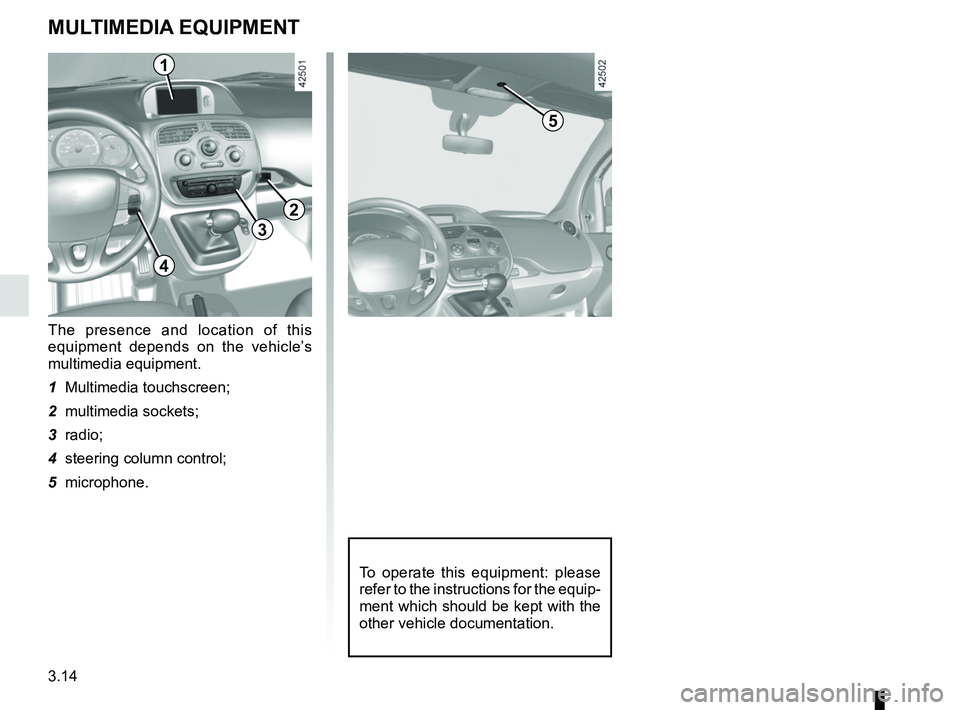
The presence and location of this
equipment depends on the vehicle’s
multimedia equipment.
1 Multimedia touchscreen;
2 multimedia sockets;
3 radio;
4 steering column control;
5 microphone.
To operate this equipment: please
refer to the instructions for the equip-
ment which should be kept with the
other vehicle documentation.
1
3
2
4
5
Page 193 of 230
5.25
Choice of breakdown service
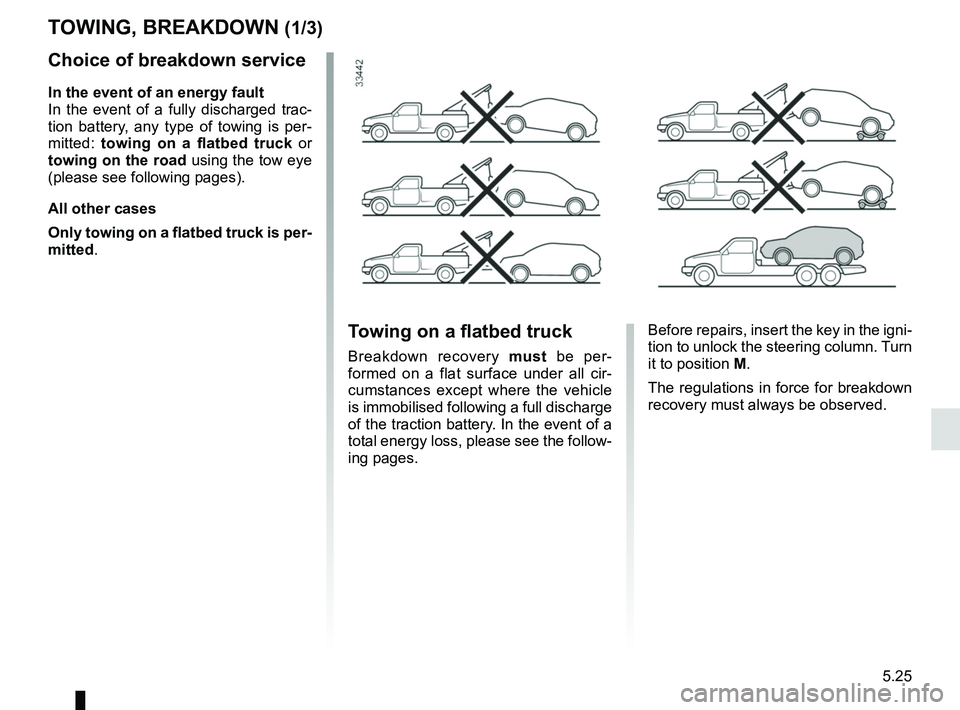
In the event of an energy fault
In the event of a fully discharged trac-
tion battery, any type of towing is per-
mitted: towing on a flatbed truck or
towing on the road using the tow eye
(please see following pages).
All other cases
Only towing on a flatbed truck is per-
mitted.
TOWING, BREAKDOWN (1/3)
Before repairs, insert the key in the igni-
tion to unlock the steering column. Turn
it to position M.
The regulations in force for breakdown
recovery must always be observed.Towing on a flatbed truck
Breakdown recovery must be per-
formed on a flat surface under all cir-
cumstances except where the vehicle
is immobilised following a full discharge
of the traction battery. In the event of a
total energy loss, please see the follow-
ing pages.
Page 194 of 230
5.26
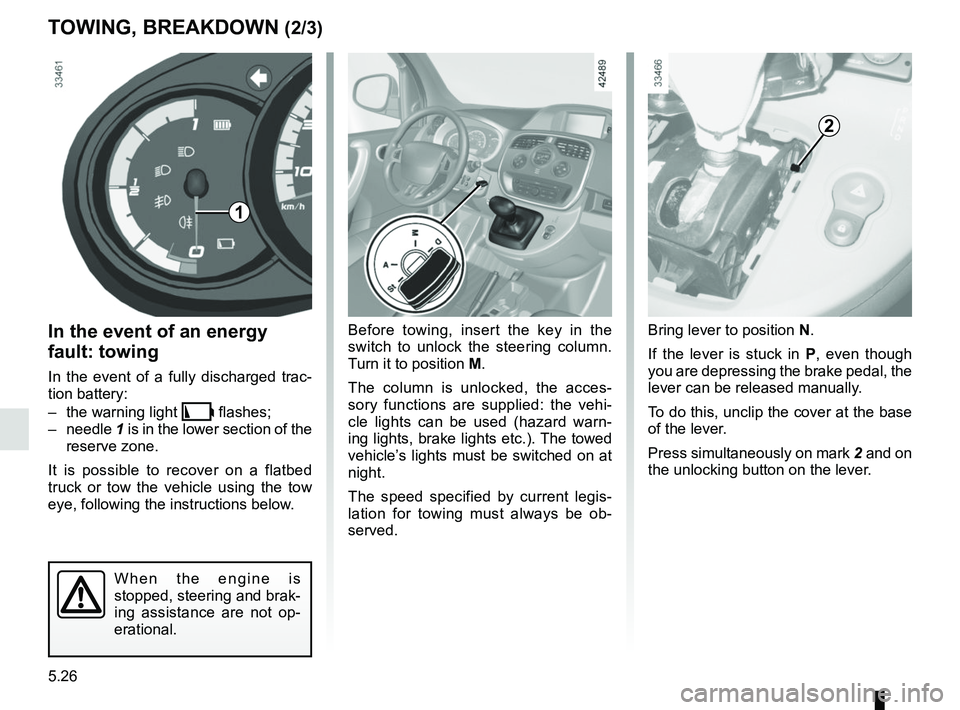
Bring lever to position N.
If the lever is stuck in P , even though
you are depressing the brake pedal, the
lever can be released manually.
To do this, unclip the cover at the base
of the lever.
Press simultaneously on mark 2 and on
the unlocking button on the lever.
TOWING, BREAKDOWN (2/3)
In the event of an energy
fault: towing
In the event of a fully discharged trac-
tion battery:
– the warning light
Ṏ flashes;
– needle 1 is in the lower section of the
reserve zone.
It is possible to recover on a flatbed
truck or tow the vehicle using the tow
eye, following the instructions below.
When the engine is
stopped, steering and brak-
ing assistance are not op-
erational.
Before towing, insert the key in the
switch to unlock the steering column.
Turn it to position M.
The column is unlocked, the acces-
sory functions are supplied: the vehi-
cle lights can be used (hazard warn-
ing lights, brake lights etc.). The towed
vehicle’s lights must be switched on at
night.
The speed specified by current legis-
lation for towing must always be ob-
served.
4
1
2
Page 202 of 230
5.34
On the roadPOSSIBLE CAUSESWHAT TO DO
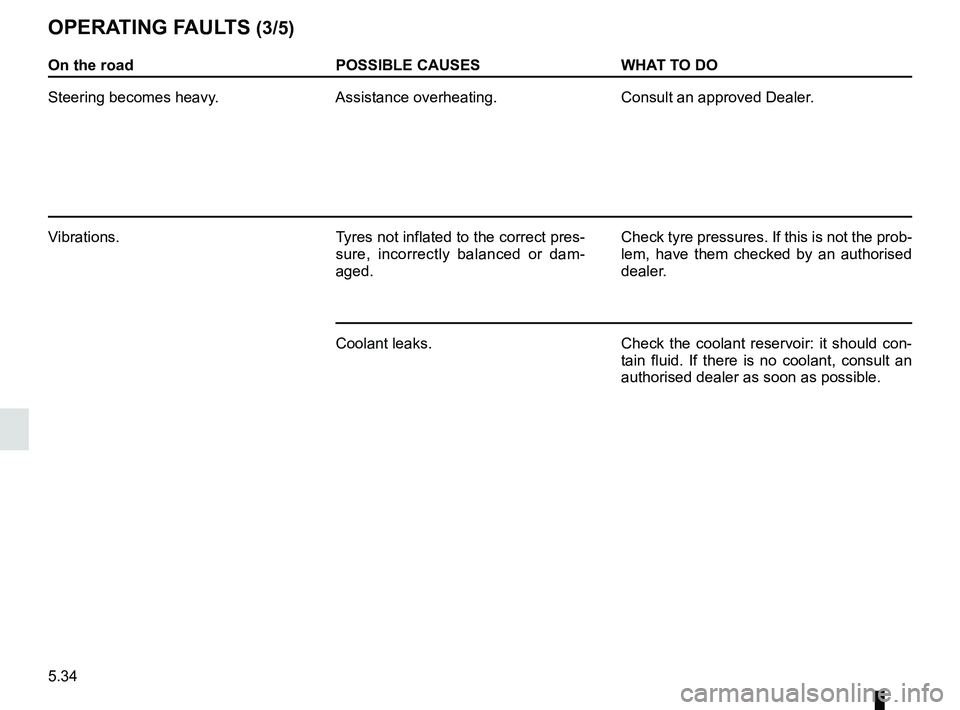
Steering becomes heavy. Assistance overheating.Consult an approved Dealer.
Vibrations. Tyres not inflated to the correct pres-
sure, incorrectly balanced or dam-
aged. Check tyre pressures. If this is not the prob-
lem, have them checked by an authorised
dealer.
Coolant leaks. Check the coolant reservoir: it should con-
tain fluid. If there is no coolant, consult an
authorised dealer as soon as possible.
OPERATING FAULTS (3/5)
Page 226 of 230

7.4
ALPHABETICAL INDEX (4/5)
pedestrian warning system ................................................ 1.84
power-assisted steering..................................................... 1.61
practical advice ..........................................................2.6 → 2.9
presentation of the electric vehicle batteries ..............................................................\
.1.2 → 1.7
pretensioners ..........................................................\
........... 1.41
puncture........................................................................\
5.6, 5.8
R
radio........................................................................\
.. 3.14, 5.28
radio frequency remote control/key use ....................................................................\
.. 1.17, 1.19
range of the traction battery........................................ 2.6 – 2.7
rear bench seat....................................................... 3.23 – 3.24
rear lights changing bulbs .................................................5.16 → 5.18
rear screen demisting ..............................................................\
......... 3.2
rear seats functions ........................................................... 3.23 – 3.24
rear view camera .................................................... 2.27 – 2.28
rear view mirrors ................................................................ 1.82
remote control door locking batteries ..............................................................\
......... 5.31
remote control electric door locking .......................... 1.17, 1.19
RENAULT ANTI-INTRUDER DEVICE (RAID) ................... 1.28
replacement parts ................................................................ 6.7
reverse gear selecting ................................................................ 2.4 – 2.5
reversing sensor ..................................................... 2.25 – 2.26
S
seat belts ...............................................................1.37 → 1.45
see-me-home lighting ........................................................ 1.86
service sheets..........................................................6.8 → 6.13side indicator lights
changing bulbs ............................................................. 5.19
side protection devices ...................................................... 1.44
signals and lights ...................................................1.85 → 1.87
speed control .............................................................. 2.4 – 2.5
speed limiter ..........................................................2.18 → 2.20
steering wheel adjustment .............................................................\
...... 1.61
storage compartment.............................................3.19 → 3.21
storage compartments ...........................................3.19 → 3.21
sun visor ................................................................... 3.16, 3.21
T
tailgate ................................................ 1.24 – 1.25, 3.25 – 3.26
tanks and reservoirs brake fluid ...................................................................... 4.5
coolant ................................................................\
........... 4.4
tanks and reservoirs: windscreen washer ........................................................ 4.5
technical specifications .......................................6.2, 6.4 → 6.7
temperature regulation ........................................... 3.12 – 3.13
tool kit ........................................................................\
.......... 5.6
towing in the event of energy failure ...........................5.25 → 5.27
breakdown .......................................................5.25 → 5.27
towing equipment fitting ................................................................\
............ 3.26
towing hitch...................................................... 5.6, 5.26 – 5.27
towing rings ...........................................................1.49 → 1.51
traction battery charge .................................................................\
........... 1.9
traction battery ...........................................................1.2 → 1.8
traction battery charge ....................................1.9 → 1.16, 1.19
traction control .......................................................2.15 → 2.17
transporting children ..........................1.46 – 1.47, 1.49 → 1.60