tow RENAULT KANGOO Z.E. 2018 User Guide
[x] Cancel search | Manufacturer: RENAULT, Model Year: 2018, Model line: KANGOO Z.E., Model: RENAULT KANGOO Z.E. 2018Pages: 230, PDF Size: 5.03 MB
Page 133 of 230
3.5
iThe air flow is directed to the
windscreen demisting vents,
the side windows and the passenger
footwells.
This is the recommended position for
the best temperature in cold weather.
óThe air flow is directed mainly
towards the footwells.
GThe air flow is directed to all air
vents and the footwells.
This is the recommended position for
the best temperature in hot weather.
JThe air flow is directed mainly
to the dashboard vents.
Rapid demisting
Turn the controls to the positions W:
– air from the outside;
– maximum temperature;
– demisting.
Using the climate control increases the
speed of demisting.
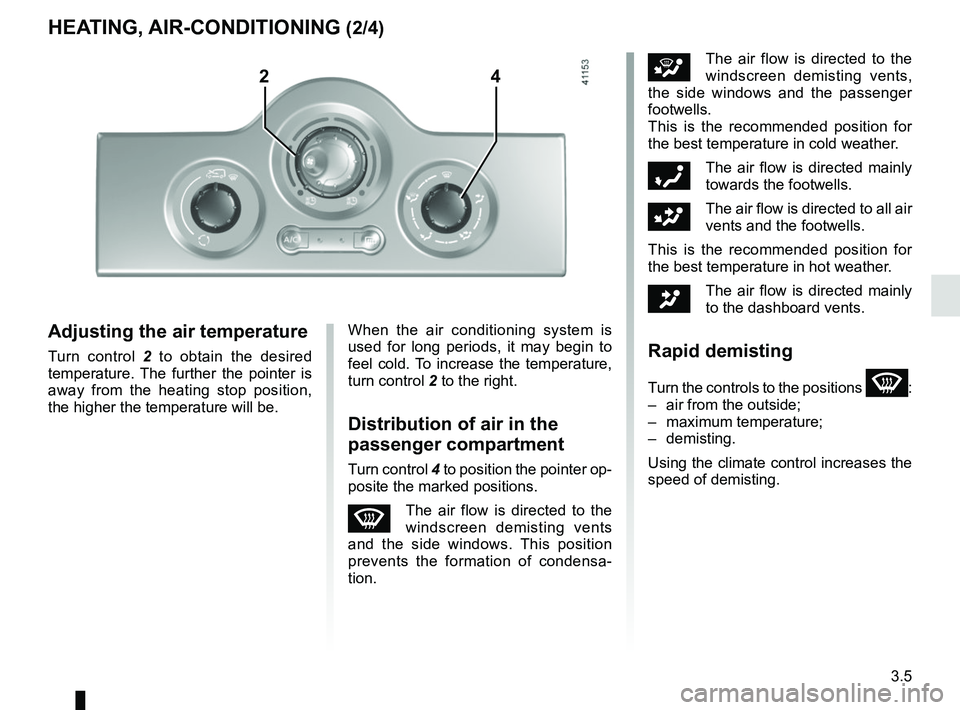
Adjusting the air temperature
Turn control 2 to obtain the desired
temperature. The further the pointer is
away from the heating stop position,
the higher the temperature will be.
HEATING, AIR-CONDITIONING (2/4)
When the air conditioning system is
used for long periods, it may begin to
feel cold. To increase the temperature,
turn control 2 to the right.
Distribution of air in the
passenger compartment
Turn control 4 to position the pointer op-
posite the marked positions.
WThe air flow is directed to the
windscreen demisting vents
and the side windows. This position
prevents the formation of condensa-
tion.
24
Page 135 of 230
3.7
HEATING, AIR-CONDITIONING (4/4)
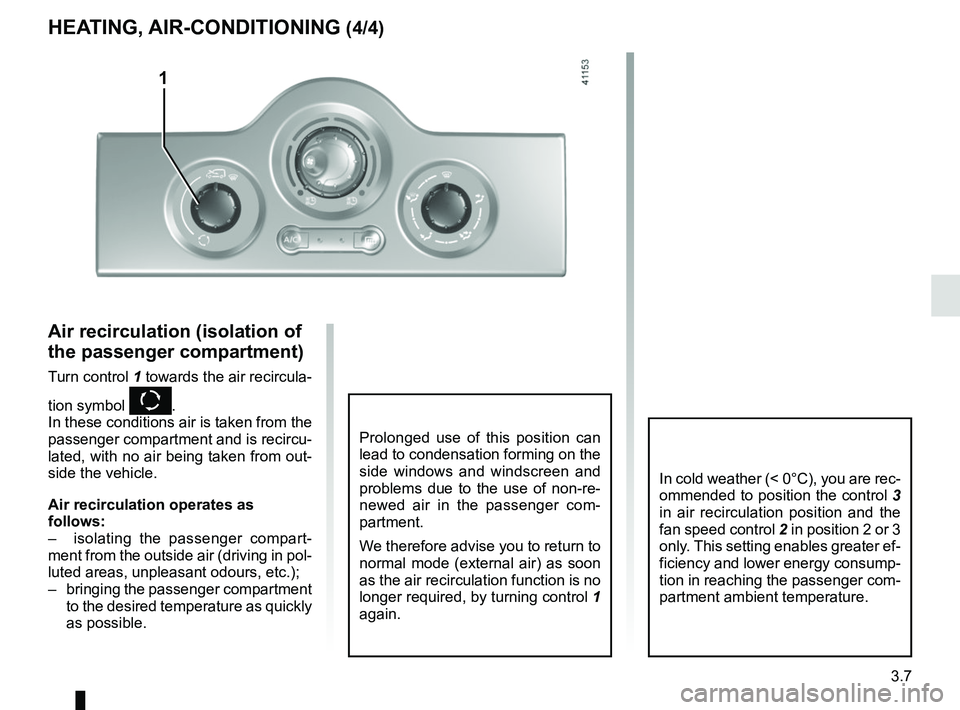
Air recirculation (isolation of
the passenger compartment)
Turn control 1 towards the air recircula-
tion symbol
K.
In these conditions air is taken from the
passenger compartment and is recircu-
lated, with no air being taken from out-
side the vehicle.
Air recirculation operates as
follows:
– isolating the passenger compart-
ment from the outside air (driving in pol-
luted areas, unpleasant odours, etc.);
– bringing the passenger compartment to the desired temperature as quickly
as possible.
Prolonged use of this position can
lead to condensation forming on the
side windows and windscreen and
problems due to the use of non-re-
newed air in the passenger com-
partment.
We therefore advise you to return to
normal mode (external air) as soon
as the air recirculation function is no
longer required, by turning control 1
again.
1
In cold weather (< 0°C), you are rec-
ommended to position the control 3
in air recirculation position and the
fan speed control 2 in position 2 or 3
only. This setting enables greater ef-
ficiency and lower energy consump-
tion in reaching the passenger com-
partment ambient temperature.
Page 150 of 230
3.22
The headrest is a safety
component; check that it is
fitted and in the correct po-
sition.
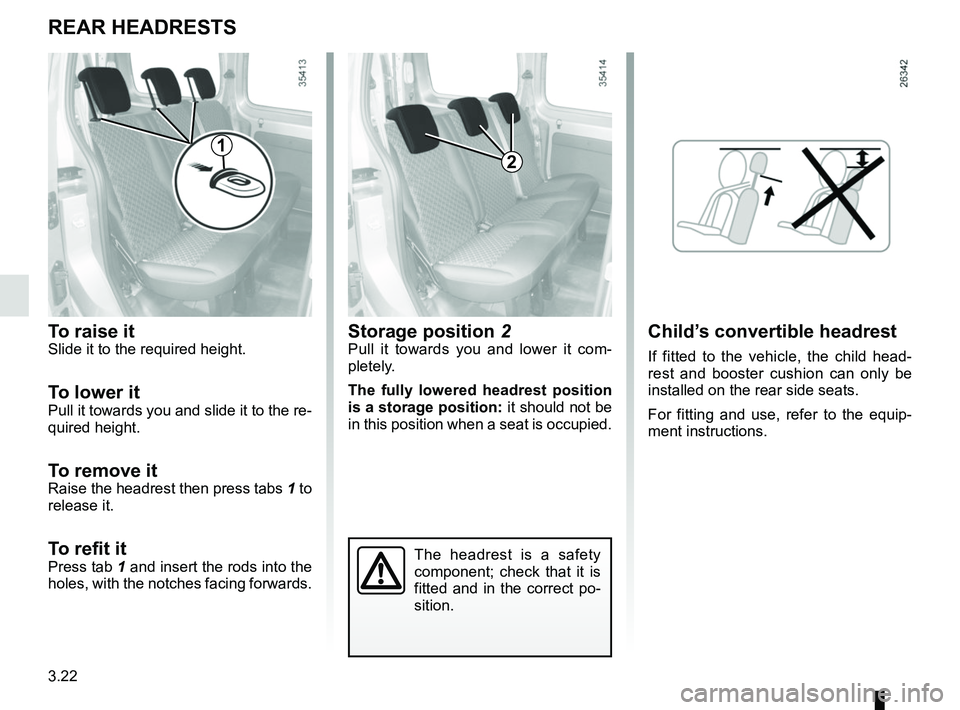
Storage position 2Pull it towards you and lower it com-
pletely.
The fully lowered headrest position
is a storage position: it should not be
in this position when a seat is occupied.To raise itSlide it to the required height.
To lower itPull it towards you and slide it to the re-
quired height.
To remove itRaise the headrest then press tabs 1 to
release it.
To refit itPress tab 1 and insert the rods into the holes, with the notches facing forwards.
REAR HEADRESTS
Child’s convertible headrest
If fitted to the vehicle, the child head-
rest and booster cushion can only be
installed on the rear side seats.
For fitting and use, refer to the equip-
ment instructions.
12
Page 154 of 230
3.26
TRANSPORTING OBJECTS IN THE BOOT (2/2)/TOWING
If the towbar ball obscures the regis-
tration plate or the rear fog lights, it
should be removed when not in use.
In all cases, comply with local leg-
islation.
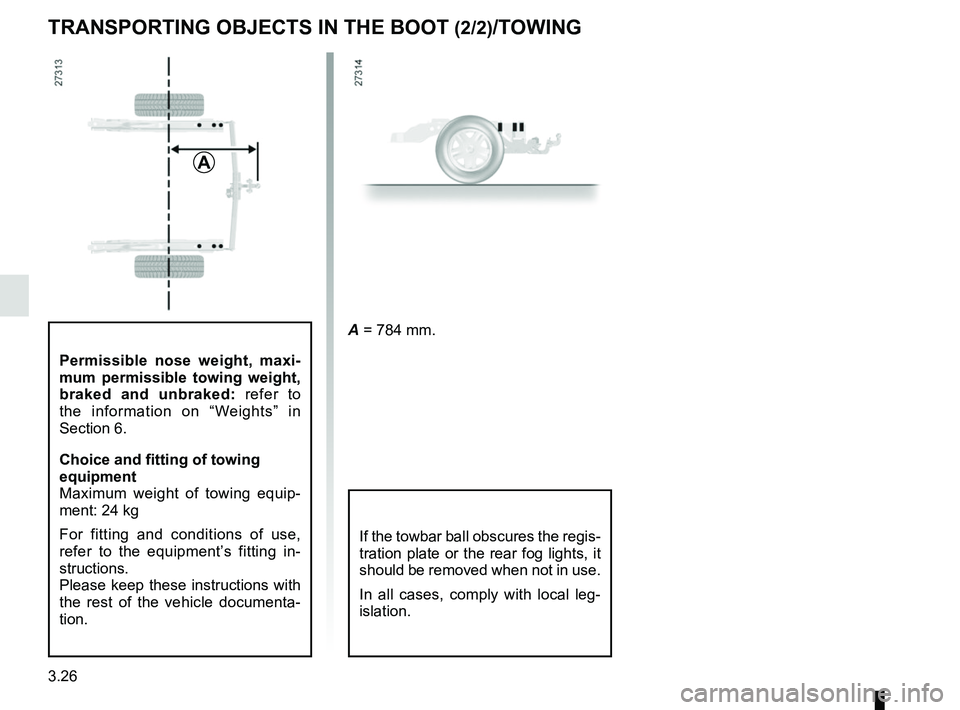
A = 784 mm.
A
Permissible nose weight, maxi-
mum permissible towing weight,
braked and unbraked: refer to
the information on “Weights” in
Section 6.
Choice and fitting of towing
equipment
Maximum weight of towing equip-
ment: 24 kg
For fitting and conditions of use,
refer to the equipment’s fitting in-
structions.
Please keep these instructions with
the rest of the vehicle documenta-
tion.
Page 162 of 230
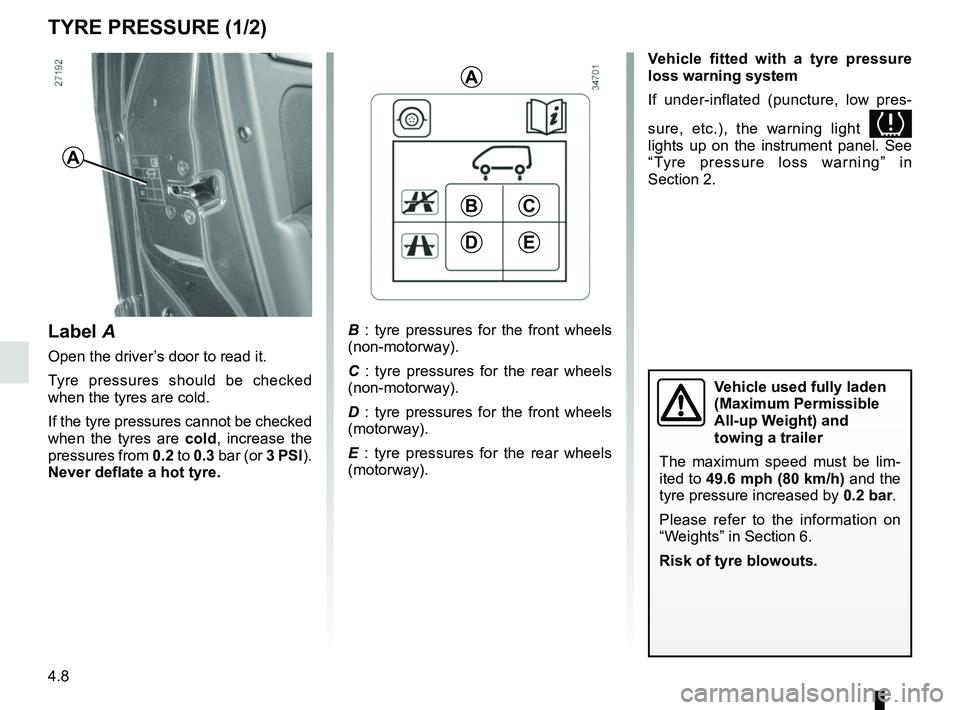
4.8
A
B : tyre pressures for the front wheels
(non-motorway).
C : tyre pressures for the rear wheels
(non-motorway).
D : tyre pressures for the front wheels
(motorway).
E : tyre pressures for the rear wheels
(motorway).
BC
ED
A
Label A
Open the driver’s door to read it.
Tyre pressures should be checked
when the tyres are cold.
If the tyre pressures cannot be checked
when the tyres are cold, increase the
pressures from 0.2 to 0.3 bar (or 3 PSI).
Never deflate a hot tyre.
TYRE PRESSURE (1/2)
Vehicle used fully laden
(Maximum Permissible
All-up Weight) and
towing a trailer
The maximum speed must be lim-
ited to 49.6 mph (80 km/h) and the tyre pressure increased by 0.2 bar.
Please refer to the information on
“Weights” in Section 6.
Risk of tyre blowouts.
Vehicle fitted with a tyre pressure
loss warning system
If under-inflated (puncture, low pres-
sure, etc.), the warning light
lights up on the instrument panel. See
“Tyre pressure loss warning” in
Section 2.
Page 169 of 230

5.1
Section 5: Practical advice
Puncture . . . . . . . . . . . . . . . . . . . . . . . . . . . . . . . . . . . .\
. . . . . . . . . . . . . . . . . . . . . . . . . . . . . . . . . . 5.2
Emergency spare wheel . . . . . . . . . . . . . . . . . . . . . . . . . . . . . . . . . . . .\
. . . . . . . . . . . . . . . . . . . . . . 5.2
Tyre inflation kit . . . . . . . . . . . . . . . . . . . . . . . . . . . . . . . . . . . .\
. . . . . . . . . . . . . . . . . . . . . . . . . . . . . 5.3
Tool kit . . . . . . . . . . . . . . . . . . . . . . . . . . . . . . . . . . . . \
. . . . . . . . . . . . . . . . . . . . . . . . . . . . . . . . . . . . 5.6
Wheels, trim . . . . . . . . . . . . . . . . . . . . . . . . . . . . . . . . . . . . \
. . . . . . . . . . . . . . . . . . . . . . . . . . . . . . . . 5.7
Changing a wheel . . . . . . . . . . . . . . . . . . . . . . . . . . . . . . . . . . . .\
. . . . . . . . . . . . . . . . . . . . . . . . . . . 5.8
Tyres . . . . . . . . . . . . . . . . . . . . . . . . . . . . . . . . . . . .\
. . . . . . . . . . . . . . . . . . . . . . . . . . . . . . . . . . . . . 5.10
Headlights: changing bulbs . . . . . . . . . . . . . . . . . . . . . . . . . . . . . . . . . . . . \
. . . . . . . . . . . . . . . . . . . . 5.13
Fog lights: changing bulbs . . . . . . . . . . . . . . . . . . . . . . . . . . . . . . . . . . . . \
. . . . . . . . . . . . . . . . . . . . . 5.15
Rear lights: changing bulbs . . . . . . . . . . . . . . . . . . . . . . . . . . . . . . . . . . . . \
. . . . . . . . . . . . . . . . . . . . 5.16
Indicator lights: changing bulbs . . . . . . . . . . . . . . . . . . . . . . . . . . . . . . . . . . . . \
. . . . . . . . . . . . . . . . . 5.19
Interior lighting: changing bulbs . . . . . . . . . . . . . . . . . . . . . . . . . . . . . . . . . . . . \
. . . . . . . . . . . . . . . . . 5.20
Fuses . . . . . . . . . . . . . . . . . . . . . . . . . . . . . . . . . . . . \
. . . . . . . . . . . . . . . . . . . . . . . . . . . . . . . . . . . . . 5.21
Wiper blades . . . . . . . . . . . . . . . . . . . . . . . . . . . . . . . . . . . .\
. . . . . . . . . . . . . . . . . . . . . . . . . . . . . . . 5.23
Towing/breakdown . . . . . . . . . . . . . . . . . . . . . . . . . . . . . . . . . . . . \
. . . . . . . . . . . . . . . . . . . . . . . . . . . 5.25
Fitting a radio . . . . . . . . . . . . . . . . . . . . . . . . . . . . . . . . . . . . \
. . . . . . . . . . . . . . . . . . . . . . . . . . . . . . . 5.28
Accessories . . . . . . . . . . . . . . . . . . . . . . . . . . . . . . . . . . . . \
. . . . . . . . . . . . . . . . . . . . . . . . . . . . . . . . 5.29
Radio frequency remote control: batteries. . . . . . . . . . . . . . . . . . . . . . . . . . . . . . . . . . . . \
. . . . . . . . . 5.31
Operating faults . . . . . . . . . . . . . . . . . . . . . . . . . . . . . . . . . . . . \
. . . . . . . . . . . . . . . . . . . . . . . . . . . . . 5.32
Page 174 of 230
5.6
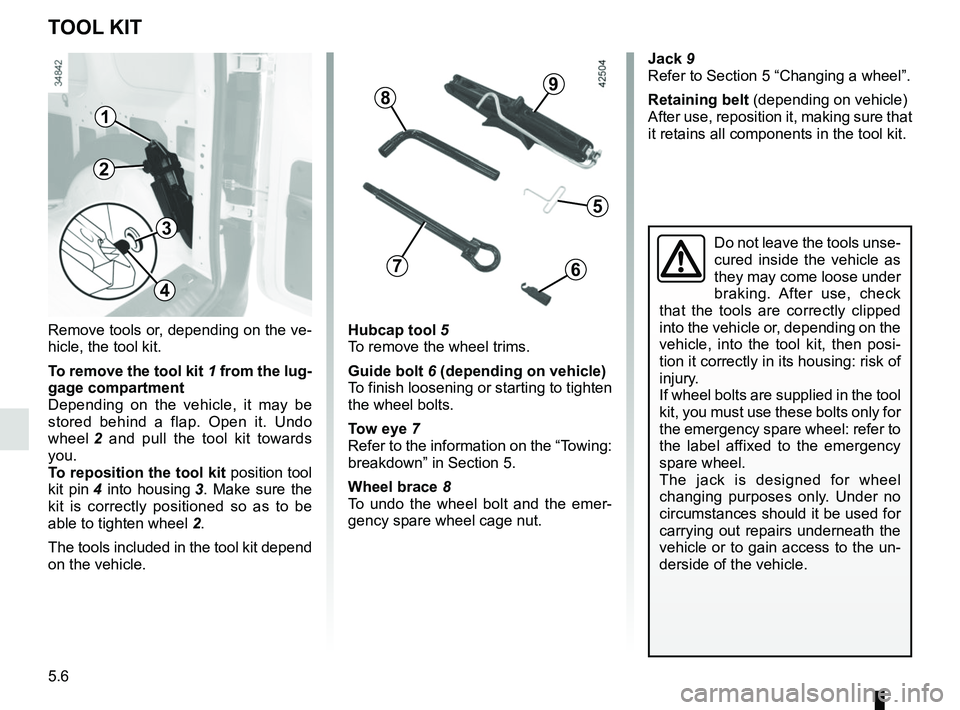
Remove tools or, depending on the ve-
hicle, the tool kit.
To remove the tool kit 1 from the lug-
gage compartment
Depending on the vehicle, it may be
stored behind a flap. Open it. Undo
wheel 2 and pull the tool kit towards
you.
To reposition the tool kit position tool
kit pin 4 into housing 3. Make sure the
kit is correctly positioned so as to be
able to tighten wheel 2.
The tools included in the tool kit depend
on the vehicle.
TOOL KIT
1
3
2
4
Do not leave the tools unse-
cured inside the vehicle as
they may come loose under
braking. After use, check
that the tools are correctly clipped
into the vehicle or, depending on the
vehicle, into the tool kit, then posi-
tion it correctly in its housing: risk of
injury.
If wheel bolts are supplied in the tool
kit, you must use these bolts only for
the emergency spare wheel: refer to
the label affixed to the emergency
spare wheel.
The jack is designed for wheel
changing purposes only. Under no
circumstances should it be used for
carrying out repairs underneath the
vehicle or to gain access to the un-
derside of the vehicle.
Jack 9
Refer to Section 5 “Changing a wheel”.
Retaining belt (depending on vehicle)
After use, reposition it, making sure that
it retains all components in the tool kit.
5
67
89
Hubcap tool 5
To remove the wheel trims.
Guide bolt 6 (depending on vehicle)
To finish loosening or starting to tighten
the wheel bolts.
Tow eye 7 Refer to the information on the “Towing:
breakdown” in Section 5.
Wheel brace 8
To undo the wheel bolt and the emer-
gency spare wheel cage nut.
Page 184 of 230
5.16
The bulbs are under pres-
sure and can break when
replaced.
Risk of injury.
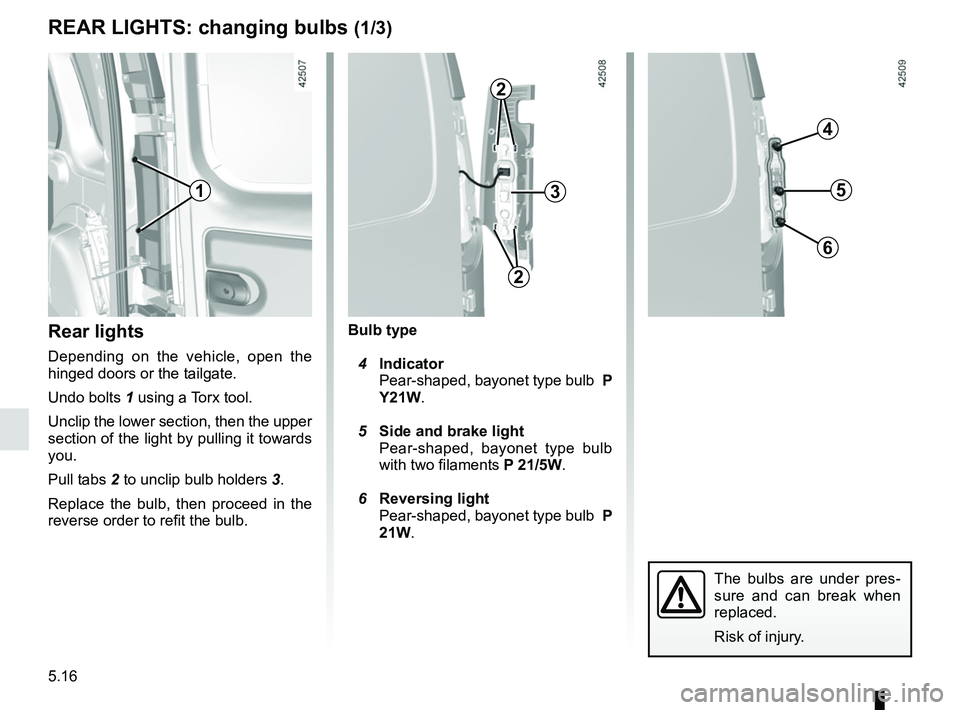
Bulb type
4 Indicator
Pear-shaped, bayonet type bulb P
Y21W.
5 Side and brake light
Pear-shaped, bayonet type bulb
with two filaments P 21/5W.
6 Reversing light
Pear-shaped, bayonet type bulb P
21W.Rear lights
Depending on the vehicle, open the
hinged doors or the tailgate.
Undo bolts 1 using a Torx tool.
Unclip the lower section, then the upper
section of the light by pulling it towards
you.
Pull tabs 2 to unclip bulb holders 3.
Replace the bulb, then proceed in the
reverse order to refit the bulb.
REAR LIGHTS: changing bulbs (1/3)
31
2
2
5
4
6
Page 190 of 230

5.22
FUSES (2/2)
Number Allocation
1 Not used
2 Not used
3 Air conditioning, pedestrian
horn
4 heating, traction battery
5 Rear windscreen wiper
6 Horn, diagnostic socket
7 Heated seats, telematic box
8 Traction battery
9 Passenger compartment
ECU
10 Windscreen washer
11 Brake lights
12 Passenger compartment
ECU
13 Electric window, ECO mode
14 Heated rear screen
15 Starter
12
3456
78910
11121314
15161718
19202122
23242526
27
28
29
Allocation of fusesThe presence of certain fuses de-
pends on the vehicle equipment
level.
Number Allocation
16 Brake lights, additional
equipment, ABS, ESP,
luggage compartment light,
courtesy light, rain and light
sensor
17 Radio, navigation system,
display, alarm
18 Additional equipment
19 Heated door mirrors
20 Hazard lights, rear fog lights
21 Central locking of opening
elements
22 Instrument panel
23 Not used
24 Radio, heated seats, brake
lights
25 Front accessories socket
26 Towbar
27 Electric front windows
28 Rear-view mirror control
29 Passenger compartment
motor-driven fan assembly
Page 193 of 230
5.25
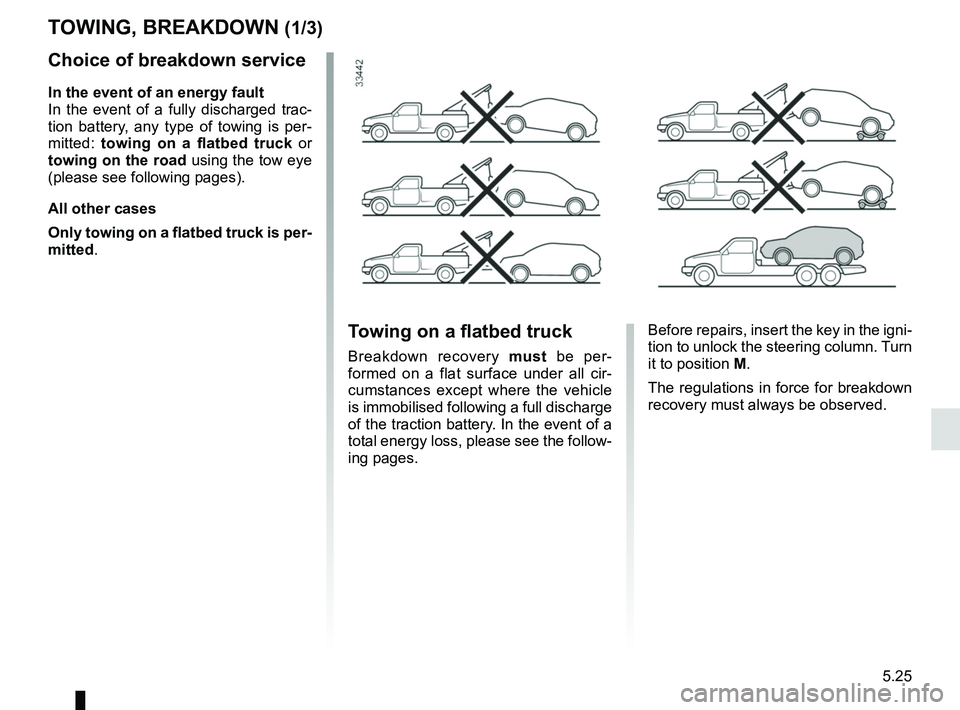
Choice of breakdown service
In the event of an energy fault
In the event of a fully discharged trac-
tion battery, any type of towing is per-
mitted: towing on a flatbed truck or
towing on the road using the tow eye
(please see following pages).
All other cases
Only towing on a flatbed truck is per-
mitted.
TOWING, BREAKDOWN (1/3)
Before repairs, insert the key in the igni-
tion to unlock the steering column. Turn
it to position M.
The regulations in force for breakdown
recovery must always be observed.Towing on a flatbed truck
Breakdown recovery must be per-
formed on a flat surface under all cir-
cumstances except where the vehicle
is immobilised following a full discharge
of the traction battery. In the event of a
total energy loss, please see the follow-
ing pages.