heating RENAULT KANGOO Z.E. 2018 Owner's Manual
[x] Cancel search | Manufacturer: RENAULT, Model Year: 2018, Model line: KANGOO Z.E., Model: RENAULT KANGOO Z.E. 2018Pages: 230, PDF Size: 5.03 MB
Page 136 of 230
3.8
AIR CONDITIONING, HEATING: programming (1/2)
Adjusting the programming
This function enables the electric net-
work (and the not the traction battery)
to be used under certain conditions, in
order to obtain a comfortable tempera-
ture prior to using the vehicle.
It triggers the heating in cold weather
and the air conditioning in warm
weather.
1
Operating conditions
– The ignition must be switched off;
– the battery must be charged more than 90% for the function to be trig-
gered;
– the vehicle has to be plugged into the mains;
and
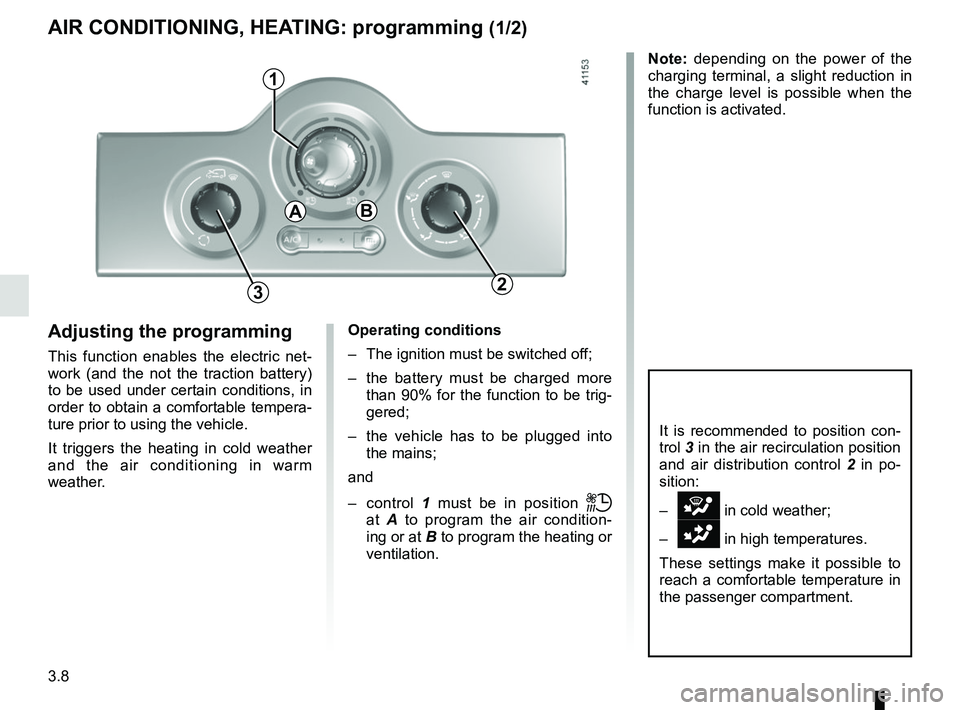
– control 1 must be in position
ṗ
at A to program the air condition-
ing or at B to program the heating or
ventilation.
3
It is recommended to position con-
trol 3 in the air recirculation position
and air distribution control 2 in po-
sition:
–
i in cold weather;
–
G in high temperatures.
These settings make it possible to
reach a comfortable temperature in
the passenger compartment.
AB
2
Note: depending on the power of the
charging terminal, a slight reduction in
the charge level is possible when the
function is activated.
Page 137 of 230
3.9
AIR CONDITIONING, HEATING: programming (2/2)
Activating the function
– With the ignition on, position the con-trol 1 in one of the
ṗ positions;
– turn off the ignition. The “COMFORT” message and the programmed time
are displayed on the instrument
panel for a few seconds;
– wait approximately one minute before charging your vehicle;
– plug in your vehicle to a power supply (refer to the information on “Electric
vehicle: charging” in section 1).
The function switches on during the
hour preceding the programmed time in
order to reach a comfortable tempera-
ture.
Automatically switching off the
function
– About 10 minutes after the pro- grammed time;
– if the charging socket is discon- nected;
– if control 1 is not in one of the
ṗ
positions.
4
5
C
D
Setting the start time for the
function
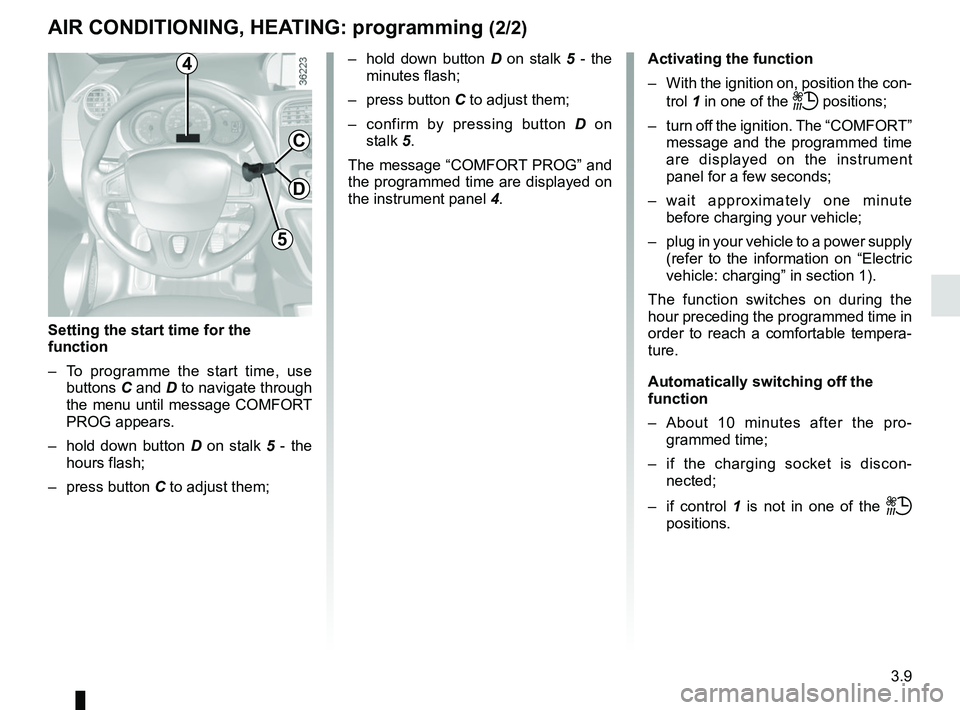
– To programme the start time, use buttons C and D to navigate through
the menu until message COMFORT
PROG appears.
– hold down button D on stalk 5 - the
hours flash;
– press button C to adjust them; – hold down button
D on stalk 5 - the
minutes flash;
– press button C to adjust them;
– confirm by pressing button D on
stalk 5.
The message “COMFORT PROG” and
the programmed time are displayed on
the instrument panel 4.
Page 138 of 230
3.10
Conditions of use
– The engine must be running;
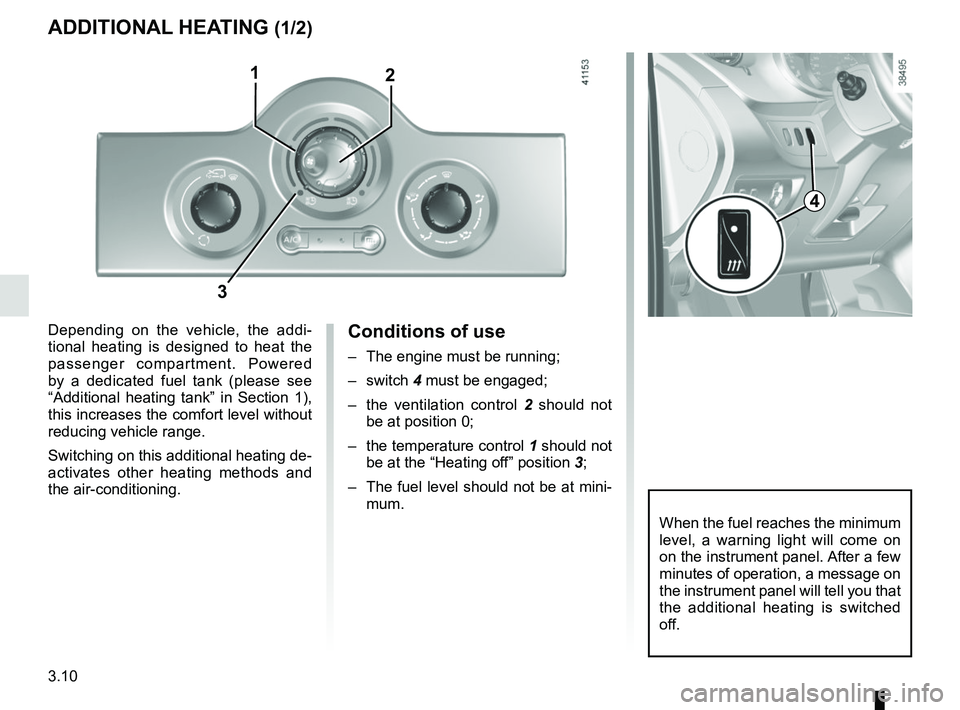
– switch 4 must be engaged;
– the ventilation control 2 should not
be at position 0;
– the temperature control 1 should not
be at the “Heating off” position 3;
– The fuel level should not be at mini- mum.
ADDITIONAL HEATING (1/2)
Depending on the vehicle, the addi-
tional heating is designed to heat the
passenger compartment. Powered
by a dedicated fuel tank (please see
“Additional heating tank” in Section 1),
this increases the comfort level without
reducing vehicle range.
Switching on this additional heating de-
activates other heating methods and
the air-conditioning.
2
When the fuel reaches the minimum
level, a warning light will come on
on the instrument panel. After a few
minutes of operation, a message on
the instrument panel will tell you that
the additional heating is switched
off.
3
1
4
Page 139 of 230
3.11
ADDITIONAL HEATING (2/2)
Operating fault
If the additional heating does not switch
on:
– start the vehicle;
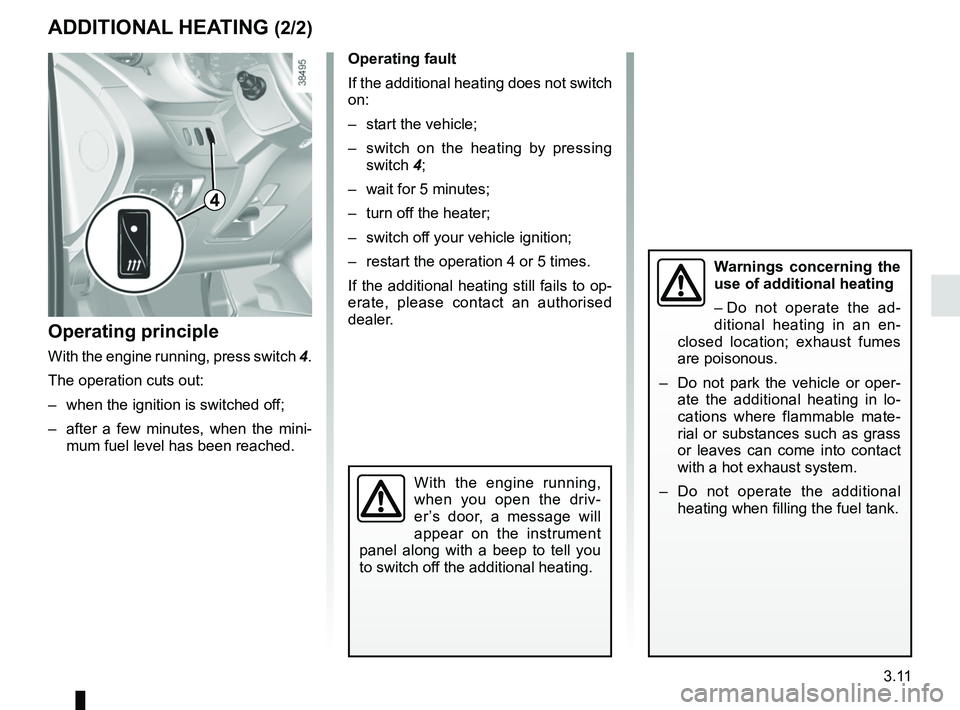
– switch on the heating by pressing switch 4;
– wait for 5 minutes;
– turn off the heater;
– switch off your vehicle ignition;
– restart the operation 4 or 5 times.
If the additional heating still fails to op-
erate, please contact an authorised
dealer.
Operating principle
With the engine running, press switch 4.
The operation cuts out:
– when the ignition is switched off;
– after a few minutes, when the mini- mum fuel level has been reached.
With the engine running,
when you open the driv-
er’s door, a message will
appear on the instrument
panel along with a beep to tell you
to switch off the additional heating.
Warnings concerning the
use of additional heating
– Do not operate the ad-
ditional heating in an en-
closed location; exhaust fumes
are poisonous.
– Do not park the vehicle or oper- ate the additional heating in lo-
cations where flammable mate-
rial or substances such as grass
or leaves can come into contact
with a hot exhaust system.
– Do not operate the additional heating when filling the fuel tank.
4
Page 140 of 230
3.12
AIR CONDITIONING: information and operating instructions (1/2)
Do not open the refriger-
ant fluid circuit. The fluid
may damage eyes or skin.
Operating faults
As a general rule, contact your ap-
proved Dealer in the event of an oper-
ating fault.
– Reduction in de-icing, demisting or air conditioning performance.
This may be caused by the passen-
ger compartment filter cartridge be-
coming clogged.
– No cold air is being produced.
Check that the controls are set cor-
rectly and that the fuses are sound.
Otherwise, switch off the system.
Range
It is normal to notice an increase in
energy usage when the air conditioning
is operating.
Switch off the system when it is not re-
quired.
Advice for reducing consumption
and helping to preserve the environ-
ment
Drive with the air vents on and the win-
dows closed.
If the vehicle has been parked in the
sun, open the doors for a few moments
to let the hot air escape before starting
the engine.
MaintenanceRefer to the Maintenance Document
for your vehicle for the inspection fre-
quency.
Below approximately 10°C, with the
engine off it is normal to notice cold
air enter the passenger compart-
ment via the vents when ventilation
has not stopped (refer to the infor-
mation on “Heating, air condition-
ing” in section 3). It is recommended
to position the ventilation control at
0 in case of brief stops.
Presence of water under the
vehicle.
After prolonged use of the air condi-
tioning system, it is normal for water
to be present under the vehicle. This is
caused by condensation.
Noise
Each time the ignition is switched off,
the ventilation will be switched off after
about ten seconds.
Vehicles equipped with
mode ECO
Once activated, ECO mode may
reduce air conditioning perform-
ance. Please refer to the informa-
tion on “Driving advice, Eco-driving”
in Section 2.
Use the air conditioning system reg-
ularly, even in cold weather, running
it at least once a month for approxi-
mately 5 minutes.
Page 190 of 230

5.22
FUSES (2/2)
Number Allocation
1 Not used
2 Not used
3 Air conditioning, pedestrian
horn
4 heating, traction battery
5 Rear windscreen wiper
6 Horn, diagnostic socket
7 Heated seats, telematic box
8 Traction battery
9 Passenger compartment
ECU
10 Windscreen washer
11 Brake lights
12 Passenger compartment
ECU
13 Electric window, ECO mode
14 Heated rear screen
15 Starter
12
3456
78910
11121314
15161718
19202122
23242526
27
28
29
Allocation of fusesThe presence of certain fuses de-
pends on the vehicle equipment
level.
Number Allocation
16 Brake lights, additional
equipment, ABS, ESP,
luggage compartment light,
courtesy light, rain and light
sensor
17 Radio, navigation system,
display, alarm
18 Additional equipment
19 Heated door mirrors
20 Hazard lights, rear fog lights
21 Central locking of opening
elements
22 Instrument panel
23 Not used
24 Radio, heated seats, brake
lights
25 Front accessories socket
26 Towbar
27 Electric front windows
28 Rear-view mirror control
29 Passenger compartment
motor-driven fan assembly
Page 192 of 230
5.24
WINDSCREEN WIPER BLADES (2/2)
– In frosty weather, make
sure that the wiper blades
are not stuck by ice (to
avoid the risk of the motor
overheating).
– Check the condition of the wiper
blades.
Replace the wiper blades as soon
as they begin to lose efficiency
(approximately once a year).
Whilst changing the blade, take care
not to drop the arm onto the window
after it has been removed as this
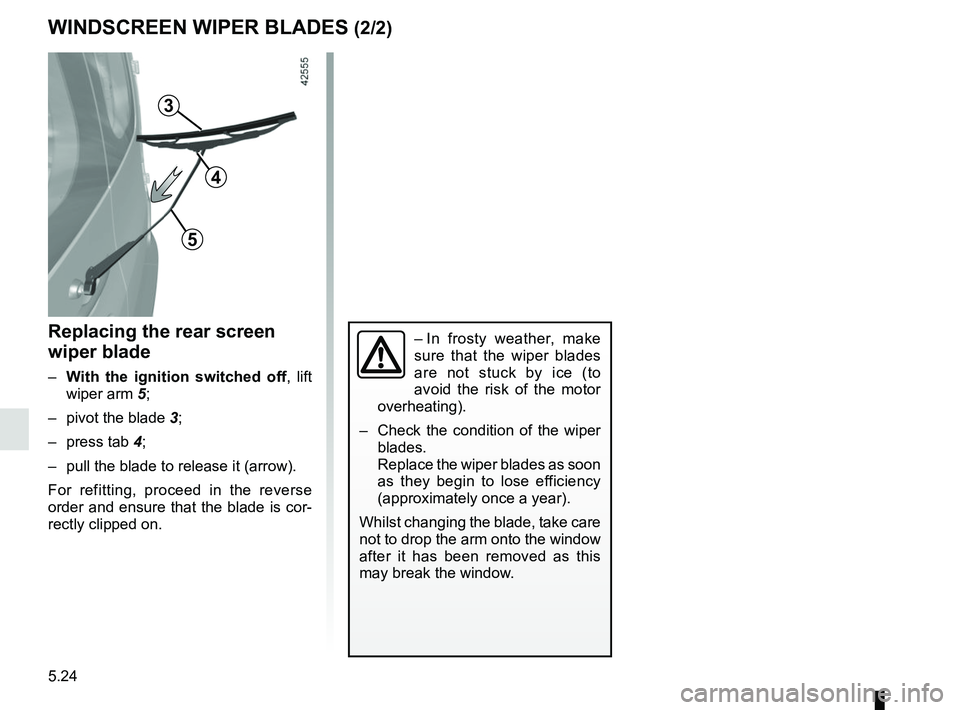
may break the window.Replacing the rear screen
wiper blade
– With the ignition switched off , lift
wiper arm 5;
– pivot the blade 3;
– press tab 4;
– pull the blade to release it (arrow).
For refitting, proceed in the reverse
order and ensure that the blade is cor-
rectly clipped on.
3
5
4
Page 201 of 230
5.33
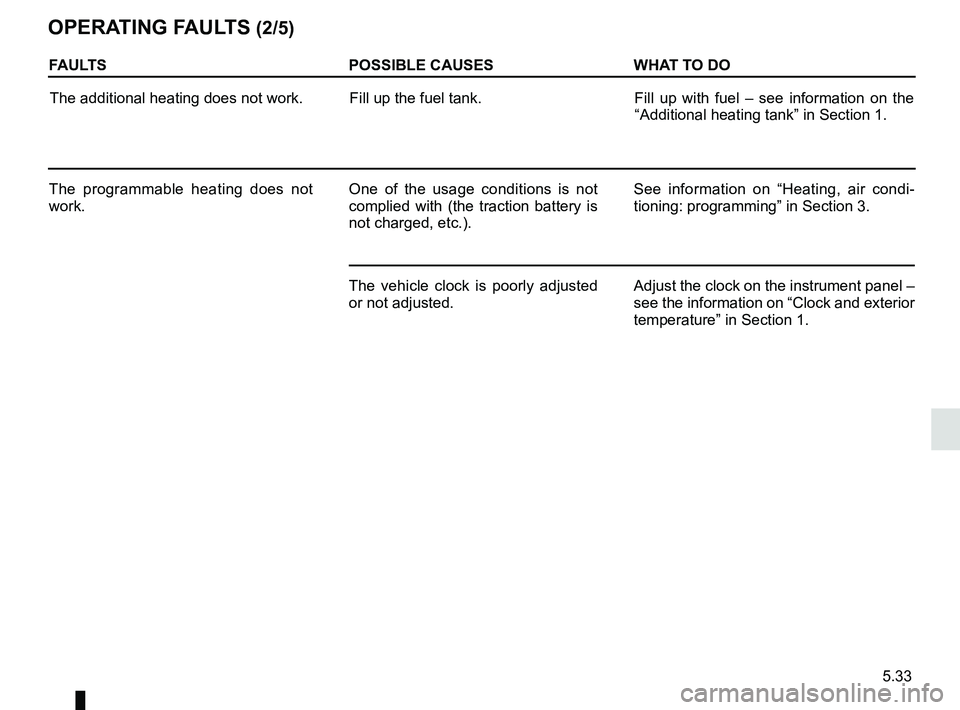
FAULTSPOSSIBLE CAUSESWHAT TO DO
The additional heating does not work. Fill up the fuel tank. Fill up with fuel – see information on the
“Additional heating tank” in Section 1.
The programmable heating does not
work. One of the usage conditions is not
complied with (the traction battery is
not charged, etc.).See information on “Heating, air condi-
tioning: programming” in Section 3.
The vehicle clock is poorly adjusted
or not adjusted. Adjust the clock on the instrument panel –
see the information on “Clock and exterior
temperature” in Section 1.
OPERATING FAULTS (2/5)
Page 202 of 230
5.34
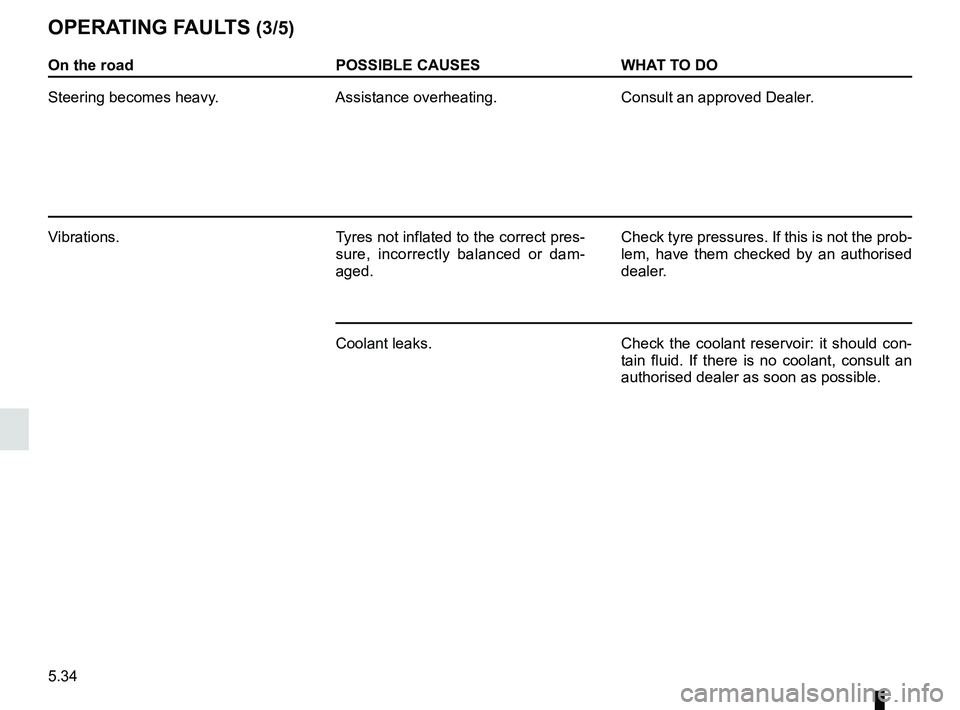
On the roadPOSSIBLE CAUSESWHAT TO DO
Steering becomes heavy. Assistance overheating.Consult an approved Dealer.
Vibrations. Tyres not inflated to the correct pres-
sure, incorrectly balanced or dam-
aged. Check tyre pressures. If this is not the prob-
lem, have them checked by an authorised
dealer.
Coolant leaks. Check the coolant reservoir: it should con-
tain fluid. If there is no coolant, consult an
authorised dealer as soon as possible.
OPERATING FAULTS (3/5)
Page 223 of 230

A
ABS ....................................................................\
...2.15 → 2.17
accessories............................................................. 5.29")
7.1
ALPHABETICAL INDEX (1/5)
A
ABS ....................................................................\
...2.15 → 2.17
accessories............................................................. 5.29 – 5.30
accessories socket ............................................................ 3.18
additional heating fuel........................................................ 1.93
additional heating tank....................................................... 1.93
additional methods of restraint .......................................... 1.45
additional heating ................................................... 3.10 – 3.11 additional heating fuel tank .......................................... 1.93
additional tank capacity ..................................................... 1.93
additional tank filling .......................................................... 1.93
air bag....................................................................1.41 → 1.45
activating the front passenger air bags ............1.58 → 1.60
deactivating the front passenger air bags ........1.58 → 1.60
air conditioning ......................................3.4 → 3.7, 3.12 – 3.13
air vents ...................................................................... 3.2 – 3.3
anti-corrosion check ..............................................6.14 → 6.18
anti-corrosion protection .................................................... 4.10
anti-lock braking system: ABS ...............................2.15 → 2.17
ashtrays ...............................................................\
.............. 3.18
audible and visual signals.................................................. 1.83
B
12 volt battery maintenance ......................................................... 4.6 – 4.7
12 volt battery ............................................1.2 → 1.7, 4.6 – 4.7
battery (remote control) ..................................................... 5.31
bonnet........................................................................\
. 4.2 – 4.3
brake fluid ........................................................................\
.... 4.5
brake lights changing bulbs .................................................. 5.16 – 5.17
bulbs changing ..........................................................5.13 → 5.20
C
central door locking ........................................................... 1.21 changing a bulb .................................5.13
→ 5.15, 5.19 – 5.20
changing a wheel................................................................. 5.8
changing gear ............................................................. 2.4 – 2.5
charge meter ....................................................1.70, 2.6 → 2.8
charging cord ..................................................1.9 → 1.16, 1.19
charging flap ............................................................1.8 → 1.16
charging socket ..................................... 1.2 → 1.7, 1.9 → 1.16
child minder mirror ............................................................. 3.16
child restraint/seat .............................1.46 – 1.47, 1.49 → 1.60
child safety.....1.17, 1.19, 1.23, 1.46 – 1.47, 1.49 → 1.60, 3.17
child seats..........................................1.46 – 1.47, 1.49 → 1.57
children ................................................................... 1.46 – 1.47
cigar lighter ........................................................................\
3.18
cleaning: inside the vehicle .............................................. 4.13 – 4.14
clock ..................................................................\
................ 1.81
closing the doors ...................................................1.22 → 1.25
connected services .............................................................. 1.3
control instruments ................................................1.69 → 1.77
controls ...............................................................\
...1.62 → 1.65
coolant ................................................................\
................. 4.4
courtesy light ..................................................................... 3.15
courtesy mirrors ................................................................. 3.16
cruise control .........................................................2.21 → 2.24
D
dashboard..............................................................1.62 → 1.65
deadlocking the doors ....................................................... 1.19
de-icing ...............................................................\
................. 3.5
dimensions ................................................................. 6.4 – 6.5
display ................................................................\
...1.66 → 1.71
doors......................................................................1.22 → 1.28
driver’s position .....................................................1.62 → 1.68
driving .................................................. 2.4 → 2.9, 2.11 → 2.26
driving position settings ............................................................1.37 →
1.40