lock RENAULT KANGOO Z.E. 2018 Owner's Manual
[x] Cancel search | Manufacturer: RENAULT, Model Year: 2018, Model line: KANGOO Z.E., Model: RENAULT KANGOO Z.E. 2018Pages: 230, PDF Size: 5.03 MB
Page 39 of 230
1.33
FRONT SEATS(2/2)
Front seats
Operating faults
(depending on vehicle)
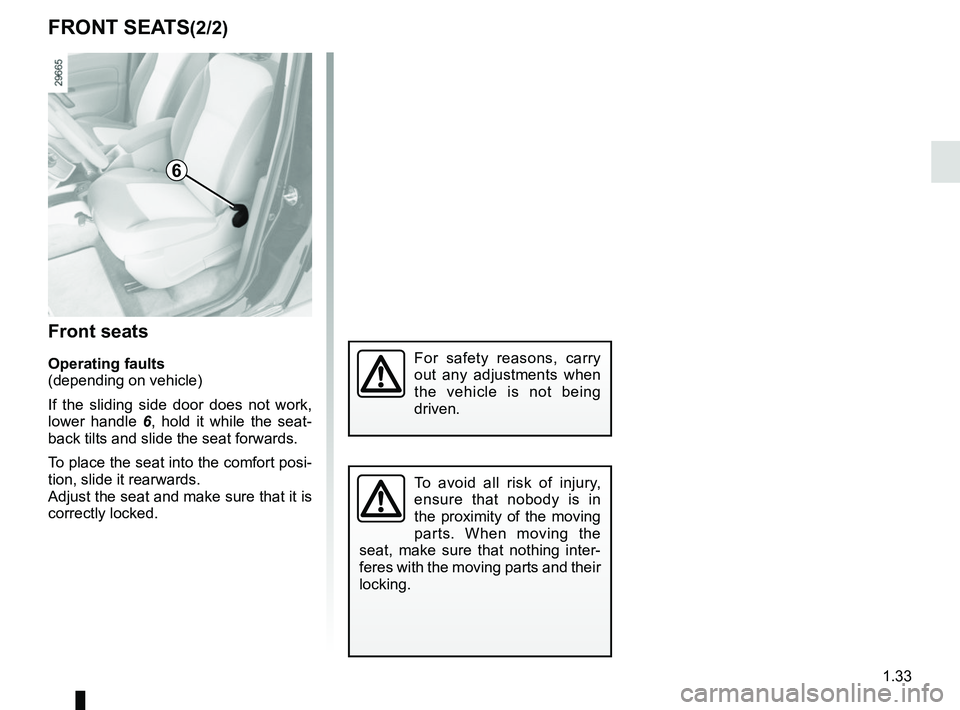
If the sliding side door does not work,
lower handle 6, hold it while the seat-
back tilts and slide the seat forwards.
To place the seat into the comfort posi-
tion, slide it rearwards.
Adjust the seat and make sure that it is
correctly locked.
To avoid all risk of injury,
ensure that nobody is in
the proximity of the moving
parts. When moving the
seat, make sure that nothing inter-
feres with the moving parts and their
locking.
For safety reasons, carry
out any adjustments when
the vehicle is not being
driven.
6
Page 40 of 230
1.34
ROOF FLAP (1/2)
123
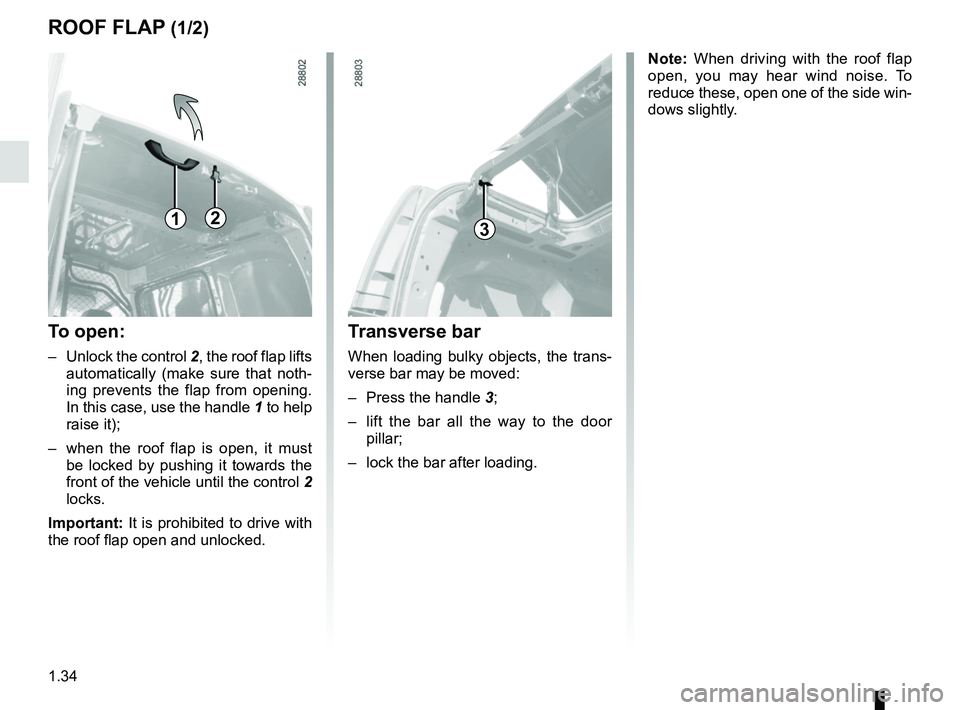
Transverse bar
When loading bulky objects, the trans-
verse bar may be moved:
– Press the handle 3;
– lift the bar all the way to the door pillar;
– lock the bar after loading.
To open:
– Unlock the control 2, the roof flap lifts
automatically (make sure that noth-
ing prevents the flap from opening.
In this case, use the handle 1 to help
raise it);
– when the roof flap is open, it must be locked by pushing it towards the
front of the vehicle until the control 2
locks.
Important: It is prohibited to drive with
the roof flap open and unlocked. Note: When driving with the roof flap
open, you may hear wind noise. To
reduce these, open one of the side win-
dows slightly.
Page 41 of 230
1.35
ROOF FLAP (2/2)
Before starting, always reposition
the transverse bar and ensure it is
correctly locked.
The rear hinged doors can only be
closed with the bar locked.
Remember that the overall vehicle
dimensions may change when you
are transporting bulky objects.
12
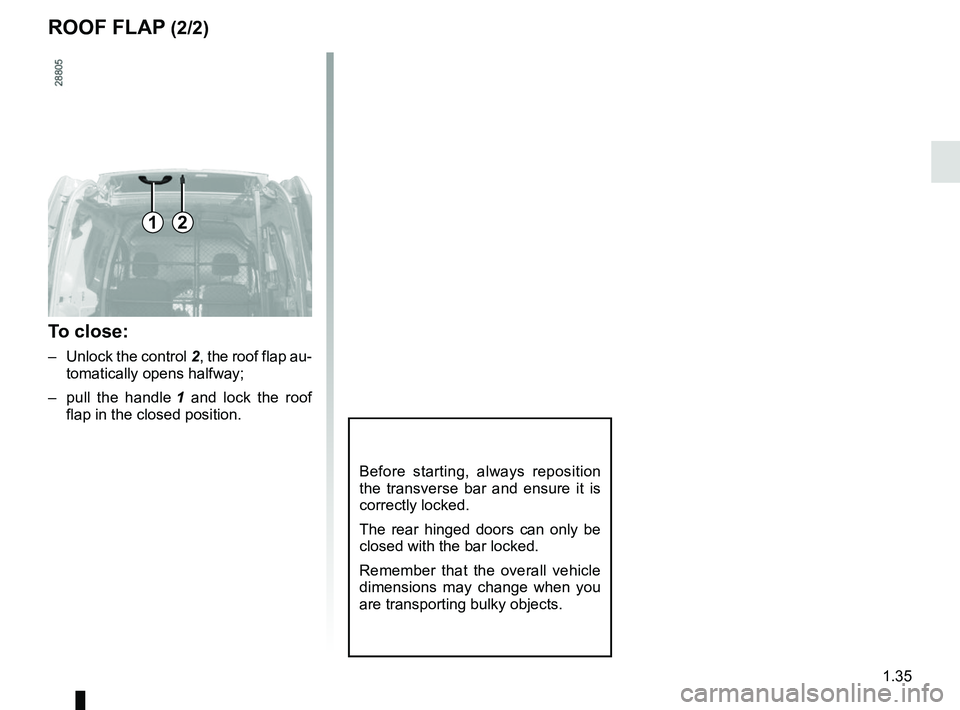
To close:
– Unlock the control 2, the roof flap au-
tomatically opens halfway;
– pull the handle 1 and lock the roof
flap in the closed position.
Page 42 of 230
1.36
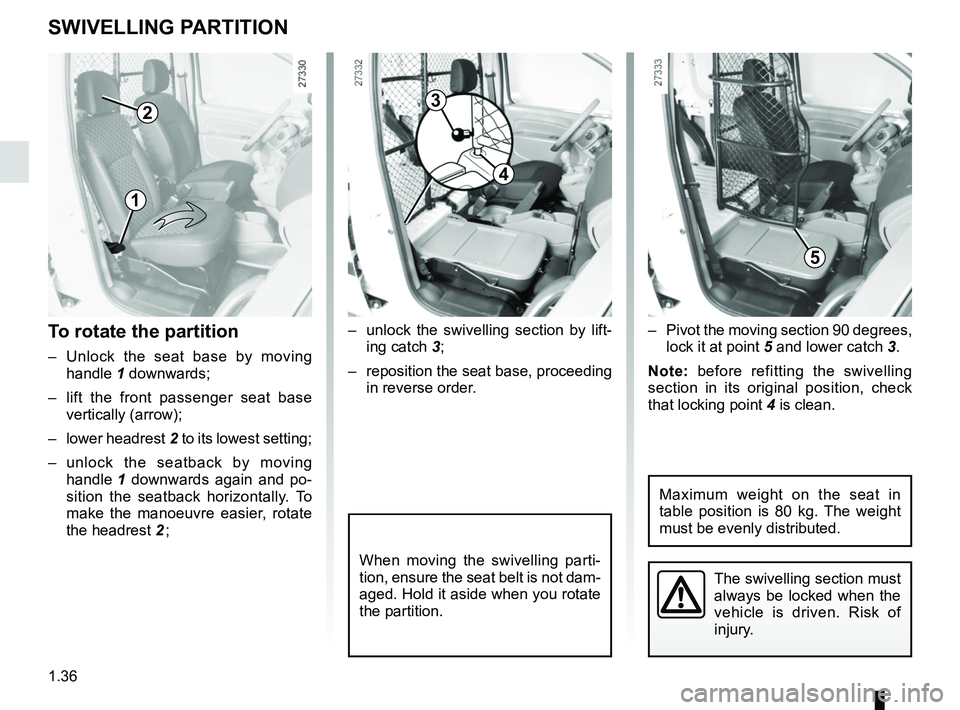
To rotate the partition
– Unlock the seat base by moving handle 1 downwards;
– lift the front passenger seat base vertically (arrow);
– lower headrest 2 to its lowest setting;
– unlock the seatback by moving handle 1 downwards again and po-
sition the seatback horizontally. To
make the manoeuvre easier, rotate
the headrest 2 ; – Pivot the moving section 90 degrees,
lock it at point 5 and lower catch 3.
Note: before refitting the swivelling
section in its original position, check
that locking point 4 is clean.
– unlock the swivelling section by lift-
ing catch 3;
– reposition the seat base, proceeding in reverse order.
The swivelling section must
always be locked when the
vehicle is driven. Risk of
injury.
SWIVELLING PARTITION
When moving the swivelling parti-
tion, ensure the seat belt is not dam-
aged. Hold it aside when you rotate
the partition.
1
23
4
5
Maximum weight on the seat in
table position is 80 kg. The weight
must be evenly distributed.
Page 43 of 230
1.37
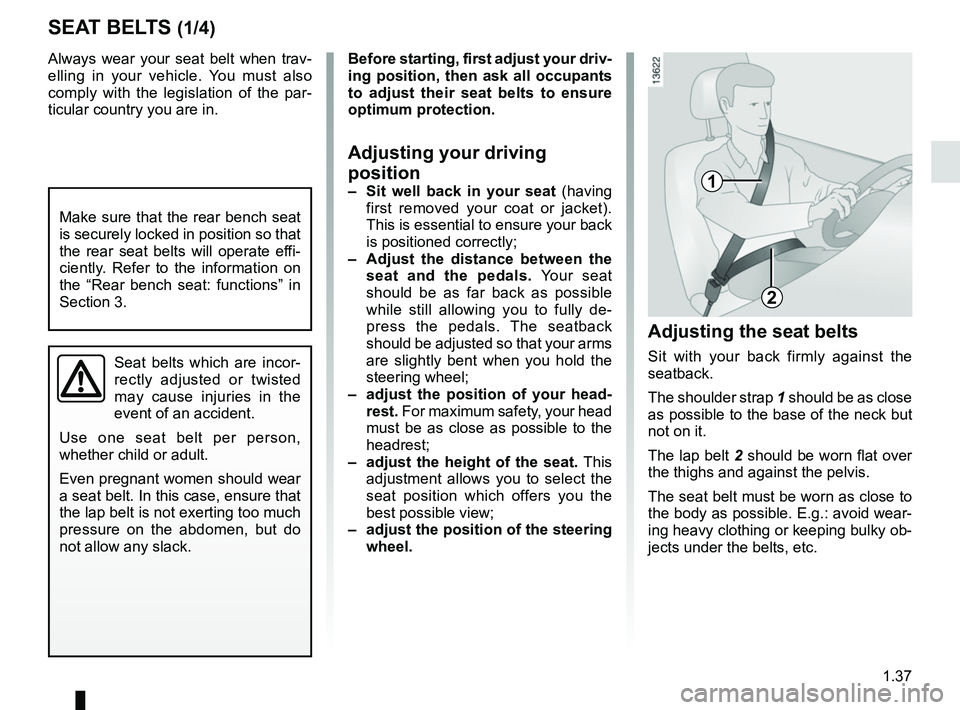
SEAT BELTS (1/4)Adjusting the seat belts
Sit with your back firmly against the
seatback.
The shoulder strap 1 should be as close
as possible to the base of the neck but
not on it.
The lap belt 2 should be worn flat over
the thighs and against the pelvis.
The seat belt must be worn as close to
the body as possible. E.g.: avoid wear-
ing heavy clothing or keeping bulky ob-
jects under the belts, etc.
1
2
Always wear your seat belt when trav-
elling in your vehicle. You must also
comply with the legislation of the par-
ticular country you are in.
Seat belts which are incor-
rectly adjusted or twisted
may cause injuries in the
event of an accident.
Use one seat belt per person,
whether child or adult.
Even pregnant women should wear
a seat belt. In this case, ensure that
the lap belt is not exerting too much
pressure on the abdomen, but do
not allow any slack.
Before starting, first adjust your driv-
ing position, then ask all occupants
to adjust their seat belts to ensure
optimum protection.
Adjusting your driving
position
– Sit well back in your seat (having
first removed your coat or jacket).
This is essential to ensure your back
is positioned correctly;
– Adjust the distance between the seat and the pedals. Your seat
should be as far back as possible
while still allowing you to fully de-
press the pedals. The seatback
should be adjusted so that your arms
are slightly bent when you hold the
steering wheel;
– adjust the position of your head- rest. For maximum safety, your head
must be as close as possible to the
headrest;
– adjust the height of the seat. This
adjustment allows you to select the
seat position which offers you the
best possible view;
– adjust the position of the steering
wheel.
Make sure that the rear bench seat
is securely locked in position so that
the rear seat belts will operate effi-
ciently. Refer to the information on
the “Rear bench seat: functions” in
Section 3.
Page 44 of 230
1.38
SEAT BELTS (2/4)
™Front seat belt reminder
warning light
It remains on when the engine
is started if your seat belt is not fas-
tened. When the vehicle reaches a
speed of 12 mph (20 km/h), the warn-
ing light flashes and a buzzer sounds.
Then, the beep sounds at a low volume
for 30 seconds, then at a high volume
for 90 seconds.
Unfastening
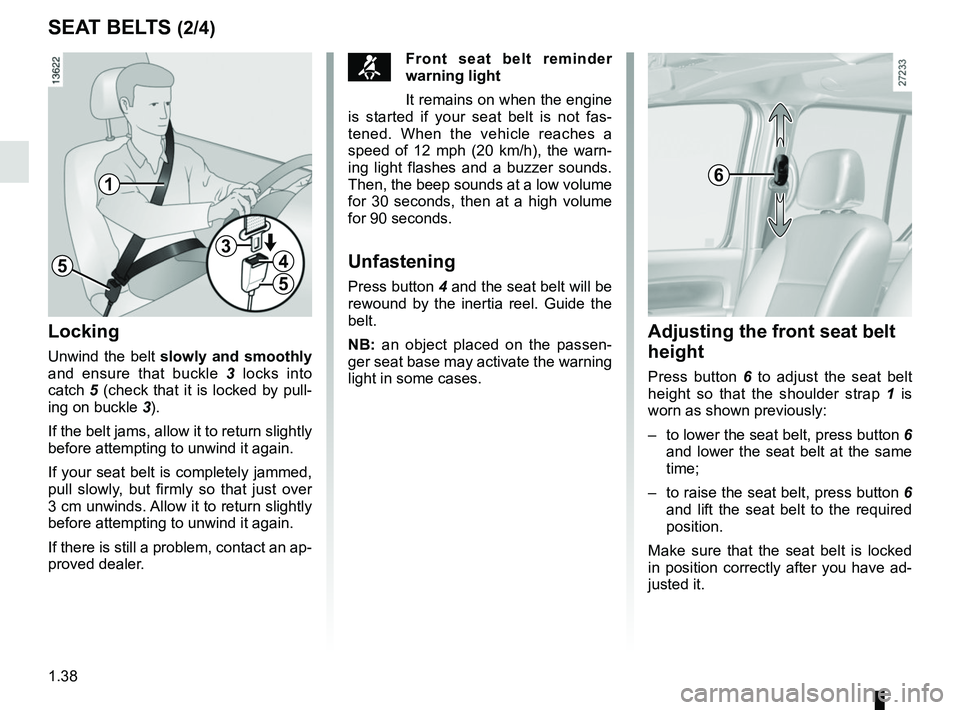
Press button 4 and the seat belt will be
rewound by the inertia reel. Guide the
belt.
NB: an object placed on the passen-
ger seat base may activate the warning
light in some cases.
6
Adjusting the front seat belt
height
Press button 6 to adjust the seat belt
height so that the shoulder strap 1 is
worn as shown previously:
– to lower the seat belt, press button 6 and lower the seat belt at the same
time;
– to raise the seat belt, press button 6 and lift the seat belt to the required
position.
Make sure that the seat belt is locked
in position correctly after you have ad-
justed it.
Locking
Unwind the belt slowly and smoothly
and ensure that buckle 3 locks into
catch 5 (check that it is locked by pull-
ing on buckle 3).
If the belt jams, allow it to return slightly
before attempting to unwind it again.
If your seat belt is completely jammed,
pull slowly, but firmly so that just over
3 cm unwinds. Allow it to return slightly
before attempting to unwind it again.
If there is still a problem, contact an ap-
proved dealer.
1
5
34
5
Page 45 of 230
1.39
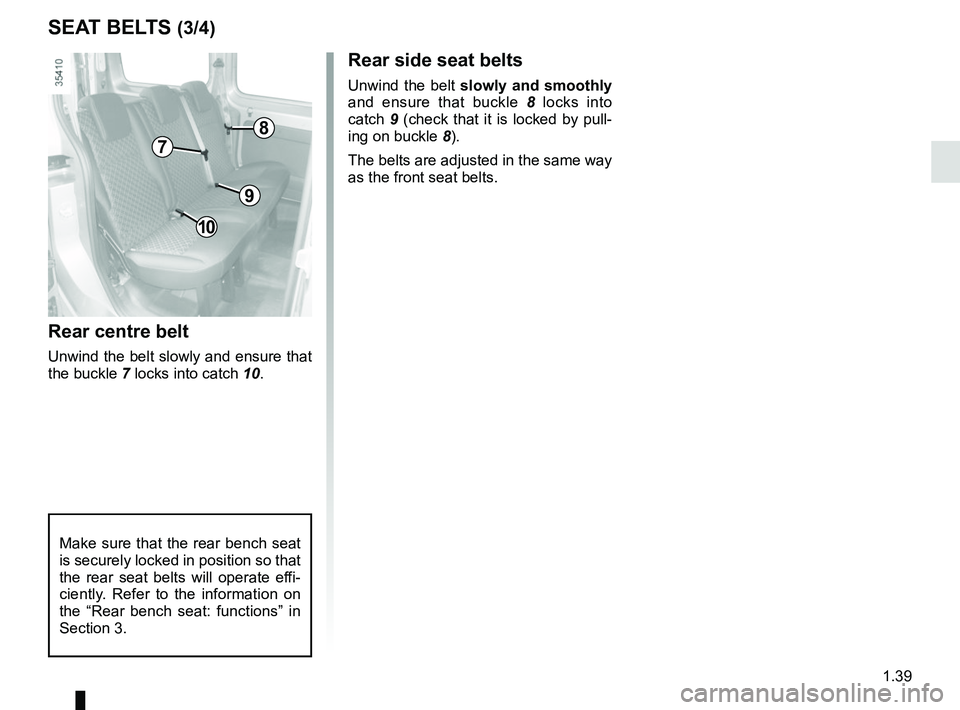
Rear centre belt
Unwind the belt slowly and ensure that
the buckle 7 locks into catch 10.
Rear side seat belts
Unwind the belt slowly and smoothly
and ensure that buckle 8 locks into
catch 9 (check that it is locked by pull-
ing on buckle 8).
The belts are adjusted in the same way
as the front seat belts.
SEAT BELTS (3/4)
Make sure that the rear bench seat
is securely locked in position so that
the rear seat belts will operate effi-
ciently. Refer to the information on
the “Rear bench seat: functions” in
Section 3.
7
8
9
10
Page 47 of 230
1.41
METHODS OF RESTRAINT IN ADDITION TO THE FRONT SEAT BELTS (1/3)
12
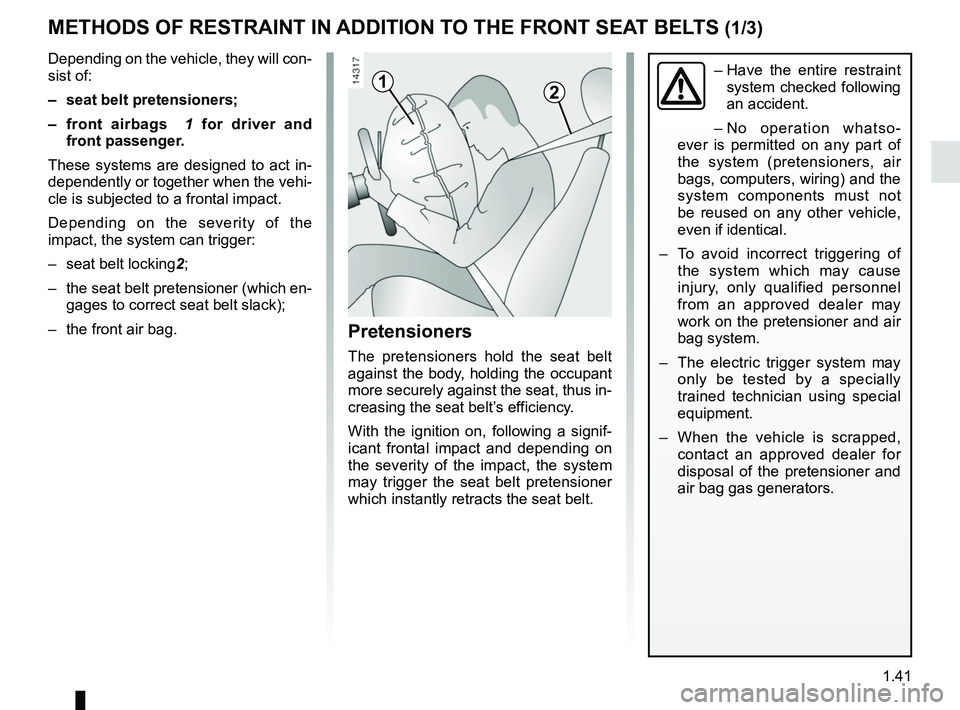
Depending on the vehicle, they will con-
sist of:
– seat belt pretensioners;
– front airbags 1 for driver and
front passenger.
These systems are designed to act in-
dependently or together when the vehi-
cle is subjected to a frontal impact.
Depending on the severity of the
impact, the system can trigger:
– seat belt locking 2;
– the seat belt pretensioner (which en- gages to correct seat belt slack);
– the front air bag.
Pretensioners
The pretensioners hold the seat belt
against the body, holding the occupant
more securely against the seat, thus in-
creasing the seat belt’s efficiency.
With the ignition on, following a signif-
icant frontal impact and depending on
the severity of the impact, the system
may trigger the seat belt pretensioner
which instantly retracts the seat belt.
– Have the entire restraint
system checked following
an accident.
– No operation whatso-
ever is permitted on any part of
the system (pretensioners, air
bags, computers, wiring) and the
system components must not
be reused on any other vehicle,
even if identical.
– To avoid incorrect triggering of the system which may cause
injury, only qualified personnel
from an approved dealer may
work on the pretensioner and air
bag system.
– The electric trigger system may only be tested by a specially
trained technician using special
equipment.
– When the vehicle is scrapped, contact an approved dealer for
disposal of the pretensioner and
air bag gas generators.
Page 49 of 230
1.43
METHODS OF RESTRAINT IN ADDITION TO THE FRONT SEAT BELTS (3/3)
Warnings concerning the driver’s air bag
– Do not modify the steering wheel or the steering wheel boss.
– Do not cover the steering wheel boss under any circumstances.
– Do not attach any objects (badge, logo, clock, telephone support, etc.)\
to the steering wheel boss.
– The steering wheel must not be removed (except by qualified personnel f\
rom our Network).
– Do not sit too close to the steering wheel when driving: sit with your a\
rms slightly bent (see Section 1 “Adjusting your driv ing
position”). This will allow sufficient space for the airbag to deploy correctly and be fully effective.
Warnings concerning the passenger air bag
– Do not attach or glue any objects (badge, logo, clock, telephone cradle\
, etc.) to the dashboard in the airbag zone.
– Do not place anything between the dashboard and the passenger (animal, \
umbrella, walking stick, parcels, etc.).
– The passenger must not put his or her feet on the dashboard or seat as t\
here is a risk that serious injuries may be sustained .
As a general rule, keep all body parts (knees, hands, head, etc.) away\
from the dashboard.
– The devices in addition to the front passenger seat belt should be react\
ivated as soon as a child seat is removed, to ensure the protection of the passenger in the event of an impact.
A REAR-FACING CHILD SEAT MUST NOT BE FITTED TO THE FRONT PASSENGER SEAT UNLESS THE ADDITIONAL RESTRAINT SYSTEMS, I.E. THE PASSENGER AIR BAG, ARE DEACTIVATED.
(Refer to the information on “Child safety: front passenger airbag d\
eactivation/activation” Section 1).
All of the warnings below are given so that the air bag is not obstructe\
d in any way when it is inflated and also to prevent
the risk of serious injuries caused by items which may be dislodged when\
the air bag inflates.
Page 52 of 230
1.46
CHILD SAFETY: General information (1/2)
Carrying children
Please ensure that you comply with the
legislation of your country.
Children, and adults, must be correctly
seated and strapped in for all journeys.
The children being carried in your vehi-
cle are your responsibility.
A child is not a miniature adult. Children
are at risk of specific injuries as their
muscles and bones have not yet fin-
ished growing. The seat belt alone
would not provide suitable protection.
Use an approved child seat and ensure
you use it correctly.
A collision at 30 mph (50
km/h) is the same as fall-
ing a distance of 10 metres.
Transporting a child without
a restraint is the equivalent of allow-
ing him or her to play on a fourth-
floor balcony without railings.
Never travel with a child held in your
arms. In the event of an accident,
you will not be able to keep hold of
the child, even if you yourself are
wearing a seat belt.
If your vehicle has been involved in
a road accident, replace the child
seat and have the seat belts and
ISOFIX anchorage points checked.
To prevent the doors being
opened, use the “Child
safety” device (refer to the
information on “Opening
and closing the doors” in Section 1).
Driver’s responsibility
when parking or stopping
the vehicle
Never leave an animal,
child or adult who is not self-suffi-
cient alone on your vehicle, even for
a short time.
They may pose a risk to themselves
or to others by starting the engine,
activating equipment such as the
electric windows or by locking the
doors.
Also, in hot and/or sunny weather,
please remember that the tempera-
ture inside the passenger compart-
ment increases very quickly.
RISK OF DEATH OR SERIOUS
INJURY.