weight RENAULT KANGOO Z.E. 2018 Owners Manual
[x] Cancel search | Manufacturer: RENAULT, Model Year: 2018, Model line: KANGOO Z.E., Model: RENAULT KANGOO Z.E. 2018Pages: 230, PDF Size: 5.03 MB
Page 42 of 230
1.36
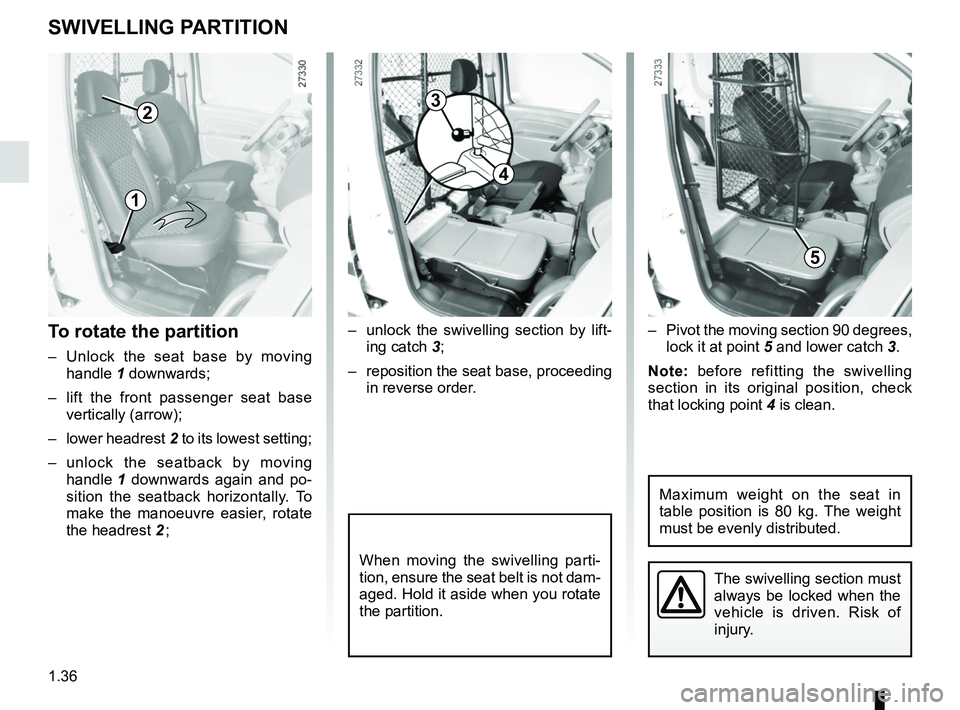
To rotate the partition
– Unlock the seat base by moving handle 1 downwards;
– lift the front passenger seat base vertically (arrow);
– lower headrest 2 to its lowest setting;
– unlock the seatback by moving handle 1 downwards again and po-
sition the seatback horizontally. To
make the manoeuvre easier, rotate
the headrest 2 ; – Pivot the moving section 90 degrees,
lock it at point 5 and lower catch 3.
Note: before refitting the swivelling
section in its original position, check
that locking point 4 is clean.
– unlock the swivelling section by lift-
ing catch 3;
– reposition the seat base, proceeding in reverse order.
The swivelling section must
always be locked when the
vehicle is driven. Risk of
injury.
SWIVELLING PARTITION
When moving the swivelling parti-
tion, ensure the seat belt is not dam-
aged. Hold it aside when you rotate
the partition.
1
23
4
5
Maximum weight on the seat in
table position is 80 kg. The weight
must be evenly distributed.
Page 60 of 230
1.54
CHILD SAFETY: fitting a child seat (3/6)
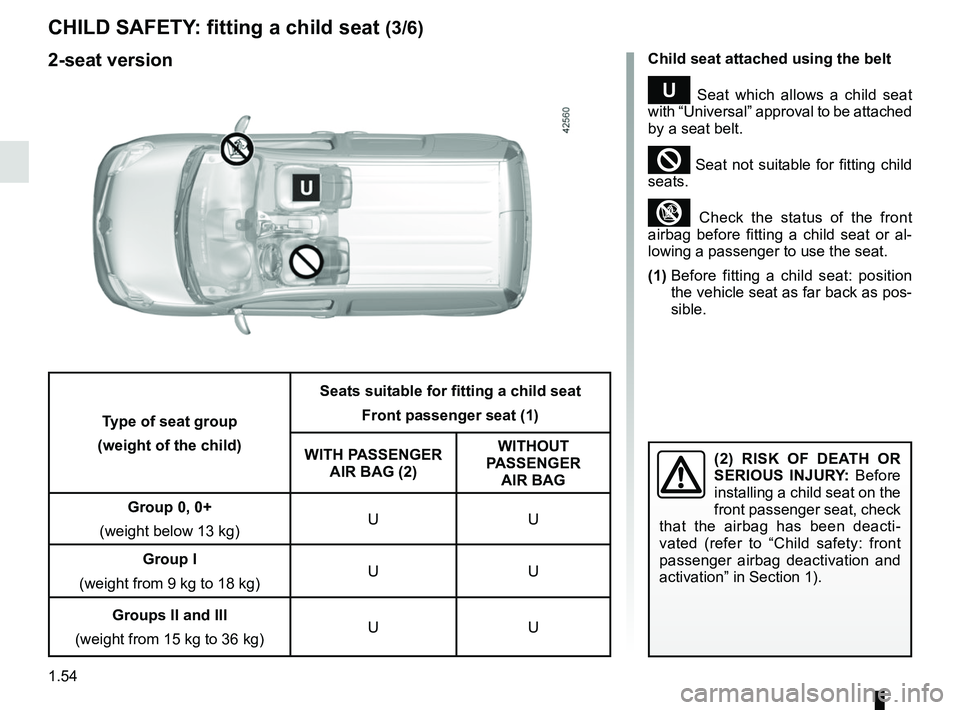
Child seat attached using the belt
¬ Seat which allows a child seat
with “Universal” approval to be attached
by a seat belt.
² Seat not suitable for fitting child
seats.
³ Check the status of the front
airbag before fitting a child seat or al-
lowing a passenger to use the seat.
(1) Before fitting a child seat: position
the vehicle seat as far back as pos-
sible.
Type of seat group
(weight of the child) Seats suitable for fitting a child seat
Front passenger seat (1)
WITH PASSENGER AIR BAG (2) WITHOUT
PASSENGER AIR BAG
Group 0, 0+
(weight below 13 kg) UU
Group I
(weight from 9 kg to 18 kg) UU
Groups II and III
(weight from 15 kg to 36 kg) UU
(2) RISK OF DEATH OR
SERIOUS INJURY: Before
installing a child seat on the
front passenger seat, check
that the airbag has been deacti-
vated (refer to “Child safety: front
passenger airbag deactivation and
activation” in Section 1).
2-seat version
Page 62 of 230
1.56
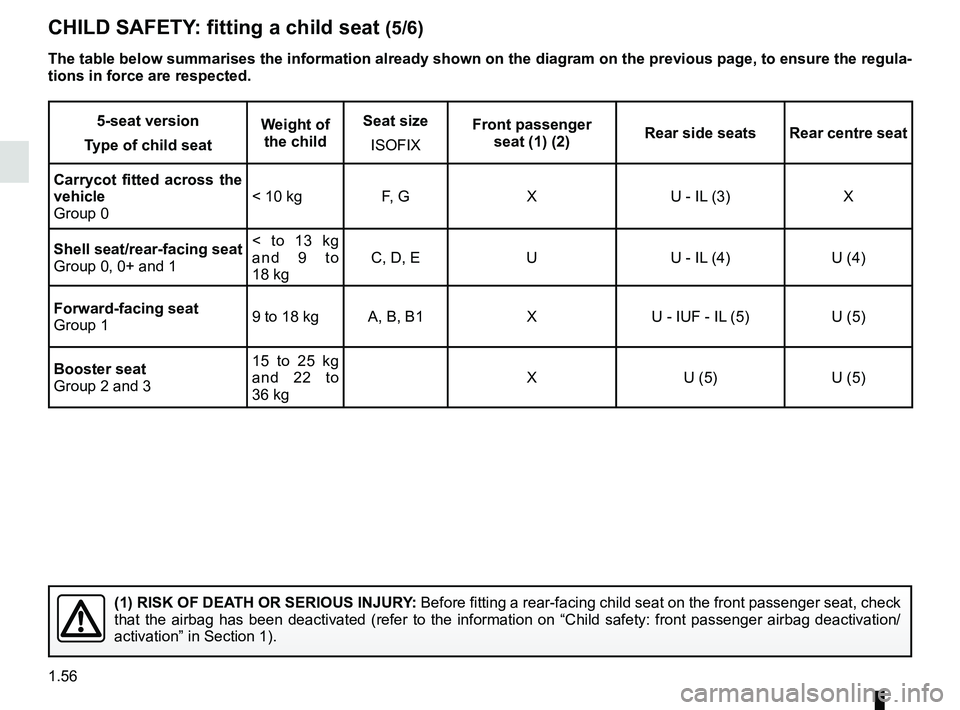
CHILD SAFETY: fitting a child seat (5/6)
5-seat version
Type of child seat Weight of
the child Seat size
ISOFIX Front passenger
seat (1) (2) Rear side seats Rear centre seat
Carrycot fitted across the
vehicle
Group 0 < 10 kg F, G X U - IL (3) X
Shell seat/rear-facing seat
Group 0, 0+ and 1 < to 13 kg
and 9 to
18 kg
C, D, E U U - IL (4) U (4)
Forward-facing seat
Group 1 9 to 18 kg A, B, B1 X U - IUF - IL (5) U (5)
Booster seat
Group 2 and 3 15 to 25 kg
and 22 to
36 kg
X U (5) U (5)
(1) RISK OF DEATH OR SERIOUS INJURY:
Before fitting a rear-facing child seat on the front passenger seat, ch\
eck
that the airbag has been deactivated (refer to the information on “C\
hild safety: front passenger airbag deactivation/
activation” in Section 1).
The table below summarises the information already shown on the diagram \
on the previous page, to ensure the regula-
tions in force are respected.
Page 141 of 230
3.13
AIR CONDITIONING: information and operating instructions (2/2)
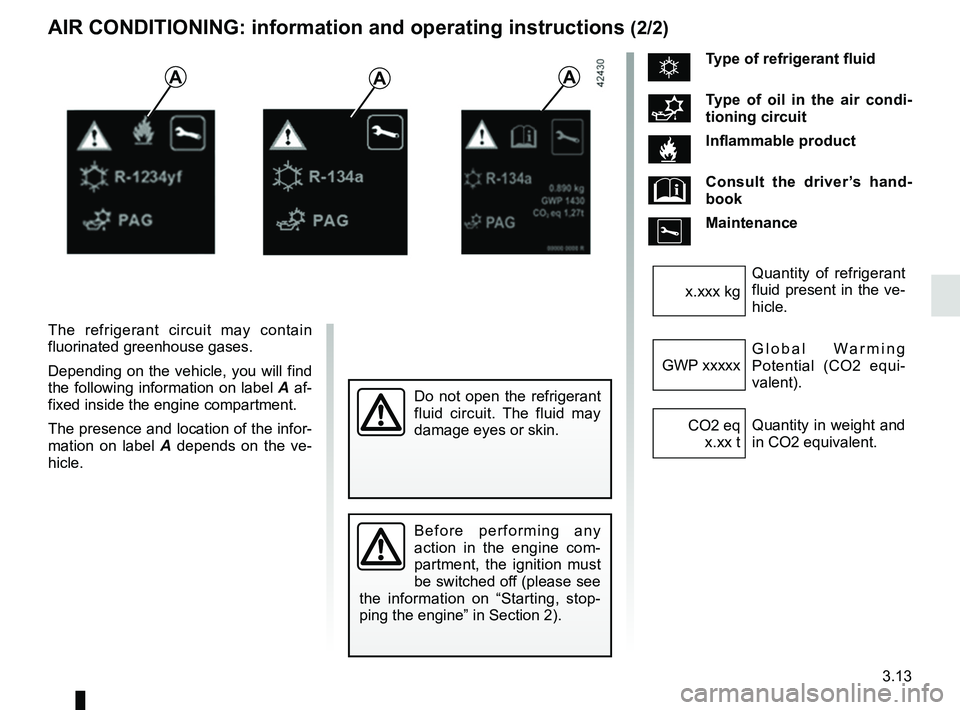
The refrigerant circuit may contain
fluorinated greenhouse gases.
Depending on the vehicle, you will find
the following information on label A af-
fixed inside the engine compartment.
The presence and location of the infor-
mation on label A depends on the ve-
hicle.
AAA
Do not open the refrigerant
fluid circuit. The fluid may
damage eyes or skin.
ÑType of refrigerant fluid
Type of oil in the air condi-
tioning circuit
Inflammable product
Consult the driver’s hand-
book
Maintenance
Quantity of refrigerant
fluid present in the ve-
hicle.
x.xxx kg
Global Warming
Potential (CO2 equi-
valent).
GWP xxxxx
Quantity in weight and
in CO2 equivalent.
CO2 eq
x.xx t
Before performing any
action in the engine com-
partment, the ignition must
be switched off (please see
the information on “Starting, stop-
ping the engine” in Section 2).
Page 152 of 230
3.24
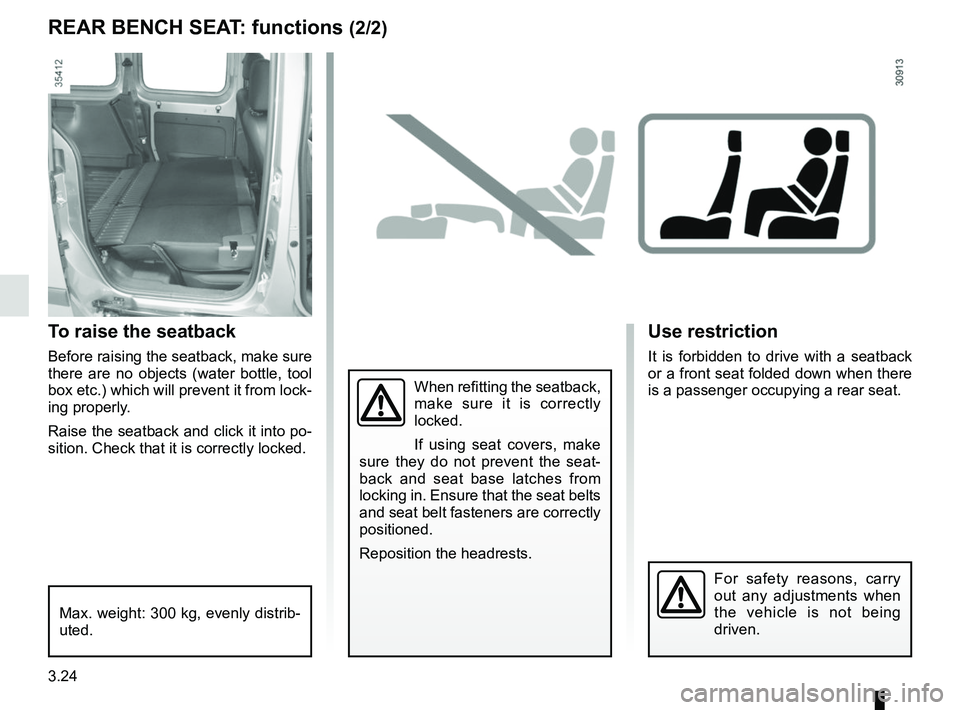
REAR BENCH SEAT: functions (2/2)Use restriction
It is forbidden to drive with a seatback
or a front seat folded down when there
is a passenger occupying a rear seat.
For safety reasons, carry
out any adjustments when
the vehicle is not being
driven.
To raise the seatback
Before raising the seatback, make sure
there are no objects (water bottle, tool
box etc.) which will prevent it from lock-
ing properly.
Raise the seatback and click it into po-
sition. Check that it is correctly locked.
When refitting the seatback,
make sure it is correctly
locked.
If using seat covers, make
sure they do not prevent the seat-
back and seat base latches from
locking in. Ensure that the seat belts
and seat belt fasteners are correctly
positioned.
Reposition the headrests.
Max. weight: 300 kg, evenly distrib-
uted.
Page 154 of 230
3.26
TRANSPORTING OBJECTS IN THE BOOT (2/2)/TOWING
If the towbar ball obscures the regis-
tration plate or the rear fog lights, it
should be removed when not in use.
In all cases, comply with local leg-
islation.
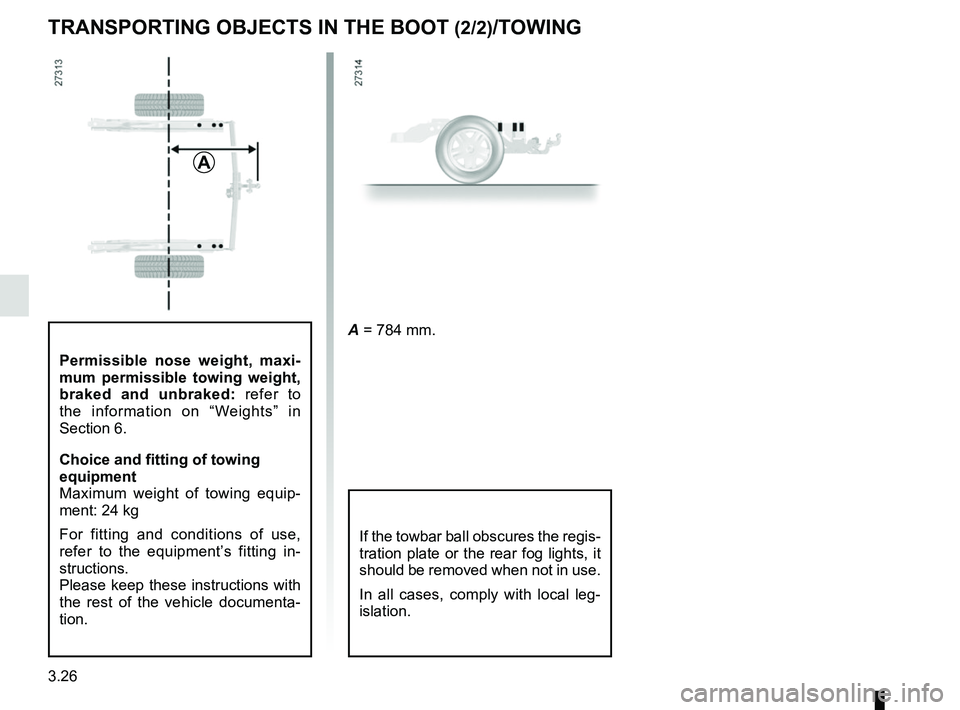
A = 784 mm.
A
Permissible nose weight, maxi-
mum permissible towing weight,
braked and unbraked: refer to
the information on “Weights” in
Section 6.
Choice and fitting of towing
equipment
Maximum weight of towing equip-
ment: 24 kg
For fitting and conditions of use,
refer to the equipment’s fitting in-
structions.
Please keep these instructions with
the rest of the vehicle documenta-
tion.
Page 162 of 230
4.8
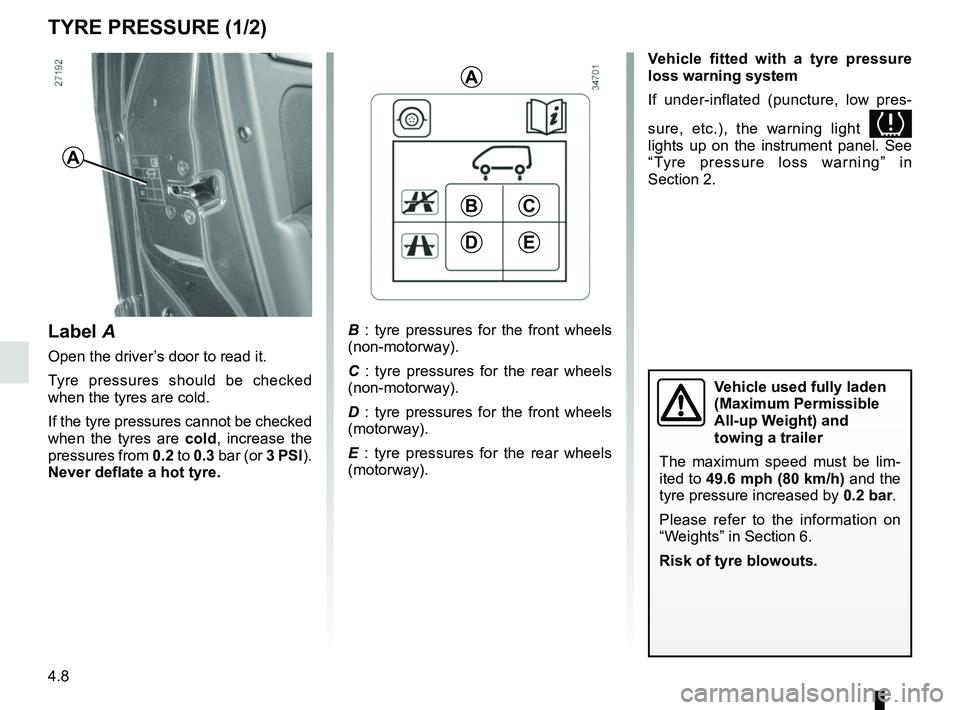
A
B : tyre pressures for the front wheels
(non-motorway).
C : tyre pressures for the rear wheels
(non-motorway).
D : tyre pressures for the front wheels
(motorway).
E : tyre pressures for the rear wheels
(motorway).
BC
ED
A
Label A
Open the driver’s door to read it.
Tyre pressures should be checked
when the tyres are cold.
If the tyre pressures cannot be checked
when the tyres are cold, increase the
pressures from 0.2 to 0.3 bar (or 3 PSI).
Never deflate a hot tyre.
TYRE PRESSURE (1/2)
Vehicle used fully laden
(Maximum Permissible
All-up Weight) and
towing a trailer
The maximum speed must be lim-
ited to 49.6 mph (80 km/h) and the tyre pressure increased by 0.2 bar.
Please refer to the information on
“Weights” in Section 6.
Risk of tyre blowouts.
Vehicle fitted with a tyre pressure
loss warning system
If under-inflated (puncture, low pres-
sure, etc.), the warning light
lights up on the instrument panel. See
“Tyre pressure loss warning” in
Section 2.
Page 205 of 230

6.1
Section 6: Technical specifications
Vehicle identification plates . . . . . . . . . . . . . . . . . . . . . . . . . . . . . . . . . . . . \
. . . . . . . . . . . . . . . . . . . . 6.2
Engine identification plate . . . . . . . . . . . . . . . . . . . . . . . . . . . . . . . . . . . .\
. . . . . . . . . . . . . . . . . . . . . 6.3
Engine specification. . . . . . . . . . . . . . . . . . . . . . . . . . . . . . . . . . . . \
. . . . . . . . . . . . . . . . . . . . . . . . . . 6.3
Dimensions . . . . . . . . . . . . . . . . . . . . . . . . . . . . . . . . . . . .\
. . . . . . . . . . . . . . . . . . . . . . . . . . . . . . . . 6.4
Weights . . . . . . . . . . . . . . . . . . . . . . . . . . . . . . . . . . . .\
. . . . . . . . . . . . . . . . . . . . . . . . . . . . . . . . . . . 6.6
Replacement parts and repairs . . . . . . . . . . . . . . . . . . . . . . . . . . . . . . . . . . . . \
. . . . . . . . . . . . . . . . . 6.7
Service sheets . . . . . . . . . . . . . . . . . . . . . . . . . . . . . . . . . . . . \
. . . . . . . . . . . . . . . . . . . . . . . . . . . . . . 6.8
Anticorrosion check . . . . . . . . . . . . . . . . . . . . . . . . . . . . . . . . . . . . \
. . . . . . . . . . . . . . . . . . . . . . . . . . 6.14
Page 206 of 230
6.2
VEHICLE IDENTIFICATION PLATES
A
B
A
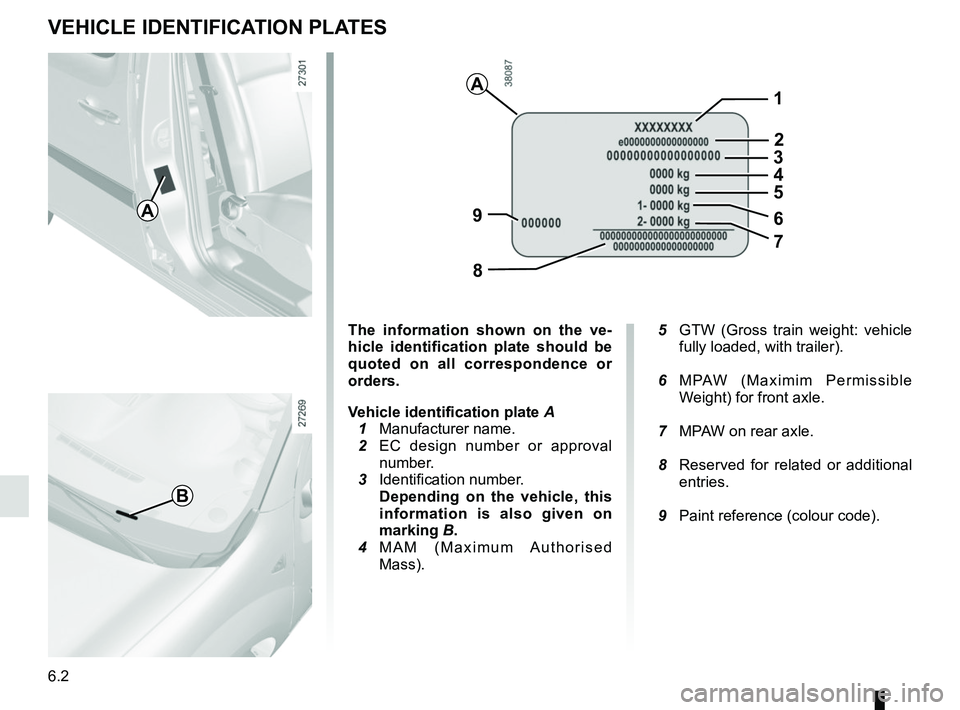
The information shown on the ve-
hicle identification plate should be
quoted on all correspondence or
orders.
Vehicle identification plate A
1 Manufacturer name.
2 EC design number or approval
number.
3 Identification number.
Depending on the vehicle, this
information is also given on
marking B.
4 MAM (Maximum Authorised
Mass).
5 GTW (Gross train weight: vehicle
fully loaded, with trailer).
6 MPAW (Maximim Permissible
Weight) for front axle.
7 MPAW on rear axle.
8 Reserved for related or additional
entries.
9 Paint reference (colour code).
7
8
96
5
4
3
2
1
Page 210 of 230

The weights indicated are for a basic vehicle without options: they vary\
depending on the your vehicle’s equipment.
Contact an approved Dealer.
Maximum permissible all-up weig")
6.6
WEIGHTS (in kg)
The weights indicated are for a basic vehicle without options: they vary\
depending on the your vehicle’s equipment.
Contact an approved Dealer.
Maximum permissible all-up weight (MMAC)
Total train weight (MTR)Medium long
Weights are indicated on the vehicle identification plate (refer to the information on “Vehicle identification plates” in Section 6)
Braked Trailer Weight * found by calculating: MTR - MMAC
Unbraked trailer weight * 374 322
Permissible nose weight * 75
Maximum permissible load on roof 80 (including the carrying device)
* Towing weight (Towing a caravan, boat, etc.)
Towing is prohibited when the GTW - MAM calculation is equal to zero, or \
when the GTW is equal to zero (or is not listed) on th e
identification plate.
– It is important to comply with the towing weights, governed by local leg\
islation in each country and, in particular, laid down in the Road Traffic Regulations. Contact an approved Dealer about any towing equipment.
– When towing, under no circumstances may the total train weight (vehicle + trailer) be exceeded . However the following is
permitted:
– the Maximum permissible weight at the rear may be exceeded by no more th\
an 15%,
– the maximum permissible all-up weight may be exceeded by no more than 10\
% or 100 kg (whichever occurs first).
In either case, the maximum speed of the towing assembly must not exceed\
48 mph (80 km/h) and the tyre pressure must be increased by 0.2 bar (3 PSI).