ECU RENAULT KANGOO ZERO EMISSION 2012 X61 / 2.G User Guide
[x] Cancel search | Manufacturer: RENAULT, Model Year: 2012, Model line: KANGOO ZERO EMISSION, Model: RENAULT KANGOO ZERO EMISSION 2012 X61 / 2.GPages: 213, PDF Size: 6.08 MB
Page 53 of 213

ENG_NU_911-4_F61e_Renault_1
Jaune NoirNoir texte
chilD SAFetY : fitting a child seat (2/5)
child seat at")
1.48
ENG_UD26558_3
Sécurité enfants : installation du siège enfant (X61 - F61 - R\
enault)
ENG_NU_911-4_F61e_Renault_1
Jaune NoirNoir texte
chilD SAFetY : fitting a child seat (2/5)
child seat attached using the belt
¬ Seat which allows a child seat
with “Universal” approval to be attached
by a seat belt.
² Seat not suitable for fitting child
seats.
³ Check the status of the front
airbag before fitting a child seat or al -
lowing a passenger to use the seat.
(1) Before fitting a child seat: position
the vehicle seat as far back as pos-
sible.
type of seat group
(weight of the child) Seats suitable for fitting a child seat
Front passenger seat (1)
With PASSeNger Air BAg (2) WithOUt
PASSeNger Air BAg
group 0, 0+
(weight below 13 kg) U
U
group i
(weight from 9 kg to 18 kg) U
U
groups ii and iii
(weight from 15 kg to 36 kg) U
U
(2) riSK OF D eAth Or
S eri OUS iNJU rY: Before
installing a child seat on the
front passenger seat, check
that the airbag has been deacti -
vated (refer to “Child safety: front
passenger airbag deactivation and
activation” in Section 1).
2-seat version
Page 54 of 213

ENG_NU_911-4_F61e_Renault_1
chilD SAFetY : fitting a child seat (3/5)
child seats")
JauneNoirNoir texte
1.49
ENG_UD26558_3
Sécurité enfants : installation du siège enfant (X61 - F61 - R\
enault)
ENG_NU_911-4_F61e_Renault_1
chilD SAFetY : fitting a child seat (3/5)
child seats attached using the
ISOFIX mounting
üSeat which allows an ISOFIX.
child seat to be fitted.
³ Check the status of the air bag
before fitting a child seat or allowing a
passenger to use the seat.
² Seat not suitable for fitting child
seats.
± The rear seats are fitted with
an anchorage point which allows a
forward-facing ISOFIX child seat with
universal approval to be fitted. The an-
chorage points are located in the lug -
gage compartment and are visible.
The size of the ISOFIX child seat is in-
dicated by a letter:
– A, B and B1: for forward-facing seats
in group 1 (9 to 18 kg);
– C: rear-facing seats in group 1 (9 to
18 kg);
– D and E: shell seat or rear-facing
seats in group 0 or 0+ (less than
13 kg);
– F and G: carrycots in group 0 (less
than 10 kg).
child seat attached using the belt
¬ Seat which allows a standard
-
ised “Universal” seat to be fitted using
a seat belt;
− Seat which only allows a rear-
facing standardised “Universal” seat to
be installed using a seat belt.
Using a child safety system which is not approved for this vehicle will not
correctly protect the baby or child. They risk serious or even fatal injury.
r i S K O F D eAt h O r
S eri OUS iNJU rY: Before
fitting a rear-facing child
seat on the front passenger
seat, check that the airbag has been
deactivated (refer to the information
on “Child safety: front passenger
airbag deactivation/activation” in
Section 1).
5-seat version
Page 55 of 213

ENG_NU_911-4_F61e_Renault_1
Jaune NoirNoir texte
chilD SAFetY : fitting a child seat (4/5)
5-seat versio")
1.50
ENG_UD26558_3
Sécurité enfants : installation du siège enfant (X61 - F61 - R\
enault)
ENG_NU_911-4_F61e_Renault_1
Jaune NoirNoir texte
chilD SAFetY : fitting a child seat (4/5)
5-seat version
t ype of child seat Weight of
the child Seat size
ISOFIX Front passenger
seat (1) (2) rear side seats
rear centre seat
carrycot fitted across the
vehicle
Group 0 < 10 kg
F, G XU - IL (3) U (3)
Shell seat/rear-facing seat
Group 0, 0+ and 1 < to 13 kg
a n d 9 t o
18 kg
C, D, E
U - IL (6) U - IL (4)U (4)
Forward-facing seat
Group 1 9 to 18 kg
A, B, B1 XU - IUF - IL (5) U (5)
Booster seat
Group 2 and 3 15 to 25 kg
a n d 2 2 t o
36 kg
X
U (5)U (5)
(1) riSK OF DeA th Or SeriOUS iNJUrY: Before fitting a rear-facing child seat on the front passenger seat, check
that the airbag has been deactivated (refer to the information on “Child safety: front passenger airbag deactivation/
activation” in Section 1).
the table below summarises the information already shown on the diagram on the previous page, to ensure the regula-
tions in force are respected.
Page 56 of 213

ENG_NU_911-4_F61e_Renault_1
X = Seat not suitable for fitting child seats.
U = Sea")
JauneNoirNoir texte
1.51
ENG_UD26558_3
Sécurité enfants : installation du siège enfant (X61 - F61 - R\
enault)
ENG_NU_911-4_F61e_Renault_1
X = Seat not suitable for fitting child seats.
U = Seat which allows a child seat with “Universal” approval to be installed using a seat belt; check that it can be fitted.
iUF/il = On equipped vehicles, seat which allows an approved “Universal/semi-universal” or “vehicle specific” child seat to be at-
tached using the ISOFIX system; check that it can be fitted.
(2) Only a rear-facing child seat can be fitted in this seat: raise the seat to the maximum and position it as far back as possible,
tilting the seatback slightly (approximately 25°).
(3) A carrycot is fitted crosswise and occupies at least two seats (the chil\
d’s feet are placed nearest the door).
(4) Move the front seat as far forward as possible to install a rear-facing child seat, then move back the seat in front as far as it will
go, although without allowing it to come into contact with the child sea\
t.
(5) Forward-facing child seat; position the seatback of the child seat in contact with the seatback of the vehicle seat. Adjust the
headrest, or remove it if necessary. In addition, do not push the seat in front of the child further than halfway along its runners,
or incline the seatback more than 25°.
(6) Depending on vehicle.
chilD SAFetY : fitting a child seat (5/5)
Page 57 of 213
air bagdeactivating the front passenger air bags
(up to the end of the DU)
air bag activating the front passenger air bags
(up to the end of the DU)
child safety ............................................ (up to the end of the DU)
child restraint/seat ................................ (up to the end of the DU)
transporting children ............................. (up to the end of the DU)
front passenger air bag deactivation .... (up to the end of the DU)
child restraint/seat ................................ (up to the end of the DU)
1.52
ENG_UD28660_3
Sécurité enfants : désactivation/activation airbag passager ava\
nt (X61 - F61 - Renault)
ENG_NU_911-4_F61e_Renault_1
Jaune NoirNoir texte
Deactivating/activating the front passenger airbag
Deactivating the front
passenger air bags
(on equipped vehicles)
You must deactivate the devices in ad-
dition to the front passenger seat belt
before fitting a child seat in the front
passenger seat. t
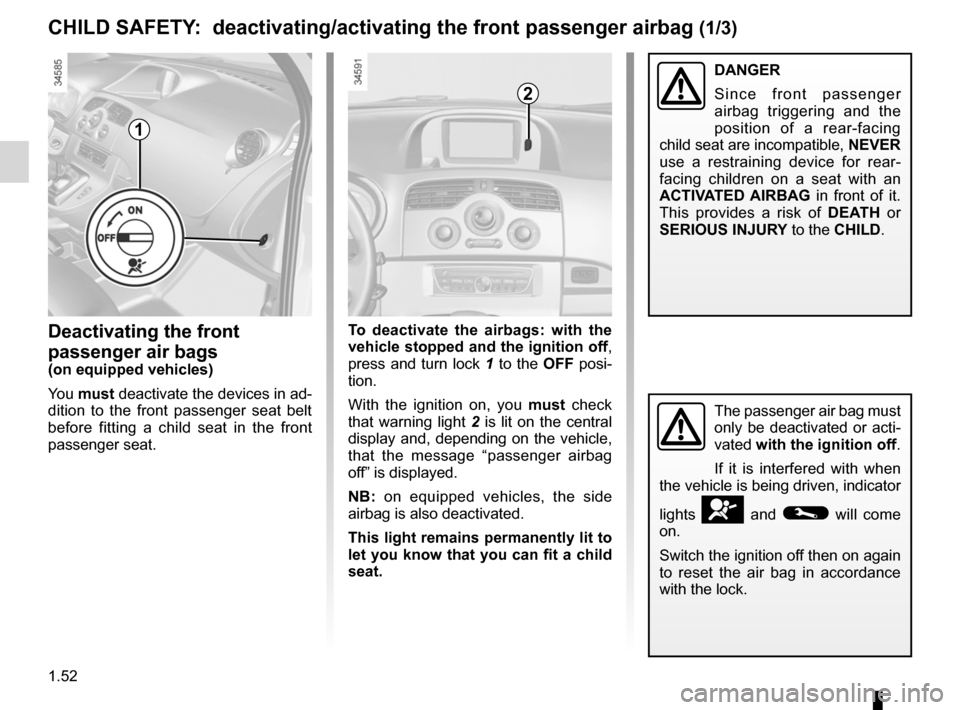
o deactivate the airbags: with the
vehicle stopped and the ignition off,
press and turn lock 1 to the OFF posi-
tion.
With the ignition on, you must check
that warning light 2 is lit on the central
display and, depending on the vehicle,
that the message “passenger airbag
off” is displayed.
NB: on equipped vehicles, the side
airbag is also deactivated.
this light remains permanently lit to
let you know that you can fit a child
seat.
chilD SAFetY : deactivating/activating the front passenger airbag (1/3)
The passenger air bag must
only be deactivated or acti-
vated with the ignition off.
If it is interfered with when
the vehicle is being driven, indicator
lights
å and © will come
on.
Switch the ignition off then on again
to reset the air bag in accordance
with the lock.
2
1
DANger
S i n c e f r o n t p a s s e n g e r
airbag triggering and the
position of a rear-facing
child seat are incompatible, Never
use a restraining device for rear -
facing children on a seat with an
A ctiv Ate D A irBA g in front of it.
This provides a risk of DeAth or
SeriOUS iNJUr Y to the chilD.
Page 58 of 213

ENG_NU_911-4_F61e_Renault_1
chilD SAFetY : deactivating/activating")
JauneNoirNoir texte
1.53
ENG_UD28660_3
Sécurité enfants : désactivation/activation airbag passager ava\
nt (X61 - F61 - Renault)
ENG_NU_911-4_F61e_Renault_1
chilD SAFetY : deactivating/activating the front passenger airbag (2/3)
3
The markings on the dashboard and
labels A on each side of the passen -
ger sun visor 3 (for example, the labels
shown above) will remind you of these
instructions.
AA
DANger
S i n c e f r o n t p a s s e n g e r
airbag triggering and the
position of a rear-facing
child seat are incompatible, Never
use a restraining device for rear -
facing children on a seat with an
A ctiv Ate D A irBA g in front of it.
This provides a risk of DeAth or
SeriOUS iNJUr Y to the chilD.
A
Page 59 of 213

ENG_NU_911-4_F61e_Renault_1
The passenger air bag must
only be deactivated or acti-")
1.54
ENG_UD28660_3
Sécurité enfants : désactivation/activation airbag passager ava\
nt (X61 - F61 - Renault)
ENG_NU_911-4_F61e_Renault_1
The passenger air bag must
only be deactivated or acti-
vated with the ignition off.
If it is interfered with when
the vehicle is being driven, indicator
lights
å and © will come
on.
Switch the ignition off then on again
to reset the air bag in accordance
with the lock.
Operating faults
In the event that the front passenger air
bag activation/deactivation system is
faulty, child seats must not be fitted to
the front seat.
Allowing any other passenger to sit in
that seat is not recommended.
Contact your approved Dealer as soon
as possible.
Activation of the front
passenger air bag
You should reactivate the air bag as
soon as you remove the child seat from
the front passenger seat to ensure the
protection of the front passenger in the
event of an impact.
r eactivating the airbags: with the
vehicle stopped and the ignition off,
press and turn lock 1 to the ON posi -
tion.
With the ignition on, you must check
that the warning light 2 is off.
The front passenger seat belt additional
restraint systems are activated.
2
chilD SAFetY : deactivating/activating the front passenger airbag (3/3)
1
Page 137 of 213
luggage retaining net ............................................. (current page)
3.26
ENG_UD12999_2
Filet de retenue de bagages (X61 - F61 - K61 - Renault)
ENG_NU_911-4_F61e_Renault_3
Luggage net
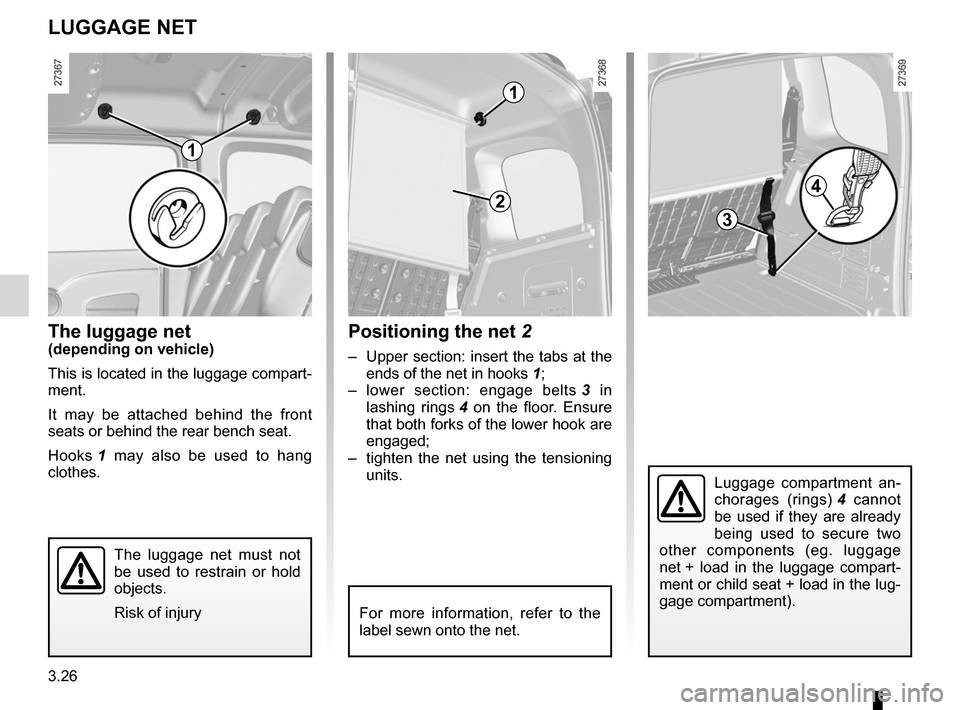
the luggage net(depending on vehicle)
This is located in the luggage compart-
ment.
It may be attached behind the front
seats or behind the rear bench seat.
Hooks 1 may also be used to hang
clothes.
luGGAGe net
For more information, refer to the
label sewn onto the net.
1
1
3
4
Positioning the net 2
– Upper section: insert the tabs at the
ends of the net in hooks 1;
– lower section: engage belts 3 in
lashing rings 4 on the floor. Ensure
that both forks of the lower hook are
engaged;
– tighten the net using the tensioning
units.
Luggage compartment an -
chorages (rings) 4 cannot
be used if they are already
being used to secure two
other components (eg. luggage
net + load in the luggage compart -
ment or child seat + load in the lug-
gage compartment).
2
The luggage net must not
be used to restrain or hold
objects.
Risk of injury
Page 147 of 213
4.10
ENG_UD26559_3
Entretien de la carosserie (X61 - X38 - X61 électrique - L38 électrique - X10 - Renault)
ENG_NU_911-4_F61e_Renault_4
using a roller type car wash
Return the windscreen wiper stalk to
the Park position (refer to the informa-
tion on the “Windscreen washer, wiper”
in Section 1). Check the mounting of
external accessories, additional lights
and mirrors, and ensure that the wiper
blades are secured with adhesive tape.
Remove the radio aerial mast if your
vehicle is fitted with this equipment.
Remember to remove the tape and refit
the antenna after washing.
Observe the vehicle stopping distances
when driving on gravelled surfaces to
prevent paint damage.
Repair, or have repaired quickly, areas
where the paint has been damaged, to
prevent corrosion spreading.
Remember to visit the body shop pe
-
riodically in order to maintain your
anti-corrosion warranty. Refer to the
Maintenance Document.
Respect local regulations about wash -
ing vehicles (e.g. do not wash your ve-
hicle on a public highway).
If it is necessary to clean mechani -
cal components, hinges, etc., spray
them with products approved by our
Technical Department to protect them
after they have been cleaned.
BODyWORk MaIntenanCe (2/2)
Cleaning the headlights
As the headlights are made of plastic
“glass”, use a soft cloth or cotton wool
to clean them. If this does not clean
them properly, moisten the cloth with
soapy water, then wipe clean with a soft
damp cloth or cotton wool.
Finally, carefully dry off with a soft dry
cloth.
Cleaning products containing alco -
hol must not be used.
vehicles with a matte paint
finish
This type of paint requires certain pre-
cautions.
Do not do the following
– use wax-based products (polishing);
– rub too hard;
– wash the vehicle in a roller-type car
wash;
– wash the vehicle using a high-pres-
sure device;
– attach stickers to the paintwork (risk
of leaving marks).
y ou should do the following
Wash the vehicle by hand using plenty
of water, using a soft cloth or a gentle
sponge.
We have selected special products
to care for your vehicle and you can
obtain these from the manufactur -
er’s accessory outlets.
Washing the vehicle
Never wash the engine
compartment, the charging
connection or the traction
battery with a high-pressure jet.
This risks damaging the electric cir-
cuit.
Never wash the vehicle while it is
charging.
Risk of electric shock and a risk to
life.
Page 154 of 213
JauneNoirNoir texte
5.5
ENG_UD28662_1
Kit de gonflage des pneumatiques (X61 électrique - Renault)
ENG_NU_911-4_F61e_Renault_5
tyre InFlatIOn KIt (3/5)
9
8
Precautions when using the kit
The kit should not be operated for more
than 15 consecutive minutes.
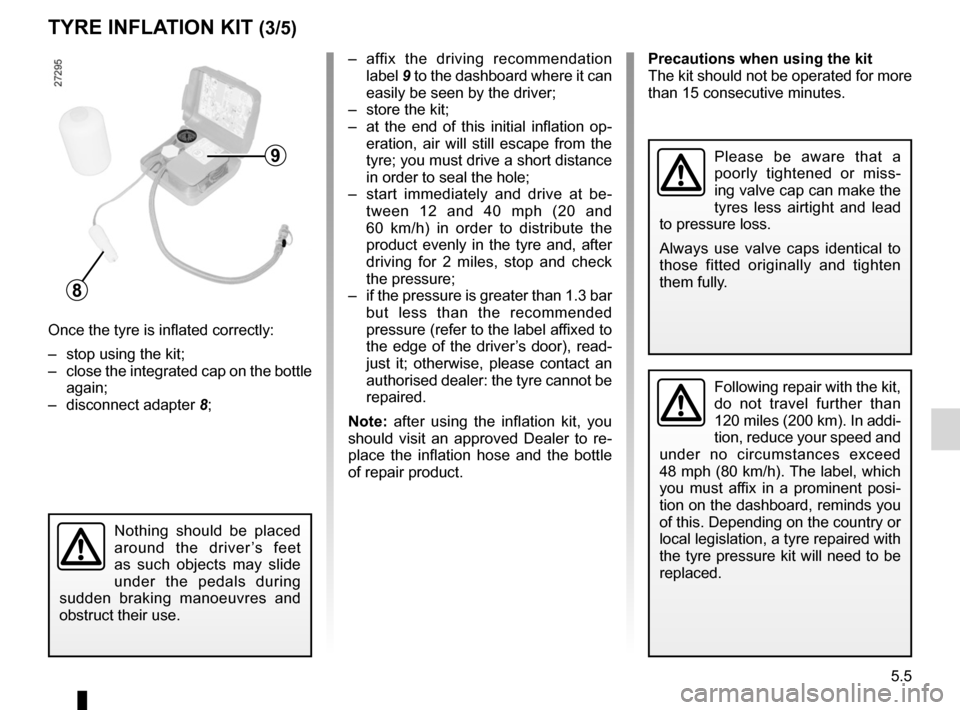
Once the tyre is inflated correctly:
– stop using the kit;
– close the integrated cap on the bottle
again;
– disconnect adapter 8; –
affix the driving recommendation
label 9 to the dashboard where it can
easily be seen by the driver;
– store the kit;
– at the end of this initial inflation op -
eration, air will still escape from the
tyre; you must drive a short distance
in order to seal the hole;
– start immediately and drive at be -
tween 12 and 40 mph (20 and
60 km/h) in order to distribute the
product evenly in the tyre and, after
driving for 2 miles, stop and check
the pressure;
– if the pressure is greater than 1.3 bar
but less than the recommended
pressure (refer to the label affixed to
the edge of the driver’s door), read-
just it; otherwise, please contact an
authorised dealer: the tyre cannot be
repaired.
n ote: after using the inflation kit, you
should visit an approved Dealer to re -
place the inflation hose and the bottle
of repair product.
Following repair with the kit,
do not travel further than
120 miles (200 km). In addi -
tion, reduce your speed and
under no circumstances exceed
48 mph (80 km/h). The label, which
you must affix in a prominent posi -
tion on the dashboard, reminds you
of this. Depending on the country or
local legislation, a tyre repaired with
the tyre pressure kit will need to be
replaced.
Nothing should be placed
around the driver ’s feet
as such objects may slide
under the pedals during
sudden braking manoeuvres and
obstruct their use.
Please be aware that a
poorly tightened or miss -
ing valve cap can make the
tyres less airtight and lead
to pressure loss.
Always use valve caps identical to
those fitted originally and tighten
them fully.