seats RENAULT KOLEOS 2015 1.G User Guide
[x] Cancel search | Manufacturer: RENAULT, Model Year: 2015, Model line: KOLEOS, Model: RENAULT KOLEOS 2015 1.GPages: 232, PDF Size: 18.18 MB
Page 38 of 232
JauneNoir Noir texte
38
ENG_UD23487_5
Sécurité enfants : installation du siège enfant (X45 - H45 - Renault) ENG_NU_1057-1_H45_Ph3_Renault_1
CHILD SAFETY: fitting a child seat (2/3)
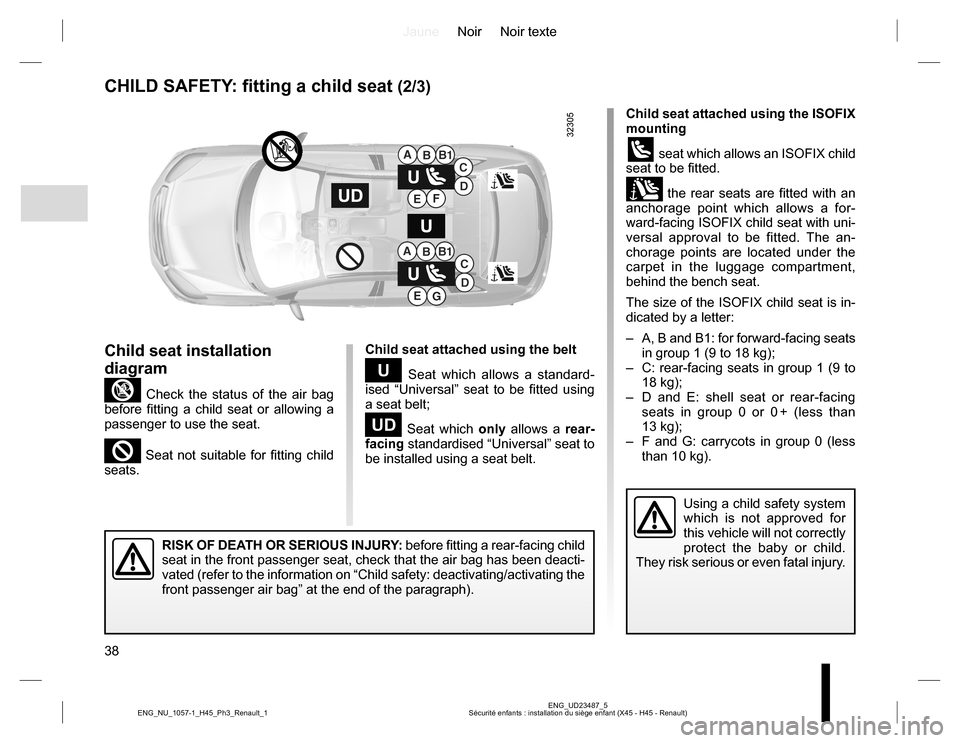
Child seat attached using the ISOFIX
mounting
ü seat which allows an ISOFIX child
seat to be fitted.
± the rear seats are fitted with an
anchorage point which allows a for-
ward-facing ISOFIX child seat with uni-
versal approval to be fitted. The an-
chorage points are located under the
carpet in the luggage compartment,
behind the bench seat.
The size of the ISOFIX child seat is in-
dicated by a letter:
– A, B and B1: for forward-facing seats
in group 1 (9 to 18 kg);
– C: rear-facing seats in group 1 (9 to
18 kg);
– D and E: shell seat or rear-facing
seats in group 0 or 0 + (less than
13 kg);
– F and G: carrycots in group 0 (less
than 10 kg).
Child seat attached using the belt
¬ Seat which allows a standard-
ised “Universal” seat to be fitted using
a seat belt;
− Seat which only allows a rear-
facing standardised “Universal” seat to
be installed using a seat belt.
Using a child safety system
which is not approved for
this vehicle will not correctly
protect the baby or child.
They risk serious or even fatal injury.
Child seat installation
diagram
³ Check the status of the air bag
before fitting a child seat or allowing a
passenger to use the seat.
² Seat not suitable for fitting child
seats.
RISK OF DEATH OR SERIOUS INJURY: before fitting a rear-facing child
seat in the front passenger seat, check that the air bag has been deacti-
vated (refer to the information on “Child safety: deactivating/activating the
front passenger air bag” at the end of the paragraph).
Page 39 of 232
JauneNoir Noir texte
39
ENG_UD23487_5
Sécurité enfants : installation du siège enfant (X45 - H45 - Renault) ENG_NU_1057-1_H45_Ph3_Renault_1
CHILD SAFETY: fitting a child seat (3/3)
(5) RISK OF DEATH OR SERIOUS INJURY: before fitting a rear-facing child seat in the front passenger seat, check
that the air bag has been deactivated (refer to the information on “Child safety: deactivating/activating the front pas-
senger air bag” at the end of the paragraph).
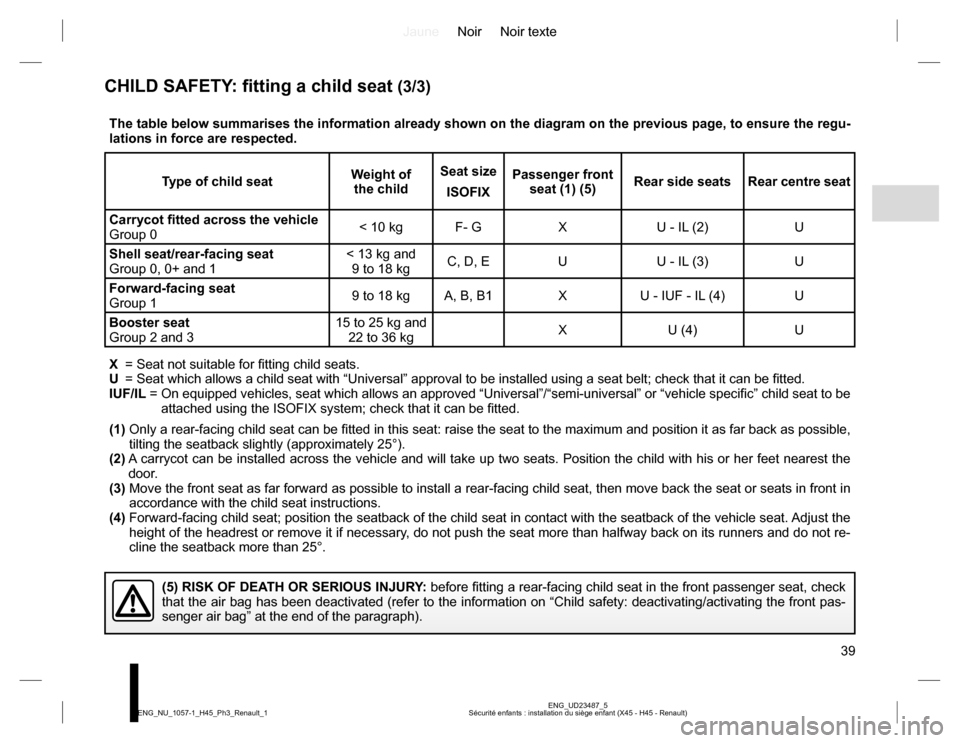
The table below summarises the information already shown on the diagram on the previous page, to ensure the regu-
lations in force are respected.
Type of child seatWeight of
the childSeat size
ISOFIXPassenger front
seat (1) (5)Rear side seats Rear centre seat
Carrycot fitted across the vehicle
Group 0< 10 kg F- G X U - IL (2) U
Shell seat/rear-facing seat
Group 0, 0+ and 1< 13 kg and
9 to 18 kgC, D, E U U - IL (3) U
Forward-facing seat
Group 19 to 18 kg A, B, B1 X U - IUF - IL (4) U
Booster seat
Group 2 and 315 to 25 kg and
22 to 36 kgX U (4) U
X = Seat not suitable for fitting child seats.
U = Seat which allows a child seat with “Universal” approval to be installed using a seat belt; check that it can be fitted.
IUF/IL =
On equipped vehicles, seat which allows an approved “Universal”/“semi-universal” or “vehicle specific” child seat to be
attached using the ISOFIX system; check that it can be fitted.
(1) Only a rear-facing child seat can be fitted in this seat: raise the seat to the maximum and position it as far back as possible,
tilting the seatback slightly (approximately 25°).
(2) A carrycot can be installed across the vehicle and will take up two seats. Position the child with his or her feet nearest the
door.
(3) Move the front seat as far forward as possible to install a rear-facing child seat, then move back the seat or seats in front in
accordance with the child seat instructions.
(4) Forward-facing child seat; position the seatback of the child seat in contact with the seatback of the vehicle seat. Adjust the
height of the headrest or remove it if necessary, do not push the seat more than halfway back on its runners and do not re-
cline the seatback more than 25°.
Page 127 of 232
JauneNoir Noir texte
127
ENG_UD20983_3
Conditionnement d’air automatique bizone (X45 - H45 - Renault) ENG_NU_1057-1_H45_Ph3_Renault_3
AUTOMATIC CLIMATE CONTROL (1/6)
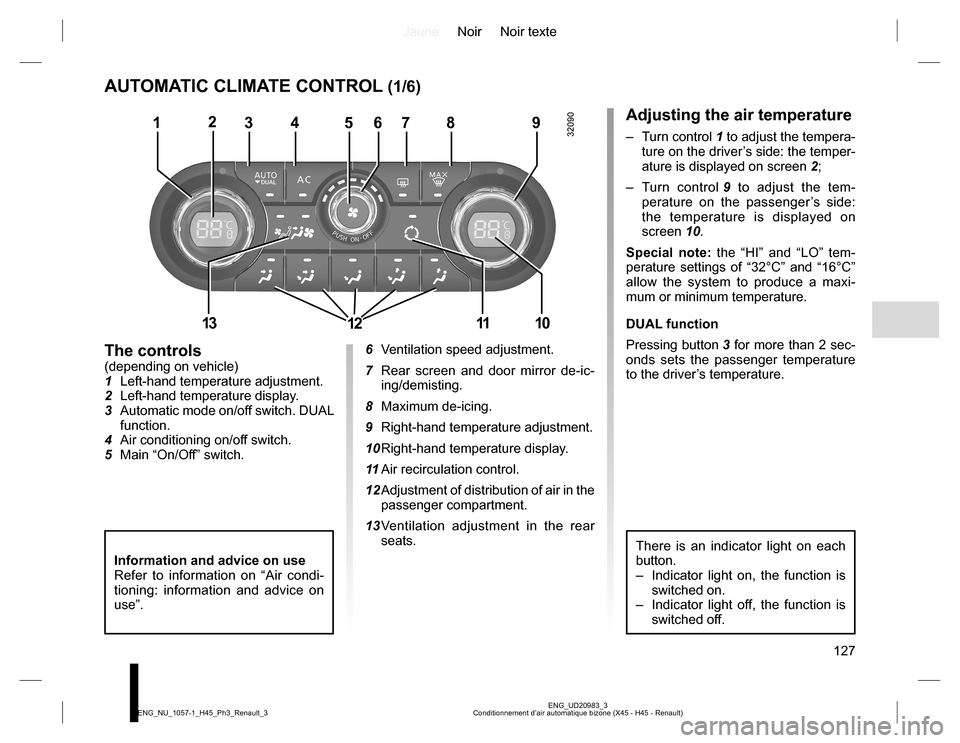
The controls(depending on vehicle)
1 Left-hand temperature adjustment.
2 Left-hand temperature display.
3 Automatic mode on/off switch. DUAL
function.
4 Air conditioning on/off switch.
5 Main “On/Off” switch.6 Ventilation speed adjustment.
7 Rear screen and door mirror de-ic-
ing/demisting.
8 Maximum de-icing.
9 Right-hand temperature adjustment.
10 Right-hand temperature display.
11 Air recirculation control.
12 Adjustment of distribution of air in the
passenger compartment.
13 Ventilation adjustment in the rear
seats.
Adjusting the air temperature
– Turn control 1 to adjust the tempera-
ture on the driver’s side: the temper-
ature is displayed on screen 2;
– Turn control 9 to adjust the tem-
perature on the passenger’s side:
the temperature is displayed on
screen 10.
Special note: the “HI” and “LO” tem-
perature settings of “32°C” and “16°C”
allow the system to produce a maxi-
mum or minimum temperature.
DUAL function
Pressing button 3 for more than 2 sec-
onds sets the passenger temperature
to the driver’s temperature.
There is an indicator light on each
button.
– Indicator light on, the function is
switched on.
– Indicator light off, the function is
switched off.
13457896
10
2
Information and advice on use
Refer to information on “Air condi-
tioning: information and advice on
use”.
131112
Page 132 of 232
JauneNoir Noir texte
132
ENG_UD20983_3
Conditionnement d’air automatique bizone (X45 - H45 - Renault) ENG_NU_1057-1_H45_Ph3_Renault_3
AUTOMATIC CLIMATE CONTROL (6/6)
Setting the air recirculation
mode
Pressing button 11 activates air recircu-
lation mode (the symbol lights up on the
display).
During recirculation, air is taken from
the passenger compartment and is re-
cycled, with no air being taken from out-
side the vehicle.
Air recirculation allows the passenger
compartment to be isolated from the
outside air (when driving in polluted
areas, etc.).Prolonged use of this position may lead
to odours, caused by non-renewal of
air, and the formation of condensation
on the windows.
We therefore advise you to return to
normal mode (external air or automatic
recirculation) as soon as air recircula-
tion is no longer needed, by pressing
button 11.
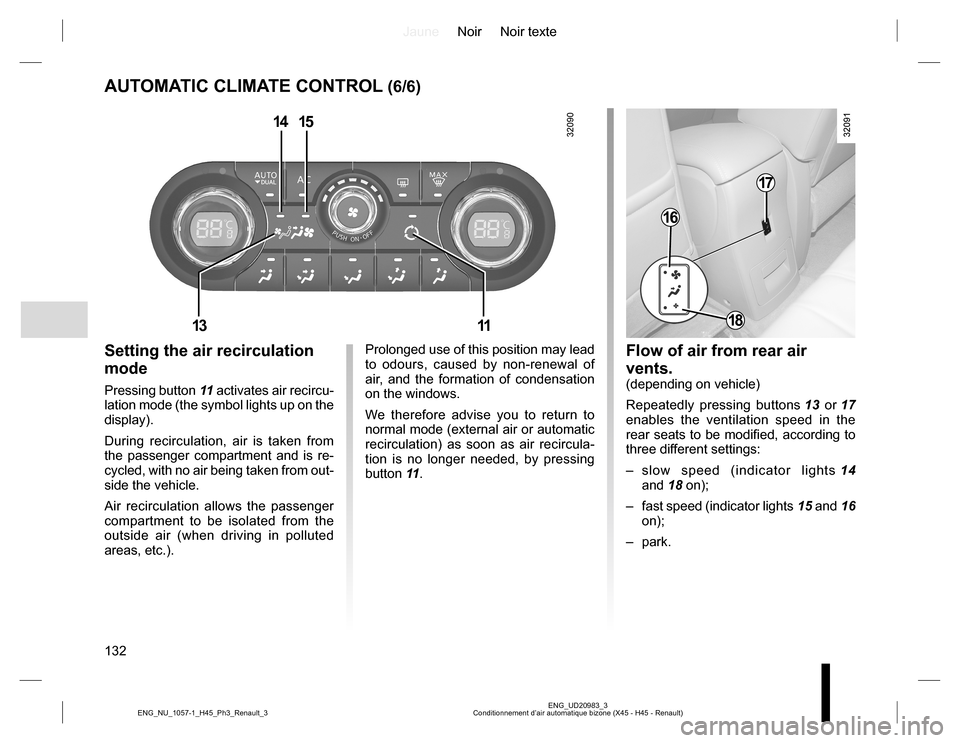
Flow of air from rear air
vents.
(depending on vehicle)
Repeatedly pressing buttons 13 or 17
enables the ventilation speed in the
rear seats to be modified, according to
three different settings:
– slow speed (indicator lights 14
and 18 on);
– fast speed (indicator lights 15 and 16
on);
– park.
1415
1311
16
17
18
Page 134 of 232
JauneNoir Noir texte
134
ENG_UD31661_4
L ves-vitres lectriques (X45 - H45 - Renault) ENG_NU_1057-1_H45_Ph3_Renault_3
ELECTRIC WINDOWS (1/2)
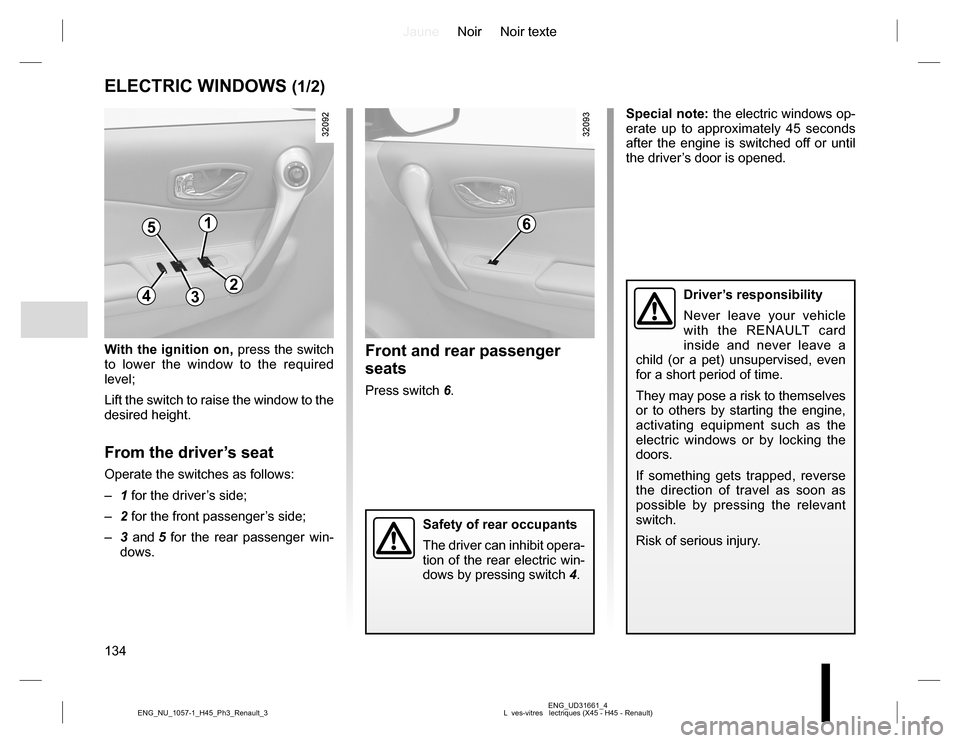
With the ignition on, press the switch
to lower the window to the required
level;
Lift the switch to raise the window to the
desired height.
From the driver’s seat
Operate the switches as follows:
– 1 for the driver’s side;
– 2 for the front passenger’s side;
– 3 and 5 for the rear passenger win-
dows.
Front and rear passenger
seats
Press switch 6.Special note: the electric windows op-
erate up to approximately 45 seconds
after the engine is switched off or until
the driver’s door is opened.
Driver’s responsibility
Never leave your vehicle
with the RENAULT card
inside and never leave a
child (or a pet) unsupervised, even
for a short period of time.
They may pose a risk to themselves
or to others by starting the engine,
activating equipment such as the
electric windows or by locking the
doors.
If something gets trapped, reverse
the direction of travel as soon as
possible by pressing the relevant
switch.
Risk of serious injury.
Safety of rear occupants
The driver can inhibit opera-
tion of the rear electric win-
dows by pressing switch 4.
51
432
6
Page 138 of 232
JauneNoir Noir texte
138
ENG_UD28047_5
Pare-soleil/Miroir de communication (X45 - H45 - Renault) ENG_NU_1057-1_H45_Ph3_Renault_3
SUN VISOR, CHILD MINDER MIRROR
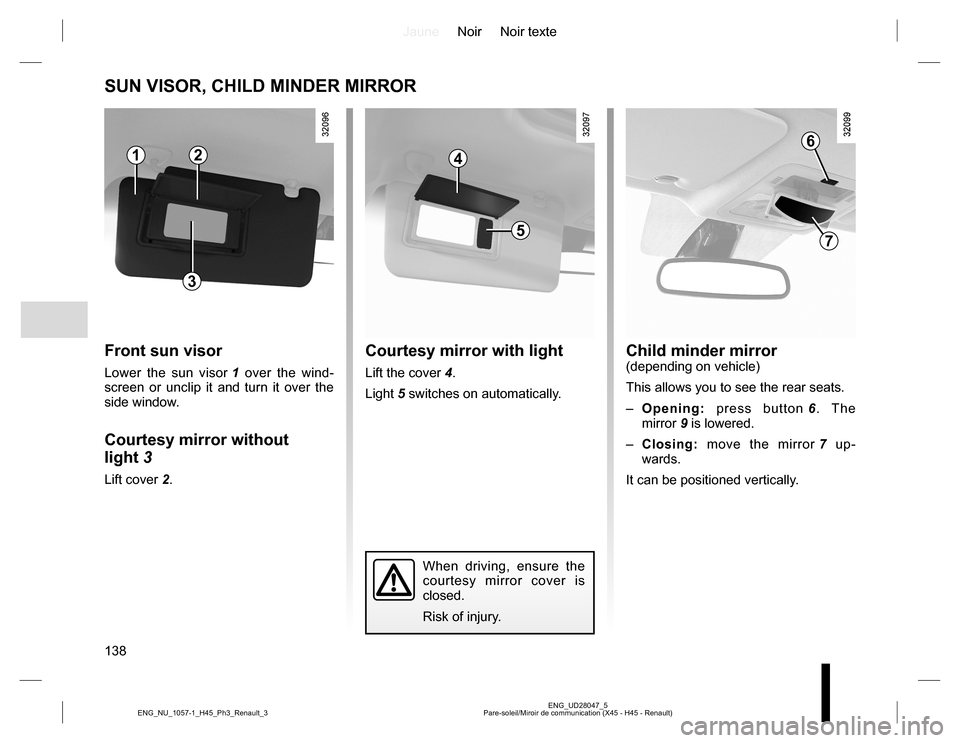
Child minder mirror(depending on vehicle)
This allows you to see the rear seats.
– Opening: press button 6. The
mirror 9 is lowered.
– Closing: move the mirror 7 up-
wards.
It can be positioned vertically.
6
7
Front sun visor
Lower the sun visor 1 over the wind-
screen or unclip it and turn it over the
side window.
Courtesy mirror without
light 3
Lift cover 2.
Courtesy mirror with light
Lift the cover 4.
Light 5 switches on automatically.
2
3
1
When driving, ensure the
courtesy mirror cover is
closed.
Risk of injury.
4
5
Page 139 of 232
JauneNoir Noir texte
139
ENG_UD23659_3
Eclairage intérieur (X45 - H45 - Renault) ENG_NU_1057-1_H45_Ph3_Renault_3
INTERIOR LIGHTING (1/2)
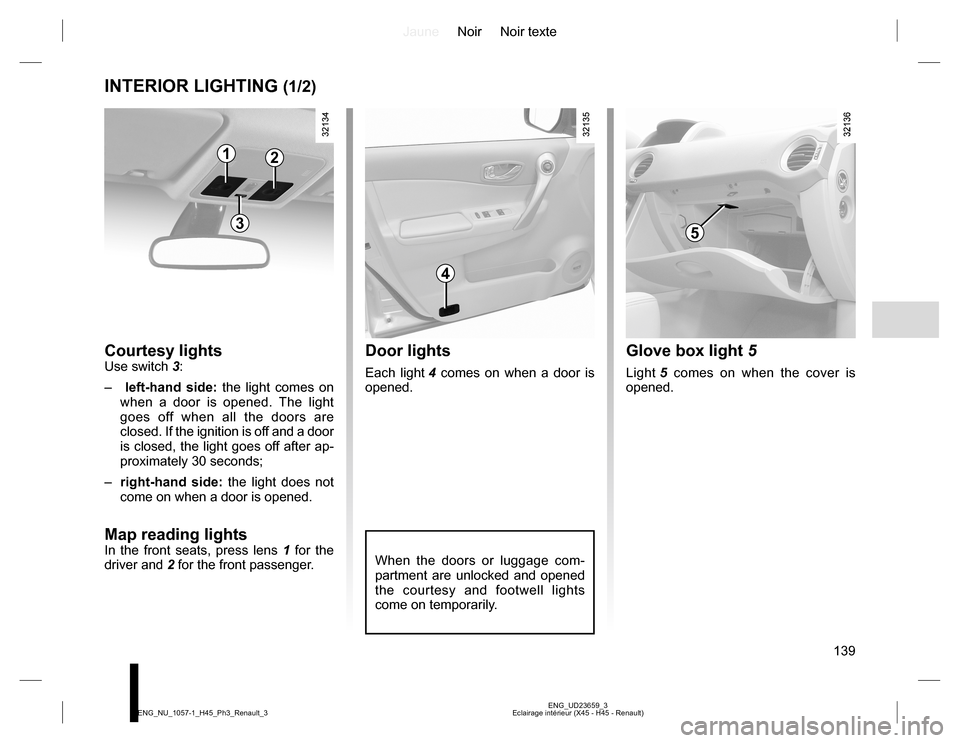
Courtesy lightsUse switch 3:
– left-hand side: the light comes on
when a door is opened. The light
goes off when all the doors are
closed. If the ignition is off and a door
is closed, the light goes off after ap-
proximately 30 seconds;
– right-hand side: the light does not
come on when a door is opened.
Map reading lights
In the front seats, press lens 1 for the
driver and 2 for the front passenger.
Door lights
Each light 4 comes on when a door is
opened.
Glove box light 5
Light 5 comes on when the cover is
opened.
When the doors or luggage com-
partment are unlocked and opened
the courtesy and footwell lights
come on temporarily.
12
3
4
5
Page 145 of 232
JauneNoir Noir texte
145
ENG_UD31507_7
Rangements, am nagements habitacle (X45 - H45 - Renault) ENG_NU_1057-1_H45_Ph3_Renault_3
PASSENGER COMPARTMENT STORAGE, FITTINGS (5/6)
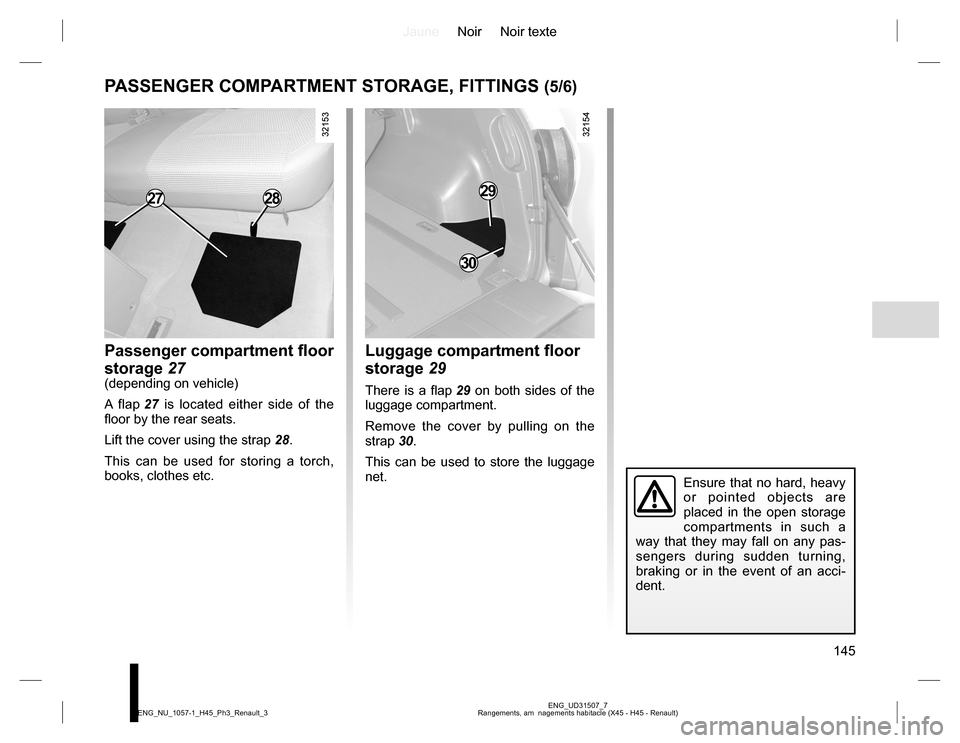
Passenger compartment floor
storage 27
(depending on vehicle)
A flap 27 is located either side of the
floor by the rear seats.
Lift the cover using the strap 28.
This can be used for storing a torch,
books, clothes etc.
Luggage compartment floor
storage 29
There is a flap 29 on both sides of the
luggage compartment.
Remove the cover by pulling on the
strap 30.
This can be used to store the luggage
net.
2829
30
27
Ensure that no hard, heavy
or pointed objects are
placed in the open storage
compartments in such a
way that they may fall on any pas-
sengers during sudden turning,
braking or in the event of an acci-
dent.
Page 149 of 232
JauneNoir Noir texte
149
ENG_UD8576_2
Banquette arri re (X45 - H45 - Renault) ENG_NU_1057-1_H45_Ph3_Renault_3
REAR BENCH SEAT FUNCTIONS (1/2)
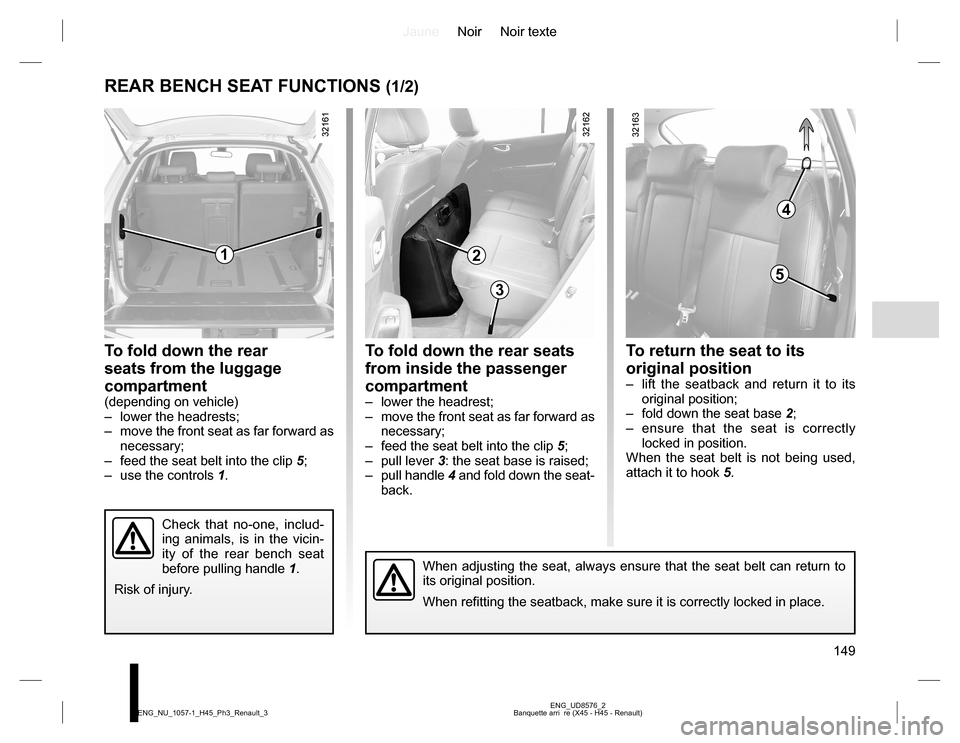
When adjusting the seat, always ensure that the seat belt can return to
its original position.
When refitting the seatback, make sure it is correctly locked in place.
2
3
4
5
1
To fold down the rear seats
from inside the passenger
compartment
– lower the headrest;
– move the front seat as far forward as
necessary;
– feed the seat belt into the clip 5;
– pull lever 3: the seat base is raised;
– pull handle 4 and fold down the seat-
back.
Check that no-one, includ-
ing animals, is in the vicin-
ity of the rear bench seat
before pulling handle 1.
Risk of injury.
To fold down the rear
seats from the luggage
compartment
(depending on vehicle)
– lower the headrests;
– move the front seat as far forward as
necessary;
– feed the seat belt into the clip 5;
– use the controls 1.
To return the seat to its
original position
– lift the seatback and return it to its
original position;
– fold down the seat base 2;
– ensure that the seat is correctly
locked in position.
When the seat belt is not being used,
attach it to hook 5.
Page 152 of 232
JauneNoir Noir texte
152
ENG_UD23903_4
Coffre à bagages (X45 - H45 - Renault) ENG_NU_1057-1_H45_Ph3_Renault_3
LUGGAGE COMPARTMENT (2/2)
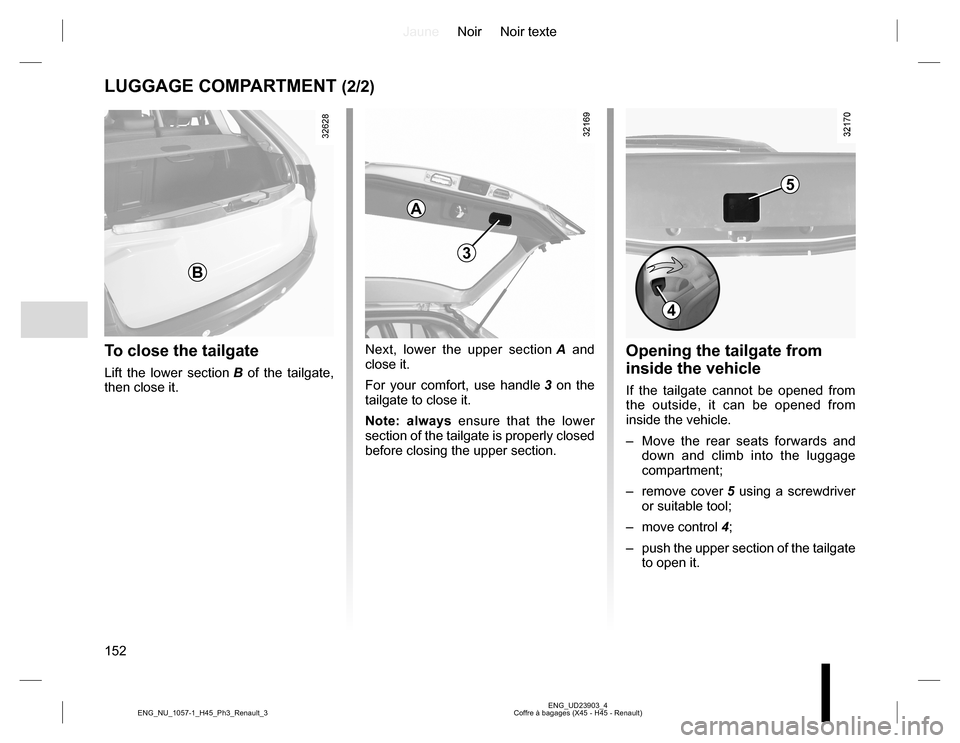
To close the tailgate
Lift the lower section B of the tailgate,
then close it.
Opening the tailgate from
inside the vehicle
If the tailgate cannot be opened from
the outside, it can be opened from
inside the vehicle.
– Move the rear seats forwards and
down and climb into the luggage
compartment;
– remove cover 5 using a screwdriver
or suitable tool;
– move control 4;
– push the upper section of the tailgate
to open it.
3
5
4
Next, lower the upper section A and
close it.
For your comfort, use handle 3 on the
tailgate to close it.
Note: always ensure that the lower
section of the tailgate is properly closed
before closing the upper section.
A
B