warning RENAULT KOLEOS 2015 1.G Workshop Manual
[x] Cancel search | Manufacturer: RENAULT, Model Year: 2015, Model line: KOLEOS, Model: RENAULT KOLEOS 2015 1.GPages: 232, PDF Size: 18.18 MB
Page 105 of 232
JauneNoir Noir texte
105
ENG_UD31417_1
Blind Spot Warning (X45 - H45 - Renault) ENG_NU_1057-1_H45_Ph3_Renault_2
BLIND SPOT WARNING (1/2)
This system notifies the driver when
the other vehicle comes up in the blind
spot.
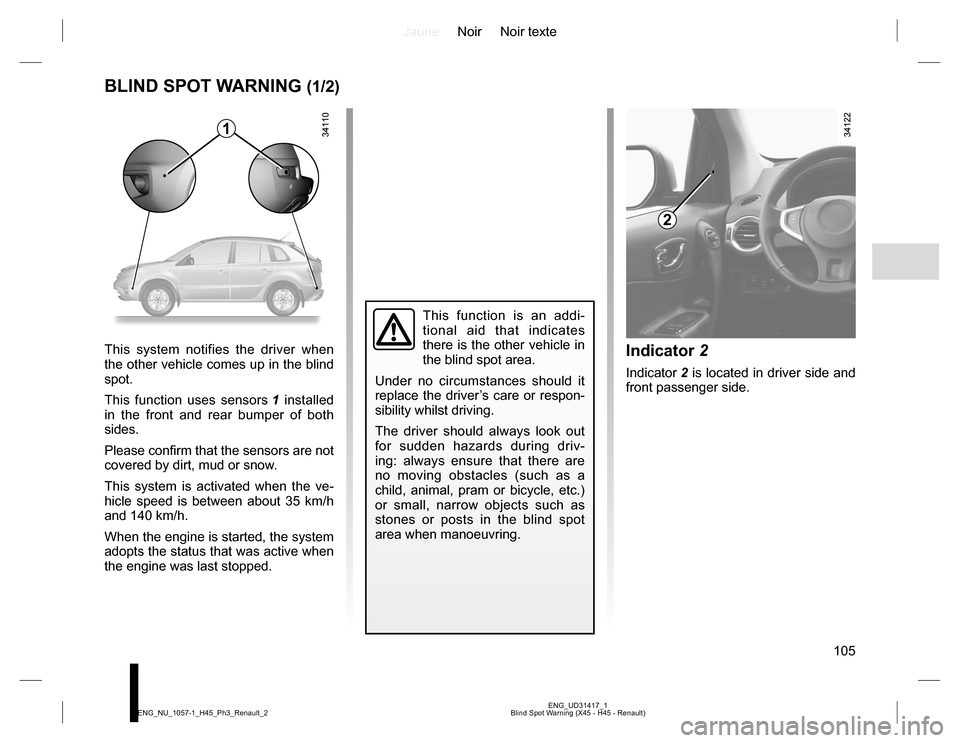
This function uses sensors 1 installed
in the front and rear bumper of both
sides.
Please confirm that the sensors are not
covered by dirt, mud or snow.
This system is activated when the ve-
hicle speed is between about 35 km/h
and 140 km/h.
When the engine is started, the system
adopts the status that was active when
the engine was last stopped.
This function is an addi-
tional aid that indicates
there is the other vehicle in
the blind spot area.
Under no circumstances should it
replace the driver’s care or respon-
sibility whilst driving.
The driver should always look out
for sudden hazards during driv-
ing: always ensure that there are
no moving obstacles (such as a
child, animal, pram or bicycle, etc.)
or small, narrow objects such as
stones or posts in the blind spot
area when manoeuvring.
2
Indicator 2
Indicator 2 is located in driver side and
front passenger side.
1
Page 106 of 232
JauneNoir Noir texte
106
ENG_UD31417_1
Blind Spot Warning (X45 - H45 - Renault) ENG_NU_1057-1_H45_Ph3_Renault_2
BLIND SPOT WARNING (2/2)
Operating faults
If the system detects a faults, indicator
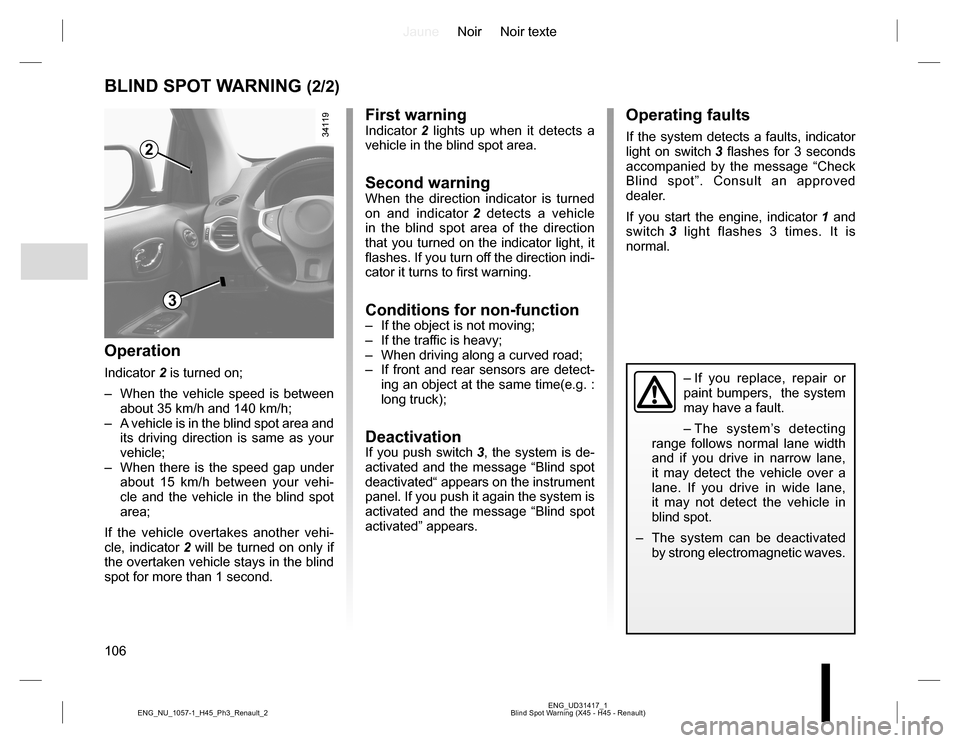
light on switch 3 flashes for 3 seconds
accompanied by the message “Check
Blind spot”. Consult an approved
dealer.
If you start the engine, indicator 1 and
switch 3 light flashes 3 times. It is
normal.2
3
First warningIndicator 2 lights up when it detects a
vehicle in the blind spot area.
Second warningWhen the direction indicator is turned
on and indicator 2 detects a vehicle
in the blind spot area of the direction
that you turned on the indicator light, it
flashes. If you turn off the direction indi-
cator it turns to first warning.
Conditions for non-function– If the object is not moving;
– If the traffic is heavy;
– When driving along a curved road;
– If front and rear sensors are detect-
ing an object at the same time(e.g. :
long truck);
DeactivationIf you push switch 3, the system is de-
activated and the message “Blind spot
deactivated“ appears on the instrument
panel. If you push it again the system is
activated and the message “Blind spot
activated” appears.
– If you replace, repair or
paint bumpers, the system
may have a fault.
– The system’s detecting
range follows normal lane width
and if you drive in narrow lane,
it may detect the vehicle over a
lane. If you drive in wide lane,
it may not detect the vehicle in
blind spot.
– The system can be deactivated
by strong electromagnetic waves.
Operation
Indicator 2 is turned on;
– When the vehicle speed is between
about 35 km/h and 140 km/h;
– A vehicle is in the blind spot area and
its driving direction is same as your
vehicle;
– When there is the speed gap under
about 15 km/h between your vehi-
cle and the vehicle in the blind spot
area;
If the vehicle overtakes another vehi-
cle, indicator 2 will be turned on only if
the overtaken vehicle stays in the blind
spot for more than 1 second.
Page 116 of 232
JauneNoir Noir texte
11 6
ENG_UD27281_8
Aide au parking (X45 - H45 - Renault) ENG_NU_1057-1_H45_Ph3_Renault_2
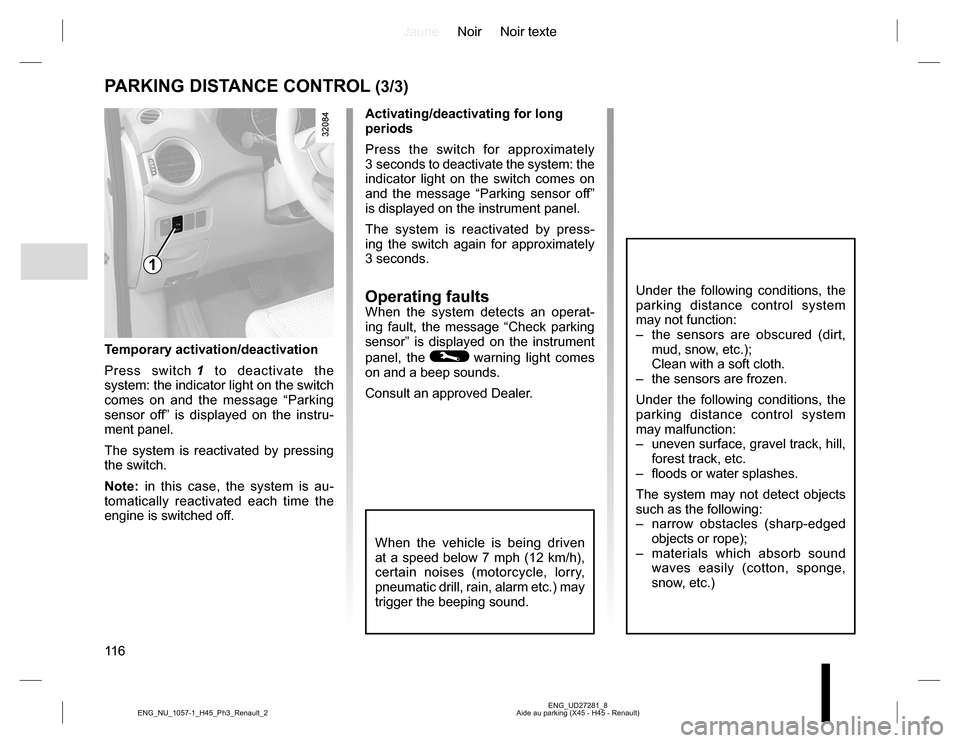
Temporary activation/deactivation
Press switch 1 to deactivate the
system: the indicator light on the switch
comes on and the message “Parking
sensor off” is displayed on the instru-
ment panel.
The system is reactivated by pressing
the switch.
Note: in this case, the system is au-
tomatically reactivated each time the
engine is switched off.
1
Activating/deactivating for long
periods
Press the switch for approximately
3 seconds to deactivate the system: the
indicator light on the switch comes on
and the message “Parking sensor off”
is displayed on the instrument panel.
The system is reactivated by press-
ing the switch again for approximately
3 seconds.
Operating faultsWhen the system detects an operat-
ing fault, the message “Check parking
sensor” is displayed on the instrument
panel, the
© warning light comes
on and a beep sounds.
Consult an approved Dealer.
When the vehicle is being driven
at a speed below 7 mph (12 km/h),
certain noises (motorcycle, lorry,
pneumatic drill, rain, alarm etc.) may
trigger the beeping sound.
PARKING DISTANCE CONTROL (3/3)
Under the following conditions, the
parking distance control system
may not function:
– the sensors are obscured (dirt,
mud, snow, etc.);
Clean with a soft cloth.
– the sensors are frozen.
Under the following conditions, the
parking distance control system
may malfunction:
– uneven surface, gravel track, hill,
forest track, etc.
– floods or water splashes.
The system may not detect objects
such as the following:
– narrow obstacles (sharp-edged
objects or rope);
– materials which absorb sound
waves easily (cotton, sponge,
snow, etc.)
Page 118 of 232
JauneNoir Noir texte
11 8
ENG_UD27292_7
Bo tes de vitesses automatiques ou variation continue (X45 - H45 - Renault) ENG_NU_1057-1_H45_Ph3_Renault_2
AUTOMATIC OR CONTINUOUSLY VARIABLE TRANSMISSION (2/3)
Driving in manual mode
With the selector lever in position D,
move the lever to the left. Shifting the
lever repeatedly allows you to change
gears manually:
– backwards to shift down the gears;
– forwards to shift up the gears.
The gear selected is displayed on the
instrument panel.
Special cases
Under certain driving conditions (e.g.
engine protection, or electronic stability
control (ESC) operational etc.) the au-
tomatic system may change gear auto-
matically.
Likewise, to prevent incorrect manoeu-
vres, a gear change may be refused by
the automatic system: in this case the
gear display flashes for a few seconds
as a warning.
Special circumstances
– If the bends and road surface do
not allow you to stay in automatic
mode (e.g. in the mountains), we
recommend that you change to
manual mode.
This will prevent repeated gear
changes when climbing and will
enable engine braking on long de-
scents.
– In very cold weather, to avoid stall-
ing the engine, start the engine and
wait a few seconds before moving
the lever from position P or N to po-
sition D or R.
– Vehicles not fitted with traction
control: to avoid wheelspin when
starting on a slippery or low grip sur-
face, change to manual mode and
select second gear before moving
off.
Parking the vehicle
When the vehicle is stopped, move the
lever to position P while keeping your
foot on the brake pedal: the gearbox is
in neutral and the drive wheels are me-
chanically locked by the driveshaft.
Depending on the vehicle, apply the
handbrake or check that the elec-
tronic parking brake is on (refer to
the information on the Parking brake in
Section 2).
In very cold weather, the system may prevent the gears from being shifted in
manual mode until the gearbox reaches the right temperature.
An impact to the under-
side of the vehicle while
manoeuvring (e.g.: strik-
ing a post, raised kerb or
other street furniture) may result in
damage to the vehicle (e.g.: defor-
mation of an axle).
To avoid any risk of accident, have
your vehicle checked by an ap-
proved Dealer.
Page 166 of 232
JauneNoir Noir texte
166
ENG_UD28051_5
Niveaux/filtres (X45 - H45 - Renault) ENG_NU_1057-1_H45_Ph3_Renault_4
LEVELS, FILTERS (2/3)
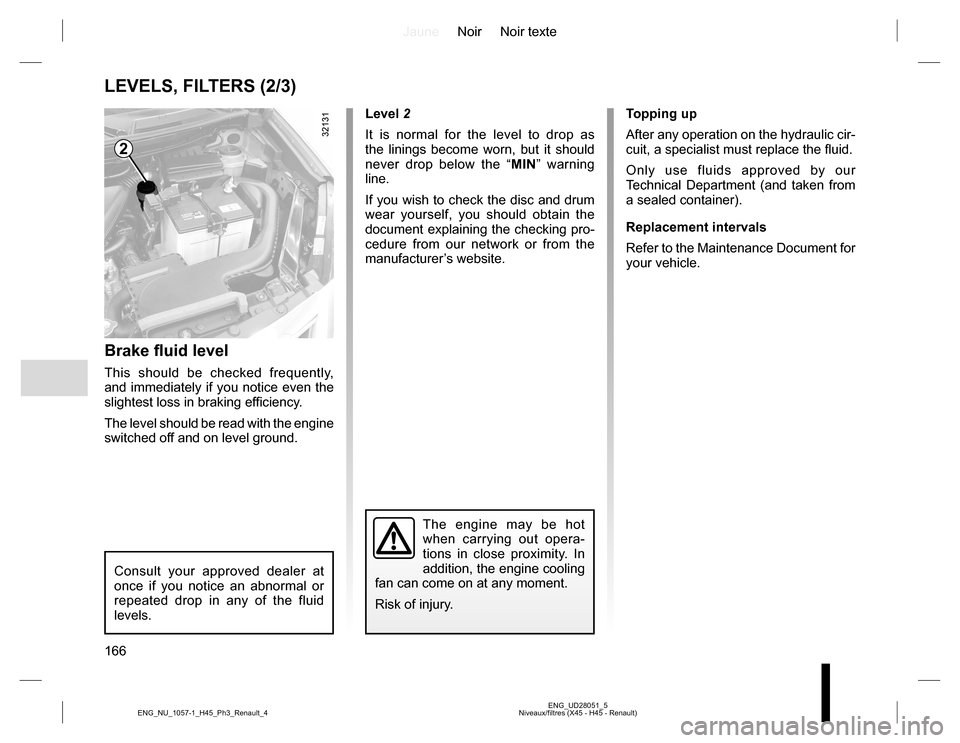
2
Brake fluid level
This should be checked frequently,
and immediately if you notice even the
slightest loss in braking efficiency.
The level should be read with the engine
switched off and on level ground.Level 2
It is normal for the level to drop as
the linings become worn, but it should
never drop below the “MIN” warning
line.
If you wish to check the disc and drum
wear yourself, you should obtain the
document explaining the checking pro-
cedure from our network or from the
manufacturer’s website.Topping up
After any operation on the hydraulic cir-
cuit, a specialist must replace the fluid.
Only use fluids approved by our
Technical Department (and taken from
a sealed container).
Replacement intervals
Refer to the Maintenance Document for
your vehicle.
The engine may be hot
when carrying out opera-
tions in close proximity. In
addition, the engine cooling
fan can come on at any moment.
Risk of injury.
Consult your approved dealer at
once if you notice an abnormal or
repeated drop in any of the fluid
levels.
Page 179 of 232
JauneNoir Noir texte
179
ENG_UD21005_5
Changement de roue (X45 - H45 - Renault) ENG_NU_1057-1_H45_Ph3_Renault_5
Undo the bolts and take off the wheel.
Fit the emergency spare wheel on the
central hub and turn it to locate the
mounting holes in the wheel and the
hub.
If bolts are supplied with the emergency
spare wheel, only use these bolts for
the emergency spare wheel. Tighten
the bolts, checking that the wheel is
correctly positioned on its hub and
lower the jack.
With the wheel on the ground, tighten
the screws as fully as possible and
check the tightness as soon as possi-
ble (tightening torque 108 N.m).
If you have a puncture, re-
place the wheel as soon as
possible.
A tyre which has been punc-
tured should always be inspected
(and repaired, where possible) by a
specialist.
Anti-theft bolt
If you use anti-theft bolts, fit these
nearest the valve (wheel embel-
lisher may not be able to fit).
If the vehicle is parked on
the hard shoulder, you must
warn other road users of
your vehicle’s presence
with a warning triangle or with other
devices as per the legislation apply-
ing to the country you are in.
CHANGING A WHEEL (2/2)
Page 182 of 232
JauneNoir Noir texte
182
ENG_UD21006_4
Pneumatiques (X45 - H45 - Renault) ENG_NU_1057-1_H45_Ph3_Renault_5
Studded tyres
This type of equipment may only be
used for a limited period and as laid
down by local legislation. It is neces-
sary to observe the speed specified by
current legislation.
These tyres must, at a minimum, be
fitted to the two front wheels.Use in winter
Chains
For safety reasons, fitting snow
chains to the rear axle is strictly for-
bidden.
Chains cannot be fitted to tyres which
are larger than those originally fitted to
the vehicle.
Snow or Winter tyres
We would recommend that these be
fitted to all four wheels to ensure that
your vehicle retains maximum adhe-
sion.
Warning: These tyres sometimes have
a specific direction of rotation and a
maximum speed index which may be
lower than the maximum speed of your
vehicle.
TYRES (3/3)
Chains may only be fitted
to tyres of the same size
as those originally fitted to
your vehicle.
In all cases, we would recommend
that you contact an approved dealer
who will be able to advise you on
the choice of equipment which is
most suitable for your vehicle.
Fitting new tyres
Always ensure tyres with identi-
cal specifications are fitted to all four
wheels (brand, size, structure, wear
etc.). Fitting tyres of different sizes to
the front and rear wheels and/or left
and right wheels may have serious
consequences for the tyres, gearbox,
transfer gearbox and the rear differen-
tial pinions.
For safety reasons, this op-
eration must be carried out
by a specialist.
Fitting different tyres may
change your vehicle as follows:
– it may mean that your vehicle no
longer conforms to current regu-
lations;
– it may change the way it handles
when cornering;
– it may cause the steering to be
heavy;
– It may affect the use of snow
chains.
When changing a tyre, make sure all four tyres are changed at the same
time in order to preserve the transmission system.
Page 205 of 232
JauneNoir Noir texte
205
ENG_UD21017_3
Anomalies de fonctionnement (X45 - H45 - X95 - J95 - R95 - Renault) ENG_NU_1057-1_H45_Ph3_Renault_5
OPERATING FAULTS (3/5)
On the road POSSIBLE CAUSES WHAT TO DO
Vibrations. Tyres not inflated to correct pres-
sures, incorrectly balanced or dam-
aged.Check the tyre pressures: if this is not the
problem, have them checked by an ap-
proved Dealer.
White smoke from the exhaust. This is not necessarily a fault. Smoke
may be caused by regeneration of the
particle filter.Refer to the information on “Special fea-
tures of diesel versions” in Section 2.
Smoke under the bonnet. Short-circuit or cooling system leak.Stop, switch off the ignition, stand away
from the vehicle and contact an approved
dealer.
The oil pressure warning light comes
on:
while cornering or braking The level is too low. Top up the engine oil (refer to the informa-
tion on “Engine oil level – Topping up/refill-
ing” in Section 4).
is slow to go out or remains lit
under accelerationLoss of oil pressure.Stop the vehicle: contact an authorised
dealer.
Page 206 of 232
JauneNoir Noir texte
206
ENG_UD21017_3
Anomalies de fonctionnement (X45 - H45 - X95 - J95 - R95 - Renault) ENG_NU_1057-1_H45_Ph3_Renault_5
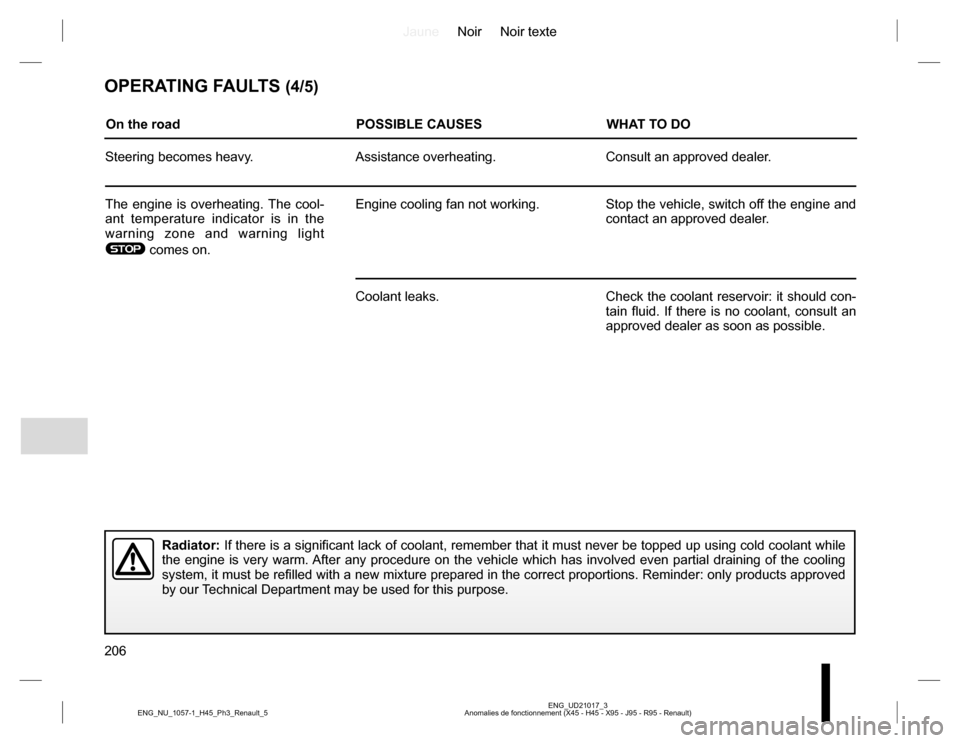
OPERATING FAULTS (4/5)
On the road POSSIBLE CAUSES WHAT TO DO
Steering becomes heavy. Assistance overheating. Consult an approved dealer.
The engine is overheating. The cool-
ant temperature indicator is in the
warning zone and warning light
® comes on.Engine cooling fan not working. Stop the vehicle, switch off the engine and
contact an approved dealer.
Coolant leaks. Check the coolant reservoir: it should con-
tain fluid. If there is no coolant, consult an
approved dealer as soon as possible.
Radiator: If there is a significant lack of coolant, remember that it must never be topped up using cold coolant while
the engine is very warm. After any procedure on the vehicle which has involved even partial draining of the cooling
system, it must be refilled with a new mixture prepared in the correct proportions. Reminder: only products approved
by our Technical Department may be used for this purpose.
Page 207 of 232
JauneNoir Noir texte
207
ENG_UD21017_3
Anomalies de fonctionnement (X45 - H45 - X95 - J95 - R95 - Renault) ENG_NU_1057-1_H45_Ph3_Renault_5
-
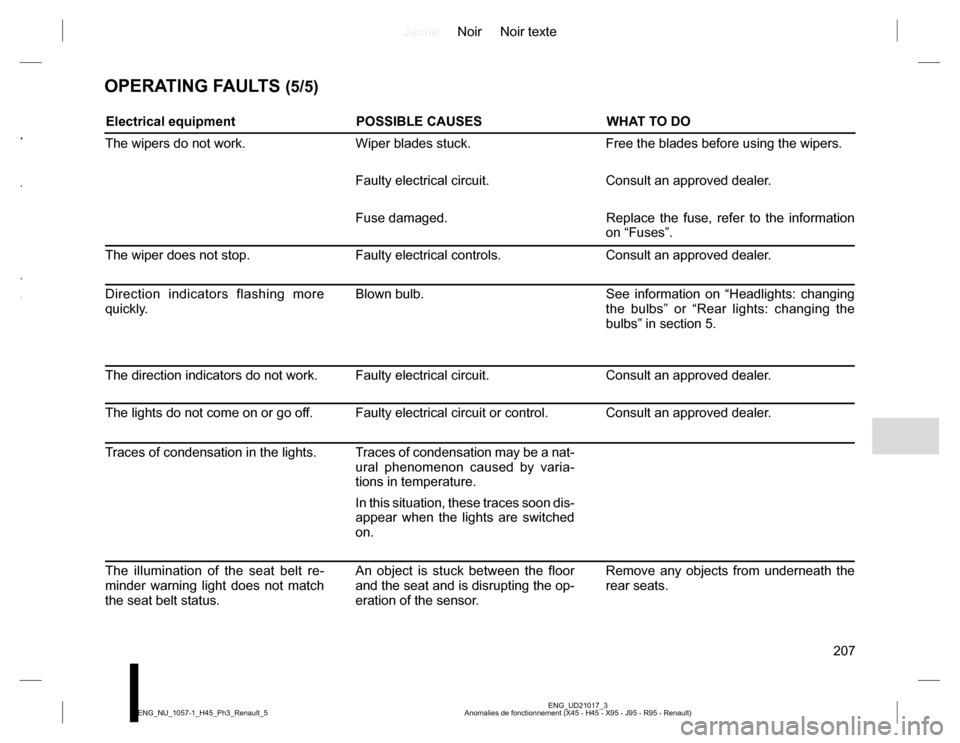
OPERATING FAULTS (5/5)
Electrical equipment POSSIBLE CAUSES WHAT TO DO
The wipers do not work. Wiper blades stuck. Free the blades before using the wipers.
Faulty electrical circuit. Consult an approved dealer.
Fuse damaged. Replace the fuse, refer to the information
on “Fuses”.
The wiper does not stop. Faulty electrical controls. Consult an approved dealer.
Direction indicators flashing more
quickly.Blown bulb. See information on “Headlights: changing
the bulbs” or “Rear lights: changing the
bulbs” in section 5.
The direction indicators do not work. Faulty electrical circuit. Consult an approved dealer.
The lights do not come on or go off. Faulty electrical circuit or control. Consult an approved dealer.
Traces of condensation in the lights. Traces of condensation may be a nat-
ural phenomenon caused by varia-
tions in temperature.
In this situation, these traces soon dis-
appear when the lights are switched
on.
The illumination of the seat belt re-
minder warning light does not match
the seat belt status.An object is stuck between the floor
and the seat and is disrupting the op-
eration of the sensor.Remove any objects from underneath the
rear seats.