ESP RENAULT LAGUNA 2012 X91 / 3.G Owner's Manual
[x] Cancel search | Manufacturer: RENAULT, Model Year: 2012, Model line: LAGUNA, Model: RENAULT LAGUNA 2012 X91 / 3.GPages: 241, PDF Size: 7.82 MB
Page 120 of 241
2.38
ENG_UD27633_9
Boîte de vitesses automatique (X91 - B91 - K91 - D91 - Renault)
ENG_NU_936-5_BK91_Renault_2
Jaune NoirNoir texte
Parking the vehicle
When the vehicle is stopped, move the
lever to position P while keeping your
foot on the brake pedal: the gearbox is
in neutral and the drive wheels are me-
chanically locked by the driveshaft.
a pply the handbrake or, depending
on the vehicle, ensure that the elec-
tronic parking brake is applied.
Special circumstances
– If the road contours and bends
do not allow you to stay in auto -
matic mode (e.g.: in the mountains),
we recommend that you change to
manual mode.
This will prevent the automatic gear-
box from changing gears repeatedly
when climbing, and permit engine
braking on long descents.
– In cold weather , to prevent the
engine from stalling, wait a few mo-
ments before shifting the selector
lever from position P or N and en -
gaging D or R.
– vehicles not fitted with traction
control: on a slippery surface or
surface with a low level of adhe -
sion, change to manual mode and
select second gear before starting
the engine to avoid wheelspin when
starting.
Driving in manual mode
With the selector lever in position D,
move the lever to the left. Shifting the
lever repeatedly allows you to change
gears manually:
– To move down through the gears,
push the lever backwards;
– To move up through the gears, push
the lever forwards.
The gear selected is displayed on the
instrument panel.
Special cases
Under certain driving conditions (e.g.
engine protection, electronic stability
program (ESP) operational etc.: ESC),
the “automatic system” may change
gear automatically.
Likewise, to prevent incorrect manoeu -
vres, a gear change may be refused by
the automatic system: in this case the
gear display flashes for a few seconds
as a warning.
aUtoMatIC GeaRbox (2/3)
An impact to the underside
of the vehicle (e.g.: striking
a post, raised kerb or other
street furniture) may result
in damage to the vehicle (e.g.: de -
formation of an axle).
To avoid any risk of accident, have
your vehicle checked by an ap -
proved Dealer.
In very cold weather, the system
may prevent the gears from being
shifted in manual mode until the
gearbox reaches the right tempera-
ture.
Page 132 of 241

ENG_NU_936-5_BK91_Renault_3
Air conditioning: information and advice on use
AIR coNDITIoNIN")
3.10
ENG_UD10081_2
Air conditionné : informations et conseils d’utilisation (X91 - B\
91 - K91 - Renault)
ENG_NU_936-5_BK91_Renault_3
Air conditioning: information and advice on use
AIR coNDITIoNINg: information and advice on use
Fuel consumption
You will normally notice an increase
in fuel consumption (especially
when driving in town) when the air
conditioning is operating.
For vehicles fitted with manual air
conditioning, switch off the system
when it is not required.
Advice for reducing
consumption and therefore
helping to preserve the
environment:
Drive with the air vents open and
the windows closed.
If the vehicle has been parked in
the sun, open the doors for a few
moments to let the hot air escape
before starting the engine.
Maintenance
Refer to the Maintenance Document
for your vehicle for the inspection
frequency.operating faults
As a general rule, contact your ap-
proved Dealer in the event of an op-
erating fault:
– reduction in de-icing, demist -
ing or air conditioning per -
formance. This may be caused
by the passenger compartment
filter cartridge becoming clogged;
– no cold air is being produced.
Check that the controls are set
correctly and that the fuses are
sound. Otherwise, switch off the
system.
Advice on use
In some situations, (air conditioning
off, air recirculation activated, venti-
lation speed at zero or low, etc.) you
may notice that condensation starts
to form on the windows and wind -
screen.
If there is condensation, use the
“clear View” function to remove it,
then use the air conditioning in auto-
matic mode to stop it forming again.
If the condensation does not clear,
use the FAST programme.
Do not open the refriger -
ant fluid circuit. The fluid
may damage eyes or skin.
Note
Presence of water under the ve -
hicle. After prolonged use of the air
conditioning system, it is normal for
water to be present under the vehi-
cle. This is caused by condensation.
Page 133 of 241
electric windows ................................... (up to the end of the DU)
child safety ............................................................. (current page)
children (safety) ..................................................... (current page)
sunroof .................................................. (up to the end of the DU)
3.11
ENG_UD23646_7
Lève-vitres électriques (X91 - B91 - K91 - Renault)
ENG_NU_936-5_BK91_Renault_3
Electric windows, electric sunroof
ElEcTRIc WINDoWS, ElEcTRIc SuNRooF (1/3)
These systems operate with the igni -
tion on or off, until the driver’s door is
opened (limited to about 5 minutes).
1
2
34
5
6
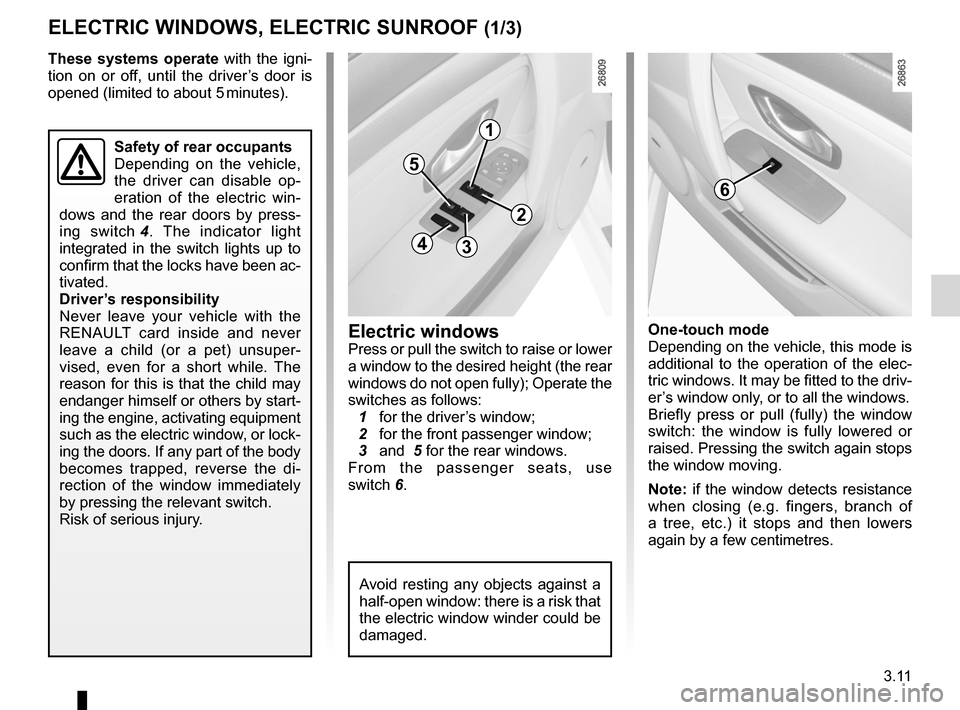
Electric windowsPress or pull the switch to raise or lower
a window to the desired height (the rear
windows do not open fully); Operate the
switches as follows:
1 for the driver’s window;
2 for the front passenger window;
3 and 5 for the rear windows.
From the passenger seats, use
switch 6. one-touch mode
Depending on the vehicle, this mode is
additional to the operation of the elec
-
tric windows. It may be fitted to the driv-
er’s window only, or to all the windows.
Briefly press or pull (fully) the window
switch: the window is fully lowered or
raised. Pressing the switch again stops
the window moving.
Note: if the window detects resistance
when closing (e.g. fingers, branch of
a tree, etc.) it stops and then lowers
again by a few centimetres.
Avoid resting any objects against a
half-open window: there is a risk that
the electric window winder could be
damaged.
Safety of rear occupants
Depending on the vehicle,
the driver can disable op -
eration of the electric win -
dows and the rear doors by press -
ing switch 4 . The indicator light
integrated in the switch lights up to
confirm that the locks have been ac-
tivated.
Driver’s responsibility
Never leave your vehicle with the
RENAULT card inside and never
leave a child (or a pet) unsuper -
vised, even for a short while. The
reason for this is that the child may
endanger himself or others by start-
ing the engine, activating equipment
such as the electric window, or lock-
ing the doors. If any part of the body
becomes trapped, reverse the di -
rection of the window immediately
by pressing the relevant switch.
Risk of serious injury.
Page 134 of 241
3.12
ENG_UD23646_7
Lève-vitres électriques (X91 - B91 - K91 - Renault)
ENG_NU_936-5_BK91_Renault_3
Jaune NoirNoir texte
ElEcTRIc WINDoWS, ElEcTRIc SuNRooF (2/3)
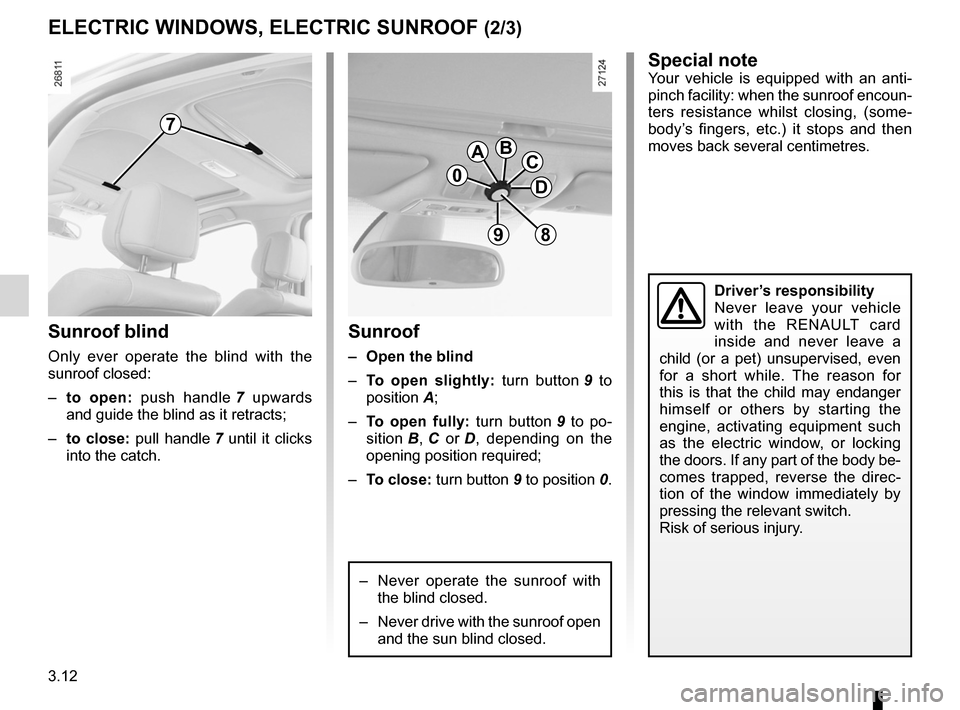
Sunroof
– open the blind
– To open slightly: turn button 9 to
position A;
– To open fully: turn button 9 to po -
sition B , C or D , depending on the
opening position required;
– To close: turn button 9 to position 0.
Sunroof blind
Only ever operate the blind with the
sunroof closed:
– to open: push handle 7 upwards
and guide the blind as it retracts;
– to close: pull handle 7 until it clicks
into the catch.
Special noteYour vehicle is equipped with an anti -
pinch facility: when the sunroof encoun -
ters resistance whilst closing, (some -
body’s fingers, etc.) it stops and then
moves back several centimetres.
– Never operate the sunroof with
the blind closed.
– Never drive with the sunroof open
and the sun blind closed.
7
0
ABc
D
98
Driver’s responsibility
Never leave your vehicle
with the RENAULT card
inside and never leave a
child (or a pet) unsupervised, even
for a short while. The reason for
this is that the child may endanger
himself or others by starting the
engine, activating equipment such
as the electric window, or locking
the doors. If any part of the body be-
comes trapped, reverse the direc -
tion of the window immediately by
pressing the relevant switch.
Risk of serious injury.
Page 148 of 241
rear parcel shelf .................................... (up to the end of the DU)
tailgate .................................................. (up to the end of the DU)
rear parcel shelf .................................... (up to the end of the DU)
3.26
ENG_UD23648_2
Tablette arrière (X91 - B91 - K91 - Renault)
ENG_NU_936-5_BK91_Renault_3
Rear parcel shelf
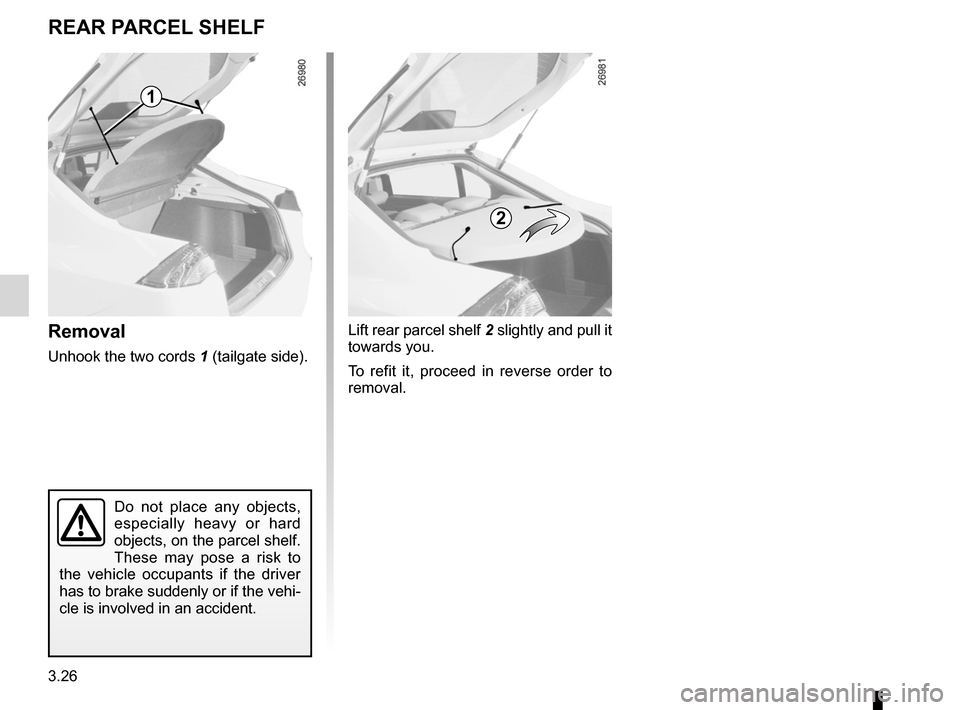
Removal
Unhook the two cords 1 (tailgate side).
Do not place any objects,
especially heavy or hard
objects, on the parcel shelf.
These may pose a risk to
the vehicle occupants if the driver
has to brake suddenly or if the vehi-
cle is involved in an accident.
Lift rear parcel shelf 2 slightly and pull it
towards you.
To refit it, proceed in reverse order to
removal.
REAR PARcEl ShElF
2
1
Page 170 of 241
battery................................................... (up to the end of the DU)
4.12
ENG_UD29071_2
Batterie (X91 - B91 - K91 - Renault)
ENG_NU_936-5_BK91_Renault_4
Jaune NoirNoir texte
Battery
BAtteR y (1/2)
The engine may be hot
during operations in close
proximity. In addition, the
engine cooling fan may
start at any moment.
Risk of injury.
Depending on the vehicle, the battery is
in the engine compartment or in the lug-
gage compartment.
It is always maintenance-free.
Depending on the vehicle, a system
continuously checks the battery charge
status. If the level drops, the message
“ Battery low start engine ” is displayed
on the instrument panel. In this case,
start the engine. Then the message
“ Battery charging ” appears on the in -
strument panel.
The charge status of your battery can
decrease especially if you use your ve-
hicle:
– for short journeys;
– for driving in town;
– when the temperature drops;
– when the radio is used for extended
periods with the engine switched off
etc.
Handle the battery with care
as it contains sulphuric acid
which must not come into
contact with the eyes or
skin. If it does, wash the affected
area with plenty of cold water. If
necessary, consult a doctor.
Ensure that naked flames, red hot
objects and sparks do not come into
contact with the battery as there is a
risk of explosion.
The battery is a specific
type , please ensure it is
replaced with the same
type. Consult an approved
dealer.
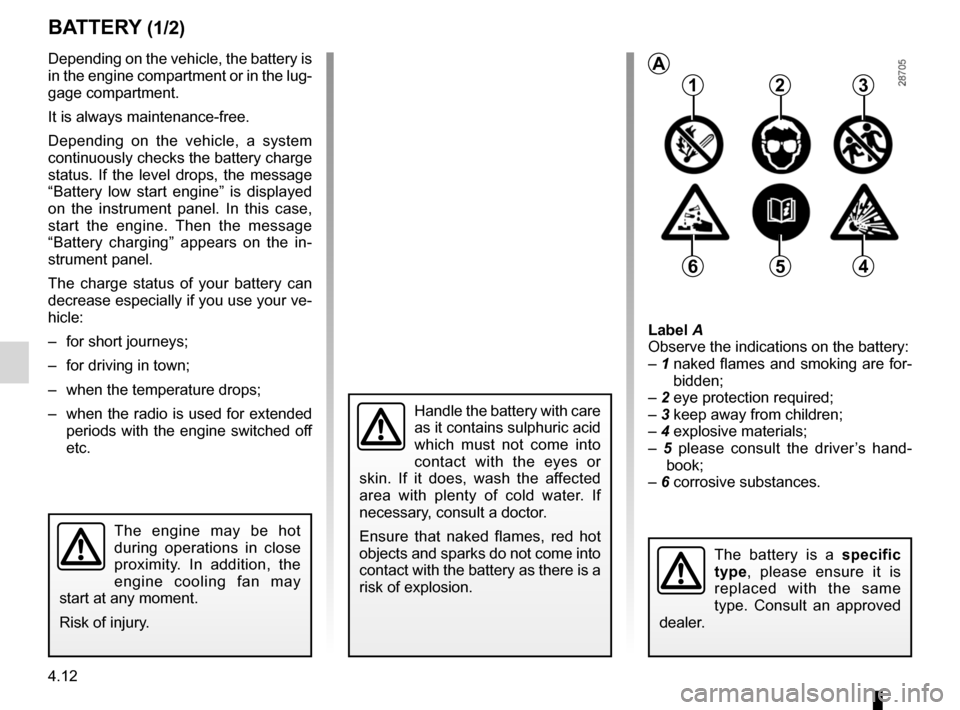
Label A
Observe the indications on the battery:
– 1 naked flames and smoking are for-
bidden;
– 2 eye protection required;
– 3 keep away from children;
– 4 explosive materials;
– 5 please consult the driver’s hand -
book;
– 6 corrosive substances.
A
123
456
Page 173 of 241
 (X44 - X77 - J77 - X85 - \
B90 - X61 - TEST - X77 ph2 - X95 - B95 - D95 - K95 - J95 - R95 - L90 Ph2 - F90 Ph2 - R90\")
JauneNoirNoir texte
4.15
ENG_UD26811_2
Entretien de la carrosserie (peinture mate) (X44 - X77 - J77 - X85 - \
B90 - X61 - TEST - X77 ph2 - X95 - B95 - D95 - K95 - J95 - R95 - L90 Ph2 - F90 Ph2 - R90\
Ph2 - X62
ENG_NU_936-5_BK91_Renault_4
Respect local regulations about wash -
ing vehicles (e.g. do not wash your ve-
hicle on a public highway).
Observe the vehicle stopping distances
when driving on gravelled surfaces to
prevent paint damage.
Repair, or have repaired quickly, areas
where the paint has been damaged, to
prevent corrosion spreading.
Remember to visit the body shop pe -
riodically in order to maintain your
anti-corrosion warranty. Refer to the
Maintenance Document.
If it is necessary to clean mechani -
cal components, hinges, etc., spray
them with products approved by our
Technical Department to protect them
after they have been cleaned.
BODyWORk MAIntenAnCe (2/2)
We have selected special products
to care for your vehicle and you can
obtain these from the manufactur -
er’s accessory outlets.
Using a roller type car wash
Return the windscreen wiper stalk to
the Park position (refer to the informa-
tion on the “Windscreen washer, wiper”
in Section 1). Check the mounting of
external accessories, additional lights
and mirrors, and ensure that the wiper
blades are secured with adhesive tape.
Remove the radio aerial mast if your
vehicle is fitted with this equipment.
Remember to remove the tape and refit
the antenna after washing.
Cleaning the headlights
As the headlights are made of plastic
“glass”, use a soft cloth or cotton wool
to clean them. If this does not clean
them properly, moisten the cloth with
soapy water, then wipe clean with a soft
damp cloth or cotton wool.
Finally, carefully dry off with a soft dry
cloth.
Cleaning products containing alco -
hol must not be used.
Vehicles with a matte paint
finish
This type of paint requires certain pre-
cautions.
Do not do the following
– use wax-based products (polishing);
– rub hard;
– wash the vehicle in a roller-type car
wash;
– wash the vehicle using a high-pres-
sure device;
– attach stickers to the paintwork (risk
of leaving marks).
y ou should do the following
Wash the vehicle by hand using plenty
of water, using a soft cloth or a gentle
sponge.
Page 204 of 241
RENAULT cardbattery ............................................. (up to the end of the DU)
RENAULT card battery .........................(up to the end of the DU)
5.28
ENG_UD19354_3
Carte RENAULT : pile (X45 - H45 - X91 - B91 - K91 - X95 - B95 - D95 - E95 - K95 - J9\
5 - R95 - L38 - X38 - X32 - B32 - Renault)
ENG_NU_936-5_BK91_Renault_5
Operating faultsIf the battery is too weak to ensure cor-
rect operation, you may start (insert the
RENAULT card in the card reader) and
lock/unlock the vehicle (refer to the in-
formation on “Locking/unlocking the
doors” in Section 1).
RENAULT card: battery
renAuL t cArD: battery
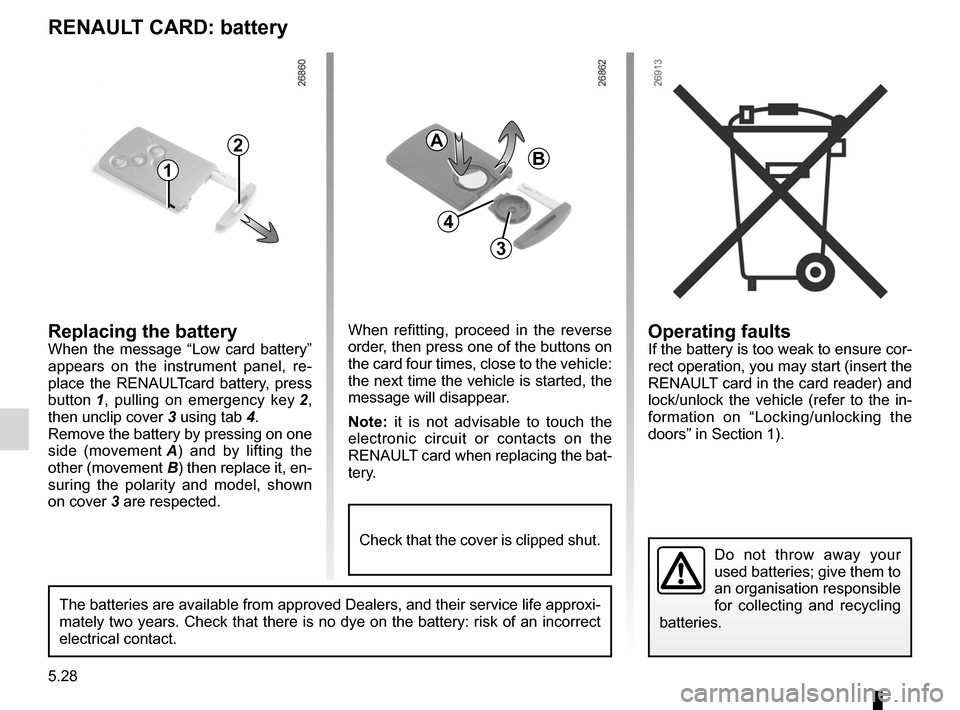
replacing the batteryWhen the message “Low card battery”
appears on the instrument panel, re -
place the RENAULTcard battery, press
button 1 , pulling on emergency key 2 ,
then unclip cover 3 using tab 4.
Remove the battery by pressing on one
side (movement A ) and by lifting the
other (movement B) then replace it, en-
suring the polarity and model, shown
on cover 3 are respected.
Do not throw away your
used batteries; give them to
an organisation responsible
for collecting and recycling
batteries.
1
2
When refitting, proceed in the reverse
order, then press one of the buttons on
the card four times, close to the vehicle:
the next time the vehicle is started, the
message will disappear.
n ote: it is not advisable to touch the
electronic circuit or contacts on the
RENAULT card when replacing the bat-
tery.
A
B
3
The batteries are available from approved Dealers, and their service life approxi -
mately two years. Check that there is no dye on the battery: risk of an incorrect
electrical contact.
4
Check that the cover is clipped shut.
Page 206 of 241
wiper blades ......................................... (up to the end of the DU)
wipers blades ............................................. (up to the end of the DU)
5.30
ENG_UD20530_1
Balais d’essuie-vitres (X91 - B91 - K91 - Renault)
ENG_NU_936-5_BK91_Renault_5
Wipers (replacing blades)
WInDScreen WIPer BLADeS
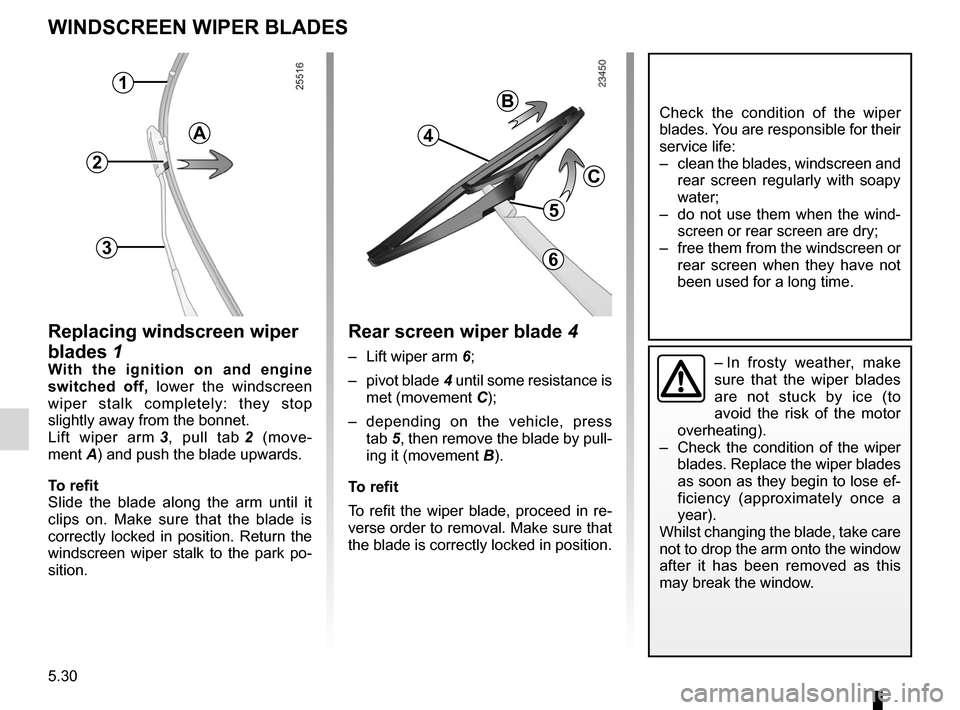
replacing windscreen wiper
blades 1
With the ignition on and engine
switched off, lower the windscreen
wiper stalk completely: they stop
slightly away from the bonnet.
Lift wiper arm 3 , pull tab 2 (move -
ment A) and push the blade upwards.
t o refit
Slide the blade along the arm until it
clips on. Make sure that the blade is
correctly locked in position. Return the
windscreen wiper stalk to the park po-
sition.– In frosty weather, make
sure that the wiper blades
are not stuck by ice (to
avoid the risk of the motor
overheating).
– Check the condition of the wiper
blades. Replace the wiper blades
as soon as they begin to lose ef-
ficiency (approximately once a
year).
Whilst changing the blade, take care
not to drop the arm onto the window
after it has been removed as this
may break the window.
Check the condition of the wiper
blades. You are responsible for their
service life:
– clean the blades, windscreen and
rear screen regularly with soapy
water;
– do not use them when the wind-
screen or rear screen are dry;
– free them from the windscreen or
rear screen when they have not
been used for a long time.
rear screen wiper blade 4
– Lift wiper arm 6;
– pivot blade 4 until some resistance is
met (movement C);
– depending on the vehicle, press
tab 5, then remove the blade by pull -
ing it (movement B).
t o refit
To refit the wiper blade, proceed in re-
verse order to removal. Make sure that
the blade is correctly locked in position.
A
1
2
3
B
4
c
5
6
Page 216 of 241
vehicle identification ............................. (up to the end of the DU)
paintwork reference .......................................................... (current page)
vehicle identification plates ................... (up to the end of the DU)
technical specifications ......................... (up to the end of the DU)
6.2
ENG_UD29076_5
Plaques d’identification véhicule (X91 - B91 - K91 - Renault)
ENG_NU_936-5_BK91_Renault_6
Vehicle identification plates
Vehicle identification plates
a
B
a
97
8
10
5
1
2
3
4
6
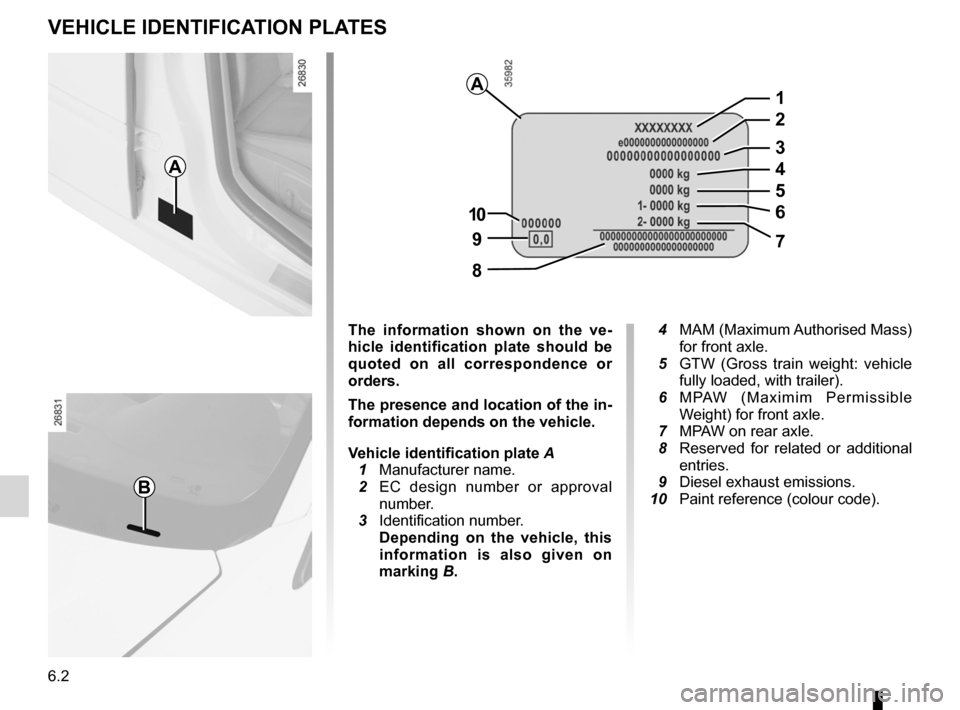
t he information shown on the ve -
hicle identification plate should be
quoted on all correspondence or
orders.
the presence and location of the in-
formation depends on the vehicle.
Vehicle identification plate A
1 Manufacturer name.
2 EC design number or approval
number.
3 Identification number.
depending on the vehicle, this
information is also given on
marking B.
4 MAM (Maximum Authorised Mass)
for front axle.
5 GTW (Gross train weight: vehicle
fully loaded, with trailer).
6 MPAW (Maximim Permissible
Weight) for front axle.
7 MPAW on rear axle.
8 Reserved for related or additional
entries.
9 Diesel exhaust emissions.
10 Paint reference (colour code).