Light RENAULT MASTER 2016 X62 / 2.G User Guide
[x] Cancel search | Manufacturer: RENAULT, Model Year: 2016, Model line: MASTER, Model: RENAULT MASTER 2016 X62 / 2.GPages: 284, PDF Size: 6.69 MB
Page 33 of 284
1.27
METHODS OF RESTRAINT IN ADDITION TO THE FRONT SEAT BELTS (2/3)
Air bags for driver and front
passenger
It is fitted to the front seats on the driv-
er’s side and, depending on the vehicle,
on the passenger’s side as well.
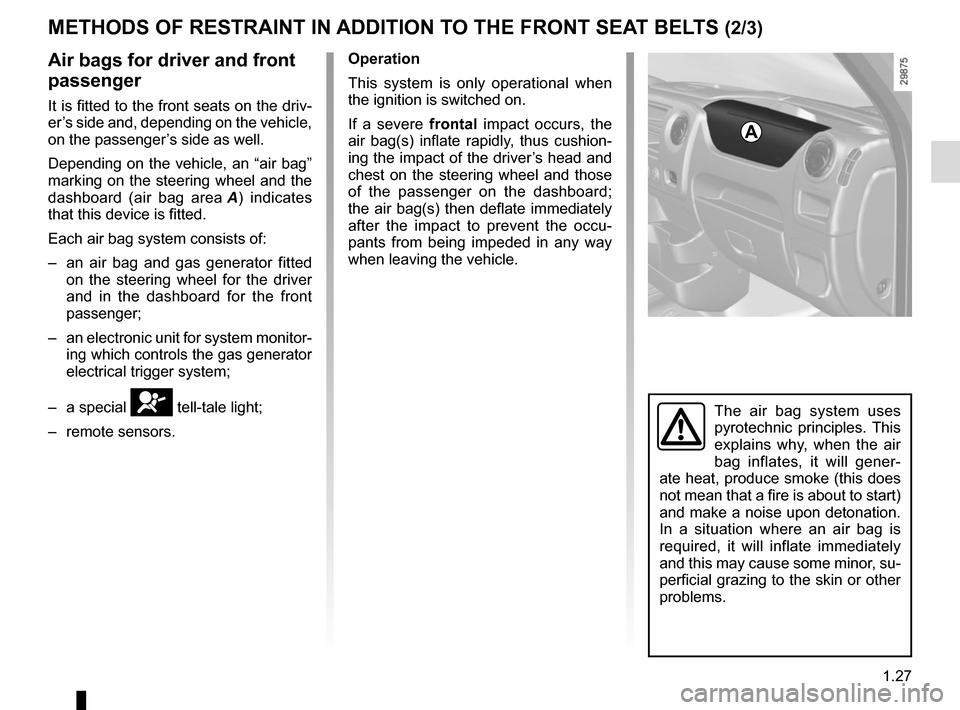
Depending on the vehicle, an “air bag”
marking on the steering wheel and the
dashboard (air bag area A) indicates
that this device is fitted.
Each air bag system consists of:
– an air bag and gas generator fitted on the steering wheel for the driver
and in the dashboard for the front
passenger;
– an electronic unit for system monitor- ing which controls the gas generator
electrical trigger system;
– a special
å tell-tale light;
– remote sensors. Operation
This system is only operational when
the ignition is switched on.
If a severe frontal impact occurs, the
air bag(s) inflate rapidly, thus cushion-
ing the impact of the driver’s head and
chest on the steering wheel and those
of the passenger on the dashboard;
the air bag(s) then deflate immediately
after the impact to prevent the occu-
pants from being impeded in any way
when leaving the vehicle.
A
The air bag system uses
pyrotechnic principles. This
explains why, when the air
bag inflates, it will gener-
ate heat, produce smoke (this does
not mean that a fire is about to start)
and make a noise upon detonation.
In a situation where an air bag is
required, it will inflate immediately
and this may cause some minor, su-
perficial grazing to the skin or other
problems.
Page 34 of 284

All of the warnings below are given so that the air bag is not obstructe\
d in any way when it is deployed and also to pre-
vent the")
1.28
METHODS OF RESTRAINT IN ADDITION TO THE FRONT SEAT BELTS (3/3)
All of the warnings below are given so that the air bag is not obstructe\
d in any way when it is deployed and also to pre-
vent the risk of serious injuries caused by items which may be dislodged\
when the air bag deploys.
Warnings concerning the driver’s air bag
– Do not modify the steering wheel or the steering wheel boss.
– Do not cover the steering wheel boss under any circumstances.
– Do not attach any objects (badge, logo, clock, telephone holder, etc.) to the steering wheel boss.
– The steering wheel must not be removed (except by qualified personnel f\
rom our Network).
– When driving, do not sit too close to the steering wheel. Sit with your \
arms slightly bent (see the information on “Adjusting
your driving position” in Section 1). This will allow sufficient space for the air bag to deploy correctly and be fully effective.
Warnings concerning the passenger air bag
– Do not attach or glue any objects (badge, logo, clock, telephone holder\
, etc.) to the dashboard on or near the air bag.
– Do not place anything between the dashboard and the passenger (pet, umb\
rella, walking stick, parcels, etc.).
– The passenger must not put his or her feet on the dashboard or seat as t\
here is a risk that serious injuries may occur. In general, parts of the body should be kept away from the dashboard (knee\
s, hands, head, etc.).
– The devices in addition to the front passenger seat belt should be react\
ivated as soon as a child seat is removed, to ensure the protection of the passenger in the event of an impact.
A CHILD SEAT MUST NOT BE FITTED TO THE FRONT PASSENGER SEAT UNLESS THE
ADDITIONAL RESTRAINT SYSTEMS, I.E. THE PASSENGER AIR BAG, ARE DEACTIVATED.
(refer to the information on “Child safety: deactivating/activating \
the front passenger air bag” in Section 1)
Page 36 of 284
1.30
ADDITIONAL METHODS OF RESTRAINT
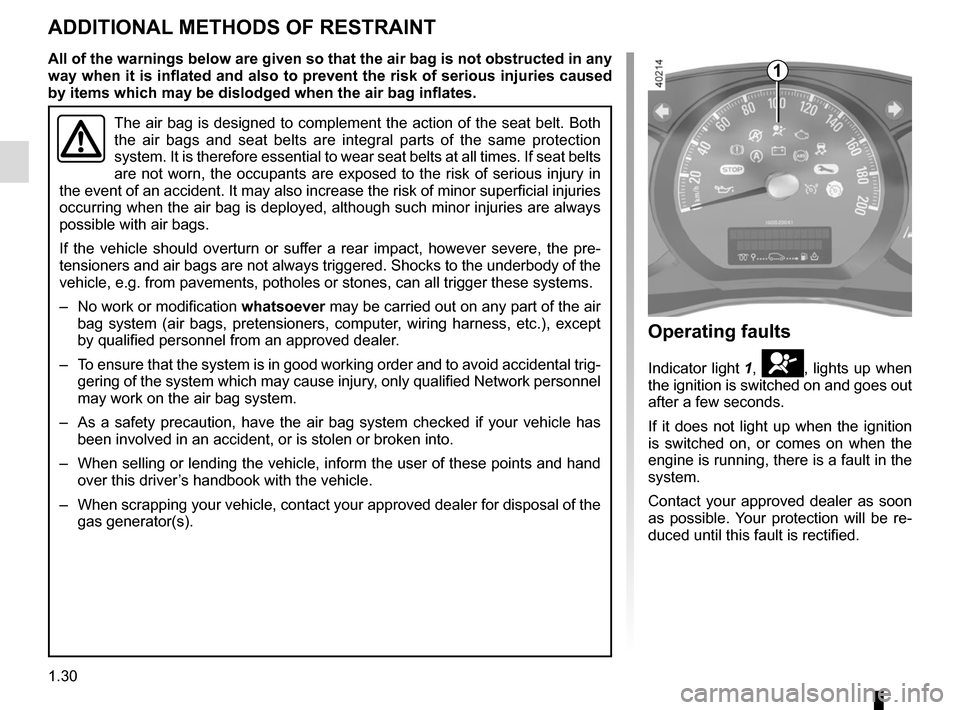
Operating faults
Indicator light 1, å, lights up when
the ignition is switched on and goes out
after a few seconds.
If it does not light up when the ignition
is switched on, or comes on when the
engine is running, there is a fault in the
system.
Contact your approved dealer as soon
as possible. Your protection will be re-
duced until this fault is rectified.
1
The air bag is designed to complement the action of the seat belt. Both \
the air bags and seat belts are integral parts of the same protection
system. It is therefore essential to wear seat belts at all times. If se\
at belts
are not worn, the occupants are exposed to the risk of serious injury in\
the event of an accident. It may also increase the risk of minor superfi\
cial injuries
occurring when the air bag is deployed, although such minor injuries are\
always
possible with air bags.
If the vehicle should overturn or suffer a rear impact, however severe, the pre-
tensioners and air bags are not always triggered. Shocks to the underbod\
y of the
vehicle, e.g. from pavements, potholes or stones, can all trigger these \
systems.
– No work or modification whatsoever may be carried out on any part of the air
bag system (air bags, pretensioners, computer, wiring harness, etc.), except
by qualified personnel from an approved dealer.
– To ensure that the system is in good working order and to avoid accidenta\
l trig- gering of the system which may cause injury, only qualified Network personnel
may work on the air bag system.
– As a safety precaution, have the air bag system checked if your vehicle \
has been involved in an accident, or is stolen or broken into.
– When selling or lending the vehicle, inform the user of these points and\
hand over this driver’s handbook with the vehicle.
– When scrapping your vehicle, contact your approved dealer for disposal o\
f the gas generator(s).
All of the warnings below are given so that the air bag is not obstructed in any
way when it is inflated and also to prevent the risk of serious injuries caused
by items which may be dislodged when the air bag inflates.
Page 42 of 284
1.36
CHILD SAFETY: fitting a child seat: general information (1/2)
Some seats are not suitable for fitting
child seats. The diagrams on the fol-
lowing pages show you how to attach
a child seat.
The types of child seats indicated may
not be available. Before using a differ-
ent child seat, check with the manufac-
turer that it can be fitted.
Fit the child seat in a rear
seat wherever possible.
Check that when installing
the child seat in the vehicle
it is not at risk of coming loose from
its base.
If you have to remove the headrest,
check that it is correctly stored so
that it does not come loose under
harsh braking or impact.
Always attach the child seat to the
vehicle even if it is not in use so that
it does not come loose under harsh
braking or impact.
Front seats
The laws concerning children travel-
ling in the front passenger seat differ in
every country. Consult the legislation in
force and follow the indications on the
diagrams on the following pages.
Before fitting a child seat in this seat (if
authorised):
– lower the seat belt as far as possible;
– on equipped vehicles, push the seat back as far as possible;
– on equipped vehicles, tilt the seat- back slightly (approximately 25°);
– on equipped vehicles, raise the seat base as far as possible.
Do not change these settings after the
child seat is installed.
RISK OF DEATH OR
SERIOUS INJURY: before
installing a child seat on the
front passenger seat, check
that the air bag has been deacti-
vated (refer to "Child safety: front
passenger air bag deactivation/acti-
vation" Section 1).
Page 74 of 284
1.68
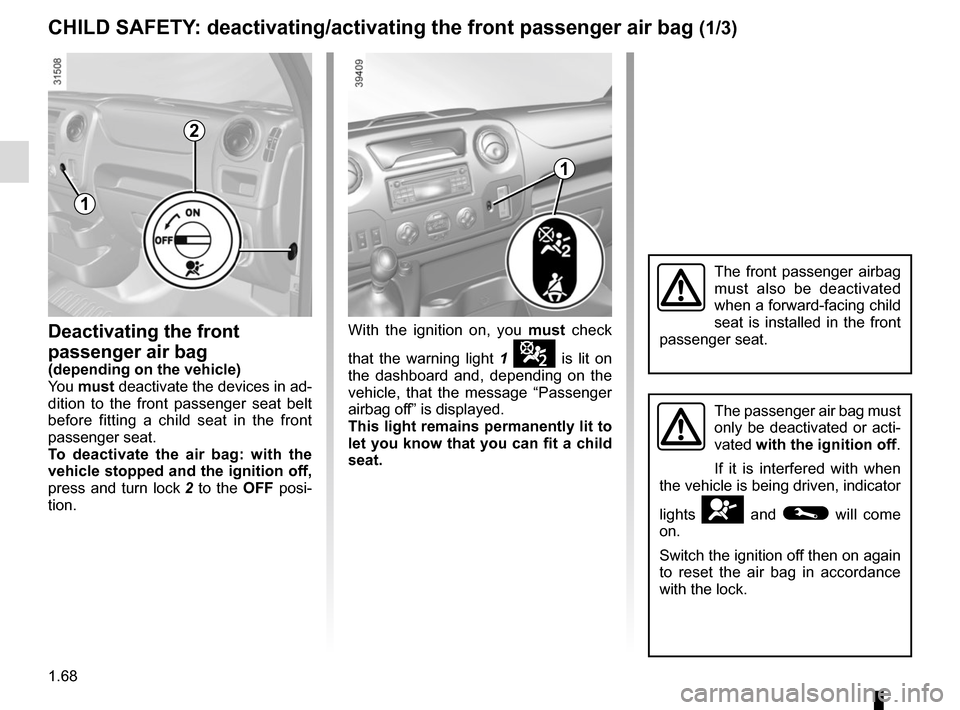
Deactivating the front
passenger air bag
(depending on the vehicle)
You must deactivate the devices in ad-
dition to the front passenger seat belt
before fitting a child seat in the front
passenger seat.
To deactivate the air bag: with the
vehicle stopped and the ignition off,
press and turn lock 2 to the OFF posi-
tion. With the ignition on, you
must check
that the warning light 1 ¹ is lit on
the dashboard and, depending on the
vehicle, that the message “Passenger
airbag off” is displayed.
This light remains permanently lit to
let you know that you can fit a child
seat.
CHILD SAFETY: deactivating/activating the front passenger air bag (1/3)
1
2
The front passenger airbag
must also be deactivated
when a forward-facing child
seat is installed in the front
passenger seat.
The passenger air bag must
only be deactivated or acti-
vated with the ignition off.
If it is interfered with when
the vehicle is being driven, indicator
lights
å and © will come
on.
Switch the ignition off then on again
to reset the air bag in accordance
with the lock.
1
Page 76 of 284
1.70
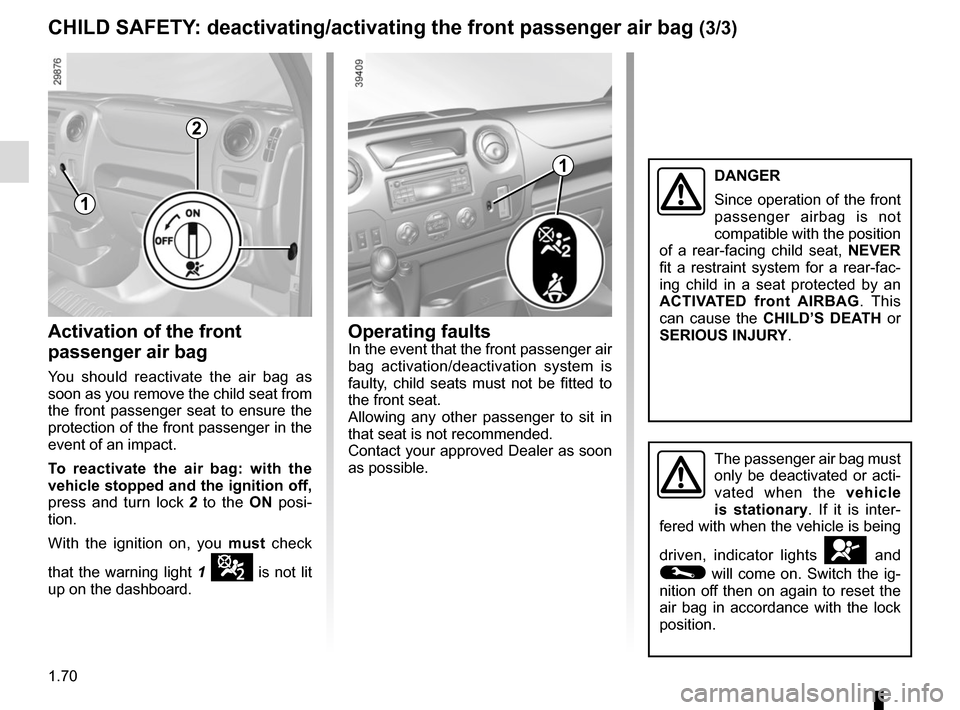
Operating faultsIn the event that the front passenger air
bag activation/deactivation system is
faulty, child seats must not be fitted to
the front seat.
Allowing any other passenger to sit in
that seat is not recommended.
Contact your approved Dealer as soon
as possible.Activation of the front
passenger air bag
You should reactivate the air bag as
soon as you remove the child seat from
the front passenger seat to ensure the
protection of the front passenger in the
event of an impact.
To reactivate the air bag: with the
vehicle stopped and the ignition off,
press and turn lock 2 to the ON posi-
tion.
With the ignition on, you must check
that the warning light 1
¹ is not lit
up on the dashboard.
CHILD SAFETY: deactivating/activating the front passenger air bag (3/3)
1
2
The passenger air bag must
only be deactivated or acti-
vated when the vehicle
is stationary. If it is inter-
fered with when the vehicle is being
driven, indicator lights
å and
© will come on. Switch the ig-
nition off then on again to reset the
air bag in accordance with the lock
position.
1DANGER
Since operation of the front
passenger airbag is not
compatible with the position
of a rear-facing child seat, NEVER
fit a restraint system for a rear-fac-
ing child in a seat protected by an
ACTIVATED front AIRBAG . This
can cause the CHILD’S DEATH or
SERIOUS INJURY.
Page 77 of 284
1.71
REAR-VIEW MIRRORS
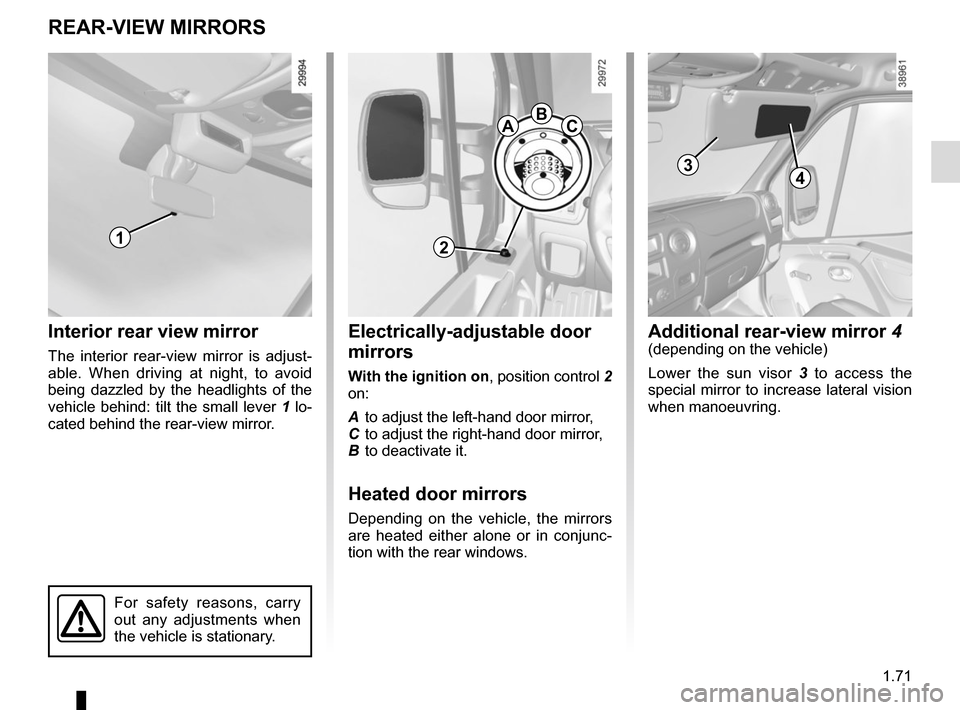
Interior rear view mirror
The interior rear-view mirror is adjust-
able. When driving at night, to avoid
being dazzled by the headlights of the
vehicle behind: tilt the small lever 1 lo-
cated behind the rear-view mirror.
Electrically-adjustable door
mirrors
With the ignition on , position control 2
on:
A to adjust the left-hand door mirror,
C to adjust the right-hand door mirror,
B to deactivate it.
Heated door mirrors
Depending on the vehicle, the mirrors
are heated either alone or in conjunc-
tion with the rear windows.
12
ABC
For safety reasons, carry
out any adjustments when
the vehicle is stationary.
Additional rear-view mirror 4(depending on the vehicle)
Lower the sun visor 3 to access the
special mirror to increase lateral vision
when manoeuvring.
43
Page 79 of 284
1.73
DRIVER’S POSITION: LEFT-HAND DRIVE (2/2)
The equipment fitted, described below, DEPENDS ON THE VERSION AND COUNTRY.
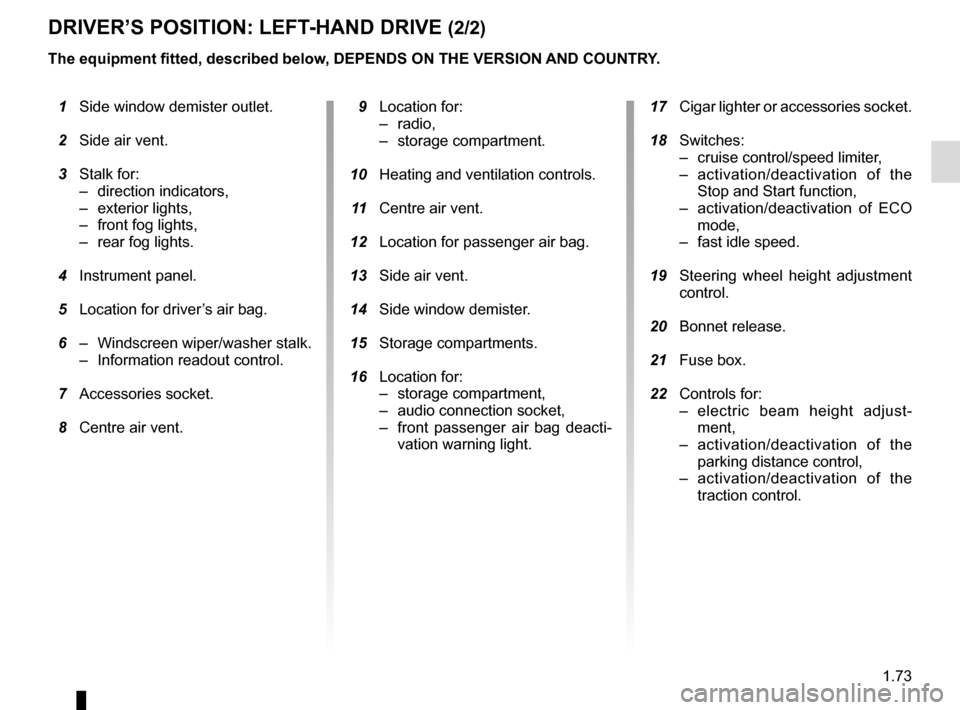
1 Side window demister outlet.
2 Side air vent.
3 Stalk for:
– direction indicators,
– exterior lights,
– front fog lights,
– rear fog lights.
4 Instrument panel.
5 Location for driver’s air bag.
6 – Windscreen wiper/washer stalk.
– Information readout control.
7 Accessories socket.
8 Centre air vent.
9 Location for:
– radio,
– storage compartment.
10 Heating and ventilation controls.
11 Centre air vent.
12 Location for passenger air bag.
13 Side air vent.
14 Side window demister.
15 Storage compartments.
16 Location for:
– storage compartment,
– audio connection socket,
– front passenger air bag deacti-vation warning light.
17 Cigar lighter or accessories socket.
18 Switches:
– cruise control/speed limiter,
– activation/deactivation of the Stop and Start function,
– activation/deactivation of ECO mode,
– fast idle speed.
19 Steering wheel height adjustment
control.
20 Bonnet release.
21 Fuse box.
22 Controls for:
– electric beam height adjust-ment,
– activation/deactivation of the parking distance control,
– activation/deactivation of the traction control.
Page 81 of 284
1.75
DRIVER’S POSITION, RIGHT-HAND DRIVE (2/2)
The equipment fitted, described below, DEPENDS ON THE VERSION AND COUNTRY.
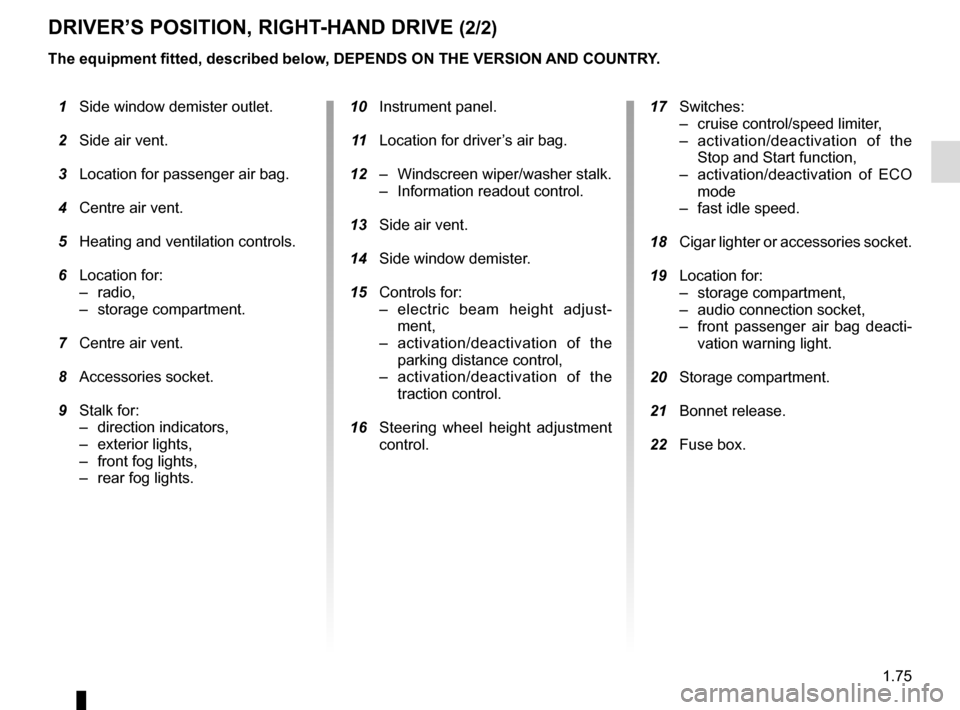
1 Side window demister outlet.
2 Side air vent.
3 Location for passenger air bag.
4 Centre air vent.
5 Heating and ventilation controls.
6 Location for:
– radio,
– storage compartment.
7 Centre air vent.
8 Accessories socket.
9 Stalk for:
– direction indicators,
– exterior lights,
– front fog lights,
– rear fog lights.
10 Instrument panel.
11 Location for driver’s air bag.
12 – Windscreen wiper/washer stalk.
– Information readout control.
13 Side air vent.
14 Side window demister.
15 Controls for:
– electric beam height adjust-ment,
– activation/deactivation of the parking distance control,
– activation/deactivation of the traction control.
16 Steering wheel height adjustment
control.
17 Switches:
– cruise control/speed limiter,
– activation/deactivation of the Stop and Start function,
– activation/deactivation of ECO mode
– fast idle speed.
18 Cigar lighter or accessories socket.
19 Location for:
– storage compartment,
– audio connection socket,
– front passenger air bag deacti-vation warning light.
20 Storage compartment.
21 Bonnet release.
22 Fuse box.
Page 82 of 284
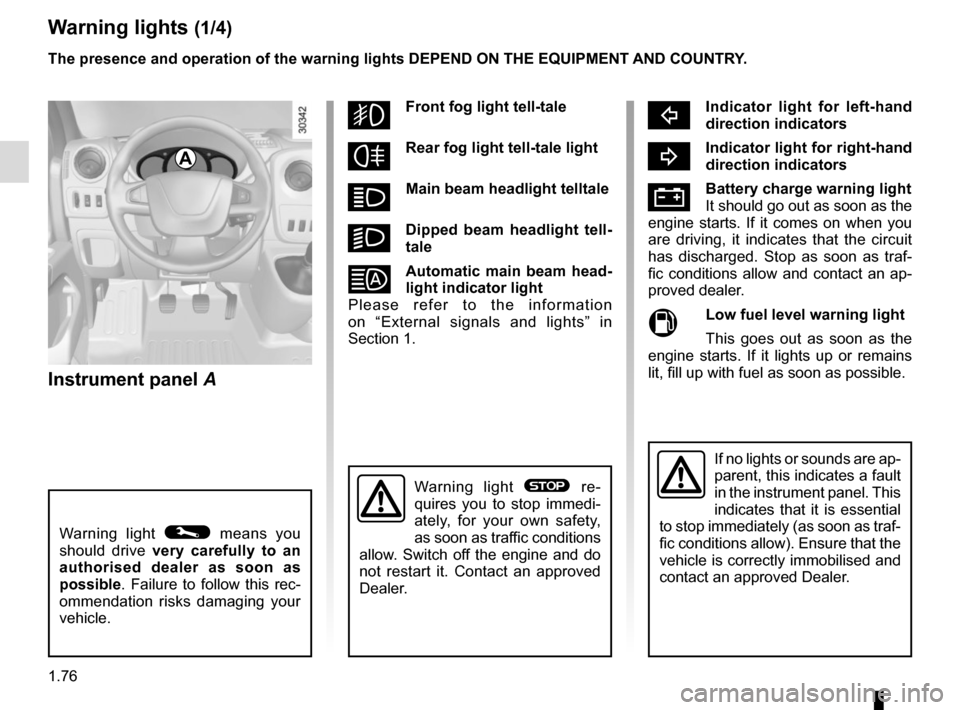
1.76
Instrument panel A
Warning lights (1/4)
cIndicator light for left-hand
direction indicators
bIndicator light for right-hand
direction indicators
ÚBattery charge warning light
It should go out as soon as the
engine starts. If it comes on when you
are driving, it indicates that the circuit
has discharged. Stop as soon as traf-
fic conditions allow and contact an ap-
proved dealer.
MLow fuel level warning light
This goes out as soon as the
engine starts. If it lights up or remains
lit, fill up with fuel as soon as possible.
The presence and operation of the warning lights DEPEND ON THE EQUIPMENT\
AND COUNTRY.
If no lights or sounds are ap-
parent, this indicates a fault
in the instrument panel. This
indicates that it is essential
to stop immediately (as soon as traf-
fic conditions allow). Ensure that the
vehicle is correctly immobilised and
contact an approved Dealer.
Warning light © means you
should drive very carefully to an
authorised dealer as soon as
possible. Failure to follow this rec-
ommendation risks damaging your
vehicle.
Warning light ® re-
quires you to stop immedi-
ately, for your own safety,
as soon as traffic conditions
allow. Switch off the engine and do
not restart it. Contact an approved
Dealer.
A
gFront fog light tell-tale
fRear fog light tell-tale light
áMain beam headlight telltale
kDipped beam headlight tell-
tale
Automatic main beam head-
light indicator light
Please refer to the information
on “External signals and lights” in
Section 1.