steering wheel RENAULT MASTER 2016 X62 / 2.G User Guide
[x] Cancel search | Manufacturer: RENAULT, Model Year: 2016, Model line: MASTER, Model: RENAULT MASTER 2016 X62 / 2.GPages: 284, PDF Size: 6.69 MB
Page 117 of 284
2.3
STARTING/STOPPING THE ENGINE
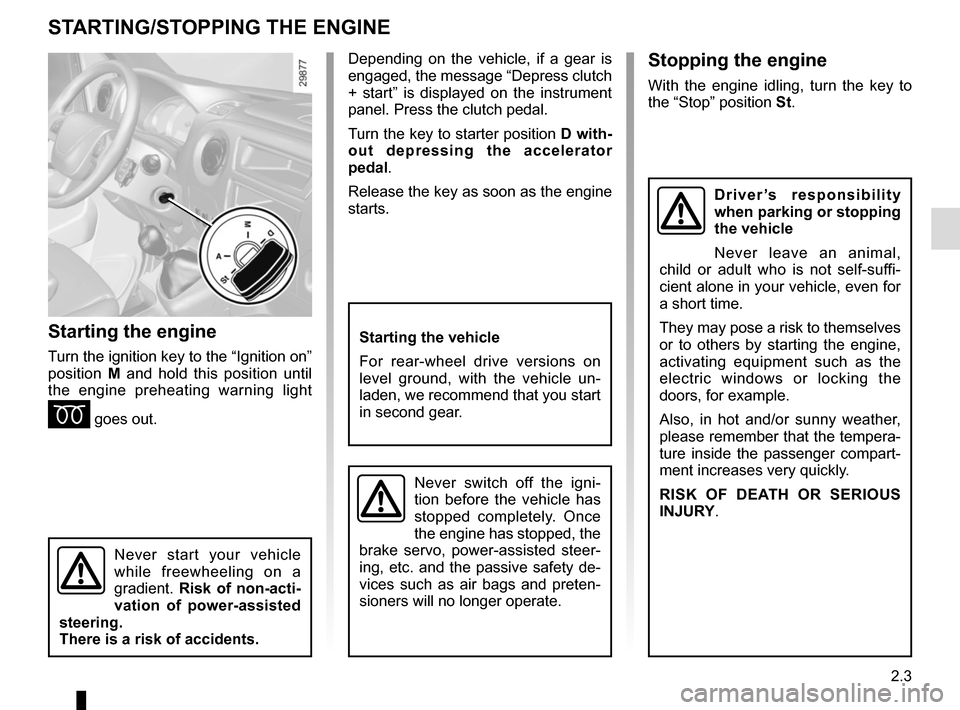
Starting the engine
Turn the ignition key to the “Ignition on”
position M and hold this position until
the engine preheating warning light
É goes out.
Stopping the engine
With the engine idling, turn the key to
the “Stop” position St.
Starting the vehicle
For rear-wheel drive versions on
level ground, with the vehicle un-
laden, we recommend that you start
in second gear.
Never switch off the igni-
tion before the vehicle has
stopped completely. Once
the engine has stopped, the
brake servo, power-assisted steer-
ing, etc. and the passive safety de-
vices such as air bags and preten-
sioners will no longer operate.
Driver’s responsibility
when parking or stopping
the vehicle
Never leave an animal,
child or adult who is not self-suffi-
cient alone in your vehicle, even for
a short time.
They may pose a risk to themselves
or to others by starting the engine,
activating equipment such as the
electric windows or locking the
doors, for example.
Also, in hot and/or sunny weather,
please remember that the tempera-
ture inside the passenger compart-
ment increases very quickly.
RISK OF DEATH OR SERIOUS
INJURY.
Never start your vehicle
while freewheeling on a
gradient. Risk of non-acti-
vation of power-assisted
steering.
There is a risk of accidents.
Depending on the vehicle, if a gear is
engaged, the message “Depress clutch
+ start” is displayed on the instrument
panel. Press the clutch pedal.
Turn the key to starter position D with-
out depressing the accelerator
pedal.
Release the key as soon as the engine
starts.
Page 131 of 284
2.17
Electronic stability program
(ESC) with understeer control
and traction control
Electronic stability control ESC
This system helps you to keep control
of the vehicle in critical driving condi-
tions (avoiding an obstacle, loss of grip
on a bend, etc.).
Operating principle
A sensor in the steering wheel detects
the direction selected by the driver.
Other sensors throughout the vehicle
measure the actual direction.
The system compares driver input to
the actual trajectory of the vehicle and
corrects the trajectory if necessary by
controlling the braking of certain wheels
and/or engine power. In the event that
the system is engaged, indicator light
flashes on the instrument panel.
DRIVING CORRECTION DEVICES AND AIDS (2/5)
Understeer control
This system optimises the action of the
ESC in the case of pronounced un-
dersteer (loss of front axle road hol-
ding).
Traction control
This system helps to limit wheelspin of
the drive wheels and to control the vehi-
cle when pulling away accelerating or
decelerating.
Operating principle
Using the wheel sensors, the system
measures and compares the speed of
the drive wheels at all times and slows
down their over-rotation. If a wheel is
starting to slip, the system brakes au-
tomatically until the drive supplied be-
comes compatible with the level of grip
under the wheel again.
The system also adjusts the engine
speed to the grip available under the
wheels, independently of the pressure
exerted on the accelerator pedal.
These functions are an ad-
ditional aid in the event of
critical driving conditions,
enabling the vehicle beha-
viour to be adapted to suit the dri-
ving conditions.
However, the functions do not take
the place of the driver. They do
not increase the vehicle’s limits
and should not encourage you
to drive more quickly. Therefore,
they can under no circumstances
replace the vigilance or responsibi-
lity of the driver when manoeuvring
the vehicle (the driver must always
be ready for sudden incidents which
may occur when driving).
Operating faults
When the system detects an operating
fault the message “CHECK ESC” and
warning light
© and appear
on the instrument panel. In this case,
the ESC and traction control system
are deactivated.
Consult an approved dealer.
Page 151 of 284
2.37
REVERSING CAMERA (2/2)
The screen shows a reverse image.
The frames are a representation
projected onto flat ground; this in-
formation must not be taken into
account when superimposed on a
vertical object or an object on the
ground.
Objects which appear on the edge
of the screen may be deformed.
In very bright light (snow, vehicle in
sunshine etc.), the camera vision
may be adversely affected.
If the rear doors are open or poorly
closed, the camera display disap-
pears and, depending on the ve-
hicle, the message “BOOT OPEN”
appears.
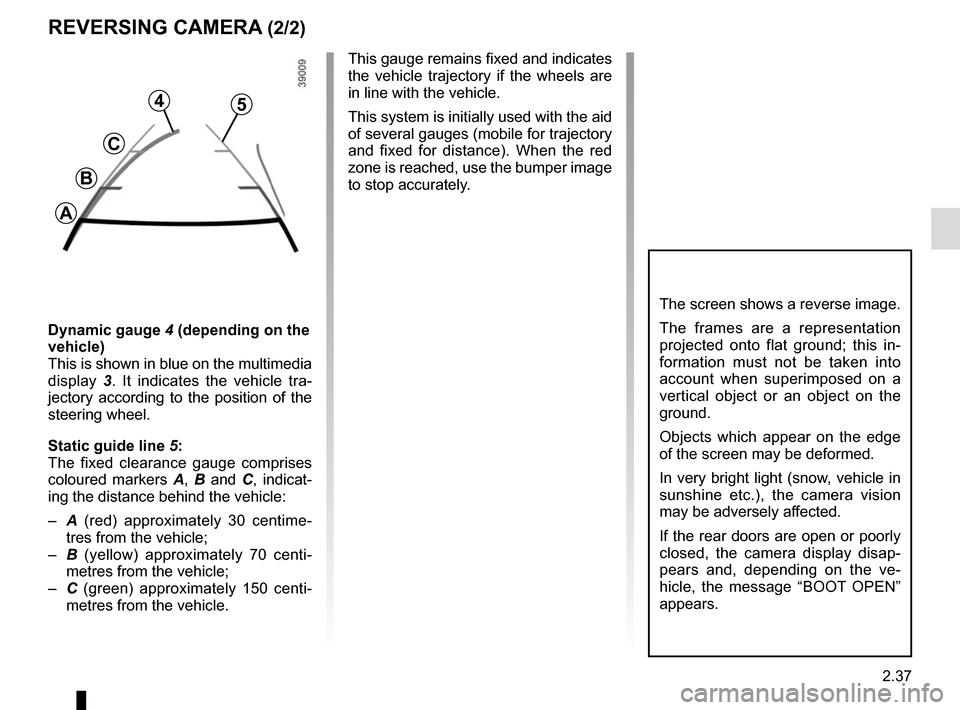
Dynamic gauge 4 (depending on the
vehicle)
This is shown in blue on the multimedia
display 3. It indicates the vehicle tra-
jectory according to the position of the
steering wheel.
Static guide line 5:
The fixed clearance gauge comprises
coloured markers A, B and C , indicat-
ing the distance behind the vehicle:
– A (red) approximately 30 centime-
tres from the vehicle;
– B (yellow) approximately 70 centi-
metres from the vehicle;
– C (green) approximately 150 centi-
metres from the vehicle. This gauge remains fixed and indicates
the vehicle trajectory if the wheels are
in line with the vehicle.
This system is initially used with the aid
of several gauges (mobile for trajectory
and fixed for distance). When the red
zone is reached, use the bumper image
to stop accurately.
4
C
B
A
5
Page 227 of 284
5.19
Fitting new tyres
TYRES (2/3)
Tyre pressures
Adhere to the tyre pressures (including
the emergency spare wheel). The tyre
pressures should be checked at least
once a month and additionally before
any long journey (refer to the label af-
fixed to the edge of the driver’s door).
Incorrect tyre pressures
lead to abnormal tyre wear
and unusually hot running.
These are factors which
may seriously affect safety and lead
to:
– poor road holding,
– risk of bursting or tread separa- tion.
The pressure depends on the load
and the speed of use. Adjust the
pressure according to the condi-
tions of use (refer to the label affixed
to the edge of the driver’s door).
Please be aware that a
poorly tightened or missing
valve cap can make the
tyres less airtight and lead
to pressure loss.
Always use valve caps identical to
those fitted originally and tighten
them fully.
For safety reasons, this
operation must be carried
out by a specialist.
Fitting different tyres may
change your vehicle as follows:
– it may mean that your vehicle no longer conforms to current regu-
lations;
– it may change the way it handles when cornering;
– it may cause the steering to be heavy;
– It may affect the use of snow chains.
Pressures should be checked when the
tyres are cold; ignore higher pressures
which may be reached in hot weather
or following a fast journey.
If tyre pressures cannot be checked
when the tyres are cold, the normal
pressures must be increased by 0.2 to
0.3 bar (or 3 PSI).
Never deflate a hot tyre.
Dual wheel versions
To inflate the outer wheel, it is recom-
mended that the inflation tube is passed
between the two wheels. Vehicle fitted with a tyre pressure
loss warning system
If underinflated (puncture, low pres-
sure, etc.), the warning light
on
the instrument panel comes on, see
“Tyre pressure loss warning system” in
Section 2.
Page 246 of 284
5.38
TOWING: breakdown (1/2)
The steering wheel must be un-
locked and the ignition key must be
in position M (ignition on) to provide
brake lights and hazard warning
lights on the towed vehicle. At night
the vehicle must have its lights on.
Unhitch the trailer, etc., if one is
being towed.
You must observe the towing regu-
lations which apply in the country in
which you are driving: do not exceed
the towing weight for your vehicle.
Contact an approved dealer.
Only use:
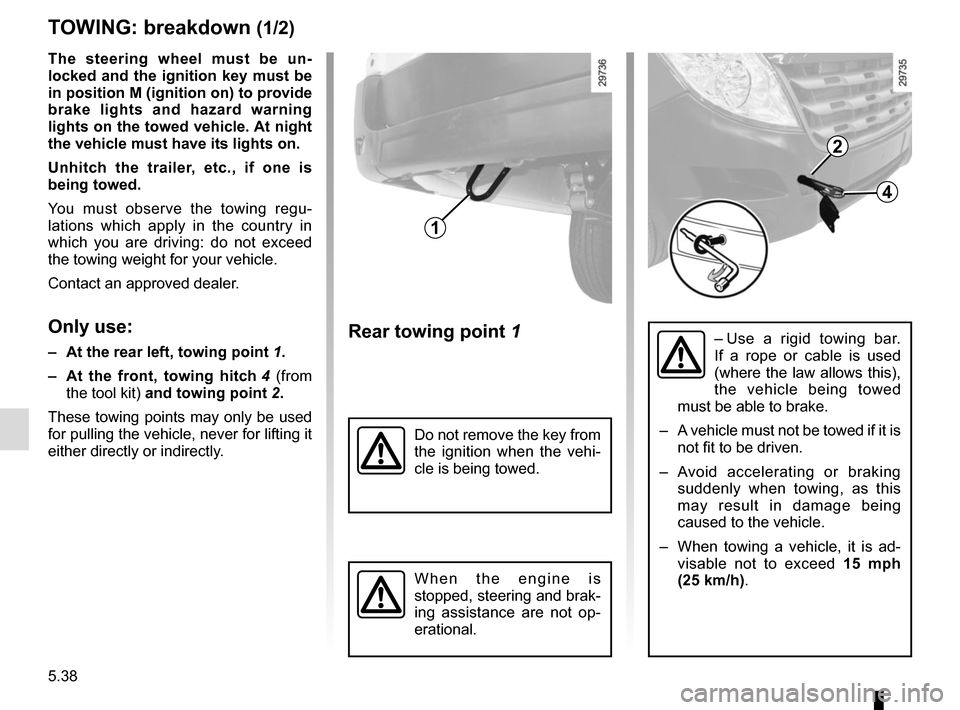
– At the rear left, towing point 1.
– At the front, towing hitch 4 (from
the tool kit) and towing point 2.
These towing points may only be used
for pulling the vehicle, never for lifting it
either directly or indirectly.
Rear towing point 1– Use a rigid towing bar.
If a rope or cable is used
(where the law allows this),
the vehicle being towed
must be able to brake.
– A vehicle must not be towed if it is not fit to be driven.
– Avoid accelerating or braking suddenly when towing, as this
may result in damage being
caused to the vehicle.
– When towing a vehicle, it is ad- visable not to exceed 15 mph
(25 km/h).
1
When the engine is
stopped, steering and brak-
ing assistance are not op-
erational.
Do not remove the key from
the ignition when the vehi-
cle is being towed.
2
4
Page 250 of 284
5.42
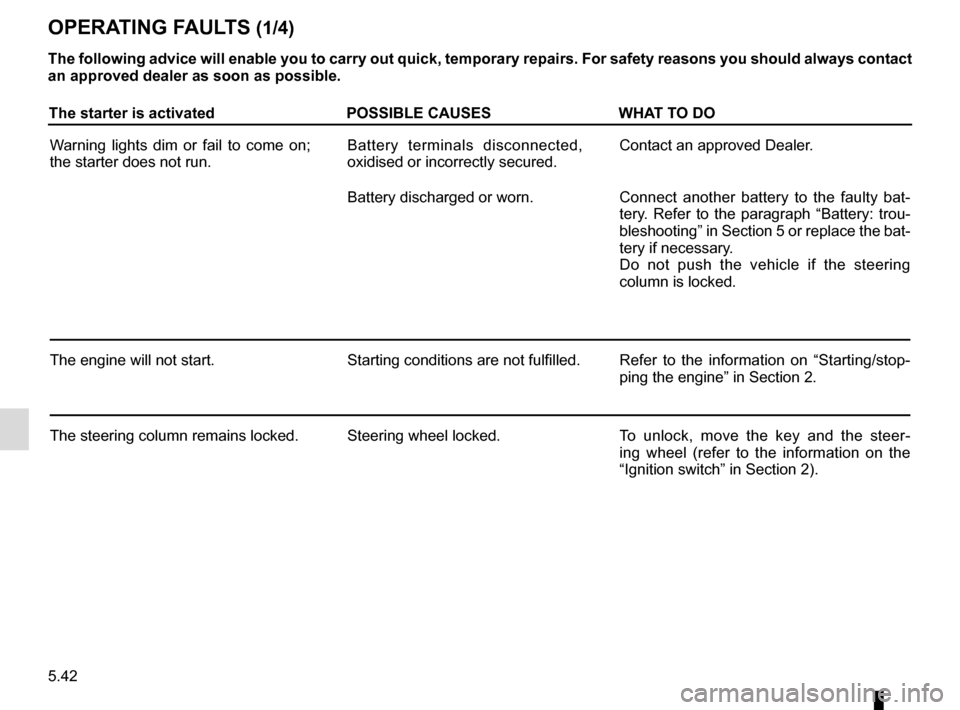
The starter is activatedPOSSIBLE CAUSESWHAT TO DO
Warning lights dim or fail to come on;
the starter does not run. Battery terminals disconnected,
oxidised or incorrectly secured.Contact an approved Dealer.
Battery discharged or worn. Connect another battery to the faulty bat-
tery. Refer to the paragraph “Battery: trou-
bleshooting” in Section 5 or replace the bat-
tery if necessary.
Do not push the vehicle if the steering
column is locked.
The engine will not start. Starting conditions are not fulfilled.Refer to the information on “Starting/stop-
ping the engine” in Section 2.
The steering column remains locked. Steering wheel locked. To unlock, move the key and the steer-
ing wheel (refer to the information on the
“Ignition switch” in Section 2).
OPERATING FAULTS (1/4)
The following advice will enable you to carry out quick, temporary repai\
rs. For safety reasons you should always contact
an approved dealer as soon as possible.
Page 279 of 284

coolant ................................................................\
........... 4.9
power-assisted steering pump ..................................... 4.10
lifting t")
7.3
ALPHABETICAL INDEX (3/4)
coolant ................................................................\
........... 4.9
power-assisted steering pump ..................................... 4.10
lifting the vehicle changing a wheel .............................5.4, 5.13 → 5.15, 5.17
lighting: interior ...............................................................\
........... 3.16
lights: adjustment of headlight beam height ........................... 1.99
brake lights ....................................................... 5.25 – 5.26
daytime running lights ....................................... 5.21 – 5.22
dipped beam headlights .................. 1.95, 5.21 – 5.22, 5.25
direction indicators ............................................ 5.21 – 5.22
fog lights ............................................................. 1.98, 5.25
hazard warning ............................................................ 5.25
main beam headlights .............................. 1.96, 5.21 – 5.22
reversing lights ............................................................. 5.25
side lights ................................................. 1.95, 5.21 – 5.22
lights-on warning buzzer.................................................... 1.96
locking the doors .......................... 1.2 → 1.8, 1.11, 1.14 – 1.15
M
maintenance ............................................................\
.......... 2.12
maintenance: bodywork .......................................................... 4.14 – 4.15
interior trim ........................................................ 4.16 – 4.17
mechanical .......................................................6.10 → 6.15
mileage before service .....................................6.10 → 6.15
manufacturer’s plates .......................................................... 6.2
methods of restraint in addition to the front seat belts ..............
1.26 → 1.28
N
navigation system ..................................................... 1.92, 3.27
O
oil change ................................................................... 4.6 – 4.7 operating faults ......................................................5.42
→ 5.45
P
paintwork maintenance ..................................................... 4.14 – 4.15
reference ..............................................................\
.......... 6.2
parking distance control.......................................... 2.34 – 2.35
power-assisted steering..................................................... 1.91
puncture.................................... 5.2 → 5.10, 5.13 → 5.15, 5.17
R
radio fitting a radio ................................................................ 5.40
rear bench seat....................................................... 3.25 – 3.26
rear view camera .................................................... 2.36 – 2.37
rear view mirrors ................................................................ 1.71
remote control door locking batteries ..............................................................\
......... 5.35
remote control door locking unit ................................1.2 → 1.6
RENAULT ANTI-INTRUDER DEVICE (RAID) ................... 1.11
replacement parts ................................................................ 6.9
reverse gear selecting ..............................................................\
......... 2.14
running in ........................................................................\
..... 2.2
S
screen wash/wipe ................................................... 1.93 – 1.94
seat belt pretensioners front seat belt ...................................................1.26 → 1.28
seat belts ......................................................1.22 → 1.24, 1.29
see-me-home lighting ........................................................ 1.96
sequential gearbox ................................................2.41 → 2.46
service sheets........................................................6.10 → 6.15
signals and lights ...................................................1.95 → 1.99
speakers location ...............................................................\
......... 5.40
Page 280 of 284
7.4
ALPHABETICAL INDEX (4/4)
special features of diesel versions....................................... 2.7
speed limiter ..........................................................2.26 → 2.28
starting the engine ............................................................... 2.3
steering wheel adjustment .............................................................\
...... 1.91
Stop & Start ...............................................................2.4 → 2.6
Stop & Start function..................................................2.4 → 2.6
stopping the engine ............................................................. 2.3
storage compartment.............................................3.19 → 3.24
storage compartments ...........................................3.19 → 3.24
sun visor ........................................................................\
.... 3.17
T
tailgate ...............................................................\
................ 3.28
tank AdBlue .........................................................1.103 → 1.108
tanks and reservoirs: windscreen washer ...................................................... 4.10
technical specifications ..............................6.2 – 6.3, 6.6 → 6.9
temperature regulation ...................................................... 3.13
tool kit ........................................................................\
.......... 5.4
towing .................................................................\
............... 3.28 driving ................................................................\
.......... 2.18
breakdown ........................................................ 5.38 – 5.39
towing a caravan ............................................................ 6.8
towing hitch........................................................................\
.. 5.4
towing rings ............................................................ 3.28 – 3.29
towing weights ..................................................................... 6.8
traction control .......................................................2.16 → 2.20
transporting children .... 1.31 – 1.32, 1.36 → 1.55, 1.68 → 1.70
transporting objects in the luggage compartment ............................. 3.28 – 3.29
trims ........................................................................\
5.11 – 5.12
trip computer and warning system.......................... 1.82 – 1.83
turning circle ............................................................... 6.6 – 6.7
tyre inflation kit.........................................................5.5 → 5.10tyre pressure...................................... 2.21
→ 2.23, 4.11 – 4.12
tyre pressure loss warning.....................................2.21 → 2.23
tyre pressures ......................................................... 4.11 – 4.12
tyres ............................. 2.21 → 2.23, 4.11 – 4.12, 5.18 → 5.20
U
unlocking the doors .................................................1.7 → 1.10
use in winter ...................................................................... 5.20
V
vehicle identification ................................................... 6.2 – 6.3
vehicle identification plates ......................................... 6.2 – 6.3
ventilation ............................................................\
.............. 3.13 air conditioning ...................................................... 3.2 – 3.3
W
warning buzzer ....................................................... 1.12 – 1.13
warning lights.........................................................1.76 → 1.81
washing .................................................................. 4.14 – 4.15
weights ................................................................\
................ 6.8
wheelbrace .............................................................\
............. 5.4
wheels (safety) ......................................................5.18 → 5.20
windows .................................................................. 3.14 – 3.15
wiper blades ...................................................................... 5.37