Tyre RENAULT MASTER 2016 X62 / 2.G Owner's Manual
[x] Cancel search | Manufacturer: RENAULT, Model Year: 2016, Model line: MASTER, Model: RENAULT MASTER 2016 X62 / 2.GPages: 284, PDF Size: 6.69 MB
Page 225 of 284
5.17
CHANGING A WHEEL: jack (2/2)
If you have a puncture, re-
place the wheel as soon as
possible.
A tyre which has been
punctured should always be inspec-
ted (and repaired, where possible)
by a specialist.
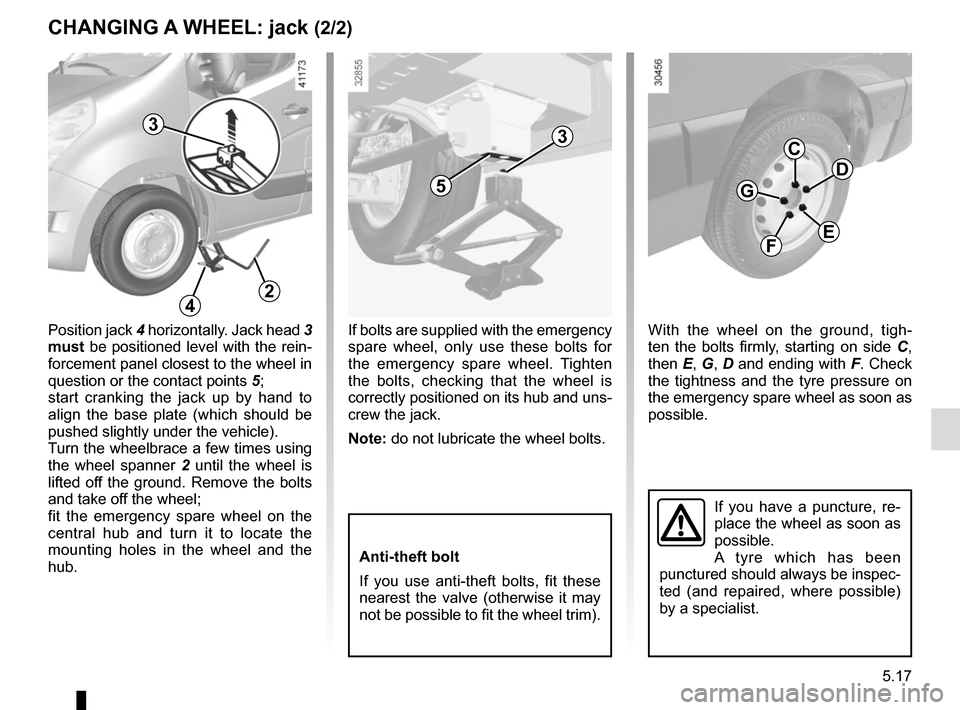
With the wheel on the ground, tigh-
ten the bolts firmly, starting on side C,
then E, G, D and ending with F. Check
the tightness and the tyre pressure on
the emergency spare wheel as soon as
possible.
C
E
G
D
F
If bolts are supplied with the emergency
spare wheel, only use these bolts for
the emergency spare wheel. Tighten
the bolts, checking that the wheel is
correctly positioned on its hub and uns-
crew the jack.
Note: do not lubricate the wheel bolts.
Anti-theft bolt
If you use anti-theft bolts, fit these
nearest the valve (otherwise it may
not be possible to fit the wheel trim).
Position jack 4 horizontally. Jack head 3
must be positioned level with the rein-
forcement panel closest to the wheel in
question or the contact points 5;
start cranking the jack up by hand to
align the base plate (which should be
pushed slightly under the vehicle).
Turn the wheelbrace a few times using
the wheel spanner 2 until the wheel is
lifted off the ground. Remove the bolts
and take off the wheel;
fit the emergency spare wheel on the
central hub and turn it to locate the
mounting holes in the wheel and the
hub.
3
5
3
24
Page 226 of 284
5.18
TYRES (1/3)
Maintaining the tyres
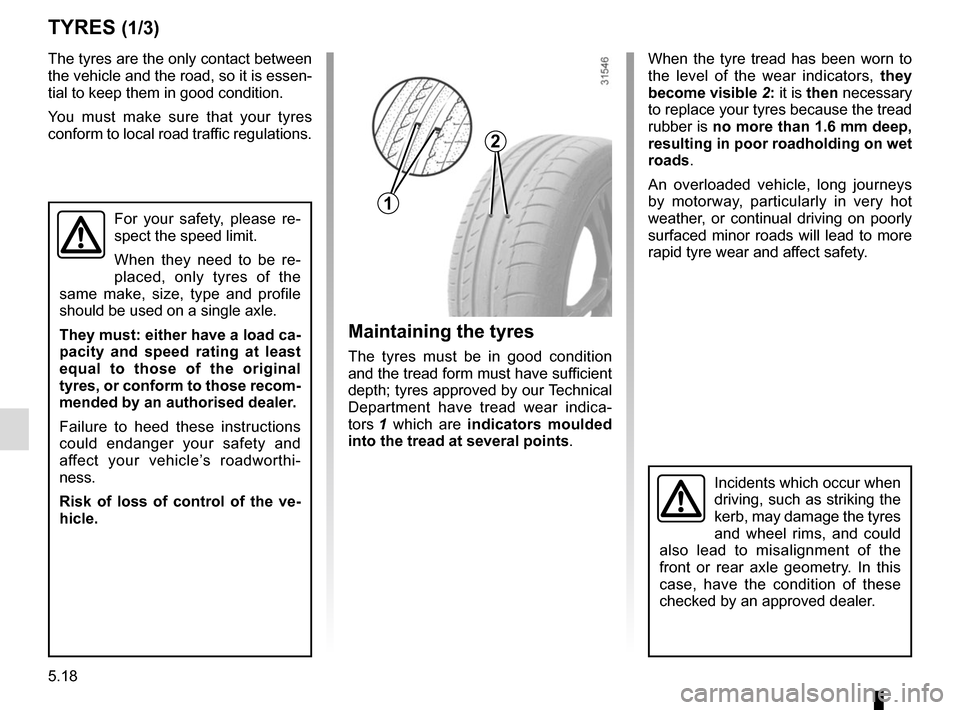
The tyres must be in good condition
and the tread form must have sufficient
depth; tyres approved by our Technical
Department have tread wear indica-
tors 1 which are indicators moulded
into the tread at several points .
The tyres are the only contact between
the vehicle and the road, so it is essen-
tial to keep them in good condition.
You must make sure that your tyres
conform to local road traffic regulations.
When the tyre tread has been worn to
the level of the wear indicators,
they
become visible 2: it is then necessary
to replace your tyres because the tread
rubber is no more than 1.6 mm deep,
resulting in poor roadholding on wet
roads.
An overloaded vehicle, long journeys
by motorway, particularly in very hot
weather, or continual driving on poorly
surfaced minor roads will lead to more
rapid tyre wear and affect safety.
For your safety, please re-
spect the speed limit.
When they need to be re-
placed, only tyres of the
same make, size, type and profile
should be used on a single axle.
They must: either have a load ca-
pacity and speed rating at least
equal to those of the original
tyres, or conform to those recom-
mended by an authorised dealer.
Failure to heed these instructions
could endanger your safety and
affect your vehicle’s roadworthi-
ness.
Risk of loss of control of the ve-
hicle.
Incidents which occur when
driving, such as striking the
kerb, may damage the tyres
and wheel rims, and could
also lead to misalignment of the
front or rear axle geometry. In this
case, have the condition of these
checked by an approved dealer.
1
2
Page 227 of 284
5.19
Fitting new tyres
TYRES (2/3)
Tyre pressures
Adhere to the tyre pressures (including
the emergency spare wheel). The tyre
pressures should be checked at least
once a month and additionally before
any long journey (refer to the label af-
fixed to the edge of the driver’s door).
Incorrect tyre pressures
lead to abnormal tyre wear
and unusually hot running.
These are factors which
may seriously affect safety and lead
to:
– poor road holding,
– risk of bursting or tread separa- tion.
The pressure depends on the load
and the speed of use. Adjust the
pressure according to the condi-
tions of use (refer to the label affixed
to the edge of the driver’s door).
Please be aware that a
poorly tightened or missing
valve cap can make the
tyres less airtight and lead
to pressure loss.
Always use valve caps identical to
those fitted originally and tighten
them fully.
For safety reasons, this
operation must be carried
out by a specialist.
Fitting different tyres may
change your vehicle as follows:
– it may mean that your vehicle no longer conforms to current regu-
lations;
– it may change the way it handles when cornering;
– it may cause the steering to be heavy;
– It may affect the use of snow chains.
Pressures should be checked when the
tyres are cold; ignore higher pressures
which may be reached in hot weather
or following a fast journey.
If tyre pressures cannot be checked
when the tyres are cold, the normal
pressures must be increased by 0.2 to
0.3 bar (or 3 PSI).
Never deflate a hot tyre.
Dual wheel versions
To inflate the outer wheel, it is recom-
mended that the inflation tube is passed
between the two wheels. Vehicle fitted with a tyre pressure
loss warning system
If underinflated (puncture, low pres-
sure, etc.), the warning light
on
the instrument panel comes on, see
“Tyre pressure loss warning system” in
Section 2.
Page 228 of 284

5.20
TYRES (3/3)
Changing wheels around
This practice is not recommended.
Emergency spare wheel
Refer to the information on the
“Emergency spare wheel” and
“Changing a wheel” in Section 5.
Use in winter
Chains
Chains must not be fitted to tyres
which are larger than those originally
fitted to the vehicle.
Chains may only be fitted
to tyres of the same size
as those originally fitted to
your vehicle.
Only certain chains can be fitted to
tyres. Consult an approved Dealer.
Front wheel drive versions
For safety reasons, fitting snow
chains to the rear axle is strictly for-
bidden.
Rear wheel drive versions
For safety reasons, only fit chains
on the rear axle.
Note: for rear wheel drive, dual wheel
versions, fit chains on the outer rear
wheels.
Snow or winter tyres
We would recommend that these be
fitted to all four wheels to ensure that
your vehicle retains maximum grip.
Note: be aware that these tyres may
sometimes have:
– a direction of travel ;
– a maximum speed index which may be lower than the maximum speed of
your vehicle.
In all cases, we would recommend
that you contact an approved dealer
who will be able to advise you on
the choice of equipment which is
most suitable for your vehicle.
Studded tyres
This type of equipment may only be
used for a limited period and as laid
down by local legislation.
It is necessary to observe the speed
specified by current legislation.
These tyres must, as a minimum, be
fitted to the two wheels on the front
axle for front wheel drive versions and
all the rear wheels for rear wheel drive
versions.
Page 251 of 284
5.43
On the roadPOSSIBLE CAUSESWHAT TO DO
Vibrations. Tyres not inflated to the correct pres-
sure, incorrectly balanced or dam-
aged. Check the tyre pressures: if this is not the
problem, have them checked by an ap-
proved dealer.
Coolant boiling in the coolant reservoir . Mechanical fault: damaged cylinder
head gasket. Stop the engine.
Contact an approved Dealer.
Smoke under the bonnet. Short circuit or cooling system leak.Stop, switch off the ignition, stand away
from the vehicle and contact an approved
dealer.
The oil pressure warning light comes
on: while cornering or braking The level is too low. Top up the engine oil (refer to the informa-
tion on “Engine oil level – Topping up/refill-
ing” in Section 4).
is slow to go out or remains lit under
acceleration Loss of oil pressure.
Stop the vehicle and contact an approved
Dealer.
White smoke from the exhaust. This is not necessarily a fault. Smoke
may be caused by regeneration of
the particle filter. Refer to the information on “Special fea-
tures of diesel versions” in Section 2.
OPERATING FAULTS (2/4)
Page 262 of 284
6.8
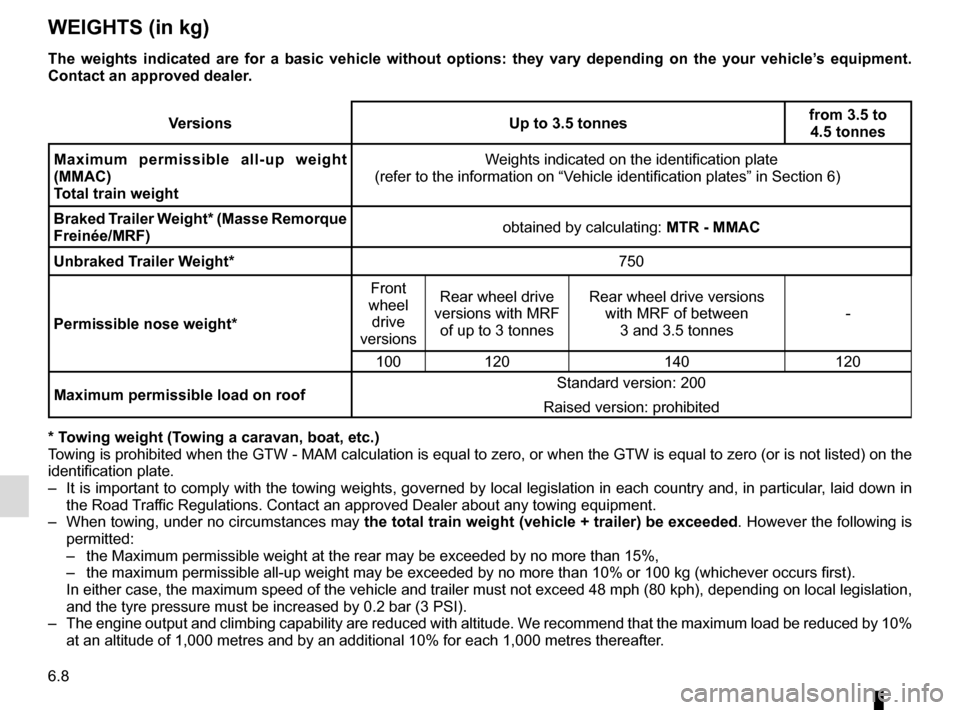
WEIGHTS (in kg)
VersionsUp to 3.5 tonnesfrom 3.5 to
4.5 tonnes
Maximum permissible all-up weight
(MMAC)
Total train weight Weights indicated on the identification plate
(refer to the information on “Vehicle identification plates” in Section 6)
Braked Trailer Weight* (Masse Remorque
Freinée/MRF) obtained by calculating:
MTR - MMAC
Unbraked Trailer Weight* 750
Permissible nose weight* Front
wheel drive
versions Rear wheel drive
versions with MRF of up to 3 tonnes Rear wheel drive versions
with MRF of between 3 and 3.5 tonnes -
100 120 140120
Maximum permissible load on roof Standard version: 200
Raised version: prohibited
* Towing weight (Towing a caravan, boat, etc.)
Towing is prohibited when the GTW - MAM calculation is equal to zero, or \
when the GTW is equal to zero (or is not listed) on th e
identification plate.
– It is important to comply with the towing weights, governed by local leg\
islation in each country and, in particular, laid down in the Road Traffic Regulations. Contact an approved Dealer about any towing equipment.
– When towing, under no circumstances may the total train weight (vehicle + trailer) be exceeded . However the following is
permitted:
– the Maximum permissible weight at the rear may be exceeded by no more th\
an 15%,
– the maximum permissible all-up weight may be exceeded by no more than 10\
% or 100 kg (whichever occurs first).
In either case, the maximum speed of the vehicle and trailer must not ex\
ceed 48 mph (80 kph), depending on local legislation, and the tyre pressure must be increased by 0.2 bar (3 PSI).
– The engine output and climbing capability are reduced with altitude. We recommend that the maximum load be reduced by 10% at an altitude of 1,000 metres and by an additional 10% for each 1,000 m\
etres thereafter.
The weights indicated are for a basic vehicle without options: they vary\
depending on the your vehicle’s equipment.
Contact an approved dealer.
Page 280 of 284
7.4
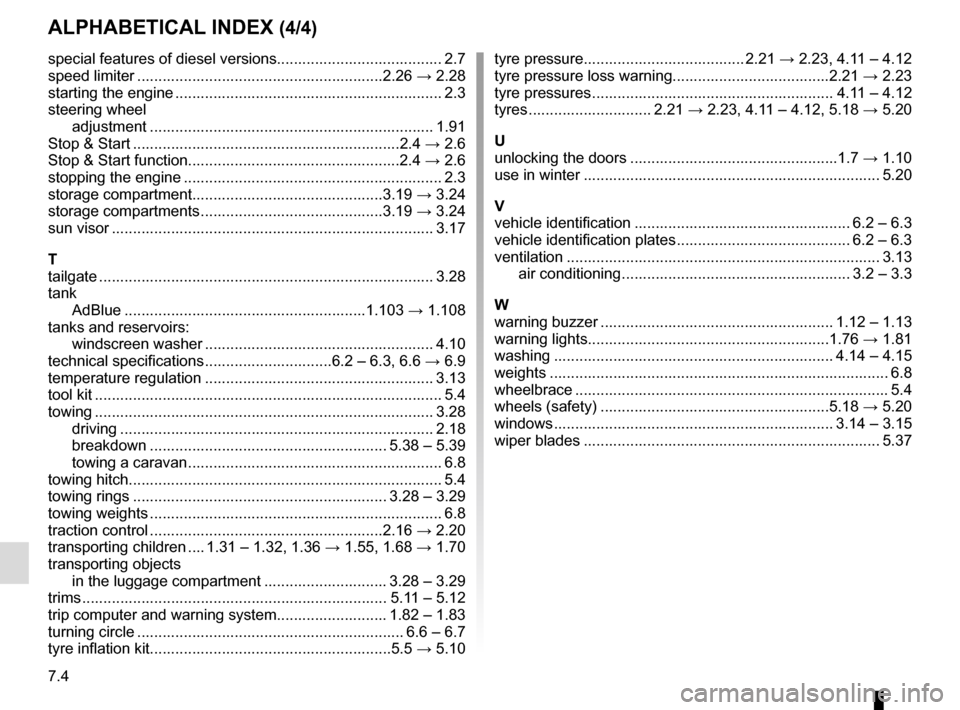
ALPHABETICAL INDEX (4/4)
special features of diesel versions....................................... 2.7
speed limiter ..........................................................2.26 → 2.28
starting the engine ............................................................... 2.3
steering wheel adjustment .............................................................\
...... 1.91
Stop & Start ...............................................................2.4 → 2.6
Stop & Start function..................................................2.4 → 2.6
stopping the engine ............................................................. 2.3
storage compartment.............................................3.19 → 3.24
storage compartments ...........................................3.19 → 3.24
sun visor ........................................................................\
.... 3.17
T
tailgate ...............................................................\
................ 3.28
tank AdBlue .........................................................1.103 → 1.108
tanks and reservoirs: windscreen washer ...................................................... 4.10
technical specifications ..............................6.2 – 6.3, 6.6 → 6.9
temperature regulation ...................................................... 3.13
tool kit ........................................................................\
.......... 5.4
towing .................................................................\
............... 3.28 driving ................................................................\
.......... 2.18
breakdown ........................................................ 5.38 – 5.39
towing a caravan ............................................................ 6.8
towing hitch........................................................................\
.. 5.4
towing rings ............................................................ 3.28 – 3.29
towing weights ..................................................................... 6.8
traction control .......................................................2.16 → 2.20
transporting children .... 1.31 – 1.32, 1.36 → 1.55, 1.68 → 1.70
transporting objects in the luggage compartment ............................. 3.28 – 3.29
trims ........................................................................\
5.11 – 5.12
trip computer and warning system.......................... 1.82 – 1.83
turning circle ............................................................... 6.6 – 6.7
tyre inflation kit.........................................................5.5 → 5.10tyre pressure...................................... 2.21
→ 2.23, 4.11 – 4.12
tyre pressure loss warning.....................................2.21 → 2.23
tyre pressures ......................................................... 4.11 – 4.12
tyres ............................. 2.21 → 2.23, 4.11 – 4.12, 5.18 → 5.20
U
unlocking the doors .................................................1.7 → 1.10
use in winter ...................................................................... 5.20
V
vehicle identification ................................................... 6.2 – 6.3
vehicle identification plates ......................................... 6.2 – 6.3
ventilation ............................................................\
.............. 3.13 air conditioning ...................................................... 3.2 – 3.3
W
warning buzzer ....................................................... 1.12 – 1.13
warning lights.........................................................1.76 → 1.81
washing .................................................................. 4.14 – 4.15
weights ................................................................\
................ 6.8
wheelbrace .............................................................\
............. 5.4
wheels (safety) ......................................................5.18 → 5.20
windows .................................................................. 3.14 – 3.15
wiper blades ...................................................................... 5.37