door RENAULT MASTER 2016 X62 / 2.G Owner's Manual
[x] Cancel search | Manufacturer: RENAULT, Model Year: 2016, Model line: MASTER, Model: RENAULT MASTER 2016 X62 / 2.GPages: 284, PDF Size: 6.69 MB
Page 37 of 284
1.31
CHILD SAFETY: General information (1/2)
Carrying children
Children, and adults, must be correctly
seated and strapped in for all journeys.
The children being carried in your vehi-
cle are your responsibility.
A child is not a miniature adult. Children
are at risk of specific injuries as their
muscles and bones have not yet fin-
ished growing. The seat belt alone
would not provide suitable protection.
Use an approved child seat and ensure
you use it correctly.
A collision at 30 mph
(50 km/ h) is the same
as falling a distance of
10 metres. Transporting a
child without a restraint is the equiv-
alent of allowing him or her to play
on a fourth-floor balcony without
railings.
Never travel with a child held in your
arms. In the event of an accident,
you will not be able to keep hold of
the child, even if you yourself are
wearing a seat belt.
If your vehicle has been involved
in a road accident, replace the
child seat and have the seat belts
checked.
To prevent the doors being
opened, use the childproof
locks (please refer to the in-
formation on “Locking/un-
locking the doors” in Section 1).
Driver’s responsibility
when parking or stopping
the vehicle
Never leave an animal,
child or adult who is not self-suffi-
cient alone on your vehicle, even for
a short time.
They may pose a risk to themselves
or to others by starting the engine,
activating equipment such as the
electric windows or by locking the
doors.
Also, in hot and/or sunny weather,
please remember that the tempera-
ture inside the passenger compart-
ment increases very quickly.
RISK OF DEATH OR SERIOUS
INJURY.
Page 43 of 284
1.37
CHILD SAFETY: fitting a child seat, general information (2/2)
A child seat with a floor sup-
port must never be installed
on the rear centre seat.
RISK OF DEATH OR
SERIOUS INJURY.
In the rear seat
A carrycot can be installed across the
vehicle and will take up at least two
seats. Position the child with his or her
feet nearest the door.
Move the front seat as far forward as
possible to install a rear-facing child
seat, then move back the seat in front
as far as it will go, although without al-
lowing it to come into contact with the
child seat.
For the safety of the child in the for-
ward-facing seat, do not move the seat
in front back past the middle of the
runner, do not tilt the seatback too far
(maximum of 25° ) and raise the seat as
much as possible.
Check that the forward-facing child seat
is resting against the back of the vehi-
cle seat and that the headrest of the ve-
hicle is not obstructing its use.
Page 77 of 284
1.71
REAR-VIEW MIRRORS
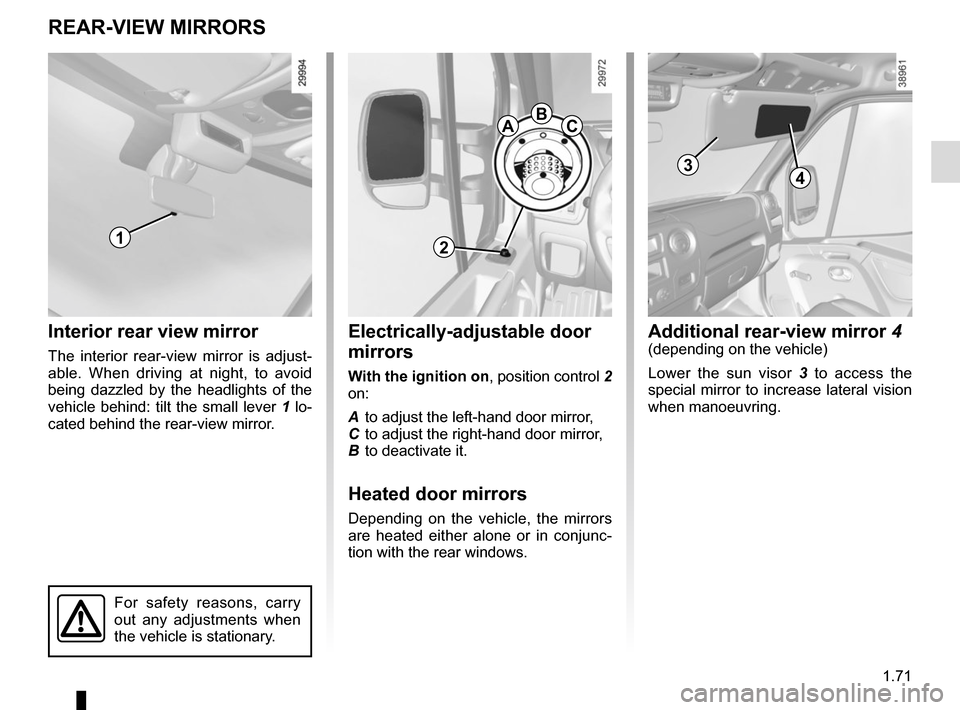
Interior rear view mirror
The interior rear-view mirror is adjust-
able. When driving at night, to avoid
being dazzled by the headlights of the
vehicle behind: tilt the small lever 1 lo-
cated behind the rear-view mirror.
Electrically-adjustable door
mirrors
With the ignition on , position control 2
on:
A to adjust the left-hand door mirror,
C to adjust the right-hand door mirror,
B to deactivate it.
Heated door mirrors
Depending on the vehicle, the mirrors
are heated either alone or in conjunc-
tion with the rear windows.
12
ABC
For safety reasons, carry
out any adjustments when
the vehicle is stationary.
Additional rear-view mirror 4(depending on the vehicle)
Lower the sun visor 3 to access the
special mirror to increase lateral vision
when manoeuvring.
43
Page 84 of 284

The presence and operation of the warning lights DEPEND ON THE EQUIPMENT\
AND COUNTRY.
xAnti-lock braking warning
light
This light comes on when the ignition is
switched o")
1.78
Warning lights (3/4)
The presence and operation of the warning lights DEPEND ON THE EQUIPMENT\
AND COUNTRY.
xAnti-lock braking warning
light
This light comes on when the ignition is
switched on and goes out within 3 sec-
onds. If it comes on when you are driv-
ing, it indicates a fault in the anti-lock
braking system. Braking will then occur
normally, without the anti-lock system.
Contact an approved dealer as soon as
possible.
^Water in the diesel filter
warning light
If it comes on when you are driving, it
indicates the presence of water in the
diesel. Contact your approved dealer
as soon as possible.
ÀOil pressure warning light
This light comes on when the
ignition is switched on and goes out
within 3 seconds. If it comes on while
you are driving, stop at once and switch
off the ignition. Check the oil level. If
the level is correct, the light has come
on for another reason; contact an ap-
proved dealer.
2
Door status warning light
If it lights up when the ignition
is switched on, it indicates that
a door is not properly closed.
Traction control warning
light
Refer to the information on “Driving cor-
rection devices and aids” in Section 2.
Tyre pressure loss warning
Please refer to the information
on the “Tyre pressure loss warning” in
Section 2.
ÉPreheating warning light
This should come on when
the ignition is switched on. It indicates
that the heater plugs are in operation.
It goes out after preheating is sufficient
and the engine can be started.
T Digital tacograph warning light
If it comes on, there is a fault in the
system. Refer to the handbook for the
equipment.
Engine standby warning
light
Please refer to the information on the
“Stop and Start Function” in Section 2.
Unavailability of engine
standby warning light
Please see information in the para-
graph on “Stop and Start Function” in
Section 2.
A
Page 92 of 284
1.86
TRIP COMPUTER: journey parameters (3/4)
Examples of selectionsInterpreting the display selected
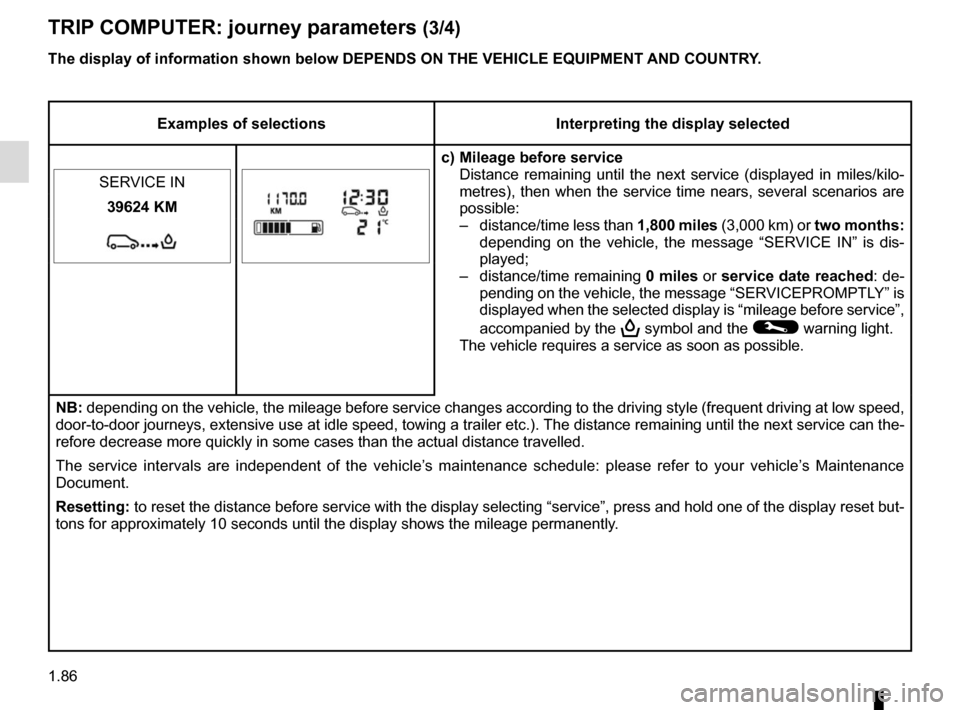
c) Mileage before service Distance remaining until the next service (displayed in miles/kilo-
metres), then when the service time nears, several scenarios are
possible:
– distance/time less than 1,800 miles (3,000 km) or two months:
depending on the vehicle, the message “SERVICE IN” is dis-
played;
– distance/time remaining 0 miles or service date reached : de-
pending on the vehicle, the message “SERVICEPROMPTLY” is
displayed when the selected display is “mileage before service”,
accompanied by the
9 symbol and the © warning light.
The vehicle requires a service as soon as possible.
SERVICE IN
39624 KM
NB: depending on the vehicle, the mileage before service changes according \
to the driving style (frequent driving at low speed,
door-to-door journeys, extensive use at idle speed, towing a trailer etc\
.). The distance remaining until the next service can t
he-
refore decrease more quickly in some cases than the actual distance trav\
elled.
The service intervals are independent of the vehicle’s maintenance schedule: please refer to your vehicle’s Maintenance
Document.
Resetting: to reset the distance before service with the display selecting “ser\
vice”, press and hold one of the display reset but-
tons for approximately 10 seconds until the display shows the mileage pe\
rmanently.
The display of information shown below DEPENDS ON THE VEHICLE EQUIPMENT \
AND COUNTRY.
Page 104 of 284
1.98
EXTERIOR LIGHTING AND SIGNALS (4/5)
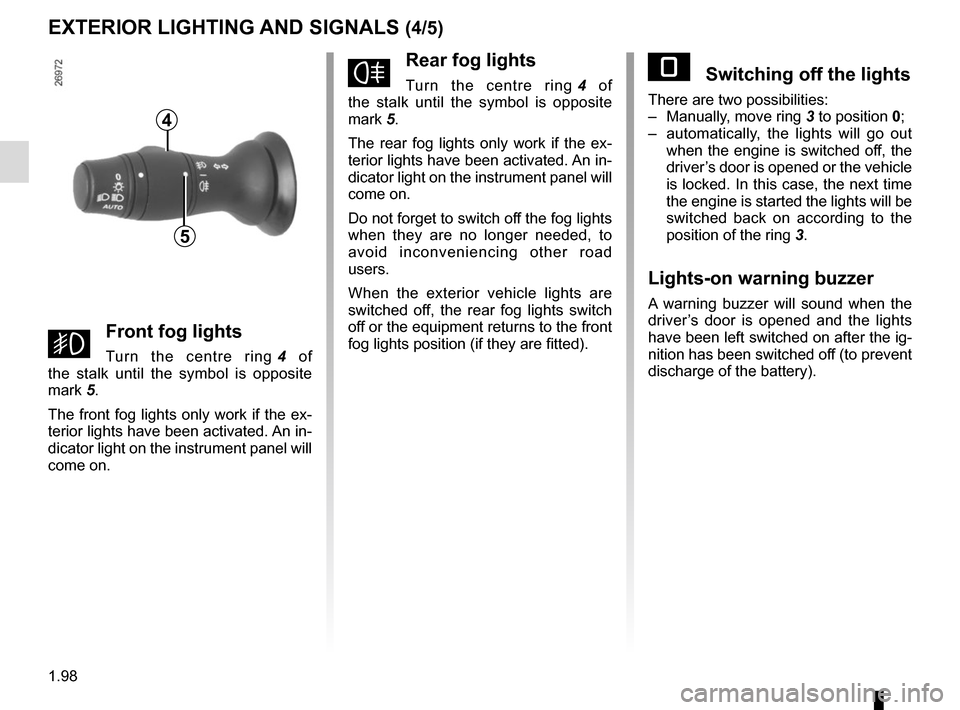
gFront fog lights
Turn the centre ring 4 of
the stalk until the symbol is opposite
mark 5.
The front fog lights only work if the ex-
terior lights have been activated. An in-
dicator light on the instrument panel will
come on.
fRear fog lights
Turn the centre ring 4 of
the stalk until the symbol is opposite
mark 5.
The rear fog lights only work if the ex-
terior lights have been activated. An in-
dicator light on the instrument panel will
come on.
Do not forget to switch off the fog lights
when they are no longer needed, to
avoid inconveniencing other road
users.
When the exterior vehicle lights are
switched off, the rear fog lights switch
off or the equipment returns to the front
fog lights position (if they are fitted).
4
5
eSwitching off the lights
There are two possibilities:
– Manually, move ring 3 to position 0;
– automatically, the lights will go out when the engine is switched off, the
driver’s door is opened or the vehicle
is locked. In this case, the next time
the engine is started the lights will be
switched back on according to the
position of the ring 3.
Lights-on warning buzzer
A warning buzzer will sound when the
driver’s door is opened and the lights
have been left switched on after the ig-
nition has been switched off (to prevent
discharge of the battery).
Page 107 of 284
1.101
FUEL TANK (1/2)
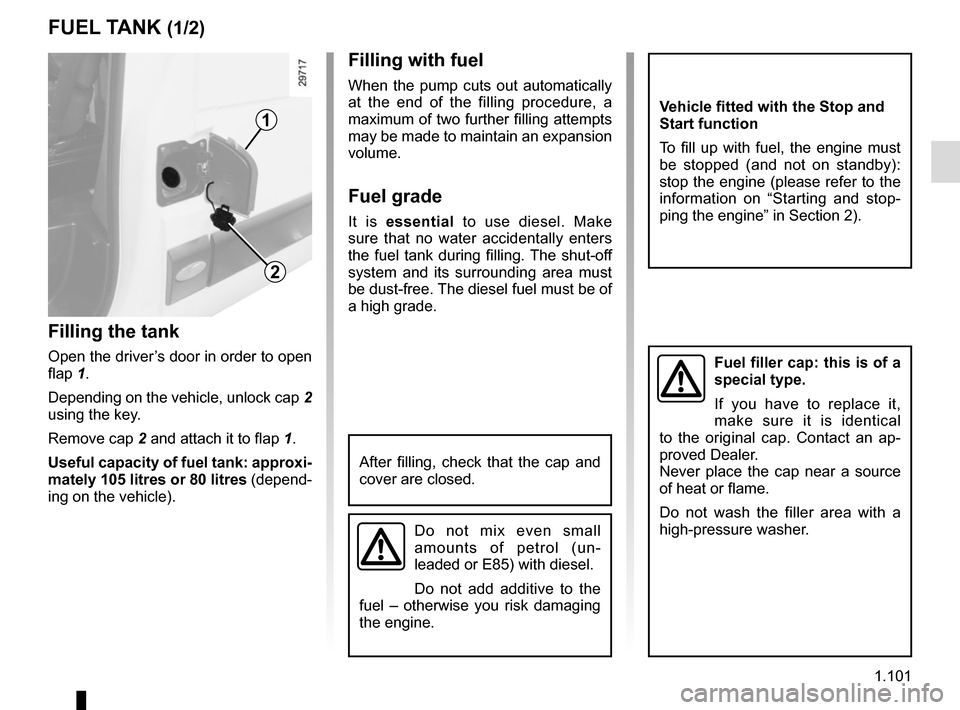
Filling the tank
Open the driver’s door in order to open
flap 1.
Depending on the vehicle, unlock cap 2
using the key.
Remove cap 2 and attach it to flap 1.
Useful capacity of fuel tank: approxi-
mately 105 litres or 80 litres (depend-
ing on the vehicle).
Filling with fuel
When the pump cuts out automatically
at the end of the filling procedure, a
maximum of two further filling attempts
may be made to maintain an expansion
volume.
Fuel grade
It is essential to use diesel. Make
sure that no water accidentally enters
the fuel tank during filling. The shut-off
system and its surrounding area must
be dust-free. The diesel fuel must be of
a high grade.
2
1
After filling, check that the cap and
cover are closed.
Fuel filler cap: this is of a
special type.
If you have to replace it,
make sure it is identical
to the original cap. Contact an ap-
proved Dealer.
Never place the cap near a source
of heat or flame.
Do not wash the filler area with a
high-pressure washer.
Do not mix even small
amounts of petrol (un-
leaded or E85) with diesel.
Do not add additive to the
fuel – otherwise you risk damaging
the engine.
Vehicle fitted with the Stop and
Start function
To fill up with fuel, the engine must
be stopped (and not on standby):
stop the engine (please refer to the
information on “Starting and stop-
ping the engine” in Section 2).
Page 109 of 284
1.103
Please ensure that you comply with the
legislation of your country.
It is important to remember that failure
to respect regulations in force could
lead to legal action being taken against
the vehicle owner.
Operating principleThe use of additives reduces exhaust
emissions by transforming the pollu-
tants into water vapour and nitrogen.
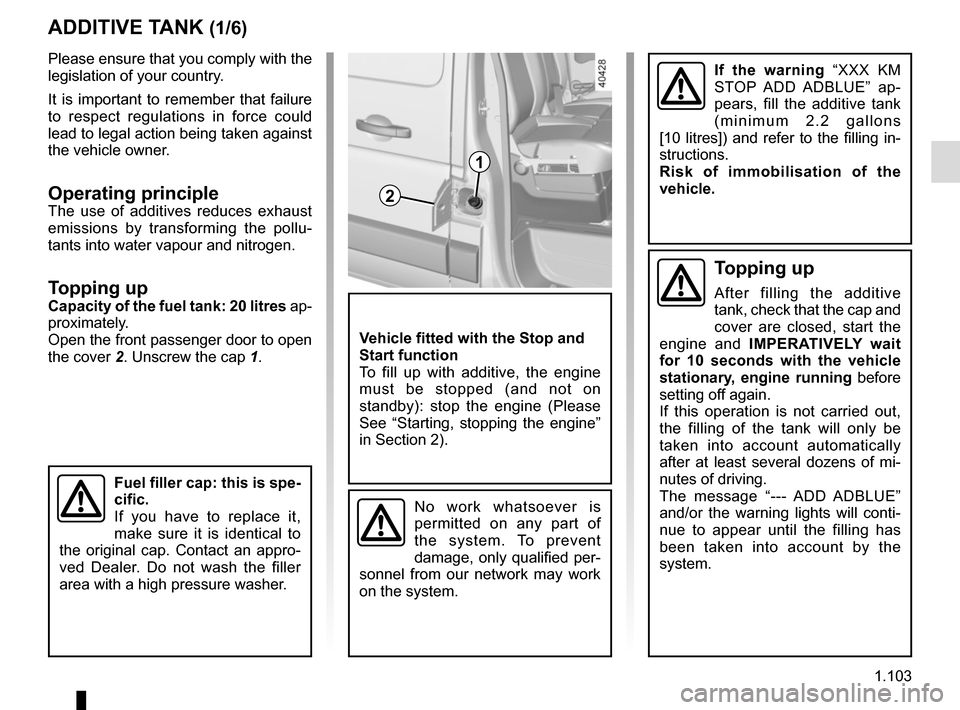
Topping upCapacity of the fuel tank: 20 litres ap-
proximately.
Open the front passenger door to open
the cover 2. Unscrew the cap 1.
ADDITIVE TANK (1/6)
Fuel filler cap: this is spe-
cific.
If you have to replace it,
make sure it is identical to
the original cap. Contact an appro-
ved Dealer. Do not wash the filler
area with a high pressure washer.
2
1
Vehicle fitted with the Stop and
Start function
To fill up with additive, the engine
must be stopped (and not on
standby): stop the engine (Please
See “Starting, stopping the engine”
in Section 2).
No work whatsoever is
permitted on any part of
the system. To prevent
damage, only qualified per-
sonnel from our network may work
on the system.
If the warning “XXX KM
STOP ADD ADBLUE” ap-
pears, fill the additive tank
(minimum 2.2 gallons
[10 litres]) and refer to the filling in-
structions.
Risk of immobilisation of the
vehicle.
Topping up
After filling the additive
tank, check that the cap and
cover are closed, start the
engine and IMPERATIVELY wait
for 10 seconds with the vehicle
stationary, engine running before
setting off again.
If this operation is not carried out,
the filling of the tank will only be
taken into account automatically
after at least several dozens of mi-
nutes of driving.
The message “--- ADD ADBLUE”
and/or the warning lights will conti-
nue to appear until the filling has
been taken into account by the
system.
Page 117 of 284
2.3
STARTING/STOPPING THE ENGINE
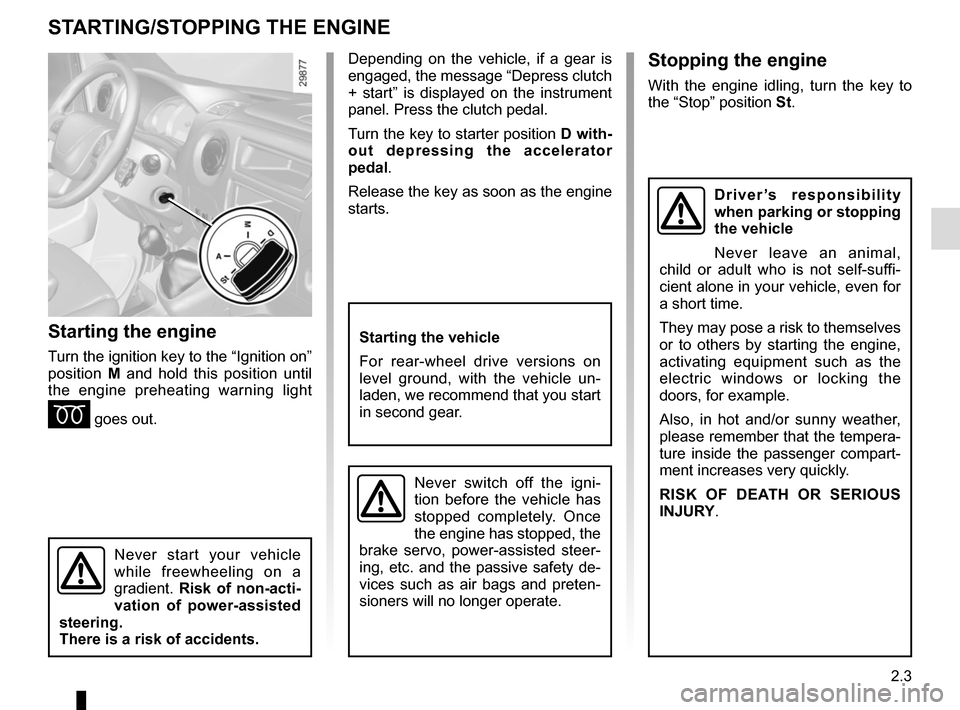
Starting the engine
Turn the ignition key to the “Ignition on”
position M and hold this position until
the engine preheating warning light
É goes out.
Stopping the engine
With the engine idling, turn the key to
the “Stop” position St.
Starting the vehicle
For rear-wheel drive versions on
level ground, with the vehicle un-
laden, we recommend that you start
in second gear.
Never switch off the igni-
tion before the vehicle has
stopped completely. Once
the engine has stopped, the
brake servo, power-assisted steer-
ing, etc. and the passive safety de-
vices such as air bags and preten-
sioners will no longer operate.
Driver’s responsibility
when parking or stopping
the vehicle
Never leave an animal,
child or adult who is not self-suffi-
cient alone in your vehicle, even for
a short time.
They may pose a risk to themselves
or to others by starting the engine,
activating equipment such as the
electric windows or locking the
doors, for example.
Also, in hot and/or sunny weather,
please remember that the tempera-
ture inside the passenger compart-
ment increases very quickly.
RISK OF DEATH OR SERIOUS
INJURY.
Never start your vehicle
while freewheeling on a
gradient. Risk of non-acti-
vation of power-assisted
steering.
There is a risk of accidents.
Depending on the vehicle, if a gear is
engaged, the message “Depress clutch
+ start” is displayed on the instrument
panel. Press the clutch pedal.
Turn the key to starter position D with-
out depressing the accelerator
pedal.
Release the key as soon as the engine
starts.
Page 119 of 284
2.5
STOP AND START FUNCTION (2/3)Conditions for coming out of
engine standby
For sequential gearbox:
– the brake pedal is released, position A or M engaged or,
– the brake pedal is released, position N engaged and the handbrake off, or
– the brake pedal is pressed again, with position P engaged or position
N engaged with the handbrake ap-
plied, or
– position R is engaged or,
– the accelerator pedal is pressed.
For manual gearboxes:
– the gearbox is in neutral and the clutch pedal is slightly depressed, or
– the engine is in gear and the clutch pedal is pressed right down.
Conditions preventing the
standby of the engine
Certain conditions prevent the system
from using the engine standby function,
including when:
– reverse gear is engaged;
– the bonnet is not locked; – the outdoor temperature is too low or
too high (less than around 0 °C or
higher than around 30 °C);
– the battery is not sufficiently charged;
– the difference between the vehicle interior temperature and the auto-
matic climate control instruction is
too high;
– the “Clear View” function is activated (please see “Automatic Climate
Control” in Section 3);
– the engine coolant temperature is too low;
– automatic particle filter cleaning is underway;
or
– ...
Warning light
is displayed on the
instrument panel. This notifies you that
the engine is on standby.
To fill up with fuel, the engine must
be stopped (and not on standby):
always stop the engine (please see
“Starting, stopping the engine”).
Preventing the engine from
standing by
In certain situations, such as negotiat-
ing a crossroads for instance, it is pos-
sible (with the system activated) to keep
the engine running so as to be ready to
move off quickly.
Sequential gearbox:
keep the vehicle stationary without
pressing too hard on the brake pedal.
Manual gearbox:
keep the clutch pedal pressed right
down.