Flap RENAULT MASTER 2016 X62 / 2.G Owners Manual
[x] Cancel search | Manufacturer: RENAULT, Model Year: 2016, Model line: MASTER, Model: RENAULT MASTER 2016 X62 / 2.GPages: 284, PDF Size: 6.69 MB
Page 107 of 284
1.101
FUEL TANK (1/2)
Filling the tank
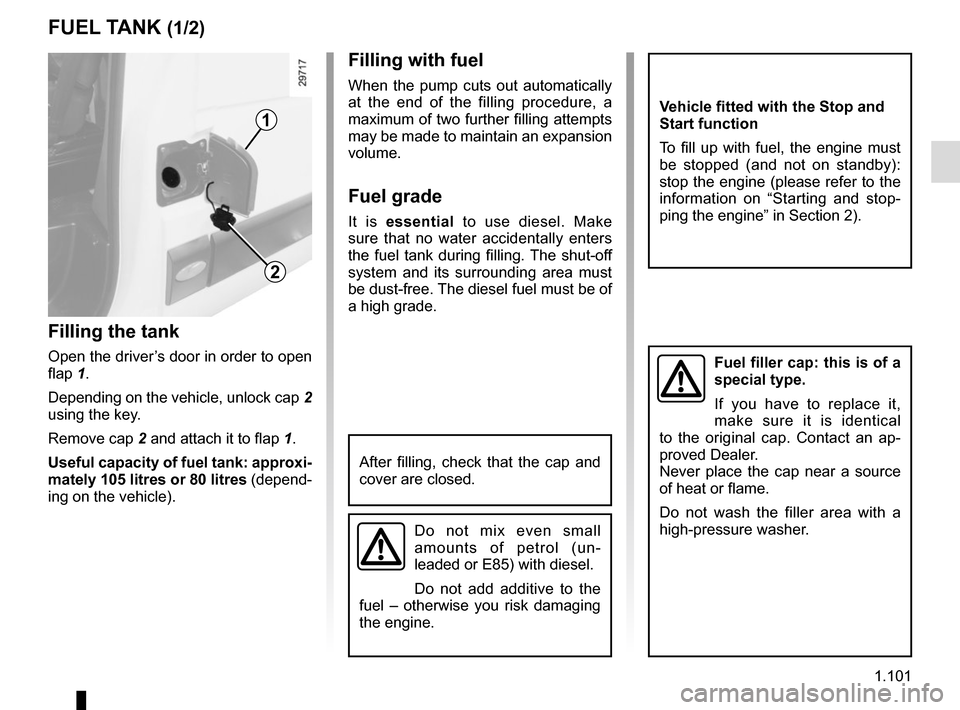
Open the driver’s door in order to open
flap 1.
Depending on the vehicle, unlock cap 2
using the key.
Remove cap 2 and attach it to flap 1.
Useful capacity of fuel tank: approxi-
mately 105 litres or 80 litres (depend-
ing on the vehicle).
Filling with fuel
When the pump cuts out automatically
at the end of the filling procedure, a
maximum of two further filling attempts
may be made to maintain an expansion
volume.
Fuel grade
It is essential to use diesel. Make
sure that no water accidentally enters
the fuel tank during filling. The shut-off
system and its surrounding area must
be dust-free. The diesel fuel must be of
a high grade.
2
1
After filling, check that the cap and
cover are closed.
Fuel filler cap: this is of a
special type.
If you have to replace it,
make sure it is identical
to the original cap. Contact an ap-
proved Dealer.
Never place the cap near a source
of heat or flame.
Do not wash the filler area with a
high-pressure washer.
Do not mix even small
amounts of petrol (un-
leaded or E85) with diesel.
Do not add additive to the
fuel – otherwise you risk damaging
the engine.
Vehicle fitted with the Stop and
Start function
To fill up with fuel, the engine must
be stopped (and not on standby):
stop the engine (please refer to the
information on “Starting and stop-
ping the engine” in Section 2).
Page 110 of 284
1.104
ADDITIVE TANK (2/6)Precautions for use
Always read the information on the ad-
ditive can.
Handle additives with care. They can
damage clothes, shoes, bodywork
components etc.
If the additive overflows, or contami-
nates any paintwork, clean the affected
area quickly with a damp cloth.
In extreme cold weather conditions
The vehicle is fitted with a system for
reheating the additive fluid that enables
you to drive in extreme cold weather
conditions.
Precautions when filling the tank
The additive fluid freezes below about
-10°C.
In this case, do not attempt filling when
the fluid is frozen.
It is therefore advisable to top up the
additive fluid or have it topped up by a
qualified professional as soon as the
warning light on the instrument
panel first comes on.
The additive must not come
into contact with eyes or
skin. If it does, wash the af-
fected area with plenty of
cold water. If necessary, consult a
doctor.
Additive quality
Use only additives which conform
to standard ISO 22241 and in accor-
dance with the label on the fuel filler
flap.
Average fuel consumption
Approximately 810 mpg
(3.5 L/1,000 km) depending on the ve-
hicle and the driving style.
Page 236 of 284
5.28
FUSES (1/5)
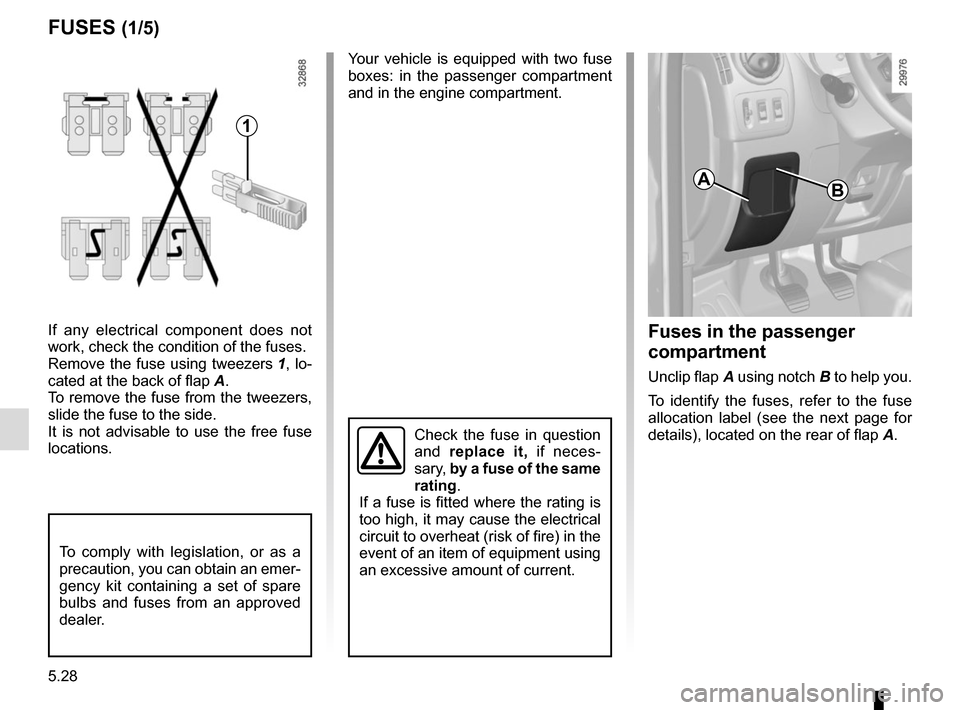
1
If any electrical component does not
work, check the condition of the fuses.
Remove the fuse using tweezers 1, lo-
cated at the back of flap A.
To remove the fuse from the tweezers,
slide the fuse to the side.
It is not advisable to use the free fuse
locations.
To comply with legislation, or as a
precaution, you can obtain an emer-
gency kit containing a set of spare
bulbs and fuses from an approved
dealer.
Your vehicle is equipped with two fuse
boxes: in the passenger compartment
and in the engine compartment.
A
Fuses in the passenger
compartment
Unclip flap A using notch B to help you.
To identify the fuses, refer to the fuse
allocation label (see the next page for
details), located on the rear of flap A.
B
Check the fuse in question
and replace it, if neces-
sary, by a fuse of the same
rating.
If a fuse is fitted where the rating is
too high, it may cause the electrical
circuit to overheat (risk of fire) in the
event of an item of equipment using
an excessive amount of current.