door lock RENAULT MASTER 2017 X62 / 2.G Owner's Manual
[x] Cancel search | Manufacturer: RENAULT, Model Year: 2017, Model line: MASTER, Model: RENAULT MASTER 2017 X62 / 2.GPages: 286, PDF Size: 6.97 MB
Page 104 of 286
1.98
EXTERIOR LIGHTING AND SIGNALS (4/5)
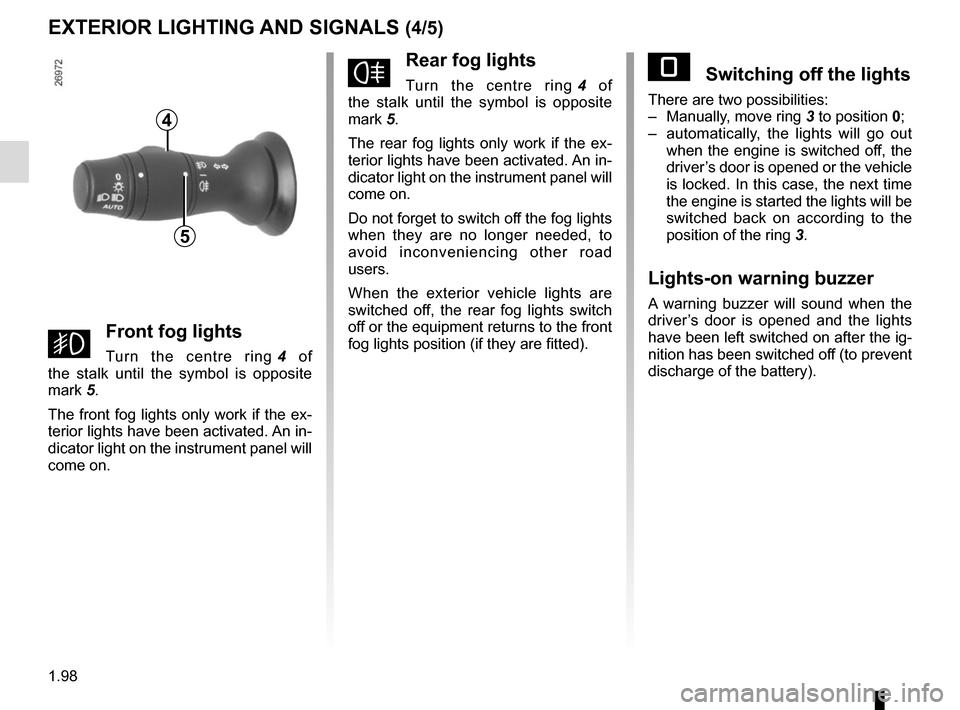
gFront fog lights
Turn the centre ring 4 of
the stalk until the symbol is opposite
mark 5.
The front fog lights only work if the ex-
terior lights have been activated. An in-
dicator light on the instrument panel will
come on.
fRear fog lights
Turn the centre ring 4 of
the stalk until the symbol is opposite
mark 5.
The rear fog lights only work if the ex-
terior lights have been activated. An in-
dicator light on the instrument panel will
come on.
Do not forget to switch off the fog lights
when they are no longer needed, to
avoid inconveniencing other road
users.
When the exterior vehicle lights are
switched off, the rear fog lights switch
off or the equipment returns to the front
fog lights position (if they are fitted).
4
5
eSwitching off the lights
There are two possibilities:
– Manually, move ring 3 to position 0;
– automatically, the lights will go out when the engine is switched off, the
driver’s door is opened or the vehicle
is locked. In this case, the next time
the engine is started the lights will be
switched back on according to the
position of the ring 3.
Lights-on warning buzzer
A warning buzzer will sound when the
driver’s door is opened and the lights
have been left switched on after the ig-
nition has been switched off (to prevent
discharge of the battery).
Page 107 of 286
1.101
FUEL TANK (1/2)
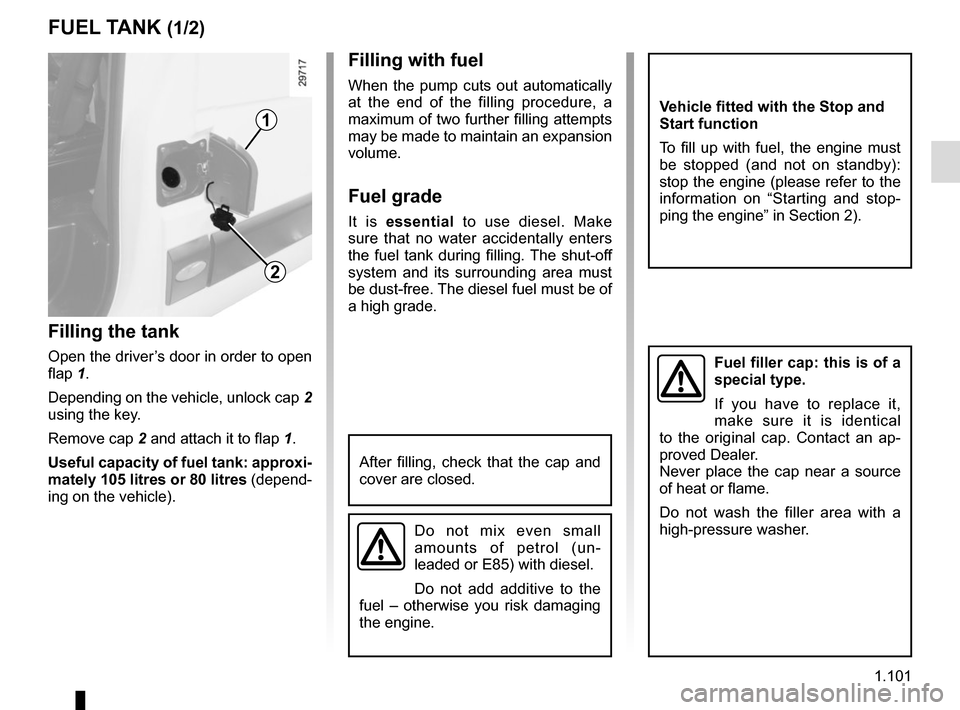
Filling the tank
Open the driver’s door in order to open
flap 1.
Depending on the vehicle, unlock cap 2
using the key.
Remove cap 2 and attach it to flap 1.
Useful capacity of fuel tank: approxi-
mately 105 litres or 80 litres (depend-
ing on the vehicle).
Filling with fuel
When the pump cuts out automatically
at the end of the filling procedure, a
maximum of two further filling attempts
may be made to maintain an expansion
volume.
Fuel grade
It is essential to use diesel. Make
sure that no water accidentally enters
the fuel tank during filling. The shut-off
system and its surrounding area must
be dust-free. The diesel fuel must be of
a high grade.
2
1
After filling, check that the cap and
cover are closed.
Fuel filler cap: this is of a
special type.
If you have to replace it,
make sure it is identical
to the original cap. Contact an ap-
proved Dealer.
Never place the cap near a source
of heat or flame.
Do not wash the filler area with a
high-pressure washer.
Do not mix even small
amounts of petrol (un-
leaded or E85) with diesel.
Do not add additive to the
fuel – otherwise you risk damaging
the engine.
Vehicle fitted with the Stop and
Start function
To fill up with fuel, the engine must
be stopped (and not on standby):
stop the engine (please refer to the
information on “Starting and stop-
ping the engine” in Section 2).
Page 117 of 286
2.3
STARTING/STOPPING THE ENGINE
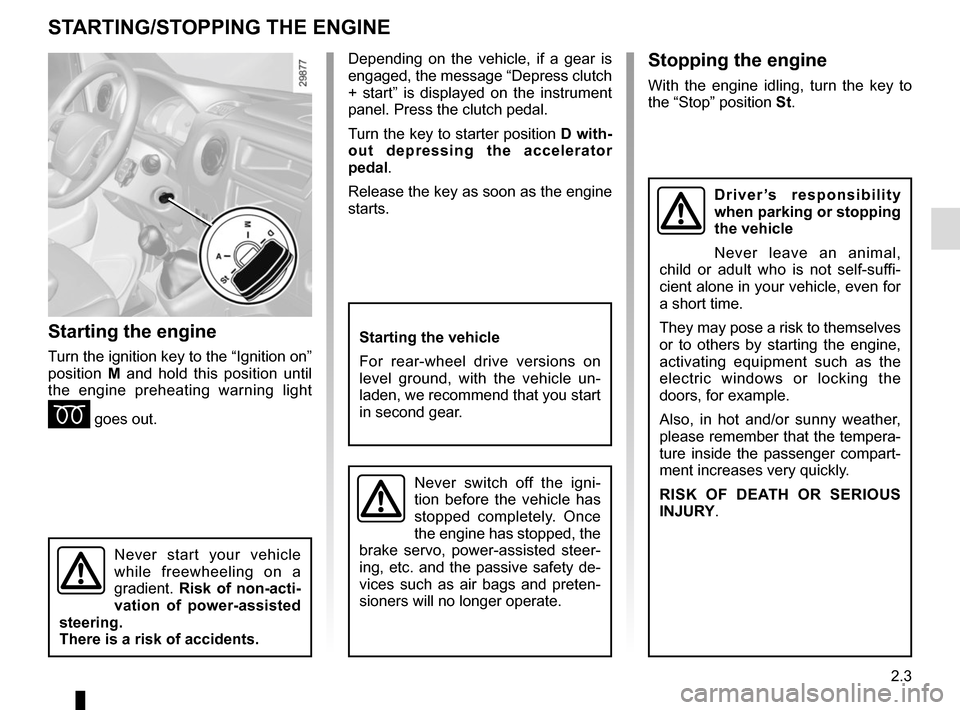
Starting the engine
Turn the ignition key to the “Ignition on”
position M and hold this position until
the engine preheating warning light
É goes out.
Stopping the engine
With the engine idling, turn the key to
the “Stop” position St.
Starting the vehicle
For rear-wheel drive versions on
level ground, with the vehicle un-
laden, we recommend that you start
in second gear.
Never switch off the igni-
tion before the vehicle has
stopped completely. Once
the engine has stopped, the
brake servo, power-assisted steer-
ing, etc. and the passive safety de-
vices such as air bags and preten-
sioners will no longer operate.
Driver’s responsibility
when parking or stopping
the vehicle
Never leave an animal,
child or adult who is not self-suffi-
cient alone in your vehicle, even for
a short time.
They may pose a risk to themselves
or to others by starting the engine,
activating equipment such as the
electric windows or locking the
doors, for example.
Also, in hot and/or sunny weather,
please remember that the tempera-
ture inside the passenger compart-
ment increases very quickly.
RISK OF DEATH OR SERIOUS
INJURY.
Never start your vehicle
while freewheeling on a
gradient. Risk of non-acti-
vation of power-assisted
steering.
There is a risk of accidents.
Depending on the vehicle, if a gear is
engaged, the message “Depress clutch
+ start” is displayed on the instrument
panel. Press the clutch pedal.
Turn the key to starter position D with-
out depressing the accelerator
pedal.
Release the key as soon as the engine
starts.
Page 119 of 286
2.5
STOP AND START FUNCTION (2/3)Conditions for coming out of
engine standby
For sequential gearbox:
– the brake pedal is released, position A or M engaged, or;
– the brake pedal is released, position N engaged and the handbrake off,
or;
– or the brake pedal is pressed again, with position P engaged or position
N engaged with the parking brake
applied or;
– position R is engaged or;
– the accelerator pedal is pressed.
For manual gearboxes:
– the gearbox is in neutral and the clutch pedal is slightly depressed, or
– the engine is in gear and the clutch pedal is pressed right down.
Conditions preventing the
standby of the engine
Certain conditions prevent the system
from using the engine standby function,
including when:
– reverse gear is engaged;
– the bonnet is not locked; – the outdoor temperature is too low or
too high (less than around 0 °C or
higher than around 30 °C);
– the battery is not sufficiently charged;
– the difference between the vehicle interior temperature and the auto-
matic climate control instruction is
too high;
– the “Clear View” function is activated (please see “Automatic Climate
Control” in Section 3);
– the engine coolant temperature is too low;
– automatic particle filter cleaning is underway;
or
– ...
Warning light
is displayed on the
instrument panel. This notifies you that
the engine is on standby.
To fill up with fuel, the engine must
be stopped (and not on standby):
always stop the engine (please see
“Starting, stopping the engine”).
Preventing the engine from
standing by
In certain situations, such as negotiat-
ing a crossroads for instance, it is pos-
sible (with the system activated) to keep
the engine running so as to be ready to
move off quickly.
Sequential gearbox:
keep the vehicle stationary without
pressing too hard on the brake pedal.
Manual gearbox:
keep the clutch pedal pressed right
down.
Page 179 of 286

3.17
INTERIOR LIGHTING
12
Courtesy light
Use switch 1 to:
– permanent lighting;
– intermittent lighting, which comes on when a door is opened. It goes out
when the doors concerned are prop-
erly closed;
– immediate switching off.
Map reading lights(depending on the vehicle)
Move switch 2.
Note
Remote unlocking of the doors triggers
timed lighting of the passenger com-
partment.
If one of the front or rear doors is
opened, the timed lighting will start
again.
Then the courtesy light and the luggage
compartment light dim and go out. The
lighting timer will cut out for various rea-
sons:
– if a door has been open for 15 min- utes;
– if all the doors have been closed for 15 seconds:
– when the ignition is switched on.
Rear light 3
Turn switch 4 to:
– switch on continuous lighting;
– switch on intermittent lighting when one of the rear doors is opened. The
lights only go out when the doors are
correctly closed;
– force the lights off.
3
4
Page 208 of 286
4.16
Glass instrument panel(e.g.: instrument panel, clock, exterior
temperature display, radio display, mul-
timedia or multifunction display etc.)
Use a soft cloth (or cotton wool).
If this does not clean them properly,
use a soft cloth (or cotton wool) slightly
moistened with soapy water and then
wipe clean with another soft damp cloth
or cotton wool.
Finally, carefully dry off with a soft dry
cloth.
Do not use products containing alco-
hol and/or spray fluids on the area.
Seat belts
These must be kept clean.
Use products selected by our Technical
Department (Approved outlets) or
warm, soapy water and a sponge and
wipe with a dry cloth.
Detergents or dyes must not be used
under any circumstances.
INTERIOR TRIM MAINTENANCE (1/2)
Textiles (seats, door trim, etc)
Vacuum-clean the textiles regularly.
Liquid stain
Use soapy water.
Dab lightly (never rub) with a soft cloth,
rinse and remove the excess.
Solid or pasty stain
Carefully remove the excess solid or
pasty material immediately with a
spatula (working from the edges to the
centre to avoid spreading the stain).
Clean as for a liquid stain.
Special instructions for sweets or
chewing gum
Put an ice cube on the stain to solidify
it, then proceed as for a solid stain.
A well-maintained vehicle will last
longer. It is therefore recommended to
maintain the interior of the vehicle regu-
larly.
A stain should always be dealt with
swiftly.
Whatever type of stain is on the trim,
use
cold (or warm) soapy water with
natural soap.
Detergents (washing-up liquid, pow-
dered products, alcohol-based prod-
ucts) should not be used.
Use a soft cloth.
Rinse and soak up the excess.
For further recommendations for
maintaining the interior, and/or for
any unsatisfactory results, please
see an authorised dealer.
Page 279 of 286

A
ABS ....................................................................\
...2.16 → 2.20
accessories...................................................................")
7.1
ALPHABETICAL INDEX (1/4)
A
ABS ....................................................................\
...2.16 → 2.20
accessories........................................................................\
5.41
accessories socket ............................................................ 3.19
AdBlue ...............................................................1.103 → 1.108
AdBlue additive..................................................1.103 → 1.108
additional systems to the seat belts................................... 1.29
additive (tank) ....................................................1.103 → 1.108
additive tank ......................................................1.103 → 1.108
adjusting the seats............................................................. 1.22
adjusting your driving position ........................................... 1.22
advice on antipollution ....................................................... 2.12
air bag....................................................................1.26 → 1.29
activating the front passenger air bags ............1.68 → 1.70
deactivating the front passenger air bags ........1.68 → 1.70
air conditioning ........................................................3.2 → 3.14
air vents ...................................................................... 3.2 – 3.3
anti-corrosion check ..............................................6.16 → 6.21
anti-corrosion protection .................................................... 4.14
anti-lock braking system: ABS ...............................2.16 → 2.20
antipollution advice .................................................................\
......... 2.12
ashtrays ...............................................................\
.............. 3.19
audible and visual signals................................................ 1.100
B
battery........................................................................\
........ 4.13 troubleshooting ................................................. 5.33 – 5.34
bonnet........................................................................\
.......... 4.2
brake fluid ........................................................................\
.... 4.8
bulbs changing ......................................5.21 – 5.22, 5.25 → 5.27
C
capacity of mechanical components........................4.8 → 4.10
central door locking ........................... 1.2 → 1.11, 1.14 → 1.17changing a bulb .................................5.21 – 5.22, 5.25
→ 5.27
changing a wheel........................ 5.2 → 5.4, 5.11 → 5.15, 5.17
changing gear .................................................................... 2.14
child restraint/seat 1.28, 1.31 – 1.32, 1.36 → 1.55, 1.68 → 1.70
child safety............ 1.2, 1.31 – 1.32, 1.36 → 1.55, 1.68 → 1.70
child seats..........................................1.31 – 1.32, 1.36 → 1.55
children ............................................................ 1.2, 1.31 – 1.32
cigar lighter ........................................................................\
3.19
cleaning: inside the vehicle .............................................. 4.16 – 4.17
clock ..................................................................\
................ 1.92
control instruments ................................................1.76 → 1.83
coolant ................................................................\
............... 1.81
courtesy light ............................................................ 3.17, 5.27
cruise control .........................................................2.30 → 2.33
cruise control-speed limiter....................................2.27 → 2.33
D
demisting windscreen ..................................................3.4, 3.7 → 3.12
dimensions ................................................................. 6.6 – 6.7
dipstick................................................................\
........ 4.4 – 4.5
display .................................................................... 1.82 – 1.83
doors................................................... 1.12 – 1.13, 1.16 – 1.17
driver’s position .....................................................1.72 → 1.75
driving ...........................................2.2, 2.10, 2.16 → 2.23, 2.34
driving recommendations ........................................ 2.8 → 2.11
E
ECO driving ............................................................. 2.8 →
2.11
ECO mode ........................................................................\
... 2.9
electric beam height adjustment ........................................ 1.99
electric windows ..................................................... 3.15 – 3.16
electronic stability control: ESC .............................2.16 → 2.20
emergency brake assist.........................................2.16 → 2.20
emergency braking ................................................2.16 → 2.20
Page 281 of 286

coolant ................................................................\
........... 4.9
power-assisted steering pump ..................................... 4.10
lifting t")
7.3
ALPHABETICAL INDEX (3/4)
coolant ................................................................\
........... 4.9
power-assisted steering pump ..................................... 4.10
lifting the vehicle changing a wheel .............................5.4, 5.13 → 5.15, 5.17
lighting: interior ...............................................................\
........... 3.17
lights: adjustment of headlight beam height ........................... 1.99
brake lights ....................................................... 5.25 – 5.26
daytime running lights ....................................... 5.21 – 5.22
dipped beam headlights .................. 1.95, 5.21 – 5.22, 5.25
direction indicators ............................................ 5.21 – 5.22
fog lights ............................................................. 1.98, 5.25
hazard warning ............................................................ 5.25
main beam headlights .............................. 1.96, 5.21 – 5.22
reversing lights ............................................................. 5.25
side lights ................................................. 1.95, 5.21 – 5.22
lights-on warning buzzer.................................................... 1.96
locking the doors .......................... 1.2 → 1.8, 1.11, 1.14 – 1.15
M
maintenance ............................................................\
.......... 2.12
maintenance: bodywork .......................................................... 4.14 – 4.15
interior trim ........................................................ 4.16 – 4.17
mechanical .......................................................6.10 → 6.15
mileage before service .....................................6.10 → 6.15
manufacturer’s plates .......................................................... 6.2
methods of restraint in addition to the front seat belts ..............
1.26 → 1.28
N
navigation system ..................................................... 1.92, 3.28
O
oil change ................................................................... 4.6 – 4.7 operating faults ......................................................5.42
→ 5.45
P
paintwork maintenance ..................................................... 4.14 – 4.15
reference ..............................................................\
.......... 6.2
parking distance control.......................................... 2.35 – 2.36
power-assisted steering..................................................... 1.91
puncture.................................... 5.2 → 5.10, 5.13 → 5.15, 5.17
R
radio fitting a radio ................................................................ 5.40
rear bench seat....................................................... 3.26 – 3.27
rear view camera .................................................... 2.37 – 2.38
rear view mirrors ................................................................ 1.71
remote control door locking batteries ..............................................................\
......... 5.35
remote control door locking unit ................................1.2 → 1.6
RENAULT ANTI-INTRUDER DEVICE (RAID) ................... 1.11
replacement parts ................................................................ 6.9
reverse gear selecting ..............................................................\
......... 2.14
running in ........................................................................\
..... 2.2
S
screen wash/wipe ................................................... 1.93 – 1.94
seat belt pretensioners front seat belt ...................................................1.26 → 1.28
seat belts ......................................................1.22 → 1.24, 1.29
see-me-home lighting ........................................................ 1.96
sequential gearbox ................................................2.42 → 2.47
service sheets........................................................6.10 → 6.15
signals and lights ...................................................1.95 → 1.99
speakers location ...............................................................\
......... 5.40
Page 282 of 286
7.4
ALPHABETICAL INDEX (4/4)
special features of diesel versions....................................... 2.7
speed limiter ..........................................................2.27 → 2.29
starting the engine ............................................................... 2.3
steering wheel adjustment .............................................................\
...... 1.91
Stop & Start ...............................................................2.4 → 2.6
Stop & Start function..................................................2.4 → 2.6
stopping the engine ............................................................. 2.3
storage compartment.............................................3.20 → 3.25
storage compartments ...........................................3.20 → 3.25
sun visor ........................................................................\
.... 3.18
T
tailgate ...............................................................\
................ 3.29
tank AdBlue .........................................................1.103 → 1.108
tanks and reservoirs: windscreen washer ...................................................... 4.10
technical specifications ..............................6.2 – 6.3, 6.6 → 6.9
temperature regulation ........................................... 3.13 – 3.14
tool kit ........................................................................\
.......... 5.4
towing .................................................................\
............... 3.29 driving ................................................................\
.......... 2.18
breakdown ........................................................ 5.38 – 5.39
towing a caravan ............................................................ 6.8
towing hitch........................................................................\
.. 5.4
towing rings ............................................................ 3.29 – 3.30
towing weights ..................................................................... 6.8
traction control .......................................................2.16 → 2.20
transporting children .... 1.31 – 1.32, 1.36 → 1.55, 1.68 → 1.70
transporting objects in the luggage compartment ............................. 3.29 – 3.30
trims ........................................................................\
5.11 – 5.12
trip computer and warning system.......................... 1.82 – 1.83
turning circle ............................................................... 6.6 – 6.7
tyre inflation kit.........................................................5.5 → 5.10tyre pressure...................................... 2.21
→ 2.23, 4.11 – 4.12
tyre pressure loss warning.....................................2.21 → 2.23
tyre pressures ......................................................... 4.11 – 4.12
tyres ............................. 2.21 → 2.23, 4.11 – 4.12, 5.18 → 5.20
U
unlocking the doors .................................................1.7 → 1.10
use in winter ...................................................................... 5.20
V
vehicle identification ................................................... 6.2 – 6.3
vehicle identification plates ......................................... 6.2 – 6.3
ventilation ............................................................... 3.13 – 3.14 air conditioning ...................................................... 3.2 – 3.3
W
warning buzzer ....................................................... 1.12 – 1.13
warning lights.........................................................1.76 → 1.81
washing .................................................................. 4.14 – 4.15
weights ................................................................\
................ 6.8
wheelbrace .............................................................\
............. 5.4
wheels (safety) ......................................................5.18 → 5.20
windows .................................................................. 3.15 – 3.16
wiper blades ...................................................................... 5.37