key RENAULT MASTER 2017 X62 / 2.G Owner's Manual
[x] Cancel search | Manufacturer: RENAULT, Model Year: 2017, Model line: MASTER, Model: RENAULT MASTER 2017 X62 / 2.GPages: 286, PDF Size: 6.97 MB
Page 212 of 286
5.2
PUNCTURE, EMERGENCY SPARE WHEEL (1/2)
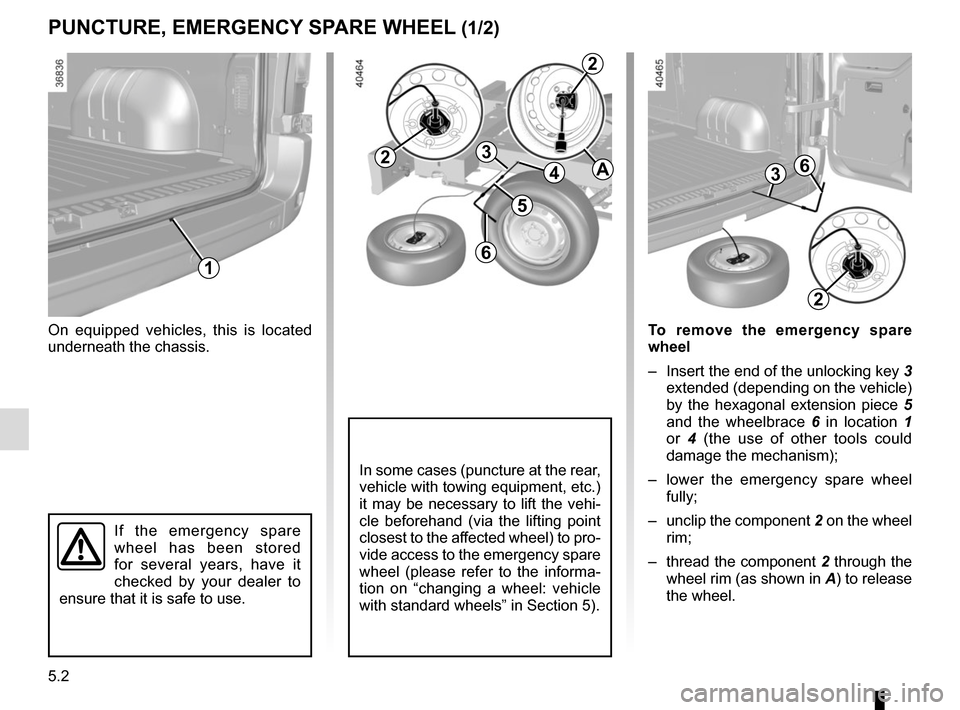
On equipped vehicles, this is located
underneath the chassis.
If the emergency spare
wheel has been stored
for several years, have it
checked by your dealer to
ensure that it is safe to use.
In some cases (puncture at the rear,
vehicle with towing equipment, etc.)
it may be necessary to lift the vehi-
cle beforehand (via the lifting point
closest to the affected wheel) to pro-
vide access to the emergency spare
wheel (please refer to the informa-
tion on “changing a wheel: vehicle
with standard wheels” in Section 5).
1
4
3
5
6
2
2
A
2
36
To remove the emergency spare
wheel
– Insert the end of the unlocking key 3
extended (depending on the vehicle)
by the hexagonal extension piece 5
and the wheelbrace 6 in location 1
or 4 (the use of other tools could
damage the mechanism);
– lower the emergency spare wheel fully;
– unclip the component 2 on the wheel
rim;
– thread the component 2 through the
wheel rim (as shown in A) to release
the wheel.
Page 214 of 286
5.4
TOOL KIT
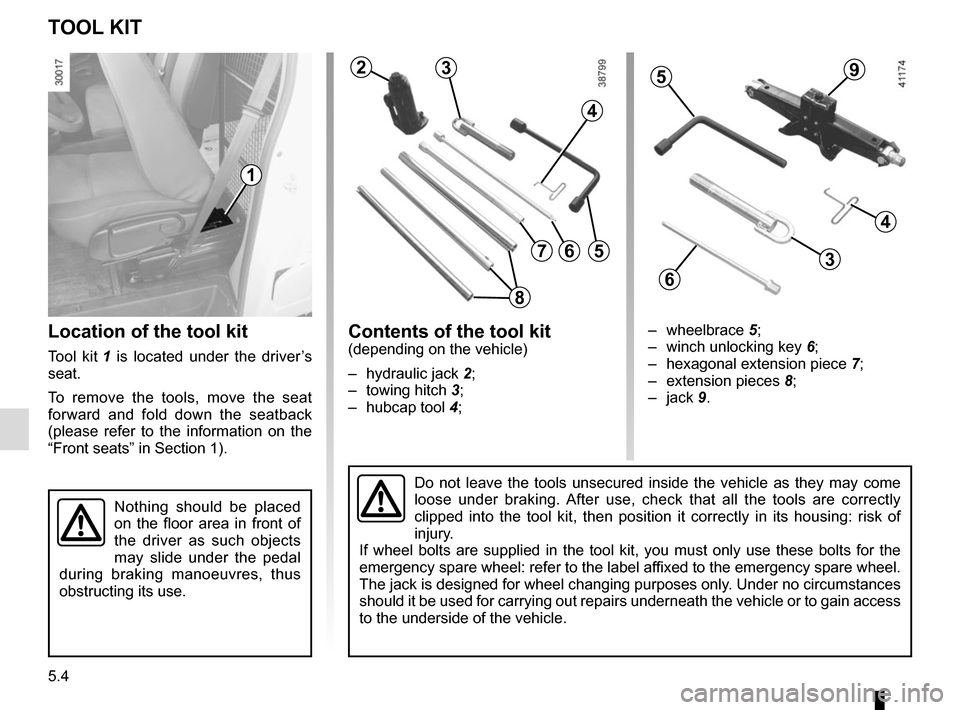
Location of the tool kit
Tool kit 1 is located under the driver’s
seat.
To remove the tools, move the seat
forward and fold down the seatback
(please refer to the information on the
“Front seats” in Section 1).
Contents of the tool kit(depending on the vehicle)
– hydraulic jack 2;
– towing hitch 3;
– hubcap tool 4;
1
Do not leave the tools unsecured inside the vehicle as they may come
loose under braking. After use, check that all the tools are correctly
clipped into the tool kit, then position it correctly in its housing: ri\
sk of
injury.
If wheel bolts are supplied in the tool kit, you must only use these bol\
ts for the
emergency spare wheel: refer to the label affixed to the emergency spare wheel.
The jack is designed for wheel changing purposes only. Under no circumstances
should it be used for carrying out repairs underneath the vehicle or to \
gain access
to the underside of the vehicle.
Nothing should be placed
on the floor area in front of
the driver as such objects
may slide under the pedal
during braking manoeuvres, thus
obstructing its use.
23
4
56
– wheelbrace 5;
– winch unlocking key 6;
– hexagonal extension piece 7;
– extension pieces 8;
– jack 9.
59
4
3
6
7
8
Page 245 of 286
5.35
RADIO FREQUENCY REMOTE CONTROL: battery
Do not dispose of your used
batteries in the countryside.
Give them to an organisa-
tion that collects and recy-
cles used batteries.
1
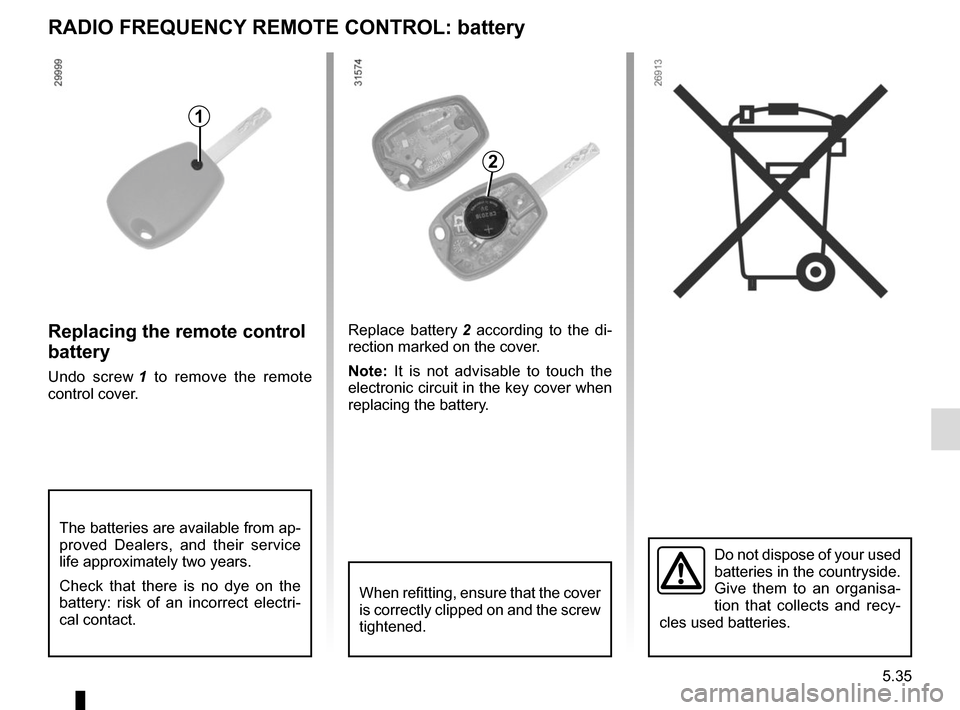
Replacing the remote control
battery
Undo screw 1 to remove the remote
control cover. Replace battery
2 according to the di-
rection marked on the cover.
Note: It is not advisable to touch the
electronic circuit in the key cover when
replacing the battery.
When refitting, ensure that the cover
is correctly clipped on and the screw
tightened.
The batteries are available from ap-
proved Dealers, and their service
life approximately two years.
Check that there is no dye on the
battery: risk of an incorrect electri-
cal contact.
2
Page 248 of 286
5.38
TOWING: breakdown (1/2)
The steering wheel must be un-
locked and the ignition key must be
in position M (ignition on) to provide
brake lights and hazard warning
lights on the towed vehicle. At night
the vehicle must have its lights on.
Unhitch the trailer, etc., if one is
being towed.
You must observe the towing regu-
lations which apply in the country in
which you are driving: do not exceed
the towing weight for your vehicle.
Contact an approved dealer.
– Use a rigid towing bar.
If a rope or cable is used
(where the law allows this),
the vehicle being towed
must be able to brake.
– A vehicle must not be towed if it is not fit to be driven.
– Avoid accelerating or braking suddenly when towing, as this
may result in damage being
caused to the vehicle.
– When towing a vehicle, it is ad- visable not to exceed 15 mph
(25 km/h).
When the engine is
stopped, steering and brak-
ing assistance are not op-
erational.
Do not remove the key from
the ignition when the vehi-
cle is being towed.
Towing a vehicle with a
sequential gearbox
If the gearbox is stuck in a gear:
– switch on the ignition;
– select neutral with the brake pedal depressed;
– check that the gearbox is in neutral (by pushing the vehicle for example).
If you cannot find neutral you must tow
the vehicle with the front wheels raised.
The vehicle should always be towed
with the ignition switched off.
Page 252 of 286
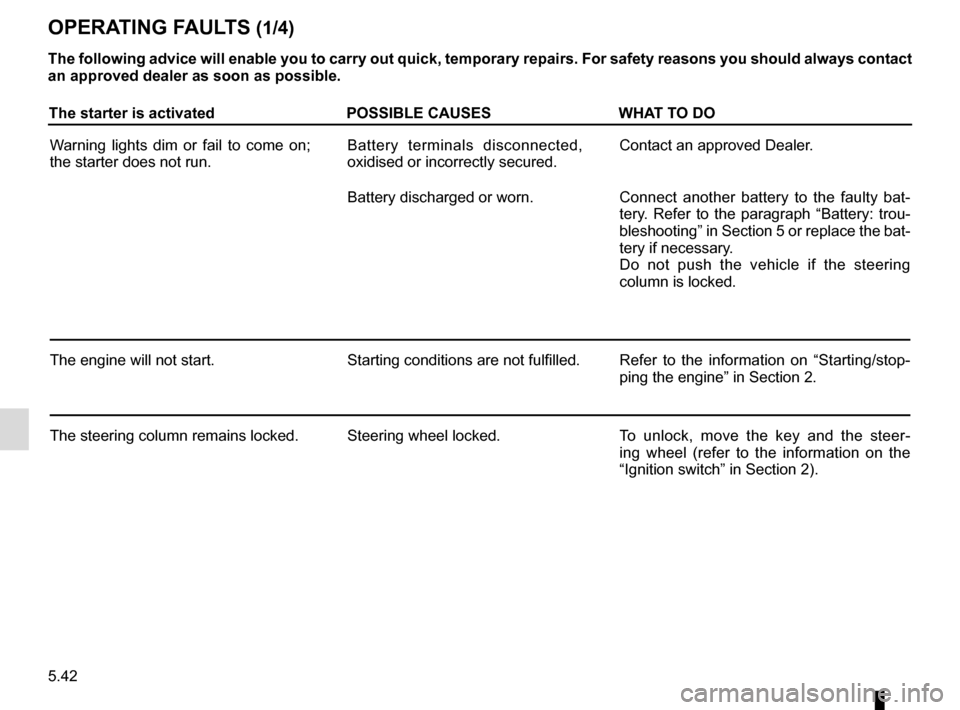
5.42
The starter is activatedPOSSIBLE CAUSESWHAT TO DO
Warning lights dim or fail to come on;
the starter does not run. Battery terminals disconnected,
oxidised or incorrectly secured.Contact an approved Dealer.
Battery discharged or worn. Connect another battery to the faulty bat-
tery. Refer to the paragraph “Battery: trou-
bleshooting” in Section 5 or replace the bat-
tery if necessary.
Do not push the vehicle if the steering
column is locked.
The engine will not start. Starting conditions are not fulfilled.Refer to the information on “Starting/stop-
ping the engine” in Section 2.
The steering column remains locked. Steering wheel locked. To unlock, move the key and the steer-
ing wheel (refer to the information on the
“Ignition switch” in Section 2).
OPERATING FAULTS (1/4)
The following advice will enable you to carry out quick, temporary repai\
rs. For safety reasons you should always contact
an approved dealer as soon as possible.
Page 280 of 286
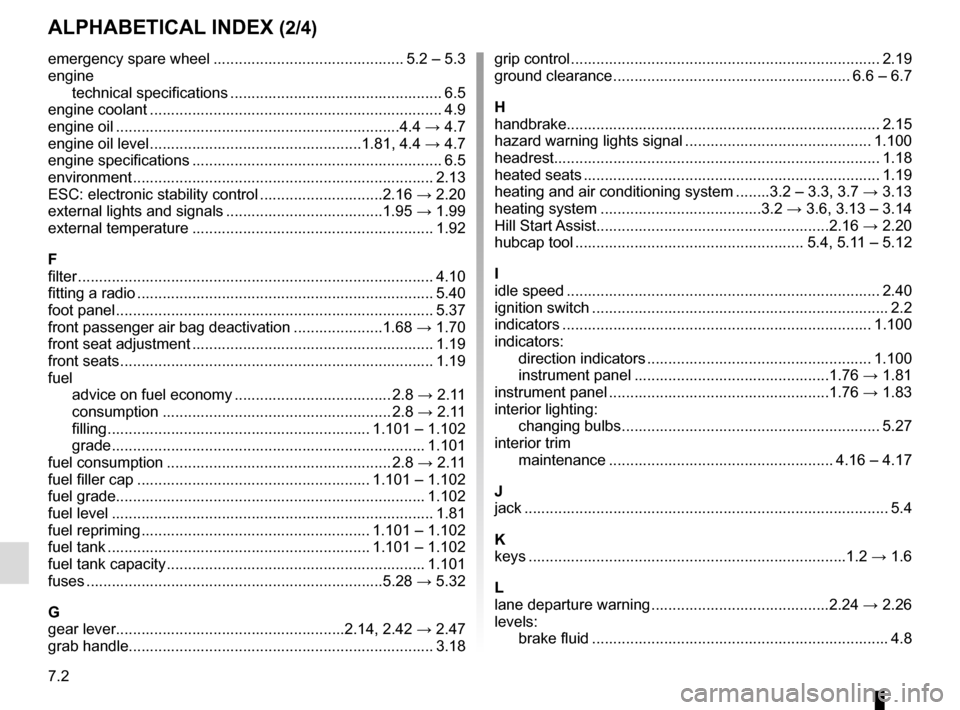
7.2
ALPHABETICAL INDEX (2/4)
emergency spare wheel ............................................. 5.2 – 5.3
enginetechnical specifications .................................................. 6.5
engine coolant ..................................................................... 4.9
engine oil ...................................................................4.4 → 4.7
engine oil level ..................................................1.81, 4.4 → 4.7
engine specifications ........................................................... 6.5
environment ............................................................\
........... 2.13
ESC: electronic stability control .............................2.16 → 2.20
external lights and signals .....................................1.95 → 1.99
external temperature ......................................................... 1.92
F
filter .................................................................\
................... 4.10
fitting a radio ...................................................................... 5.40
foot panel ........................................................................\
... 5.37
front passenger air bag deactivation .....................1.68 → 1.70
front seat adjustment ......................................................... 1.19
front seats ........................................................................\
.. 1.19
fuel advice on fuel economy ..................................... 2.8 → 2.11
consumption ...................................................... 2.8 → 2.11
filling .............................................................. 1.101 – 1.102
grade ..................................................................\
........ 1.101
fuel consumption ..................................................... 2.8 → 2.11
fuel filler cap ....................................................... 1.101 – 1.102
fuel grade........................................................................\
. 1.102
fuel level ........................................................................\
.... 1.81
fuel repriming ...................................................... 1.101 – 1.102
fuel tank .............................................................. 1.101 – 1.102
fuel tank capacity ............................................................. 1.101
fuses ..................................................................\
....5.28 → 5.32
G
gear lever......................................................2.14, 2.42 → 2.47
grab handle........................................................................\
3.18 grip control ........................................................................\
. 2.19
ground clearance ........................................................ 6.6 – 6.7
H
handbrake........................................................................\
.. 2.15
hazard warning lights signal ............................................ 1.100
headrest........................................................................\
..... 1.18
heated seats ...................................................................... 1.19
heating and air conditioning system ........3.2 – 3.3, 3.7 → 3.13
heating system ......................................3.2 → 3.6, 3.13 – 3.14
Hill Start Assist.......................................................2.16 → 2.20
hubcap tool ...................................................... 5.4, 5.11 – 5.12
I
idle speed ........................................................................\
.. 2.40
ignition switch ...................................................................... 2.2
indicators .............................................................\
............ 1.100
indicators: direction indicators ..................................................... 1.100
instrument panel ..............................................1.76 → 1.81
instrument panel ....................................................1.76 → 1.83
interior lighting: changing bulbs ............................................................. 5.27
interior trim maintenance ..................................................... 4.16 – 4.17
J
jack ...................................................................\
................... 5.4
K
keys ...................................................................\
........1.2 → 1.6
L
lane departure warning ..........................................2.24 → 2.26
levels: brake fluid ...................................................................... 4.8